• 검색 결과가 없습니다.

Catalytic Reduction of ortho- and meta-Nitroaniline by Nickel Oxide Nanoparticles

N/A
N/A
Protected

Academic year: 2021

Share "Catalytic Reduction of ortho- and meta-Nitroaniline by Nickel Oxide Nanoparticles"

Copied!
8
0
0

로드 중.... (전체 텍스트 보기)

전체 글

(1)

DOI: https://doi.org/10.7473/EC.2020.55.3.191

Catalytic Reduction of ortho- and meta-Nitroaniline by Nickel Oxide Nanoparticles

Sugyeong Jeon * , Jeong Won Ko ** , and Weon Bae Ko *, **, ***,†

*

Department of Convergence Science, Graduate School, Sahmyook University, 815, Hwarang-ro, Nowon-gu, Seoul 01795, Republic of Korea

**

Nanomaterials Research Institute, Sahmyook University, 815, Hwarang-ro, Nowon-gu, Seoul 01795, Republic of Korea

***

Department of Chemistry, Sahmyook University, 815, Hwarang-ro, Nowon-gu, Seoul 01795, Republic of Korea (Received July 14, 2020, Revised July 27, 2020, Accepted August 2, 2020)

Abstract: Nickel oxide (NiO) nanoparticles were synthesized by a reaction of nickel nitrate hexahydrate (Ni(NO

3

)

2

·6H

2

O) and sodium hydroxide (NaOH). The synthesized NiO nanoparticles were examined with X-ray diffraction, scanning electron microscopy, Raman spectroscopy, and ultraviolet-visible (UV-vis) spectroscopy. The NiO nanoparticles were used as the catalyst for the reduction of o- and m-nitroaniline to phenylenediamine. The reduction rate of m-nitroaniline was faster than that of o-nitroaniline. The reduction rate for both o- and m-nitroaniline increased as the reaction temperature increased. The rate of reduction for nitroaniline followed a pseudo first-order reaction rate law.

Keywords: Catalytic reduction, Nickel oxide nanoparticles, o-Nitroaniline, m-Nitroaniline

Introduction

Nitroanilines are used as intermediates in pharmaceuticals, pesticides, pigments, dyes, and rubber chemicals.

1

They are toxic contaminants in viewpoint of the environment. The nitro anion radicals are known as mutagens and carcinogens.

They disturb biochemical cycles and their effects are con- sequently observed in nature.

1

Therefore, effective methods to remove nitroanilines from industrial wastewater are nec- essary. The types of nitroaniline include ortho-, meta-, and para-nitroaniline, depending on the location of the nitro func- tional group. Various methods for nitroaniline removal, such as adsorption, thermal decomposition, photocatalysis, bio- logical degradation, and catalytic reduction, have been inves- tigated.

2–4

The most favored method of nitroaniline removal is cat- alytic reduction in an aqueous solution because the products of catalytic reductions are applied in various fields.

3

The organic compound m-phenylenediamine is used as a raw material for a polymer synthesis such as polyurea elastomers, which are included as dye elements in the textile industry.

3

o-Phenylenediamine is used as a precursor in pharmaceuti-

cals, dyes, and antiseptic agents. Therefore, the catalytic reduction of nitroaniline to phenylenediamine is preferred over the other methods.

5

Nickel oxide (NiO) is a type of important semiconducting material. It has been extensively used in various fields, includ- ing capacitors, rechargeable lithium-ion batteries, gas-sensing material, and catalysis.

6,7

The photocatalytic efficiency of NiO nanoparticles was confirmed by researching the photodegra- dation of methylene blue.

8,9

Nickel oxide nanoparticles are synthesized through various methods including the sol-gel method, microwave, hydrothermal method, sonochemical syn- thesis, and precipitation method.

6,10–14

In this work, we studied the catalytic reduction of o- and m-nitroaniline from an aqueous solution using NiO nanopar- ticles as catalyst.

Experimental

1. Chemicals

Nickel nitrate hexahydrate (Ni(NO

3

)

2

·6H

2

O), sodium hydrox- ide (NaOH), o-nitroaniline (H

2

NC

6

H

4

NO

2

) and m-nitroaniline (H

2

NC

6

H

4

NO

2

) were purchased from SAMCHUN PURE CHEMICALS and Sigma-Aldrich, Merck. Deionized water was

Corresponding author E-mail: [email protected]

(2)

3. Synthesis of NiO nanoparticles

NiO nanoparticles were synthesized using the co-precipi- tation method described as follows. First, 0.2 M nickel nitrate hexahydrate (Ni(NO

3

)

2

·6H

2

O, 0.872 g) and 0.4 M sodium hydroxide (NaOH, 0.24 g) were dissolved in 15 ml of distilled water, respectively. Then, sodium hydroxide solution was mixed with drop wise in aqueous nickel nitrate solution under stirring condition. After the reaction was performed, the green precipitate was obtained and washed several times with dis- tilled water and dried in an oven at 100

o

C. The green pre- cipitate (Ni(OH)

2

) was heated in an electric furnace under Ar gas at 400

o

C for 1 h. The color of the precipitate powder turned from green to black.

8,15

4. Catalytic reduction of o- and m-nitroaniline in the presence of NaBH

4

by nickel oxide nanoparticles

The catalytic reduction of o- and m- nitroaniline by nickel

solutions was 1.45 × 10

2

mM. 13.4 mM of NaBH

4

was added to 1.45 × 10

2

mM of o- and m-nitroaniline solutions, respectively.

5 mg of NiO nanoparticles were added to o- and m- nitroaniline solutions and stirred using a magnetic stirrer. The catalytic reduction of o- and m-nitroaniline was measured with every 10 min interval by UV-vis spectroscopy.

Results and Discussion

The XRD patterns of NiO were observed at 2 = 37.30

o

, 43.33

o

, 62.94

o

, 75.48

o

, and 79.49

o

corresponding to the (111), (200), (220), (311), and (222) planes of the cubic phase, respectively (Figure 1). The crystallite size of synthesized NiO nanoparticles was calculated using the Scherrer formula

16

:

D is the crystallite size of synthesized NiO nanoparticles,

D k

 cos  ---

=

Figure 1. XRD pattern of the synthesized NiO nanoparticles. Figure 2. Raman spectrum of the synthesized NiO nanoparticles.

(3)

k is the Scherrer constant (0.89), λ is the X-ray wavelength,

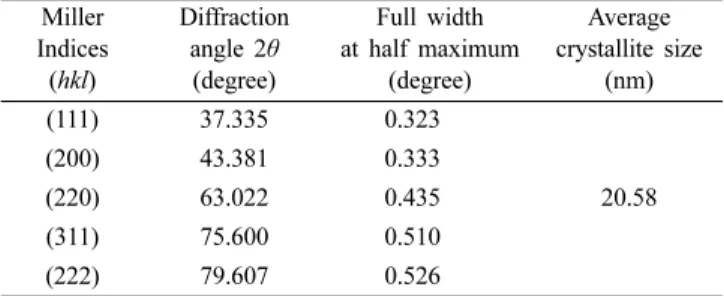
 is the full width at half maximum (FWHM) of the X-ray diffraction peak, and θ is the Bragg angle. The average crys- tallite size of the NiO nanoparticles was calculated to be 20.58 nm (Table 1).

17

The Raman spectrum of NiO nanoparticles show one-pho- non LO mode and two-phonon 2LO modes. Defects of the lattice produced phonon scattering in a single crystal.

18

The peak value of 514.73 cm

1

corresponds to LO due to first- order scattering, the peak value of 1036.47 cm

1

is attributed to 2LO due to second-order scattering (Figure 2).

19

The morphology of NiO nanoparticles was investigated by SEM. The SEM image of the NiO nanoparticles revealed that they are oval-shaped particles (Figure 3).

8

The change of nitroaniline concentration was monitored over time by UV-vis spectroscopy. The synthesized NiO nanoparticles was used as the reduction catalyst of o- and m- nitroaniline to o- and m-phenylenediamine with NaBH

4

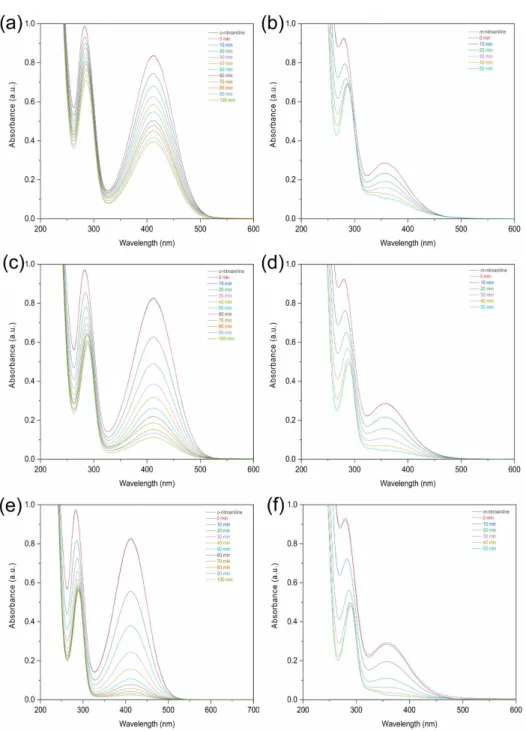
reducing agent. The o-nitroaniline was added into deionized water. The color of solution was yellow and the peaks of the UV-visible spectrum of the o-nitroaniline solution appeared at 283 and 412 nm. The absorption peak at 283 nm shifted to a longer wavelength at 289 nm and the absorption peak at 412 nm disappeared (Figure 4a).

3

The UV-visible spectrum of m-nitroaniline appears at 280 and 358 nm. The absorption peak at 280 nm shifted to a longer wavelength at 289 nm and the absorption peak at 358 nm disappeared (Figure 4b).

The catalytic activities occurred due to the hydrogen gener- ation between the NaBH

4

and water molecules on the catalytic surface.

20

Borohydride ions was generated on the surface of the NiO nanoparticles. At the same time, nitroaniline molecules were adsorbed on the surface of the NiO nanoparticles. After

adsorption on the catalytic surface, nitroaniline was reduced to phenylenediamine by the transfer of hydrogen from BH

4-

ions to the NO

2

group of nitroaniline.

21,22

Since the concentration of NaBH

4

in the reaction is higher than that of nitroaniline, it is possible to assume that the con- centration of sodium borohydride remains constant during the reduction reaction. The reduction follows a pseudo-first order reaction rate law (Figure 4c).

23

dc dt --- = – kC Figure 3. SEM image of the synthesized NiO nanoparticles.

Figure 4. UV-vis absorption spectra for the reduction and kinetic

study of (a) o-nitroaniline (b) m-nitroaniline and (c) their kinetic

study at 40

o

C of o-nitroaniline and m-nitroaniline in the presence

of NaBH

4

with NiO nanoparticles as catalyst.

(4)

The reduction rate of m-nitroaniline was faster than that of o-nitroaniline. o-Nitroaniline was stabilized by resonance.

24

However, m-nitroaniline is the less stable compare to o- nitroaniline as there is no resonance stabilization.

24

Due to the resonance, o-nitroaniline was less reactive in the reduc- tion process compare to m-nitroaniline.

25,26

The temperature of the nitroaniline solution is an important parameter in the reduction process. The yield percentage for reduction of o-nitroaniline increased from 52.7% to 97.0% as

the temperature increases from 303.15 K to 313.15 K (Figure 5a, 5c, 5e, Table 2). The yield percentage for reduction of m-nitroaniline increased from 62.7% to 91.9% by increasing temperature from 303.15 K to 313.15 K (Figure 5b, 5e, 5f, Table 2). The reduction processes of nitroaniline were endo- thermic reactions.

The activation energy of the nitroaniline reductions was calculated using the Arrhenius equation (Figure 6a, 6b).

Figure 5. The variation of UV-vis absorption spectra for the reductions of o-nitroaniline, m-nitroaniline with temperatures at (a-b) 30

o

C

(c-d) 35

o

C and (e-f) 40

o

C in the presence of NaBH

4

and NiO nanoparticles catalyst.

(5)

where E

a

is the activation energy, k is the apparent reaction rate constant, A is the Arrhenius factor, R is the ideal gas con- stant (8.314 J·K

1

·mol

1

), and T is absolute temperature. The activation energy values for the reduction of o-nitroaniline and m-nitroaniline were calculated to be 125.20 kJ·mol

1

and 75.09 kJ·mol

1

. The catalytic reduction of o-nitroaniline

required more activation energy than that of m-nitroani- line.

27,28

Kinetic parameters such as the activation enthalpy (ΔH) and activation entropy (ΔS) were calculated using the Eyring equation (Figure 6c, 6d).

... Eyring equation k

ln E

a

RT ---

– + ln A ... Arrhenius equation

=

k T ---

ln  H

--- 1 R T --- k

B

--- h  S --- R + ln +

 –

=

Table 2. Change in the Catalytic Reduction Rate Constants of o-Nitroaniline and m-Nitroaniline with Different Temperatures and Activation Parameters in Catalysis with Nickel Oxide Nanoparticles

Compound Temperature (

o

C) k (min

1

) R

2

(COD) E

a

(kJ mol

1

) H (kJ mol

1

) S (J mol

1

K

1

)

o-nitroaniline 30 0.00727 0.99224 125.20 122.74 540.53

35 0.01953 0.99212

45 0.03549 0.99228

m-nitroaniline 30 0.02010 0.99968 75.09 72.53 384.22

35 0.03697 0.99696

40 0.05197 0.99719

(Reaction condition: 10 ml [o-, m-nitroaniline] = 0.0145 mM, [NaBH

4

] = 13.4 mM, 5mg catalyst.)

*Rate constant (k), coefficient of determination (R

2

), activation energy (E

a

), enthalpy (H), and entropy (S) for the NaBH

4

reduction of o-nitroaniline, m-nitroaniline at different temperatures using nickel oxide nanoparticles catalyst

Figure 6. lnk vs 1/T graphs (Arrhenius equation); reduction of (a) o-nitroaniline (b) m-nitroaniline and ln(k/T) vs 1/T graphs (Eyring

equation); reduction of (c) o-nitroaniline (d) m-nitroaniline using NiO nanoparticles as catalyst with NaBH

4

at different temperatures.

(6)

where k

B

is the Boltzmann constant (1.381 × 10

23

J·K

1

) and h is the Plank constant (6.626 × 10

34

J·s). In the above Eyring equation, it is assumed that the all species in the tran- sition state proceed to the phenylenediamines, the transmis- sion coefficient (κ = 1). The activation enthalpy (ΔH) for the reductions of o-nitroaniline and m-nitroaniline were 122.74 kJ·mol

1

and 72.53 kJ·mol

1

, from the Eyring equation. The activation entropy (ΔS) for the reductions of o-nitroaniline and m-nitroaniline were 540.53 J·mol

1

·K

1

and 384.22 J·mol

1

·K

1

, from the Eyring equation.

29,30

The reduction of o-, m-nitroaniline was spontaneous reaction. After the cata- lytic reduction was finished, the catalyst could be separated through centrifugation. The catalyst was washed several times with deionized water, and reused under same condi- tion.

31,32

The results showed that the catalytic activity of nickel oxide after 5 cycles of the reduction of o-nitroaniline and m-nitroaniline was decreased slightly from 97.0% to 90.1% and 91.9% to 82.7%, respectively. The catalytic reduction efficiency was decreased due to the loss of catalyst during the washing process.

33

The catalytic activity of the recycled nickel oxide nanoparticles showed good reusability in the reduction of o- and m-nitroaniline (Figure 7).

Conclusions

The synthesized NiO nanoparticles catalyst was used to reduce o- and m-nitroanilines in an aqueous solution with NaBH

4

. At the constant concentrations of NaBH

4

, nitroan- iline, and NiO nanoparticles, m-nitroaniline was reduced faster than o-nitroaniline. Due to resonance stabilization, o- nitroaniline is a more stable than m-nitroaniline. After reduc- ing agent of NaBH

4

, o- and m-nitroanilines were adsorbed

on the surface of the NiO nanoparticles, the reduction process occurred. The kinetics study showed that the reduction of o- and m-nitroanilines were followed a pseudo first-order reac- tion rate law. Due to the endothermic reaction, the reduction rate of o- and m-nitroanilines was enhanced by increasing the temperature.

Acknowledgements

This work was supported by Research Foundation of Sah- myook University in 2019.

References

1. M. T. Amouzadeh, M. Shamsipur, R. Saber and S. Sarkar, U.

S. patent 0062185 (2019).

2. K. Zhang, H. Li, X. Xu, and H. Yu, “Synthesis of reduced graphene oxide/NiO nanocomposites for the removal of Cr(VI) from aqueous water by adsorption”, Microporous Mesoporous Mater., 255, 7 (2018).

3. K. Naseem, R. Begum, and Z. H. Farooqi, “Catalytic reduc- tion of 2-nitroaniline: a review. Environmental Science and Pollution Research”, Environ. Sci. Pollut. Res., 24, 6446 (2017).

4. D. B. Jirekar, M. Ubale, and M. Farooqui, “Evaluation of Adsorption Capacity of Low-Cost Adsorbent for the Removal of Congo Red Dye from Aqueous Solution”, Orbital: Elec- tron. J. Chem., 8, 282 (2016).

5. Z. H. Farooqi, K. Naseem, R. Begum, and A. Ijaz, “Catalytic Reduction of 2-Nitroaniline in Aqueous Medium Using Silver Nanoparticles Functionalized Polymer Microgels”, J. Inorg.

Organomet. Polym. Mater., 25, 1554 (2015).

6. A. Aslani, V. Oroojpour, and M. Fallahi, “Sonochemical syn-

Figure 7. Reusability studies of NiO nanoparticles catalyst for the reduction of (a) o-nitroaniline and (b) m-nitroaniline.

(7)

thesis, size controlling and gas sensing properties of NiO nanoparticles”, Appl. Surf. Sci., 257, 4056 (2011).

7. V. S. R. Channu, R. Holze, and B. Rambabu, “Synthesis and characterization of NiO nanoparticles for electrochemical applications”, Colloids Surf. A Physicochem. Eng. Asp., 414, 204 (2012).

8. G. Jayakumar, A. A. Irudayaraj, and A. D. Raj, “Photocata- lytic Degradation of Methylene Blue by Nickel Oxide Nanoparticles”, Mater. Today: Proc., 4, 11690 (2017).

9. X. Wan, M. Yuan, S. Tie, and S. Lan, “Effects of catalyst characters on the photocatalytic activity and process of NiO nanoparticles in the degradation of methylene blue”, Appl.

Surf. Sci., 277, 40 (2013).

10. N. N. M. Zorkipli, N. H. H. Kaus, and A. A. Mohamad, “Syn- thesis of NiO Nanoparticles through Sol-gel Method”, Proce- dia Chem., 19, 626 (2016).

11. H. Wu, Y. Wang, C. Zheng, J. Zhu, G. Wu, and X. Li, “Multi- shelled NiO hollow spheres: Easy hydrothermal synthesis and lithium storage performances”, J. Alloys Compd., 685, 8 (2016).

12. S. J. Musevi, A. Aslani, H. Motahari, and H. Salimi, “Offer a novel method for size appraise of NiO nanoparticles by PL analysis: Synthesis by sonochemical method”, J. Saudi Chem.

Soc., 20, 245 (2016).

13. K. Karthik, G. K. Selvan, M. Kanagaraj, S. Arumugam, and N. V. Jaya, “Particle size effect on the magnetic properties of NiO nanoparticles prepared by a precipitation method”, J.

Alloys Compd., 509, 181 (2011).

14. K. Anandan and V. Rajendran, “Effects of Mn on the mag- netic and optical properties and photocatalytic activities of NiO nanoparticles synthesized via the simple precipitation process”, Mater. Sci. Eng. B, 199, 48 (2015).

15. A. C. Gandhi, J. Pant, S. D. Pandit, S. K. Dalimbkar, T. S. Cha, C. L. Cheng, Y. R. Ma, and S. Y. Wu. “Short-Range Magnon Excitation in NiO Nanoparticles”, J. Phys. Chem. C, 117, 18666 (2013).

16. H. Ullah, L. Mushtaq, Z. Ullah, M. A. Bangesh, and M.

Nawaz, “Cost effective green synthesis of NiO nanostructures as highly efficient photocatalysts for degradation of organic dyes”, Micro Nano Lett., 14, 103 (2019).

17. A. Rahdar, M. Aliahmadb, and Y. Azizib, “NiO Nanoparti- cles: Synthesis and Characterization”, J. Nanostruct., 5, 145 (2015).

18. G. George and S. Anandhan, “Synthesis and characterisation of nickel oxide nanofibre webs with alcohol sensing charac- teristics”, RSC Adv., 4, 62009 (2014).

19. B. T. Sone, X. G. Fuku, and M. Maaza, “Physical & Electro- chemical Properties of Green Synthesized Bunsenite NiO Nanoparticles via Callistemon Viminalis’ Extracts”, Int. J.

Electrochem. Sci., 11, 8204 (2016).

20. L. Jia, W. Zhang, J. Xu, J. Cao, Z. Xu, and Y. Wang, “Facile Fabrication of Highly Active Magnetic Aminoclay Supported Palladium Nanoparticles for the Room Temperature Catalytic Reduction of Nitrophenol and Nitroanilines”, Nanomaterials, 8, 409 (2018).

21. B. Naik, S. Hazra, V. S. Prasad, and N. N. Ghosh, “Synthesis of Ag nanoparticles within the pores of SBA-15: An efficient catalyst for reduction of 4-nitrophenol”, Catal. Commun., 12, 1104 (2011).

22. R. Vijayan, S. Joseph, and B. Mathew, “Indigofera tinctoria leaf extract mediated green synthesis of silver and gold nanoparticles and assessment of their anticancer, antimicrobial, antioxidant and catalytic properties”, Artif. Cells Nanomed. Biotechnol., 46, 861 (2017).

23. M. A. Bhosale, D. R. Chenna, and B. M. Bhanage, “Ultra- sound Assisted Synthesis of Gold Nanoparticles as an Effi- cient Catalyst for Reduction of Various Nitro Compounds”, Chemistry Select, 2, 1225 (2017).

24. T. Aditya, J. Jana, N. K. Singh, A. Pal, and T. Pal, “Remark- able Facet Selective Reduction of 4-Nitrophenol by Morpho- logically Tailored (111) Faceted Cu

2

O Nanocatalyst”, ACS Omega, 2, 1968 (2017).

25. J. Sun, Y. Fu, G. He, X. Sun, and X. Wang, “Catalytic hydro- genation of nitrophenols and nitrotoluenes over a palladium/

graphene nanocomposite”, Catal. Sci. Technol., 4, 1742 (2014).

26. T. Aditya, J. Jana, A. Pal, and T. Pal, “One-Pot Fabrication of Perforated Graphitic Carbon Nitride Nanosheets Decorated with Copper Oxide by Controlled Ammonia and Sulfur Tri- oxide Release for Enhanced Catalytic Activity”, ACS Omega, 3, 9318 (2018).

27. N. Sahiner, S. Sagbas, and N. Aktas, “Very fast catalytic reduction of 4-nitrophenol, methylene blue and eosin Y in natural waters using green chemistry: p(tannic acid)–Cu ionic liquid composites”, RSC Adv., 5, 18183 (2015).

28. N. Sahiner, A. Kaynak, and S. Butun, “Soft hydrogels for dual use: Template for metal nanoparticle synthesis and a reactor in the reduction of nitrophenols”, J. Non. Cryst. Solids, 358, 758 (2012).

29. P. Ptáček, F. Šoukal, and T. Opravil, “Introducing the Effec- tive Mass of Activated Complex and the Discussion on the Wave Function of This Instanton”, ed by P. Ptáček, F. Šoukal and T. Opravil, p.27-46, IntechOpen Publishers, London, 2018.

30. S. Butun and N. Sahiner, “A versatile hydrogel template for metal nano particle preparation and their use in catalysis”, Polymer, 52, 4834 (2011).

31. J. A. Tanna, R. G. Chaudhary, N. V. Gandhare, A.R. Rai, and

H. D. Juneja, “Nickel oxide nanoparticles: Synthesis, charac-

(8)

수치

Figure  1.  XRD  pattern  of  the  synthesized  NiO  nanoparticles. Figure 2. Raman spectrum of the synthesized NiO nanoparticles.
Figure 4. UV-vis absorption spectra for the reduction and kinetic study  of  (a)  o-nitroaniline  (b)  m-nitroaniline  and  (c)  their  kinetic study at 40 o C of o-nitroaniline and m-nitroaniline in the presence of  NaBH 4   with  NiO  nanoparticles  as
Figure 5.  The variation of UV-vis absorption spectra for the reductions of  o-nitroaniline,  m-nitroaniline with temperatures at (a-b) 30 o C (c-d)  35 o C  and  (e-f)  40 o C  in  the  presence  of  NaBH 4   and  NiO  nanoparticles  catalyst
Figure  6.  lnk  vs  1/T  graphs  (Arrhenius  equation);  reduction  of  (a)  o-nitroaniline  (b)  m-nitroaniline  and  ln(k/T)  vs  1/T  graphs  (Eyring equation);  reduction  of  (c)  o-nitroaniline  (d)  m-nitroaniline  using  NiO  nanoparticles  as  ca

참조

관련 문서

The goal of this research is worked one reasonable function analysis of the cost reduction and quality enhancement to spread out by using QFD (Quality

This report, therefore, analyses two important policy issues: (1) the appropriateness of the government allocated GHG reduction targets by sector and industry; (2) the

In general, commercial LIBs use ~10 m sized spherical anode (graphite) and cathode (e.g., lithium cobalt oxide, lithium iron phosphate, and lithium nickel cobalt

In Jangsu stream, blue-green algae were temporarily increased by 59% due to the eutrophication and reduction of water level in July, but no toxins

The purpose of this research is to the development and effect of the anthroposophy group art therapy program for improvement of creativity and reduction

It considers the energy use of the different components that are involved in the distribution and viewing of video content: data centres and content delivery networks

After first field tests, we expect electric passenger drones or eVTOL aircraft (short for electric vertical take-off and landing) to start providing commercial mobility

1 John Owen, Justification by Faith Alone, in The Works of John Owen, ed. John Bolt, trans. Scott Clark, "Do This and Live: Christ's Active Obedience as the