ISSN 2287-6782 (Online)
Korean J Endocrine Surg 2013;13:87-91
Endocrine Surgery
수술 전 위험도 분류에 따른 갑상선 유두암 치료 시 내시경 갑상선 절제술과 고식적 갑상선 절제술의 비교분석
건국대학교 의과대학 외과학교실
강병준ㆍ박경식ㆍ서수연ㆍ김근영ㆍ조민정ㆍ유영범ㆍ양정현
A Comparative Analysis of Endoscopic Versus Conventional Open Thyroidectomy in the Treatment of Papillary Thyroid Cancer According to Preoperative Risk Stratification
Purpose: It is well known that papillary thyroid cancer (PTC) has a good prognosis and high incidence in young women. The objective of the study was to review our criteria to select surgical modality and surgical results and to confirm the feasibility of endoscopic thyroidectomy according to the preoperative risk stratification in the treatment of papillary thyroid cancer.
Methods: Between May 2009 and April 2012, 197 patients underwent either a con- ventional open or an endoscopic thyroidectomy with the preoperative consideration of risk group using clinical parameters of AMES system (patient age, size of tumor, extrathyroid extension, and presence of distant metastasis). A retrospective analysis of the pathologic data according to AMES system after surgery was also conducted. The endoscopic thyroidectomy was performed using the BABA (bilateral axillo-breast approach) method.
Results: Based on the method of operation, the low-risk group patients (n=197) were divided into two groups: endoscopic group (n=78) and open group (n=119). Procedure time, postoperative complication rates, and length of hospital stay were tracked, albeit these were not significantly different between the two groups. From the pathologic findings, it was reported that there were no significant differences in tumor size, extrathyroid extension, and metastasis and also in the Off T4 – thyroglobulin level between the two groups.
Conclusion: Endoscopic thyroidectomy is a feasible method for the treatment of selected cases of thyroid cancer such as low-risk group according to the appropriate preoperative risk stratification.
Key Words: Thyroid cancer, Endoscopic thyroidectomy, Risk stratification 중심 단어: 갑상선암, 내시경 갑상선 절제술, 위험도 분류
Byoung Joon Kang, Kyoung Sik Park, Su Yeon Seo, Kun Young Kim, Min Jeng Cho, Young Bum Yoo, Jung-Hyun Yang
Department of Surgery, Konkuk University School of Medicine, Seoul, Korea
Received April 8, 2013, Revised June 7, 2013, Accepted June 7, 2013
Correspondence: Kyoung Sik Park Department of Surgery, Konkuk University School of Medicine, 4-12 Hwayang-dong, Gwangjin-gu, Seoul 143-729, Korea Tel: +82-2-2030-7697
Fax: +82-2-2030-7749 E-mail: [email protected]
Copyright © 2013 Korean Association of Thyroid and Endocrine Surgeons; KATES. All Rights Reserved.
cc This is an Open Access article distributed under the terms of the Creative Commons Attribution Non-Commercial License (http://creativecommons.org/licenses/by-nc/3.0) which permits unrestricted non-commercial use, distribution, and reproduction in any medium, provided the original work is properly cited.
서 론
갑상선암의 초기 치료 원칙은 원발 병소를 근치적으로 절제 하는 것이다.(1) 진행된 상태의 갑상선암의 경우에는 고전적인 경부 절개술식 갑상선 절제술이 추천되고 있다. 그러나 몇몇 기
관들에서 종양의 크기가 작고, 피막침습 소견이 없으며, 중심부 나 측경부 림프절 전이가 없는 초기 갑상선암의 경우에 환자의 선호도에 따라 내시경을 이용한 갑상선 절제술을 시행하고 있 다.(2-12) 그러나 내시경 갑상선 절제술의 적응증을 어떻게 결 정할 것인가에 대한 연구는 현재까지 명확하게 제시된 바는 없는
Fig. 1. Flowchart of this study design.
실정이다.
분화 갑상선암의 가장 기본적인 치료는 수술이므로 정확한 수 술 전 병기 결정은 분화 갑상선암의 치료에 있어서 핵심적인 요 소이며 수술 전 계획 수립의 의미를 지닌다고 할 수 있다. 현재까 지 갑상선암의 수술 전 병기 결정은 주로 임상적인 병기이며 이 학적 소견 및 영상의학적 평가가 가장 중요한 역할을 한다. 따라 서 저자들은 2009년 3월부터 갑상선암의 치료 시에 병력 청취와 신체 검진, 경부 초음파, 컴퓨터 단층 촬영(CT) 및 양전자 단층 촬 영(PET) 등을 통해서 고전적인 위험도 분류체계인 AMES 체계 상의 변수들(나이, 전신 전이, 피막 침습 및 종양크기)을 고려하 여 수술 전 위험도를 분류하고, 분류된 저위험군의 일부 환자에 서 내시경 갑상선 절제술을 시행하여 왔다. 이러한 내시경 갑상 선 절제술 환자들의 수술 후 합병증, 병리 결과 및 동위 원소 치료 등을 경부 절개 갑상선 절제술 환자들과 비교하였고 이를 통해 내시경 갑상선 절제술의 적응증을 결정할 근거를 제시하고자 하 였다.
방 법
1) 환자 선택
2009년 5월부터 2012년 4월까지 갑상선암을 진단받고 갑상 선 절제술을 시행받은 228명의 환자를 대상으로, 후향적인 분석 을 통해 수술 전 위험도 평가를 시행하였는데, 수술 당시 나이와 원격전이 여부를 확인하였고, 초음파, CT/PET 등 영상의학적인 방법을 통해 종양 크기와 피막 침습 여부를 확인하였으며, 최종 적으로 211명의 환자가 저위험군으로 분류되었다. 분류된 저위 험군 중에서 80명은 BABA 방식을 이용한 내시경하 갑상선 절제
술을 시행 받았고, 131명은 고식적 경부 절개하 갑상선절제술을 시행 받았으며, 이들 중 병리 결과 및 임상 결과를 분석한 후에도 저위험군으로 분류된 환자는 각 군당 78명과 119명이었으며, 두 군간의 임상병리적 특징, 수술 형태, 수술 시간, 수술 후 동위 원소 치료결과 등이 최종 분석되었다. 이 연구는 병원 내 윤리 위 원회로부터 승인을 받았다.
2) 수술 방법
접근 방식에 따라 경부 절개 수술법과 내시경적 수술법으로 나누어진다. 경부 절개법은 경부 아래쪽 피부 주름에 절개창을 만들어 병변에 접근하였고 내시경적 수술법은 양측 유방의 상부 유륜을 따라 5 mm의 절개창을, 양측 액와부 주름에 각각 5 mm, 10 mm의 절개창을 내어 투관침 삽입부를 형성하여 접근하였 다. 갑상선 절제술의 과정은 두 군 모두에서 동일한 방법으로 진 행하였다.
3) 통계 분석
통계학적 분석은 DBSTAT [computer program] Version 5.0 (Chuncheon, Korea: DBSTAT Co.; 2008. Available from:
http://dbstat.com/)을 이용하여 chi-square test, student t-test와 Mann-Whitney test를 통해 양 군 간의 차이를 비교하 였다. P-value 0.05 미만을 유의수준으로 판정하였다.
결 과
1) 후향적 분석에 의한 수술 전후 위험도 분류
수술 전 위험군 분류에 의해 Fig. 1과 같이 저위험 환자군을 분
Endoscopic group (n=78)
Open group (N=119)
P-value
Transient hypocalcemia 35 (44.9%) 67 (56.3%) 0.12 Permanent hypocalcemia 1 (1.2%) 0 (0.00%) 0.83 Transient RLN† palsy 3 (3.8%) 4 (3.4%) 0.83 Permanent RLN† palsy 0 (0.00%) 0 (0.00%) NA*
Bleeding 2 (2.6%) 4 (3.4%) 0.47
Chyle leakage 0 (0.00%) 5 (4.4%) 0.07
*NA = not applicable; †RLN = recurrent laryngeal nerve.
Table 2. Comparison of postoperative complication between the two groups
Total Endoscopic group (n=78) Open group (n=119) P-value
Age (year) 39.9±1.2 (13∼61) 43.4±1.0 (19∼72) 0.80
Sex ratio (F:M) 78:0 90:29 0.00
Height (cm) 159.4±0.7 (144.8∼177.5) 161.1±0.8 (14.2∼181.1) 0.69
Weight (kg) 58.8±1.0 (41.0∼77.5) 63.8±1.1 (42.∼108.7) 0.15
Type of operation 0.00
Unilateral lobectomy 39 (50.0%) 19 (16.0%)
Total thyroidectomy 39 (50.0%) 100 (84.0%)
Operating time (min) 185.9±5.4 (101∼365) 164.2±5.9 (70∼420) 0.11
Postop. hospital stay 3.95±0.35 (1∼25) 3.82±2.61 (2∼14) 0.93
Tumor size (cm) 0.92±0.01 (0.1∼5.00) 1.23±0.09 (0.3∼5.00) 0.13
Extrathyroidal extension 11/78 (14.1%) 34/119 (28.6%) 0.17
Retrieved CLN No* 4 (0∼42) 16 (0∼95) 0.00
Central LN (+) rate 14 (18.0%) 58 (48.7%) 0.00
Multiplicity 14/78 (17.9%) 33/119 (27.7%) 0.16
Thyroiditis 9 (11.5%) 22 (18.5%) 0.19
*CLN No = central lymph node number.
Table 1. Clinical characteristics of the patients in the two groups
류할 수 있었다(Fig. 1). 수술 전 저위험군(n=211)을 수술 후 AMES 체계에 의한 재분류시 저위험군으로 197명이 확정되었 고, 수술 방법(내시경 수술 군; n=78, 고식적 수술 군; n=119)에 따라 두 그룹으로 분류하여 임상 병리학적인 결과를 비교하였 다. 저위험군으로 내시경 수술을 받은 환자 중 2명이 미세한 갑 상선외 침범 소견으로 수술 후 위험도 분류에서 변동이 생겼지만 갑상선 전절제술과 중앙 림프절 절제가 고위험군으로 변동 대상 에서도 가능하였기에 수술 방법에 문제는 없었다.
2) 저위험군에서 내시경 수술군과 절개 수술군 간의 임상 결과 비교
(1) 두 그룹간의 임상병리학적 결과 비교
내시경적 절제술을 받은 환자는 78명이었고, 고식적 절제술 을 받은 환자는 119명이었다(Table 1). 내시경 갑상선 절제술을 받은 환자군에서 평균 나이는 39.9±1.2 (13∼61)세였고, 고식 적 절제술을 받은 환자군은 43.4±1.0 (19∼72) 세로 두 군 간에 유의한 차이는 없었다. 남녀 성별비는 내시경 수술 그룹에서 0:
78이었고, 고식적 수술군에서 29:90 (1:3.1)로 내시경 갑상 선 절제술을 받은 군에서 여성의 빈도가 높게 나타났으며 이는 여성 환자군의 내시경 선호도도 기여하지만 남성 환자에서 내시 경적 갑상선 절제술의 적용의 어려움이 있어 내시경 수술군의 고 려 시에 배제한 것 또한 중요한 요인으로 생각된다. 두 그룹간의 신장 및 체중에서는 통계학적으로 차이가 없었다. 수술시간은 내시경 절제술을 받은 환자군에서 185.9±5.4 (101∼365)분이 었고 고식적 절제술을 받은 군에서는 164.2±5.9 (70∼420)분 으로 두 군 간의 유의한 차이는 없었다. 수술 후 재원 기간은 내시 경 절제술을 받은 환자군이 3.95±0.35 (1∼25)일이었고 고식 적 절제술을 받은 군에서는 3.82±2.61 (2∼14)로 수술 시간 및
재원기간 모두 통계학적으로 차이가 없었다(P=0.93).
두 군 간의 종양 크기, 피막외 침범, 유두암의 다발성 및 갑상 선염 유무를 비교했을 때도 유의한 차이는 발견되지 않았다. 박 리된 림프절 개수의 숫자는 유의한 차이가 있었지만 내시경 절제 술을 받은 환자군에서도 8.5±8.7 (0∼42.0)개의 림프절을 제 거할 수 있었다.
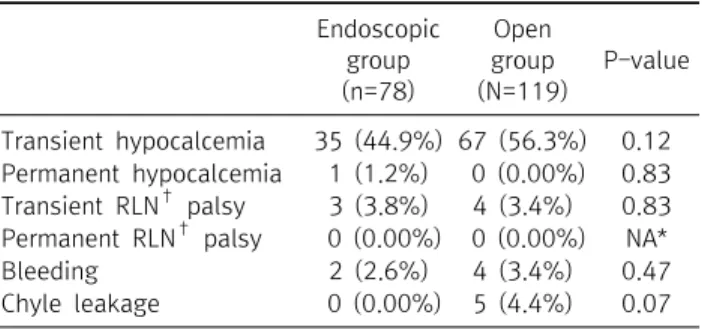
(2) 수술 후 합병증
수술 후 합병증으로는 일시적 저칼슘혈증 및 영구적 저칼슘혈 증, 혈종, 유미즙 유출이 발생하였고, 기도 손상이나 영구적 되돌 이 후두 신경 마비는 발생하지 않았다(Table 2). 일시적인 저칼 슘혈증은 내시경 절제술을 받은 환자군에서는 44% 발생하였고, 고식적 절제술을 받은 군에서는 56% 발생하였으나 통계적으로 의미 있는 차이는 없었으며, 증상이 심한 환자는 없었다. 영구적 저칼슘혈증은 1예(1.3%)가 내시경 절제술을 받은 군에서만 발 생하였으며 두 군 간의 통계학적 차이는 없었다(P-value=
0.216).
수술 후 혈종의 발생 및 유미즙 유출 등에서 두 군 간의 통계학
Total Endoscopic group (n=13) Open group (n=40) P-value
Off-T4 Tg* level 3.3±2.1 (0∼6.0) 3.0±2.8 (0∼10.0) 0.48
Proportion of stimulated Tg ≤1.0 ng/mL 9/13 (69.2%) 28/40 (70.0%) 0.77
*Tg = thyroglobulin; †RAI = radioactive iodine.
Table 3. The results of postoperative RAI† ablation of the patients in the two groups
적 차이를 보이지 않았다(Table 2).
(3) 수술 후 경과 관찰
수술 후 첫 동위원소 치료 준비 시 측정한 Thyroglobulin (Tg) 수치는 내시경 절제술을 받은 환자군이 평균 3.3±2.1 (0∼6.0), 고식적 절제술을 받은 군에서는 평균 3.0±2.8 (0∼10.0)였고 Tg 수치가 1.0 이하로 나타난 경우의 비율은 각각 69.2% (9/13), 70.0% (28/40)로 나타나 두 군 간에 유의한 차이는 없었다 (Table 3).
고 찰
갑상선 유두암은 95% 이상에서 매우 좋은 예후를 갖고 있 다.(13-15) 현재까지의 권고안에서 갑상선암의 초기 치료 원칙 은 전절제술 또는 아전절제술로 삼고 있다.(1,16,17) 또한 1 cm 이하의 저위험군 갑상선암의 치료 시 일측엽 절제술로도 충분할 수 있다고 하였다.(16) 따라서 수술 전 저위험군의 분류를 미리 알면 수술범위나 수술방법을 결정하는 데 큰 도움을 받겠지만 현 재까지는 제시된 어떤 위험도 분류법으로도 수술 전에 저위험군 의 명확한 분류는 불가능하며 단지 수술 후 최종 조직검사를 고 려한 나이 등에서 후향적으로 알 수 밖에 없다는 한계가 있 다.(18-20) 그럼에도 불구하고 많은 연구자들은 최소침습적 내 시경 또는 로봇 내시경 갑상선 수술의 적응증으로 미세유두상 갑 상선암 또는 임파선 전이가 없는 1기 또는 2기 갑상선암 등의 조 기 갑상선암 환자들을 대상으로 삼아 수술을 진행해 왔다. 현재 까지 조기 갑상선암 환자들을 대상으로 내시경 또는 로봇수술을 절개 수술과 비교한 대규모 무작위 전향적 연구 결과는 보고된 바가 없고 후향적인 연구들이 다수 보고되고 있다.(2-6,9,10)
저자들은 수술 전 검사를 통해 판단한 초기 갑상선암 상태에 서 가장 잘 알려진 수술 후 위험도 분류체계인 AEMS 체계와 비 교해 보고 이를 수술 전 환자 위험도 분류의 방법으로 적용가능 한지 후향적으로 파악하고자 하였고 또한 내시경 수술법이 수술 전 저위험군의 치료법으로 적용가능한지를 연구하고자 하였다.
본 연구에서는 기존의 수술 받은 갑상선 유두암환자에서 후향적 분석을 통해 임상적인 수준의 AMES 체계상의 위험인자들을 적 용하여 수술 전 위험도를 재평가 후 선별된 저위험군에서 내시경 수술법을 적용하였을 때에도 절개방법을 적용한 군과 비교하여
나쁘지 않은 임상적인 결과를 보였다.
수술 전 위험도의 분류는 몇 가지 문제점을 가지고 있는데, 먼 저 수술 전 신체, 영상 및 핵의학 검사를 통한 수술 전 초기 갑상선 암 환자의 위험도를 분류하더라도 수술 중이나 수술 후에 림프절 전이를 보이거나 피막 침습 소견을 보이는 등 수술 후 고위험군 으로 판명되는 경우가 있고 이에 대한 장기 추적 결과가 없다는 것이다. 만약 위험도 변경이 있는 환자들의 장기간의 추적 및 큰 모집단을 이용한 연구결과가 뒷받침한다면 수술 전 위험도 분류 체계를 환자의 예후 판정에 이용할 뿐만 아니라 갑상선암 환자의 수술 전 치료계획 수립에 이용할 수 있는 지표로 삼을 수 있을 것 이다.(18,20-26)
본 연구의 제한점으로는 첫째, 후향적 연구라서 선택 비뚤림 의 문제점이 있고, 본 연구에서 선별한 위험도 분류체계인 AMES 체계가 림프절 전이의 문제점을 간과하고 있는 제한점이 있다는 점이다. 따라서 향후 잘 설계된 전향적 연구를 통한 임상 연구가 필요하고, 또한 림프절 전이 유무에 따른 예후 예측 또한 포함하 여 연구를 진행하여야 하겠다.
결론적으로 내시경적 갑상선 절제술이 적절한 위험도 평가 후 선별된 저위험군 갑상선 유두암 환자에서 효과적으로 적용할 수 있을 것으로 생각되며, 하지만 향후 잘 설계된 전향적 연구가 필 요하다.
REFERENCES
1. American Thyroid Association (ATA) Guidelines Taskforce on Thyroid Nodules and Differentiated Thyroid Cancer, Cooper DS, Doherty GM, Haugen BR, Kloos RT, Lee SL, et al. Revised American Thyroid Association management guidelines for pa- tients with thyroid nodules and differentiated thyroid cancer.
Thyroid 2009;19:1167-214.
2. Ikeda Y, Takami H, Sasaki Y, Kan S, Niimi M. Endoscopic re- section of thyroid tumors by the axillary approach. J Cardiovasc Surg (Torino) 2000;41:791-2.
3. Hüscher CS, Chiodini S, Napolitano C, Recher A. Endoscopic right thyroid lobectomy. Surg Endosc 1997;11:877.
4. Choe JH, Kim SW, Chung KW, Park KS, Han W, Noh DY, et al.
Endoscopic thyroidectomy using a new bilateral axillo-breast approach. World J Surg 2007;31:601-6.
5. Chung YS, Choe JH, Kang KH, Kim SW, Chung KW, Park KS, et al. Endoscopic thyroidectomy for thyroid malignancies: com-
parison with conventional open thyroidectomy. World J Surg 2007;31:2302-6.
6. Choi JY, Lee KE, Chung KW, Kim SW, Choe JH, Koo do H, et al.
Endoscopic thyroidectomy via bilateral axillo-breast approach (BABA): review of 512 cases in a single institute. Surg Endosc 2012;26:948-55.
7. Lee KE, Rao J, Youn YK. Endoscopic thyroidectomy with the da Vinci robot system using the bilateral axillary breast approach (BABA) technique: our initial experience. Surg Laparosc Endosc Percutan Tech 2009;19:e71-5.
8. Jeong JJ, Kang SW, Yun JS, Sung TY, Lee SC, Lee YS, et al.
Comparative study of endoscopic thyroidectomy versus con- ventional open thyroidectomy in papillary thyroid micro- carcinoma (PTMC) patients. J Surg Oncol 2009;100:477-80.
9. Kang SW, Jeong JJ, Yun JS, Sung TY, Lee SC, Lee YS, et al. Gasless endoscopic thyroidectomy using trans-axillary approach; sur- gical outcome of 581 patients. Endocr J 2009;56:361-9.
10. Kang SW, Jeong JJ, Yun JS, Sung TY, Lee SC, Lee YS, et al.
Robot-assisted endoscopic surgery for thyroid cancer: experi- ence with the first 100 patients. Surg Endosc 2009;23:
2399-406.
11. Lee KE, Koo do H, Kim SJ, Lee J, Park KS, Oh SK, et al. Outcomes of 109 patients with papillary thyroid carcinoma who under- went robotic total thyroidectomy with central node dissection via the bilateral axillo-breast approach. Surgery 2010;148:
1207-13.
12. Kim SJ, Lee KE, Choe JH, Lee J, Koo do H, Oh SK, et al.
Endoscopic completion thyroidectomy by the bilateral axil- lo-breast approach. Surg Laparosc Endosc Percutan Tech 2010;20:312-6.
13. Jemal A, Siegel R, Ward E, Murray T, Xu J, Thun MJ. Cancer sta- tistics, 2007. CA Cancer J Clin 2007;57:43-66.
14. Jung KW, Park S, Kong HJ, Won YJ, Lee JY, Park EC, et al. Cancer statistics in Korea: incidence, mortality, survival, and preva- lence in 2008. Cancer Res Treat 2011;43:1-11.
15. Mazzaferri EL. Long-term outcome of patients with differ- entiated thyroid carcinoma: effect of therapy. Endocr Pract 2000;6:469-76.
16. Nixon IJ, Ganly I, Patel SG, Palmer FL, Whitcher MM, Tuttle RM, et al. Thyroid lobectomy for treatment of well differentiated in- trathyroid malignancy. Surgery 2012;151:571-9.
17. Bilimoria KY, Bentrem DJ, Ko CY, Stewart AK, Winchester DP, Talamonti MS, et al. Extent of surgery affects survival for papil- lary thyroid cancer. Ann Surg 2007;246:375-81.
18. Cady B, Rossi R. An expanded view of risk-group definition in differentiated thyroid carcinoma. Surgery 1988;104:947-53.
19. Hay ID, Bergstralh EJ, Goellner JR, Ebersold JR, Grant CS.
Predicting outcome in papillary thyroid carcinoma: develop- ment of a reliable prognostic scoring system in a cohort of 1779 patients surgically treated at one institution during 1940 through 1989. Surgery 1993;114:1050-7.
20. Voutilainen PE, Siironen P, Franssila KO, Sivula A, Haapiainen RK, Haglund CH. AMES, MACIS and TNM prognostic classi- fications in papillary thyroid carcinoma. Anticancer Res 2003;23:4283-8.
21. Xing M, Westra WH, Tufano RP, Cohen Y, Rosenbaum E, Rhoden KJ, et al. BRAF mutation predicts a poorer clinical prog- nosis for papillary thyroid cancer. J Clin Endocrinol Metab 2005;90:6373-9.
22. Durante C, Attard M, Torlontano M, Ronga G, Monzani F, Costante G, et al; Papillary Thyroid Cancer Study Group.
Identification and optimal postsurgical follow-up of patients with very low-risk papillary thyroid microcarcinomas. J Clin Endocrinol Metab 2010;95:4882-8.
23. Shaha AR, Shah JP, Loree TR. Low-risk differentiated thyroid cancer: the need for selective treatment. Ann Surg Oncol 1997;4:328-33.
24. Mazzaferri EL. Management of low-risk differentiated thyroid cancer. Endocr Pract 2007;13:498-512.
25. Lo CY, Chan WF, Lam KY, Wan KY. Optimizing the treatment of AMES high-risk papillary thyroid carcinoma. World J Surg 2004;28:1103-9.
26. Miccoli P, Pinchera A, Materazzi G, Biagini A, Berti P, Faviana P, et al. Surgical treatment of low- and intermediate-risk papillary thyroid cancer with minimally invasive video-assisted thyro- idectomy. J Clin Endocrinol Metab 2009;94:1618-22.