ISSN 2234-3806 • eISSN 2234-3814
Ann Lab Med 2020;40:321-325
https://doi.org/10.3343/alm.2020.40.4.321
Emergence of optrA-Mediated Linezolid-
Nonsusceptible Enterococcus faecalis in a Tertiary Care Hospital
Kuenyoul Park , M.D.1, Yun Sil Jeong , M.T.1, Jeonghyun Chang , M.D.2, Heungsup Sung , M.D.1, and Mi-Na Kim , M.D., Ph.D.1
1Department of Laboratory Medicine, University of Ulsan College of Medicine and Asan Medical Center, Seoul, Korea; 2Department of Laboratory Medicine, Inje University Ilsan Paik Hospital, Goyang, Korea
This study investigated resistance mechanisms and epidemiology of emerging linezolid- nonsusceptible Enterococcus faecalis (LNSEF) in a tertiary care hospital. LNSEF isolated from clinical samples were collected from November 2017 to June 2019. The isolates were investigated for linezolid resistance and the associated molecular mechanisms, in- cluding mutations of 23S rRNA domain V and acquisition of the cfr or optrA resistance gene. We used pulsed-field gel electrophoresis (PFGE) and multilocus sequence typing for the molecular typing of the isolates. Among 4,318 E. faecalis isolates, 10 (0.23%) were linezolid-nonsusceptible. All LNSEF isolates were optrA-positive and cfr-negative. Of these isolates, five were sequence type (ST) 476, two ST585, one ST16, one ST16-like, and one ST480. Six LNSEF isolates obtained in the first year clustered to three types in the PFGE analysis: two ST476 isolates of type A, two ST585 isolates of type B, and two ST16 or ST16-like isolates of type C. Seven cases were of community-onset and three were hospi- tal acquired, but total of eight were healthcare-associated including five community-onset.
None of the patients had a history of linezolid treatment, and in one patient, we detected linezolid-susceptible E. faecalis one month before LNSEF detection. In conclusion, heter- ogenous clones of optrA-positive LNSEF emerged in the hospital mainly via community- onset.
Key Words: Linezolid resistance, Mechanism, Epidemiology, optrA, Enterococcus faecalis, Pulsed-field gel electrophoresis, Multilocus sequence typing
Received: October 22, 2019 Revision received: December 4, 2019 Accepted: February 5, 2020 Corresponding author:
Mi-Na Kim, M.D., Ph.D.
Department of Laboratory Medicine, University of Ulsan College of Medicine and Asan Medical Center, 88 Olympic-ro 43-gil, Songpa-gu, Seoul 05505, Korea
Tel: +82-2-3010-4511 Fax: +82-2-478-0884 E-mail: [email protected]
© Korean Society for Laboratory Medicine This is an Open Access article distributed under the terms of the Creative Commons Attribution Non-Commercial License (https://creativecom- mons.org/licenses/by-nc/4.0) which permits unrestricted non-commercial use, distribution, and reproduction in any medium, provided the original work is properly cited.
Linezolid is an oxazolidinone that binds 23S rRNA and inhibits protein synthesis by preventing 70S ribosomal unit formation [1]. Since its introduction in 2000, linezolid has been the last- resort antimicrobial for vancomycin-resistant enterococci and methicillin-resistant Staphylococcus aureus [1]. Linezolid-resis- tant Enterococcus faecium was first observed in patients in- fected with vancomycin-resistant E. faecium who were treated with linezolid for a prolonged period. The resistance was due to mutations in domain V of the 23S rRNA of E. faecium [2]. While this mechanism of linezolid resistance in E. faecium and S. au-
reus is predominant in Korea, resistance due to variants in ribo- somal proteins L3, L4, and L22 have also been reported [3].
Acquisition of the linezolid resistance gene cfr or, more recently, optrA is more threatening because these genes are plasmid en- coded and, thus, transmissible [4]. Human isolates of optrA- positive linezolid-nonsusceptible Enterococcus faecalis (LNSEF) were reported first in 2016 in China [4] and later in the USA, Sweden, France, Thailand, Taiwan, Malaysia, and Korea [3, 5].
However, optrA has been detected among archival clinical iso- lates traceable to 2012 in Korea [3]. In Asan Medical Center, a
2017-03-16 https://crossmark-cdn.crossref.org/widget/v2.0/logos/CROSSMARK_Color_square.svg
2,715-bed, university-affiliated tertiary care hospital in Seoul, Korea, LNSEF was first detected in November 2017. There is a lack of data on LNSEF in Korea. In this study, we investigated the resistance mechanisms and epidemiology of LNSEF isolates.
Clinical isolates of Enterococcus species collected at the Asan Medical Center were subjected to species identification and an- timicrobial susceptibility testing using the MicroScan PBC 28 panel (Beckman Coulter, Brea, CA). Linezolid susceptibility was confirmed by the E-test (bioMérieux SA, Marcy l’Etoile, France).
LNSEF isolates were collected for 20 months, from November 2017 to June 2019.
The molecular mechanism for linezolid resistance was investi- gated by 23S rRNA gene sequencing and cfr or optrA-specific PCR. For molecular epidemiological analysis, seven housekeep- ing genes (gdh, gyd, pstS, gki, aroE, xpt, and yiqL) were sequenced using PCR, and sequence types (STs) were determined by com- parison with an open-access database (PubMLST, https://pub- mlst.org/efaecalis/). The primers were adopted from a previous report [6]. Six LNSEF strains isolated in the first year until Octo- ber 2018 were subjected to pulsed-field gel electrophoresis (PF- GE) typing with SmaI restriction (Takara, Tokyo, Japan) using the CHEF Mapper system (Bio-Rad, Hercules, CA, USA). Clon- ality based on PFGE analysis was interpreted according to a pre- vious report [7].
Demographic findings and clinical history, including infection, operation, antimicrobial treatment, and microbiological data, were obtained from electronic medical records of the patients. This study was approved by the Institutional Review Board of Asan
Medical Center (S2019-1169-0001).
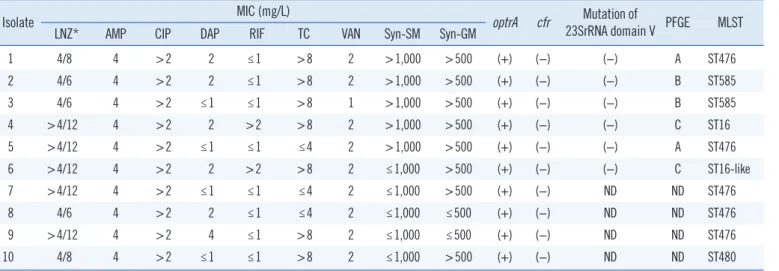
In total, 4,318 E. faecalis isolates were obtained from 2,639 patients. Ten isolates (0.23%) were found to be linezolid-non- susceptible and included five linezolid-intermediate (0.115%) and five linezolid-resistant (0.115%) isolates. Minimum inhibi- tory concentrations of linezolid as determined by E-tests were 6–12 μg/mL, which were resistant. The isolates were obtained from urine (N=6), Jackson Pratt drainage (N=2), and open pus (N=2) samples. The antimicrobial susceptibility and resistance genes of the LNSEF isolates are listed in Table 1. All LNSEF iso- lates were susceptible to penicillin, ampicillin, daptomycin, ni- trofurantoin, teicoplanin, and vancomycin, but resistant to fluo- roquinolone and quinupristin/dalfopristin.
All 10 LNSEF isolates were positive for optrA, but none were positive for cfr. The domain V of the 23S rRNA genes of all six isolates in the first year were wild-type. Multilocus sequence typ- ing (MLST) revealed that five isolates were ST476, two ST585, one ST16, one ST16-like, and one ST480. The pulsotypes of the six isolates in the first year were clustered into three types (Fig. 1). The ST16-like isolate harbored a thymine at the 27th position of yiqL, while ST16 had cytosine. Clinical and epidemi- ological features of the 10 patients with LNSEF are presented in Table 2. Seven of these LNSEF isolates were obtained from urine samples and open pus samples in an outpatient setting, whereas the remaining three were hospital-acquired. In one pa- tient, linezolid-susceptible enterococci were recovered from a urine sample one month before LNSEF isolation. None of the patients carrying LNSEF had been treated with linezolid. Eight
Table 1. Antibiogram, resistance genes, and molecular epidemiology of LNSEF
Isolate MIC (mg/L)
optrA cfr Mutation of
23SrRNA domain V PFGE MLST
LNZ* AMP CIP DAP RIF TC VAN Syn-SM Syn-GM
1 4/8 4 >2 2 ≤1 >8 2 >1,000 >500 (+) (−) (−) A ST476
2 4/6 4 >2 2 ≤1 >8 2 >1,000 >500 (+) (−) (−) B ST585
3 4/6 4 >2 ≤1 ≤1 >8 1 >1,000 >500 (+) (−) (−) B ST585
4 >4/12 4 >2 2 >2 >8 2 >1,000 >500 (+) (−) (−) C ST16
5 >4/12 4 >2 ≤1 ≤1 ≤4 2 >1,000 >500 (+) (−) (−) A ST476
6 >4/12 4 >2 2 >2 >8 2 ≤1,000 >500 (+) (−) (−) C ST16-like
7 >4/12 4 >2 ≤1 ≤1 ≤4 2 ≤1,000 >500 (+) (−) ND ND ST476
8 4/6 4 >2 2 ≤1 ≤4 2 ≤1,000 ≤500 (+) (−) ND ND ST476
9 >4/12 4 >2 4 ≤1 >8 2 ≤1,000 ≤500 (+) (−) ND ND ST476
10 4/8 4 >2 ≤1 ≤1 >8 2 ≤1,000 >500 (+) (−) ND ND ST480
*Linezolid MICs are denoted as the MicroScan MIC/E-test MIC.
Abbreviations: AMP, ampicillin; CIP, ciprofloxacin; DAP, daptomycin; MIC, minimal inhibitory concentration; LNZ, linezolid; LNSEF, linezolid-nonsusceptible Enterococcus faecalis; MLST, multilocus sequence typing; ND, not determined; PFGE, pulsed-field gel electrophoresis; RIF, rifampin; Syn-GM: high-dose gentamicin; TC, tetracycline; VAN, vancomycin; Syn-SM, high-dose streptomycin.
patients had a history of hospitalization. Two patients had an overlap in admission period, but they had been treated in differ- ent wards, ruling out contact transmission. The five ST476 iso- lates were from patients who lived in three different cities.
In this study, the prevalence of optrA-positive LNSEF of 0.23%
was comparable to those of a linezolid resistance surveillance program (2011 to 2015) in the United States, in which 0.3%–
0.7% of enterococci were linezolid-nonsusceptible [8]. In line with this finding, a recent study in a tertiary care hospital in Ko- rea revealed that 1.65% of enterococci were nonsusceptible to linezolid, and 20.8% of LNSEF isolates carried optrA, account- ing for approximately 0.3% of the total E. faecalis isolates [3].
This prevalence of optrA-mediated linezolid resistance is similar to that observed in the present study. We identified optrA as the primary mechanism of linezolid resistance in E. faecalis, whereas during the same period, 23S rRNA mutations was identified as the primary mechanism underlying linezolid resis- tance in E. faecium [9]. Considering the ability of bacteria to Table 2.
Clinical and epidemiological features of 10 patients from whom LNSEF was isolated PatientSex/age (year)Sample date, typeAdmission dateAdmission history (≤1 yr)Underlying diseaseSurgical history (≤1 yr)Previous antimicrobial treatment (≤30 days)Type of infectionLocation (city)Clinical outcome 1M/2417.11.01, urineOutpatientYesRetrocaval ureterYesCefixime, ceftriaxoneColonizationWonju, Kangwon 2F/4617.11.02, urineOutpatientYesCervical cancerNoLevofloxacin, piperacillin/tazobactam, ceftizoxime, ceftazidime, ampicillin, cotrimoxazole, ceftriaxoneAcute pyelonephritisGuri, GyeonggiResolved 3M/7718.06.07, JP drainage18.05.20YesHepatocellular carcinomaYesCiprofloxacin, meropenemLiver abscessBuk, BusanResolved 4F/6418.06.07, urine18.05.31YesThrombotic microangiopathyNoCephradineColonizationHanam, GyeonggiNot applicable 5F/5918.09.27, urineOutpatientYesEndometrial cancerYesNoCystitisSeocho, SeoulResolved 6M/7018.11.06, urineOutpatientYesBenign prostate hyperplasiaYesCiprofloxacinColonizationGangdong, SeoulNot applicable 7F/2519.01.01 open pusOutpatientYesIschemic cardiomyopathyNoPiperacillin/tazobactam, cefpodoxime, cefazedoneChronic woundWanju, ChonbukResolved 8F/8419.02.20 urineOutpatientNoAtrial fibrillationNoNoCystitisGangdong, SeoulResolved 9F/7419.05.31 JP drainage19.05.25YesRectal cancerYesCiprofloxacin, metronidazole, cefoxitinColonizationWonju, Kangwon 10M/7019.06.07 open pusOutpatientNoAcute myeloid leukemiaNoCiprofloxacin, metronidazolePerianal abscessGwangjin, SeoulResolved Abbreviations: F, female; JP, Jackson Pratt; LNSEF, linezolid-nonsusceptible Enterococcus faecalis; M, male.
Fig. 1. Pulsed-field gel electrophoresis (PFGE) analysis of linezolid- nonsusceptible Enterococcus faecalis isolates after SmaI-digestion.
M denotes Lambda Ladder PFG Marker (New England Biolabs Inc., N0341S, Beverly, MA). Each of lanes from 1 to 6 denoted the pulso- type of isolate number 1, 5, 2, 3, 4, and 6 in order.
M 1 2 3 4 5 6 M
transfer optrA via plasmids and the marked increase in optrA-posi- tive E. faecalis cases in China [4], the spread of optrA-mediated linezolid resistance could be an imminent threat in Korea.
In this study, all LNSEF isolates except one were multidrug- resistant. The susceptibility rates of LNSEF isolates to ciprofloxa- cin, high-level gentamicin, and high-level streptomycin were 0.0%, 20.0%, and 50.0%, respectively, whereas the average susceptibility rates of the total E. faecalis isolates to these anti- microbials were 59.9%, 51.4%, and 86.1%, respectively (un- published data). Except two, all patients underwent antimicro- bial treatment within 30 days before LNSEF isolation. Therefore, most cases were healthcare-associated, although they were iso- lated from an outpatient setting. Antibiotic pressure seemed to trigger the spread of LNSEF, but none of the patients had a his- tory of linezolid treatment. Therefore, linezolid resistance is likely to spread via clonal expansion or horizontal transfer of resistance genes in a community setting, but in a healthcare-associated manner. Increased spread of LNSEF would complicate the anti- microbial treatment of urogenital and wound infections.
ST476 was the most prevalent strain in this study. Previously optrA-positive ST476 strains were reported only in China, where it has been frequently found in humans and pigs [10-12]. The epidemiological interpretation of these findings needs further investigation. Among other STs, ST16 is an optrA-carrying clone with a worldwide distribution [12]. ST585 strains harbor- ing optrA have been reported in the USA, China, and Germany [5, 10, 13]. ST480 strains harboring optrA have been reported in China, France, Germany, and Belgium [12-15]. Studies in China have revealed that optrA is more prevalent in animal en- terococcal isolates (15.9%) than human isolates (2.0%) [10]
and that 3.5% of healthy individuals carry optrA-carrying E.
faecalis, regardless of age [16]. The optrA gene has been found from the enterococcal isolates of food animals since 2008 in Korea, and optrA-positive LNSEF from food animals belong to several STs, of which only ST16 was detected in the present study [17, 18]. Therefore, ST16 may be responsible for the spread of optrA-positive LNSEF in both food animals and hu- mans. All STs in this study have been previously detected in China. Geographical vicinity along with substantial food ex- change and extensive human traveling may explain the epide- miological linkage of optrA-positive E. faecalis between these two countries.
In this study, none of the patients with LNSEF were epidemio- logically related to one another. Most LNSEF infections were of the community-onset and healthcare-associated type. This may herald an era of linezolid resistance by plasmid-mediated resis-
tance gene acquisition. A Chinese hospital reported that as high as 3.93% of E. faecalis isolates were linezolid-resistant, and all those isolates were positive for optrA, cfr, or both [11]. There- fore, the rapid spread of LNSEF via clonal expansion or horizon- tal transfer of resistance genes is a possible scenario once it is introduced [3, 4, 19].
There were some limitations in this study. First, the number of LNSEF isolates studied was relatively small, because linezolid resistance in E. faecalis is still rare. Second, this was a single- center study; further multi-center studies are needed to confirm the prevalence and epidemiology of optrA-harboring E. faecalis.
In conclusion, the emergence of optrA-mediated LNSEF in a community setting is alarming. Therefore, adequate infection control measures and surveillance of linezolid resistance are necessary in Korea.
ACKNOWLEDGEMENTS
This study used the Enterococcus faecalis MLST Database (http://pubmlst.org/efaecalis/) of the University of Oxford (Jolley, et al. Wellcome Open Res 2018, 3:124 [version 1; referees: 2 approved]).
AUTHOR CONTRIBUTIONS
MNK directed the study. KP and YSJ conducted the experiments.
HS and JC analyzed the data. KP wrote the paper.
CONFLICTS OF INTEREST
The authors report no potential conflicts of interest relevant to this article.
RESEARCH FUNDING
The authors have no funding relevant to this article.
ORCID
Kuenyoul Park https://orcid.org/0000-0003-3950-4946 Yun Sil Jeong https://orcid.org/0000-0002-1782-3965 Jeonghyun Chang https://orcid.org/0000-0001-7928-7195 Heungsup Sung https://orcid.org/0000-0002-6062-4451 Mi-Na Kim https://orcid.org/0000-0002-4624-6925
REFERENCES
1. Mendes RE, Deshpande LM, Jones RN. Linezolid update: stable in vitro activity following more than a decade of clinical use and summary of associated resistance mechanisms. Drug Resist Updat 2014;17:1-12.
2. Bae HG, Sung H, Kim MN, Lee EJ, Koo Lee S. First report of a linezolid- and vancomycin-resistant Enterococcus faecium strain in Korea. Scand J Infect Dis 2006;38:383-6.
3. Lee SM, Huh HJ, Song DJ, Shim HJ, Park KS, Kang CI, et al. Resis- tance mechanisms of linezolid-nonsusceptible enterococci in Korea:
low rate of 23S rRNA mutations in Enterococcus faecium. J Med Micro- biol 2017;66:1730-5.
4. Cui L, Wang Y, Lv Y, Wang S, Song Y, Li Y, et al. Nationwide surveillance of novel oxazolidinone resistance gene optrA in Enterococcus isolates in China from 2004 to 2014. Antimicrob Agents Chemother 2016;60:7490-3.
5. Deshpande LM, Castanheira M, Flamm RK, Mendes RE. Evolving oxa- zolidinone resistance mechanisms in a worldwide collection of entero- coccal clinical isolates: results from the SENTRY Antimicrobial Surveil- lance Program. J Antimicrob Chemother 2018;73:2314-22.
6. Hua R, Xia Y, Wu W, Yang M, Yan J. Molecular epidemiology and mech- anisms of 43 low-level linezolid-resistant Enterococcus faecalis strains in Chongqing, China. Ann Lab Med 2019;39:36-42.
7. Tenover FC, Arbeit RD, Goering RV, Mickelsen PA, Murray BE, Persing DH, et al. Interpreting chromosomal DNA restriction patterns produced by pulsed-field gel electrophoresis: criteria for bacterial strain typing. J Clin Microbiol 1995;33:2233-9.
8. Pfaller MA, Mendes RE, Streit JM, Hogan PA, Flamm RK. Five-year sum- mary of in vitro activity and resistance mechanisms of linezolid against clinically important Gram-positive cocci in the United States from the LEADER surveillance program (2011 to 2015). Antimicrob Agents Che- mother 2017;61:e00609-17.
9. Jung J, Park K, Shin SH, Lee JY, Kim MN, Kim SH. The pitfall of cohort isolation in an outbreak of linezolid-resistant, vancomycin-resistant en- terococci. Clin Microbiol Infect 2019;25:1568-9.
10. Wang Y, Lv Y, Cai J, Schwarz S, Cui L, Hu Z, et al. A novel gene, optrA, that confers transferable resistance to oxazolidinones and phenicols and its presence in Enterococcus faecalis and Enterococcus faecium of human and animal origin. J Antimicrob Chemother 2015;70:2182-90.
11. Zhang Y, Dong G, Li J, Chen L, Liu H, Bi W, et al. A high incidence and coexistence of multiresistance genes cfr and optrA among linezolid-re- sistant enterococci isolated from a teaching hospital in Wenzhou, China.
Eur J Clin Microbiol Infect Dis 2018;37:1441-8.
12. Zhou W, Gao S, Xu H, Zhang Z, Chen F, Shen H, et al. Distribution of the optrA gene in Enterococcus isolates at a tertiary care hospital in Chi- na. J Glob Antimicrob Resist 2019;17:180-6.
13. Bender JK, Fleige C, Lange D, Klare I, Werner G. Rapid emergence of highly variable and transferable oxazolidinone and phenicol resistance gene optrA in German Enterococcus spp. clinical isolates. Int J Antimi- crob Agents 2018;52:819-27.
14. Argudín MA, Youzaga S, Dodémont M, Heinrichs A, Roisin S, Deplano A, et al. Detection of optrA-positive enterococci clinical isolates in Belgium.
Eur J Clin Microbiol Infect Dis 2019;38:985-7.
15. Sassi M, Guérin F, Zouari A, Beyrouthy R, Auzou M, Fines-Guyon M, et al. Emergence of optrA-mediated linezolid resistance in enterococci from France, 2006-16. J Antimicrob Chemother 2019;74:1469-72.
16. Cai J, Schwarz S, Chi D, Wang Z, Zhang R, Wang Y. Faecal carriage of optrA-positive enterococci in asymptomatic healthy humans in Hang- zhou, China. Clin Microbiol Infect 2019;25:630.e1-6.e6.
17. Na SH, Moon DC, Choi MJ, Oh SJ, Jung DY, Kang HY, et al. Detection of oxazolidinone and phenicol resistant enterococcal isolates from duck feces and carcasses. Int J Food Microbiol 2019;293:53-9.
18. Tamang MD, Moon DC, Kim SR, Kang HY, Lee K, Nam HM, et al. De- tection of novel oxazolidinone and phenicol resistance gene optrA in enterococcal isolates from food animals and animal carcasses. Vet Mi- crobiol 2017;201:252-6.
19. Huang J, Chen L, Wu Z, Wang L. Retrospective analysis of genome se- quences revealed the wide dissemination of optrA in Gram-positive bac- teria. J Antimicrob Chemother 2017;72:614-6.