Notes Bull. Korean Chem. Soc. 2014, Vol. 35, No. 12 3675 http://dx.doi.org/10.5012/bkcs.2014.35.12.3675
Regioselective Click Chemistry for Construction of Arylpiperazinyl 1,2,3-Triazole
Derivative Libraries as Dopamine D
4/D
3Receptor Ligands
Ju Myung Kwak, Ji Su Moon, Sangei Seo, Jea I Choi, Vasu Sampath,† Hee-Yoon Lee,†,* and Hun Yeong Koh* Department of Chemistry, Inha University, Nam-gu, Incheon 402-751, Korea. *E-mail: [email protected]
†Department of Chemistry, Korea Advanced Institute of Science and Technology, Daejeon 305-701, Korea
Received October 2, 2014, Accepted October 10, 2014
Key Words : Dopamine receptor ligand, 1,2,3-Triazole, Arylpiperazine, Regioselective reaction, Click chem-istry, Microwave reaction
The Huisgen 1,3-dipolar cycloaddition between azides and alkynes stands out as the most direct way of assembling 1,2,3-triazole functionality.1,2 Since CuAAC was first report-ed, the click chemistry, copper-catalyzed azide-alkyne cyclo-addition (CuAAC), became a synthetic tool for the regio-selective formation of 1,4-disubstituted 1,2,3-triazoles under very mild conditions,3 and a number of applications in medicinal chemistry, organic synthesis, chemical biology, materials science, and polymer chemistry have been reported.3 In particular, 1,2,3-triazole structures have been the key bioisostere for medicinal chemistry due to their wide appli-cability in the drug development fields.4,5 However, with the exception of our previous report,6 no report has been issued on application of click chemistry for disubstituted 1,2,3-triazole derivatives as dopamine receptors ligands.
In our previous report, arylpiperazinylpropyl and butyl 1,2,3-triazole derivatives were synthesized from two regio-isomeric trialzole alcohols as building blocks through thermal Huisgen reaction without any regioselectivity for dopamine receptor ligands.6 These arylpiperazinyl alkyl 1,2,3-triazole derivatives showed good binding affinity selective for dop-amine D3/D4 receptors. In this paper, we describe improved strategy for the regioselective synthesis of derivatives using click chemistry. Since metal catalyzed azide-alkyne cyclo-addition could serve as a useful tool for the development of selective ligands for dopamine D3 receptor7 or D4 receptor,8 1,4-disubstituted 1,2,3-triazole derivatives were synthesized selectively through CuAAC and 1,5-disubstituted 1,2,3-triazole derivatives were synthesized via Ru-catalyzed 1,3-dipolar azide-alkyne cycloaddition.
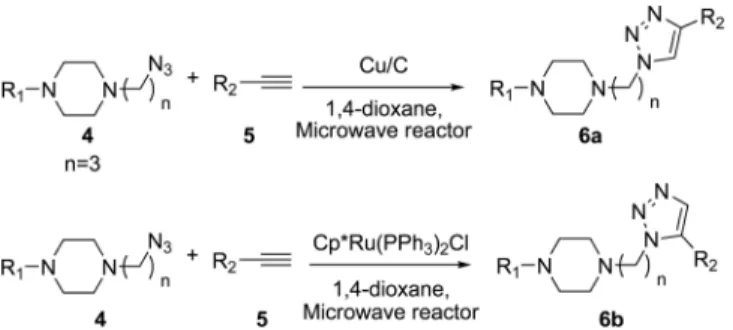
The synthetic strategies of arylpiperazinyl alkyl 1,2,3-triazole derivatives are shown in Schemes 1 and 2. Pre-paration of the building blocks (4) is described in Scheme 1. The arylpiperazines (3) was synthesized in 65% yield from 3-chloro-1-bromopropane/4-chloro-1-bromobutane (2) and arylpiperazines (1) in the presence of K2CO3 in acetonitrile
at room temperature. The piperazinyl nitrogen reacted selec-tively with bromide to form chloroalkyl substituted piper-azines. Azido-arylpiperazines (4) were synthesized from chloroalkyl arylpiperazines (3) and NaN3 in
N,N-dimethyl-formamide at 60oC in 90% yields.
Regioselective synthesis of 1,2,3-triazole derivatives was
performed through cycloaddition reaction between alkynes and azides in the presence of Cu or Ru catalysts. Various Cu and Ru based catalysts were tested for the regioselective construction of 1,2,3-triazole derivatives as shown in the Table 1.
Scheme 1. Synthesis of arylpiperazinyl alkyl azides.
Table 1. Reaction conditions used for regioselective syntheses
Entrya Catalyst Solvent Time Yieldb
Ratio12 (anti:syn)
6a : 6b
1c Cu/C Dioxane 10 min 68 100:0
2c CuSO4 Dioxane 20 min 55 100:0
3c Cu(NO3)2 Dioxane 10 min 60 100:0 4c Cu (powder) Dioxane 10 min 67 100:0
5c Cu/C H2O 10 min 14 100:0
6c Cu/C ACN 10 min 68 100:0
7d Cp*Ru(PPh3)2Cl Dioxane 30 min 61 3.8:96.2 8d Cp*Ru(PPh3)2Cl ACN 30 min 56 4.2:95.8
aall reactions were performed in a microwave reactor at 150W, 90oC. bIsolated yield of major product. cusing 2 mol % of catalyst, 1,4-disubstituted product was synthesized. d1,5-disubstituted product was synthesized
3676 Bull. Korean Chem. Soc. 2014, Vol. 35, No. 12 Notes
Regioselective formation of 1,4-disubstituted 1,2,3-triazole derivatives were tested by using Cu/C,7 CuSO4, Cu(NO3)2 or
Cu(powder) (Table 1. Entries 1-4). All the catalysts showed good selectivity with exclusive formation of 1,4-disubstitut-ed compounds. The reaction conditions with Cu/C catalyst showed highest yields (Table 1. Entry 1). Reactions in dioxane and acetonitrile produced better yields than water. (Table 1. Entries 1, 5 and 6). Synthesis of 1,5-disubstituted 1,2,3-triazole derivatives was investigated using Ru catalysts (Table 1. Entry 7 and 8). Pentamethyl cyclopentadienyl ruthenium bistriphenylphosphine chloride [Cp*Ru(PPh3)2Cl]
catalyst produced good results for the 1,5-disubstituted 1,2,3-triazole formation reaction in acetonitrile or dioxane.
Based on the results in the Table 1, a library of 1,4-disubstituted and 1,5-1,4-disubstituted arylpiperazinyl 1,2,3-triazole derivatives were constructed using the Cu/C or [Cp*Ru(PPh3)2Cl] catalysts in 1,4-dioxane at 90oC for 10
min using a microwave reactor (Scheme 2). Products were characterized by 1H NMR and LC-MS.
Constructed library of 1,4-disubstituted and 1,5-disub-stituted 1,2,3-triazole derivatives is shown in the Table 2.
In the synthesis of arylpiperazinyl 1,2,3-triazole derivatives (6), Aryl piperazine moieties (where, R1 is A, B, C, D, E, F,
G, H, I, J or K) and aryl 1,2,3-triazole moieties (where, R2 is
A or L) were linked through propyl or butyl chains. A library of 1,4-disubstituted 1,2,3-triazole derivatives using Cu/C catalyst and 1,5-disubstituted 1,2,3-triazole derivatives using Cp*Ru(PPh3)2Cl catalyst were constructed in good yields.
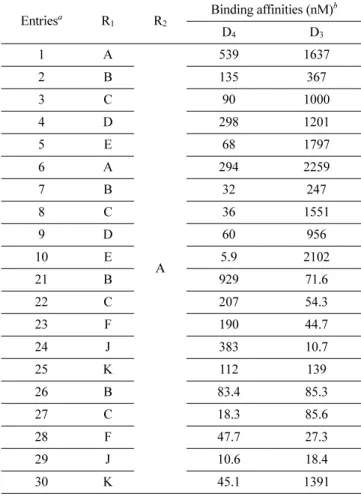
The binding affinities of synthesized 1,2,3-triazole deriva-tives for dopamine D3 and D4 receptors were tested. 9,10 Most
compounds showed varying binding affinities for dopamine D3 and D4 . Entries 10 and 29 (Table 3) showed excellent
binding affinities for dopamine D4 and entries 24 with
dop-amine D3. Propyl linked 1,2,3-triazole derivatives produced
better results for dopamine D4 than D3 but butyl linked
compounds produced better results for dopamine D3 than D4.
It is quite intriguing that the slight change of the tether length changed the selectivity between D3 and D4. When two
aryl parts are connected with propyl tether, compounds showed D4 selectivity regardless of the position of the R2
group. This trend indicates that the spacer between two aryl groups plays an important role in distinguishing two receptors. Between 1,4-substitution and 1,5-substitution, 1,5-substitu-tion provided better D4 selectivity with propyl tether. Sub-Scheme 2. Regioselective preparation of 1,4- or 1,5-disubstituted 1,2,3-triazole derivatives.
Table 2. The library construction of 1,4 or 1,5 disubstituted 1,2,3 triazolederivativesa
Entries R1 R2 catalyst n Yieldb
1 A A Cu/C 3 76 2 B 58 3 C 85 4 D 82 5 E 75 6 A [Cp*Ru(PPh3)2Cl] 89 7 B 88 8 C 87 9 D 89 10 E 79 11 F L Cu/C 84 12 G 88 13 H 65 14 I 82 15 J 80 16 F [Cp*Ru(PPh3)2Cl] 75 17 G 70 18 H 89 19 I 79 20 J 83 21 B A Cu/C 4 74 22 C 81 23 F 79 24 J 75 25 K 74 26 B [Cp*Ru(PPh3)2Cl] 69 27 C 83 28 F 84 29 J 82 30 K 76 31 B L Cu/C 78 32 C 79 33 F 71 34 J 76 35 K 65 36 B [Cp*Ru(PPh3)2Cl] 69 37 C 82 38 F 74 39 J 73 40 K 71
aall reactions were performed in a microwave reactor at 150W, 90oC using 2 mol % of catalyst. bIsolated yield of the major product
Notes Bull. Korean Chem. Soc. 2014, Vol. 35, No. 12 3677
stitution around the phenyl ring of the arylpiperazine also showed a dramatic improvement of D4 selectivity as ortho-,
and 3,4-disubstituted ligands provided the enhanced selec-tivity (entries 3, 5, 8 and 10). On the other hand, butyl tether seemed to provide only the slight selectivity for D3. Contrary
to the propyl tether, butyl tether provided better selectivity with 1,4-substitution than 1,5-substitution. It is clear that 2,3-disubstituted compounds (entries 21 and 24) provides good selectivity for D3.
In summary, improved methods for regioselective syn-thesis of 1,2,3-triazole derivatives in high yields within short reaction time were developed. In general, each regioselec-tive 1,2,3-triazole libraries were constructed using selecregioselec-tive Cu/C catalyst or Cp*Ru(PPh3)2Clcatalyst via click chemistry.
Thus constructed library of compounds provided important information on the selectivity between D3 and D4 receptors
for the future design of a drug candidate with a better selectivity or dual activity.
Experimental
General Procedure; Synthesis of 4-Phenyl-piperazinyl 3-Chloro Propane (3). A solution of 1-bromo-3-chloropro-pane ((1) where n = 3, 1.46 g, 9.24 mmol) and phenylpiper-azine (1 g, 6.16 mmol) containing K2CO3 (1.3 g, 9.24 mmol)
in acetonitrile (30 mL) under a nitrogen atmosphere was stirred well at 25oC for 10 h. The progress of the reaction was monitored by TLC. The reaction mixture was filtered and the solvent was evaporated. The product obtained was washed with water and the aqueous layer was extracted with ethyl acetate (3 × 50 mL). The combined organic layers were dried over Na2SO4 and filtered. The product was obtained
after evaporating the solvent using a rotary evaporator as a slightly brown colored liquid and was purified by column chromatography (EA:n-Hex = 1:2) to produce 3 (0.96 g, 4.00 mmol) in 65% yield.
1H NMR (200 MHz, CDCl
3) δ 7.26 (m, 2H), 6.93 (d, 2H),
6.83 (t, 1H), 3.62 (t, 2H), 3.20 (t, 4H), 2.61 (t, 4H), 2.52 (t, 2H), 2.00 (t, 2H).
General Procedure; Synthesis of 4-Phenyl-piperazinyl Azidopropane (4). A solution of 4-phenyl-piperazinyl 3-chloro propane (3) (where, n = 3 and 0.7 g, 2.93 mmol) and NaN3 (0.38 g, 5.86 mmol) in DMF (30 mL) was stirred well
in a nitrogen atmosphere at 60oC for 5 h. The progress of the reaction was monitored by TLC. The reaction mixture was then filtered and the solvent was evaporated off. The product obtained was washed with water and extracted with ethyl acetate (3 × 50 mL). The collected organic layer was dried over Na2SO4 and filtered. The product was isolated
after evaporating the solvent using a rotary evaporator and purified by column chromatography (EA:n-Hex = 1:2). The final yield was 90%.
1H NMR (200 MHz, CDCl
3) δ 7.26 (m, 2H), 6.94 (t, 2H),
6.83 (t, 1H), 3.37 (t, 2H), 3.20 (d, 4H), 2.61 (t, 4H), 2.48 (t, 2H), 1.81 (m, 2H).
General Procedure for the Synthesis of 1-Phenyl-4-(3-4-phenyl-1H-1,2,3-triazole-1-yl)propyl)piperazine (6a). A solution of 4-phenyl-piperazinyl 3-azidopropane (4) (0.10 g, 0.41 mmol) and phenylacetylene (62 mg, 0.61 mmol) containing Cu/C (100 mg, 2 mol %) in 2 mL of 1,4-dioxane was placed in a microwave reactor (150W/90oC/10 min). The progress of the reaction was monitored by TLC. After reaction completion, water was added and the organic layer was separated. The organic layer was then dried over MgSO4
and filtered to remove MgSO4. Finally, the product was
purified by flash column chromatography (EA:isopropyl alcohol = 9:1). The final yield of the product was 68%.
1H NMR (Entry 1) (400 MHz, CDCl
3) δ 7.86 (d, 2H), 7.78
(s, 1H), 7.43 (t, 2H), 7.35 (t, 2H), 6.92 (d, 2H), 6.86 (t, 2H), 4.51 (t, 2H), 3.20 (t, 4H), 2.61 (t, 4H), 2.45 (t, 2H), 2.18 (m, 2H). ESI-MS m/z calcd for C21H25N5 [M + H]+ 347.2110,
found 348.3.
Other arylpiperazinyl 1,2,3-triazole derivatives were syn-thesized similarly and characterized by 1H NMR.
General Procedure for the Synthesis of 1-Phenyl-4-(3-5-phenyl-1H-1,2,3-triazole-1-yl)propyl)piperazine (6b). A solution of 4-phenyl-piperazinyl 3-azidopropane (4) (100 mg, 0.4 mmol) and phenylacetylene (62 mg, 0.61 mmol) containing Cp*Ru(PPh3)2Cl (6.4 mg, 0.008 mmol, 2 mol %)
in 2 mL of 1,4-dioxane was reacted in a microwave reactor (150W/90oC/10 min). The progress of the reaction was monitored by TLC. After reaction completion, water was
Table 3. In vitro binding affinities of selected compounds for Dopamine receptor D3/D411 Entriesa R 1 R2 Binding affinities (nM)b D4 D3 1 A A 539 1637 2 B 135 367 3 C 90 1000 4 D 298 1201 5 E 68 1797 6 A 294 2259 7 B 32 247 8 C 36 1551 9 D 60 956 10 E 5.9 2102 21 B 929 71.6 22 C 207 54.3 23 F 190 44.7 24 J 383 10.7 25 K 112 139 26 B 83.4 85.3 27 C 18.3 85.6 28 F 47.7 27.3 29 J 10.6 18.4 30 K 45.1 1391
3678 Bull. Korean Chem. Soc. 2014, Vol. 35, No. 12 Notes
added, the organic layer was separated, dried over MgSO4
and then filtered to remove MgSO4. Finally, the product was
purified by flash column chromatography (EA:isopropyl alcohol = 9:1). The final yield of the product was 76%.
1H NMR (Entry 7) (400 MHz, CDCl
3) δ 7.71 (s, 1H),
7.49–7.46 (m, 4H), 7.28–7.25 (m, 3H), 6.92–6.86 (m, 3H), 4.48 (t, 2H), 3.10 (m, 4H), 2.47 (d, 4H), 2.36 (t, 2H), 2.10 (m, 2H). ESI-MS m/z calcd for C21H25N5 [M + H]+ 347.2110,
found 348.3.
Other arylpiperazinyl 1,2,3-triazole derivatives were syn-thesized similarly and characterized by 1H NMR.
Acknowledgments. This work was supported by Inha University Research Grant.
References
1. Huisgen, R.; Szeimies, G.; Mobius, L. Chem. Ber. 1967, 100, 2494.
2. Huisgen, R. In 1,3-Dipolar Cycloaddition Chemistry; Padwa, A., Ed.; Wiley: New York, NY, 1984; Vol. 1, p 1.
3. Leoneti, V. A.; Campo, V. L.; Gomes, A. S.; Field, R. A.; Carvalho,
I. Tetrahedron 2010, 66, 9475.
4. Kolb, H. C.; Sharpless, K. B. Drug Discovery Today 2003, 8, 1128. 5. Trom, G. C.; Pirali, T.; Billington, R. A.; Canonico, P. L.; Sorba,
G.; Genazzani, A. A. Med. Res. Rev. 2008, 28, 278.
6. Kwak, J. M.; Moon, J. S.; Murugan, R. N.; Park, W. K.; Gong, J. Y.; Lee, H. Y.; Koh, H. Y. Bull. Korean Chem. Soc. 2013, 34, 3467. 7. Lipshutz, B. H.; Taft, B. R. Angew. Chem. Int. Ed. 2006, 45, 8235. 8. Zhang, L.; Chen, X.; Xue, P.; Sun, H. H. Y.; Williams, I. D.; Sharpless, K. B.; Fokin, V. V.; Jia, G. J. Am. Chem. Soc. 2005, 127, 15998.
9. (a) Pazos, A.; Hoyer, D.; Palacios, J. M. Eur. J. Pharmacol. 1985, 106, 539. (b) Park, W. K.; Jeong, D.; Cho, H.; Lee, S. J.; Cha, M. Y.; Pae, A. N.; Choi, K. I.; Koh, H. Y.; Kong, J. Y. Pharmacol. Biochem. Behav. 2005, 82, 361.
10. Compounds were evaluated in vitro for dopamine D3 and D4
receptors binding affinity by measuring their ability to displace radio ligand ([3H]Methylspiperone for D3, [3H]YM-09151-2 for
D4) from the cloned human dopamine receptors D3 and D4 stably
expressed in CHO or Sf9 cells, respectively.
11. These binding affinities were not described in our previous report. 12. The ratio for each syn and anti isomer in Table 1 was identified by
HPLC under the following condition. *Solvent; H2O:MeOH = 30:70