Management of Low-Risk Papillary Thyroid Cancer
Nicole M. Iñiguez-Ariza1,2, Juan P. Brito2,3
1Department of Endocrinology and Metabolism, Instituto Nacional de Ciencias Médicas y Nutrición Salvador Zubirán, Mexico City, Mexico; 2Division of Endocrinology, Diabetes, Metabolism, and Nutrition, 3Knowledge and Evaluation Research Unit, Mayo Clinic, Rochester, MN, USA
The incidence of thyroid cancer has increased, mainly due to the incidental finding of low-risk papillary thyroid cancers (PTC).
These malignancies grow slowly, and are unlikely to cause morbidity and mortality. New understanding about the prognosis of tu- mor features has led to reclassification of many tumors within the low-risk thyroid category, and to the development of a new one
“very low-risk tumors.” Alternative less aggressive approaches to therapy are now available including active surveillance and mini- mally invasive interventions. In this narrative review, we have summarized the available evidence for the management of low-risk PTC.
Keywords: Low-risk; Carcinoma, papillary; Micropapillary; Active surveillance; Ethanol injection
INTRODUCTION
Over the past 20 to 30 years there has been an increase in the in- cidence of thyroid cancers in industrialized countries, with sta- ble or little change in mortality [1-4]. The majority of the new thyroid cancer cases are small papillary thyroid cancers (PTCs).
These small low-risk lesions are often found incidentally, and in patients without any symptoms [5,6]. This change in the epide- miology of thyroid cancer has implications on the management of this disease. The traditional paradigm of treating all patients with thyroid cancer with surgery, radioactive iodine (RAI), and suppressive thyroid hormone therapy is no longer suitable.
Rather, patients with thyroid cancer should receive treatment according to their overall prognosis, recurrent and mortality risks, the treatment’s benefits and harms, and the patient’s con- text and values. In this review, we describe new elements of the individualized approach for the management of low-risk thyroid cancers.
THE DEFINITION OF LOW-RISK THYROID CANCER HAS EXPANDED
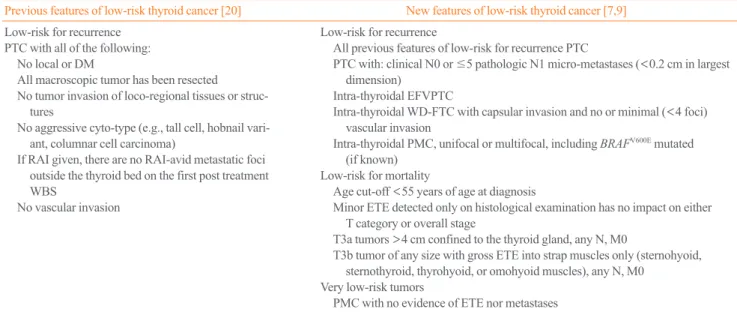
Low-risk thyroid cancers are those malignancies unlikely to re- cur, and to cause morbidity and mortality. Although, this defini- tion was used mostly to describe intrathyroidal micropapillary cancers, recent changes in several scoring systems have expand- ed this definition to include tumors with other pathological fea- tures within the low-risk category (Tables 1, 2) [7-9].
Some of the changes reflect a better understanding of patient and tumor features not associated with increases in cancer spe- cific mortality. The American Joint Committee on Cancer (AJCC)/
tumor size and invasion, regional lymph nodes status and distant metastatic spread (TNM) cancer staging system (a system that provides stages associated with risk of cancer mortality) [9]
changed the age cut-off for the diagnosis of thyroid cancer, in- creasing it from 45 to 55 years of age, with consequent down staging of 12% of patients into a low-risk category (Stage I),
Received: 4 May 2018, Revised: 14 May 2018, Accepted: 21 May 2018 Corresponding author: Juan P. Brito
Division of Endocrinology, Diabetes, Metabolism, and Nutrition, and Knowledge and Evaluation Research Unit, Mayo Clinic, 200 First St. SW, Rochester, MN 55905, USA
Tel: +1-507-284-2463, Fax: +1-507-284-5745, E-mail: brit [email protected]
Copyright © 2018 Korean Endocrine Society
This is an Open Access article distributed under the terms of the Creative Com- mons Attribution Non-Commercial License (http://creativecommons.org/
licenses/by-nc/4.0/) which permits unrestricted non-commercial use, distribu- tion, and reproduction in any medium, provided the original work is properly cited.
Table 1. ATA 2009 Risk Stratification System with Proposed Modifications for Structural Disease Recurrence in Differentiated Thyroid Cancer
ATA low-risk ATA intermediate risk ATA high risk
PTC with all of the following:
No local or DM
All macroscopic tumor has been resected No tumor invasion of loco-regional tissues or
structures
No aggressive cyto-type (e.g., tall cell, hobnail variant, columnar cell carcinoma) If RAI given, there are no RAI-avid metastat-
ic foci outside the thyroid bed on the first post treatment WBS
No vascular invasion
Clinical N0 or ≤5 pathologic N1 micro-me- tastases (<0.2 cm in largest dimension) Intra-thyroidal EFVPTC
Intra-thyroidal WD-FTC with capsular invasion and no or minimal (<4 foci) vascular inva- sion
Intra-thyroidal PMC, unifocal or multifocal, including BRAFV600E mutated (if known)
Microscopic ETE
RAI-avid metastatic foci in the neck on the first post-treatment WBS
Aggressive cyto-type (e.g., tall cell, hobnail variant, columnar cell carcinoma) PTC with vascular invasion
Clinical N1 or >5 pathologic N1 with all involved LN <3 cm in largest dimension Multifocal PMC with ETE and BRAFV600E
mutated (if known)
Gross ETE
Incomplete tumor resection Distant metastases
Postoperative serum thyroglobulin suggestive of DM
Pathologic N1 with any metastatic LN ≥3 cm in largest dimension
FTC with extensive vascular invasion (>4 foci of vascular invasion)
Adapted from Haugen et al. [7].
ATA, American Thyroid Association; PTC, papillary thyroid cancer; DM, distant metastases; RAI, radioactive iodine; WBS, whole body scan; N0, no evidence of regional lymph node metastasis; N1, metastasis to regional node; EFVPTC, encapsulated follicular variant of papillary thyroid cancer; WD- FTC, well differentiated follicular thyroid cancer; PMC, papillary microcarcinoma; ETE, extrathyroidal extension; LN, lymph nodes; Gross ETE, mac- roscopic invasion of tumor into the perithyroidal soft tissues; FTC, follicular thyroid cancer.
Table 2. The Expanded Definition of Low-Risk Thyroid Cancer
Previous features of low-risk thyroid cancer [20] New features of low-risk thyroid cancer [7,9]
Low-risk for recurrence PTC with all of the following:
No local or DM
All macroscopic tumor has been resected
No tumor invasion of loco-regional tissues or struc- tures
No aggressive cyto-type (e.g., tall cell, hobnail vari- ant, columnar cell carcinoma)
If RAI given, there are no RAI-avid metastatic foci outside the thyroid bed on the first post treatment No vascular invasion WBS
Low-risk for recurrence
All previous features of low-risk for recurrence PTC
PTC with: clinical N0 or ≤5 pathologic N1 micro-metastases (<0.2 cm in largest dimension)
Intra-thyroidal EFVPTC
Intra-thyroidal WD-FTC with capsular invasion and no or minimal (<4 foci) vascular invasion
Intra-thyroidal PMC, unifocal or multifocal, including BRAFV600E mutated (if known)
Low-risk for mortality
Age cut-off <55 years of age at diagnosis
Minor ETE detected only on histological examination has no impact on either T category or overall stage
T3a tumors >4 cm confined to the thyroid gland, any N, M0
T3b tumor of any size with gross ETE into strap muscles only (sternohyoid, sternothyroid, thyrohyoid, or omohyoid muscles), any N, M0
Very low-risk tumors
PMC with no evidence of ETE nor metastases T3 tumors, >4 cm limited to the thyroid, or gross ETE invading only strap muscles (Stage II).
PTC, papillary thyroid cancer; DM, distant metastases; RAI, radioactive iodine; WBS, whole body scan; N0, no evidence of regional lymph node metas- tasis; N1, metastasis to regional node; EFVPTC, encapsulated follicular variant of papillary thyroid cancer; WD-FTC, well differentiated follicular thy- roid cancer; PMC, papillary microcarcinoma; ETE, extrathyroidal extension; M0, no distant metastasis.
without significantly altering the mortality associated with the various stages. Another change in the staging system is that mi- nor extrathyroidal extension (ETE) detected on histological ex- amination only was deemed to be a low-risk feature. Although previous literature considered both gross and minimal ETE as risk factors for recurrence [10]; microscopic ETE remained a topic of controversy. The change to the TNM system is consis- tent with newer evidence showing that minimal ETE in PTC does not result in increased rates of either cause-specific mortal- ity or postoperative tumor recurrence [11-13]. As a consequence of these changes, the 8th edition of the AJCC/TNM for differen- tiated thyroid cancer results in more patients being adequately classified as low-risk (Stage I or II). A necessary consequence of the decanting of low-risk patients from the high-risk category however, is that epidemiologically the average prognosis for the patients remaining in the high-risk category is poorer.
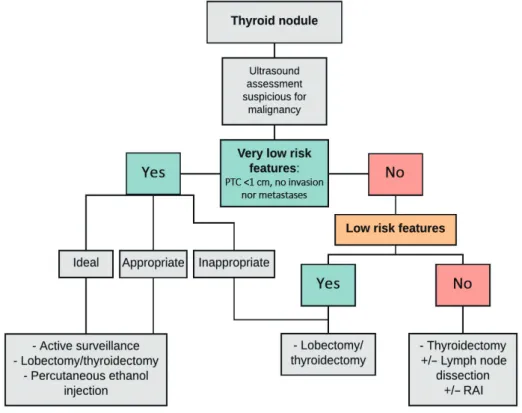
To further refine the category of low-risk, the American Thy- roid Association (ATA) guideline created a subcategory of “very low-risk tumors.” These tumors are subcentimeter PTC without clinically evident metastases or local invasion and no cytologic evidence of aggressive disease. This change is important as it recognizes the low-risk of mortality in patients with tumors with these features and may lead patients and their clinicians to con- sider less aggressive options such as active surveillance to man-
age these tumors (Table 2, Fig. 1) [7].
The ATA, in an additional effort to highlight the low-risk of mortality with certain tumors, has also recognized that “Non-In- vasive Follicular Thyroid neoplasm with Papillary-like nuclear features (NIFTP)” are low-risk. These tumors, previously called non-invasive encapsulated follicular variant of papillary thyroid cancer, have a <1% risk of recurrence in 15 years [14]. By changing the nomenclature and removing the cancer label, ex- perts hope to reduce unnecessary post-thyroidectomy treatments (e.g., RAI), to reduce the intensity of follow-up, and improve patients’ emotional well-being [15-19].
Beyond better differentiating high-risk and low-risk tumors, the updated guidelines modified the stratification system used for risk of recurrence [7]. Intrathyroidal PTC with ≤5 small volume lymph node (<0.2 cm) metastases, previously classified as intermediate [20] is now classified as low-risk. Other features that indicate a low-risk of recurrence include: intrathyroidal en- capsulated follicular variant PTC, intrathyroidal well differenti- ated follicular thyroid cancer with capsular invasion and no or minimal (<4 foci) vascular invasion and intrathyroidal papillary microcarcinoma, unifocal or multifocal, including BRAFV600E mutated (if known) (Table 1). Despite emerging evidence to the contrary [11-13], the ATA chose to keep microscopic ETE as an indicator of intermediate risk of recurrence.
Fig. 1. Approach to low-risk papillary thyroid cancer (PTC). RAI, radioactive iodine.
TREATMENT MODALITIES FOR PATIENTS WITH LOW-RISK THYROID CANCER
Active surveillance for subcentimeter papillary thyroid cancer
In the 1990s the natural history of small PTC was not clear, but it was thought that most would not grow over time or would grow very slowly. Based on this hypothesis Miyauchi et al. [21], proposed a clinical trial of observation without immediate sur- gery for subcentimeter PTCs at Kuma Hospital, later called “ac- tive surveillance.” Patients with subcentimeter low-risk PTC were offered active surveillance or immediate surgery as alter- natives. For those who chose “active surveillance,” ultrasound was performed every 6 months after diagnosis and once a year thereafter. Surgery was recommended when tumors grew by ≥ 3 mm or when novel lymph node metastasis developed [21].
By 2014, they had enrolled 1,235 patients, and showed that only 8% of subcentimeter low-risk PTC had a size enlargement of >3 mm and only 3.8% were found to have novel regional nodal metastases after a 10-year observation period and none of the 1,235 patients showed distant metastasis or died from sub- centimeter low-risk PTC [22,23]. They also noted that young patients (<40 years) were more likely to experience thyroid tu- mor enlargement and novel lymph node appearance compared with middle-age (40 to 59 years) or older patients (>60 years).
Similarly, in 2010, the Tokyo Cancer Institute Hospital group reported [24] their findings on active surveillance of 300 lesions in 230 patients for a mean of 5 years (range, 1 to 17). They showed that only 7% had size enlargement during “active-sur- veillance” protocol, 90% had remained unchanged and 3% de- creased in size. No patient developed extrathyroidal invasion or distant metastasis. Both groups data showed that rescue surgery after progression was detected was successful and no life-threat- ening recurrence was detected thereafter [22,24]. The results of these landmarks studies have demonstrated that active surveil- lance is a safe and adequate treatment for properly selected pa- tients with subcentimeter low-risk PTC [21,25,26].
To assess if a patient with subcentimeter low-risk PTC is suit- able for an “active surveillance” approach, a variety of factors should be taken into consideration. The Memorial Sloan Ketter- ing Cancer Center (MSKCC) in collaboration with the Kuma Hospital group developed a clinical framework to assess suit- ability for an “active surveillance” approach. The rationale for the development of this risk-stratified clinical decision-making framework is that though the 2015 ATA guidelines endorse “ac- tive surveillance” as an alternative to immediate biopsy and sur-
gery in subcentimeter thyroid nodules with highly suspicious ultrasonographic characteristics, as well as in cyto-confirmed very low-risk PTC; the guidelines do not specify how to proper- ly select patients for an “active surveillance” approach. In this framework, patients are divided in distinct categories: ideal, ap- propriate and inappropriate candidates for “active surveillance”
based on a variety of factors (inherent to the tumor, patient char- acteristics and medical team characteristics) (Table 3) [27]. An
“ideal” candidate, would be an older patient (>60 years old), with a subcentimeter low-risk PTC (probable or proven), with regular margins, confined to the thyroid parenchyma and not adjacent to the thyroid capsule. An “appropriate” candidate, would be younger, with tumor multifocality, with potentially aggressive molecular phenotype, adjacent to thyroid capsule but not in risky-zones, or have other imaging findings that can make follow-up more problematic (e.g., thyroiditis, other benign-ap- pearing nodules, nonspecific lymph nodes). An “inappropriate”
candidate, has tumors at risky-subcapsular locations (e.g., adja- cent to the trachea or recurrent laryngeal nerve), has evidence of loco-regional or distant spread, or has evidence of disease pro- gression on serial examinations.
Patients in the “ideal” category demonstrate a <2% rate of disease progression, and should be offered active surveillance.
On the other hand, patients in the “appropriate” category might demonstrate a 10% rate of disease progression, and active sur- veillance may be offered by an experienced management team, as delayed surgery will still be effective, with good clinical out- comes. Finally, patients in the “inappropriate” category should not be offered active surveillance given the possibility that mi- nor disease progression could lead to significant morbidity, and because a high rate of disease progression is expected.
Despite the potential benefits of active surveillance for some patients with very low-risk thyroid cancer, this management op- tion has not been widely adopted. One potential barrier is that clinicians may have difficulty communicating the comparative benefits and downsides of the treatment options, and under- standing patients’ treatment preferences. Recently, and to sup- port decision making for patients with subcentimeter low-risk PTC, researchers from MSKCC and Mayo Clinic in the United States developed a decision aid for use in clinical encounters called Thyroid Cancer Choice (TCC). This tool includes (1) an estimate of the frequency of thyroid cancer in the population;
(2) the management options, active surveillance and thyroid surgery; (3) the risk of death, metastasis, tumor growth and ad- verse effects with each option; (4) the planned type and fre- quency of follow-up; (5) the out-of-pocket costs with each
choice; and (6) the interaction of pregnancy and each manage- ment option. A Korean adaption of this tool underwent pilot testing at Seoul National University Hospital and Seoul Nation- al University Bundang Hospital, and found that among the 220 patients with small PTC, patients using TCC were more likely to choose active surveillance than the patients seen in the usual care clinic (relative risk, 1.16; 95% confidence interval, 1.04 to 1.29). Although this result suggests that this tool increases ac- ceptance of active surveillance, additional and more rigorous studies are needed to confirm this finding.
To further assess active surveillance of subcentimeter low-risk PTC in different populations, Seoul, Korea has two ongoing re- cruiting studies (NCT02952612 and NCT02938702; both require fine needle aspiration [FNA] diagnosis to be performed as a cri- teria of inclusion). And there is another study (NCT03327636) ex-
pected to start recruiting on June 2018 in Hong Kong, China, it is a randomized study comparing high intensity focus ultrasound (HIFU) versus active surveillance for the management approach of subcentimeter PTC confirmed on FNA (Bethesda V or VI).
Active surveillance for larger papillary thyroid cancers As described above, the initial studies of active surveillance were conducted in patients with subcentimeter tumors. As the comfort with active surveillance grows, clinicians are exploring the appropriateness of active surveillance in patients with larger tumors, specifically those ≤1.5 cm.
Building on the experience from the two cohorts in Japan, Tuttle et al. [28] developed an active surveillance cohort at MSKCC. The cohort consisted of 291 patients with low-risk PTC (≤1.5 cm) followed by a median of 25 months (range, 6 to Table 3. Clinical Framework: Risk Stratification Approach to Decision Making in Probable or Proven Papillary Microcarcinoma
Candidates for observation Tumor and neck US findings Patient features Medical team features
Ideal Single thyroid nodule
Well-defined margins
Surrounded by 2+ mm of normal thyroid parenchyma
No evidence of ETE Previous US with stability cN0cM0
Older individuals (>60 years) Willing to accept an active surveillance
approach
Understands that a surgical interven- tion might be necessary in the future Expected to be compliant with FU
plans
Supportive significant others Life-threatening comorbidities
Experienced multidisciplinary team
High-quality neck US performed by skilled radiologist Prospective data collection Tracking or reminder program to
ensure proper FU
Appropriate Multifocal PMC
Subcapsular locations not adjacent to RLN without evidence of ETE
Ill-defined margins
Background US findings that will make FU difficult (thyroiditis, nonspecific LNs, multiple, other benign-appearing thyroid nodules)
FDG avid PMC
Young adults and middle-aged patients (18–59 years)
Strong FH of PTC Child bearing potential
Experienced endocrinologist or thyroid surgeon
Neck US routinely available
Inappropriate Evidence of aggressive cytology on FNA (rare)
Subcapsular locations adjacent to RLN Evidence of ETE
Clinical evidence of invasion of RLN or trachea (rare)
N1 disease at initial evaluation or identified during FU
M1 disease (very rare)
Definitive increase in size of ≥3 mm in a confirmed PTC tumor
Children and adolescents (<18 years of age)
Unlikely to be compliant with FU plans
Not willing to accept an observation approach
Reliable neck US not available Little experience with TC
management
Adapted from Brito et al. [27].
US, ultrasound/ultrasonographic; ETE, extrathyroidal extension; cN0, clinically no lymph node; cM0, clinically no distant metastasis; FU, follow-up;
PMC, papillary microcarcinoma; RLN, recurrent laryngeal nerve; LN, lymph node; FDG, fluorodeoxyglucose; FH, family history; FNA, fine needle as- piration; N1, metastasis to regional node; M1, distant metastasis; PTC, papillary thyroid cancer; TC, thyroid cancer.
166). Consistent with previous reports, growth in tumor diame- ter ≥3 mm was observed in 11 of 291 (3.8%), with a cumula- tive incidence of 2.5% (2 years) and 12.1% (5 years). No re- gional or distant metastases developed during “active surveil- lance.” They also noticed that the tumor growth follows an ex- ponential pattern with a median doubling time of 2.2 years (range, 0.5 to 4.8) indicating the change in tumor size could be modeled and predicted (Table 4). Other studies assessing the possibility of active surveillance for larger low-risk PTC tumors are currently active at different locations. There is a study (NCT03271892) recruiting patients 18 years of age or older with newly diagnosed previously untreated PTC (FNA biopsy positive for PTC or suspicious for PTC) and a tumor size <2 cm in maximal diameter on thyroid ultrasound, with no evi- dence of lymph node and/or distant metastatic disease. The study, based in Toronto, started in May 2016 and the estimated completion date of the study is May 2026. Another study (NCT02609685), being conducted in Los Angeles, is recruiting adult patients with pathologically confirmed Bethesda V or VI thyroid nodules with PTC and ≤1.5 cm, the study started in De- cember 2015 and the estimated primary completion date is De- cember 2030.
Lobectomy as a treatment option for low-risk cancers As the role of active surveillance has expanded, so has the role of lobectomy as a treatment option for low-risk tumors. Previ- ously, lobectomy was only indicated for unifocal tumors <1 cm in size without preoperative evidence of extrathyroid extension or lymph node metastases (cN0). More recent evidence howev- er, suggests that lobectomy can be safely performed in patients with larger tumors [29,30]. Lobectomy is most commonly per- formed using a transcervical approach (collar incision) under general anesthesia. However, a variety of minimally invasive techniques have been developed which are appropriate for low- risk tumors. These approaches often leave no obvious scar, a
patient important outcome, and include techniques such as: en- doscopic thyroidectomy using transaxillary approach, anterior chest, breast, “facelift” or even transoral endoscopic thyroidec- tomy via a vestibular approach (TOETVA). TOETVA is a novel, scar-free procedure that has no visible incisions [31].
For low-risk PTC, the decision to perform a total thyroidecto- my or a lobectomy must be based on accurate and complete preoperative assessment as to the extent of the disease and after properly assessing patient’s preferences. Thyroid surgery should be performed by high-volume surgeons (>25 thyroid surgeries yearly) at high-volume centers to avoid higher rates of surgical complications [32-34]. Furthermore, thyroidectomy without prophylactic central neck dissection is appropriate for low-risk thyroid cancer.
It is important to properly assess the benefits and harms of each particular therapy and to set expectations clear upfront to patients, so they engage fully in a conversation around what is the best therapy for them. The advantages of near total or total thyroidectomy is the ease of follow-up and the capability of ad- ministering RAI though, RAI has very limited role in the treat- ment of low-risk PTC; patients treated without RAI have similar survival rates. The disadvantages of total or near total thyroid- ectomy are that it is associated with higher surgical risks (e.g., transient or permanent post-surgical hypoparathyroidism, recur- rent laryngeal nerve injury unilateral or bilateral, hematoma for- mation, infection and even chyle leak with unexperienced sur- geons when thyroidectomy is combined with prophylactic node dissection) and the necessity of thyroid hormone replacement in all. The lobectomy has the advantages of lower surgical risks (e.g., unilateral recurrent laryngeal nerve injury, transient hypo- parathyroidism, hematoma, infection) and only around 50% of patients will require thyroid hormone replacement after surgery [35]. The disadvantages are that biochemical follow-up is not as straightforward; therefore, the follow-up should rely more on structural serial-imaging assessment and some patients might Table 4. Active Surveillance Studies
Japan: Ito et al. (2014) [22] Japan: Sugitani et al. (2010) [24] USA: Tuttle et al. (2017) [28]
No. of patients 1,235 230 Patients and 300 lesions 291
Tumor size cut-off, cm ≤1 ≤1 ≤1.5
Time of follow-up Mean, 6.25 years (range, 1.5–18.91)
At 10 year observation Mean, 5 years (range, 1–17) Median, 25 months (range, 6–166)
Ultrasound surveillance 1–2/year 1–2/year 2/year for 2 years then 1/year
Tumor increase by ≥3 mm, % 8 7 3.8
Novel lymph node metastases, % 3.8 1 0
require a second surgery to remove the contralateral lobe in the future.
Systemic therapy with RAI and thyroid stimulating hormone suppression
Radioactive remnant ablation (RRA) is the process by which the administration of RAI is given to treat any possible remnant of “normal” thyroid tissue, while RAI for therapeutic adjuvant purposes is used when we know there is disease left, like due to incomplete tumor resection with “gross residual disease” [36].
The doses vary for RRA and therapeutic RAI, with 30 mCi now considered appropriate to ablate the remnants in selected pa- tients and higher doses administered in the setting of adjuvant therapeutic doses [7].
The goal of RAI is to reduce risk of recurrence and mortality, and to facilitate follow-up. When deciding if a patient is candi- date for RAI, using validated scoring systems to determine the risks of recurrence and mortality, as well as to having a thor- ough conversation with the endocrine surgeon as to determine if there was any disease left is imperative [9,37,38]. Patients with low-risk PTC have an excellent survival, with rates at 30 post- operative years of only 1% cause-specific-mortality and <15%
tumor recurrence at any site [39]. Patients with high-risk for re- currence or mortality are good candidates for RAI because of the absolute benefit of this therapy is higher (higher risk and higher benefit from the intervention). For patients with low and intermediate risk, the decision to treat with RAI should be an in- dividualized one. Most recent systematic reviews and meta- analysis suggest that overwhelming evidence shows that RAI has no role in improving survival or recurrent rates of low-risk PTC [40,41]. This body of evidence suggests that the only role for RAI in low-risk patients is to facilitate follow-up. Though, low-risk PTC patients treated with total thyroidectomy and without RAI can be safely and easily followed by ultrasound as- sessment and thyroglobulin (TG) trend overtime. Furthermore, they tend to have low TG levels and the levels tend to spontane- ously drop over time [42].
For low-risk PTC, thyroid stimulating hormone (TSH) sup- pression is generally not recommended. The goal of L-thyroxine treatment among low-risk patients is to restore euthyroidism, and to avoid iatrogenic hyperthyroidism, with a TSH goal of 0.5 to 2.0 mU/L [7].
Alternative minimally invasive therapies Percutaneous ethanol injection for primary tumor
Percutaneous ethanol injection (PEI) is an option for some pa-
tients who are uncomfortable with both surgery and active sur- veillance. Hay et al. [43] showed their results after ablating 17 biopsy-proven tumor foci in 15 patients with subcentimeter low-risk PTC (two-multicentric). Tumor diameters ranged from 4 to 10 mm (median, 7), patients were followed for 4 to 91 months (mean, 36). All tumor foci treated with PEI decreased in size (diameter and volume), no patient developed neck nodal metastases, neck tenderness lasted hours only and no patient ex- perienced hoarseness. The median tumor volume reduction in the 17 tumor foci at last follow-up was 79% (range, 48% to 100%), at latest assessment, 11 tumors (65%) were still identifi- able, median volume decrease 74%. Six foci in five patients (35%) were no longer identifiable after being followed on aver- age for 11 months (range, 3 to 19). A study (NCT01974284) is being conducted at Yale (anticipated completion 2018) to fur- ther evaluate the effectiveness of PEI for low-risk PTC.
Radiofrequency ablation
Percutaneous, image-guided, in situ tumor ablation with thermal energy source radiofrequency ablation (RFA) has been an effec- tive minimally invasive approach for the treatment of patients with a variety of primary and secondary malignancies, such as liver tumors [44]. It has also been used for the treatment of be- nign thyroid nodules, proving to be safe and effective in select- ed patients with symptomatic thyroid nodules [45-47]. The term radiofrequency refers to an alternating electric current oscillat- ing between 200 and 1,200 kHz. Heat results in immediate damage to tumor tissue, significant only in regions very close to the electrode (a few millimeters) [48].
RFA has been used in the setting of loco-regional recurrences in thyroid cancer [49] and more recently has been administered for the treatment of thyroid cancer primary tumor [50,51]. In a study by Zhang et al. [52], ultrasound-guided RFA of subcenti- meter low-risk PTC proved to be effective and safe. No suspi- cious metastatic lymph nodes were detected on follow-up. And no major complications were encountered; one patient had moderate pain and four had transient hoarseness.
Ultrasound-guided percutaneous laser ablation
Another minimally invasive thermal ablation technique is the ultrasound-guided percutaneous laser ablation (PLA) that can be a therapeutic option in patients with low-risk PTC and high surgical risk, who do not wish an “active surveillance” approach [53]. The energy delivered by the laser results in tissue destruc- tion and carbonization, leading to lack of viability of subcenti- meter low-risk PTC treated with this technique [54]. In a recent
publication by Zhou et al. [55], PLA treatment of unifocal T1N0M0 subcentimeter low-risk PTC in 30 patients was evalu- ated retrospectively, 29 patients were treated successfully under local anesthesia in a single session. At last follow-up, 10 abla- tion zones (33.3%) had disappeared, and 20 ablation zones (66.67%) remained as scar-like lesions. No regrowth of treated tumors, local recurrence or distant metastases were detected.
The procedure was apparently well tolerated without serious complications.
CONCLUSIONS
The definition of low-risk PTC has expanded. The previous no- tion of “one size fits all” (all surgery, all RAI) is no longer ac- ceptable. Management should be individualized, and after prop- er assessment of cytologic features, tumor location, evidence or absence of metastatic spread, and after considering patient’s values and preferences in terms of what is the best treatment ap- proach for a particular patient in their own context. Newer less aggressive approaches and alternatives exist for the treatment of low-risk PTC, such as active surveillance and minimally inva- sive therapies in properly selected patients.
CONFLICTS OF INTEREST
No potential conflict of interest relevant to this article was re- ported.
ORCID
Nicole M. Iñiguez-Ariza https://orcid.org/0000-0002-8614- 7163
REFERENCES
1. Davies L, Welch HG. Current thyroid cancer trends in the United States. JAMA Otolaryngol Head Neck Surg 2014;140:
317-22.
2. Davies L, Morris LG, Haymart M, Chen AY, Goldenberg D, Morris J, et al. American Association of Clinical Endocri- nologists and American College of Endocrinology disease state clinical review: the increasing incidence of thyroid cancer. Endocr Pract 2015;21:686-96.
3. Vaccarella S, Dal Maso L, Laversanne M, Bray F, Plummer M, Franceschi S. The impact of diagnostic changes on the rise in thyroid cancer incidence: a population-based study in
selected high-resource countries. Thyroid 2015;25:1127-36.
4. Vaccarella S, Franceschi S, Bray F, Wild CP, Plummer M, Dal Maso L. Worldwide thyroid-cancer epidemic? The in- creasing impact of overdiagnosis. N Engl J Med 2016;375:
614-7.
5. Guth S, Theune U, Aberle J, Galach A, Bamberger CM.
Very high prevalence of thyroid nodules detected by high frequency (13 MHz) ultrasound examination. Eur J Clin In- vest 2009;39:699-706.
6. Dal Maso L, Panato C, Franceschi S, Serraino D, Buzzoni C, Busco S, et al. The impact of overdiagnosis on thyroid cancer epidemic in Italy, 1998-2012. Eur J Cancer 2018;94:6-15.
7. Haugen BR, Alexander EK, Bible KC, Doherty GM, Man- del SJ, Nikiforov YE, et al. 2015 American Thyroid Associa- tion management guidelines for adult patients with thyroid nodules and differentiated thyroid cancer: the American Thyroid Association guidelines task force on thyroid nodules and differentiated thyroid cancer. Thyroid 2016;26:1-133.
8. Tarasova VD, Tuttle RM. Current management of low risk differentiated thyroid cancer and papillary microcarcinoma.
Clin Oncol (R Coll Radiol) 2017;29:290-7.
9. Tuttle RM, Haugen B, Perrier ND. Updated American Joint Committee on cancer/tumor-node-metastasis staging system for differentiated and anaplastic thyroid cancer (eighth edi- tion): what changed and why? Thyroid 2017;27:751-6.
10. Arora N, Turbendian HK, Scognamiglio T, Wagner PL, Goldsmith SJ, Zarnegar R, et al. Extrathyroidal extension is not all equal: implications of macroscopic versus microscop- ic extent in papillary thyroid carcinoma. Surgery 2008;144:
942-7.
11. Hay ID, Johnson TR, Thompson GB, Sebo TJ, Reinalda MS. Minimal extrathyroid extension in papillary thyroid carcinoma does not result in increased rates of either cause- specific mortality or postoperative tumor recurrence. Sur- gery 2016;159:11-9.
12. Jin BJ, Kim MK, Ji YB, Song CM, Park JH, Tae K. Charac- teristics and significance of minimal and maximal extrathy- roidal extension in papillary thyroid carcinoma. Oral Oncol 2015;51:759-63.
13. Nixon IJ, Ganly I, Patel S, Palmer FL, Whitcher MM, Tuttle RM, et al. The impact of microscopic extrathyroid extension on outcome in patients with clinical T1 and T2 well-differ- entiated thyroid cancer. Surgery 2011;150:1242-9.
14. Nikiforov YE, Seethala RR, Tallini G, Baloch ZW, Basolo F, Thompson LD, et al. Nomenclature revision for encapsulated follicular variant of papillary thyroid carcinoma: a paradigm
shift to reduce overtreatment of indolent tumors. JAMA On- col 2016;2:1023-9.
15. Hodak S, Tuttle RM, Maytal G, Nikiforov YE, Randolph G.
Changing the cancer diagnosis: the case of follicular variant of papillary thyroid cancer-primum non nocere and NIFTP.
Thyroid 2016;26:869-71.
16. Thompson LD. Ninety-four cases of encapsulated follicular variant of papillary thyroid carcinoma: a name change to noninvasive follicular thyroid neoplasm with papillary-like nuclear features would help prevent overtreatment. Mod Pathol 2016;29:698-707.
17. Xu B, Tallini G, Ghossein RA. Noninvasive follicular thy- roid neoplasm with papillary-like nuclear features: historical context, diagnosis, and future challenges. Endocr Pathol 2017;28:128-38.
18. Xu B, Tallini G, Scognamiglio T, Roman BR, Tuttle RM, Ghossein RA. Outcome of large noninvasive follicular thy- roid neoplasm with papillary-like nuclear features. Thyroid 2017;27:512-7.
19. Lloyd RV, Asa SL, LiVolsi VA, Sadow PM, Tischler AS, Ghossein RA, et al. The evolving diagnosis of noninvasive follicular thyroid neoplasm with papillary-like nuclear fea- tures (NIFTP). Hum Pathol 2018;74:1-4.
20. American Thyroid Association (ATA) Guidelines Taskforce on Thyroid Nodules and Differentiated Thyroid Cancer, Cooper DS, Doherty GM, Haugen BR, Kloos RT, Lee SL, et al. Revised American Thyroid Association management guidelines for patients with thyroid nodules and differentiat- ed thyroid cancer. Thyroid 2009;19:1167-214.
21. Miyauchi A, Ito Y, Oda H. Insights into the management of papillary microcarcinoma of the thyroid. Thyroid 2018;28:
23-31.
22. Ito Y, Miyauchi A, Kihara M, Higashiyama T, Kobayashi K, Miya A. Patient age is significantly related to the progres- sion of papillary microcarcinoma of the thyroid under obser- vation. Thyroid 2014;24:27-34.
23. Ito Y, Kudo T, Kobayashi K, Miya A, Ichihara K, Miyauchi A. Prognostic factors for recurrence of papillary thyroid car- cinoma in the lymph nodes, lung, and bone: analysis of 5,768 patients with average 10-year follow-up. World J Surg 2012;36:1274-8.
24. Sugitani I, Toda K, Yamada K, Yamamoto N, Ikenaga M, Fujimoto Y. Three distinctly different kinds of papillary thy- roid microcarcinoma should be recognized: our treatment strategies and outcomes. World J Surg 2010;34:1222-31.
25. Ito Y, Uruno T, Nakano K, Takamura Y, Miya A, Kobayashi
K, et al. An observation trial without surgical treatment in patients with papillary microcarcinoma of the thyroid. Thy- roid 2003;13:381-7.
26. Ito Y, Miyauchi A, Inoue H, Fukushima M, Kihara M, Hi- gashiyama T, et al. An observational trial for papillary thy- roid microcarcinoma in Japanese patients. World J Surg 2010;34:28-35.
27. Brito JP, Ito Y, Miyauchi A, Tuttle RM. A clinical frame- work to facilitate risk stratification when considering an ac- tive surveillance alternative to immediate biopsy and sur- gery in papillary microcarcinoma. Thyroid 2016;26:144-9.
28. Tuttle RM, Fagin JA, Minkowitz G, Wong RJ, Roman B, Patel S, et al. Natural history and tumor volume kinetics of papillary thyroid cancers during active surveillance. JAMA Otolaryngol Head Neck Surg 2017;143:1015-20.
29. Nixon IJ, Ganly I, Patel SG, Palmer FL, Whitcher MM, Tut- tle RM, et al. Thyroid lobectomy for treatment of well differ- entiated intrathyroid malignancy. Surgery 2012;151:571-9.
30. Matsuzu K, Sugino K, Masudo K, Nagahama M, Kitagawa W, Shibuya H, et al. Thyroid lobectomy for papillary thyroid cancer: long-term follow-up study of 1,088 cases. World J Surg 2014;38:68-79.
31. Dionigi G, Chai YJ, Tufano RP, Anuwong A, Kim HY. Tran- soral endoscopic thyroidectomy via a vestibular approach:
why and how? Endocrine 2018;59:275-9.
32. Adam MA, Thomas S, Youngwirth L, Hyslop T, Reed SD, Scheri RP, et al. Is there a minimum number of thyroidecto- mies a surgeon should perform to optimize patient out- comes? Ann Surg 2017;265:402-7.
33. Al-Qurayshi Z, Robins R, Hauch A, Randolph GW, Kandil E. Association of surgeon volume with outcomes and cost savings following thyroidectomy: a national forecast. JAMA Otolaryngol Head Neck Surg 2016;142:32-9.
34. Youngwirth LM, Adam MA, Scheri RP, Roman SA, Sosa JA. Patients treated at low-volume centers have higher rates of incomplete resection and compromised outcomes: analy- sis of 31,129 patients with papillary thyroid cancer. Ann Surg Oncol 2016;23:403-9.
35. Farkas EA, King TA, Bolton JS, Fuhrman GM. A compari- son of total thyroidectomy and lobectomy in the treatment of dominant thyroid nodules. Am Surg 2002;68:678-82.
36. Mancino AT, Kim LT. Management of differentiated thyroid cancer. Cham: Springer; 2017. Chapter 17, Role of radioac- tive iodine for remnant ablation in patients with papillary thyroid cancer; p. 205-22.
37. Dean DS, Hay ID. Prognostic indicators in differentiated
thyroid carcinoma. Cancer Control 2000;7:229-39.
38. Hay ID, Bergstralh EJ, Goellner JR, Ebersold JR, Grant CS.
Predicting outcome in papillary thyroid carcinoma: develop- ment of a reliable prognostic scoring system in a cohort of 1,779 patients surgically treated at one institution during 1940 through 1989. Surgery 1993;114:1050-7.
39. Hay ID. Management of patients with low-risk papillary thyroid carcinoma. Endocr Pract 2007;13:521-33.
40. Lamartina L, Durante C, Filetti S, Cooper DS. Low-risk dif- ferentiated thyroid cancer and radioiodine remnant ablation:
a systematic review of the literature. J Clin Endocrinol Metab 2015;100:1748-61.
41. Sacks W, Fung CH, Chang JT, Waxman A, Braunstein GD.
The effectiveness of radioactive iodine for treatment of low- risk thyroid cancer: a systematic analysis of the peer-re- viewed literature from 1966 to April 2008. Thyroid 2010;20:
1235-45.
42. Janovsky CC, Maciel RM, Camacho CP, Padovani RP, Nak- abashi CC, Yang JH, et al. A prospective study showing an excellent response of patients with low-risk differentiated thyroid cancer who did not undergo radioiodine remnant ab- lation after total thyroidectomy. Eur Thyroid J 2016;5:44-9.
43. Hay ID, Lee R, Morris J, Stan M, Castro M, Fatourechi V, et al. Ultrasound-guided percutaneous ethanol ablation for se- lected patients with papillary thyroid microcarcinoma: a novel, effective and well tolerated alternative to neck sur- gery or observation. 87th Annual Meeting of the American Thyroid Association; 2017 Oct 18-22; Victoria, BC.
44. Gazelle GS, Goldberg SN, Solbiati L, Livraghi T. Tumor ab- lation with radio-frequency energy. Radiology 2000;217:
633-46.
45. Cervelli R, Mazzeo S, De Napoli L, Boccuzzi A, Pontillo- Contillo B, Materazzi G, et al. Radiofrequency ablation in the treatment of benign thyroid nodules: an efficient and safe alternative to surgery. J Vasc Interv Radiol 2017;28:1400- 8.
46. Cheng Z, Che Y, Yu S, Wang S, Teng D, Xu H, et al. US- guided percutaneous radiofrequency versus microwave ab- lation for benign thyroid nodules: a prospective multicenter
study. Sci Rep 2017;7:9554.
47. Radzina M, Cantisani V, Rauda M, Nielsen MB, Ewertsen C, D’Ambrosio F, et al. Update on the role of ultrasound guid- ed radiofrequency ablation for thyroid nodule treatment. Int J Surg 2017;41 Suppl 1:S82-93.
48. Cesareo R, Palermo A, Pasqualini V, Cianni R, Gaspa G, Manfrini S, et al. Radiofrequency ablation for the manage- ment of thyroid nodules: a critical appraisal of the literature.
Clin Endocrinol (Oxf) 2017;87:639-48.
49. Zhao Q, Tian G, Kong D, Jiang T. Meta-analysis of radio- frequency ablation for treating the local recurrence of thy- roid cancers. J Endocrinol Invest 2016;39:909-16.
50. Jeong SY, Baek JH, Choi YJ, Chung SR, Sung TY, Kim WG, et al. Radiofrequency ablation of primary thyroid car- cinoma: efficacy according to the types of thyroid carcino- ma. Int J Hyperthermia 2018 Jan 24 [Epub]. https://doi.org/
10.1080/02656736.2018.1427288.
51. Sun J, Liu X, Zhang Q, Hong Y, Song B, Teng X, et al. Pap- illary thyroid carcinoma treated with radiofrequency abla- tion in a patient with hypertrophic cardiomyopathy: a case report. Korean J Radiol 2016;17:558-61.
52. Zhang M, Luo Y, Zhang Y, Tang J. Efficacy and safety of ul- trasound-guided radiofrequency ablation for treating low- risk papillary thyroid microcarcinoma: a prospective study.
Thyroid 2016;26:1581-7.
53. Papini E, Guglielmi R, Gharib H, Misischi I, Graziano F, Chianelli M, et al. Ultrasound-guided laser ablation of inci- dental papillary thyroid microcarcinoma: a potential thera- peutic approach in patients at surgical risk. Thyroid 2011;21:
917-20.
54. Valcavi R, Piana S, Bortolan GS, Lai R, Barbieri V, Negro R.
Ultrasound-guided percutaneous laser ablation of papillary thyroid microcarcinoma: a feasibility study on three cases with pathological and immunohistochemical evaluation.
Thyroid 2013;23:1578-82.
55. Zhou W, Jiang S, Zhan W, Zhou J, Xu S, Zhang L. Ultra- sound-guided percutaneous laser ablation of unifocal T1N0M0 papillary thyroid microcarcinoma: preliminary re- sults. Eur Radiol 2017;27:2934-40.