• 검색 결과가 없습니다.

Effects of Different External Loads on the Activities of the Gluteus Maximus and Biceps Femoris during Prone Hip Extension in Healthy Young Men

N/A
N/A
Protected

Academic year: 2021

Share "Effects of Different External Loads on the Activities of the Gluteus Maximus and Biceps Femoris during Prone Hip Extension in Healthy Young Men"

Copied!
9
0
0

로드 중.... (전체 텍스트 보기)

전체 글

(1)


| Abstract |

1)

PURPOSE: This study examined the effects of different external loads on the muscle activities around the hip during prone hip extension with knee flexion (PHEKF) exercise in healthy young men.

METHODS: Sixteen healthy adult males participated in the study. A pressure biofeedback unit was used to provide feedback to the participants during the abdominal drawing-in maneuver (ADIM) with PHEKF. Sandbags (0 kg, 1 kg, 2 kg, and 3 kg) were used to provide external resistance. The quadriceps was contracted to maintain knee flexion 90° against resistance.

Each resistance condition using a sandbag weight was given in random order. Surface electromyography (sEMG) was used to measure the electrical activity of the gluteus maximus, biceps femoris, and erector spinae during PHEKF.

RESULTS: The muscle activity of the gluteus maximus

†Corresponding Author : Myoung-Kwon Kim

[email protected], https://orcid.org/0000-0002-7251-6108 This is an Open Access article distributed under the terms of the Creative Commons Attribution Non-Commercial License (http://creativecommons.org/licenses/by-nc/3.0) which permits unrestricted non-commercial use, distribution, and reproduction in any medium, provided the original work is properly cited.

was highest with the 3 kg resistance and lowest with 0 kg (F

= 128.46, P = .00). The muscle activities of the biceps femoris and erector spinae were highest with 0 kg and lowest with 3 kg (F = 29.49, P = .00). The muscle activity rate of the gluteus maximus/biceps femoris was highest with 3 kg and lowest with 0 kg (F = 37.49, P = .00).

CONCLUSION: The activity of the gluteus maximus was increased using a higher external weight load during PHEKF, while the activity of the biceps femoris decreased. These findings suggest that an external weight is needed during hip extensor exercise to strengthen the gluteus maximus and inhibit the biceps femoris.

Key Words: Electromyography, External loads, Gluteus maximus, Prone hip extension

Ⅰ. Introduction

Hip extension exercise is the general clinical method for improving the weakened muscle strength of the hip extensors [1,2]. Hip extension exercise is often used to strengthen the gluteus maximus, and is also recommended for patients with pain in the lower back, pelvis, or hip [2-4]. The gluteus maximus contributes to the postural

Research Article Open Access

Effects of Different External Loads on the Activities of the Gluteus Maximus and Biceps Femoris during Prone Hip Extension in Healthy Young Men

Chang-Hwan Bae, PT, PhD⋅Yu-Won Choe, PT, MS 1 ⋅Myoung-Kwon Kim, PT, PhD 2†

Bae Chang Hwan Training Center, Samsan-ro, Nam-gu, Ulsan, 37, Republic of Korea

1 Department of Rehabilitation Sciences, Graduate School, Daegu University

2 Department of Physical Therapy, College of Rehabilitation Sciences, Daegu University

Received: December 30, 2019 / Revised: March 10, 2020 / Accepted: March 7, 2020

ⓒ 2020 J Korean Soc Phys Med

(2)

alignments, core stability, and functional abilities that are important for normal gait [5]. A weakness of gluteus maximus can cause an abnormal gait cycle that can affect the gait mechanics at both hip and knee joints [5-7]. In particular, gluteus maximus exercise is important for patients who have low back pain and lower extremity injuries [8]. Patients with low back pain show reduced activity of the gluteus maximus [3,9-11]. Early activation of the hamstring muscles and spinal erector, as well as delayed or decreased activation of the gluteal muscles, are considered indications of faulty muscle activation [1,12,13].

Many studies have assessed methods for selective strengthening of the gluteus maximus. Prone hip extension (PHE) exercise is generally used to activate and strengthen the gluteus maximus selectively [14,15]. Active prone hip extension with knee flexion is a common exercise employed to optimize gluteus maximus activation because this position causes active insufficiency of the hamstring [11].

A previous study reported that PHE exercise is the most effective method for activating the gluteal muscles when subjects extend their hip with 30° abduction [8].

Other studies have suggested that an abdominal drawing-in maneuver (ADIM) with prone hip extension is useful for the selective activation of the gluteus maximus from the erector spinae and hamstring [2,16]. The hamstring activation earlier than the gluteal muscles contributes to pain and hip dysfunction [1,13,17]. A correction of the abnormal pattern is recommended to reduce the stress on the spine and hip joint [1,12,13]. In a clinical setting, the ADIM is used during hip extension to prevent abnormal motion of the pelvis and lumbar [16].

Previous studies have shown that the activity of the gluteus maximus is related to the hamstring activity [3,13,18], and the degree of knee extension has an effect on the gluteus maximus activity [11,19]. When the level of knee extension is increased, the activity of the gluteus maximus decreases, and the hamstring activity increases [11,19]. Previous studies compared the muscle activities

of the hamstring and gluteus maximus during prone hip extension with ADIM [20-22]. The following were applied during active prone hip extension exercise: knee flexion, knee extension, hip external rotation with knee flexion, and hip external rotation with knee extension [21]. In addition, eleven different exercises of the gluteus maximus used in therapeutic exercises were compared [22]. On the other hand, few studies have examined the effects of the external weight loads on the muscle activities around hip during prone hip extension for selective strengthening of the gluteus maximus. Therefore, this study examined the effects of an external weight load on the muscle activities around the hip during prone hip extension with knee flexion (PHEKF) exercise.

Ⅱ. Methods

1. Participants

Sixteen healthy adult males in their 20s, who agreed voluntarily to this experiment, were included. The sample size for this study was calculated using the G* Power program 3.1.0 (G power program Version 3.1, Heinrich- Heine-University Düsseldorf, Germany). Based on the data from a pilot study, the estimated sample size required to obtain a minimum power of 80% at a significant alpha level of 95% was 14. Accordingly, 16 participants were recruited to account for a possible dropout rate of 20%.

The participants had an average age, height, weight, and BMI of 20.60 ± 3.33 years, 176.93 ± 4.69 cm, 74.20

± 8.17 kg, and 23.71 ± 1.90 kg/m, respectively (Table 1).

General Characteristics Mean ± SD Range Sex (male/female) 16/0

Age (years) 20.60 ± 3.33 23 ~ 29 Height (cm) 176.93 ± 4.69 169 ~ 186 Weight (kg) 74.20 ± 8.17 65 ~ 89 BMI (kg/m²) 23.71 ± 1.90 20.98 ~ 26.42 Mean ± SD, *p < .05

Table 1. General Characteristics of the Participants

(3)

Before starting the study, all subjects understood its content and signed an informed consent form. This study was approved by the ethical committee of Daegu University (1040621-201911-HR-027-02) and complied with the ethical standards of the declaration of Helsinki. The exclusion criteria for the participants included the following: (1) a history of hip or back pain lasting for more than one week within the last five years before testing [13], (2) current lower extremity injury [13], (3) lumbar or hip pain when performing prone hip extension with knee flexion [8], (4) Thomas test at 10° below the hip extension and knee flexion below 80° [3], and (5) hip pain with active straight-leg raises or passive hip flexion with adduction and medial rotation [13].

2. Measurements

1) Surface Electromyography (sEMG)

The electrical activity of the muscles was measured by sEMG (Noraxon myosystem DTS, USA) (Fig. 1). The sEMG data were recorded, and the muscle activities of the gluteus maximus, biceps femoris, and erector spinae on the dominant side were analyzed. Ag/AgC surface electrodes were used for the sEMG measurements. The electrodes were disposable grounded electrodes with an electrode area of 4.7 cm 2 . The inter-electrode distance was attached to the surface parallel to the muscle fibers to 2 cm [23]. Before measuring sEMG, any hair on the skin was shaved, which was then cleaned with an alcohol swab.

All electrodes were attached to the muscles based on anatomical landmarks [24](Fig. 2) The gluteus maximus electrodes were attached half the distance between the greater trochanter and second sacral vertebra and at an oblique angle, or slightly above, the level of the trochanter [24]. Biceps femoris electrodes were attached a percentage distance from the ischial tuberosity to the lateral side of the popliteus cavity [24]. The erector spinae electrodes were attached approximately 2cm lateral to the spinous process at the L1 level and aligned parallel to the spine [24].

The electromyography (EMG) data were collected using a TeleMyo DTS (Noraxon myosystem DTS, USA). A sampling rate of 1,500 Hz was used for the raw EMG signal acquisition, and the signals were full-wave rectified.

Band-pass filtering at 30–500 Hz was performed using the

MyoResearch XP 1.72 (Noraxon Inc., Holtsville, NY,

USA) software, and the signals were also notch filtered

at 60 Hz to remove noise. To normalize the EMG data,

a maximum voluntary isometric contraction (MVIC) was

performed for each muscle, and the EMG amplitude was

recorded. The mean of the EMG data between 2-4 seconds

was processed using the root-mean-square (RMS) and

represent 100% MVIC. For the MVIC of the gluteus

maximus, the participants were asked to maintain hip

extension with 90° knee flexion against a resistance in

the prone position [25]. The MVIC of the biceps femoris

was performed in the prone position, with the knee flexed

with a resistance applied just above the ankle [26,27]. For

the MVIC of the erector spinae, the participants were asked

Fig. 1. Noraxon myosystem DTS. Fig. 2. Surface electromyography.

(4)

to raise their trunk against the resistance in the prone position.

At the same time, the lower extremities were stabilized firmly on the table [28]. A five-minute break was allowed between each test to prevent muscle fatigue [24].

3. Experimental Procedures

1) Abdominal Drawing-in Maneuver (ADIM) The participants received education about ADIM and exercise method using a pressure biofeedback unit (PBFU, Stabilizer, Chattanooga, USA) for ten minutes before the experiment began. The participants laid down in the prone position, and the PBFU was placed between the table and the participants’ lower abdomen [29]. The participants performed the ADIM in the prone position using a PBFU to control the pelvic posterior tilt [16]. The participants were then asked to draw in the abdomen and hold this position, so the change in pressure could be measured [29].

The PBFU was inflated until the pressure reached 70 mmHg, and the participant and investigator monitored this pressure during the ADIM to ensure that it remained at 60 mmHg [16]. Data collected within pressure changes of ± 5 mmHg were used for statistical analysis [16].

2) Prone Hip Extension with Knee Flexion (PHEKF) PHEKF was used for selective strengthening of the

gluteus maximus while inhibiting the activity of the biceps femoris [14]. The participants performed PHEKF in 90°

knee flexion with 30° hip abduction and 10° hip extension to increase the muscle activity of gluteus maximus [8].

After measuring the degree of prone hip extension using a goniometer (Prstige medical, USA), a horizontal bar was hung by a rope and used as a reference point when the participants reached 10° hip extension (Fig. 3). In the prone position, the participant performed 10° hip extension until the posterior knee reached the horizontal bar [30]. The participants maintained 90° knee flexion with 30° hip abduction and 10° hip extension in the prone position against the resistance. Sandbags (0 kg, 1 kg, 2 kg, and 3 kg) were used to provide the resistance on the ankle through a rope and pulley. The quadriceps muscles were contracted to maintain 90° knee flexion against a knee flexion force. Each resistance condition using a sandbag weight was given in random order. Each condition was tested three times for five seconds each. A five-minute break was allowed between the tests.

4. Statistical Analysis

The data were analyzed using SPSS version 18.0 (SPSS Inc. Chicago, IL) for Windows. The changes in the muscle activity of gluteus maximus, biceps femoris, and erector spinae associated with four resistance conditions during

Starting position Ending position

Fig. 3. Prone hip extension with knee flexion.

(5)

the PHEKF were determined using one-way repeated ANOVA. A Bonferroni correction was used for the post-hoc test. The significance levels were set to α = .05.

Ⅲ. Results

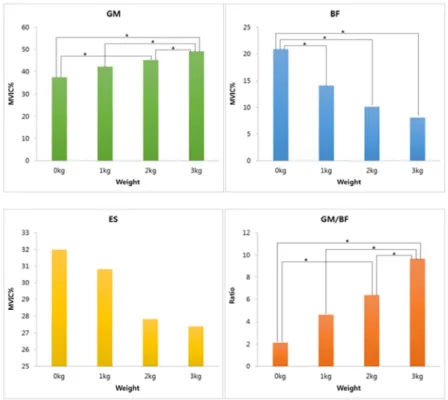
The activity of the gluteus maximus and the muscle activity rate of the gluteus maximus/biceps femoris were

highest with 3 kg resistance and lowest with 0 kg (Table 2).

Repeated measure analysis revealed significant differences in muscle activities associated with the changes in external weight loads (p < .05). A comparison of the resistance revealed significant differences between 0 kg and 2 kg, 0 kg and 3 kg, 1 and 3 kg, and 2 and 3 kg (p < .008)(Fig. 4).

The activities of the biceps femoris and erector spinae were highest with 0kg resistance and lowest with 3 kg

Muscles Weight Loads

F p

0 kg 1 kg 2 kg 3 kg

GM 37.50 ± 3.31 42.18 ± 4.10 45.06 ± 4.07 49.06 ± 4.11 128.469 .000 *

BF 20.85 ± 4.02 14.12 ± 2.85 10.12 ± 1.84 8.12 ± 1.49 29.493 .000 *

ES 32.00 ± 3.59 30.81 ± 3.59 27.81 ± 3.33 27.37 ± 4.01 73.851 .000 *

GM/BF 2.14 ± 1.28 4.61 ± 3.82 6.38 ± 3.81 9.67 ± 6.84 37.498 .000*

Mean ± SD, *p < .05

GM: Gluteus Maximus, BF: Biceps Femoris, ES: Erector Spinae

Table 2. Muscle Activity Around Hip Associated with External Weight Loads

Fig. 4. Post-hoc test of the muscle activity around hip associated with external weight loads.

(6)

(Table 2). Repeated measure analysis revealed significant differences in the muscle activities associated with the changes in the external weight loads (p < .05). A comparison of the resistances revealed significant differences between 0 kg and 1 kg, 0 kg and 2 kg, and 0 kg and 3 kg (p <

.008)(Fig. 4) in the biceps femoris, but there were no significant differences between the resistances (p <

.008)(Fig. 4) in the erector spinae.

Ⅳ. Discussion

This study examined the effects of external weight loads with PHEKF and ADIM on the muscle activities around the hip. The activity of the gluteus maximus increased with increasing external weight load during PHEKF while the activity of the biceps femoris decreased.

During hip extension, when the hamstring is taut, or gluteus maximus activation is delayed, the hamstring is activated more than the gluteus maximus. Therefore, this study used PHEKE in 90° knee flexion with 30° hip abduction to strengthen the gluteus maximus selectively and inhibit hamstring activation [31].

The muscle activity of the gluteus maximus was highest with 3 kg external loads and lowest with 0 kg. Excessive knee flexion has been considered a sign of hamstring over-activity [13,32,33]. In this study, weights to provide the quadriceps with resistance play a role in preventing hamstring activation. Neurophysiologically, the hamstring activity decreases during quadriceps contraction [34]. The gluteus maximus activity is low while the hamstring is activated [1,12,13], and the greatest activity of the gluteus maximus is related to the lowest activity for the hamstring [11]. Since the quadriceps had to contract to maintain knee flexion 90° against external weight loads given by the weights, the quadriceps activity increased with increasing external load. Therefore, when a larger external load was given, the hamstring showed less activation with a concomitant increase in gluteus maximus activation. In this

study, the muscle activity of the gluteus maximus was highest with 3 kg resistance during PHEKF with ADIM.

Under the condition of 0kg resistance, the biceps femoris was activated more than that under the 1 kg, 2 kg, and 3 kg conditions. As a result of increasing biceps femoris activity, the muscle activity of gluteus maximus was lowest at 0kg resistance. A higher external load was found to be related to a higher activity of the gluteus maximus and lower activity biceps femoris.

The muscle activity of the biceps femoris was highest with a 0 kg external load and lowest with a 3 kg load.

The hamstring activity is related to the activity of the gluteus maximus [1,11-13]. The hamstring showed the highest EMG activity, and the gluteus maximus showed the lowest activity. The greatest activity of the gluteus maximus is related to the lowest activity of the hamstring [11]. The hamstring activity is also affected by the degree of knee flexion [35,36]. A previous study showed that the hamstring activity was lowest during hip extension with knee flexion [11]. When the quadriceps muscle was activated to maintain 90° knee flexion, the hamstring activity was relatively low. In this study, the muscle activity of the biceps femoris was lowest with 3 kg resistance during PHEKF with ADIM. With 0 kg resistance, the biceps femoris was activated more than under the 1kg, 2 kg, and 3 kg loads. The muscle activity of biceps femoris was low because of the increasing knee extensor activity to maintain the knee degree.

The muscle activity of the erector spinae was highest with a 0 kg external load and lowest with a 3 kg load.

A weak activation or delayed recruitment of the gluteus

maximus leads to compensatory stress on the lumbar with

over-activity of the erector spinae [17]. In this study, the

activity of the erector spinae tended to increase with

decreasing activity of the gluteus maximus. These findings

are consistent with previous studies suggesting that the

increased activity of the erector spinae is associated with

a low activity of the gluteus maximus [17]. Although the

(7)

participants performed ADIM to stabilize the lumbar motion and prevent activation of the erector spinae, the erector spinae activity increased in the low resistance condition. Under the 0 kg condition, biceps femoris activity increased with decreasing quadriceps activity, and the erector spinae activity increased with decreasing activity of the gluteus maximus. As the quadriceps, hamstrings, gluteus maximus, rectus abdominis, and erector spinae are linked functionally and kinetically [5], as the activity of one muscle was increased, the activity of the other muscle was decreased.

No significant differences were observed with increasing external loads in erector spinae. This is because knee extension resistance caused quadriceps contraction and hamstring relaxation, which increased the activation of the gluteus maximus with hamstring inhibition during hip extension. During ADIM exercise, knee extension resistance could not change erector spinae activation because the pelvic posterior tilt changed the length of the erector spinae.

The muscle activity rate of the gluteus maximus/biceps femoris was highest with a 3 kg external load and the lowest with 0kg. These results mean that the muscle activity of the gluteus maximus increased while the biceps femoris activity decreased. These results are consistent with previous studies. Previous studies suggested that the gluteus maximus activity is related to the hamstring activity [1,11-13]. In addition, the highest activity of the gluteus maximus is associated with the lowest activity of the hamstring [11], and the gluteus maximus activity is low when the hamstring is activated [1,12,13]. Overall, the increased activity of the gluteus maximus was associated with the decreased activities of the biceps femoris and erector spinae. Compared to low external loads, high external loads help activate the gluteus maximus selectively.

This study had several limitations. First, the small sample size might have influenced certain variables and the results. Second, this study was aimed at males who were in good health. Hence, the effects of gender were

not assessed. Third, the long-term effects of external loads with PHEKF and ADIM for gluteus maximus strengthening were not examined. Fourth, there is the possibility of a measurement error of EMG. Finally, this study measured the EMG activities of the gluteus maximus, biceps femoris, and erector spinae, but this is insufficient to identify the interactions between the muscles around the trunk, pelvic, hip, and lower extremities. Therefore, further studies will be needed to find the long-term effects, difference between genders, and activities of more muscles.

Ⅴ. Conclusion

This study suggests a method for strengthening exercise of the gluteus maximus to prevent low back pain and injury.

In this study, the results showed that the activity of the gluteus maximus increased with a higher external weight load during PHEKF while the activity of the biceps femoris decreased. These findings suggest that external weight loads are needed during hip extensor exercise to strengthen the gluteus maximus and inhibit the biceps femoris.

Acknowledgment

This material is based on work supported by the Ministry of Trade, Industry & Energy (MOTIE, Korea) under the Industrial Technology Innovation Program. No.20001123,

‘Advanced design development of the design of integrated sleep optimization platform service through core stretching and motion air cell mattress based on pressure sensors and IoT technology’

References

[1] Sahrmann SA. Diagnosis and treatment of movement impairment syndromes. St. Louis. Mosby Inc. 2002.

[2] Kim TW, Kim YW. Effects of abdominal drawing-in

during prone hip extension on the muscle activities of

(8)

the hamstring, gluteus maximus, and lumbar erector spinae in subjects with lumbar hyperlordosis. J Phys Ther Sci.

2015;27(2):383-6.

[3] Vogt L, Banzer W. Dynamic testing of the motor stereotype in prone hip extension from neutral position. Clin Biomech.

1997;12(2);122-7.

[4] Tateuchi H, Taniguchi M, Mori N, et al. Balance of hip and trunk muscle activity is associated with increased anterior pelvic tilt during prone hip extension. J Electromyogr Kinesiol. 2012;22(3):391-7.

[5] Khaiyat OA, Norris J. Electromyographic activity of selected trunk, core, and thigh muscles in commonly used exercises for ACL rehabilitation. J Phys Ther Sci.

2018;30(4):642-8.

[6] Dingenen B, Janssens L, Claes S, et al. Lower extremity muscle activation onset times during the transition from double-leg stance to single-leg stance in anterior cruciate ligament reconstructed subjects. Clin Biomech. 2016;

35:116-23.

[7] Huxel Bliven KC, Anderson BE. Core stability training for injury prevention. Sports health. 2013;5(6):514-22.

[8] Kang SY, Jeon HS, Kwon O, et al. Activation of the gluteus maximus and hamstring muscles during prone hip extension with knee flexion in three hip abduction positions. Man Ther. 2013;18(4):303-7.

[9] Leinonen V, Kankaanpää M, Airaksinen O, et al. Back and hip extensor activities during trunk flexion/extension:

effects of low back pain and rehabilitation. Arch Phys Med Rehabil. 2000;81(1):32-7.

[10] Kankaanpää M, Taimela S, Laaksonen D, et al. Back and hip extensor fatigability in chronic low back pain patients and controls. Arch Phys Med Rehabil. 1998;

79(4):412-7.

[11] Sakamoto ACL, Teixeira-Salmela LF, Rodrigues DPF, et al. Gluteus maximus and semitendinosus activation during active prone hip extension exercises. Braz J Phys Ther. 2009;13(4):335-42.

[12] Janda V, Frank C, Liebenson C. Evaluation of muscular

imbalance. Rehabilitation of the spine: a practitioner's manual. Baltimore. Lippincott Williams & Wilkins. 1996.

[13] Lewis CL, Sahrmann SA. Muscle activation and movement patterns during prone hip extension exercise in women.

J Athl Train. 2009;44(3):238-48.

[14] Distefano LJ, Blackburn JT, Marshall SW, et al. Gluteal muscle activation during common therapeutic exercises.

J Orthop Sports Phys Ther. 2009;39(7):532-40.

[15] Wilson J, Ferris E, Heckler A, et al. A structured review of the role of gluteus maximus in rehabilitation. New Zealand Journal of Physiotherapy. 2005;33(3):95-100.

[16] Oh JS, Cynn HS, Won JH, et al. Effects of performing an abdominal drawing-in maneuver during prone hip extension exercises on hip and back extensor muscle activity and amount of anterior pelvic tilt. J Orthop Sports Phys Ther. 2007;37(6):320-4.

[17] Frank C, Page P, Lardner R. Assessment and treatment of muscle imbalance: the Janda approach. Human kinetics.

2009.

[18] Lehman GJ, Lennon D, Tresidder B, et al. Muscle recruitment patterns during the prone leg extension. BMC Musculoskelet Disord. 2004;5(1):3.

[19] Tassi N, Engrácia VV. Electromyographyc evaluation of movements of lower limb in double pulley system equipment: comparison between gastrocnemius (caput laterale) and gluteus maximus. Electromyogr Clin Neurophysiol. 2007;47(6):293-9.

[20] Oh JS, Cynn HS, Won JH, et al. Effects of performing an abdominal drawing-in maneuver during prone hip extension exercises on hip and back extensor muscle activity and amount of anterior pelvic tilt. J Orthop Sports Phys Ther. 2007;37(6):320-4.

[21] Sakamoto AC, Teixeira-Salmela LF, de Paula-Goulart FR, et al. Muscular activation patterns during active prone hip extension exercises J Electromyogr Kinesiol. 2009;

19(1):335-42.

[22] Selkowitz DM, Beneck GJ, Powers CM. Comparison

of electromyographic activity of the superior and inferior

(9)

portions of the gluteus maximus muscle during common therapeutic exercises. J Orthop Sports Phys Ther. 2016;

46(9):794-9.

[23] Cram JR, Kasman GS, Holtz J. Introduction to surface electromyography (1st ed). Aspen Publisher Incorporation.

Gaithers-burg. 1998.

[24] Criswell E. Cram's introduction to surface electromyography.

Jones & Bartlett Publishers. 2010.

[25] Willcox EL, Burden AM. The influence of varying hip angle and pelvis position on muscle recruitment patterns of the hip abductor muscles during the clam exercise.

J Orthop Sports Phys Ther. 2013;43(5):325-31.

[26] Montgomery HJHJ, Avers D. Daniels and Worthingham's Muscle Testing: Techniques of Manual Examination.

Saunders. 1996.

[27] Chan MK, Chow KW, Lai AY, et al. The effects of therapeutic hip exercise with abdominal core activation on recruitment of the hip muscles. BMC Musculoskelet Disord. 2017;18(1):313.

[28] Ansari B, Bhati P, Singla D, et al. Lumbar Muscle Activation Pattern During Forward and Backward Walking in Participants With and Without Chronic Low Back Pain: An Electromyographic Study. J Chiropr Med.

2018;17(4):217-25.

[29] Kim CY, Lee JS, Kim HD, et al. Short-term effects of respiratory muscle training combined with the abdominal drawing-in maneuver on the decreased

pulmonary function of individuals with chronic spinal cord injury: A pilot randomized controlled trial. J Spinal Cord Med. 2017;40(1):17-25.

[30] Noh KH, Moon SN, Lee DK, et al. Influence of internal and external stabilization methods during prone hip extension on the selective activation of the gluteus maximus. Phys Ther Korea. 2011;18(3):1-7.

[31] Kang SY, Jeon HS, Kwon O, et al. Activation of the gluteus maximus and hamstring muscles during prone hip extension with knee flexion in three hip abduction positions. Man Ther. 2013;18(4):303-7.

[32] Prentice WE, Voight ML. Techniques in musculoskeletal rehabilitation. McGraw Hill Professional. 2001.

[33] Hertling D, Kessler RM. Management of common musculoskeletal disorders: physical therapy principles and methods (4th ed). Baltimore. Lippincott Williams &

Wilkins. 2006.

[34] Lundy-Ekman L. Neuroscience: Fundamentals for Rehabilitation (3rd ed). St. Louis, MO: Sunders Elsevier.

2007.

[35] Read PJ, Turner AN, Clarke R, et al. Knee angle affects posterior chain muscle activation during an isometric test used in soccer players. Sports. 2019;7(1):13.

[36] Monajati A, Larumbe-Zabala E, Goss-Sampson M, et al. Analysis of the hamstring muscle activation during two injury prevention exercises. J Hum Kinet. 2017;

60(1):29-37.

수치

Table 1. General Characteristics of the Participants
Fig. 4. Post-hoc test of the muscle activity around hip associated with external weight loads.

참조

관련 문서

Now that you have the right bike for you, it is important to learn the right riding position.. A poor riding position can lead to injuries

44 글의 첫 번째 문장인 The most important thing in the Boat Race is harmony and teamwork.을 통해 Boat Race에서 가장 중요한 것은 조 화와 팀워크임을

 The Dutch physicist Pieter Zeeman showed the spectral lines emitted by atoms in a magnetic field split into multiple energy levels...  With no magnetic field to align them,

Modern Physics for Scientists and Engineers International Edition,

If both these adjustments are considered, the resulting approach is called a bootstrap-BC a -method (bias- corrected-accelerated). A description of this approach

③ A student who attended Korean course at KNU Korean Language Program and holds TOPIK Level 3 or a student who completed Korean course Level 4 at the KNU Korean Language

· 50% exemption from tuition fee Ⅱ for the student with a TOPIK score of level 3 or higher or completion of level 4 or higher class of the Korean language program at the

웹 표준을 지원하는 플랫폼에서 큰 수정없이 실행 가능함 패키징을 통해 다양한 기기를 위한 앱을 작성할 수 있음 네이티브 앱과