• 검색 결과가 없습니다.

Right Main Bronchus Rupture Presenting with Pneumoperitoneum

N/A
N/A
Protected

Academic year: 2021

Share "Right Main Bronchus Rupture Presenting with Pneumoperitoneum"

Copied!
4
0
0

로드 중.... (전체 텍스트 보기)

전체 글

(1)

ISSN: 2233-601X (Print) ISSN: 2093-6516 (Online)

− 216 −

This paper was presented at the 19th Gyeonggi-Incheon monthly meeting of the Korean Society for Thoracic and Cardiovascular Surgery.

Received: August 28, 2017, Revised: September 22, 2017, Accepted: September 26, 2017, Published online: June 5, 2018

Corresponding author: Jong Hui Suh, Department of Thoracic and Cardiovascular Surgery, Incheon St. Mary’s Hospital, College of Medicine, The Catholic University of Korea, 56 Dongsu-ro, Bupyeong-gu, Incheon 21431, Korea

(Tel) 82-2-2258-6139 (Fax) 82-2-594-8644 (E-mail) [email protected]

© The Korean Society for Thoracic and Cardiovascular Surgery. 2018. All right reserved.

This is an open access article distributed under the terms of the Creative Commons Attribution Non-Commercial License (http://creativecommons.org/

licenses/by-nc/4.0) which permits unrestricted non-commercial use, distribution, and reproduction in any medium, provided the original work is properly cited.

Right Main Bronchus Rupture Presenting with Pneumoperitoneum

Seok Beom Hong, M.D. 1 , Ji Yoon Lee, M.D. 1 , June Lee, M.D. 1 , Kuk Bin Choi, M.D. 2 , Jong Hui Suh, M.D. 3

1
Department of Thoracic and Cardiovascular Surgery, Seoul St. Mary’s Hospital, College of Medicine, The Catholic University of Korea,

2

The 8th Mechanized Infantry Division, The 3rd Republic of Korea Army,

3

Department of Thoracic and

Cardiovascular Surgery, Incheon St. Mary’s Hospital, College of Medicine, The Catholic University of Korea

We report the case of a 16-year-old male patient who was involved in a traffic accident and transferred to the emergency department with mild chest pain. We initially did not find evidence of tracheal injury on computed tomography (CT). Within an hour after presentation, the patient developed severe dyspnea and newly developed subcutaneous emphysema and pneumoperitoneum were discovered. Abdominal CT showed no intra-abdominal injury. However, destruction of the right main bronchus was identified on coronal images of the initially performed CT scan. Emergency exploratory surgery was performed. The amputated right main bronchus was identified. End-to-end tracheobronchial anastomosis was performed, and the patient recovered without any complications.

Key words: 1. Bronchial diseases 2. Tracheal injury 3. Blunt trauma

Case report

A 16-year-old male patient presented to the emer- gency department with mild chest pain that had aris- en after he was crushed by a slow-moving vehicle while riding his bicycle. The patient was under the car for only a brief period, and no abnormalities were found on the physical examination, except mild tenderness and swelling of the anterior chest. The patient showed an alert mental status and blood pressure in the normal range, with an elevated heart rate of 120 bpm. No dyspnea was present, and arte- rial oxygen saturation was 99%. Because a plain-film chest X-ray showed mild pneumomediastinum, a

chest computed tomography (CT) scan was per- formed to identify potential injuries of the thorax , but no evidence of bronchial or esophageal injury was found in the unreconstructed axial CT images.

Thus, oxygen therapy via a nasal cannula was plan- ned for the patient without further examination.

However, the patient suddenly developed severe dyspnea, and his arterial oxygen saturation decreased rapidly 1 hour after his arrival at the hospital. An emergency intubation was performed with single lu- men endotracheal tube, but the decreased arterial ox ygen saturation did not recover. A new chest X-ray showed a massive pneumoperitoneum that had sud- denly developed and subcutaneous emphysema with-

Korean J Thorac Cardiovasc Surg 2018;51:216-219 □ CASE REPORT □

https://doi.org/10.5090/kjtcs.2018.51.3.216

(2)

Bronchial Rupture Presenting with Pneumoperitoneum

− 217 −

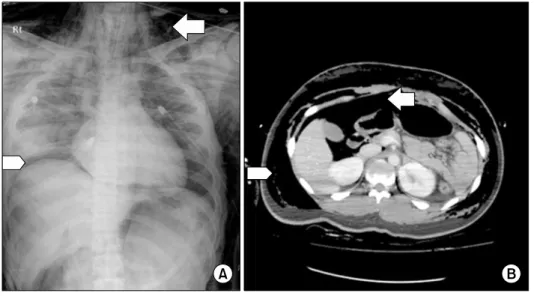
Fig. 1. (A) Taken immediately after intubation, a chest X-ray shows a suddenly developed massive pneu- moperitoneum (arrow) and sub- cutaneous emphysema (arrowhead) without any evidence of pneumo- thorax. (B) Computed tomography of the abdomen, performed to evaluate the intra-abdominal le- sion, shows massive pneumoperito- neum (arrow) and subcutaneous emphysema (arrowhead) without abdominal injury.

Fig. 2. (A) An axial image from the initial chest computed tomography (CT) scan shows the defect of the bronchus in only 1 cut, which we missed in the initial diagnosis. (B) A reconstructed coronal image from the initial chest CT scan definitively shows the amputated right main bronchus (arrow) without pneumoperitoneum. (C) A 3-dimensional reconstruction of the chest CT scan also shows the discontinuity of the right main bronchus (dotted circle).

out any evidence of pneumothorax. Another CT scan was performed on the abdomen to check for any vis- ceral perforation, but no evidence of visceral injury was seen (Fig. 1). However, rupture of the right main bronchus was revealed on the initially-obtained chest CT image, which was only reconstructed after some delay (Fig. 2). Since the patient showed hypotension and hypoxia, a double-lumen endotracheal tube was inserted into the left bronchus to ventilate the left lung and to block the path to the perforated right main bronchus. A few minutes after intubation, the patient was stabilized and transferred to the operat- ing room. Exploration via an emergency right thor-

acotomy was performed under general anesthesia with the pre-positioned endotracheal tube. After the unperforated mediastinal pleura was divided, the completely amputated right main bronchus was found, with no injury to the lung parenchyma (Fig.

3). End-to-end anastomosis of the trachea to the

right main bronchus was performed. Bronchoscopy

performed 2 days later indicated an intact anasto-

mosis without any evidence of leakage. After a few

days of recovery, the patient was discharged without

any complications.

(3)

Seok Beom Hong, et al

− 218 −

Fig. 3. The completely amputated right main bronchus (arrow) was found with no injury to the mediastinal pleura and lung parenchyma.

Discussion

Tracheobronchial injury after blunt trauma is a rare consequence that occurs in less than 1% of blunt chest trauma patients [1]. However, because patients with a tracheobronchial injury often do not survive the journey to the hospital, the true in- cidence of tracheobronchial injuries is unknown. The delayed diagnosis of tracheobronchial injuries may be fatal and often requires lung parenchyma resection, which is associated with long-term complications.

Thus, a rigorous evaluation, including bronchoscopy, is necessary when the possibility of tracheobronchial injury exists [2]. After blunt trauma, injuries of the bronchus are seen more frequently than those of the trachea, with the most common site of injury being the right side within 2.5 cm of the carina, followed by the left main bronchus [3]. Injury of the cervical trachea is infrequent, although it can result from a direct blow to the neck, even if the force of the blow is small.

Radiographs generally reveal subcutaneous emphy- sema, and pneumothorax also presents frequently [4].

Despite the frequent occurrence of pneumo- mediastinum in patients with a tracheobronchial in- jury, the presentation of pneumoperitoneum has not yet been documented. In our case, the development of pneumoperitoneum could have resulted from the severely injured bronchus in combination with the

intact mediastinal pleura. It is possible that, after the injury, the air that had leaked into the mediastinum created more space between the 2 sides of the de- stroyed bronchus, which could have gradually in- creased the flow of air into the mediastinum as time passed. Since continuous air leakage was blocked by the undamaged mediastinal pleura, the pressure could conceivably have been high enough to result in pneumoperitoneum through the esophageal or aortic hiatus.

Although bronchoscopy may be a definitive diag- nostic modality, it can only be performed by a skilled practitioner. Thus, it is not always readily available in emergency situations. Otherwise, CT readily en- ables the diagnosis of tracheobronchial injuries when the patient is hemodynamically stable. Scaglione et al.

[5] reported 18 patients with tracheobronchial in- juries who underwent CT scans. The CT images of 17 patients showed direct evidence of tracheobronchial injuries, including discontinuity of the tracheal or bronchial wall, endotracheal cuff herniation, over- distention of the endotracheal cuff, and bronchial enlargement. The CT image of only 1 patient showed air leakage at the level of the carina, and the small injury was confirmed using bronchoscopy. However, a simple ex amination of the CT scan with only ax ial CT sections resulted in the diagnosis being overlooked. In fact, only about 75% of tracheal rup- tures are diagnosed using conventional axial sections of CT images [6]. Therefore, multiple reformatting and 3-dimensional image reconstruction are neces- sary to avoid misdiagnosis.

While approximately half of the patients with a tracheobronchial injury are diagnosed within 48 hours, delayed diagnoses do occur frequently [2].

Since the common presentations of tracheobronchial

injury, pneumothorax and subcutaneous emphysema,

also arise from bony injuries of the thorax, it is easy

to overlook the possibility of tracheobronchial injury

even with those signs. According to the report of

Kiser and colleagues [4], in contrast to when the di-

agnosis is made early (within 48 hours), the risk of

death after tracheobronchial injury is 3 times higher

when the diagnosis is made between 2 and 7 days

after trauma. Therefore, a more rigorous evaluation

for tracheobronchial injury is required when any sign

of thoracic trauma is present. In our case, the injury

was missed in the first evaluation, even though evi-

(4)

Bronchial Rupture Presenting with Pneumoperitoneum

− 219 − dence of bronchial rupture was present in the CT image. However, because the patient’s symptoms worsened so quickly, the diagnosis was made within 1 hour of his arrival at the emergency department, and a rapid intervention was performed without fur- ther delay.

Conflict of interest

No potential conflict of interest relevant to this ar- ticle was reported.

References

1. Sangster GP, Gonzalez-Beicos A, Carbo AI, et al. Blunt traumatic injuries of the lung parenchyma, pleura, thora- cic wall, and intrathoracic airways: multidetector com- puter tomography imaging findings. Emerg Radiol

2007;14:297-310.

2. Hwang JJ, Kim YJ, Cho HM, Lee TY. Traumatic tracheo- bronchial injury: delayed diagnosis and treatment outcome. Korean J Thorac Cardiovasc Surg 2013;46:

197-201.

3. Zinck SE, Primack SL. Radiographic and CT findings in blunt chest trauma. J Thorac Imaging 2000;15:87-96.

4. Rossbach MM, Johnson SB, Gomez MA, Sako EY, Miller OL, Calhoon JH. Management of major tracheobronchial in- juries: a 28-year experience. Ann Thorac Surg 1998;65:

182-6.

5. Scaglione M, Romano S, Pinto A, Sparano A, Scialpi M, Rotondo A. Acute tracheobronchial injuries: Impact of imaging on diagnosis and management implications. Eur J Radiol 2006;59:336-43.

6. Le Guen M, Beigelman C, Bouhemad B, Wenjie Y, Marmion

F, Rouby JJ. Chest computed tomography with multi-

planar reformatted images for diagnosing traumatic bron-

chial rupture: a case report. Crit Care 2007;11:R94.

수치

Fig. 1. (A) Taken immediately after  intubation, a chest X-ray shows a  suddenly developed massive  pneu-moperitoneum (arrow) and  sub-cutaneous emphysema (arrowhead)  without any evidence of  pneumo-thorax
Fig. 3. The completely amputated right main bronchus (arrow)  was found with no injury to the mediastinal pleura and lung  parenchyma.

참조

관련 문서

Chest CT scan two months later shows dis- appeared filling defects in pulmonary artery of right lower lung (arrow).. CT:

Contrast-enhanced computed tomography (CT) with coronal reformatted images shows a large mass with a fatty component in the retro- peritoneum (thin arrows) extending into the

Axial CT scan of the right temporal bone shows a pedunculated bony mass (arrow) located at the lateral part of the external auditory canal.. Coronal CT scan demonstrates the

CT scan shows mild wall thickening of the distal trachea (arrow) and diffuse luminal narrowing of the left main bronchus (ar- rowheads).. The left lung

(A) Initial coronal CT scan showed diffusely enhancing ductal wall which was thickened from the intrahepatic duct to proximal common bile duct (arrow).. (B) Follow up CT scan after

Coronal reformatted CT image showing thickening and stenosis of the distal common bile duct (arrow) and dilatation of proximal biliary treeF. Coronal reformatted CT image showing

Chest CT scan shows a huge mass arising from right ventricle invading right atrium and epicardium with large pericardial effusion.... 아래쪽으로는 심근층과 장막심장막의

(A) Enhanced chest CT scan (5.0 mm section thickness) obtained at the level of the main bronchi shows homogeneous endobronchial nodule (arrows) obliterating right upper