ABSTRACT
Purpose: We aimed to investigate the clinicopathologic factors associated with distant
metastasis (DM) and post-recurrence overall survival (OS) after salvage treatments for isolated locoregional recurrence (ILRR) of breast cancer and identify long-term surviving patients for providing a more personalized therapy.
Methods: We analyzed 125 patients who underwent salvage local treatments for ILRR after
initial curative breast surgery.
Results: Fifty-two (41.6%) patients experienced secondary recurrence or disease progression,
of which 20 (38.5%) experienced a secondary locoregional recurrence and 40 (76.9%) experienced DM as the first site of failure. In multivariate analysis of distant metastasis free survival (DMFS) and post-recurrence OS, the initial pN2-3 stage, a disease-free interval of
< 36 months, and non-curative resection for recurrent disease were independently poor prognosticators. The score for patients stratified according to the number of risk factors increased from 0 to 3; the corresponding 5-year DMFS rates were 91.4%, 53.0%, 35.9%, and 0% and the 5-year OS rates were 97.3%, 70.4%, 32.7%, and 25.0%, respectively (p < 0.001).
Systemic chemotherapy reduced DM in patients with a score of 2–3, but it did not in those with a score of 0-1.
Conclusion: Our collective stratification can help with prognosis prediction for ILRR of
breast cancer. Depending on the DM risk of patients, the potential combination of systemic therapy should be discussed further.
Keywords:
Breast neoplasm; Neoplasm recurrence; Local; Risk factors; Survivors
Original Article
Received: Jan 9, 2020 Accepted: Apr 14, 2020 Correspondence to Suzy Kim
Department of Radiation Oncology, Seoul Metropolitan Government Seoul National University Boramae Medical Center, 20 Boramae-ro 5-gil, Dongjak-gu, Seoul 07061, Korea.
E-mail: [email protected]
© 2020 Korean Breast Cancer Society This is an Open Access article distributed under the terms of the Creative Commons Attribution Non-Commercial License (https://
creativecommons.org/licenses/by-nc/4.0/) which permits unrestricted non-commercial use, distribution, and reproduction in any medium, provided the original work is properly cited.
ORCID iDs Byoung Hyuck Kim
https://orcid.org/0000-0002-6156-0744 Kyung Hwan Shin
https://orcid.org/0000-0002-5852-7644 Eui Kyu Chie
https://orcid.org/0000-0003-2027-7472 Jin Ho Kim
https://orcid.org/0000-0002-7918-1072 Kyubo Kim
https://orcid.org/0000-0001-6093-1294 Ki-Tae Hwang
https://orcid.org/0000-0001-6597-3119 Jongjin Kim
https://orcid.org/0000-0001-5234-7856 In Sil Choi
https://orcid.org/0000-0002-8494-584X Jin Hyun Park
https://orcid.org/0000-0003-1078-4139
Byoung Hyuck Kim
1, Kyung Hwan Shin
2, Eui Kyu Chie
2, Jin Ho Kim
2, Kyubo Kim
3, Ki-Tae Hwang
4, Jongjin Kim
4, In Sil Choi
5,
Jin Hyun Park
5, Suzy Kim
11 Department of Radiation Oncology, Seoul Metropolitan Government Seoul National University Boramae Medical Center, Seoul, Korea
2Department of Radiation Oncology, Seoul National University College of Medicine, Seoul, Korea
3Department of Radiation Oncology, Ewha Womans University College of Medicine, Seoul, Korea
4 Department of Surgery, Seoul Metropolitan Government Seoul National University Boramae Medical Center, Seoul, Korea
5 Department of Internal Medicine, Seoul Metropolitan Government Seoul National University Boramae Medical Center, Seoul, Korea
Identifying Long-Term Survival Candidates among Patients with Isolated Locoregionally Recurrent
Breast Cancer: Implications of the Use
of Systemic Chemotherapy
Suzy Kim
https://orcid.org/0000-0001-7161-8340 Conflict of Interest
The authors declare that they have no competing interests.
Author Contributions
Conceptualization: Kim BH, Kim S; Data curation: Kim BH; Formal analysis: Kim BH, Kim S; Investigation: Shin KH, Chie EK, Kim JH, Kim K, Hwang KT, Kim J, Choi IS, Park JH;
Methodology: Kim S; Resources: Shin KH, Chie EK, Kim JH, Kim K, Hwang KT, Kim J, Choi IS, Park JH, Kim S; Supervision: Shin KH, Chie EK, Kim JH, Kim K, Kim S; Writing – original draft:
Kim BH, Kim S; Writing – review & editing: Kim BH, Shin KH, Chie EK, Kim JH, Kim K, Hwang KT, Kim J, Choi IS, Park JH, Kim S.
INTRODUCTION
Despite the contemporary multidisciplinary approaches used to treat breast cancer, locoregional recurrence (LRR) rates after initial treatments remain around 5%–15% [1,2].
The most common site of recurrence is the ipsilateral breast or chest wall (60%–95% of all locoregional events) with or without evidence of distant metastasis (DM). Patients with isolated locoregional recurrence (ILRR) are at substantial risk of developing systemic relapse [3]. Salvage mastectomy or wide excision after ILRR has resulted in 5-year overall survival (OS) rates of 50%–85%, but some patients with rapid progression or therapeutic resistance have demonstrated a worse prognosis [4,5].
Because of the heterogeneity in the extent of recurrent disease and previous treatments, ILRR treatment strategies are usually based on multidisciplinary approaches that are developed on a case-by-case basis. Robust clinical evidence and guidelines are still limited. Recently, the Chemotherapy as Adjuvant for LOcally Recurrent breast cancer (CALOR) trial has demonstrated that adjuvant chemotherapy for LRR in addition to radiation and hormonal therapy is associated with high disease-free survival (DFS) for completely resected ILRR, especially estrogen receptor (ER)-negative recurrence [1,6]. Meanwhile, the Radiation Therapy Oncology Group (RTOG) launched a prospective trial of repeat breast-conserving therapy (BCT) with conformal partial breast re-irradiation for locally recurrent lesions, which was less distressing than the mutilation of rescue surgery. However, there is still no consensus on when and how to appropriately combine systemic and local treatments for these patients. Some of these patients may achieve considerable, long-term survival.
However, prognostic factors after salvage local treatments, including radiation therapy (RT) for ILRR of breast cancer, are rarely introduced in the literature. With a substantial risk of experiencing DM, implementing salvage local therapy should be tailored. The factors affecting better distant metastasis free survival (DMFS) after salvage treatments need to be further evaluated.
Therefore, in this study, we aimed to improve personalized therapy recommendations for patients with ILRR by investigating the clinicopathologic factors associated with DM and post-recurrence survival after salvage local treatments and identify potential long-term survivors. Such patients will be more suitable candidates for salvage RT, whereas patients with high DM probability will be more suitable candidates for early systemic chemotherapy.
METHODS
Study population
After obtaining institutional review board approval (Seoul Metropolitan Government Seoul
National University Boramae Medical Center, 30-2018-37 and Seoul National University
Hospital, J-1806-119-952), we manually searched an intra-department database for eligible
patients who were diagnosed with ILRR after the initial curative resection (mastectomy or
breast-conserving surgery) and had undergone salvage RT for ILRR at the two institutions
between January 2006 and December 2016. For this type of study formal consent is not
required. LRR after resection was defined as the presence of a tumor in the ipsilateral breast
or chest wall, axillary nodes, internal mammary nodes (IMN), or supraclavicular lymph nodes
(SCL). We excluded patients with initial stage IV disease and those with DM prior to or at the
time of the detection of LRR. Finally, we retrospectively analyzed the medical records of 125
patients with ILRR that had met the above inclusion and exclusion criteria. These patients were referred to the Department of Radiation Oncology by treating surgeons or medical oncologists.
The flow diagram of the patient selection process is shown in Supplementary Figure 1.
Staging, molecular subtypes, and follow-up
All patients had restaging work-up whenever LRR was suspected including chest/
abdominal/pelvis CT combined with bone scan +/− positron emission tomography (PET).
Patients who were initially treated with BCT were also checked up with mammography, and ultrasonography +/− breast MRI. After confirming the absence of systemic disease, local therapy was considered and resectability of recurred disease was also evaluated by these imaging studies. All but four patients were pathologically confirmed with LRR, and the others were diagnosed clinically by PET as positive for SCL or IMN without a tissue diagnosis. We used the 7th edition of the American Joint Committee on Cancer staging system. Molecular subtypes were classified into one of the following four categories: Luminal A (ER or progesterone receptor (PR) positive, and human epidermal growth factor receptor gene (HER2) negative), Luminal B (ER or PR positive, and HER2 positive), HER2 (ER and PR negative, and HER2 positive), and triple negative (TN) (ER, PR, and HER2 negative).
After salvage treatments, the patients were followed up at regular intervals of 3–4 months for the first 2 years, 6 months for 2–5 years, and then annually. Subsequent recurrences or progression were classified as LRR, DM, or both by the above definition.
Baseline characteristics
Table 1 shows the overall patient and tumor characteristics. Initially, 92 patients had
undergone mastectomy, and 33 had undergone breast-conserving surgery (BCS). Twenty- eight (22.4%) patients had received RT for primary breast cancer mainly after BCS. The median time from initial operation to ILRR was 38 months (range: 1–234). The comparison of the molecular subtype of initial and recurrent tumors revealed no change in subtype for 43/54 (79.6%) of the analyzable cases.
Treatment courses for isolated locoregional recurrence
Supplementary Table 1 details the treatment courses after ILRR according to the initial breast
operation and recurrence sites. After ILRR, the patterns of treatment were diverse according to the patient and disease-presenting features. We used the term ‘adjuvant chemotherapy for LRR’ after local salvage treatments for LRR as it was defined in the CALOR trial.
Ninety-six (76.8%) patients underwent curative resection followed by postoperative RT and 29 (23.2%) underwent definitive RT without resection or after incomplete resection. In 11 patients, the first LRR was treated without RT, and then RT was used at the time of the second LRR. Among the 28 patients who had received RT for primary breast cancer, only 10 (8.0%) patients underwent re-irradiation (8 for LR and 2 for RR, 18.0–54.0 Gy) and the remaining 18 patients received RT for regional lymph nodes without overlapping fields at the breast or chest wall (50.0–67.5 Gy). A second BCS approach was undertaken in only 3 patients whose first BCT courses were incomplete regarding RT because of early termination or patient refusal. Overall, the median RT dose was 51.0 Gy (range: 18.0–70.4). The median RT dose was 50.4 Gy (18.0–61.2) after curative resection and 60.0 Gy (20.0–70.4) for patients without curative resection.
Ninety-eight (98.4%) patients received systemic chemotherapy. Among them, 86 received
adjuvant chemotherapy for LRR after resection or RT and 12 patients were treated with
chemotherapy followed by local treatments. Although systemic chemotherapy was recommended in most cases, it was not performed in some patients because of underlying comorbidity, patient refusal, alternative use of hormonal therapy, or rapid progression after resection or RT. Seventy-five (60.0%) patients received hormonal therapy according to their hormone receptor status. Partial breast irradiation or hyperthermia was not performed at all.
Statistical analysis
The time interval between initial breast surgery and the first detection of ILRR was defined as the disease-free interval (DFI). Locoregional progression-free survival (LPFS), DMFS, progression-free survival (PFS), and post-recurrence OS were calculated from the date of
Table 1. Baseline characteristics of 125 patients at the time of LRRCharacteristics Values
Median age (range) (yr) 51 (25–79)
Initial breast surgery
Mastectomy 92 (73.6)
Breast-conserving surgery 33 (26.4)
Primary axillary surgery
Sentinel lymph node biopsy 31 (24.8)
Axillary dissection 88 (70.4)
Not done 6 (4.8)
Margin status of the primary tumor resection
Positive 7 (5.6)
Negative 118 (94.4)
Initial adjuvant chemotherapy
Yes 89 (71.2)
No 36 (28.8)
Initial adjuvant radiotherapy
Yes 28 (22.4)
No 97 (77.8)
Median time from initial operation to LRR (range) (mon) 38 (1–234) Type of LRR
LR 42 (33.6)
RR 64 (51.2)
LR + RR 19 (15.2)
SCL involvement
Yes 22 (17.6)
No 103 (82.4)
IMN involvement
Yes 18 (14.4)
No 107 (85.6)
Curative resection for LRR
Yes 96 (76.8)
No 29 (23.2)
Molecular subtype
Luminal A 55 (44.0)
Luminal B 11 (8.8)
HER2 10 (8.0)
TN 28 (22.4)
Unknown 21 (16.8)
Adjuvant chemotherapy for LRR (after surgery or RT for LRR)
Yes 86 (68.8)
No 39 (31.2)
Hormonal therapy for LRR
Yes 75 (60.0)
No 50 (40.0)
Values are presented as number (%).
LRR = locoregional recurrence; LR = local recurrence; RR = regional recurrence; SCL = supraclavicular node; IMN
= internal mammary node; TN = triple-negative; RT = radiation therapy.
the detection of ILRR to the date of subsequent LRR, DM, any treatment failure, and death from any cause or the last follow-up, respectively. Since most patients died after developing DM without local progression (as shown in the later analysis), death events were treated as censored data in the LPFS calculation. Survival rates were determined through the Kaplan–
Meier method and compared using the log-rank test. In multivariate analysis, the Cox proportional hazards model was used. Significant factors on univariate analysis (p < 0.05) were included in the multivariate analysis. Pearson's correlation test or Chi-square test was used to analyze the correlation between clinicopathologic factors. The R 3.3.0 statistical package (https://www.r-project.org/) was used for all the above statistical analyses.
RESULTS
Patterns of failure
The median follow-up duration from the date of ILRR diagnosis was 48 months (range:
3–155). During the follow-up period, 52 patients (41.6%) had experienced some type of subsequent recurrence or disease progression and 38 (30.4%) had died. Among 52 patients who had failed after salvage treatments, 20 (38.5%) had experienced a secondary LRR and 40 (76.9%) had experienced DM as the first site of failure. Among these, eight also showed simultaneous LRR and DM. The most common site of the first DM was the lung. Most patients who experienced secondary LRR without DM subsequently had DM during follow- up. Finally, 49 (94.2%) had experienced DM until the last follow-up. Overall, the 5-year LPFS and DMFS were 78.4% and 59.0%, respectively.
Salvage treatment outcomes and prognostic factors
Overall, the 5-year PFS and post-recurrence OS rates were 55.0% and 69.7%, respectively.
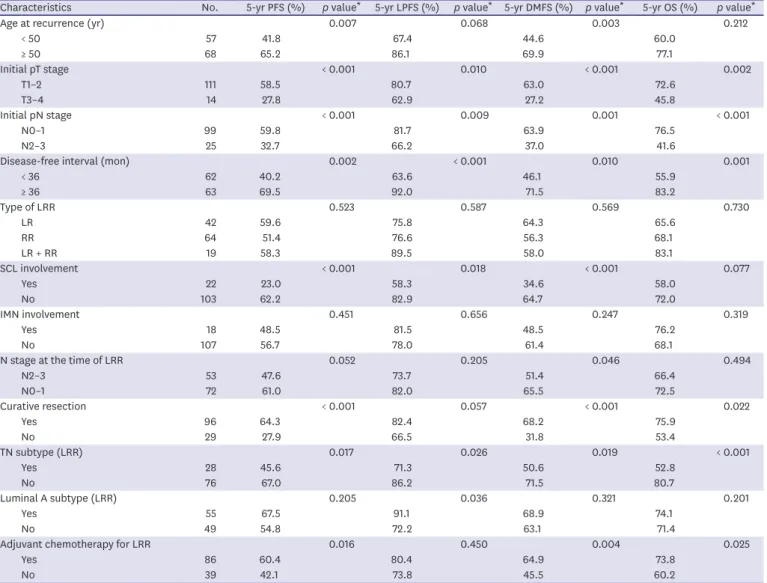
The results of the univariate analysis of prognostic factors for various survival endpoints are listed in Table 2. The prognostic significance of each factor was generally consistent across all the examined endpoints. The initial pT stage, initial pN stage, and DFI showed significant impacts on all endpoints. The N stage at the time of LRR and the use of adjuvant chemotherapy for LRR were significant prognostic factors for PFS and DMFS, but not for LPFS. Patients receiving adjuvant chemotherapy for LRR showed significantly better OS. The TN subtype at the time of LRR was also an important prognosticator, but luminal A subtype was only significant for LPFS. Hormone or HER2 receptor status alone was not prognostic as a single factor.
Collectively, several factors appeared to be associated with DMFS in the univariate analysis: age at recurrence, initial pT stage, initial pN stage, DFI, SCL involvement, N stage for LRR, curative resection, TN subtype, and adjuvant chemotherapy for LRR. Among these factors, a significant correlation existed between SCL involvement (p < 0.001)/N stage for LRR (p < 0.001)/adjuvant chemotherapy for LRR (p < 0.001) and curative resection and also between the age at recurrence (p < 0.001)/initial pT stage (p = 0.021)/TN subtype (p = 0.006) and DFI. We excluded the formers in the following multivariate analysis model and included curative resection and DFI only to avoid multicollinearity.
With multivariate analysis including three factors, the initial pN0-1 stage, longer DFI (≥ 36
months), and curative resection were all found to be independently associated with better
DMFS and OS (Table 3). The Kaplan-Meier curves of DMFS and OS according to the initial pN
stage, DFI, and curative resection are presented in Figure 1.
Distant metastasis risk and survival stratification by prognostic scores Based on the multivariate analysis, we identified three independent risk factors: initial pN2-3 stage, DFI < 36 months, and non-curative resection. We stratified all the patients in the study by the number of risk factors as follows: 39 patients scored 0 (low risk), 60 patients scored 1 (intermediate risk), 22 patients scored 2 (high risk), and 4 patients scored 3 (very high
Table 2. Univariate analysis of prognostic factors for various survival endpoints from diagnosis of LRRCharacteristics No. 5-yr PFS (%) p value* 5-yr LPFS (%) p value* 5-yr DMFS (%) p value* 5-yr OS (%) p value*
Age at recurrence (yr) 0.007 0.068 0.003 0.212
< 50 57 41.8 67.4 44.6 60.0
≥ 50 68 65.2 86.1 69.9 77.1
Initial pT stage < 0.001 0.010 < 0.001 0.002
T1–2 111 58.5 80.7 63.0 72.6
T3–4 14 27.8 62.9 27.2 45.8
Initial pN stage < 0.001 0.009 0.001 < 0.001
N0–1 99 59.8 81.7 63.9 76.5
N2–3 25 32.7 66.2 37.0 41.6
Disease-free interval (mon) 0.002 < 0.001 0.010 0.001
< 36 62 40.2 63.6 46.1 55.9
≥ 36 63 69.5 92.0 71.5 83.2
Type of LRR 0.523 0.587 0.569 0.730
LR 42 59.6 75.8 64.3 65.6
RR 64 51.4 76.6 56.3 68.1
LR + RR 19 58.3 89.5 58.0 83.1
SCL involvement < 0.001 0.018 < 0.001 0.077
Yes 22 23.0 58.3 34.6 58.0
No 103 62.2 82.9 64.7 72.0
IMN involvement 0.451 0.656 0.247 0.319
Yes 18 48.5 81.5 48.5 76.2
No 107 56.7 78.0 61.4 68.1
N stage at the time of LRR 0.052 0.205 0.046 0.494
N2–3 53 47.6 73.7 51.4 66.4
N0–1 72 61.0 82.0 65.5 72.5
Curative resection < 0.001 0.057 < 0.001 0.022
Yes 96 64.3 82.4 68.2 75.9
No 29 27.9 66.5 31.8 53.4
TN subtype (LRR) 0.017 0.026 0.019 < 0.001
Yes 28 45.6 71.3 50.6 52.8
No 76 67.0 86.2 71.5 80.7
Luminal A subtype (LRR) 0.205 0.036 0.321 0.201
Yes 55 67.5 91.1 68.9 74.1
No 49 54.8 72.2 63.1 71.4
Adjuvant chemotherapy for LRR 0.016 0.450 0.004 0.025
Yes 86 60.4 80.4 64.9 73.8
No 39 42.1 73.8 45.5 60.2
LRR = locoregional recurrence; PFS = progression-free survival; LPFS = locoregional progression-free survival; DMFS = distant metastasis-free survival; OS = overall survival; LR = local recurrence; RR = regional recurrence; SCL = supraclavicular node; IMN = internal mammary node; TN = triple-negative.
*p-value by log-rank test.
Table 3. Multivariate analysis of prognostic factors
Characteristics PFS LPFS DMFS OS
HR (95% CI) p value HR (95% CI) p value HR (95% CI) p value HR (95% CI) p value
Initial pN stage
(N0–1 vs. N2–3) 0.352 (0.187–0.661) 0.001 0.303 (0.123–0.742) 0.009 0.409 (0.214–0.783) 0.007 0.275 (0.138–0.549) < 0.001 Disease-free interval
(≥ 36 mon vs. < 36 mon) 0.266 (0.144–0.492) < 0.001 0.102 (0.033–0.321) < 0.001 0.320 (0.173–0.593) < 0.001 0.267 (0.130–0.549) < 0.001 Curative resection
(Yes vs. No) 0.246 (0.137–0.445) < 0.001 0.238 (0.098–0.577) < 0.001 0.226 (0.123–0.416) < 0.001 0.387 (0.195–0.768) 0.007 PFS = progression-free survival; LPFS = locoregional progression-free survival; DMFS = distant metastasis-free survival; OS = overall survival; HR = hazard ratio; CI
= confidence interval.
risk). When we compared patient survival using these prognostic scores, pairwise significant differences in DMFS and OS were found (Figure 2, overall p < 0.001 and any pairwise p < 0.05 in both graphs). As the score increased from 0 to 3, the 5-year DMFS rates were 91.4%, 53.0%, 35.9%, and 0%, respectively; 5-year PFS rates were 91.4%, 46.4%, 30.7%, and 0%, respectively;
and corresponding 5-year OS rates were 97.3%, 70.4%, 32.7%, and 25.0%, respectively.
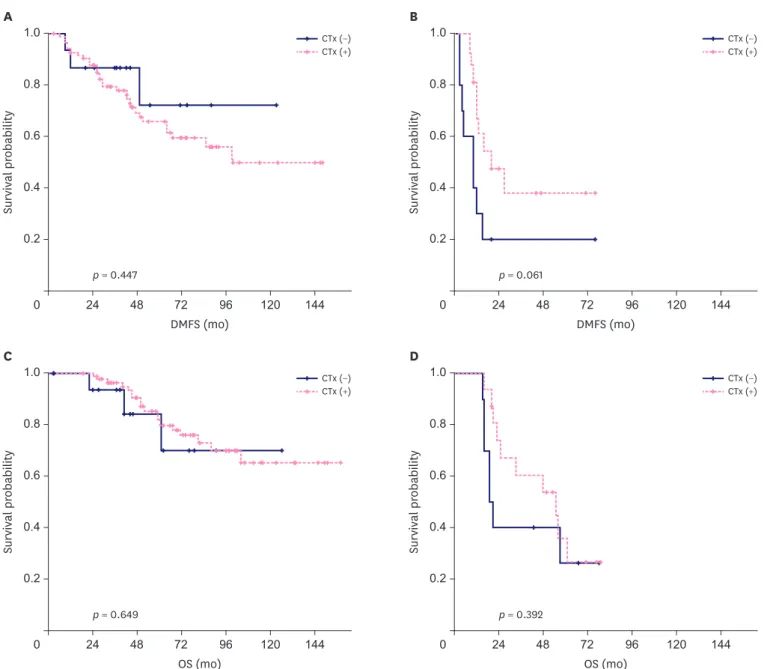
When examining the benefit of administrating systemic chemotherapy based on proposed prognostic scores, we found that chemotherapy reduced DM in patients with a score of 2–3 (5-year DMFS 36.9% vs. 20.0%, p = 0.061), but not in patients with a score of 0–1 (5-year DMFS 65.6% vs. 72.2%, p = 0.447) (Figure 3A and B). There were no significant differences in OS with the use of systemic chemotherapy, irrespective of prognostic scores (Figure 3C and D).
DISCUSSION
Researchers have suggested that there is a favorable subgroup that could experience long-term survival [7]. In our study, a very heterogeneous prognosis of locoregionally
DMFS (mo)0 48 96
1.0
0.4 0.8
0.2 0.6
144
24 72 120
A
Surviving probability
p = 0.001
Initial pN2-3 Initial pN0-1
DMFS (mo)
0 48 96
1.0
0.4 0.8
0.2 0.6
144
24 72 120
B
Surviving probability
p = 0.010
DFI ≥ 3 yr DFI < 3 yr
DMFS (mo)
0 48 96
1.0
0.4 0.8
0.2 0.6
144
24 72 120
C
Surviving probability
p < 0.001
Resection (+) Resection (−)
OS (mo)
0 48 96
1.0
0.4 0.8
0.2 0.6
144
24 72 120
D
Surviving probability
p < 0.001
Initial pN2-3 Initial pN0-1
OS (mo)
0 48 96
1.0
0.4 0.8
0.2 0.6
144
24 72 120
E
Surviving probability
p = 0.001
DFI ≥ 3 yr DFI < 3 yr
OS (mo)
0 48 96
1.0
0.4 0.8
0.2 0.6
144
24 72 120
F
Surviving probability
p = 0.020
Resection (+) Resection (−)
Figure 1. Kaplan-Meier curves of DMFS and OS by the (A, D) initial pN stage, (B, E) DFI, and (C, F) curative resection for recurrent disease in 125 patients treated for isolated locoregional recurrence.
DMFS = distant metastasis-free survival; DFI = disease-free interval; OS = overall survival.
recurrent breast cancer patients was observed. According to our proposed groups, 5-year PFS ranged from 0% to 91.4% and 5-year OS ranged from 25.0% to 97.3%. Multivariate analysis revealed that among various clinicopathologic factors, initial pN stage, DFI, and curative resection were important prognosticators. DFI has been consistently reported as an essential prognostic factor for recurrent diseases, not only in breast cancer but also in other carcinomas [8-11]. A significant impact of the initial pN stage was also cited by several investigators [10-12]. Specifically, our proposed prognosticators (initial pN2–3 stage, a DFI of < 36 months, and non-curative resection) can also be useful before a salvage treatment decision. Therefore, our collective stratification using these factors can help predict accurate prognosis and decide treatment strategies for patients with ILRR of breast cancer. In this study, we demonstrated that DM was a major failure pattern after salvage local treatment and a major factor affecting PFS and OS. Depending on the DM risk of patients, whether and when a systemic therapy combined should be further discussed.
ILRR after primary curative treatment poses a therapeutic challenge because initial treatments often limit salvage options. The combination of several strategies, including surgery, external beam RT, brachytherapy, or hyperthermia, is capable of achieving local control [2]. Despite a relatively high local control rate, ILRR has been associated with an increased risk of DM and poor prognosis [4,13]. The results of our study also showed considerably inferior DMFS when compared with LPFS. Likewise, DFS and OS benefits demonstrated by the CALOR trial might have been derived from enhancing DMFS by adjuvant chemotherapy. It is important to identify potential long-term survival candidates among patients with ILRR. Even after complete resection, overall DFS was 69% in the chemotherapy group versus 57% in the control group (HR, 0.59; p = 0.046) [1]. In our study, patients with adjuvant chemotherapy for LRR after local treatment also showed higher PFS (60.4% vs. 42.1%, p = 0.016), although the survival rate was somewhat lower because not all patients underwent complete resection. Little is known about the role of adjuvant chemotherapy for LRR after salvage RT or non-complete resection. Considerable debate exists regarding the use of systemic treatment for ILRR of breast
DMFS (mo)0
Survival probability
0.8 1.0
96
A
0.6
0.4
0.2
144 120
24 48 72
p < 0.001
OS (mo) 0
Survival probability
0.8 1.0
96
B
0.6
0.4
0.2
144 120
24 48 72
Score 0 Score 1 Score 2
Score 3 p < 0.001
Score 0 Score 1 Score 2 Score 3
Figure 2. Kaplan-Meier curves of (A) DMFS and (B) post-recurrence OS by the different prognostic scores (score = initial pN2-3 + disease-free interval <3 years + non-curative resection [each 1 point]).
DMFS = distant metastasis-free survival; OS = overall survival.
cancer. CALOR trial suggested the use of adjuvant chemotherapy for LRR in patients with ER- negative tumors, not in ER-positive tumors [6]. Our finding suggested that patients with low proposed score of 0–1 could be sufficiently treated with local therapy alone without systemic chemotherapy. However, patients with a high score of 2–3 who demonstrated low DMFS may have been treated better with early adoption of systemic therapy, although those patients had been treated with upfront local therapy with or without chemotherapy. Currently, the National Comprehensive Cancer Network guidelines recommend systemic therapy or endocrine therapy after applying a local treatment modality for patients with ILRR to combine all potential treatment options for improving patient survival [1,14].
In our study, the 5-year LPFS of 78.4% is quite high considering that two-thirds of our study population had RR. The proportion of RR in this study was higher than in previous studies
DMFS (mo)0
Survival probability
0.8 1.0
96
A
0.6
0.4
0.2
144 120
24 48 72
DMFS (mo) 0
Survival probability
0.8 1.0
96
B
0.6
0.4
0.2
144 120
24 48 72
p = 0.447
CTx (+) CTx (−)
p = 0.061
CTx (+) CTx (−)
OS (mo) 0
Survival probability
0.8 1.0
96
C
0.6
0.4
0.2
144 120
24 48 72
OS (mo) 0
Survival probability
0.8 1.0
96
D
0.6
0.4
0.2
144 120
24 48 72
p = 0.649
CTx (+) CTx (−)
p = 0.392
CTx (+) CTx (−)
Figure 3. Kaplan-Meier curves of DMFS and OS by the administration of systemic CTx in patients with (A, C) a prognostic score 0–1 and (B, D) a score 2–3.
DMFS = distant metastasis-free survival; OS = overall survival; CTx = chemotherapy.
because, in the case of LR, additional RT was not performed after salvage surgery. Patients with RR were known to have had a less favorable prognosis than those with LR because many of the RR had not been feasible for further resection at the time of recurrence [15,16]. Our correlation analysis revealed that the N2–3 stage and SCL involvement at the time of LRR were significantly associated with non-curative resection. Nevertheless, we observed a 5-year PFS and OS of 55% and 70%, respectively, which is comparable to previous studies. Kuo et al. reported a 5-year DFS and OS of 54% and 63%, respectively, in 115 postmastectomy breast cancer patients treated for ILRR [7]. The composition of patients in the study was similar to that of ours, with 98 patients who had undergone resection plus postoperative RT and 17 patients who had received definitive RT alone. Similarly, the patients treated with resection plus RT had a significantly better 5-year DFS and OS than those treated with definitive RT alone (DFS: 51% vs. 16%, p = 0.006; OS: 62% vs. 37%, p = 0.017) [7]. Although direct comparison between different retrospective studies is not reasonable, the above findings imply that the salvage RT approach of our study seemed to be effective, especially when curative resection was not feasible. Patients with less identified risk factors also had a fairly good OS. The effect of RT dose escalation or elective nodal irradiation for ILRR could not be analyzed in the present study and should be investigated in the future.
In patients with a history of RT, the second BCS approach as a part of individual treatment can be applied. Even in previously fully irradiated patients, re-irradiation with doses between 45 and 50 Gy using either an external beam or interstitial brachytherapy for partial breast irradiation was well tolerated and could provide durable locoregional control [2,17-19].
However, in the present study, most patients with ILRR referred for RT were radiation-naive and re-irradiation was performed only in 10 (8.0%) patients. Partial breast irradiation was not performed at all. Therefore, it was difficult to analyze the results of re-irradiation or partial breast irradiation in our study. This phenomenon was also observed in the recent prospective CALOR study. Among the 89 patients who had undergone initial BCS plus RT, postoperative chest wall RT was used in only 2.7% (2/73) after salvage mastectomy for ILRR and breast RT was used in 18.8% (3/16) with a repeated BCS approach [20]. On the other hand, among the patients who had undergone initial mastectomy (mostly without RT), 78.8% (41/52) received RT after chest wall resection. Similarly, most of the patients (73.6%) referred for RT in our institutions were initially mastectomy-treated patients that had not undergone post- mastectomy RT. It is presumed that patients treated with initial BCS are rarely referred when considering that BCS is performed more frequently than mastectomy in the contemporary era. Still, concern about re-irradiation may be widespread among oncologists, and salvage surgery without RT seems to be yet preferred. Although previous studies revealed that severe late toxicity rates after re-irradiation were around 10%, the clinical benefit of the second BCS approach may be greater than the predicted risk in high-risk patients [17,18,21,22]. Of note, the time interval between the first RT course and ILRR as well as the presence of late side effects also should be considered before attempting the second BCS approach. Appropriate indications need to be studied to balance the therapeutic benefits with the toxicities. A prospective RTOG 1014 trial involving repeat lumpectomy with partial breast re-irradiation will provide additional insights into the safety and efficacy of this approach [23].
Our study has several limitations such as the selection bias regarding the referral of patients
to radiation oncologists, a small number of the study population, and retrospective study
design. Interpreting the results may also be difficult as the heterogeneity of the salvage
treatments (including surgery, systemic therapy for LRR, and RT) hinders the ability to
clearly evaluate the potential benefit of each treatment.
Nevertheless, the present study identified several important prognostic factors related to disease control and post-recurrence survival after salvage treatments. Stratification of patients based on our prognostic factors could provide important clinical information. With the evolution of chemotherapy and immunotherapy options for patients with recurrent breast cancer, further research on combining these new therapeutic options will be required.
SUPPLEMENTARY MATERIALS
Supplementary Table 1
Detailed treatment courses according to the initial breast operation and recurrence type, with the number of patients receiving each treatment
Click here to view
Supplementary Figure 1
Flow diagram of patient selection process.
Click here to view
REFERENCES
1. Aebi S, Gelber S, Anderson SJ, Láng I, Robidoux A, Martín M, et al. Chemotherapy for isolated locoregional recurrence of breast cancer (CALOR): a randomised trial. Lancet Oncol 2014;15:156-63.
PUBMED | CROSSREF
2. Harms W, Budach W, Dunst J, Feyer P, Fietkau R, Haase W, et al. DEGRO practical guidelines for radiotherapy of breast cancer VI: therapy of locoregional breast cancer recurrences. Strahlenther Onkol 2016;192:199-208.
PUBMED | CROSSREF
3. Gennaro M, Di Cosimo S, Ardoino I, Veneroni S, Mariani L, Agresti R, et al. Dynamics of the hazard for distant metastases after ipsilateral breast tumor recurrence according to estrogen receptor status: An analysis of 2851 patients. Breast 2018;40:131-5.
PUBMED | CROSSREF
4. Anderson SJ, Wapnir I, Dignam JJ, Fisher B, Mamounas EP, Jeong JH, et al. Prognosis after ipsilateral breast tumor recurrence and locoregional recurrences in patients treated by breast-conserving therapy in five National Surgical Adjuvant Breast and Bowel Project protocols of node-negative breast cancer. J Clin Oncol 2009;27:2466-73.
PUBMED | CROSSREF
5. Vila J, Garcia-Etienne CA, Vavassori A, Gentilini O. Conservative surgery for ipsilateral breast tumor recurrence. J Surg Oncol 2014;110:62-7.
PUBMED | CROSSREF
6. Wapnir IL, Price KN, Anderson SJ, Robidoux A, Martín M, Nortier JW, et al. Efficacy of chemotherapy for ER-negative and ER-positive isolated locoregional recurrence of breast cancer: final analysis of the CALOR trial. J Clin Oncol 2018;36:1073-9.
PUBMED | CROSSREF
7. Kuo SH, Huang CS, Kuo WH, Cheng AL, Chang KJ, Chia-Hsien Cheng J. Comprehensive locoregional treatment and systemic therapy for postmastectomy isolated locoregional recurrence. Int J Radiat Oncol Biol Phys 2008;72:1456-64.
PUBMED | CROSSREF
8. Carreño G, Del Casar JM, Corte MD, González LO, Bongera M, Merino AM, et al. Local recurrence after mastectomy for breast cancer: analysis of clinicopathological, biological and prognostic characteristics.
Breast Cancer Res Treat 2007;102:61-73.
PUBMED | CROSSREF
9. Beck TM, Hart NE, Woodard DA, Smith CE. Local or regionally recurrent carcinoma of the breast: results of therapy in 121 patients. J Clin Oncol 1983;1:400-5.
PUBMED | CROSSREF
10. Schmoor C, Sauerbrei W, Bastert G, Schumacher M. Role of isolated locoregional recurrence of breast cancer: results of four prospective studies. J Clin Oncol 2000;18:1696-708.
PUBMED | CROSSREF
11. Jeong Y, Kim SS, Gong G, Lee HJ, Ahn SH, Son BH, et al. Treatment results of breast cancer patients with locoregional recurrence after mastectomy. Radiat Oncol J 2013;31:138-46.
PUBMED | CROSSREF
12. Kim K, Chie EK, Han W, Noh DY, Oh DY, Im SA, et al. Prognostic factors affecting the outcome of salvage radiotherapy for isolated locoregional recurrence after mastectomy. Am J Clin Oncol 2010;33:23-7.
PUBMED | CROSSREF
13. Haffty BG, Reiss M, Beinfield M, Fischer D, Ward B, McKhann C. Ipsilateral breast tumor recurrence as a predictor of distant disease: implications for systemic therapy at the time of local relapse. J Clin Oncol 1996;14:52-7.
PUBMED | CROSSREF
14. Waeber M, Castiglione-Gertsch M, Dietrich D, Thürlimann B, Goldhirsch A, Brunner KW, et al. Adjuvant therapy after excision and radiation of isolated postmastectomy locoregional breast cancer recurrence:
definitive results of a phase III randomized trial (SAKK 23/82) comparing tamoxifen with observation.
Ann Oncol 2003;14:1215-21.
PUBMED | CROSSREF
15. Voogd AC, Cranenbroek S, de Boer R, Roumen RM, Rutten HJ, van der Sangen MJ. Long-term prognosis of patients with axillary recurrence after axillary dissection for invasive breast cancer. Eur J Surg Oncol 2005;31:485-9.
PUBMED | CROSSREF
16. Harris EE, Hwang WT, Seyednejad F, Solin LJ. Prognosis after regional lymph node recurrence in patients with stage I-II breast carcinoma treated with breast conservation therapy. Cancer 2003;98:2144-51.
PUBMED | CROSSREF
17. Wadasadawala T, Vadgaonkar R, Bajpai J. Management of isolated locoregional recurrences in breast cancer: a review of local and systemic modalities. Clin Breast Cancer 2017;17:493-502.
PUBMED | CROSSREF
18. Deutsch M. Repeat high-dose external beam irradiation for in-breast tumor recurrence after previous lumpectomy and whole breast irradiation. Int J Radiat Oncol Biol Phys 2002;53:687-91.
PUBMED | CROSSREF
19. Kauer-Dorner D, Pötter R, Resch A, Handl-Zeller L, Kirchheiner K, Meyer-Schell K, et al. Partial breast irradiation for locally recurrent breast cancer within a second breast conserving treatment: alternative to mastectomy? Results from a prospective trial. Radiother Oncol 2012;102:96-101.
PUBMED | CROSSREF
20. Wapnir IL, Gelber S, Anderson SJ, Mamounas EP, Robidoux A, Martín M, et al. Poor prognosis after second locoregional recurrences in the CALOR trial. Ann Surg Oncol 2017;24:398-406.
PUBMED | CROSSREF
21. Linthorst M, Baaijens M, Wiggenraad R, Creutzberg C, Ghidey W, van Rhoon GC, et al. Local control rate after the combination of re-irradiation and hyperthermia for irresectable recurrent breast cancer: results in 248 patients. Radiother Oncol 2015;117:217-22.
PUBMED | CROSSREF
22. Auoragh A, Strnad V, Ott OJ, Beckmann MW, Fietkau R. Re-irradiation of the chest wall for local breast cancer recurrence: results of salvage brachytherapy with hyperthermia. Strahlenther Onkol 2016;192:617-23.
PUBMED | CROSSREF
23. ClinicalTrials.gov. Radiation therapy in treating women with locally recurrent breast cancer previously treated with repeat breast-preserving surgery. https://clinicaltrials.gov/ct2/show/NCT01082211. Accessed March 25th, 2020.

![Figure 2. Kaplan-Meier curves of (A) DMFS and (B) post-recurrence OS by the different prognostic scores (score = initial pN2-3 + disease-free interval <3 years + non-curative resection [each 1 point])](https://thumb-ap.123doks.com/thumbv2/123dokinfo/4748702.270644/8.892.75.827.131.457/figure-kaplan-recurrence-different-prognostic-interval-curative-resection.webp)