184
Short Communication
Inhibitory effect of Plant Essential Oils on Malassezia pachydermatis
Jeong-Hyun Lee and Jae-Sug Lee*
Department of Beauty Science, Kwangju Women’s University, Kwangju 506-713, Korea Received June 8, 2010; Accepted September 6, 2010
Effect of the plant essential oils on the growth of Malassezia pachydermatis was evaluated and the essential oils of Ocimum basilicum L., Melaleuca alternifolia (Maid. & Bet.) Cheel, and Rosa damascene Mill. were the most active against M. pachydermatis and their activity were high than that of itraconazole at 2 mg/mL. The major constituents of the three oils by GC–MS analysis were linalool (21.83%) and estragole (74.29%) for O. basilicum, ã-terpinolene (17.96%) and terpinen-4- ol (45.54%) for M. alternifolia, and â-citronellol (59.98%) and geraniol (27.58%) for R. damascene.
Results showed that these selected three oils could be effective toward controlling M. pachydermatis opportunistic infections.
Keywords: anti-Malassezial activity, essential oil, GC-MS analysis, Malassezia pachydermatis
The yeasts of the Malassezia genus are common commensal organisms of the skin of humans, birds and many domestic and wild animal species [Crespo et al., 2002; Coutinho et al, 2006].
Today 10 lipid-dependent species are known (i.e. M. dermatis, M. equi, M. furfur, M. globosa, M. japonica, M. nana, M. obtusa, M. restricta, M. slooffiae and M. sympodialis), together with M.
pachydermatis which is not dependent on lipid supplementation for in vitro growth [Hirai et al., 2004]. In humans, M.
pachydermatis was the responsible agent of infection both in immunocompetent [Ming Fan et al., 2006], and in immuno- compromised subjects [Midgley, 2000].
Yeasts are considered to be normal constituents of the feline ear microflora [Claudia et al., 2005]. However, the pathogenic role of these yeasts has been recognized in various animals, mainly otitis externa and dermatitis disorders [Guillot and Bond, 1999; Crespo et al., 2002].
Azoles, such as ketoconazole and itraconazole, are antifungal agents available in clinical practice, but they are highly toxic and expensive to use in prolonged treatments [Martinez Fernandez et al., 1998]. Therefore, the development of more economical antifungal agents is required.
In this communication, we have analysed the antifungal properties of plant essential oils on Malassezia pachydermatis.
The most active Chamomilla recutita (L.) Rauschert and Artemisia dracunculus L. essential oils were phytochemically examined by GC-MS analysis, and its main constituents were identified.
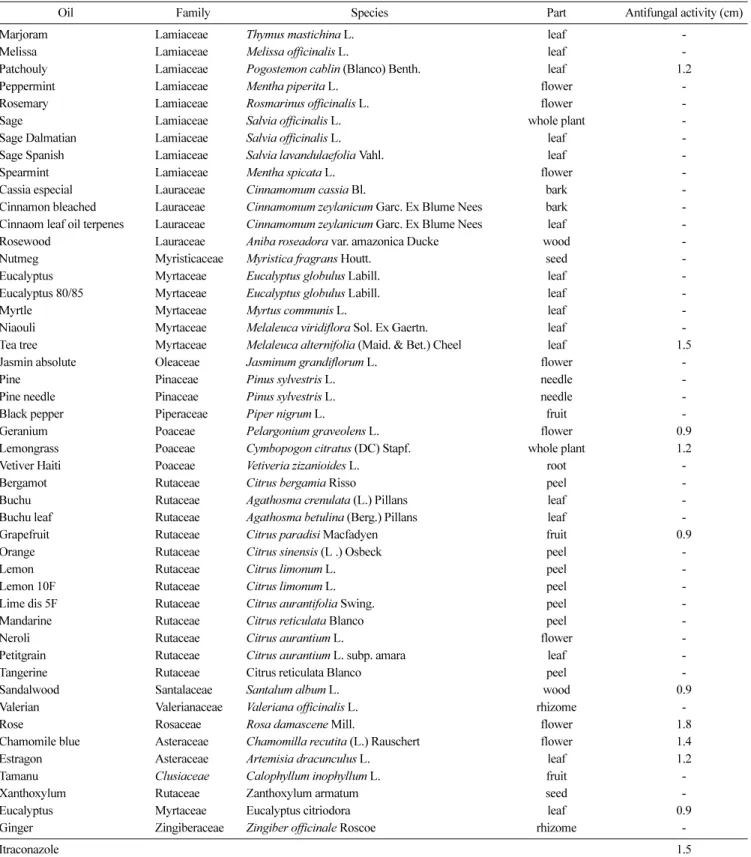
In our experiments, 87 plant essential oils were used for antifungal activity tests, and they were purchased from UNIQ F&F Co., Ltd. (Seoul, Korea). The detailed information of these essential oils is shown in Table 1. Itraconazole was purchased from Sigma-Aldrich (St. Louis, MO, USA). All other chemicals were a reagent grade.
Malassezia pachydermatis (KCCM 50374) was obtained from the Korean Culture Center of Microorganisms (Seoul, Korea). This strain was grown on Sabouraud Dextrose Broth (SDB) or Sabouraud Dextrose Agar (SDA) (Difco, Sparks, MD, USA) supplemented with 1% (v/v) of pure olive oil (Yakuri Pure Chemicals, Kyoto, Japan), following incubation at 37oC during 2-7 days. Malassezia strains were maintained on the same medium described previously, at 4oC, with subcultures being carried out on a monthly basis. The same medium was used in all the experiments. Inoculum suspensions were prepared by the method as described previously [Rukayadi et al., 2006]. One milliliter of 48 h culture was centrifuged (3000 g at 4oC for 1 min), followed by washing the pellets twice with 1 mL of phosphate buffered saline (PBS). Clusters of Malassezia cells were formed upon preparation of inoculum suspensions. The washing of these suspensions with PBS promotes single-cell status and more accurate turbidity measurements.
The antifungal activity of the plant essential oils was carried out by the disk diffusion method [Anesini and Perez, 1993]
using 100µL of suspension containing 5×10⁶ CFU/mL of M.
pachydermatis. The disks (Whatman, 6 mm in diameter) which impregnated with 2, 1.5, 0.5, and 0.1 mg/mL of essential oil were placed on the inoculated agar. Control disk containing only ethanol employed to dissolve the essential oil showed no inhibition. Itraconazole of four concentrations were used as positive reference standards. The antifungal activity was
*Corresponding author
Phone: +82-62-950-3656; Fax: +82-62-953-2218 E-mail: [email protected]
doi:10.3839/jabc.2010.033
evaluated by measuring the inhibition-zone diameter observed after 48 h of incubation.
The analysis was performed by gas chromatography-mass spectrometry (6890, Aglient Co., Palo Alto, CA, USA). Helium as carrier gas for individual constituents was averaged. The amount of the samples injected was 0.2µL in split mode (400:1). The injector temperature was set at 270oC. The GC column was DB- 5MS stationary phase (60 m×0.32 mm i.d., 0.25µm film thickness, J&W Scientific, Folsom, CA, USA).
The GC oven temperature was initially maintained at 60oC for 2 min and then programmed to 5oC/min to 300 and maintained for 5 min. 0.2µL of sample dissolved in CH2Cl2 (1:100 v/v) was injected. Essential oil samples were analyzed and the relative peak areas for individual constituents averaged. Quantification
was computed as the percentage contribution of each compound to the total amount present. The percentage composition of the oils was computed by the normalization method from the GC peak areas. GC-MS analysis of the essential oil with the GC (6890 Plus, Agilent Co.) coupled with 5973 mass selective detector quadrupole mass spectrometer. The mass spectrometer was run in the electron impact (EI) mode with electron energy at 70 eV. The mass spectrometer was operated in full scan mode between 35 and 700 amu. The components of essential oil were tentatively identified by comparison of mass spectra of each peak with those of authentic samples in the NIST MS library.
Antifungal activity of 86 plant essential oils was found when the essential oil was assayed at 2 mg/mL (Table 1). The results showed the inhibitory effects of 11 oils [Ocimum basilicum L., Table 1. Antifungal activities against Malassezia pachydermatis of 86 plant essential oils
Oil Family Species Part Antifungal activity (cm)
Cananga Annonaceae Cananga odorata Hook fil. et Thomp. flower -
Ylang ylang Annonaceae Cananga odorata Hook. f. et Thomson flower -
Anise Apiaceae Pimpinella anisum L. fruit -
Aniseed Apiaceae Pimpinella anisum L. fruit -
Carrot seed Apiaceae Daucus carota L. seed -
Celery seed Apiaceae Apium graveolens L. seed -
Coriander Apiaceae Coriandrum sativum L. flower -
Fennel Apiaceae Foeniculum vulgare Mill. seed -
Galbanum Apiaceae Ferula galbaniflua Boiss.et Buhse root -
Lovage root Apiaceae Levisticum officinale L. Koch fruit -
Parsley herb Apiaceae Petroselinum crispum (Mill.) Nyman whole plant -
Parsley seed Apiaceae Petroselinum crispum (Mill.) Nyman seed -
Star anise Apiaceae Illicium verum L. fruit -
Armoise Asteraceae Artemesia vulgaris L. whole plant -
Chamomile blue Asteraceae Chamomilla recutita (L.) Rauschert flower -
Chamomile roman Asteraceae Chamaemelum nobil (L.) All. flower -
Davana Asteraceae Artemisia pallens Wall. Ex DC whole plant -
Helichrysum Asteraceae Helichrysum angustifolium DC flower -
Estragon Asteraceae Artemisia dracunculus L. leaf -
Wormwood Asteraceae Artemisia absinthium L. flower -
Frankincense Burseraceae Boswellia thurifera Roxburgh root -
Myrrh Burseraceae Commiphora myrrha var. molmol Engl. stem -
Tarragon Asteraceae Artemisia dracunculus L. stem -
Yarrow Asteraceae Achillea millefolium L. flower -
Cade Cupressaceae Juniperus oxycedrus L. wood -
Cedarleaf Cupressaceae Thuja occidentalis L. leaf -
Cedarwood Cupressaceae Juniperus irginiana L. bark -
Cedarwood Chinese Cupressaceae Juniperus funebris Endl. bark -
Cedarwood Texas Cupressaceae Juniperus mexicana Spring. bark -
Cypress Cupressaceae Cupressus sempervirens L. twig -
Juniperberry Cupressaceae Juniperus communis L. berry -
Wintergreen Ericaceae Gaultheria procumbens L. leaf -
Cascarilla bark Euphorbiaceae Croton eleuteria Bennett bark -
Basil Lamiaceae Ocimum basilicum L. flower 1.5
Basil sweet Lamiaceae Ocimum basilicum L. whole plant -
Clary sage Lamiaceae Salvia sclarea L. flower -
Hyssop Lamiaceae Hyssopus officinalis L. leaf -
Lavender Lamiaceae Lavaendula officinalis (Chaiz.) flower -
Lavender 10/42 Lamiaceae Lavandula angustifolia Mill. flower -
Pogostemon cablin (Blanco) Benth., Melaleuca alternifolia (Maid. & Bet.) Cheel, Pelargonium graveolens L., Cymbopogon citratus (DC) Stapf., Citrus paradisi Macfadyen, Santalum album L., Rosa damascene Mill., Chamomilla recutita (L.) Rauschert, Artemisia dracunculus L., and Eucalyptus citriodora]
on M. pachydermatis at 2 mg/mL. Among the 11 active oils, the oils of Ocimum basilicum L., Melaleuca alternifolia (Maid. &
Bet.) Cheel, and Rosa damascene Mill. showed strong inhibitory activity at a dose dependant manner and the activity were higher than itraconazole at the same concentration (Fig. 1).
Table 1. Continued.
Oil Family Species Part Antifungal activity (cm)
Marjoram Lamiaceae Thymus mastichina L. leaf -
Melissa Lamiaceae Melissa officinalis L. leaf -
Patchouly Lamiaceae Pogostemon cablin (Blanco) Benth. leaf 1.2
Peppermint Lamiaceae Mentha piperita L. flower -
Rosemary Lamiaceae Rosmarinus officinalis L. flower -
Sage Lamiaceae Salvia officinalis L. whole plant -
Sage Dalmatian Lamiaceae Salvia officinalis L. leaf -
Sage Spanish Lamiaceae Salvia lavandulaefolia Vahl. leaf -
Spearmint Lamiaceae Mentha spicata L. flower -
Cassia especial Lauraceae Cinnamomum cassia Bl. bark -
Cinnamon bleached Lauraceae Cinnamomum zeylanicum Garc. Ex Blume Nees bark -
Cinnaom leaf oil terpenes Lauraceae Cinnamomum zeylanicum Garc. Ex Blume Nees leaf -
Rosewood Lauraceae Aniba roseadora var. amazonica Ducke wood -
Nutmeg Myristicaceae Myristica fragrans Houtt. seed -
Eucalyptus Myrtaceae Eucalyptus globulus Labill. leaf -
Eucalyptus 80/85 Myrtaceae Eucalyptus globulus Labill. leaf -
Myrtle Myrtaceae Myrtus communis L. leaf -
Niaouli Myrtaceae Melaleuca viridiflora Sol. Ex Gaertn. leaf -
Tea tree Myrtaceae Melaleuca alternifolia (Maid. & Bet.) Cheel leaf 1.5
Jasmin absolute Oleaceae Jasminum grandiflorum L. flower -
Pine Pinaceae Pinus sylvestris L. needle -
Pine needle Pinaceae Pinus sylvestris L. needle -
Black pepper Piperaceae Piper nigrum L. fruit -
Geranium Poaceae Pelargonium graveolens L. flower 0.9
Lemongrass Poaceae Cymbopogon citratus (DC) Stapf. whole plant 1.2
Vetiver Haiti Poaceae Vetiveria zizanioides L. root -
Bergamot Rutaceae Citrus bergamia Risso peel -
Buchu Rutaceae Agathosma crenulata (L.) Pillans leaf -
Buchu leaf Rutaceae Agathosma betulina (Berg.) Pillans leaf -
Grapefruit Rutaceae Citrus paradisi Macfadyen fruit 0.9
Orange Rutaceae Citrus sinensis (L .) Osbeck peel -
Lemon Rutaceae Citrus limonum L. peel -
Lemon 10F Rutaceae Citrus limonum L. peel -
Lime dis 5F Rutaceae Citrus aurantifolia Swing. peel -
Mandarine Rutaceae Citrus reticulata Blanco peel -
Neroli Rutaceae Citrus aurantium L. flower -
Petitgrain Rutaceae Citrus aurantium L. subp. amara leaf -
Tangerine Rutaceae Citrus reticulata Blanco peel -
Sandalwood Santalaceae Santalum album L. wood 0.9
Valerian Valerianaceae Valeriana officinalis L. rhizome -
Rose Rosaceae Rosa damascene Mill. flower 1.8
Chamomile blue Asteraceae Chamomilla recutita (L.) Rauschert flower 1.4
Estragon Asteraceae Artemisia dracunculus L. leaf 1.2
Tamanu Clusiaceae Calophyllum inophyllum L. fruit -
Xanthoxylum Rutaceae Zanthoxylum armatum seed -
Eucalyptus Myrtaceae Eucalyptus citriodora leaf 0.9
Ginger Zingiberaceae Zingiber officinale Roscoe rhizome -
Itraconazole 1.5
Samples treated with concentration of 2 mg. ‘-’ expressed no activity.
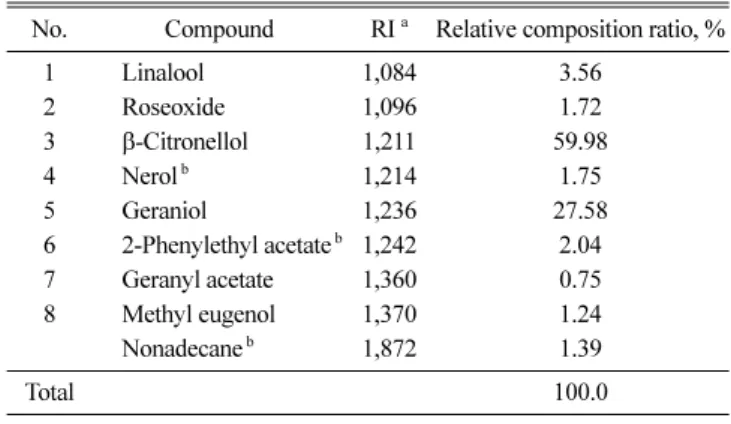
The three oils were analysed by GC-MS. The chemical compositions of O. basilicum oil are shown in Table 2~4.
Altogether 3 compounds were identified, representing 98.29%
of the total oil constituents. The major constituents of the oil were linalool (21.83%) and estragole (74.29 %). M. alternifolia oil composed of major constituents of the γ-terpinolene
(17.96%) and terpinen-4-ol (45.54%). The major constituents of R. damascene were β-citronellol (59.98%) and geraniol (27.58%).
Consequently, we demonstrated that the 11 oils among the 86 plant essential oils had inhibitory activity against M.
pachydermatis at first screening. The highest antifungal activity was found in the essential oils of O. basilicum, M. alternifolia, and R. damascene. This activity was dose-dependant and higher than that of itraconazole. Although, further studies are needed, the use of essential oils of O. basilicum, M. alternifolia, and R.
damascene against microbial growth seems a valuable alternative as antifungal compound, especially in the cases of anti-Malassezia resistance.
References
Anesini C and Perez C (1993) Screening of plants used in Argentine folk medicine for antimicrobial activity. J Ethnopharmacol 39, 119-128.
Claudia C, Sabrina G, Gioia C, and Domenico O (2005) Occurrence and population size of Malassezia spp. in the external ear canal of dogs and cats both healthy and with otitis.
Mycopathologia 160, 143-149.
Coutinho SD, Fedullo JD, and Corrêa SH (2006) Isolation of Malassezia spp. from cerumen of wild felids. Med Mycol 44, 383-387.
Crespo MJ, Abarca ML, and Cabañes FJ (2002) Occurrence of Malassezia spp. in the external ear canals of dogs and cats with and without otitis externa. Med Mycol 40, 115-121.
Crespo CMJ, Abarca ML, and Cabañes FJ (2002) Occurrence of Malassezia spp. in horses and domestic ruminants. Mycoses 45, 333-337.
Guillot J and Bond R (1999) Malassezia pachydermatis: a review.
Med Mycol 37, 295-306.
Hirai A, Kano R, and Makimura K (2004) Malassezia nana sp.
nov, a novel lipid-dependent yeast species isolated from animals. Int J Syst Evol Microbiol 54, 623-627.
Martinez Fernandez CA, Carnot Uría J, De Castro Arenas R, Muñío Perureral J, and Torres Ilibar W (1998) Tratamiento de las micosis profundas. Estado actual Acta med 8, 80-85.
Fig. 1. Antifungal activity of essential oil of Ocimum basilicum, Melaleuca alternifolia, and Rosa damascene against Malassezia pachydermatis. Values represent the means of 3 independent experiments.
Table 2. Chemical composition of Melaleuca alternifolia essential oil No. Compound RI a Relative composition ratio, %
1 α-thujene 921 0.65
2 α-pinene 928 2.50
3 β-pinene 967 0.59
4 β-myrcene 981 6.44
5 α-terpinene 1,007 7.25
6 p-cymene 1,010 5.32
7 1,8-cineole 1,018 3.72
8 Limonene 1,019 0.99
9 γ-terpinene 1,049 17.96
10 Terpinolene 1,077 2.81
11 Terpinen-4-ol 1,159 45.54
12 α-terpineol 1,170 3.26
13 Armodendrene b 1,435 1.02
14 Cadinene b 1,514 0.88
Total 98.93
aRetention indices.
bTentatively identified by mass library.
Table 3. Chemical composition of Ocimum basilicum
No. Compound RI a Relative composition ratio, %
1 Linalool 1,084 21.83
2 Estragole 1,173 74.29
3 α-Humulene b 1,447 2.17
Total 98.29
aRetention indices.
bTentatively identified by mass library.
Table 4. Chemical composition of Rosa damascene
No. Compound RI a Relative composition ratio, %
1 Linalool 1,084 3.56
2 Roseoxide 1,096 1.72
3 β-Citronellol 1,211 59.98
4 Nerol b 1,214 1.75
5 Geraniol 1,236 27.58
6 2-Phenylethyl acetate b 1,242 2.04
7 Geranyl acetate 1,360 0.75
8 Methyl eugenol 1,370 1.24
Nonadecane b 1,872 1.39
Total 100.0
aRetention indices.
bTentatively identified by mass library.
Ming Fan YM, Huang WM, Li SF, Wu GF, Lai K, and Chen RY (2006) Granulomatous skin infection caused by Malassezia pachydermatis in a dog owner. Arch Dermatol 142, 1181-1184.
Midgley G (2000) The lipophilic yeasts: state of the art and
prospects. Med Mycol 38, 9-16.
Rukayadi Y, Yong D, and Hwang JK (2006) In vitro anticandidal activity of xanthorrhizol isolated from Curcuma xanthorrhiza Roxb. J Antimicrob Chemother 57, 1231-1234.