• 검색 결과가 없습니다.

Cytotoxic Evaluation of the Essential Oils from Korean Native Plant on Human Skin and Lung Cells

N/A
N/A
Protected

Academic year: 2021

Share "Cytotoxic Evaluation of the Essential Oils from Korean Native Plant on Human Skin and Lung Cells"

Copied!
13
0
0

로드 중.... (전체 텍스트 보기)

전체 글

(1)

Cytotoxic Evaluation of the Essential Oils from Korean Native Plant on Human Skin and Lung Cells 1

Changhwan AHN 2,3 ⋅Yeong-Min YOO 3 ⋅Mi-Jin PARK 4 ⋅ Youngseok HAM 4 ⋅Jiyoon YANG 4 ⋅Eui-Bae JEUNG 3,†

ABSTRACT

1)

Plant essential oils are used in products such as fragrances and cosmetics due to their individual aromatic characteristics.

Currently, essential oils are not only used in cosmetics but also in pharmaceutical products with anti-bacterial, anti-viral, anti-fungal, anti-parasitic, insecticidal, anti-cancer, neuroprotective, psychophysiological, or anti-aging effects. Despite their pharmaceutical properties, some studies reported cytotoxic effects in high doses. Therefore, for pharmaceutical purposes, the margin of safety of essential oils needs to be examined. Herein, we evaluated the IC 50 of 10 essential oil from Korean native plants: Juniperus chinensis L. var. sargentii Henry, Citrus natsudaidai Hayata, Citrus reticulata Blanco, Citrus unshiu (Yu. Tanaka ex Swingle) Marcow, Artemisia capillaris Thunb, Aster glehnii F. Schmidt, Juniperus chinensis L, Zanthoxylum schinifolium Siebold & Zucc, Zanthoxylum piperitum (L.) D, and Cinnamomum loureirii. In addition, gene regulation of the cell-cycle gene and apoptosis marker CASP3 was examined at the IC 50 level. The purpose of this study was to describe the toxic concentrations of essential oils extracted from Korean native plants, thereby providing toxic concentration guidelines for inclusion in a toxicity database and in the application of plant essential oils in various fields.

Keywords: essential oil, cytostatic effect, cell death, skin, lung

1. INTRODUCTION

Essential oils are secondary plant metabolites main- ly composed of monoterpenes and sesquiterpenes (Mahmoud et al., 2002; Min et al., 2017). Essential oils have been of interest worldwide for their applica- tion in alternative medicines to treat diseases and for

their stress-relieving, anti-inflammatory, anti-oxidant, and anti-microbial properties (Pujiarti et al., 2016;

Elshafie et al., 2017; Yang et al., 2019; Ham et al., 2020; Lee et al., 2021). Whereas, at the same time, researchers have indicated that essential oils need fur- ther research (Farrar et al., 2020). Systematic and rig- orous approaches to studying the biological activities

1 Date Received May 18, 2021, Date Accepted July 12, 2021

2 Laboratory of Veterinary Physiology, College of Veterinary Medicine, Jeju National University, Jeju, 63243, Republic of Korea

3 Laboratory of Veterinary Biochemistry and Molecular Biology, College of Veterinary Medicine, Chungbuk National University, Cheongju, Chungbuk 28644, Republic of Korea

4 Division of Forest industrial Materials, Department of Forest Products and Industry, National Institute of Forest Science, Seoul 02455, Republic of Korea

† Corresponding author: Eui-Bae JEUNG (e-mail: [email protected], ORCID: 0000-0001-8936-916X)

Original Article

(2)

of potential phytotherapeutics have only been initiated in recent decades (Ahn et al., 2018; Ahn et al., 2020).

Phytotherapeutics such as essential oils are natural substances, but natural should not be considered syn- onymous with harmless. Evaluation of the toxicity of essential oils and regulation of their use are underway.

The toxicity of essential oil may be considered trivial compared to that of conventional medicines; however, such essential oils could bring forth severe public health problems as the occurrence of side effects of essential oils is common. Moreover, there is possible toxicity resulting from improper use. Toxicity tests are de- signed to assess or predict toxic effects in vivo and to assess the relative toxicity of substances. In vitro cyto- toxicity assaying is the first approach to evaluating the biocompatibility of an essential oil (Rogero et al., 2003).

Natural products such as essential oils can also in- teract with DNA, producing changes in its structure or function, and such modifications can trigger the cell replication system (Edris, 2007). A cell replication cy- cle is a series of events within a cell as it grows and divides. A cell spends most of its time in what is called interphase, and during this time, it grows, repli- cates its chromosomes, and prepares for cell division (Baserga, 1965). The G1/S and G2/M cell-cycle checkpoints maintain genomic stability in eukaryotes in response to genotoxic stress (Wang et al., 1999).

Cinnamomum loureirii is from the plant family Lauraceae, which has a worldwide distribution in trop- ical and warm climates. Many Lauraceae contain high concentrations of essential oils, some of which are val- ued for use in spices and perfumes (Prabuseenivasan et al., 2006). Within Lauraceae plants, most such sub- stances are components of their irritant or toxic saps or tissues, which may repel or poison many herbivorous or parasitic organisms (Schausberger, 2018). Juniperus chinensis L. and Juniperus chinensis L. var. sargentii Henry is from the plant family Cupressaceae. The Cupressaceae may be a rich source of anti‐tick com-

pounds, and further investigation of cypress species for repellent and insecticidal chemicals is warranted (Dolan et al., 2007; Dolan et al., 2009). Aster glehnii F.

Schmidt and Artemisia capillaris Thunb. are from the plant family Asteraceae, which includes more than 1,600 genera and 20,000 species of herbs and trees worldwide.

Zanthoxylum schinifolium Siebold & Zucc, Zanthoxylum piperitum (L.) DC, Citrus natsudaidai Hayata, Citrus unshiu (Yu. Tanaka ex Swingle) Marcow, and Citrus reticulata Blanco are members of the Rutaceae plant family. Rutaceae members are considered good sources of essential oil. Some family members are Amyris (Amyris balsamifera), Bergamot (Citrus bergamia), Boronia (Boronia megastigma), Cape May (Coleonema album), Clementine (Citrus clementina), Grapefruit (Citrus paradisi), Lemon (Citrus limonum), Lime (Citrus aurantifolia), Mandarin (Citrus reticulata), Neroli (Citrus aurantium var.amara), Orange Blood (Citrus si- nensis), Orange Sweet (Citrus sinensis), Petitgrain (Citrus aurantium var. amara), Rue (Ruta graveolens), Tangerine (Citrus reticulata), Tosa Konatsu (Citrus tamur- ana), Xanthoxylum (Zanthoxylum armatum), Yuzu (Citrus junos), and Zanthoxylum (Zanthoxylum odor- um), each of which is a source of essential oils.

This study was undertaken to examine the cytotoxic

dosage of essential oils of several Korean native

plants, with that dosage based on the IC 50 values ob-

tained in human lung (A549) and human skin (Detroit-

551) cells of oils extracted from Cinnamomum loureir-

ii, Juniperus chinensis L., Aster glehnii F. Schmidt,

Artemisia capillaris Thunb, Juniperus chinensis L.,

Juniperus chinensis L. var. sargentii Henry, Citrus

natsudaidai Hayata, Citrus unshiu (Yu. Tanaka ex

Swingle) Marcow, and Citrus reticulata Blanco. In ad-

dition, the cytotoxic mechanisms of the examined es-

sential oils were determined by examining changes in

the gene and protein expressions of four cell-cycle

markers (Cyclin A, Cyclin B, Cyclin D, and Cyclin

E) and one cell-death marker (caspase-3).

(3)

2. MATERIALS and METHODS

2.1. Extraction of plant essential oils

Plant essential oils are extracted by hydrodistillation with 1 kg of plant leafs and 10L of distilled water on heating mantle (Catalog number: MS-DM608, MTOPS ® , Seoul, Republic of Korea) at 102℃.

Volatile steam are condensed in dean stark trap.

Acquired essential oils are dehydration with sodium sulfite anhydrous, and then stored at 4℃.

2.2. Cell Count Kit assay

A549 (KCLB No: 10185) and Detroit 551 cells (KCLB No: 10110) from Korean cell line bank (Seoul, Republic of Korea) were seeded at a density of 0.5

× 10 3 cells per well in 6-well plate and the medium used for cell culture was DMEM high glucose media (Catalog number: L0102, Biowest, Nuaillé, France) supplemented with penicillin-streptomycin solution (Catalog number: L0018 Biowest), Plasmocin™ pro- phylactic (Catalog number: ant-mpp, InvivoGen, San Diego, USA) and fetal bovine serum (Catalog number:

16140071, Thermo Fisher Scientific Korea Ltd., Seoul, Republic of Korea). Cells were incubated in a CO 2 atmosphere at 37℃ for 24 h prior to treating with essential oil. The plant essential oils were prepared in four concentrations of 10 -8 , 10 -6 , 10 -4 , and 10 -2 . After 24 h incubation, the cells are treated with diluted plant essential oil and incubated for 24 h additionally.

Subsequently, the plant essential oil and the medium treating the cells were removed and the cells washed with PBS solution (Catalog number: LB 001-02, WELGENE Inc., Gyeongsan, Republic of Korea).

EZ-Cytox enhanced cell viability assay reagent (Catalog number: EZ-1000, DoGenBio Co., Ltd., Seoul, Republic of Korea) at the recommended concentration was then placed in each well. One hour later, the ab- sorbance value at 450 nm was measured with an

Epoch microplate spectrophotometer (Catalog number:

Epoch, BioTek Instruments, Inc., Vermont, USA). Cell viability (%) was determine by using the formula of optical density (OD) of sample treated cells / OD of un- treated cells as the control × 100 for each tested concentration. A cell survival curve was calculated from those values, and the IC 50 value was determined.

After conducting the CCK assay, the same procedure was repeated with plant essential oils that were diluted to concentrations of 10 -6 , 10 -5 , 10 -4 , 10 -3 , and 10 -2 .

2.3. Reverse-transcription real-time polymerase chain reaction

Cells were seeded in 6-well plates at a density of 0.3 × 10 -4 cells per well and incubated at 37℃ in 5%

CO 2 atmosphere. Plant essential oils in DMEM high glucose media were prepared in three concentrations:

IC 50 from the CCK assay, 10 times more than the IC 50 , and 10 times less than the IC 50 . When cell confluency was 70%, the cells were treated with the appropriate concentration of plant essential oil. Harvesting of cells and RNA extraction were accomplished by using TRI Reagent TM Solution (Catalog number: AM9738, Thermo Fisher Scientific Korea Ltd.) at 24 h after plant essential oil treatment. The purity and concen- tration of the extracted RNA were measured by using an Epoch microplate spectrophotometer.

The extracted RNA was synthesized by reverse transcription. The concentration of RNA was titrated to 1µg/µL and DEPC-treated water was added to adjust the total volume to 10.5µL. The mixture contained Moloney murine leukemia virus (MMLV) reverse transcriptase (Catalog number: 28025013, Invitrogen, Massachusetts, USA), Ribonuclease inhibitor (Invitrogen), random primers (Catalog number: 3801, TaKaRa, Kyoto, Japan), 100 mM DTT (Invitrogen), dNTP and 5× first strand buffer (Catalog number: 28025013, Invitrogen).

The reaction mixture was incubated at 37℃ for 60

min. After incubation, the cells were incubated further

(4)

at 95℃ for 5 min for inactivation of the enzyme. After cooling for 5 min on ice, the cDNA was stored at -20℃

prior to use.

For real-time polymerase chain reaction (RT-PCR), a mastermix of the following reaction components was prepared: cDNA sample (2 µL), 0.25 µL 50× ROX dye, 6.25 µL 2× prime Q-mastermix SYBR (Catalog number: Q-9210, GeNetBio, Daejeon, Republic of Korea), 0.5 µL forward primer, and 0.5 µL reverse primer. RT-PCR was performed using 7300 RT-PCR system (Applied Biosystems, Foster City, CA, USA) and the procedure sequence was as follows: cDNA de- natured at 95℃ for 30 sec and annealed at 58℃ for 30 sec, elongation is performed at 72℃ for 30 sec, and the whole cycle is repeated 40 times. The degree of gene expression was determined by using RQ soft- ware (Applied Biosystems).

The primer sequences used are as follows:

5'-CATACTCCACAGCACCTGGTTA-3' (forward) and 5'-CTGTTGCCACCTTTCGGTTA-3' (reverse) for CASP3; 5'-TACTTTCTGCATCAGCAGCC-3' (forward) and 5'-TGATTCAGGCCAGCTTTGTC-3' (reverse) for Cyclin A; 5'-CTTTGCACTTCCTTCGGAGA-3' (forward) and GTAGAGTTGGTGTCCATTCACC-3' (reverse) for Cyclin B; 5'-CCTCGGTGTCCTACTTCA-3' (forward) and 5'-CTCCTCGCACTTCTGTTC-3' (reverse) for Cyclin D; and 5'-GGTTTCAGGGRATCAGTGGT-3' (forward) and 5'-TTTCTTTGCTCGGGGCTTTG-3' (reverse) for Cyclin E. The primer sequence for Rn18s was used as the primer for the control group: 5'-CTCAACAC- GGGAAACCTCAC-3' (forward) and 5'-CGCTCCA- CCAACTAAGAACG-3' (reverse). All primers were obtained from Macrogen (Korea).

2.4. Western blotting

Proteins were extracted using Pro-prep (iNtRON Biotechnology, Seongnam, Republic of Korea) accord- ing to the manufacturer's instructions. Proteins (30 µg per lane) were separated on a 10% SDS-PAGE gel

and transferred to a polyvinylidene fluoride transfer membrane (catalog number: NEF1000, PerkinElmer Inc., Seoul, Republic of Korea) in a TransBlot Cell (catalog number: TE-22; Hoefer Co. Massachusetts, USA) according to the manufacturer's instructions.

The resulting blot was blocked with TBS-T containing 5% skimmed milk for 60 min, then incubated with pri- mary antibody: Caspase-3 (mouse monoclonal, 1:500, Catalog number: 9665, Cell Signaling Technology, Massachusetts, USA), Cyclin A2 (mouse monoclonal, 1:500, Catalog number: 4656, Cell Signaling Technology), Cyclin B1 (rabbit polyclonal, 1:500, Catalog number: 4138, Cell Signaling Technology), Cyclin D1 (rabbit monoclonal, 1:500, Catalog number:

2978, Cell Signaling Technology), Cyclin E1 (mouse monoclonal, 1:500, Catalog number: 4129, Cell Signaling Technology), or β-actin (rabbit monoclonal, 1:1,000, Catalog number: 4970, Cell Signaling Technology).

After washing in buffer, the membranes were in- cubated with the appropriate horseradish perox- idase-conjugated secondary antibodies (anti-goat, 1:2,000, Catalog number: sc-2354 or anti-mouse, 1:4,000, Catalog number: sc-2005, Santa Cruz, Texas, USA) for 1 h at room temperature. Next, the blots were de- veloped by incubation in ECL chemiluminescence re- agent (Catalog number: sc-2048, Santa Cruz) and sub- sequently exposed to the GeneGnome Bioimaging System (Catalog number: 77534-3, Syngene, Maryland, USA) for development, after which images were cap- tured by using the GENESys software (Syngene). Signal specificity was confirmed by blotting in the absence of primary antibody, and bands were normalized to β-actin immunoreactive bands visualized on the same membrane after stripping. The density of each band was measured using the NIH ImageJ software.

2.5. Data analysis

All data were analyzed by applying nonparametric

one-way analysis of variance followed by Tukey’s test

(5)

for multiple comparisons. All experiments consisted of three separate trials. Statistical analysis was performed by using Prism Graph Pad (v.8.0; GraphPad Software, San Diego, USA).

3. RESULTS and DISCUSSION 3.1. Examination of IC 50 value of

each essential oils

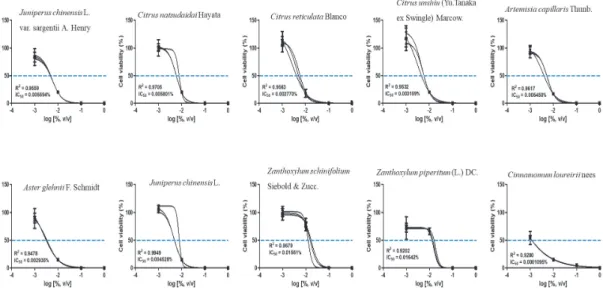
The CCK assay was used to obtain IC 50 values of each essential oil. To determine that concentration, cells were treated with four concentrations of each essential oil, followed by a further subdivision of the doses us- ing the CCK assay. The IC 50 values for the ten plant essential oils tested are presented in Fig. 1 and 2. In the Detroit-551 and A549 cell lines, the degree of cy- totoxicity of each essential oil was compared with its IC 50 value. The essential oil IC 50 values obtained from

Detroit-551 cell assays were Artemisia capillaris Thunb. (5.4510 -3 ), Aster glehnii F. Schmidt (2.9410 -3 ), Zanthoxylum piperitum (L.) DC (1.6410 -2 ), Zanthoxylum schinifolium Siebold & Zucc. (1.5610 -2 ), Juniperus chinensis L. (4.5310 -3 ), Juniperus chinensis L. var.

sargentii Henry (5.5910 -3 ), Cinnamomum loureirii Nees (1.0910 -4 ), Citrus reticulata Blanco (2.7710 -3 ), Citrus natsudaidai Hayata (5.8010 -3 ), and Citrus un- shiu (Yu. Tanaka ex Swingle) Marcow (3.1610 -3 ).

Similarly, the essential oil IC 50 values obtained from A549 cell assays were Artemisia capillaris Thunb.

(1.9110 -3 ), Aster glehnii F. Schmidt (2.7710 -3 ), Zanthoxylum piperitum (L.) DC (1.5910 -2 ), Zanthoxylum schinifolium Siebold & Zucc. (1.3010 -2 ), Juniperus chinensis L.

(2.7910 -3 ), Juniperus chinensis L. var. sargentii Henry (4.1510 -3 ), Cinnamomum loureirii Nees (7.4610 -4 ), Citrus reticulata Blanco (1.0210 -3 ), Citrus natsudaidai Hayata (6.5910 -3 ), and Citrus unshiu (Yu. Tanaka ex Swingle) Marcow (2.3410 -3 ).

Fig. 1. Cell survival curves for determining the IC 50 values of essential oil in the Detroit-551 cell line.

Through the foregoing experiments conducted to determine the experimental concentration, the essential oil was

diluted to a more detailed five concentrations; 10 -4 , 10 -3 , 10 -2 , 10 -1 , and 10 -0 (%, v/v). After the cells are treated

with essential oils, the OD value was measured using the CCK assay. Cell viability was determined by OD

value (treated) / OD value (untreated) × 100 (%), and the IC 50 value is measured through the drawn survival curve.

(6)

Fig. 2. Cell survival curves for determining the IC 50 values of essential oil in the A549 cell line.

Through the foregoing experiments conducted to determine the experimental concentration, the essential oil was diluted to a more detailed five concentrations; 10 -4 , 10 -3 , 10 -2 , 10 -1 , and 10 -0 (%, v/v). After the cells are treated with essential oils, the OD value was measured using the CCK assay. Cell viability was determined by OD value (treated) / OD value (untreated) × 100 (%), and the IC 50 value is measured through the drawn survival curve.

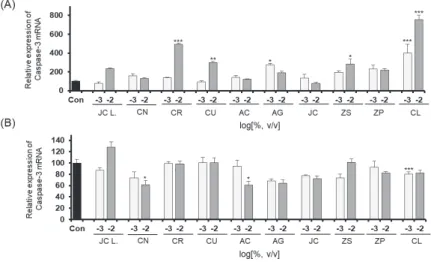
Fig. 3. The expression level of CASP3 in Detroit-551 and A549 cells after treatment with essential oil.

Relative expression of CASP3 in Detroit-551 (A) and A549 cell line (B). Based on the IC 50 values obtained

above, two concentrations were set so that the difference was ten times near IC 50 . The expression levels of

CASP3 in each group were determined by real-time polymerase chain reaction after 24 hours of essential oil

treatment. (Juniperus chinensis L. var. sargentii Henry; JC L., Citrus natsudaidai Hayata; CN., Citrus reticulata

Blanco; CR., Citrus unshiu (Yu.Tanaka ex Swingle) Marcow; CU., Artemisia capillaris Thunb; AC., Aster glehnii

F. Schmidt; AG., Juniperus chinensis L; JC., Zanthoxylum schinifolium Siebold & Zucc; ZS., Zanthoxylum piperitum

(L.) DC; ZP., Cinnamomum loureirii Nees; CL.).

(7)

3.2. mRNA expression of CASP3 gene with plant essential oils

The expression levels of CASP3, a marker gene re- lated to cellular apoptosis, were determined by per- forming quantitative RT-PCR of cells after essential oil treatment. The expression levels of CASP3 in the A549 and Detroit-551 cells after treatment with each of the ten plant essential oils are shown in Fig. 3. The expression of CASP3 in Detroit-551 cells increased at concentrations near the IC 50 values of Citrus reticulata Blanco, Citrus unshiu (Yu. Tanaka ex Swingle) Marcow, Aster glehnii F. Schmidt, Zanthoxylum schinifolium

Siebold & Zucc, Cinnamomum loureirii Nees. However, none of the ten essential oils increased CASP3 mRNA expression in A549 cells.

3.3. mRNA expression of Cyclin A, Cyclin B, Cyclin D, and Cyclin E with plant essential oils

The expression levels of Cyclin A, Cyclin B, Cyclin D, and Cyclin E when Detroit-551 cells were treated with 10 -2 and 10 -3 % (v/v) concentrations of the ten essential oils are shown in Fig. 4. The cell-cycle con- trol gene, Cyclin A, showed an increased expression

Fig. 4. The expression level of CycllinA, Cyclin B, Cyclin D, and Cyclin E in Detroit-551 cells after treatment with essential oil.

Based on the IC 50 values obtained above, two concentrations were set so that the difference was ten times.

The expression levels Cyclin A (A), Cyclin B (B), Cyclin D (C), and Cyclin E (D) in the Detroit-551 cell

line were determined by real-time polymerase chain reaction after 24 hours of essential oil treatment. The

abbreviations of plant names were shown in the legend of Fig. 3.

(8)

following Cinnamomum loureirii Nees treatment.

Cyclin B showed increased expression levels follow- ing treatment with essential oils of Citrus reticulata Blanco, Zanthoxylum piperitum (L.) DC, Cinnamomum loureirii Nees. Zanthoxylum schinifolium Siebold &

Zucc., and Zanthoxylum piperitum (L. ) Only the Zanthoxylum piperitum (L. ) DC treatment produced an increased level of Cyclin D expression, and Cinnamomum loureirii Nees was the only essential oil that induced an increase in Cyclin E expression.

In the A549 cell line, only Juniperus chinensis L.

var. sargentii Henry treatment (10 -2 % v/v concen-

tration) induced an increase in Cyclin A expression.

None of the ten essential oil treatments increased the expressions of cyclins B, D, and E in A549 cells.

3.4. Protein expression of cell apoptosis marker caspase-3 and cell-cycle marker genes with plant essential oil treatment

At the protein level, expressions of cyclins A and Cyclin B were increased in Detroit-551 cells, results considered to indicate the cells were in mitosis or the S phase of the cell cycle. Cyclin B was increased fol- Fig. 5. The expression level of CycllinA, Cyclin B, Cyclin D, and Cyclin E in A549 cells after treatment with essential oil.

Based on the IC 50 values obtained above, two concentrations were set so that the difference was ten times.

The expression levels Cyclin A (A), Cyclin B (B), Cyclin D (C), and Cyclin E (D) in the A549 cell line were

determined by real-time polymerase chain reaction after 24 hours of essential oil treatment. The abbreviations

of plant names were shown in the legend of Fig. 3.

(9)

lowing Citrus unshiu (Yu. Tanaka ex Swingle) Marcow, Artemisia capillaris Thunb, Aster glehnii F.

Schmidt, and Cinnamomum loureirii Nees treatments.

Notably, caspase-3 expression was increased in Detroit-551 cells treated with Juniperus chinensis L.

var. sargentii Henry, Citrus unshiu (Yu. Tanaka ex Swingle) Marcow, Artemisia capillaris Thunb, Juniperus chinensis L, and Cinnamomum loureirii Nees. In the treated A549 cells, Cyclin A expression was increased with Citrus reticulata Blanco, Citrus unshiu (Yu.

Tanaka ex Swingle) Marcow, Zanthoxylum schinifolium Siebold & Zucc, Zanthoxylum piperitum (L.) DC, and Cinnamomum loureirii Nees treatments. In addition, caspase-3 expression increased with Juniperus chi- nensis L. var. sargentii Henry, Citrus natsudaidai Hayata, Citrus reticulata Blanco, Citrus unshiu (Yu.

Tanaka ex Swingle) Marcow, Artemisia capillaris Thunb, and Juniperus chinensis L. treatments.

3.5. Discussion

Essential oils have been used in traditional medi- cines, and systematic, scientific examination of the bi- ological activities of essential oil from plants has been conducted for several decades (Borges et al., 2005;

Mohammadhosseini et al., 2017). Traditional herbal medicines, including essential oils, have been used for treating infections and modulating various physio- logical functions (Horvath et al., 2015). Essential oils also have great potential as anti-inflammatory, an- ti-bacterial, and anti-cancer therapeutic agents (Bravo et al., 1980; Pagano et al., 1992; Elledge, 1996).

However, dosages and the methods for oil extraction Fig. 6. The expression level of Cyclin A, Cyclin B, Cyclin D, and Cyclin E in Detroit-551 cells after treatment with essential oil.

Based on the IC 50 values obtained above, the higher dose of essential oil 10 -2 (%, v/v) was chosen to examine

protein expression of cell cycle markers and cell apoptosis marker gene. The expression levels Cyclin A, Cyclin

B, Cyclin D, Cyclin E, and Caspase-3 in each group were determined by western blotting after 24 hrs of essential

oil treatment. The abbreviations of plant names were shown in the legend of Fig. 3.

(10)

are inconsistent, which can result in cytotoxic effects when using essential oils. In addition, reports describ- ing the mechanisms of essential oil cytotoxicity are lacking. Indeed, the complex chemical composition of plant essential oil extracts makes it difficult to eval- uate a mechanism of action underlying the biological effects such as cell toxicity, cytostatic effects, and side effects (Ahn et al., 2020).

The cytotoxic mechanisms associated with plant es- sential oils are typically divided into two types: apop- tosis and necrosis; both of which are cytotoxic mecha- nisms that can kill cells or inhibit cell growth by de- laying the cell cycle and inhibiting cell proliferation.

The cell cycle is divided into the S phase, the time when DNA is doubled, the M phase, when chromo- some distribution and cell division occurs, and the G1 and G2 phases, which occur between these S and M phases; the overall cycle is a periodic sequence of phases G1, S, G2, and M (Gerdes et al., 1984). Each phase of the cell cycle and its progression to the next phase are regulated by a complex of cyclins and cy- clin-dependent kinases (CDK) (Peter et al., 1994). In the G1 phase, Cyclin D/CDK4/6 and Cyclin E/CDK2 act in sequence (Peter et al., 1994). Cell-cycle regu- lation maintains genome stability by checking for ge- nome damage and ensuring the cellular DNA is re-

plicated during one cell cycle before division into two daughter cells (Bartek et al., 2004). If the cell cycle and checkpoint system are not functioning normally, cells may die or cause chromosome instability, result- ing in fatal diseases such as cancer (Gerlach et al., 2020). Cells that do not undergo cell division exhibit apoptosis or programmed cell death. When cell death occurs, a signal is transmitted to neighboring cells (Kawamoto et al., 2016). Malfunctioning cells that un- dergo apoptosis or death are beneficial to the survival of an organism. In addition, recent reports have de- fined many roles for apoptosis in normal lung function and in pathophysiology unrelated to lung neoplasia (Schittny et al., 1998). Detroit-551 cells are repre- sentative of epithelial cells, such as skin cells, whereas A549 cells are adenocarcinomic human alveolar basal epithelial cells, have been used in type II cell study, and are sensitive to lung damage. Using these two cell types, we examined the cytostatic and cytotoxic effects of essential oils of ten Korean native plants.

In this study, by determining IC 50 values and the expression levels of cellular apoptosis marker cas- pase-3 and cell-cycle markers cyclins A, B, D, and E, we examined the cell number reduction effects in ten essential oils at concentrations near the IC 50

concentration. The apoptosis marker CASP3 displays

Species Yield Acidity Density (g/ml) Refraction

Juniperus chinensis L. var. sargentii Henry 3.92±0.13 0.94±0.02 0.87 1.48

Citrus natsudaidai Hayata 5.88±0.23 0.87±0.04 0.84 1.47

Citrus reticulata Blanco 5.35 3.34±0.16 0.84 1.47

Citrus unshiu (Yu.Tanaka ex Swingle) Marcow. 5.26±0.13 1.12±0.08 0.83 1.47

Artemisia capillaris Thunb. 0.30±0.05 4.33±0.18 0.88 1.51

Aster glehnii F. Schmidt 0.31±0.20 2.48±0.10 0.83 1.48

Juniperus chinensis L. 1.69±0.35 1.26±0.00 0.88 1.47

Zanthoxylum schinifolium Siebold & Zucc. 2.34±0.81 0.94±0.02 0.93 1.52

Zanthoxylum piperitum (L.) DC. 2.97±0.70 0.98±0.12 0.83 1.47

Cinnamomum loureirii Nees 0.58±0.18 3.10±0.22 0.88 1.48

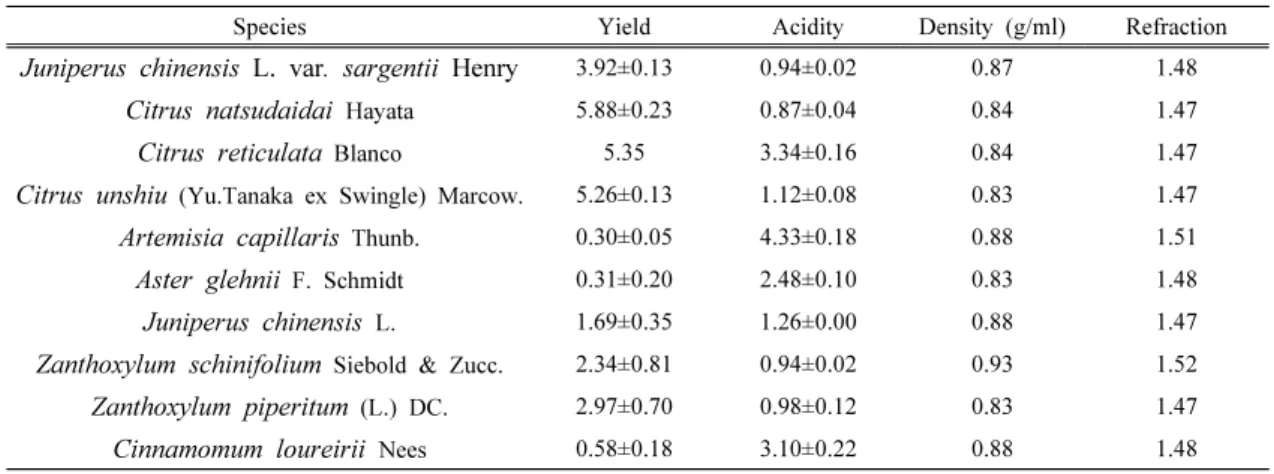
Table 1. Physical properties of the essential oil from Korean native plants

(11)

an increase in gene expression upon apoptosis; thus, we evaluated cytotoxic effects based on protein ex- pression levels. At the protein level, caspase-3 ex- pressions were increased due to Juniperus chinensis L. var. sargentii Henry, Citrus unshiu Marcow, Artemisia capillaris Thunb, Juniperus chinensis L, Cinnamomum loureirii Nees in Detroit-551. Otherwise, caspase-3 ex- pressions were increased by Juniperus chinensis L.

var. sargentii Henry, Citrus natsudaidai Hayata, Citrus reticulata Blanco, Citrus unshiu Marcow, Artemisia capillaris Thunb, Juniperus chinensis L. Those results indicates that the decrease of the cell proliferation near IC 50 value was from increased level of caspase-3 in- duced cell death by those essential oils treatment.

A relatively high dose of essential oil (10 -2 ) induced Cyclin A increases in Detroit-551 cells, which is in- dicative of mitosis or the S phase arrest in the cell cycle. M phase arrest may induced by Citrus unshiu (Yu. Tanaka ex Swingle) Marcow, Artemisia capillaris Thunb, Aster glehnii F. Schmidt, and Cinnamomum loureirii Nees treatment in order to increased Cyclin B. Similarly, in A549 cells, Cyclin A was increased with Citrus reticulata Blanco, Citrus unshiu (Yu.

Tanaka ex Swingle) Marcow, Zanthoxylum schinifo- lium Siebold & Zucc, Zanthoxylum piperitum (L. ) DC, and Cinnamomum loureirii Nees treatments.

In shorts, essential oil from Juniperus chinensis L.

var. sargentii Henry, Juniperus chinensis L. induce cell death by apoptosis in order to increase expression of caspase-3. Citrus unshiu, Artemisia capillaris Thunb essential oils induce cell death by cytostatic ef- fects in order to cell cycle arrest and inducing apoptosis. Citrus natsudaidai Hayata, Citrus reticulata Blanco, Cinnamomum loureirii Nees essential oils can induce both cytostatic and apoptotic effect depends on cell type. Other essential oil from Aster glehnii F.

Schmidt, Zanthoxylum schinifolium Siebold & Zucc., Zanthoxylum piperitum (L.) DC induce only cytostatic effect in order to cell cycle arrest. This result is need

to be considered before development and application of these essential oils.

4. CONCLUSION

Based on the results, essential oils from various plants can produce cytotoxic and cytostatic effects.

Such effects should be evaluated further to predict po- tential side effects of the clinical usage of essential oils. The pharmacological properties of essential oils depend on their chemical contents and the concen- trations used. Careful selection of a treatment concen- tration is important when using plant essential oils for medicinal or cosmetic purposes.

ACKNOWLEDGMENT

This work was supported by the Forest Science Technology Program (Project No. 1405004579) pro- vided by National Institute of Forest Science and the Global Research and Development Center (GRDC) Program through the National Research Foundation of Korea (NRF) funded by the Ministry of Education, Science and Technology (2017K1A4A3014959).

REFERENCES

Ahn, C., Lee, J.H., Park, M.J., Kim, J.W., Yang, J., Yoo, Y.M., Jeung, E.B. 2020. Cytostatic effects of plant essential oils on human skin and lung cells.

Experimental and Therapeutic Medicine 19(3):

2008-2018.

Ahn, C., Park, M.J., Kim, J.W., Yang, J., Lee, S.S., Jeung, E.B. 2018. Cytotoxic evaluation of plant essential oils in human skin and lung cells. Journal of the Korean Wood Science and Technology 46(2):

166-177.

Bartek, J., Lukas, C., Lukas, J. 2004. Checking on DNA

damage in S phase. Nature Reviews Molecular Cell

(12)

Biology 5(10): 792-804.

Baserga, R. 1965. The relationship of the cell cycle to tumor growth and control of cell division: A review. Cancer Research 25: 581-595.

Borges, F., Roleira, F., Milhazes, N., Santana, L., Uriarte, E. 2005. Simple coumarins and analogues in medicinal chemistry: Occurrence, synthesis and biological activity. Current Medicinal Chemistry 12(8): 887-916.

Bravo, R., Celis, J.E. 1980. A search for differential polypeptide synthesis throughout the cell cycle of HeLa cells. Journal of Cell Biology 84(3): 795-802.

Dolan, M.C., Dietrich, G., Panella, N.A., Montenieri, J.A., Karchesy, J.J. 2007. Biocidal activity of three wood essential oils against Ixodes scapularis (Acari:

Ixodidae), Xenopsylla cheopis (Siphonaptera:

Pulicidae), and Aedes aegypti (Diptera: Culicidae).

Journal of Economic Entomology 100(2): 622-625.

Dolan, M.C., Jordan, R.A., Schulze, T.L., Schulze, C.J., Manning, M.C., Ruffolo, D., Schmidt, J.P., Piesman, J., Karchesy, J.J. 2009. Ability of two natural products, nootkatone and carvacrol, to suppress Ixodes scapularis and Amblyomma americanum (Acari: Ixodidae) in a Lyme disease endemic area of New Jersey. Journal of Economic Entomology 102(6): 2316-2324.

Edris, A.E. 2007. Pharmaceutical and therapeutic potentials of essential oils and their individual volatile constituents: A review. Phytotherapy Research 21(4): 308-323.

Elledge, S.J. 1996. Cell cycle checkpoints: Preventing an identity crisis. Science 274(5293): 1664-1672.

Elshafie, H.S., Camele, I. 2017. An Overview of the Biological Effects of Some Mediterranean Essential Oils on Human Health. BioMed Research International 2017: 9268468.

Farrar, A.J., Farrar, F.C. 2020. Clinical aromatherapy.

Nursing Clinics of North America 55(4): 489-504.

Gerdes, J., Lemke, H., Baisch, H., Wacker, H.H.,

Schwab, U., Stein, H. 1984. Cell cycle analysis of a cell proliferation-associated human nuclear antigen defined by the monoclonal antibody Ki-67.

Journal of Immunology 133(4): 1710-1715.

Gerlach, S.U., Herranz, H. 2020. Genomic instability and cancer: Lessons from Drosophila. Open Biology 10(6): 200060.

Ham, Y., Yang, J., Choi, W.S., Ahn, B.J., Park, M.J.

2020. Antibacterial activity of essential oils from pinaceae leaves against fish pathogens. Journal of the Korean Wood Science and Technology 48(4):

527-547.

Horvath, G., Acs, K. 2015. Essential oils in the treatment of respiratory tract diseases highlighting their role in bacterial infections and their anti-inflammatory action: a review. Flavour and Fragrance Journal 30(5): 331-341.

Kawamoto, Y., Nakajima, Y.I., Kuranaga, E. 2016.

Apoptosis in cellular society: Communication between apoptotic cells and their neighbors.

International Journal of Molecular Sciences 17(12):

1-15.

Lee, S.Y., Lee, D.S., Cho, S.M., Kim, J.C., Park, M.J., Choi, I.G. 2021. Antioxidant properties of 7 domestic essential oils and identification of physiologically active components of essential oils against candida albicans. Journal of the Korean Wood Science and Technology 49(1): 23-43.

Mahmoud, S.S., Croteau, R.B. 2002. Strategies for transgenic manipulation of monoterpene biosynthesis in plants. Trends in Plant Science 7(8): 366-373.

Min, H.J., Kim, C.S., Hyun, H.J., Bae, Y.S. 2017.

Essential oil analysis of illicium anistum L. extracts.

Journal of the Korean Wood Science and Technology 45(6): 682-688.

Mohammadhosseini, M., Sarker, S.D., Akbarzadeh, A.

2017. Chemical composition of the essential oils

and extracts of Achillea species and their biological

activities: A review. Journal of Ethnopharmacology

(13)

199: 257-315.

Pagano, M., Pepperkok, R., Verde, F., Ansorge, W., Draetta, G. 1992. Cyclin A is required at two points in the human cell cycle. EMBO J 11(3): 961-971.

Peter, M., Herskowitz, I. 1994. Joining the complex:

cyclin-dependent kinase inhibitory proteins and the cell cycle. Cell 79(2): 181-184.

Prabuseenivasan, S., Jayakumar, M., Ignacimuthu, S.

2006. In vitro antibacterial activity of some plant essential oils. BMC Complementary and Alternative Medicine 6(39): 1-8.

Pujiarti, R., Kasmudjo, 2016. Chemical compositions and insecticidal activity of eucalyptus urophylla essential oil against culex quinquefasciatus mosquito.

Journal of the Korean Wood Science and Technology 44(4): 494-504.

Rogero, S.O., Malmonge, S.M., Lugao, A.B., Ikeda, T.I., Miyamaru, L., Cruz, A.S. 2003. Biocompatibility study of polymeric biomaterials. Artif Organs 27(5): 424-427.

Schausberger, P. 2018. Herbivore-associated bacteria as potential mediators and modifiers of induced plant defense against spider mites and thrips.

Frontiers in Plant Science 9: 1107.

Schittny, J.C., Djonov, V., Fine, A., Burri, P.H. 1998.

Programmed cell death contributes to postnatal lung development. American Journal of Respiratory Cell and Molecular Biology 18(6): 786-793.

Wang, X.W., Zhan, Q., Coursen, J.D., Khan, M.A., Kontny, H.U., Yu, L., Hollander, M.C., O'Connor, P.M., Fornace Jr, A.J., Harris, C.C. 1999. GADD45 induction of a G2/M cell cycle checkpoint.

Proceedings of the National Academy of Science of the United States of America 96(7): 3706-3711.

Yang, J., Choi, W.S., Kim, J.W., Lee, S.S., Park M.J.

2019. Anti-inflammatory effect of essential oils extracted from wood of four coniferous tree species.

Journal of the Korean Wood Science and

Technology 47(6): 674-691.

수치

Fig.  1.  Cell  survival  curves  for  determining  the  IC 50   values  of  essential  oil  in  the  Detroit-551  cell  line.
Fig.  3.  The  expression  level  of  CASP3  in  Detroit-551  and  A549  cells  after  treatment  with  essential  oil
Fig.  4.  The  expression  level  of  CycllinA,  Cyclin  B,  Cyclin  D,  and  Cyclin  E  in  Detroit-551  cells  after  treatment with  essential  oil.
Table  1.  Physical  properties  of  the  essential  oil  from  Korean  native  plants

참조

관련 문서

The expression levels of apoptotic related proteins and caspase dependent proteins by the ostreolysin purified from P.ostreatus on cell viability in FaDu human

Learning Korean is essential to understand Korean culture and live in Korea with fewer obstacles. Fortunately, there are many institutions in Korea offering Korean language

This paper discovered the Korean native Chinese characters which were flowed in Japanese, discussing the necessity of setting up the standards for judging

The strong role of Korean government from the days of economic development in the 1960s became the target of the regulatory reform from 1990s, the government reform and

For the data collection, we generated our gene expression profiles of Illumina platform and our gene expression profile demonstrated higher expression and connectivity than

william James Hall, M.D., Medical Missionary to the Slums of New York; Pioneer Mission of Korean Native Costumes, China Medical Journal, 1916.3; Medical Needs of Korean

In view of the essential relevance of mission in history (and not only in the history of religion), on the one hand, and in theology (and not only in missiology),

1 John Owen, Justification by Faith Alone, in The Works of John Owen, ed. John Bolt, trans. Scott Clark, "Do This and Live: Christ's Active Obedience as the