Vol. 38, No. 3, 315–321 (2010)
Chemical Composition and Antifungal Activity of Plant Essential Oils against Malassezia furfur
Lee, Jeong-Hyun and Jae-Sug Lee *
Department of Beauty Science, Kwangju Women's University
Malassezia furfur is an important causal factor for seborrheic dermatitis. Nowadays, the drugs available to treat this fungal infection are few. Several studies have documented the biological activity of essential oils.
However, its antifungal properties are not completely understood, especially its anti-Malassezia activity. The aim of this study were to evaluate the effect of the plant essential oils on the growth of M. furfur using disk dif- fusion method and analyze by Gas chromatography-mass spectrometry (GC-MS) most active essential oils. In first screening, the 17 plant essential oils have possesses inhibitory activity against M. furfur at 2 mg/mL.
Among the plant essential oils, oil of Citrus auranifoli was most active against M. furfur and its activity showed dose dependency. This anti-malassezial activity was high than that of itraconazole at 2 mg/mL. Oil of Citrus auranifolia also was phytochemically examined by GC-MS analysis, its main constituents were identi- fied as limonene, γ-terpinene and terpinolene. It can be concluded that essential oils of Citrus auranifolia may have interesting applications to control fungal-derived diseases.
Key words: Malassezia furfur, anti-Malassezia activity, Citrus auranifolia, essential oil, GC-MS analysis
Introduction
In recent years, the genus Malassezia has received considerable attention from dermatologists and clinicians [4]. Among them, Malassezia furfur has been associated with a variety of cutaneous disease [10, 5].
Ketoconazole is a representative synthetic antifungal imidazolic drug, which is prescribed for skin infections [8, 7]. The widespread use of antifungal agents may have contributed to a shift in species distribution via the emergence of inherently resistant species as significant pathogens [2].
Consequently, novel, broad-spectrum, nontoxic antifungal compounds, appropriate for empirical use and not prone to selection of resistant organisms, are required.
Medicinal plants are increasingly of interest as antimicrobial and antiviral agents and have been widely used in traditional medicine [6]. Nonetheless, little is known about antifungal effect on the genus Malassezia. To our knowledge, studies evaluating antifungal effect of essential oils against M. furfur have not been reported.
In the present study, we have analyzed the antifungal properties of plant essential oils on
M. furfur. The mostactive Citrus aurantifolia essential oil was phytochemically examined by GC-MS analysis, its main constituents were identified.
Materials and Methods
Chemicals
Itraconazole was purchased from Sigma-Aldrich (St.
Louis, MO, USA), dissolved in ethyl alcohol, and stored at -20
oC. All other chemicals were a reagent grade.
Plant essential oils
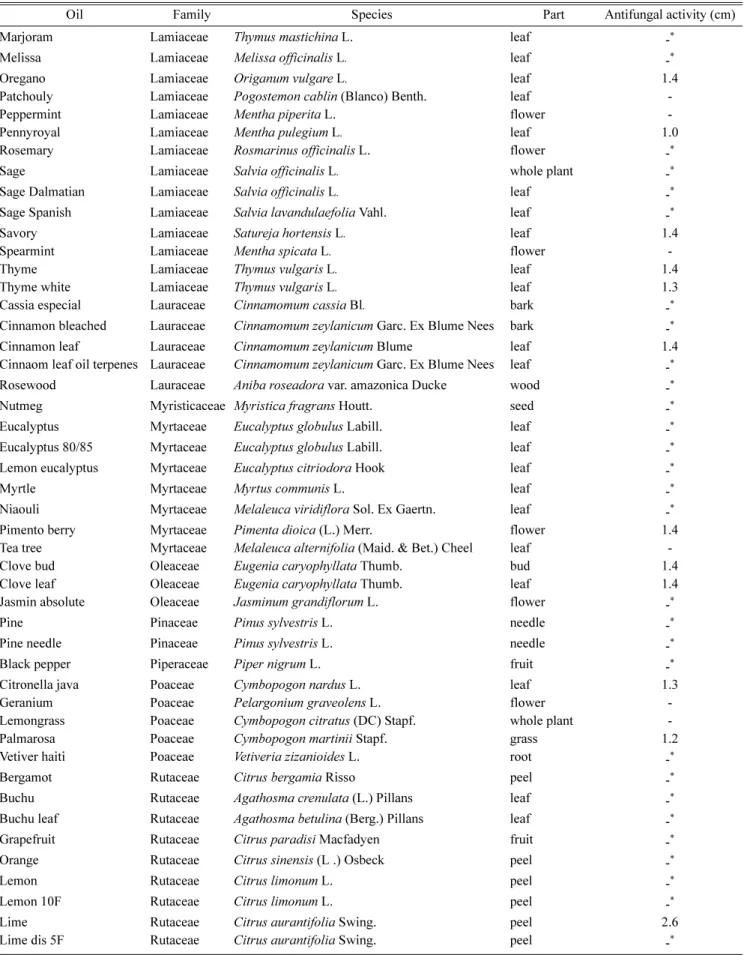
Totally 108 plant essential oils were used for antifungal activity tests, and they were purchased from UNIQ F&F Co., Ltd. (Seoul, Korea). The detail information of these essential oils was shown in Table 1.
Malassezia strain, growth conditions and inoculum preparation
Malassezia furfur (KCCM 12679) was obtained from the Korean Culture Center of Microorganisms (Seodeamun- Gu, Seoul, Korea). This strain was grown on Sabouraud
*Corresponding author
Tel: 82-62-950-3656, Fax: 82-62-953-2218 E-mail: [email protected]
Table 1. Antifungal activities against Malassezia furfur of 108 plant essential oils.
Oil Family Species Part Antifungal activity (cm)
Garlic Alliaceae Allium sativum L. root 1.0
Cananga Annonaceae Cananga odorata Hook fil. et Thomp. flower -*
Ylang ylang Annonaceae Cananga odorata Hook. f. et Thomson flower -*
Anise Apiaceae Pimpinella anisum L. fruit -*
Aniseed Apiaceae Pimpinella anisum L. fruit -*
Caraway seed Apiaceae Carum carvi L. seed 1.4
Carrot seed Apiaceae Daucus carota L. seed -*
Celery seed Apiaceae Apium graveolens L. seed -*
Coriander Apiaceae Coriandrum sativum L. flower -*
Coriander herb Apiaceae Coriandrum sativum L. leaf 1.2
Fennel Apiaceae Foeniculum vulgare Mill. seed -*
Galbanum Apiaceae Ferula galbaniflua Boiss.et Buhse root -*
Lovage root Apiaceae Levisticum officinale L. Koch fruit -*
Parsley herb Apiaceae Petroselinum crispum (Mill.) Nyman whole plant -*
Parsley seed Apiaceae Petroselinum crispum (Mill.) Nyman seed -*
Star anise Apiaceae Illicium verum L. fruit -*
Armoise Asteraceae Artemesia vulgaris L. whole plant -*
Chamomile blue Asteraceae Chamomilla recutita (L.) Rauschert flower -*
Chamomile roman Asteraceae Chamaemelum nobil (L.) All. flower -*
Davana Asteraceae Artemisia pallens Wall. Ex DC whole plant -*
Helichrysum Asteraceae Helichrysum angustifolium DC flower -*
Tagette Asteraceae Tagetes minuta L. leaf -*
Estragon Asteraceae Artemisia dracunculus L. leaf -*
Wormwood Asteraceae Artemisia absinthium L. flower -*
Frankincense Burseraceae Boswellia thurifera Roxburgh root -*
Myrrh Burseraceae Commiphora myrrha var. molmol Engl. stem -*
Tarragon Asteraceae Artemisia dracunculus L. stem -*
Yarrow Asteraceae Achillea millefolium L. flower -*
Cade Cupressaceae Juniperus oxycedrus L. wood -*
Cedarleaf Cupressaceae Thuja occidentalis L. leaf -*
Cedarwood Cupressaceae Juniperus irginiana L. bark -*
Cedarwood Chinese Cupressaceae Juniperus funebris Endl. bark -*
Cedarwood Texas Cupressaceae Juniperus mexicana Spring. bark -*
Cypress Cupressaceae Cupressus sempervirens L. twig -*
Juniperberry Cupressaceae Juniperus communis L. berry -*
Wintergreen Ericaceae Gaultheria procumbens L. leaf -*
Cascarilla bark Euphorbiaceae Croton eleuteria Bennett bark -*
Balsam peru Fabaceae Myroxylon balsamum var. pereirae Royle resin 1.2
Basil Lamiaceae Ocimum basilicum L. flower -
Basil sweet Lamiaceae Ocimum basilicum L. whole plant -
Catnip Lamiaceae Nepeta cataria L. leaf&flower 1.4
Clary sage Lamiaceae Salvia sclarea L. flower -*
Hyssop Lamiaceae Hyssopus officinalis L. leaf -*
Lavender Lamiaceae Lavaendula officinalis (Chaiz.) flower -*
Lavender 10/42 Lamiaceae Lavandula angustifolia Mill. flower -*
Table 1. Continued.
Oil Family Species Part Antifungal activity (cm)
Marjoram Lamiaceae Thymus mastichina L. leaf -*
Melissa Lamiaceae Melissa officinalis L. leaf -*
Oregano Lamiaceae Origanum vulgare L. leaf 1.4
Patchouly Lamiaceae Pogostemon cablin (Blanco) Benth. leaf -
Peppermint Lamiaceae Mentha piperita L. flower -
Pennyroyal Lamiaceae Mentha pulegium L. leaf 1.0
Rosemary Lamiaceae Rosmarinus officinalis L. flower -*
Sage Lamiaceae Salvia officinalis L. whole plant -*
Sage Dalmatian Lamiaceae Salvia officinalis L. leaf -*
Sage Spanish Lamiaceae Salvia lavandulaefolia Vahl. leaf -*
Savory Lamiaceae Satureja hortensis L. leaf 1.4
Spearmint Lamiaceae Mentha spicata L. flower -
Thyme Lamiaceae Thymus vulgaris L. leaf 1.4
Thyme white Lamiaceae Thymus vulgaris L. leaf 1.3
Cassia especial Lauraceae Cinnamomum cassia Bl. bark -*
Cinnamon bleached Lauraceae Cinnamomum zeylanicum Garc. Ex Blume Nees bark -*
Cinnamon leaf Lauraceae Cinnamomum zeylanicum Blume leaf 1.4
Cinnaom leaf oil terpenes Lauraceae Cinnamomum zeylanicum Garc. Ex Blume Nees leaf -*
Rosewood Lauraceae Aniba roseadora var. amazonica Ducke wood -*
Nutmeg Myristicaceae Myristica fragrans Houtt. seed -*
Eucalyptus Myrtaceae Eucalyptus globulus Labill. leaf -*
Eucalyptus 80/85 Myrtaceae Eucalyptus globulus Labill. leaf -*
Lemon eucalyptus Myrtaceae Eucalyptus citriodora Hook leaf -*
Myrtle Myrtaceae Myrtus communis L. leaf -*
Niaouli Myrtaceae Melaleuca viridiflora Sol. Ex Gaertn. leaf -*
Pimento berry Myrtaceae Pimenta dioica (L.) Merr. flower 1.4
Tea tree Myrtaceae Melaleuca alternifolia (Maid. & Bet.) Cheel leaf -
Clove bud Oleaceae Eugenia caryophyllata Thumb. bud 1.4
Clove leaf Oleaceae Eugenia caryophyllata Thumb. leaf 1.4
Jasmin absolute Oleaceae Jasminum grandiflorum L. flower -*
Pine Pinaceae Pinus sylvestris L. needle -*
Pine needle Pinaceae Pinus sylvestris L. needle -*
Black pepper Piperaceae Piper nigrum L. fruit -*
Citronella java Poaceae Cymbopogon nardus L. leaf 1.3
Geranium Poaceae Pelargonium graveolens L. flower -
Lemongrass Poaceae Cymbopogon citratus (DC) Stapf. whole plant -
Palmarosa Poaceae Cymbopogon martinii Stapf. grass 1.2
Vetiver haiti Poaceae Vetiveria zizanioides L. root -*
Bergamot Rutaceae Citrus bergamia Risso peel -*
Buchu Rutaceae Agathosma crenulata (L.) Pillans leaf -*
Buchu leaf Rutaceae Agathosma betulina (Berg.) Pillans leaf -*
Grapefruit Rutaceae Citrus paradisi Macfadyen fruit -*
Orange Rutaceae Citrus sinensis (L .) Osbeck peel -*
Lemon Rutaceae Citrus limonum L. peel -*
Lemon 10F Rutaceae Citrus limonum L. peel -*
Lime Rutaceae Citrus aurantifolia Swing. peel 2.6
Lime dis 5F Rutaceae Citrus aurantifolia Swing. peel -*
Dextrose Broth (SDB) or Sabouraud Dextrose Agar (SDA) (Difco, Sparks, MD, USA) supplemented with 1% (v/v) of pure olive oil (Yakuri Pure Chemicals, Kyoto, Japan), following incubation at 37
oC during 2-7 days. Malassezia strains were maintained on the same medium described previously, at 4
oC, with subcultures being carried out on a monthly basis. The same medium was used in all the experiments. Inoculum suspensions were prepared by the method as described previously [14]. One milliliter of 48 h culture was centrifuged (3000 g at 4
oC for 1 min), followed by washing the pellets twice with 1 mL of phosphate buffered saline (PBS). Clusters of Malassezia cells were formed upon preparation of inoculum suspensions. The washing of these suspensions with PBS promotes single- cell status and more accurate turbidity measurements.
Antifungal activity
The antifungal activity of the plant essential oils was carried out by minor modification of previous method using 100 µL of suspension containing 5×10
6CFU/mL of M.
furfur [1]. The discs (6 mm in diameter) were impregnated with 10 µL of essential oil diluted with 95% ethanol under aseptic conditions and placed on the inoculated agar.
Negative controls were prepared using the same solvent
that was spread on the agar plates. In first screening, the disks (Whatman, 6 mm in diameter) impregnated with essential oil of 2 mg/mL and were placed on the inoculated agar. The selected oil impregnated with 1.5 mg/mL, 1.0 mg/mL, 0.5 mg/mL, and 0.1 mg/mL also was placed on the inoculated agar. Itraconazole of four concentrations were used as positive reference standards. The antifungal activity was evaluated by measuring the inhibition-zone diameter observed after 48 h of incubation.
Gas chromatography (GC-FID)
Gas chromatography analysis was performed on the Agilent 6890N equipped with a DB-1MS column (30 m × 0.25 mm i.d., 0.25 um film thickness, J&W Scientific, Folsom, CA). The oven temperature was programmed as:
isothermal at 40
oC for 1 min, then raised to 250
oC at 6
oC/
min and held at this temperature for 4 min. Helium was used as the carrier gas at the rate of 1.5 mL/min in split mode (50 : 1 ratio). The constituents of the plant essential oil were identified by comparing their GC retention indices (RI). RI of each constitutes of plant essential oil were obtained by co-injection of essential oil and a mixture of aliphatic hydrocarbons (C8-C20; Sigma-Aldrich, St. Louis, USA). RI was calculated using the equation proposed by
Table 1. Continued.Oil Family Species Part Antifungal activity (cm)
Mandarine Rutaceae Citrus reticulata Blanco peel -*
Neroli Rutaceae Citrus aurantium L. flower -*
Petitgrain Rutaceae Citrus aurantium L. subp. amara leaf -*
Tangerine Rutaceae Citrus reticulata Blanco peel -*
Sandalwood Santalaceae Santalum album L. wood -*
Valerian Valerianaceae Valeriana officinalis L. rhizome -*
Rose Rosaceae Rosa damascene Mill. flower -*
Chamomile blue Asteraceae Chamomilla recutita (L.) Rauschert flower -*
Estragon Asteraceae Artemisia dracunculus L. leaf -*
Lemongrass Poaceae Cymbopogon citratus (DC) Stapf. whole plant -*
Bay Myrtaceae Pimenta racemosa (Mill.) J.W.Moore leaf 1.3
Litsea cubeba Lauraceae Litsea cubeba L. fruit -*
Tamanu Clusiaceae Calophyllum inophyllum L. fruit -*
Xanthoxylum Rutaceae Zanthoxylum armatum seed -*
Eucalyptus Myrtaceae Eucalyptus citriodora leaf -*
Ginger Zingiberaceae Zingiber officinale Roscoe rhizome -*
Itraconazole 1.5
Samples treated with concentration of 2 mg. ‘-
*’ expressed no activity.
van Den Dool and Kratz (1963) [15].
Gas chromatography-mass spectrometry (GC-MS)
The essential oils of Citrus aurantifoliaa was analyzed on a gas chromatograph (Agilent 6890N)-mass spectro- meter (Agilent 5973N MSD) equipped with a DB-5MS column (30 m ×0.25 mm i.d., 0.25 um film thickness, J&W Scientific, Folsom, CA). The oven temperature was pro- grammed as for the previous analysis. Helium was used as the carrier gas at the rate of 1.0 mL/min. Effluent of the GC column was introduced directly into the source of the MS via a transfer line (250
oC). Ionization voltage was 70 eV and ion source temperature was 230
oC. Scan range was 41- 450 amu. Compounds were tentatively identified by com- parison of mass spectra of each peak with those of authentic samples in the NIST MS library.
Results and Discussion
Antifungal activity of 108 plant essential oils was found when the essential oil was assayed at 2 mg/mL (Table 1).
The results showed the inhibitory effects of 17 oils [Allium sativum L., Carum carvi L., Coriandrum sativum L., Myroxylon balsamum var. pereirae Royle, Nepeta cataria L., Origanum vulgare L., Mentha pulegium L., Satureja hortensis L., Thymus vulgaris L. Thymus vulgaris L., Cinnamomum zeylanicum Blume, Pimenta dioica (L.) Merr., Eugenia caryophyllata Thumb.(Clove bud), Eugenia caryophyllata Thumb. (Clove leaf), Cymbopogon nardus L., Cymbopogon martinii Stapf., Citrus aurantifolia Swing.
and Pimenta racemosa (Mill.) J.W.Moore] on M. furfur at 2 mg/mL. These oils showed similar inhibitory activity to itraconazole at 2 mg/mL. Among the 17 active oils, only the Citrus auranifolia essential oil exhibited strong in- hibitory activity at dose dependent manner and the activity was higher than itraconazole at same concentration (Fig. 1).
The chemical compositions of the antifungal essential oil are shown in Table 2. A total of 15 compounds were identi- fied in Citrus auranifolia oil by GC and GC-MS analysis.
Among the identified compounds, limonene (51.07%) was the most abundant compound and γ-terpinene (14.29%) and terpinolene (11.32%) were followed (Table 2).
Malassezia species are associated with a number of dermatological disorders including dandruff/seborrheic der- matitis and pityriasis versicolor [3]. In general, for treat- ment of such illnesses, azole drugs such as fluconazole and
ketoconazole are used, but with increasing usage of antifungal agents, those have led undesired effects include severe toxic hepatitis, acquired cutaneous adherence [12, 13]. In contrast, there are a few reports concerning the susceptibility of Malassezia to natural antifungal or anti- Malassezia agents. Consequently, plant-derived anti-fungal agents are of increasingly interest for the development of new, more effective and specific anti-Malassezia agents In this work, we demonstrated that the 17 oils among the 108 plant essential oils had inhibitory activity against M.
furfur at 2 mg/mL. The most active C. aurantifolia essential oil among the 17 oils was some higher than that of itraconazole showing dose dependency (Fig. 1).
Hence, the C. auranifolia essential oil has most good antifungal activity among tested oils. This activity of C.
auranifolia essential oil can be associated with the presence of limonene, γ-terpinene, and terpinolene. However, also other major and/or minor components in the C. auranifolia essential oil may influence its antifungal activity. Possible synergistic and/or antagonistic interactions among the essential oil components should also be considered. There have been studies supporting these results in various Citrus species and its components [9, 11, 16].
In conclusion, the essential oils of C. auranifolia showed interesting antifungal activity. Although, further studies are
Table 2. Chemical composition of Citrus aurantifolia essential oil.Compound RI * Relative composition ratio, %
α-pinene 928 0.58
β-pinene 967 1.12
Myrcene 981 0.91
3-Carene 1,002 1.58
αTerpinene 1,007 3.02
p-Cymene 1,010 2.71
Limonene 1,019 51.07
Unknown 1 1,038 0.50
γ-Terpinene 1,049 14.29
Terpinolene 1,078 11.32
Unknown 2 1,125 0.47
α-Terpineol 1,171 7.44
Benzoic acid 1,179 1.38
β-Caryophyllene 1414 0.76
α-Cedrene* 1,432 1.12
α-Bergamotene* 1,496 1.32
α-Bisabolene† 1,529 0.43
* Retention indices.
† Tentatively identified by mass library.
needed, the use of essential oils of C. auranifolia against microbial growth seems a valuable alternative as antifungal compound, especially in the cases of anti-Malassezia resistance.
Acknowledgement
This research was supported by Kwangju Women's University in 2010, Korea.
R
EFERENCES1. Anesini, C. and C. Perez. 1993. Screening of plants used in Argentine folk medicine for antimicrobial activity. J. Ethnop- harmacol. 39: 119-128.
2 Aperis, G., N. Myriounis, E. K. Spanakis, and E. Mylonakis.
2006. Developments in the treatment of candidiasis: more choices and new challenges. Expert. Opin. Investig. Drugs 15: 1319-1336.
3. Ashbee, H. R. and E. G. V. Evans. 2002. Immunology of Diseases Associated with Malassezia Species. Clin. Micro- biol. Rev. 15: 21-57.
4. Batra, R., T. Boekhout, E. Guého, F. J. Cabañes, T. L. Daw- son Jr, and A. K. Gupta. 2005. Malassezia Baillon, emerg- ing clinical yeasts. FEMS Yeast Res. 5: 1101-1113.
5. Bulmer, A. C. and G. S. Bulmer. 1999. The antifungal action
of dandruff shampoos. Mycopathologia 147: 63-65.
6. Burt, S. 2004. Essential oils: their antibacterial properties and potential applications n foods - a review. Int. J. Food. Micro- biol. 94: 23-253.
7. Gupta, A. K., R. Batra, R. Bluhm, T. Boekhout, and T. L.
Dawson Jr. 2004. Skin diseases associated with Malassezia species. J. Am. Acad. Dermatol. 51: 785-798.
8. Hammer, K. A., C. F. Carson, and T. V. Riley. 2000. In vitro activities of ketoconazole, rconazole, miconazole and Mela- leuca alternifolia (Tea Tree) oil against Malassezia species.
Antimicrob. Agents Chemother. 44: 467-469.
9. Mayaud, L., A. Carricajo, A. Zhiri, and G. Aubert. 2008.
Comparison of bacteriostatic and bactericidal activity of 13 essential oils against strains with varying sensitivity to antibi- otics. Lett. Appl. Microbiol. 47: 167-173.
10. McGinley, K. J., L. R. Lantis, and R. R. Marples. 1970.
Microbiology of tinea versicolor. Arch. Dermatol. 102: 168- 171.
11. O'Bryan, C. A., P. G. Crandall, V. I. Chalova, and S. C.
Ricke. 2008. Orange essential oils antimicrobial activities against Salmonella spp. J. Food. Sci. 73: M264-M267.
12. Odds, F. C., A. J. P. Brown, and N. A. R. Gow. 2003. Anti- fungal agents: mechanisms of action. Trends Microbiol. 11:
272-279.
13. Polsen, J. A., P. R. Cohen, and A. Sella. 1995. Acquired cutaneous adherence in patients with androgen-independent prostate cancer receiving ketoconazole and doxorubicin:
medication induced sticky skin. J. Am. Ac. Derm. 32: 571- 575.
14. Rukayadi, Y., Yong, D. and Hwang, J. K. (2006) In vitro anticandidal activity of xanthorrhizol isolated from Curcuma xanthorrhiza Roxb. J Antimicrob Chemother 57: 1231-1234.
15. van Den Dool, H. and P. D. Kratz. (1963) Generalization of the retention index system including linear temperature pro- grammed gas-liquid partition chromatography. J Chro- matogr 11: 463-471.
16. Yang, S. A., S. K. Jeon, E. J. Lee, C. H. Shim, and I. S. Lee.
2010. Comparative study of the chemical composition and antioxidant activity of six essential oils and their compo- nents. Nat. Prod. Res. 24: 140-151.
(Received July 1, 2010/Accepted August 28, 2010) Fig. 1. Antifungal activity of essential oil of Citrus auranifolia
against Malassezia furfur. Values represent the means of 3 inde- pendent experiments.
국문초록
비듬균(Malassezia furfur)에 대한 식물 오일들의 항균활성 및 활성오일의 성분 분석
이정현·이재숙*광주여자대학교 미용과학과
비듬균(Malassezia furfur) 는 두피 질환을 일으키는 중요한 요소로써 오늘날 이러한 균들을 치료하는 치료제는 거 의 없다. 몇몇의 전의 연구에서 오일들의 다양한 생물학적 활성이 보고되어졌지만 그것들의 항비듬균 활성은 거의 연구되지 않았고, 특히 Malassezia furfur에 대한 저해 활성은 보고되어 있지 않다. 따라서, 이 연구에서는 Malassezia furfur에 대한 식물 오일들의 저해활성을 평가하고, 이러한 오일 중에서 가장 활성이 좋은 오일을 가스 크 로마토그래피(Gas chromatography-mass spectrometry)에 의해 성분을 분석하였다. 1차적으로 108개 오일의 스크리닝 과정에서 17개 오일[Allium sativum L., Carum carvi L., Coriandrum sativum L., Myroxylon balsamum var.
pereirae Royle, Nepeta cataria L., Origanum vulgare L., Mentha pulegium L., Satureja hortensis L., Thymus vulgaris L. Thymus vulgaris L., Cinnamomum zeylanicum Blume, Pimenta dioica(L.) Merr., Eugenia caryo- phyllata Thumb.(Clove bud), Eugenia caryophyllata Thumb.(Clove leaf), Cymbopogon nardus L., Cymbopogon martinii Stapf., Citrus aurantifolia Swing. and Pimenta racemosa(Mill.) J.W.Moore] 이 2 mg/mL 의 농도에서 대조구인 이크라코나졸(itraconazole)과 비슷한 활성을 나타내었다. 이러한 17개 오일 중에서 Citrus auranifolia 오일 이 가장 활성이 좋았으며, 처리농도 (1.5 mg/mL, 1.0 mg/mL, 0.5 mg/mL와 0.1 mg/mL) 에 따라 활성이 감소하는 경향을 보였다. 또한 Citrus auranifoli 오일의 가스크로마토그래피(GC-MS) 성분분석 결과 limonene, γ-terpinene and terpinolene의 함유율이 높은 것으로 나타났다. 그러므로 Citrus auranifolia 오일은 곰팡이 유래 질병들을 치료하기 위 한 활성성분을 함유하고 있는 것으로 보인다.