pISSN 1738-3544 eISSN 2288-1662
Improved Antibacterial Effect of Blending Essential Oils
Pil Seung Kwon 1 , Dae-Jung Kim 2 , Ho Park 1
1
Department of Clinical Laboratory Science, Wonkwang Health Science University, Iksan, Korea
2
Department of Laboratory Medicine, Bundang Jesaeng Hospital, Seongnam, Korea
블렌딩 에센션오일의 항균효과 증진
권필승 1 , 김대중 2 , 박 호 1
1
원광보건대학교 임상병리과,
2분당재생병원 진단검사의학과
Essential oil from herb is known to exert pharmacological effects on the human body. In this study we investigated the antibacterial activity of 4 essential oils (teetree, rosemary, melisa, and lavender), as well as the blended mixture oil of teetree, rosemary, and melisa (TRM) on three bacteria, Staphylococcus aureus , Escherichia coli , and Pseudomonas aeruginosa . Antibacterial analysis was performed using the standard disk diffusion method, and minimum inhibition concentration was determined by the broth microdilution method with different concentrations of essential oils (0.5, 1, 2 and 3 mg/mL). After incubation at 37°C for 24 h, the antibacterial activity was assessed by measuring the zone of growth inhibition surrounding the disks. Herb oil with the inhibition zones showed varied values ranging from6 to 25 mm. However, the components of herb oil of TRM are as highly active as the teetree oil against pathogens, generating large inhibition zones for both gram negative and positive bacteria (13∼22 mm and 8 mm inhibition zones). In the analysis for MIC, TRM showed growth-inhibitory effects at 0.0625% for S . aureus and E . coli , and 1.25% for P . aeruginosa . This result demonstrated that the anti-microbial activity of TRM was greater than a single herb oil, including oxacillin, rosemary, and teetrea. As a single herb oil, both rosemary and teetrea also had an anti-microbial effect by itself, and we can expect that the blended oil mixture may exert a synergistic effect against multidrug resistant bacteria, suggesting its future application in natural preservative agents for health food and cosmetics.
Key words: Essential oil, Antibacterial activity, Growth-inhibition, Blended mixture oil
Corresponding author: Pil Seung Kwon Department of Clinical Laboratory Science, Wonkwang Health Science University, 514 Iksandae-ro, Iksan 54538, Korea Tel: 82-63-840-1212 Fax: 82-63-840-1219 E-mail: [email protected]
This is an Open Access article distributed under the terms of the Creative Commons Attribution Non-Commercial License (http://creativecommons.org/licenses/by-nc/4.0) which permits unrestricted non-commercial use, distribution, and reproduction in any medium, provided the original work is properly cited.
Copyright © 2017 The Korean Society for Clinical Laboratory Science. All rights reserved.
Received: May 18, 2017 Revised 1
st: May 23, 2017 Revised 2
nd: May 29, 2017 Revised 3
rd: June 10, 2017 Revised 4
th: June 16, 2017 Revised 5
th: June 19, 2017 Accepted: June 19, 2017
서 론
에센셜 오일(Essential Oil)은 식물의 2차 대사산물 중 인체 에 약리효과를 나타내는 성분으로 이루어진 휘발성 유기화합물 로, 주로 식물의 내분비선에서 분비되며 식물체내에서 생합성 되어 생성된다. 식물종이나 부위에 따라 여러 가지 향기나 특성 이 다르고 수증기 증류법, 용매추출법, 압착법 등에 의해 추출한
다. 오일은 수소, 탄소, 산소 등이 화학물질이 기본구조이며 테 르펜류, 에스테르, 알데하이드, 옥사이드, 케톤, 알콜, 등의 다양 한 성분과 함량이 존재한다[1].
로즈마리는 Rosemarinus officinalis 학명으로 유럽에서 오 랜세월 동안 기억을 증진시키기 위한 상징처럼 여겨지며[2], 로 즈마리 입은 항 인간면연결핍바이러스[3], 항염증[4], 항 종양 [5]과 항산화[6]를 포함하여 다양한 생리활성인자에 관여하는
것으로 알려져 있다. 티트리는 Melaeuca alternifolia 학명으로 감염된 상처부위에 탁월한 효과가 있으며, 항균효과가 있다고 알려져 있다[7]. 라벤더는 Lavandula angustifolia 학명으로 여 러 가지 용도로 사용되는 것으로 스트레스, 불면, 우울 , 항산화 에 효과가 있다고 알려져 있다[8,9]. 멜리사는 Melissa officinalis 학명으로 가장 오래되고 여전히 흔히 사용되는 것으로 평온, 항 경련효과, 항균제, 항바이러스제, 항염증제, 항산화제 및 신경 안정 효과가 있는 것으로 보고 되었다[10]. Staphylococcus aureus는 그람양성알균으로 사람의 피부와 호흡기에서 발견되 며, 항생제 내성과 조직 침습력이 강하고 기회주의적 병독성을 가진다[11,12]. Escherichia coli는 유당 발효성을 가진 그람음 성막대균으로 주로 비뇨기 감염을 일으키며, 이질과 같은 유사 감염과 발열의 원인으로 빈번하게 감염을 일으키기도 한다[12].
Pseudomonas aeruginosa는 그람음성막대균이며, 극성단 모균으로 화상환자의 상처감염이 흔하며, 종종 패혈증, 요도와 호흡기 감염을 일으키는 다제내성균이다[13]. 최근 천연물질의 자연치유능력에 대한 관심도가 높아짐에 따라 식물에서 추출한 에센셜 오일의 효과에 대한 연구가 활발히 진행되고 있다[14].
에센셜오일을 이용한 연구는 2009년 Lodhia 등[15]은 S.
aureus와 Escherichia coli 에 라벤다(Lavandula angustifolia), 팔마로사(Cymbopogon martini), 튜브로즈(Polianthus tube- rose) 에센셜 오일의 항균효과를 보고하였고, 국내에도 2010년 Chae 등[16]은 S. aureus에 라벤더 오일의 항균효과를 보고 하 였다. 아로마 테라피는 식물에서 추출한 에센셜 오일을 인체에 적용하여 각종 질병 예방에 도움을 주는 수단중의 하나로 사용 되고 있으며, 이런 아로마 테라피의 상승효과(synergistic effect) 를 위해 임상전문가들은 대개 2∼3가지의 에센셜 오일의 블렌 딩 오일(blending oil)을 추천하고 있다[17]. 지금까지 상승효 과를 연구한 논문들은 대부분 오일의 구성성분 중 1∼2가지의 대표성분을 추출하여 항균효과들을 입증해 왔다[18]. 하지만 실제로 각 질환마다 적용할 수 있고 완벽한 시너지효과를 보이 는 블랜딩 오일의 과학적 증거들이 불충분하다[19]. 따라서, 본 연구에서는 화농성질환과 병독성질환 비뇨기계통 감염에 나올 수 있는 병원성세균을 대상으로 천연 허브 오일 중에 비교적 많 이 알려져 있는 오일인 라벤더(lavender), 티트리(tea tree), 로 즈마리(rosemary), 멜리사(melisa)오일 4종류의 단일오일과 티트리와 로즈마리, 멜리사를 블렌딩하였을 때 실제로 항균력 의 상승효과를 연구하였다.
재료 및 방법
1. 대상균주
Staphylococcus aureus (ATCC 25923), Escherichia coli (ATCC 25922), Pseudomonas aeruginosa (ATCC 27853) 균 3종류를 tryptic soy broth에 접종 후 사용하여 산소성 배양기 (Vision scientific, VS1203P1, Daejeon, Korea)에서 37°C로 18∼24시간 배양을 하였다.
2. 에센셜오일
오일의 추출은 수증기 증류(steam distillation) 법으로 추출 하였으며, 티트리(teetree), 로즈마리(rosemary), 멜리사(melisa), 라벤더(lavender)와 티트리:로즈마리:멜리사(TRM)를 1:1:1 로 블렌딩한 오일 5종류를 사용하였다[20]. 오일은 원광대학교 해부학교실로부터 제공받아 사용하였다.
3. 디스크 확산법 측정
CLSI 가이드라인 M07-A10 [21]에 따라 대상균주를 Mueller Hinton agar에 직접 제조하여 계대 한 후37°C 배양기(Vision scientific, VS1203P1, Daejeon, Korea)에서 18∼24시간 동 안 배양 한 후 집락을 취하여 Mueller Hinton broth 2 mL에 현 탁시킨 다음 1.5×10
8
cell/mL가 되는 0.5 MacFatland 표준 값 을 densicheck 탁도계(bioMerieux, Marcy L'Etoile, France) 로 측정 한 후 Mueller Hinton agar 에 멸균된 면봉으로 고루 분 주 하였다. 각각의 허브오일 5종류를 멸균된 6 mm 종이디스크 를 멸균된 페트리디쉬에 세 개씩 담은 다음 수증기추출법으로 추출한 100% 허브 오일을 각 10
L 씩 분주한 뒤 15분간 흡수시 킨 후 또 10
L씩 분주한 후 1시간을 건조시킨 후 Mueller Hinton agar에 멸균된 핀셋으로 가볍게 올려 놓은 후 살짝 눌러 준 후 배지 뚜껑을 밑으로 하여 산소성 배양기에서 35°C로 18∼24시간 배양을 하였다. 이때 총 분주량은 20
L가 되며, 대조를 위해 항균제디스크 Oxacillin 10
g (Bectone dickinson, Sensi-DISC, USA)와 Ciprofloxacin 5
g (Bectone dickinson, Sensi-DISC, USA) 디스크를 동시에 시행하였다. 18∼24시간 배양 후 디스크 주위의 억제대 직경(mm)을 측정하였다. 이와 같은 실험은 3회 반복 시행하여 평균을 내었다.4. 최소억제농도(minimum inhibition concentrations, MIC) 측정
CLSI 가이드라인 M07-A10 [21]에 따라 배양된 각 균주의 단 일 colony를 Mueller Hinton broth 2 mL에 현탁시킨 다음 1.5
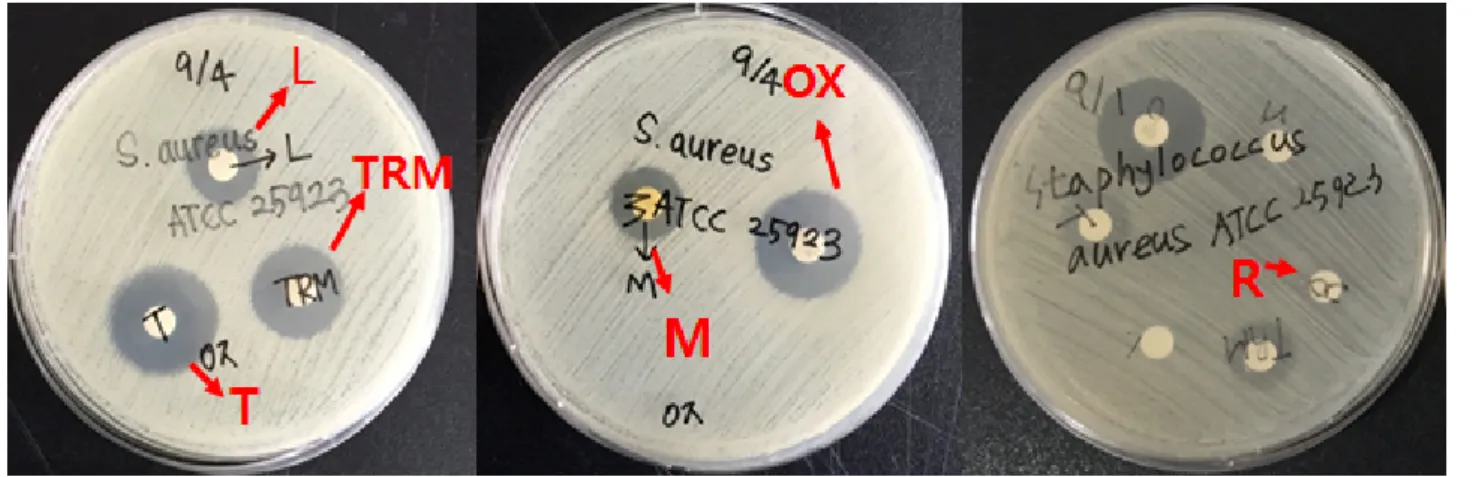
Figure 1. Antibacterial inhibition zone of essential oils against S . aureus . (A) M, melisa; OX, Oxacillin, (B) T, teetree; L, Lavender, (C) R, rosemary.
Table 1. Antimicrobial activity of 20 uL of essential oils determined by disc diffusion method
Bacteria Inhibition Zone (mm)
Teetree Rosemary Melisa Lavender Blending oil Oxacilin Ciprofloxacin
S . aureus 21 6 14 15 18 22 ND*
E . coli 25 20 21 14 22 ND 39
P . aeruginosa 13 6 9 6 13 ND 34
Abbreviation: ND, not detected.
× 10
8
cell/mL가 되는 0.5 MacFarland 표준값을 densicheck 탁도계(bioMerieux, Marcy L'Etoile, France) 로 측정 한 후 실 험균주를 1/10 씩 계단희석 하여 0.5×10⁵
cell/mL로 사용하였 다. 862
g/mL인 항균제 분말을 사용하여 역가가 1,280
g/mL인 표준용액 1 mL을 만들 때의 식을 이용하여 Oxacillin 분말 0.00148 g와 증류수 900
L와 함께 희석하여 첫 번째 웰에 최종농도는 128
g/mL부터 2배 계단희석 되었다. Ciprofloxacin 은 0.1 N NaOH와 멸균된 증류수를 1:1 희석한 용액에 효력이 980
g/mL인 항균제 분말을 사용하여 역가가 1,280
g/mL인 표준용액 1 mL 만들 때 Ciprofloxacin 파우더를 0.0013g을 희 석하여 사용하였다. 첫 번째 웰에 최종농도는 16
g/mL 부터 2 배 계단희석 되었다. 에센셜 오일 100
L 와 멸균된 증류수 900
L 를 Vortex mixer를 이용하여 혼합하여 사용하였다. 균주 부 유액 100
L 씩을 96 well plate에 분주하고 희석된 에센셜 오 일은 100
L 를 혼합한 후 계단희석을 하였다. plate는 파라핀 필름으로 테두리를 막은 후 35°C 산소성 배양기에서 18∼24시 간 배양을 한 후 육안적으로 억제된 농도를 판독하였다.결 과
1. 디스크 확산법의 결과
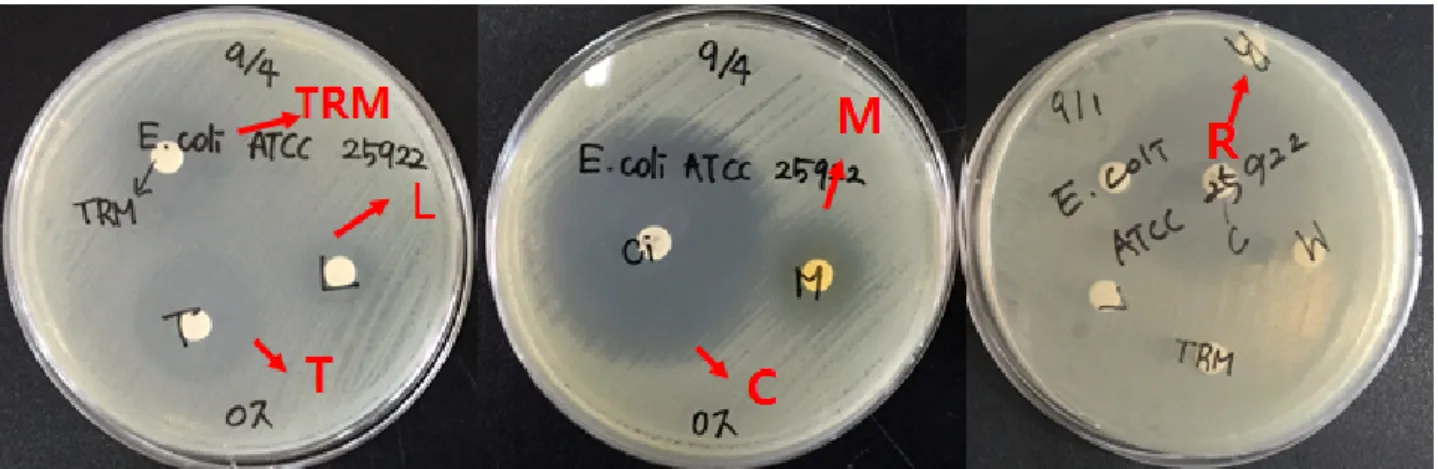
각 에센셜 오일의 디스크 확산법에 의한 항균력 결과는 Table 1과 같은 억제대 지름을 나타내었으며, 티트리와 블렌딩오일의 항균효과가 가장 우수한 것으로 나타났다. 이 중 티트리는 가장 우수한 항균력을 나타내어 S. aureus, E. coli, P. aeruginosa 균 주에서 각각 21, 25, 13 mm의 억제대가 측정되었고, 블랜딩 오 일은 균에 따라 각각 18, 22, 13 mm가 측정되었다. 멜리사는 균 에 따라 각각 14, 21, 9 mm가 측정되었고, 로즈마리는 균에 따 라 각각 6, 20, 6 mm의 억제대가 나타났다. 라벤더는 균에 따라 각각 15, 14, 6 mm가 측정되었다. CLSI 가이드라인 M100-S22 [22]에 따라 그람양성알균에 사용되는 oxacillin 1
g 디스크의 억제대를 측정한 결과 S. aureus (ATCC 25923) 그람양성균주 는22 mm 가 나와 CLSI 가이드라인에 제시하는 범위인 18∼24 mm 안에 들어가 검사의 정도관리를 확인하였으며, Escherichia coli (ATCC 25922)와 P. aeruginosa (ATCC 27853) 그람음성 막대균도 ciprofloxacin 5
g 디스크의 억제대를 측정한 결과 균주에 따라 각각 39, 32 mm 억제대를 나타내어 CLSI 가이드 라인에 제시하는 범위인 30∼40 mm 과 25∼33 mm 안에 들어 가 검사의 정도관리를 확인하였다(Figure 1∼3).Figure 2. Antibacterial inhibition zone of essential oils against E . coli . (A) M, melisa; OX, Oxacillin, (B) T, teetree; L, Lavender, (C) R, rosemary.
Figure 3. Antibacterial inhibition zone of herb oils against P . aeruginosa . M, melisa; C, cipfloxacin; T, teetree ; L, Lavender , R, rosemary.
Table 2. Minimum inhibition concentrations (MIC) of essential oils determined by broth dilution method
Bacteria MIC of each essential oil (%) MIC (µg/mL)
Teetree Rosemary Melisa Lavender Blending oil Oxacilin Ciprofloxacin
S . aureus 0.3125 0.625 2.5 2.5 0.3125 0.25 ND*
E . coli 2.5 5 5 2.5 0.3125 ND 0.008
P . aeruginosa 1.25 2.5 5 5 1.25 ND 0.25
Abbreviation: ‘See Table 1’.
2. MIC 측정결과
MIC는 그람음성균은 E. coli, P. aeruginosa, 그람양성균은 S. aureus에 대한 티트리, 로즈마리, 멜리사, 라벤더, 블렌딩(티 트리, 로즈마리, 멜리사)의 최소억제농도를 알아보기 위하여 허 브오일의 농도는 각각 0.0, 0.15, 0.3, 0.625, 1.25, 2.5, 5%로 계 단희석 하였으며, 대조군으로 그람양성균에는 Oxacillin, 그람 음성균에는 Ciprofloxacin으로 실험하였다. MIC에 의한 항균
력 결과는 Table 2와 같이 블렌딩오일의 항균효과가 가장 우수 한 것으로 나타났다.
블렌딩 오일은 S. aureus, E. coli, P. aeruginosa 균주에서 각 각 0.3125, 0.3125, 1.25%에서 최소억제농도을 나타내었고, 티트리 오일은 균에 따라 각각 0.3125, 2.5, 1.25%가 측정되었다.
로즈마리는 균에 따라 각각 0.625, 5, 2.5%가 측정되었고, 라 벤더는 균에 따라 각각 2.5, 2.5, 5% 에서 최소억제농도을 나타 내었다. 멜리사는 균에 따라 각각 2.5, 5, 5%가 측정되어 가장 낮
은 항균력을 나타내었다. CLSI 가이드라인 M100-S22 [18]에 따라 그람양성알균에 사용되는 oxacillin 최소억제농도는 S.
aureus (ATCC 25923) 그람양성균주는0.25
g/mL 가 나와 CLSI 가이드라인에 제시하는 범위인 0.12∼0.5
g/mL 안에 들어가 검사의 정도관리를 확인하였으며, Escherichia coli (ATCC 25922)와 P. aeruginosa (ATCC 27853) 그람음성막대 균도 ciprofloxacin 최소억제농도를 측정한 결과 균주에 따라 각각 0.008, 0.25
g/mL 억제농도를 나타내어 CLSI 가이드라 인에 제시하는 범위인 0.004∼0.015
g/mL과 0.25∼2
g/mL 안에 들어가 검사의 정도관리를 확인하였다.고 찰
항균성이 알려진 천연물질로는 주로 lysozyme, polylysine, protamine, conalbumun, avidin, 유기산, polyphenol 물질 등이 대표적이다[19-27]. Chae 등[28]에 의하면 로즈마리와 라벤더의 S. aureus균주의 디스크확산법에서 15, 12 mm 억제 대를 보였으며, E. coli 에서 17, 12 mm 억제대를 보였다. 그리 고 항균물질인 폴리페놀함량이 로즈마리가 가장 높고 라벤더도 비교적 높은 것으로 보고되었다. Son 등[29]은 6 mm paper disc를 사용하여 로즈마리 에탄올 추출물이 S. aureus 균에 미 치는 영향을 살펴 본 결과 8.3 mm로 페퍼민트, 스테비아 추출 물보다 뛰어난 효과를 보였으며, Chung 등 [30]은 로즈마리 추 출물로 실험한 결과 S. aureus 균에서 14 mm, E. coli 균에서는 9 mm로 나타났다. 본 연구의 결과에도 Table 2와 같이 로즈마 리와 라벤더가 항균력이 좋은 것은 일치하였지만, 원내감염균 이며, 창상감염에 주요원인균인 P. aeruginosa에는 항균효과 가 없었다. Table 2의 결과로 Oxacillin 10
g/mL 와 비슷한 항 균효과를 낸 허브오일은 티트리와 로즈마리로 확인되었으며, 특히 블렌딩 오일(티트리, 로즈마리, 멜리사)은 Oxacillin과 로 즈마리, 티트리보다 항균효과가 우수한 것으로 증명되어 허브 의 블렌딩을 활용하면 시너지효과를 발휘할 수 있음을 입증하 였다. 본 연구에서는 항균효과만 관찰하였지만, 차후 건강식품 과 식품첨가물 등의 활용을 목적으로 항산화효과를 입증하는 것도 필요하다고 할 수 있다. 본 연구에서 디스크확산법의 경우 1940년부터 발전되었으며[31], 많은 임상검사실에서 박테리 아와 진균의 항균제 감수검사에 사용되고 있다[17,18]. 이 검사 법에는 CLSI 표준에 의해 접종균액의 양과 배양시간, 온도, 성 장 배지들이 결정되고, 항균제 감수성의 양상은 감수성(sus- ceptible), 중등도 내성(intermediate), 내성(resistant)의 카테 고리로 제공되고 있다[32]. 그러므로 그것은 검사된 미생물의내성표현형을 바탕에 두고 제공되고 임상의사가 부분적, 경험 적 치료의 적합한 약제선택의 목적에 기초를 두고 있다. 디스크 확산법은 미생물의 성장이 억제된 것이며, 미생물의 사멸을 뜻 하지는 않는다. Balouiri 등[33]에 의하면 우무디스크 확산법은 최소억제농도를 결정하는데는 적절하지가 않고, 항균제의 양 을 정량 하기에는 불가능하나 그럼에도 불구하고 디스크 확산 법은 다른 방법보다 간단하고, 저렴한 비용과 많은 축적된 미생 물 및 항균제수의 결과가 제공된 결과를 쉽게 해석할 수 있는 장 점은 있다. 그러나 본 실험은 누적된 항균제가 아닌 정제된 에센 션오일의 사용으로 천연물의 효과에 대한 결과해석이 표준화 되지 않은 접종준비와 기술접근, 접종크기, 성장배지, 배양조건 및 최종적인 해석이 어렵다고 알려져 있으며, 디스크 법은 주로 간단하고 저렴한 비용의 장점으로 식물추출물, 에센셜오일 및 기타 약제의 항균력을 보기위한 예비시험으로 많이 사용된다 [34]. 본 실험결과에서 디스크확산법은 티트리가 조금 더 우수 한 결과를 보였지만, 그에 반해 MIC 값은 비록 S. aureus 와 P.
aeruginosa 에서는 큰 차이가 없었지만, E. coli 의 경우 티트리 는 2.5%로 측정되었으나 블렌딩오일에서는 0.3125%로 9배의 계단희석차이가 나타나 확실한 증진효과를 입증하였다. 그러 므로, 스크리닝 방법으로 사용된 디스크법은 에센셜오일의 접 종과 기술접근의 차이가 있어 오차가 있을 수 있다고 생각되지 만, MIC은 균주부유액에 직접 에센셜오일을 희석하는 방법에 서 정량이 가능하고 신빙도가 높다고 할 수 있다. 항균효과 결과 를 그람양성균과 음성균으로 구별해보면, 세균의 구조차이는 있어 항균효과의 차이를 예상할 수 있겠지만, Table 2의 결과와 같이 음성균인 E. coli는 양성균인 S. aureus 와 디스크 확산법 에서는 큰차이가 나지 않으나 P. aeruginosa에서는 로즈마리와 라벤더가 항균효과가 없는 것으로 나와 양성균과 음성균의 차 이에 따른 항균력의 차이는 논하기가 힘들고 균종별 항균력의 차이가 있는 것으로 보인다. 허브오일의 항균활성은 Nguefack 등[35]에 의하면 그람음성균의 세포막의 침투성증가와 ATP감 소로 LPS방출로 사멸하거나 Bouhdid 등[36]은 칼륨의 유출로 세포손상이 오고 세포벽의 구조와 성분의 변화가 사멸을 유도 한다고 알려져 있으나 앞으로 좀 더 많은 허브오일의 살균메커 니즘에 관한 연구가 필요하다고 사료된다. 그람음성균에서 디 스크확산법과 MIC법의 다소 항균력의 차이를 보이는 것은 허 브오일을 10배 희석후 MIC를 시행하여 결과가 차이가 있는 것 으로 사료된다. 시료의 추출방법에서도 수증기증류법으로 추 출하였지만 천연물로부터 정유를 추출하는 방법 중에 성분의 파괴없이 고순도 정유추출법인 초임계 추출법으로 사용하였다 면, 더 좋은 항균효과가 있을 거라 예상되고 추출방법별 항균효
과의 비교도 앞으로 연구가 필요하다고 할 수 있다. 따라서, 본 연구의 결과로 블렌딩한 허브오일의 시너지효과를 입증하였 고, 단독으로는 로즈마리와 티트리가 항균효과가 좋았으며, 향 후 천연보존제 뿐만 건강기능성 식품이나 화장품 등에 활용가 능 할 것으로 사료된다.
요 약
식물로부터 유래되는 휘발성 유기 화합물인 에센셜 오일은 인체에 약리효과를 나타낸다고 알려져 있다. 본 연구에서는 화 농성 질환과 병독성 질환 비뇨기계통 감염에 나올 수 있는 병원 성 세균 Staphylococcus aureus (그람양성알균), Escherichia coli (그람음성막대균), Pseudomonas aeruginosa (그람음성 막대균, 극성단모균)을 대상으로 천연 허브 오일 중에 비교적 많 이 알려져 있는 라벤더(lavender), 티트리(tea tree), 로즈마리 (rosemary), 멜리사(melisa) 4종류의 단일 오일과 비교해, 티트 리와 로즈마리, 멜리사를 블렌딩하였을 때 항균력이 상승되는 효과가 있는지 연구하였다. 그 결과 디스크 확산법에서 블렌딩 오일(티트리, 로즈마리, 멜리사)의 경우 단독의 허브오일보다 S.
aureus에서18 mm, E. coli 에서 22 mm 와 P. aeruginosa는13 mm의 우수한 항균능력을 확인할 수 있었다. 뿐만 아니라 블렌 딩 오일의 경우 최소억제농도(Minimum Inhibitory Concent- rations, MIC) 분석에서 S. aureus, E. coli 에서는 0.3125%에 서, P. aeruginosa는 1.25%에서 성장억제효과가 확인되었다.
따라서 본 실험에서는 블렌딩 오일이 Oxacillin과 로즈마리, 티 트리보다 항균효과가 우수한 것으로 증명되어 단독의 허브오일 보다 블렌딩 오일이 우수한 항균력을 나타나는 것을 확인할 수 있었다. 그러므로 허브의 블렌딩을 활용하면 다제 내성균에 대 한 항균시너지효과를 발휘할 수 있음을 입증했을 뿐만 아니라 향후 천연보존제와 건강기능성 식품 및 화장품에 활용 가능성 을 기대해본다.
Acknowledgements:
이 논문은 2016년도 원광보건대학교 교 내연구비 지원에 의해서 수행됨.Funding:
NoneConflict of interest:
NoneREFERENCES