원예과학기술지 19(1):81-86. 2001
관수량이 sweet basil(
Ocimum basilicum
)의 생장과 정유함량에 미치는 영향백혜원․박권우*
고려대학교 원예과학과
Effect of Watering on Growth and Essential Oil Content of Sweet Basil ( Ocimum basilicum )
Hae-Won Baeck and Kuen-Woo Park*
Department of Horticultural Science, Korea University, Seoul 136-701, Korea
*corresponding author
ABSTRACT This experiment was carried out to investigate watering with relation to growth, quality and yield of essential oil in sweet basil. The degree of water stress was taken as amount of watering. D1 was watered with 25mL for 2 weeks and 30mL from 4 to 5 weeks after planting in Wagner pot (1/20000a, ø24cm). As this, 75mL and 90mL, 225mL and 270mL, and 675mL and 810mL were watered in D2, D3, and D4 treatment respectively. DFT was set up as water stress was not inflicted. The growth of basil in D3 and D4 was better than that of others, in which root activity was as much twice as that of D1. Essential oil of D1 was recorded the lowest content as 0.33%. The result of proline content, peroxidase activity, photosynthesis, stomatal conductance and stomatal resistance were proved D1 to be stressed. This treatment consequently increased the content of essential oil. In consideration of growth and essential oil content, D3 treatment was highest as 47.37mg in oil production per plant. Finally, D3 watered with 225mL for 2 weeks and 275mL from 4 to 5 weeks after planting could be selected on the purpose of both plant growth and essential oil production. Essential oil content of sweet basil was increased in response to water stress. For increase of essential oil yield, oil synthesis could be raised by giving water stress just before harvesting.
Additional key words: herb, irrigation, pot culture, water stress
※ Received for publication 15 December 2000. Accepted for publication 7 February 2001. This research was funded in 1996 by the MAF-SGRP (Ministry of Agriculture and Forestry-Special Grants Research Program) in Korea.
서 언
바실(Ocimum basilicum)은 인도가 원산지인 호온성 작물이다.
현재 아시아 남부 지역, 북동 아프리카 그리고 북미에 널리 야생화 되어 있다. 바실은 생산지에 따라 다양한 향을 가지나, 일반적으로 정유 주성분은 linalool이 40%, methyl chavicol이 25%, 그 외에 eugenol, cineole, geraniol이 비슷한 함량을 차지한다(Deni, 1995). 바실은 피자등 서양 요리에서는 필수적인 향신료이며 정유 는 향 제조나 아로마테라피에 사용된다. 유럽에서는 바실향을 전통 적으로 인플루엔자에서 오는 열, 소화불량, 구토, 복통, 위경련, 위 장염, 편두통, 불면증, 피로 등의 치료에 이용하고 있다고 한다 (Lawless, 1995; Prasad 등, 1986; Grieve, 1981).
자연상태에서 작물은 광, 수분, 온도, 바람 등 다양한 환경적인
스트레스에 노출되며 이는 생산량을 감소시키는 원인중 하나이다.
이와 같은 스트레스는 광합성과 생장을 감소시키며, 이는 C 및 N 대사의 변화를 가져온다(Foyer 등, 1995). 정유함량은 환경적인 요 인이나 유전적인 요인에 의해 영향을 받으며, 식물의 생장단계나 부위에 따라 많은 변화가 있다(Lawrence, 1986; Denys와 Simon, 1990). 예를 들어, 물리적인 자극이 적은 온실 하에서 자란 백리향 의 경우 노지보다 향이 감소하는 것으로 관찰되었다(Letchamo와 Gosselin, 1996). 또한 마죠람의 포트 재배시 포트내 관수량을 조 절하여 실험시, 포트내 수분이 적어 생육이 저조해진 식물체가 토 양수분이 충분한 식물체에 비해 정유함량은 월등히 높았다고 한다 (Rhizopoulou와 Diamantoglou, 1991). 방향식물의 경우 토양수분 은 정유 생산에 대단히 중요한 요인이 된다. 일반적으로 식물의 정 유 생성과 축적은 건조한 환경에서 더 증가한다(Penka, 1978).
Parameter D1
z
D2 D3 D4 Wateringquantity (mL/pot)
2 weeks
y
25 75 225 675From 3 to
5 weeks 30 90 270 810
Soil water content (%) 17.15±3.2 45.21±10.4 166.54±44.8 345.02±68.5
Soil water potential (MPa) -1.98~-1.5 -0.96~-0.5 -0.24~-0.15 -0.18~-0.09
z
Four treatment (D1, D2, D3, D4) cultured in Wagner pot (1/20000a, ø24cm) on substrate mixed cocopeat with perlite (1:1, v/v) and watered with one-fold of herb nutrient solution. One treatment (DFT) cultured with same nutrient solution concentration by deep flow technique that was set up as control.y
After planting.Table 1. Parameter of watering treatment.
Watering treatment
Top length
(cm)
Leaf length
(cm)
Leaf width
(cm)
Stem diameter
(mm)
Leaf area (cm
2
)Fresh weight (g/plant)
Dry matter ratio (%)
Top Root Top Root
D1
z
51.50 dy
7.45 c 3.86 d 4.78 d 845.6 c 43.38 d 25.24 c 16.40 a 14.88 a D2 63.50 c 8.75 b 5.68 c 6.43 c 2163.3 b 92.34 c 26.28 c 15.53 ab 13.34 b D3 83.50 a 10.38 a 7.00 a 9.05 a 4352.6 a 194.91 a 27.77 a 13.70 d 10.71 c D4 83.25 a 10.63 a 7.05 a 8.28 b 4610.0 a 197.38 a 35.05 b 15.00 bc 11.45 c DFT 69.00 b 11.00 a 6.43 b 8.98 a 4404.1 a 154.62 b 79.62 a 14.13 cd 6.18 dz
See Table 1.y
Means separation within columns by Duncan’s multiple range test at P=0.05.Table 2. Effect of watering treatment on the growth of sweet basil.
본 실험은 허브 바실 재배시 수분스트레스가 외관상의 생육과 내 적인 품질과의 관계와 정유의 함량과 생산성에 미치는 영향을 구명 하고자 하였다.
재료 및 방법
본 실험은 1999년 3월에서 6월까지 고려대학교 원예과학과 비가 림 온실에서 수행되었다. 공시작물은 sweet basil(Ocimum basili-
cum)로, 영국 Uffolk Herbs. 종자회사에서 수입한 것을 사용했다.
생육에 최적으로 선발된 코코피트 : 펄라이트 1:1 혼용배지와 벨기 에의 European Vegetable R & D Center에서 Benoit와 Ceuster- nans(1994)에 의해 개발된 허브용 양액 1배액(EC=2.4mS․cm
-1
) 을 사용하여 관수량을 4단계로 처리하였으며, 고형배지경과 비교하 기 위한 담액수경인 DFT 처리구까지 모두 5처리구로 하였다. 각 처리별 관수량과 처리구의 배지 수분상태를 Table 1에 명시하였다.4월 초순 동일 배지에 파종하여 5월 7일에 정식하였으며 정식 6주 후에 수확하였다. 재배는 와그너 포트(1/20000a, ø24cm)에 3개체 씩 4개의 포트, 12개체씩을 한 처리구로 하였으며 관수는 비순환식 으로 점적핀을 이용하여 점적관수를 하였다. 근활력은 TTC-test법 (吉田, 1966), 순광합성량은 광합성 측정기(LI-6200, Li- COR)를 사용하여, 오전 7-8시와 정오, 하루 2회 측정하였다. 광합성 측정시 의 광량은 오전의 경우 500μmol․m
-2
․sec-1
이하에서, 정오의 경 우 1000μmol․m-2
․sec-1
이상이었다. 순광합성량, 기공 전도율, 그리고 기공저항 등의 측정치는 PC computer를 통해 산출하였다.수분 스트레스에 의한 세포막의 손상 정도를 알아보기 위해 전해질
용출량을 측정하였다(Kang과 Park, 1998). 전해질 용출량은 총 전 해질 용출량에서 각 시간별 전해질 용출량으로 나누어 총 전해질 용출량에 대한 %로 계산하였다(Lafuente 등, 1991). Peroxidase 활성은 Tris-HCl(pH 5.5)로 추출한 시료를 시간당 단백질(mg)에 대한 O.D값의 증가 정도로 환산하였다(Liu와 Li, 1991). Proline 함량은 생체시료를 처리후 적색의 상등액만을 분리하여 spectro- photometer(Beckman DU-64) 520nm의 파장에서 측정하였다 (Bates, 1973).
최종 수확시 잎을 채취하여 steam distillation 방법(Chales와 Simon, 1990)으로 정유를 추출하였다. 추출한 정유의 함량은 생체 중에 대한 백분율로 계산하였다. 정유샘은 생엽의 상피에 투명한 매니큐어를 칠하여 건조시킨 다음 벗겨 내고 슬라이드 글래스 위에 놓고 광학현미경 하에서 100배 배율에서 관찰되는 π․10
-2
cm2
를 단위면적으로 하여 지름이 10-2
cm 이하를 제외한 수를 세었다. 3 개체의 샘플에서, 20반복 이상을 측정하였다.통계분석은 SAS(SAS Institute, 1985) program을 이용하여 Duncan의 다중검정에 의해 처리하였다.
결과 및 고찰
생육의 차이
관수를 달리하여 재배한 결과 처음 2주간은 식물당 25mL, 그후 3주간은 270mL을 관수한 D3구와 전기 675mL과 후기 810mL을 관수한 D4 두 처리간에는 유의차가 없이 가장 좋은 생체중을 보였 다(Table 2). 초기 2주간 25mL, 후기 3주간 30mL을 준 D1 처리
Watering treatment
Net photosynthesis (CO
2
μmol․m-2
․s-1
)Stomatal resistance (s․cm
-1
)Stomatal conductance (s․cm
-1
)Electrolyte leakage (% total EL)
Peroxidase activity (units/min/mg
fresh wt)
Proline content (μmol․g fresh wt
-1
)am 8
z
am 12z
am 8 am 12 am 8 am 12D1
y
5.66 bx
0.77 d 0.48 a 1.38 a 1.75 d 0.76 d 7.45 c 0.38 a 9.83 aD2 8.14 b 3.46 c 0.43 a 0.85 b 2.41 cd 1.18 c 8.79 b 0.33 b 6.53 b
D3 18.97 a 12.24 b 0.34 b 0.41 c 3.10 bc 2.49 b 8.81 b 0.21 d 2.00 c
D4 19.45 a 13.76 ab 0.31 bc 0.29 d 3.28 b 3.45 a 11.45 a 0.25 c 2.53 d
DFT 17.90 a 9.93 b 0.21 c 0.29 d 4.25 a 3.41 a 10.92 a 0.33 b 3.53 c
z
Measured at 8 am and at noon.y
See Table 1.x
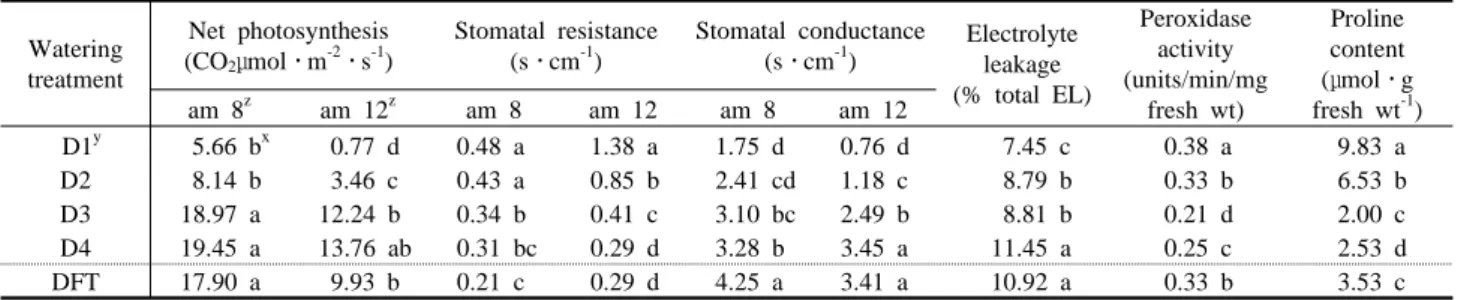
Means separation within columns by Duncan’s multiple range test at P=0.05.Table 3. Effect of watering treatment on the physiological conditions of sweet basil.
0.00 0.05 0.10 0.15 0.20 0.25 0.30
R oot activity (A
470)
D1 D2 D3 D4 DFT
Watering treatment
Fig. 1. The comparison in root activity depending on watering.
z
a
e
b
c d
z See Table 1.
y Means s eparation by DMRT at the 5% level.
x Root activity was meas ured optical dens ity by TTC tes t.
Fig. 1. The comparison in root activity depending on watering.
z
See Table 1.y
Means separation within columns by Duncan’s multiple range test at P=0.05.x
Root activity was measured optical density by TTC test.구의 경우가 생체중이 가장 저조하였다. DFT 처리는 관수량이 많 은 두 처리 D3, D4보다 생체중과 초장이 작았다. 그러나, 엽면적 은 D3, D4와 유의차가 크기 않았다. 이는 바실이 생장하는데 비교 적 많은 수분을 요구하는 것을 의미한다. Park(1998)은 바실의 경 우 알맞은 관수가 필요하다고 했는데, 이같은 결과는 수분부족으로 인한 생육 억제라고 생각된다. 특히 DFT에서 지상부중은 D3, D4 보다 낮으나 잎면적이 두 처리와 유사한 것은 Suh와 Park(1999)에 밝힌 것처럼 바실이 비교적 양액재배가 잘되는 식물이기 때문이다.
이는 근활력 측정을 통해 알 수 있었는데, 관수량이 적고 생육이 저조한 D1과 D2보다는 담액수경, 즉 DFT 처리가 근활력이 높았 으나 관수량이 적정한 D3, D4보다는 낮게 나타났다(Fig. 1). 이는 알맞은 양액조건에서 전체뿌리의 부피가 많은데 따른 활력저하를 의미한다.
생리적 차이
순광합성량은 D3, D4, DFT가 약 20 CO
2
μmol․m-2
․s-1
정도 로 모두 유의차가 없었다(Tabe 3). 그러나 수분이 부족한 D1, D2의 경우 동화량이 10 CO
2
μmol․m-2
․s-1
이하로 상당히 저조하 였다. 또한 정오에 D1은 거의 광합성을 하지 않았다. 이는 D1의 경우 수분의 부족으로 증산력이 없으며, 광과 온도가 높은 정오경 에 기공을 닫아버리기 때문으로 추정된다. 즉, 오전 8시 경의 경우 는 기공저항이 처리간 큰 차이를 보이지 않으나, 정오에는 D1처리 의 기공저항이 다른 처리구에 비해 상당히 높은 것으로 나타났다 (Table 3).식물체의 장해나 스트레스에 대한 지표로 사용되는 전해질 용출 량을 측정한 결과, 스트레스를 받았다고 추정되는 처리구 D1, D2 는 전해질 용출량이 적었으며 D4나 DFT 처리구는 많았다(Table 3). 이는 재배중의 수분 스트레스에 대한 내성으로 인하여 세포막 이 강화되었기 때문으로 생각된다. Kang(1999)의 연구에 따르면, 저장전 바실의 전해질 용출량은 고온 처리구의 경우 대조구의 절반 이하의 전해질 용출량을 보여 열에 의한 스트레스가 저온장해 완화 의 효과를 나타내었다고 하였다. Gu 등(1996)에 의하면, 수분스트 레스는 식물 세포벽 단백질의 활성과 세포벽 구조에 변화를 주어 의해 수분 스트레스 하에서 뿌리의 생장이 유지된다고 하였다. 마 죠람을 포트 재배할 경우에도 생장이 유지되는 정도의 수분스트레 스는 가뭄에 대한 내성을 유발하여 생장을 유지하는 능력을 증가시 킨다고 하였다(Rhizopoulou와 Diamantoglou, 1991).
산화적인 스트레스에 의해 활성화되는 peroxidase의 활성을 분석 한 결과 D1의 처리구, 즉 수분 스트레스를 가장 많이 받았다고 추정 되는 처리구에서 활성이 제일 높았으며, D3가 제일 적은 활성을 나 타내었다(Tabe 3). 식물생장과 peroxidase의 함량은 반비례하며, 노 화시 증가하여 엽록소의 감소를 유발한다(Liu, 1991; Ford와 Simon, 1972). 수분 스트레스시 많은 작물은 엽내의 proline을 축적 한다고 밝혀진 바 있다(Sells와 Koeppe, 1981; Mcmichael과 Elmore, 1978; Huang과 Cavalieri, 1979). Proline 분석 결과, 수분 이 많이 부족한 D1, D2 처리가 각각 9.83μmol․g fresh wt
-1
,과 6.52μmol․g fresh wt-1
으로 나머지 세 처리구에 비해 proline의 함 량이 많았다(Table 3). Proline은 삼투조절로 이온 흡수율을 높이는 물질로 보고되고 있으며, Saranga 등(1992)에 의하면, 배에 ABA와 proline의 처리시 내건성이 증가하며, 생존율이 증가하였다고 한다.또한 Handa 등(1983)은 토마토의 경우, 수분 스트레스에 적응된 개 Watering treatment
D1
z
D2 D3 D4 DFT Number ofessential oil grand (number/π․10
-2
cm2
)10.2 a
y
7.6 b 7.9 b 4.8 c 3.2 dz
See Table 1.y
Means separation within a row by Duncan’s multiple range test at P=0.05.Table 4. Effect of watering treatment on the number of
essential oil grand.
0 0.1 0.2 0.3 0.4
Essential oil content(%·FW
D1 D2 D3 D4 DFT
Watering treatment
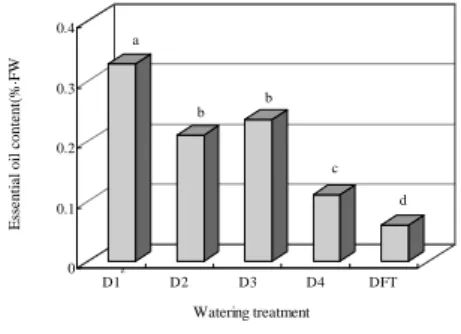
Fig. 2. The comparison in essential oil content depending on watering.
z
a
b b
c d
z See Table 1.
Fig. 2. The comparison in essential oil content depending on
watering.z
See Table 1.Y
See Fig. 1.0 10 20 30 40 50
Essential oil yield(mg·plant-1)
D1 D2 D3 D4 DFT
Watering treatment
Fig. 3. The comparison in essential oil yield depending on watering.
z
bc b
a
b
c
z See Tab le1.
y M ean s s ep aratio n b y DM RT at th e 5% lev el.
Fig. 3. The comparison in essential oil yield depending on
watering.z
See Table 1.Y
See Fig. 1.체일수록 proline의 함량이 월등히 높았다고 하였다. 본 실험의 경우 관수량이 다른 처리구에 비해 상대적으로 적었던 D1, D2 처리구가 peroxidase 활성과 proline의 함량이 많았으며, 이는 수분 스트레스 를 다른 처리구에 비해 많이 받은 결과라고 생각되었다.
수분 스트레스에 의한 정유함량과 생산량
생체 100g에 대한 정유함량은 생육이 저조한 D1 처리구에서 0.34%로 가장 높았으며, 관수량이 많아지는 D4로 갈수록 함량이 줄어들었다(Fig. 2). 외관 생육이 좋은 D4의 경우는 0.11% 정도에 그쳐 정유함량과 생장량은 부의 관계를 나타내었다. 특히 DFT의 경우는 0.06%로 정유함량은 가장 적었다. 이와 같이 본 실험의 결 과 수분 스트레스에 의해 정유함량이 증가하였음을 알 수 있었다.
수분 스트레스를 받지 않는 일반적인 생육 환경하에서 재배한 바실 의 경우, 정유 총 생산량은 생육이 좋았던 처리구에서 많았다고 Suh와 Park(1999)가 보고한 바 있다. 그러나, 보편적으로 식물의 정유 생성과 축적은 건조한 환경에서 더 증가한다고 알려져 있다 (Penka, 1978). 마죠람 포트 재배시 배지 수분함량이 적어 생육이 저조한 환경하의 식물이 정유함량이 월등히 높았다고 한다 (Rhizopoulou, 1991). 스트레스에 적응한 식물은 식물체내 각종 용질을 축적하는 경향이 있다. 스트레스에 반응하여 생성되는 물질 로 ABA는 수분스트레스시 기공을 닫는 역할을 하며, proline이나 단백질의 축적으로 건조에 대한 적응성을 높인다. 그 결과 삼투압 의 감소로 glucose, fructose가 증가한다(Larcher, 1995; Morgan, 1984; Katterman, 1990; Larosa 등, 1985). 이와 같이 용질의 축 적 등, 정유의 합성에 필요한 대사산물의 축적이 수분 스트레스에 적응한 식물의 정유합성의 증가와 관련이 있을 것이라고 추측된다.
수분 스트레스에 의한 생육의 감소로 동화물질이 정유의 생성과 축 적으로 분배가 이루어진다는 보고도 있다(Gershenzon 등, 1978).
따라서 수분스트레스를 받지 않은 DFT에서 자란 바실이 정유함유
율과 총함량이 낮은 것은 이상의 이론적 배경에서 설명될 수 있다 고 본다. 이는 양액재배를 한 바실이 토경재배보다 향기가 적어진 다는 것을 의미하며 앞으로 허브의 양액재배 시 고려해야 할 것이 다. 물론 한국인은 과다한 향을 싫어하므로(ARPC, 1999) 향기가 너무 높은 것은 양액재배로 소비자 기호를 충족시킬 수 있을 것이 다.
현미경으로 정유샘의 수를 관찰한 결과, 100배 배율의 시야에서 볼 수 있는 단위면적 π․10
-2
cm2
에서 D1의 경우, 10.2개로 가장 많았다. 정유함량에서 유의성이 없었던 D2, D3는 정유샘 수에서도 7.6과 7.9개로 유의차가 없었다(Table 4). D4와 DFT는 각각 4.8 과 3.2로 정유샘의 수도 역시 적었다(Table 4). 이와 같이 정유함 량과 정유샘을 조사한 결과 스트레스가 없을수록 정유샘이 적어 정 유함량이 감소하는 경향을 볼 수 있었다. Letchamo와 Gosselin (1996)도, 정유샘의 수와 정유량과는 비례적인 관계(r=0.64)가 있 다고 하였다.정유 생산량의 측면에서 볼 때 주당 정유 생산량은 D3가 47.37mg으로 가장 높았으며, D2와 D4는 20mg 정도였다(Fig. 3).
이에 반해 단위 무게당 정유함량이 가장 높았던 D1의 경우는 생장 이 억제되었기 때문에 주당 정유 생산량이 적었다. 그러나 생장이 좋았던 DFT는 주당 함량이 적어 주당 정유 생산량이 가장 적게
Watering treatment Watering treatment
나타났다. 이로 미루어 수분 스트레스는 생장과 동화물질의 분배에 영향을 미치며, 또한 생육의 감소는 정유 생성과 축적에 영향을 주 는 것으로 판단된다.
이상의 결과로부터 정유생산을 목적으로 허브를 재배할 경우 수 확 전까지는 최적생장상태를 유지하고, 수확 직전에 수분 스트레스 를 준다면, 정유 합성을 증가시킬 수 있을 것으로 기대된다. 따라 서 앞으로 수확 직전 최대의 정유 합성을 위하여 수분스트레스 정 도와 기간 등에 관한 실험이 필요하다고 생각된다.
초 록
관수량 조절을 통하여 수분 스트레스를 주어 외관상의 생육과 품 질, 정유의 생산성과의 관계를 구명하고자 하였다. 수분 스트레스 는 관수량에 따라 처리하였는데 코코넛파이버와 펄라이트를 1:1로 혼합한 배지가 충진된 와그너 포트(1/20000a, ø24cm)에 정식하여 처음 2주 동안은 주당 25mL, 다음 3주 동안은 30mL을 관수한 구 를 D1이라 하고, 각각 75mL, 90mL(D2), 225mL, 270mL(D3), 675mL, 810mL(D4)을 관수한 네 처리구와 수분 스트레스를 주지 않은 구로 DFT구를 설정하였다. 생체중과 엽면적은 D3과 D4에서 가장 좋았다. 이 두 처리구가 근활력에서도 D1 처리구의 2배 이상 으로 가장 높은 수치를 나타내었다. 그러나 생체중 100g당 정유함 량과 유선은 가장 관수량이 적은 D1 처리구에서 0.33%로 가장 높 았다. D1 처리구가 proline과 peroxidase activity이 가장 높았고, 광합성, 기공저항, 기공전도도 등이 가장 낮아서 수분 스트레스를 가장 많이 받았음을 알 수 있었다. 주당 정유함량과 생산량의 측면 에서 볼 때 생장과 정유함량 두 요소 모두 적절하였던 D3 처리구 가 47.37mg으로 20mg 이하의 나머지 처리구에 비해 월등히 높았 다. 외관 생육, 정유함량 및 생산량의 측면에서 볼 때 1 2주에는 225mL, 3 5주는 270mL을 관수한 D3 처리구가 최적의 관수량 이었다. 따라서 최대의 정유 생산을 위해서는 최대의 생장을 유지 시킨 후 수확 직전에 수분 스트레스를 준다면 정유합성을 증가시킬 수 있을 것으로 기대된다.
추가 주요어:허브, 관수, 포트재배, 수분스트레스
인용문헌
ARPC, 1999. Development of highly functional herbs production system. p. 25-26. Reports for ARPCSGRP in Korea.
Bates, L.S. 1973. Rapid determination of free proline for water- stress studies. Plant and Soil. 39:205-207.
Benoit, F. and N. Ceusternans. 1994. Hydroponic culture kitchen herbs. ISHS-Symposium in growing media and plant nutrition in horticulture. Glasshouse Crops Research Station, NAALD- WIJK, the Netherlands.
Charles, J.D. and J.E. Simon. 1990. Comparison of extraction
methods for the rapid determination of essential oil content and composition of basil. J. Amer. Soc. Hort. Sci. 115:458-462.
Deni, B. 1995. Encyclopedia of herbs & their uses, p. 166-167, 318-320. Dorling Kindersley, N.Y.
Denys, J.C. and J.E. Simon. 1990. Comparison of extraction methods for the rapid determination of essential oil content and compositon of basil. J. Amer. Soc. Hort. Sci. 115:458-462.
Ford, T.W. and E.W. Simon. 1972. Peroxidase and glucose-6- phosphate dehydrogenase levels in cotyledons of Cucumis
sativus. J. Exp. Bot. 71:423-431.
Foyer, C.H., N. Wouriau, S. Perret, M. Lelandias, K.J. Kunert, C.
Pruvost, and L. Jouanin. 1995. Overexpression of glutathione reductase but not glutathione synthetase leads to increases in antioxidant capacity and resistance to photoinhibition in poplar trees. Plant Physiol. 109:1047-1057.
Gershenzon, J., D.E. Lincoln, and J.H. Langenheim. 1978. The effect of moisture stress on monoterpenoid yield and compo- sition in Satureja douglassii. Syst. Ecol. 6:33-43.
Grieve, M. 1981. A modern herbal(1), p. 86-87. Dover Pub., N.Y.
Gu, S., L.H. Fuchigami, S.H. Guak, and C. Shin. 1996. Effects of short-term water stress, hydropilic polymer amendment and antitranspirant on stomatal status, transpiration,water loss, and growth in ‘Better Boy’ Tomato plants. J. Amer. Soc. Hort. Sci.
121:831-837.
Handa, S., A. Ray, K.A. Handa, and N.C. Carpita. 1983. Solutes contributing to osmotic adjustment in cultured plant cells adapted to water stress. Plant Physiol. 73:834-843.
Huang A.H.C. and A.J. Cavalieri. 1979. Proline oxidase and water stress-induced proline accumulation in spinach leaves. Plant Physiol. 63:531-535.
Kang, H.M. and K.W. Park, 1998. Changes in composition of free acids in relation to ethylene production during the ripening of tomato fruits. Kor. Soc. Hort. Sci. 39: 385-390.
Kang, H.M. 1999. Chilling stress alleviation effect of pre-harvest heat treatment during cultivation in warm-season vegetable at low temperature storage. ph D diss., Korea Univ., Seoul.
Katterman, F. 1990. Environmental injury to plants, p. 63-112.
Academic Press. San Diego.
吉田武彦. 1966. 根の活力測定法. 日本土壤肥料學雜誌 37:63-68.
Lacher, W. 1995. Physiological plant ecology: Ecophysiology and stress physiology of functional groups. p. 321-333, 379-408.
Springer-Verlag., Berlin.
Larosa, P.C., A.K. Handa, P.M. Hasegawa, and R.A. Bressan. 1985.
Abscisic acid accelerates adaptation of cultured tobacco cells to salt. Plant Physiol. 79:138-142.
Lafuente, M.T., A. Belver, M.G. Guye, and M.E. Saltveit, Jr. 1991.
Effect of temperature conditioning on chilling injury of cucum- ber cotyledons. Plant Physiol. 95:443-449.
Lawless, J. 1995. The illustrated encyclopedia of essential oils, p.
185-186. Barnes & Noble books, London.
Lawrence, B.M. 1986. Essential oil production-a discussion of influencing factors. In: Parliment TH, Croteau R, eds. Bioge- neration of aromas. Amer. Chem. Soc. 363-369.
Letchamo, W. and A. Gosselin. 1996. Transpiration, essential oil glands, epicuticular wax and morphology of Thymus vulgaris are influenced by light intensity and water supply. J. Hort. Sci.
71:123-134.
Liu, K.B. and S.X. Li. 1991. Effect of NaCl on element balance, peroxidase isozyme and protein banding patterns of Lycoper-
sicon leaf cultures and regenerated shoots. Scientia Hort.
46:97-107.
Mcmichaeal, B. L. and C.D. Elmore. 1978. Proline accumulation in water stressed cotton leaves. Crop Sci. 17:905-908.
Morgan, J. M. 1984. Osmoregulation and water stress in higher plants. Ann. Rev. Plant Physiol. 35:299-319.
Park, K.W. 1998. The cultivation and use of herb. pp. 4-8, 106-110.
Press of Korea Univ. Seoul.
Penka, M. 1978. Influence of irrigation on the contents of effective
substances in officinal plants. Acta Hort. 73: 181-198.
Prasad, G., A. Kuman, A.K. Singh, A.K. Bhattacharya, K. Singh, and V.D. Sharma. 1986. Antimicrobial activity of essential oils of some Ocimum species and clove oil. Fitoterapia. 57:429-432.
Rhizopoulou, S. and S. Diamantoglou. 1991. Water stress-induced diurnal variations in leaf water relations, stomatal conductance, soluble sugars, lipids and essential oil content of Origanum
majorana L. J. Hort. Sci. 66:119-125.
Saranga. Y., D. Rhodes., and J. Janicks. 1992. Changes in amino acid composition associated with tolerance to partial desiccation of celery somatic embryos. J. Amer. Soc. Hort. Sci. 117:337- 341.
SAS. 1985. SAS/STAT User’s guide. SAS Institute. Inc., Cary.
North Carolina.
Sells, G.D. and D.E. Koeppe. 1981. Oxidation of proline by mito- chondria isolated from water-stressed maize shoots. Plant Physiol. 68:1058-1063.
Suh, E.J. and K.W. Park. 1999. Effect of magnesium on the content and conposition of essential oil of basil cultivars in hydropo- nics. Kor. Soc. Hort. Sci. 40:385-390.