Printed in the Republic of Korea
http://dx.doi.org/10.5012/jkcs.2013.57.5.599
Solvent-Free Synthesis of Some1-Acetyl Pyrazoles
Ganesamoorthy Thirunarayanan†,* and Krishnamoorthy Guna Sekar‡
†Department of Chemistry, Annamalai University, Annamalainagar-608 002, India.
*E-mail: [email protected]
‡Department of Chemistry, National College, Tiruchirappalli-620 001, India.
(Received June 11, 2013; Accepted August 28, 2013)
ABSTRACT. Some N-acetyl pyrazoles including 1-(3-(3,4-dichlorophenyl)-5-(substituted phenyl)-4,5-dihydro-1H-pyrazole- 1-yl) ethanones have been synthesised by solvent free cyclization cum acetylation of chalcones like substituted styryl 3,4- dichlorophenyl ketones using hydrazine hydrate and acetic anhydride in presence of catalytic amount of fly-ash: H2SO4 catalyst. The yield of these N-acetyl pyrazole derivatives are more than 75%. The synthesised N-acetyl pyrazoline derivatives were charac- terized by their physical constants and spectral data
Key words: Solvent-free cyclization cum acetylation, N-acetyl pyrazoles, IR, NMR spectra
INTRODUCTION
N-acetyl pyrazole is one of the derivatives of 4, 5-dihy- dro-1H-pyrazoles. These N-acetyl pyrazole derivatives are important precursor for the synthesis of some other pyra- zoline based heterocycles such as cyanopyridine1 indoxacarb2 carbohydrazide hydrazine,3 pyrimidine.4 There are numerous solvent-free or solvent assisted acetylation methods avail- able for the synthesis of N-acetylated pyrazoline deriva- tives in literature.5−8 Glacial acetic acid and acetic anhydride were employed with solvent assisted conventional heat- ing, solvent-free microwave and ultrasound wave irradi- ation for acetylation of pyrazolines.5,6 The sulfated solid catalysts such as sulphated titania,9 sulphated zirconia,10 sulphated tinoxide11, sulphated and molybdated iron oxide12 and sulphated and phosphate zirconia13 were employed for solvent assisted and solvent-free synthesis of organics.
Osman et al.,1 have synthesised 75% yield of 4,7-dimethoxy- 5-(5-aryl-N-acetylpyrazolin-3-yl)benzofuran-6-ols by reflux- ing of Khellinone chalcones, hydrazine hydrate and glacial acetic acid. The 5-(p-tolyl)-4,5-dihydro-1-acetyl-pyrazol- 3-yl-phenyl}-3H-quinazolin-4-ones were synthesised using refluxation method of corresponding chalcones with hydra- zine acetic acid in ethanol by Mosaad et al.14 More than 84% yield of some series of new N1-cinnamoyl-3,5-diaryl- 2-pyrazolines have been synthesised using microwave as well as conventional heating by Srivastava et al.6 Shah et al., have synthesised 75% yield and studied the IR and 1H NMR spectra of some new series of 4-(4-hydroxyphenyl)- 3-chloro-1-{4-5-(substituted phenyl)-1-acetyl-4,5-dihydro- pyrazol-3-ylphenyl} azetidin-2-one with 3-chloro-1-{4-5-
(substitutedphenyl)-4,5-dihydro-pyrazol-3-ylphenyl}-4-(4- hydroxyphenyl) azetidin-2-one in acetic acid.15 N-acetyl-3- (2-naphthyl)-5-aryl pyrazoline derivatives were synthe- sised and studied their FTIR, NMR and HRMS data by Ethiraj et al.16 Many N-acetyl pyrazole derivatives such as N-acetyl-3,5-diphenyl pyrazolines,17 1-acetyl-4-5-(3-chloro- 4-fluorophenyl)-2-furyl-3-substituted phenyl-4,5-dihydro- 1H-pyrazoles,18 2,4-bis-(tetrahydro-1,4-oxazine)-6-4''- {1''-acetyl-5''-(4'''-methoxyphenyl)-2''-pyrazoline-3''-yl}
phenylamino-s-triazine19, fluorine containing arylfuryl N- acetylpyrazolines 7 and 4,6-dimethoxy-5-(1-acetyl-5-aryl-2- pyrazolin-3-yl)benzobfurans20 were synthesised by syn- thetic organic chemists using conventional heating method and studied their spectral data. These 1-acetyl pyrazoline derivatives possess important biological activities such as antibacterial,6,7,15,18 endogenous proteolysis,17 cytotoxic- ity,16 EGFR kinase8 and anti-inflammatory activities.14 The literature survey reveals that there is no information avail- able for solvent-free synthesis of some N-acetyl pyrazolines including 3-(3,4-dichlorophenyl)-5-(substitutedphenyl)- 4,5-dihydro-1H-pyrazole) derivatives by cyclization of the respective chalcones and acetic anhydride in the presence of solid fly-ash:H2SO4 catalyst. Therefore the authors have taken efforts to synthesis some N-acetyl pyrazolines including 3-(3,4-dichlorophenyl)-5-(substitutedphenyl)- 4,5-dihydro-1H-pyrazole) derivatives by solvent free microwave assisted cyclization of chalcones with hydra- zine hydrate and acetic anhydride in presence of catalytic quantity of fly-ash:H2SO4. The purities of these pyrazo- lines were checked by their physical constants and spec- tral data with reference published earlier in literature.
EXPERIMENTAL Materials and Methods
All chemicals used were procured from Sigma-Aldrich and E-Merck. Melting points of all pyrazoles have been determined in open glass capillaries on Mettler FP51 melting point apparatus and are uncorrected. Infrared spectra (KBr, 4000−400 cm−1) have been recorded on BRUKER (Thermo Nicolet) Fourier transform spectrophotometer.
The NMR spectra of all pyrazolines have been recorded on Bruker AV400 spectrometer operating at 400 MHz for recording 1H and 100 MHz for 13C spectra in CDCl3 sol- vent using TMS as internal standard. Mass spectra have been recorded on SHIMADZU spectrometer using chem- ical ionization technique.
Preparation and Characterization of Fly-ash:H2SO4
Catalyst
The fly-ash:H2SO4 catalyst was prepared by the proce- dure published in literature.21 In a 50 mL Borosil beaker, 1 g of Fly-ash and 0.8 mL (0.5 mol) of sulphuric acid were taken and mixed thoroughly with glass rod. This mixture was heated on a hot air oven at 85oC for 1 h, cooled to room temperature, stored in a Borosil bottle and tightly capped. This was characterized by infrared spectra and SEM analysis.
Infrared spectral data of fly-ash:H2SO4 is ν(cm−1): 3456 (OH); 3010 (C−H); 1495, 1390 (C−S); 1336, 1154 (S=O);
and op modes: 1136, 1090, 976, 890, 850, 820, 667, 658, 620, 580, 498, 425.
The SEM images of pure Fly-ash and Fly-ash:H2SO4 at two different magnifications are shown in Fig. 1(a−d).
Figs. 1a and 1b depicted that the crystallinity is found to be more in pure fly ash. The spherical shaped particles are clearly seen at both magnifications in Figs. 1a and 1b. Fig.
1a reveals that the globular structure of pure fly ash (round shaped particle). This also seen from Figs. 1c and 1d that some of the particles are slightly corroded by H2SO4 (indi- cated by arrow mark) and this may be due to dissolution of Fly-ash by H2SO4. This will further confirmed by Fig. 1d, the well-shaped particles of pure Fly-ash. Fig. 1b is aggre- gated to Fig. 1d due to presence of H2SO4.
Synthesis of 3,4-Dichlorophenyl Chalcones21
The substituted styryl 3,4-dichlorophenyl ketones were synthesized by literature method. An appropriate equi-molar quantities of 3,4-dichloro acetophenone (2 mmol), substi- tuted benzaldehydes (2 mmol) and Fly-ash:H2SO4 (0.5 g) were taken in Borosil tube and tightly capped. The mix- ture was subjected to microwave heated for 5−6 minutes (Scheme S1; See supplementary data) in a microwave oven at 480 W (Samsung Grill, GW73BD Microwave oven, 230V A/c, 50 Hz, 2450 Hz, 100−750 W (IEC-705), and then cooled to room temperature. The organic layer was sep- arated with dichloromethane and the solid product was obtained on evaporation. The solid, on recrystallization with benzene-hexane mixture gave glittering pale yellow solid. The insoluble catalyst was recycled by washing the solid reagent remained on the filter by ethyl acetate (8 mL) followed by drying in an oven at 100oC for 1h and it was made reusable for further reactions. The purities of the synthesized chalcones were checked by their physical constants. The analytical, physical constants and mass frag- ments of the chalcones were presented in Table S1 (See supplementary data).
Synthesis of N-Acetyl Substituted Pyrazole Derivatives An appropriate equi-molar quantities of chalcones (2 mmol), hydrazine hydrate (2 mmol), acetic anhydride (1 mmol) and fly-ash:H2SO4 (0.4 g) were taken in a 50 mL borosil beaker and closed with lid. The mixture was sub- jected to microwave irradiation for 4−6 minutes in a micro- wave oven at 550 watts, 2540 MHz frequency (Scheme 1) (Samsung Grill, GW73BD Microwave oven, 230V A/c, 50Hz, 2450Hz, 100−750W (IEC-705), and then cooled to room temperature. After separating the organic layer with dichloromethane, the solid product was separated by evapo- ration. The solid, on recrystallization from benzene-hex- ane mixture afforded glittering product. The insoluble catalyst was recovered by washing with ethyl acetate (8 mL) fol- lowed by drying in an oven at 100oC for 1h and reused for Figure 1. SEM images of fly-ash:H2SO4 catalyst.
further reaction runs.
RESULTS AND DISCUSSION
In our organic chemistry research laboratory, we attempt to synthesize N-acetyl substituted pyrazoline derivatives by cyclization of chalcones possess electron with-drawing as well as electron donating group as substituents, hydrazine hydrate and acetic anhydride in the presence of acidic cat- alyst fly-ash:H2SO4 using microwave irradiation. Hence
the authors have synthesized the N-acetyl substituted pyrazo- line derivatives by the cyclization of 2 mmol of chalcone, 2 mmol of hydrazine hydrate and 1mmol of acetic anhy- dride under microwave irradiation with 0.4 g of fly-ash:H2SO4 catalyst at 550W for 4−6 minutes (Samsung Grill, GW73BD Microwave oven, 230V A/c, 50Hz, 2450Hz, 100−750W (IEC- 705), (Scheme 1). During the course of this reaction fly- ash:H2SO4 catalyses cyclization cum acetylation between chalcones, hydrazine hydrate and acetic anhydride through elimination of water followed by proton transfer gave the
Scheme 1. Synthesis of 1-acetyl pyrazoline derivatives synthesised by solvent-free cyclization cum acetylation of aryl chalcones with hydra- zine hydrate and acetic anhydride in the presence of fly-ash:H2SO4 catalyst.
Scheme 2. The proposed general mechanism for the synthesis of 1-acetyl pyrazoline derivatives by solvent-free cyclization cum acety- lation of aryl chalcones with hydrazine hydrate and acetic anhydride in the presence of fly-ash:H2SO4 catalyst.
1-acetyl pyrazolines. The yield of the N-acetyl pyrazolines in this reaction is more than 75%. The proposed general mechanism of this reaction is shown in Scheme 2. In this cyclization and acetylation, first the amine nucleophilic attack of carbonyl carbon of the chalcone by nitrogen atom of hydrazine hydrate and the carbonyl oxygen gets hydrox- ylation. Another end of the nitrogen atom of hydrazine hydrate bonded with β-carbon of chalcone leads to cycliza- tion, the unsaturation was shifted between carbonyl and α carbon of the chalcones. The hydroxylated group was elimi- nated as water molecule. Migration of proton of cyclic N- 2 to 4th C of azole ring and the π-bond was shifted to N-2 and C-3 of the azole ring. The acetylation process was fea- sible by n-acetylation method. The chalcone containing electron donating substituent (OCH3) gave higher yields than electron-withdrawing (halogens, NO2) substituents.
Further we have investigated this cyclization reaction with equimolar quantities of the styryl 3,4-dichlorophenyl ketone (entry 13), hydrazine hydrate and 1mole of acetic anhydride under the same condition as above. In this reaction the
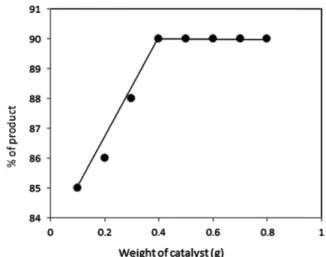
obtained yield was 90%. The effect of catalyst on this reac- tion was studied by varying the catalyst quantity from 0.1 to 1 g. As the catalyst quantity is increased from 0.1 to 0.4 g, the percentage of yield of product is increased from 82 to Figure 2. The effect of catalyst loading.
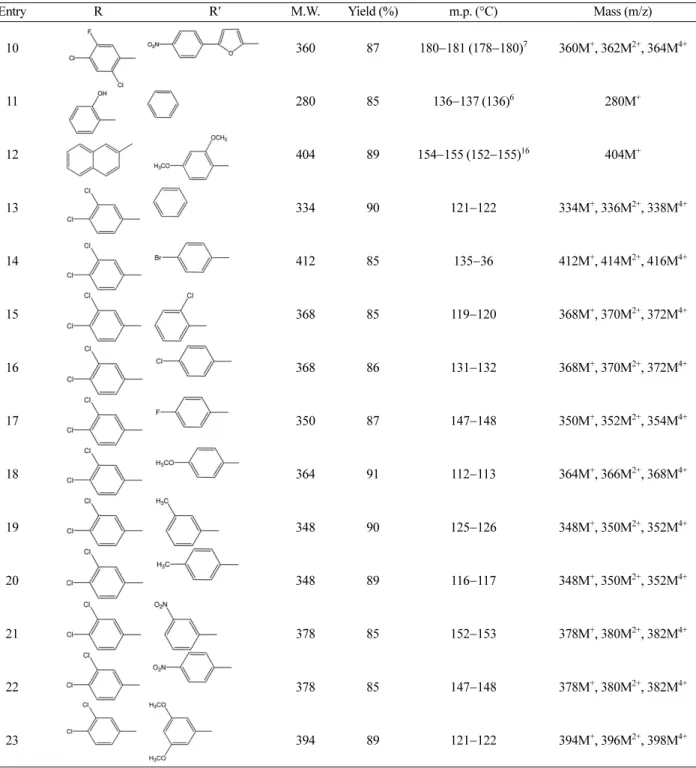
Table 1. The Analytical, physical constants and mass fragments (m/z) data of 1-acetyl pyrazoline derivatives synthesised by solvent-free cyclization cum acetylation of aryl chalcones with hydrazine hydrate and acetic anhydride in the presence of fly-ash:H2SO4 for the following reaction
Entry R R' M.W. Yield (%) m.p. (°C) Mass (m/z)
1 264 77 123−124 (120−122)17 264M+
2 298 89 111−112 (108−110)17 298M+, 300M2+
3 278 89 109−110 (107−108)17 278M+
4 309 85 163−164 (164−165)17 309M+
5 382 85 167−168 (167)18 382M+, 384M2+, 386M4+
6 418 85 177−178 (177)18 418M+, 420M2+, 422M4+
7 398 88 172−173 (175)18 398M+, 400M2+, 402M4+
8 402 86 173−174 (172)18 402M+, 404M2+, 406M4+
9 398 86 163−134 (163)18 398M+, 400M2+, 402M4+
90%. Further increase in the catalyst amount beyond 0.4 g, there is no significant increase in the percentage of the product. The effect of catalyst loading is shown in Fig. 2.
The optimum quantity of catalyst loading was found to be 0.4 g. The results, analytical and mass spectral data are summarized in Table 1. The mass spectra and the possible fragments of the selective 1-acetyl pyrazolines are presented in Table 1. Continued
Entry R R' M.W. Yield (%) m.p. (°C) Mass (m/z)
10 360 87 180−181 (178−180)7 360M+, 362M2+, 364M4+
11 280 85 136−137 (136)6 280M+
12 404 89 154−155 (152−155)16 404M+
13 334 90 121−122 334M+, 336M2+, 338M4+
14 412 85 135−36 412M+, 414M2+, 416M4+
15 368 85 119−120 368M+, 370M2+, 372M4+
16 368 86 131−132 368M+, 370M2+, 372M4+
17 350 87 147−148 350M+, 352M2+, 354M4+
18 364 91 112−113 364M+, 366M2+, 368M4+
19 348 90 125−126 348M+, 350M2+, 352M4+
20 348 89 116−117 348M+, 350M2+, 352M4+
21 378 85 152−153 378M+, 380M2+, 382M4+
22 378 85 147−148 378M+, 380M2+, 382M4+
23 394 89 121−122 394M+, 396M2+, 398M4+
Table 2. Reusability of fly-ash:H2SO4 catalyst on cyclization cum acetylation of styryl 3,4-dichlorophenyl ketone (2 mmol) with hydrazine hydrate (2 mmol) and acetic anhydride (1 mmol) under microwave irradiation (entry 13)
Run 1 2 3 4 5
Yield 90 90 89.5 89.5 89
supplementary data (See supplementary data). The reus- ability of this catalyst was studied for the cyclization of styryl 3,4-dichlorophenyl ketone, hydrazine hydrate and acetic anhydride (entry 13) and is presented in Table 2.
From the Table 2, first two runs gave 90% product. The third, fourth and fifth runs of reactions gave respectively the yields 89.5%, 89.5% and 89% of 1-acetyl pyrazolines.
There was no appreciable loss in its effect of catalytic activity observed up to fifth run. The effect of solvents on the yield was also studied with methanol, ethanol, dichloromethane and tetrahydrofuran from each component of the catalyst (entry 13). Similarly the effect of microwave irradiation was studied on each component of the catalyst. The effect of solvents on the yield of 1-acetyl pyrazolines was pre- sented in Table 3. From the table highest yield of 1-acetyl pyrazolines obtained from the cyclization cum acetyla- tion of chalcone, hydrazine hydrate and acetic anhydride with the catalyst fly-ash:H2SO4 in microwave irradiation.
The infrared and nmr spectroscopic data of these 1-acetyl pyrazolines are summarized in Table 4.
CONCLUSION
A series of some 1-acetyl pyrazolines including 1-(3-(3,4- dichlorophenyl)-5-(substituted phenyl)-4,5-dihydro-1H-pyra- zole-1-yl) ethanones have been synthesised by microwave assisted fly-ash:H2SO4 catalyzed solvent free cyclization
of chalcones cum acetylation of pyrazole and acetic anhy- dride. The yield of the synthesized 1-acetyl pyrazolines are more than 75%. This methodology offers efficient, solvent free cum acetylation of chalcones and non-haz- ardousness to the environment.
Acknowledgments. The publication cost of this paper was supported by the Korean Chemical Society.
REFERENCES
1. Osman, S. A.; Yosef, H. A. A.; Hafez, T. S.; Sawy, A. A.
E.; Mousa, H. A.; Hassan, A. S. Aust. J. Basic Appl. Sci.
2012, 6, 852.
2. Zhao, P. L.; Wang, F.; Zhang, M. Z.; Liu, Z. M.; Huang, W.; Yang, G. F. J. Agric. Foodchem. 2008, 56, 10767.
3. Yusuf, M.; Jain, P. Arab. J. Chem. 2011. DOI:10.1016/j.arabjc.
2011.09.013.
4. Mistry, R. N.; Desai, K. R. E. J. Chem. 2005, 2, 30.
5. Kanagarajan, V.; Ezhilarasi, M. R.; Gopalakrishnan, M. Spec- trochim. Acta 2011, 78A, 635.
6. Srivastava, Y. K.; Malhotra, G.; Gothwal, P. Rasayan J.
Chem. 2010, 3, 584.
7. Holla, B. S.; Shivananda, M. K.; Akberali, P. M.; Shenoy, M. S. Indian J. Chem. 2000, 39B, 440.
8. Lv, P. C.; Li, H. Q.; Sun, J.; Zhou, Y.; Zhu, H. L. Bioorg.
Med. Chem. 2010, 18, 4606.
9. Krishnakumar, B.; Velmurugan, R.; Swaminathan, M. Catal.
Commun. 2011, 12, 375.
Table 3. The effect of solvents in conventional heating and without solvent in microwave irradiation on yield of 1-acetyl pyrazoline (entry 13) Solvents
Microwave irradiation
MeOH EtOH DCM THF
FA SA FASA FA SA FASA FA SA FASA FA SA FAPA FA SA FASA
72 13 78 70 15 85 74 12 85 75 16 87 80 23 90
MeOH=Methanol; EtOH=Ethanol; DCM= Dichloromethane; THF=Tetrahydrofuran; FA=fly-ash; SA=Sulphuric acid; FASA=fly-ash:H2SO4
Table 4. The infrared, NMR spectral data of 1-(3-(3,4-dichlorophenyl)-5-(substitutedphenyl)-4,5-dihydro-1H-pyrazole-1-yl) ethanones (entries 13−23)
Entry X IR 1H NMR 13C
C=N C=O Ha Hb Hc CH3 X C=N C=O CH3 X
13 H 1574.18 1641.20 3.297 3.819 5.568 2.934 − 159.06 168.67 24.46 −
14 4-Br 1578.21 1644.65 3.197 3.857 5.565 2.401 − 159.66 173.56 24.61 −
15 2-Cl 1576.84 1643.82 3.195 3.879 5.594 2.295 − 158.97 172.96 25.87 −
16 4-Cl 1577.71 1647.41 3.851 2.996 5.671 2.265 − 158.67 169.80 25.81 −
17 4-F 1576.21 1644.17 3.201 3.846 6.071 2.401 − 159.71 168.12 24.16 −
18 4-OCH3 1570.07 1638.74 3.117 3.701 5.457 2.249 3.845 158.58 168.80 22.74 58.45 19 3-CH3 1571.19 1640.94 3.153 3.794 5.497 2.310 2.401 157.67 172.05 24.77 24.68 20 4-CH3 1570.27 1639.71 3.167 3.807 5.943 2.287 2.316 158.09 171.94 23.79 24.35
21 3-NO2 1575.16 1644.97 3.208 3.943 5.973 2.441 − 159.87 174.91 26.97 −
22 4-NO2 1575.97 1645.08 3.217 3.997 5.997 2.531 − 159.97 174.96 26.87 −
23 3,5-(OCH3)2 1572.61 1640.40 3.071 3.671 5.471 2.031 − 158.08 173.17 26.71 −
10. Reddy, B. M.; Sreekanth, P. M.; Lakshmanan, P. J. Mol.
Catal. A: Chem. 2005, 237, 93.
11. Kafuku, G.; Lee, K. T.; Mbarawa, M. Chem. Papers 2010, 64, 734.
12. Trewhella, M. J.; Grint, A. Fuel 1987, 66, 1315.
13. Stojkovic, N.; Vasic, M.; Marinkovic, M.; Randjelovic, M.;
Purenovic, M.; Putanov, P.; Zarubica. A. Chem. Ind. Chem.
Eng. Quart. 2012, 18, 209.
14. Mosaad, M. S.; Mohsen, K. M.; Emad, K. M. M.; Abotaleb, N.; Salwa, N. M.; Marwa, A. F. Acta Poloniae Pharm.- Drug Res. 2010, 67, 159.
15. Shah, S. H.; Patel, P. S. Int. J. Chem. Tech. Res. 2012, 4, 933.
16. Ethiraj, K. R.; Nithya, P.; Krishnakumar, V.; Jesil Mahew, A.; Nawaz Khan, F. Res. Chem. Intermed. 2012. DOI:
10.1007/s11164-012-0718-3.
17. Singh, M.; Raghav, N. Int. J. Pharm. Pharm. Sci. 2013, 5, 80.
18. Rana, A. K.; Lade, S. B.; Sorathia, S.; Joshi, M. J.; Shah, N. M. Der Chim. Sinica. 2012, 3, 965.
19. Solankee, A.; Patel, R.; Patel, K. Der Chim. Sinica. 2011, 3, 317.
20. Abdel Hafez, O. M.; Ahmed, Kh. M.; Haggag, E. E. Mol- ecules 2001, 6, 396.
21. Thirunarayanan, G.; Mayavel, P.; Thirumurthy, K. Spec- trochim Acta 2012, 91A, 18.
22. Thirunarayanan, G.; Surya, S.; Srinivasan, S.; Vanangamudi, G.; Sathiyendiran, V. Spectrochim. Acta, Part A. 2010, 75, 152.
23. Thirunarayanan, G. Iup. J. Chem. 2012, 5, 41.
24. Thirunarayanan, G.; Thirumurthy, K.; Vanangamudi, G.;
Subramanian, M.; Arulkumaran, R.; Kamalakkannan, D.;
Sundararajan, R.; Sakthinathan, S. P.; Vijayakumar, S.;
Ranganathan, K.; Suresh R. Elixir Org. Chem. 2012, 45, 7898.
25. Sathiyamoorthi, K.; Mala, V.; Suresh, R.; Sakthinathan, S.
P.; Kamalakkannan, D.; Ranganathan, K.; Arulkumaran, R.; Sundararajan, R.; Vijayakumar, S.; Vanangamudi, G.;
Thirunarayanan, G. Int. Lett. Chem. Phys. Astro. 2013, 7(2), 102.