INTRODUCTION
Aggressive behavior in cognitively impaired nursing home residents is a frequent and complex problem for both residents and nursing staff. The prevalence of ag- gressive behavior in nursing home residents has been re- ported as 74 96% (Oh, 1998; Ryden, Bossenmaier, &
McLachlan, 1991; Soured, McCusker, Cole, &
Abrahamowicz, 2001). Aggression in nursing home resi- dents found to be associated with cognitive and func- tional impairments. Loss of memory, diminished judge- ment, and decreased inhibition and impulse control af- fect the individual’s ability to use thought processes to mediate between feeling and behavior (Ryden, 1992;
Ryden & Feldt, 1992). Aggressive behavior frequently
A Study on Aggressive Behavior Among Nursing Home Residents with
Cognitive Impairment
Heeyoung Oh, PhD, RN1, Miran Eom, PhD, RN1, Yunjung Kwon, PhD, RN2
1. Associate professor, Eulji University College of Nursing 2. Teaching fellow, Eulji University College of Nursing
Corresponding author: Heeyoung Oh, PhD, RN, Associate professor, Eulji University College of Nursing, 143-5, Yong Du 2 Dong, Joong Gu, Taejon 305-762, Korea.
Tel. 82-42-259-1713 Fax. 82-42-259-1709 E-mail: [email protected] This work was supported by BumSuk Academic Research Fund of 2002.
Received September 11, 2004 ; Accepted October 18, 2004
Purpose. With a sample of cognitively impaired nursing home residents and nursing staff, the following were examined 1) the proportion and nature of aggressive behavior, 2) the frequency and types of aggressive behavior, 3) the difference between the residents who demonstrate aggressive behavior and those who do not demonstrate aggressive behavior (age, mental status, functional status, and pain, length of nursing home stay), and 4) nursing staff responses to aggressive behavior by residents.
Methods. A cross-sectional descriptive study design was used. Data were collected from cognitively impaired nursing home residents (N=205) and nursing staff (N=60) at two nursing homes using Ryden Aggression Scale I and II, Mini-Mental State Exam, Modified Barthel Index, Verbal Descriptor Scale, and aggressive behavior management questionnaire. Data were analyzed using descriptive statistics including t-test.
Results. About 62.9% residents were found to be aggressive and 38.5% were both physically and verbally aggressive. Pushing, making threatening gestures, hitting, slapping, cursing/obscene/vulgar languages, mak- ing verbal threats were occurred frequently. Aggressive residents were significantly older, had more cogni- tive impairment, had more pain, and stayed longer in the nursing home when compared with non-aggres- sive residents. Considerable proportion of nursing staff responded to aggressive behaviors inadequately.
Conclusion. Aggressive behavior among cognitively impaired nursing home residents is prevalent thus needs to be prevented and reduced. Along with environmental modification, educational programs for nursing staff and family caregivers need to be developed and implemented so that they can have extensive knowledge and skills to manage aggressive behaviors.
Key Words: Aggression, Aged, Dementia, Nursing homes
occurs with various precipitating events. It may be a re- sponse to touch or invasion of personal space, as it often occurs during assistance with activities of daily living (Hoeffer, Rader, McKenzie, Lavelle, & Stewart, 1997). It has been hypothesized that aggression arises as an at- tempt to defend the self from perceived threat, to guard against pain and physical discomfort, to maintain con- trol, or to respond to stressful environmental stimuli (Bridges-Parlet, Knopman, & Thompson, 1994).
Aggressive behavior often occurs towards caregivers because they are most likely in direct contact with the residents. Caregivers will continue to be the target of ag- gression as they are primary providers of direct care.
However, caregivers often have minimal training on managemnt of aggressive behaviors (Gates, Fitawater, &
Deets, 2003). Consequently, caregivers in nursing homes experience frequent aggressive behavior, harassment, threats, and assaults (Fitzwater & Gates, 2002).
Aggressive behavior can seriously affect caregivers in nursing home as they experience various emotional re- actions such as anger, frustration, and fear (Oh, 2000).
Caregivers inability to cope with the emotional and physical stress from aggressive behavior can results in burnout, turnover, job dissatisfaction, and reciprocal ag- gression against the residents.
Despite the severity of the problem, research examin- ing aggressive behavior among Korean elders is scant.
Few studies explored how caregivers respond to aggres- sive behaviors in nursing home setting. Thus, with a Korean nursing home resident sample, the followings were 1) the proportion and nature of aggressive behav- ior, 2) the frequency and types of aggressive behavior 3) the difference between the residents who demonstrate aggressive behavior and those who do not demonstrate aggressive behavior (age, mental status, functional status, pain, and length of nursing home stay), and 4) nursing staff responses to aggressive behavior by resident’s.
REVIEW OF LITERATURE
Concept of aggressive behavior
Aggressive behavior frequently occurs among nursing home residents, particularly those with cognitive impair- ment. Despite numerous research studies conducted in the past, there is no consensus regarding accepted defini- tion of aggressive behavior. Ryden (1988) defined ag- gressive behavior as “a hostile action directed toward other persons or objects or toward oneself.” She consid-
ered behavior as aggressive if it is against the expressed will and/or despite the resistance of the other person.
She includes three categories of aggressive behavior in her definition; physically aggressive behavior (PAB), ver- bally aggressive behavior (VAB), and sexually aggressive behavior (SAB). Of the three aggressive behaviors iden- tified by Ryden(1988), physical aggressive behavior and verbal aggressive behavior are most distinct and com- monly cited types of behaviors in other studies (Cohen- Mensfield & Werner, 1998). Another definition by Patel and Hope (1993) adds more understanding of aggressive behavior. They defined, “aggressive behavior is an overt act, involving the delivery of noxious stimuli to (but not necessarily aimed at) another object, organism or self, which is clearly not accidental”. (p. 458).
Aggressive behavior is often included as one of cluster of behavioral problems. Many researchers measure ag- gressive behavior under the concept of assaultive behav- ior (Gates, Fitzwater, & Deets, 2003), aggression (Talerico, Evans, & Strumpf, 2002), disruptive behavior (Beck et al., 1998), disturbing behavior (Kolanowski, 1995) aggressiveness (Soreff & Siddle, 2004), agitated behavior (Souriel, McCusker, Cole, & Abrahamowicz, 2001; Schreiner, Yamamoto, & Shitonani, 2000). These discrepancies result in various and differing operational definitions and diverse methods of measuring aggressive behaviors. Although definition and use of the term
‘aggressive behavior’ need more clarification, definitions addressed above provide us some pictures of aggressive behavior among cognitively impaired nursing home resi- dents.
Prevalence, type, and factors contributing to aggres- sive behavior
Prevalence of aggressive behavior among cognitively impaired elders reported in the literature vary widely. In nursing homes, as many as 44 86% of nursing home residents with cognitive impairment demonstrated ag- gressive behavior (Kolanowski & Garr, 1999; Oh, 1998;
Ryden et al., 1991). In a long term care facility, 18% of the staff noted aggressive behavior as a daily occurrence (Astrome & Umea, 2000). Five percent of nursing home residents will be involved with aggressive behavior each week and 40% of nursing home residents aggression is recurrent (Cohen-Mensfield, Billing, Lipson, Rosenthal,
& Pawlson, 1990). In another study, 74% of Korean nursing home residents demonstrated aggressive behav- ior with a total of 299 occurrences in 2 days (Oh, 1998).
Aggressive behavior is not only significant in nursing homes, but is also common in elders living in the com- munity. In a study of 262 patients with Alzheimer’s dis- ease, 52% exhibit some aggressive behavior, 35% were reported to be verbally aggressive and 18% were as- saultive to their caregivers (Eastly & Wilcock, 1997).
There are three types of aggressive behaviors identified in the literature (Marx, Cohen-Mensfield, & Warner, 1990; Oh, 1998; Ryden et al., 1991). These include physically aggressive behaviors such as hitting, kicking, pulling hair, and spitting; verbally aggressive behavior such as cursing, obscene, vulgar languages, making ver- bal threats; hostile language; sexually aggressive behav- iors such as touching body part of another person, hug- ging, and kissing.
In nursing home, aggressive behavior were frequently occurred in day shift, in resident’s room and the nursing staff were the primary target of the aggressive behavior (Ryden et al., 1991). Most episodes of aggressive behav- ior occurred as a response to touch or invasion of resi- dents’ personal space that are inherent in daily caregiv- ing like bathing (Hoeffer, Rader, McKenzie, Lavelle, &
Stewart, 1997; Oh, 1998; Ryden et al., 1991). Many fac- tors were found to contribute to incidence of aggressive behavior. Age, mental status, depressive affect were strong predictors of aggressive behavior (Cohen- Mensfield & Werner, 1998; Talerico et al., 2002). Other factors associated with aggressive behaviors include longer stays in nursing home, impaired functional ability (Winger, Schirm, & Stewart, 1987), and pain (Feldt, Warne, & Ryden, 1998; Olson, 2000).
Consequence of aggressive behavior on caregiving The results of two qualitative studies present the seri- ous consequence of aggressive behavior on caregiving. In a study by Miller (1996), nursing staff reported that they were subjected to aggressive behavior and experienced a decline in physical and mental health as a consequence of caring for aggressive elders. Caregivers also reported a perceived decline in the amount and quality of nursing care, an increased potential for staff-to-patient abuse and neglect, desire to eventually leave the nursing home or the dementia care unit. In another study by Oh (2000), caregivers experienced stress, anger, frustration, anxiety, and fear from aggressive behavior and used inappropri- ate management skills such as ignoring the situation, be- ing patient, leaving the situation, appeasing, scolding, us- ing restraint/isolation to handle the aggressive behavior.
These results indicate the limited ability of nursing staff to manage the aggressive behavior.
METHODS
Design
A cross-sectional, descriptive study design was used.
Setting and Sample
Subjects were recruited from two proprietary nursing homes located in Choongchung providence. The resi- dents were required to meet the following inclusion cri- teria: (a) 65 years or older (b) have cognitive impairment (MMSE score<24) (c) stayed in nursing home 1 month or longer (d) able to respond verbally (e) agreed to par- ticipate. Nursing staff, nurses and nursing assistants, who met the following inclusion criteria were eligible for the study: (a) worked in nursing home at least 1 month (b) agreed to participate.
Procedure
A pilot study was conducted in one nursing home to test research procedure and instruments. Following the pilot study, two nursing homes were randomly selected from the total list of long term care facilities in Choongchung providence. A researcher contacted ad- ministrators to determine willingness of the facility to participate. Upon agreement a researcher met residents, administrator, and nursing staff in separate session to ex- plain about the study. Subjects were informed that their participation was voluntary and were assured of anonymity. Consent was sought from families and guardians for cognitively impaired residents. For the nursing homes where families or guardians had already given written permission for participation in activities and psychosocial research projects, residents were eligi- ble to participate in the study. Written consents were ob- tained from nurses and nursing assistants. Multiple staff orientation session were held so that nursing staff had explanation of the study and practice in the use of Ryden Aggression Scale I (RAS I) and II(RAS II).
Nursing staff were given extra time to ask questions.
Since nursing assistants have the most extensive and inti- mate contact with residents, they were charged with pri- mary responsibility for documenting aggressive behavior under researchers’ supervision.
Data were collected through two steps of the proce- dure. In the first step, one licensed nurse and two nurs-
ing assistants were asked to evaluate each residents on their aggressive behaviors using RAS I to identify the ag- gressive residents. Of 205 residents evaluated, 129 sub- jects were screened as aggressive at least once within the past 1 year. Of 129 aggressive residents 75 residents were identified as aggressive at least once a month.
In step two, using RAS II, close observation and recording of aggressive behaviors were conducted for 3 days on the 75 residents identified as aggressive at least once a month. Researcher and research assistants were on the unit for the data collection period to provide sup- port, answer questions and monitor the staff’s documen- tation of RAS II. Mental and functional status, pain were assessed by researcher and demographic data were ob- tained from medical records. Nurses and nursing assis- tants were invited and asked to complete aggressive be- havior management questionnaire.
Instruments
The instruments originally developed in English were translated into Korean by the researcher, back translated into English by two nursing professors who completed graduate study in the US. Then the discrepancies were discussed with two bilingual nursing scholars and the re- visions were made upon agreement.
Aggressive behavior
Aggressive behavior was measured using RAS I and RAS II (Ryden, 1988). The RAS I is a 26 item, 6 point likert scale that has 3 subscales: physically aggressive be- havior (PAB), verbally aggressive behavior (VAB), and sexually aggressive behavior (SAB). It is designed as a retrospective measure, score ranges from 0 (none) to 5 (more than once/day) with higher score indicating higher frequency of aggressive behavior. Inter-rater reliability of RAS I was .89 in this study. RAS II include 26 items of aggressive behavior listed in a table form with space for recording the number of times each behavior is ob- served. Inter-rater reliability reliability of RAS II was .88 (Ryden et al., 1991).
Cognitive status
Residnet’s cognitive status was assessed using the Folstein Mini Mental State Exam (MMSE) (Folstein, Folstein & McHugh, 1975). The MMSE consists of 11 items, scores range from 0 to 30 with lower scores indi- cating more cognitive dysfunction. The internal consis- tency was .99 (Tombaugh & McIntyre, 1992).
Pain
Pain was assessed using the Verbal Descriptor Scale (VDS) (Herr & Mobily, 1993). The VDS has 7 pain severity descriptions including ‘no pain (0)’ to ‘pain as bad as it could be (6)’. The VDS was chosen over other pain rating scales because it has been found to be better understood by elders with lower education levels (Herr
& Mobily, 1993). Test-retest reliability of VDS was .89 in this study.
Functional status
Functional status was assessed using Modified Barthel Index (Fricke & Unworth, 1997). Barthel Index is widely used tool to assess physical function. It consists of 15 items and measures type of support that is needed in ba- sic activities of daily living. Scores on Modified Barthel Index ranges from 0 to 100 with higher scores indicating better functional ability. Cronbach’s alpha was .92 in this study.
Nursing staff response to aggressive behavior
Nursing staff response to aggressive behavior by resi- dents was assessed using a questionnaire developed in this study. The questionnaire was designed based on the findings of a study by Oh (2000). The questionnaire con- sists of 8 descriptions of nursing staff responses to ag- gressive behavior. Nursing staff are asked to answer to each item with ‘never (0)’, ‘seldom (1)’, ‘sometimes (3)’,
‘often (4)’, or ‘always(5)’. Cronbach’s alpha of this in- strument was .86 in this study.
Data analysis
Data were analyzed using SPSS/PC 12.0. Descriptive statistics were used to identify demographic characteris- tics of subjects, proportion, type and frequency of ag- gressive behavior. The t-test was used to compare aggres- sive residents with non-aggressive residents according to age, mental status, functional status, pain and length of stay.
Limitations of study
The research sample was a non-random convenience sample in the settings to which the researcher had access for data collection. Generalizability of the findings is limited. As inherent with retrospective measure, data obtained using RAS I may have been influenced by nurs- ing staff subject’s recall.
RESULTS
1. Characteristics of subjects
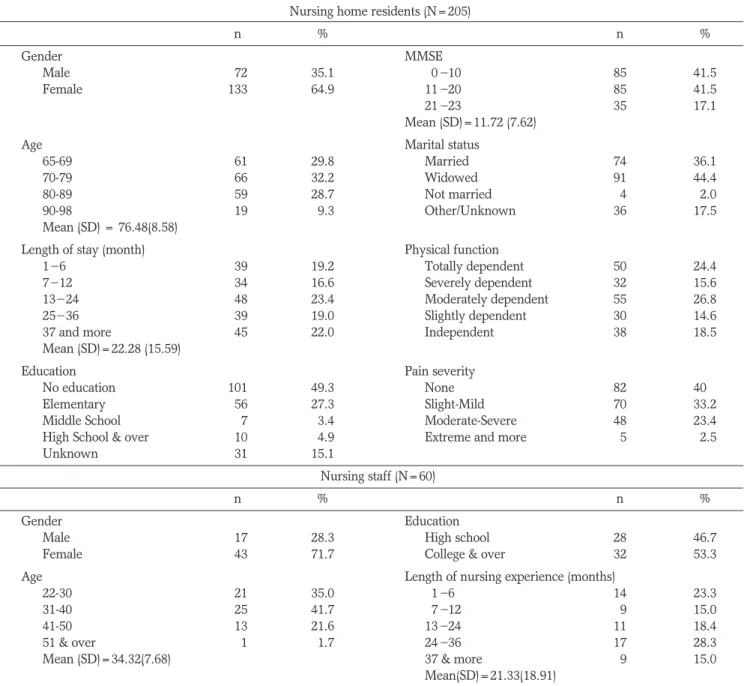
At the beginning, 225 resident subjects participated. Of 225 residnets enrolled, those who were cognitively intact (n=5) and those with incomplete data (n=15) were ex- cluded. A total of 205 residents were entered for final da- ta analysis. The mean age of the reidents was 76.48 years (SD= 8.58) ranged from 65 to 98 years. Sixty-five per- cent (n=133) were female; all were Korean. Forty-four percent (n=91) were widowed and bout half (49.3%) had no education. Mean length of nursing home stay was 22
months (SD= 15.59). All were cognitively impaired with mean MMSE score of 11.72 (SD= 7.62). Most (81.5%, n=167) of them were dependent for physical functioning and 60% (n=123) reported having pain.
Sixty nursing staff participated. The mean age of the nursing staff was 34.3 years (SD= 7.68). Mean length of nursing experience was 21.3 months (SD= 18.91). The characteristics of subjects are presented in Table 1.
2. Proportion and nature of aggressive behavior screened by RAS I
Of 205 residents evaluated with RAS I, 62.9%
(n=129) subjects demonstrated some form of aggressive
Table 1. Characteristics of Subjects
Nursing home residents (N=205)
n % n %
Gender MMSE
Male 072 35.1 00 10 85 41.5
Female 133 64.9 11 20 85 41.5
21 23 35 17.1
Mean (SD)=11.72 (7.62)
Age Marital status
65-69 061 29.8 Married 74 36.1
70-79 066 32.2 Widowed 91 44.4
80-89 059 28.7 Not married 04 02.0
90-98 019 09.3 Other/Unknown 36 17.5
Mean (SD) = 76.48(8.58)
Length of stay (month) Physical function
1 6 039 19.2 Totally dependent 50 24.4
7 12 034 16.6 Severely dependent 32 15.6
13 24 048 23.4 Moderately dependent 55 26.8
25 36 039 19.0 Slightly dependent 30 14.6
37 and more 045 22.0 Independent 38 18.5
Mean (SD)=22.28 (15.59)
Education Pain severity
No education 101 49.3 None 82 400.
Elementary 056 27.3 Slight-Mild 70 33.2
Middle School 007 03.4 Moderate-Severe 48 23.4
High School & over 010 04.9 Extreme and more 05 02.5
Unknown 031 15.1
Nursing staff (N=60)
n % n %
Gender Education
Male 017 28.3 High school 28 46.7
Female 043 71.7 College & over 32 53.3
Age Length of nursing experience (months)
22-30 021 35.0 01 6 14 23.3
31-40 025 41.7 07 12 09 15.0
41-50 013 21.6 13 24 11 18.4
51 & over 001 01.7 24 36 17 28.3
Mean (SD)=34.32(7.68) 37 & more 09 15.0
Mean(SD)=21.33(18.91)
behavior at least once within past the 1 year. About 55% subjects demonstrated PAB, 52.7% VAB, and 11.2% SAB. Aggressive behavior co-occurred with other forms of aggressive behavior. PAB seemed to occur most frequently with VAB (38.5%), and to a lesser extent with VAB and SAB. About 6% demonstrated all three forms (physical, verbal, and sexual) of aggressive behav- iors. Proportion and nature of aggressive behaviors are shown in Table 2.
3) Frequency and types of aggressive behavior ob- served for 3 days
A total of 76 aggressive behaviors were occurred dur-
ing 3 days. The most frequently observed form was PAB (n=41) followed by VAB (n=26), and SAB (n=9). Of 41 PAB that occurred, pushing and making threatening ges- tures, hitting, slapping, and kicking were common. Use of cursing/obscene/vulgar languages (n=9) was the most frequently observed VAB along with hostile language (n=7) and making threats (n=7). Total 9 SAB occurred including making obscene gesture (n=4), touching body part of another person (n=3), and hugging (n=2).
Frequency and types of aggressive behavior observed during 3 days are shown in Table 3.
4) Comparison of aggressive residents with non-ag- gressive residents
When aggressive residents were compared with non- aggressive subjects, the mean scores for age in the two groups were significantly different (t= 3.667, p=.000);
the aggressive residents were significantly older than non-aggressive residents. The mean scores for mental status, pain, length of stay scores of two groups were sig- nificantly different; the aggressive residents had more cognitive impairment (t=2.284, p=.023), had more pain (t= 2.793, p=.006), and they stayed longer in the nurs- ing home (t= 2.230, p=.029). The mean scores for func- tional status for the two groups did not differ significant- ly (t=.165, p=.845). Comparisons of the mean scores of
Table 3. Frequency and Types of Aggressive Behaviors Observed for 3 days Using RAS II (N=75)
Physically aggressive behavior n Verbally aggressive behavior n Sexually aggressive behavior n
Pushing 7 Cursing/obscene/ vulgar languages 9 Making obscene gesture 4
Making threatening gesture 6 Hostile language 7 Touching body parts of another person 3
Hitting 5 Making verbal threats 7 Hugging 2
Slapping 5 Name calling 3
Kicking 5
Throwing an object 4
Pinching/Squeezing 3
Scratching 2
Spitting 2
Striking a person with an object 1
Pulling hairs 1
Total 41 26 9
Table 4. Comparison of Aggressive Residents with Non-aggressive Residents (N=205)
Variable Aggressive residents (n=129) Non-aggressive residents (n=76)
t p
Mean (SD) Mean (SD)
Age 78.12 (8.61) 73.70 (7.86)0 3.667 .000
Mental status 10.80 (7.42) 13.29 (7.76)0 2.284 .023
Functional Status 561.29 (33.93) 62.13 (37.69) .165 .845
Pain 51.60 (1.55) 1.01 (1.25) 2.793 .006
Length of stay 524.12 (15.59) 19.14 (15.86) 2.230 .029
Table 2. Proportion and Nature of Aggressive Behaviors Screened by RAS I (N=205)
Category n %
demonstrate aggressive behavior 129 62.9
demonstrate PAB* 113 55.1
demonstrate VAB** 108 52.7
demonstrate SAB*** 023 11.2
demonstrate both PAB & VAB 079 38.5
demonstrate both PAB & SAB 05 02.4
demonstrate both VAB & SAB 02 01.0
demonstrate all PAB, VAB & SAB 12 05.9
* PAB: Physically aggressive behavior
** VAB: Verbally aggressive behavior
*** SAB: Sexually aggressive behavior
age, mental status, functional status, pain and length of stay for the two groups are shown in Table 4.
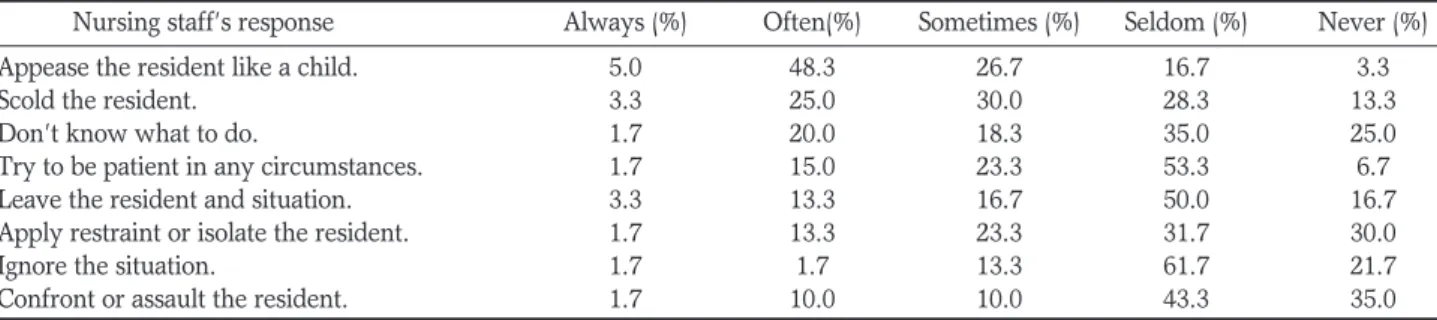
5) Nursing staff responses to aggressive behaviors About half (48.3%) of the residents reported that they often appease the residents like a child. Nursing staff an- swered they often scolded the residents (25%), or try to be patient in any circumstances (15%). Twenty percent answered that they did not know what to do with the in- cidence of aggressive behavior. Nursing staff’s responses to aggressive behaviors are presented in Table 5.
DISCUSSION
The prevalence of aggressive behaviors in these resi- dents, at 62.9%, is lower than the prevalence (74%) in a sample of Korean nursing home residents (Oh, 1998) and than 86.3% found in a study by Ryden et al. (1991) with American nursing home residents, in the united states but higher than the prevalence (44%) in another sample of nursing home residents (Kolanowski & Garr, 1999). This variability in aggressive behavior prevalence may largely be due to use of various and differing opera- tional definitions and diverse methods for data collec- tion. For instance, several previous studies measured physical, verbal, sexual aggressive behaviors (Feldt, Warne, & Ryden, 1998; Kolanowski & Garr, 1999; Oh, 1998; Ryden et al., 1991), while others (Eastly &
Wilcock, 1997; Souriel et al., 2001; Talerico et al., 2002) only measured physical and verbal aggressive behaviors.
Such absence of consensus on operational definition and measures makes it difficult to compare findings across studies or determine to what extent each type of aggres- sive behaviors occurs. Therefore, clarification of the con- cept and operational definition is an urgent need for fu- ture research. Although prevalence varied by studies in the past, a high incidence rate was a common finding.
Consistent with findings in previous studies a significant
proportion of residents in this study (n=129; 62.9%) demonstrated aggressive behavior and greater propor- tion of residents showed physical aggressive behavior compared to verbal or sexual aggressive behavior. Also a considerable proportion of residents demonstrated more than one form of aggressive behavior suggesting that a resident can be aggressive physically, verbally, or sexual- ly.
During the 3 days of data collection, a total of 76 ag- gressive behaviors such as hitting, kicking, pulling hairs, use of vulgar languages, and touching body part of other person had occurred. From this result, it can be assumed that either nursing staff or the residents in nursing home had suffered such behaviors. Although it appears that no serious injury had resulted from these aggressive behav- iors, experiencing such behaviors can be quite distress- ing. Thus, it is necessary to protect both residents and nursing staff from brutal behaviors. To do so, it would be necessary to determine in what context the aggressive behaviors occur and what have triggered the aggressive behavior. In addition, the negative impact of aggressive behavior on residents’ quality of life and staff morale and job satisfaction should not be overlooked.
To have better understanding on the etiology of ag- gressive behaviors, aggressive residents were compared with non-aggressive residents. The result showed that the aggressive residents were characterized by being older age, having more cognitive impairment, a higher level of pain, and longer stays in the nursing home. As cognitive function decreases with normal aging, advanced age and cognitive impairment may have been contribute to ag- gressive behaviors (Beck et al., 1998) which often results from misinterpretation of environmental stimuli (Ryden et al., 1991). In terms of pain and aggressive behavior, the result support previous research findings. In a study by Cohen and Werner (1998), a correlation between pain and aggressive behavior was found. In another study, aggressive behaviors were significantly more fre-
Table 5. Response to Aggressive Behaviors by Nursing Staff (N=60)
Nursing staff’s response Always (%) Often(%) Sometimes (%) Seldom (%) Never (%)
Appease the resident like a child. 5.0 48.3 26.7 16.7 3.3
Scold the resident. 3.3 25.0 30.0 28.3 13.3
Don’t know what to do. 1.7 20.0 18.3 35.0 25.0
Try to be patient in any circumstances. 1.7 15.0 23.3 53.3 6.7
Leave the resident and situation. 3.3 13.3 16.7 50.0 16.7
Apply restraint or isolate the resident. 1.7 13.3 23.3 31.7 30.0
Ignore the situation. 1.7 1.7 13.3 61.7 21.7
Confront or assault the resident. 1.7 10.0 10.0 43.3 35.0
quent in elders with pain-related diagnoses such as arthritis (Feldt, Warne, & Ryden, 1998). These findings suggest that untreated pain may have trigger aggressive behaviors. Considering limited ability of cognitively im- paired elders to verbalize their pain experience, aggres- sive behavior in elders with dementia can be understood as a non-verbal expression of their pain experience (Olson, 2000). As recommended by Feldt et al. (1998), careful assessment, amelioration of pain and strategies to increase physical comfort need to be included in inter- vention programs. Length of stay in a nursing home was significantly higher in aggressive subjects, and this find- ing is consistent with that of Souriel et al. (2001).
However, this result raises questions concerning the meaning of ‘staying longer in a nursing home’. What as- pects of staying longer in a nursing home can affect el- ders behavior? It is possible that maladjustment and oth- er stressors experienced from an extended nursing home stay might have caused the aggressive behavior. The an- swer to this question is unclear so further investigation is needed in this area. Previous studies have shown that decreased functional status is associated with increased aggressive behavior but this was not supported in this study.
Aggressive behaviors by cognitively impaired older adults in nursing home create high level of stress and burden to caregivers (Rodney, 2000). Unfortunately, the result have shown that nursing staff responses to aggres- sive behaviors are inadequate. Responses used most of- ten included appeasing the resident like a child, scolding the resident, and trying to be patient in any circum- stances. Many answered that they did not know what to do. In fact, in nursing homes, most of direct care is being provided by nursing assistant who have minimal training in interpersonal or communication skills. Thus, carefully designed educational interventions to improve aggressive behavior management skills are needed. Some nursing staff reported that they apply restraints, isolate, confront, or assault the aggressive residents. This indicates need for educating nursing staff to treat cognitively impaired residents in a way that their human dignity is main- tained.
CONCLUSION
This study investigated aggressive behaviors in cogni- tively impaired nursing home residents and nursing staff’
responses to such behaviors in nursing homes in Korea.
We believe the findings of this study add small evidence to the body of knowledge on aggressive behavior in el- ders with dementia. Based on the findings discussed above, we have drawn the following conclusions. First, aggressive behaviors in this population should be pre- vented by identifying and removing trigger factors. In doing so, environmental modification might be a strate- gy to be considered. Second, nurses and nursing assis- tants face immense challenges in providing nursing care to aggressive residents. Educational programs need to be developed and implemented so that the nursing staff can have extensive knowledge and skills to manage aggres- sive behaviors. The use of geriatric advanced practice nurses to teach interpersonal approaches and to assist in role modeling in direct care of aggressive resident is rec- ommended. Also, staff education including training ses- sion designed to teach what approaches to use in differ- ent situations might be useful. Third, we suggest con- ducting future research to implement environmental and behavioral interventions and evaluate the effects of them.
References
Astrom, S., & Umea, U. (2000). Incidence of violence towards staff caring for the elderly. Scand J Caring Sci, 16, 66-72.
Beck, C., Frant, L., Chumbler, N., O’Sullivan, P., Vogelpohl, V., Rasin, Y., Walls, R., & Baldwin, B. (1998). Correlates of dis- ruptive behavior in severely cognitively impaired nursing home residents. Gerontologist, 38 (2), 189-198.
Bridges-Parlet, S., Knopman, D., & Thompson, T. (1994). A de- scriptive study of physically aggressive behavior in dementia by direct observation. J Am Geriatr Soc, 42, 192-197.
Cohen-Mansfield, J., Billing, N., Lipson, S., Rosenthal, A.S., &
Pawlson, L.G. (1990). Medical correlates of agitation in nursing home residents. Gerontology, 36, 150-158.
Cohen-Mensfield, J., & Werner, P. (1998). Predictors of aggressive behaviors: A longitudinal study in senior day care centers. J Gerontol: Psych Sci, 53B (5), 300-310.
Eastly, R., & Wilcock, G.K. (1997). Prevalence and correlates of ag- gressive behaviors occurring in patients with Alzheimer’s dis- ease. Int J Geriatr Psychiatry, 12 (4), 484-487.
Feldt K., & Ryden, M.B. (1992). Aggressive behavior: Educating nursing assistants. J Gerontol Nurs, 18, 3-12.
Feldt. K.S (1996). Treatment of pain in cognitively impaired versus cognitively intact post hip fractured elders. Diss Abstr Int, 57- 09B, 5574.
Feldt K.S. Warne, M. A., & Ryden, M.B. (1998). Examining pain in aggressive cognitively impaired older adults. J Gerontol Nurs, 24(11), 14-22.
Folstein, M. F., Folstein, S.E., & Mchugh, P.R. (1975). ‘Mini-mental State’. A practical method for grading the cognitive state of pa- tients for the clinician. J Psychiatr Res, 12, 189-198.
Fitzwater, E., & Gates, M. (2002). Testing intervention to reduce vi-
olence in nursing homes: A pilot study. Geriatr Nurs, 23(1), 18-23.
Fricke, J., & Unsworth, C.A. (1997). Inter-rater reliaibility of the original and Modified Barthel Index, and a comparison with the Functional Independence Measure. Aust Occup Ther J, 44(1), 22-29.
Gates, D., Fitzwaer, E., & Deets, C. (2003). Development of instru- ment to assess: Assaultive behavior in nursing homes. J Gerontol Nurs, 29(8), 37-45.
Herr, K.A., & Mobily, P.R. (1993). Comparison of selected pain as- sessment tools for use with the elderly. Appl Nurs Res, 6, 39-4.
Hoeffer, B., Rader, J., McKenzie, D., Lavelle, M., & Stewart, B.
(1997). Reducing aggression during bathing cognitively im- paired nursing home residents. J Gerontol Nurs, 23(5), 16-23.
Kolanowski, A.M. (1995). Disturbing behaviors in demented elders:
A concept synthesis. Arch Psych Nurs, 9(4), 188-194.
Kolanoski, A.M., & Garr, M. (1999). The relation of premorbid fac- tors to aggressive physical behavior in dementia. J Neurosci Nurs, 31(5), 278-84.
Marks, M.S., Cohen-Mensfield, J., & Werner, P. (1990). A profile on the aggressive nursing home residents. Behavior, Health, and Aging, 1(1), 65-73.
Miller, M.F. (1996). Nursing staff responses to physically aggressive behavior in cognitively impaired institutionalized elderly: A qualitative study. Unpublished doctoral dissertation, University of Miami.
Patel, V., & Hope, P.A. (1992). Aggressive behavior in elderly psy- chiatric inpatients. Acta Psych Scan, 85, 131-135.
Oh, J. (1998). A study on the aggressive behavior of the demented elderly in a nursing home. J Korean Comm Health Nurs Acad Soc, 12(2), 172-184.
Oh, J. (2000). The experience of nursing staff on the demented pa- tient’s aggressive behavior. J Korean Acad Nurs, 30(2), 293- 305.
Olson, J. (2000). Problem behavior or pain? Contemp Longterm
Care, 23(1), 31.
Rodney, V. (2000). Nurse stress associated with aggression in peo- ple with dementia: Its relationship to hardness, cognitive ap- praisal and coping. J Adv Nurs, 31(1), 172-180.
Ryden, M.B. (1988). Aggressive behavior in persons with dementia who live in the community.: Alzheimer Dis Assoc Disord: An Int J, 2, 342-355.
Ryden, M.B., Bossenmaier, M., & McLachlan, C. (1991). Aggressive behavior in cognitively impaired nursing home residents. Res Nurs Health, 14, 87-95.
Ryden, M.B. (1992). Alternative to restraints and psychotropics in the care of aggressive cognitively impaired elderly persons. In Buckwalter, K.C. (ed.), Geriatric mental health nursing:
Current and future challenges. pp 84-93. Thorofare, NJ:Slack.
Ryden, M.B., & Feldt, K.S. (1992). Goal-directed care: Caring for aggressive nursing home residents with dementia. J Gerontol nurs, 18(11), 35-41.
Schreiner, A.S., Yamamoto, E., & Shitonani, H. (2000). Agitated behavior in elderly nursing home residents with dementia in Japan. J Geronto, 55B(3), 180-186.
Soreff, S., & Siddle, D. (2004). Understanding and dealing with resi- dent’s aggression. Nurs Homes, 53(3), 58-60.
Souriel, R., McCusker, J., Cole, M., & Abrahamowicz, M. (2001).
Agitation in demented patients in an acute care hospital:
Prevalence, disruptiveness, and staff burden. Int Psychogeriatr, 13(2), 183-97.
Talerico, K.A., Evans, L.K., & Srumpf, N.E. (2002). Mental health correlates of aggression in nursing home residents with demen- tia. Gerontologist, 42(2), 169-177.
Tombaugh, T., & McIntyre, N.J. (1992). The Mini-mental State Examination: A comprehensive review. J Am geriatr Soc, 40, 922-935.
Winger, J., Schirm, V., & Stewart, D. (1987). Aggressive behavior in long term care. J Psychosicial Nurs, 25(4), 28-33.