A Korean Nationwide Surveillance Study for Non-Typhoidal Salmonella Isolated in Humans and Food Animals from 2006 to
2008: Extended-Spectrum β-Lactamase, Plasmid-Mediated AmpC β-Lactamase, and Plasmid-Mediated Quinolone
Resistance qnr Genes
Hae-Sun Chung1, Hyukmin Lee2, Yangsoon Lee1, Dongeun Yong1, Seok Hoon Jeong1, Bok-Kwon Lee3, Suk-Chan Jung4, Suk-Kyung Lim4, Kyungwon Lee1, Yunsop Chong1
1
Department of Laboratory Medicine and Research Institute of Bacterial Resistance, Yonsei University College of Medicine, Seoul,
2Department of Laboratory Medicine, Kwandong University College of Medicine, Goyang,
3
Division of Enteric Bacterial Infections, Center for Infectious Diseases, Korea National Institute of Health, Cheongwon,
4
Animal, Plant and Fisheries Quartine and Inspection Agency, Anyang, Korea
Background: The emergence of non-typhoidal Salmo- nella (NTS) with decreased susceptibilities to fluo- roquinolone, ampicillin, or ceftriaxone has been re- ported worldwide. However, current surveillance studies of resistance among NTS in Korea are limited. Thus, the antimicrobial susceptibilities; resistance mechanisms such as extended-spectrum β-lactamase (ESBL), plas- mid-mediated AmpC β-lactamase (PABL), and plas- mid-mediated quinolone resistance (PMQR); and molec- ular epidemiologic characteristics were investigated in the present study.
Methods: National Institute of Health and National Veterinary Research and Quarantine Service collected NTS strains from 219 clinical and 293 non-clinical specimens from 2006 to 2008. The antimicrobial sus- ceptibilities were determined using the Clinical and Laboratory Standards Institute disk diffusion test.
ESBL, PABL, and qnr genotyping were performed us- ing PCR and nucleotide sequencing. Pulsed-field gel electrophoresis was used for the molecular epidemio- logic study.
Results: The resistance to ampicillin in clinical and non-clinical NTS was 49% and 18 to 47%, respec- tively. The resistance rates to trimethoprim-sulfamethox- azole in clinical and non-clinical NTS were 8% and 0 to
41%, respectively. The rates to extended- spectrum cephalosporin were 0 to 1%. One CTX-M- 15-produ- cing isolate and four CMY-2-producing isolates were detected. Notably, PFGE analysis showed four isolates carrying blaCMY-2, including one non-clinical strain had high clonality. Although the rate of ciprofloxacin resist- ance was very low, two qnrS1-carrying NTS strains were detected in non-clinical specimens.
Conclusion: The resistance rates to ampicillin in both clinical and non-clinical NTS were high, while those to trimethoprim-sulfamethoxazole varied depending on the specimen. NTS strains harboring CTX-M-15- type ESBL or CMY-2-type PABL were detected even though the resistance rates to cephalosporins were very low. Four NTS strains carrying the blaCMY-2- gene implied zoonotic infection. Continuous effort to minimize transfer of resistance genes in NTS is necessary. (Korean J Clin Microbiol 2012;15:14-20) Key Words: Antimicrobial susceptibility, Extended-
spectrum β-lactamase, Korea, Non-ty- phoidal Salmonella, Plasmid-mediated AmpC β-lactamase, Plasmid-mediated quinolone resistance
Received 8 September, 2011, Revised 8 November, 2011 Accepted 11 November, 2011
Correspondence: Kyungwon Lee, Department of Laboratory Medicine and Research Institute of Bacterial Resistance, Yonsei University College of Medicine, 50 Yonsei-ro, Seodaemun-gu, Seoul 120-752, Korea.
(Tel) 82-2-2228-2446, (Fax) 82-2-313-0906, (E-mail) [email protected]
14 서 론
살모넬라균은 오염된 물이나 동물에서 유래된 음식물을 섭취
하였을 때 사람에게 감염을 일으킨다. 2,400여 종의 혈청형이 존재하며 최근 비장티푸스성 살모넬라(non-typhoidal Salmone- lla, NTS) 감염이 증가하고 있다[1]. NTS는 주로 소아에서 위장 관염을 일으키며 항균제 투여 없이 치료되지만 침습성 감염의 경우는 fluoroquinolone, ampicillin, ceftriaxone 투여가 필요하 다. 그러나 이들 항균제에 감수성이 저하된 다제내성 NTS 균주 가 세계적으로 출현하고 있어서 중대한 위협이 되고 있다[2].
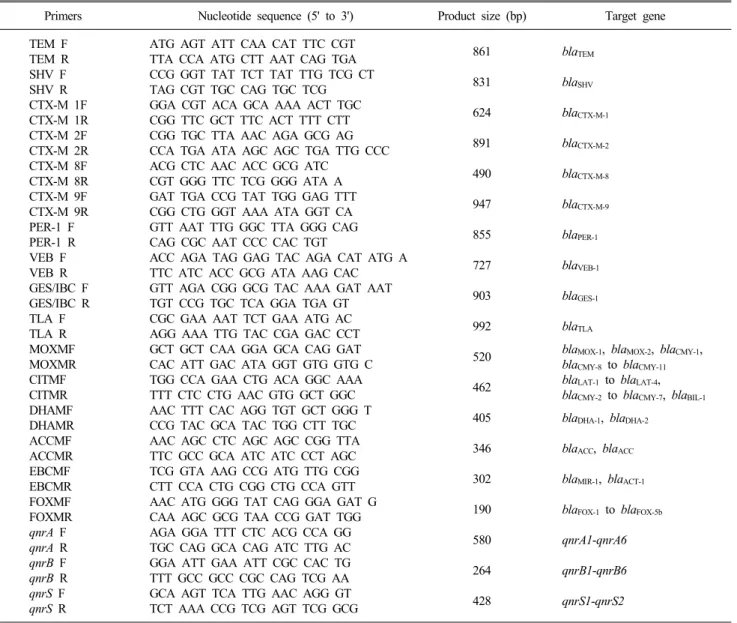
Table 1. Primers used in this study
Primers Nucleotide sequence (5' to 3') Product size (bp) Target gene
TEM F TEM R SHV F SHV R CTX-M 1F CTX-M 1R CTX-M 2F CTX-M 2R CTX-M 8F CTX-M 8R CTX-M 9F CTX-M 9R PER-1 F PER-1 R VEB F VEB R GES/IBC F GES/IBC R TLA F TLA R MOXMF MOXMR CITMF CITMR DHAMF DHAMR ACCMF ACCMR EBCMF EBCMR FOXMF FOXMR qnrA F qnrA R qnrB F qnrB R qnrS F qnrS R
ATG AGT ATT CAA CAT TTC CGT TTA CCA ATG CTT AAT CAG TGA CCG GGT TAT TCT TAT TTG TCG CT TAG CGT TGC CAG TGC TCG GGA CGT ACA GCA AAA ACT TGC CGG TTC GCT TTC ACT TTT CTT CGG TGC TTA AAC AGA GCG AG CCA TGA ATA AGC AGC TGA TTG CCC ACG CTC AAC ACC GCG ATC
CGT GGG TTC TCG GGG ATA A GAT TGA CCG TAT TGG GAG TTT CGG CTG GGT AAA ATA GGT CA GTT AAT TTG GGC TTA GGG CAG CAG CGC AAT CCC CAC TGT
ACC AGA TAG GAG TAC AGA CAT ATG A TTC ATC ACC GCG ATA AAG CAC GTT AGA CGG GCG TAC AAA GAT AAT TGT CCG TGC TCA GGA TGA GT CGC GAA AAT TCT GAA ATG AC AGG AAA TTG TAC CGA GAC CCT GCT GCT CAA GGA GCA CAG GAT CAC ATT GAC ATA GGT GTG GTG C TGG CCA GAA CTG ACA GGC AAA TTT CTC CTG AAC GTG GCT GGC AAC TTT CAC AGG TGT GCT GGG T CCG TAC GCA TAC TGG CTT TGC AAC AGC CTC AGC AGC CGG TTA TTC GCC GCA ATC ATC CCT AGC TCG GTA AAG CCG ATG TTG CGG CTT CCA CTG CGG CTG CCA GTT AAC ATG GGG TAT CAG GGA GAT G CAA AGC GCG TAA CCG GAT TGG AGA GGA TTT CTC ACG CCA GG TGC CAG GCA CAG ATC TTG AC GGA ATT GAA ATT CGC CAC TG TTT GCC GCC CGC CAG TCG AA GCA AGT TCA TTG AAC AGG GT TCT AAA CCG TCG AGT TCG GCG
861 831 624 891 490 947 855 727 903 992 520 462 405 346 302 190 580 264 428
blaTEM
blaSHV
blaCTX-M-1
blaCTX-M-2
blaCTX-M-8
blaCTX-M-9
blaPER-1
blaVEB-1
blaGES-1
blaTLA
blaMOX-1, blaMOX-2, blaCMY-1, blaCMY-8 to blaCMY-11
blaLAT-1 to blaLAT-4, blaCMY-2 to blaCMY-7, blaBIL-1
blaDHA-1, blaDHA-2
blaACC, blaACC
blaMIR-1, blaACT-1
blaFOX-1 to blaFOX-5b
qnrA1-qnrA6 qnrB1-qnrB6 qnrS1-qnrS2 특히 quinolone 제제를 투여할 수 없는 16세 미만 소아에서 3세
대 cephalosporin 내성 균주 감염이 발생할 경우 치료실패의 가 능성이 있다[3].
3세대 cephalosporin을 분해할 수 있는 β-lactamase 생성 살 모넬라는 전 세계적으로 보고되고 있다[4,5]. SHV, TEM, CTX-M형의 extended-spectrum β-lactamase (ESBL)는 플라스 미드를 통해 내성 전파가 가능하며[5], 침습성 살모넬라증 치료 에 사용되는 3, 4세대 cephalosporin을 분해할 수 있는 특징이 있다. 미국과 유럽 지역에서 CMY-2형 plasmid-mediated AmpC β-lactamase (PABL)을 생성하여 ceftriaxone을 비롯한 여러 항균제에 내성을 보이는 AmpC 생성 multidrug resistant S. Newport 균주가 보고되고 있다[4-6]. 이들의 출현은 동물에 서 사용되었던 3세대 cephalosporin인 ceftiofur의 사용이 원인 일 것으로 추정하고 있다. Plasmid-mediated quinolone resist-
ance (PMQR)는 1994년 미국의 Klebsiella pneumoniae에서 최 초 보고된 이래 아시아에서는 2001년 중국 상하이에서 분리된 Escherichia coli에서 qnrA1이 보고되었다[7,8]. 이들은 DNA gyrase를 quinolone의 작용으로부터 보호하여 내성을 부여한다.
국내에서 1995-1996년과 2000-2002년 분리된 NTS에서 nali- dixic acid 내성률은 증가하였으나 qnr 유전자는 검출되지 않았 다[9]. 한편 미국에서 분리된 NTS중 PMQR의 빈도는 1996-2003 년 0.08%이었으나 2004-2006년 0.3%로 증가하였다[10,11]. 그 러나 국내에서 다제내성 살모넬라균의 PMQR에 대한 연구는 제 한되어 있다.
본 연구에서는 국내의 임상 검체 및 비임상 검체에서 분리된 NTS의 항균제 내성 양상을 비교하였다. 또한 주요 내성 유전 자의 분리 빈도를 조사하고 분자역학적 분석을 시행하였다.
Table 2. Resistant rates (%) of nontyphoidal Salmonella species to various antimicrobial agents as a result of in vitro antimicrobial susceptibility test
Antibiotics Clinical isolates*
(219)
Non-clinical isolates (293) Pig†
(158)
Chicken‡ (80)
Food§ (55) Ampicillin
Cefotaxime Ceftazidime Ceftriaxone Cefoxitin Streptomycin Nalidixic acid Ciprofloxacin Tetracycline Cotrimoxazole Chloramphenicol
49 NT NT
<1 1 48 50
<1 37
8 29
47 1
<1 NT 1 79 66 0 88 41 29
18 0 0 NT 0 25 68 0 25 1 3
38 0 0 NT 0 47 60 0 46 0 4
*Clinical isolates included S. Typhimurium (83, 37.9%) and S.
Enteritidis (136, 62.1%), †Non-clinical isolates from pig included S.
Typhimurium (115, 72.8%), S. Schwarzengrund (18, 11.4%), and S.
Rissen (16, 10.1%), ‡Non-clinical isolates from chicken included S.
Enteritidis (32, 40.0%), S. Virchow (17, 21.3%), and S. Indiana (9, 11.3%), §Non-clinical isolates from food included S. Enteritidis (22, 40.0%), S. Blokley (19, 34.5%), and S. Typhimurium (9, 13.4%).
Abbreviation: NT, not tested.
재료 및 방법
1. 균주 수집
2006-2008년 질병관리본부에서 임상검체 분리 NTS 균주 219주를, 국립 수의과학 검역원에서 비임상검체(가금류, 돼지 및 음식물) 분리된 NTS 균주 293주를 각각 수집하였다. 균종 및 혈청형(serotype, serovar) 동정은 각각의 수집기관에서 시험 하였다. Ampicillin, cefotaxime, ceftazidime, ceftriaxone, cefox- itin, streptomycin, nalidixic acid, ciprofloxacin, tetracycline, tri- methoprim-sulfamethoxazole (cotrimoxazole), 그리고 chloram- phenicol 디스크(Becton Dickinson, Cockeysville, MD, USA)로 Clinical and Laboratory Standards Institute (CLSI) 디스크 확산 법[12]에 따라서 항균제 감수성 검사를 시행하였다.
2. β-lactamase 생성 검출: ESBL과 PABL
ESBL 선별 검사와 표현형 확진 검사는 K. penumoniae, K.
oxytoca와 E. coli에 대한 CLSI의 ESBL 선별 기준을 준용하여 시험하였다. 즉, Cefotaxime 감수성 시험 결과 ESBL 선별 양성 기준(≤27 mm)에 해당하는 균주에서 double-disk synergy법으 로 ESBL 생성을 확인하였다[12,13]. ESBL 유전형은 PCR로 확 인하였다(Table 1). DNA는 가열한 상층액 1 μL, 20 pmol pri- mer 각각 1 μL와 1 U의 Taq DNA polymerase가 들어있는 PreMix (Bioneer, Daejeon, Korea)에 증류수를 첨가하여 총 20 μL가 되게 하여 PCR을 시행하였으며, blaTEM-52, blaSHV-12,
blaCTX-M-14 양성 균주를 함께 시험하였다. PCR 증폭산물은
Sequenase Version 2.0 DNA sequencing kit (U.S. Biochemicals, Cleveland, OH, USA)를 이용하여 염기서열을 분석하였다.
Cefoxitin에 비감수성인 균주를 대상으로 multiplex AmpC PCR을 시행하였다(Table 1) [14]. AmpC PCR 산물은 염기서열 분석을 시행하여 유전자형을 확인하였다.
3. PMQR형 검출 및 규명
Nalidixic acid에 비감수성인 균주 115주를 임의로 선택하여 PMQR 유전자 중 qnrA, qnrB, 및 qnrS를 multiplex PCR법으로 검출하였다(Table 1). 양성 PCR 산물은 염기 서열을 분석하여 유전형을 확인하였다.
4. Pulsed-field gel electrophoresis (PFGE)
시험 균주를 Luria Broth 1 mL에 접종하여 하룻밤 배양한 후 2% InCert agarose와 혼합하여 mold에 넣고 굳혔다. Lysozyme 과 proteinase K로 cell membrane을 제거하고 제한효소 XbaI으 로 염색체 유전자를 절단하였다. 이를 PFGE용 agarose 1% gel 과 CHEF-DR II system (Bio-Rad, Hercules, CA, USA)로 최초 0.5 second, 최종 30 seconds switch time, 전압 6 V로 20시간 전 기영동 후 Tenover 등의 기준으로 clonality를 판정하였다[15].
결과 및 고찰
1. 균주 특성
본 연구에서 분리된 NTS는 검체에 따라서 상이한 혈청형 분 포를 보였다. 즉, 임상검체에서 분리된 NTS 219주 중 Salmonella enterica serovar Enteritidis (S. Enteritidis)가 136주 (62.1%)로 Salmonella enterica serovar Typhimurium (S. Typhi- murium) 83주(37.9%)보다 더 많았다(Table 2). 비임상 분리균주 는 돼지에서 158주가 분리 수집되어 가장 많았고 닭에서 80주, 기타 음식물에서 55균주의 빈도순서를 보였다. 돼지에서 분리된 158 균주 중에는 S. Typhimurium이 115주(72.8%)로 대부분을 차지하였고, Salmonella enterica serovar Schwarzengrund 18주 (11.4%), Salmonella enterica serovar Rissen 16주(10.1%)이었다.
닭에서 분리된 80주 중에는 S. Enteritidis가 32주(40%)로 가장 흔하였고, Salmonella enterica serovar Virchow가 17주(21.3%), Salmonella enterica serovar Indiana가 9주(11.3%) 등이었다. 그 외 음식물에서 분리된 55주 중에는 S. Enteritidis가 22주(40%), Salmonella enterica serovar Blokley 19주(34.5%), 및 S. Typhi- murium 9주(13.4%) 등이었다. 2008년 중국의 126개 병원에서 분리된 662 NTS 중에는 S. Enteritidis가 208주(31.4%), S.
Typhimurium이 181주(27.3%)의 분리빈도를 보여서 본 연구와 유사하였다[16]. 일본에서는 2001-2002년 돼지에서 분리된 18주 중 S. Typhimurium이 9주(50%)이어서 본 연구와 유사하였으나
Fig. 1. PFGE band patterns of non-typhoidal Salmonella strains. Lane 1 and 8, size marker; lane 2-3, blaCMY-2-negative non-clinical isolates from swine; lane 4, blaCMY-2-positive non-clinical isolates from swine;
lane 5-7, blaCMY-2-positive clinical isolates. All the isolates were S.
Typhimurium.
가금류에서 분리된 38주 중 혈청형을 알 수 없는(non-typable) NTS가 15주(39.5%), Salmonella enterica serovar Infantis가 11주 (29%)로 S. Enteritidis 5주(13.2%)보다 더 많아서 본 연구와는 차이를 보였다[17]. 이로써 NTS의 혈청형은 분리된 검체, 지역 및 기간에 따라서 다양함을 알 수 있었다.
2. 항균제 내성 양상
임상 검체 분리주는 혈청형에 따라서 구분하였고 비임상 균주 는 유래한 숙주에 따라서 시험관내 항균제 감수성 양상을 시험 하고 분석하였다(Table 2). Salmonella 감염증 치료 시 1, 2세대 cephalosporin과 aminoglycoside는 시험관내 항균제 감수성 시험 에서는 감수성일지라도 임상적으로 효과는 없다. NTS 감염에 주로 사용되었던 ampicillin에 대한 내성률은 임상 균주에서 49% (S. Enteritidis, 47%; S. Typhimurium, 52%)로 1996-2007년 미국의 임상검체에서 분리된 NTS에서의 ampicillin 내성률 19.8%에 비하면 현저히 높았다[18]. 비임상 균주에서는 검체에 따라 18-47%이었고, 닭에서 분리된 NTS의 ampicillin 내성률이 18%로 제일 낮았다.
Extended-spectrum cephalosporin 항균제인 cefotaxime, cefta- zidime 및 ceftriaxone에 대한 내성률은 1% 이하로 낮아서 다른 보고와 유사하였다[16-19]. Fluoroquinolone 항균제인 cipro- floxacin에 대한 내성률 역시 0-1%로 매우 낮았으나, nalidixic acid 내성률은 47-68%로 높았고, 특히 비임상 균주는 60-68%
가 nalidixic acid에 내성이었다. 세계적으로 ciprofloxacin에 고 도 내성을 보이는 균주는 상대적으로 드물지만 MIC 0.1-1 μg/
mL의 감수성이 저하된 균은 점차 흔해지고 있으며 이들은 na- lidixic acid 감수성 검사로 더 민감하게 검출할 수 있다[19]. 임 상검체에서 분리된 NTS의 nalidixic acid 내성률이 미국은 2.7%에 불과하였으나[18], 중국은 67.8%이었다[16].
Tetracycline에 대한 내성률은 임상 균주에서 혈청형에 따라 S. Typhimurium 70% 및 S. Enteritidis 17%로 차이가 있었고, 비임상 균주 중 S. Typhimurium이 72.8%로 대부분이었던 돼지 분리주는 tetracycline 내성률이 88%이었으나, S. Enteritidis가 40%로 많았던 닭 분리주는 25%만이 tetracycline에 내성이었 다. Trimethoprim-sulfamethoxazole 역시 임상 검체에서 분리된 S. Typhimurium은 21%가 내성이었으나 S. Enteritidis는 내성균 주가 없었고, 비임상 분리 균주는 돼지에서 41%의 내성률을 보 인 반면에, 닭 및 음식물에서는 0-1%의 낮은 내성률을 보였다.
3. Extended-spectrum β-lactamase 생성균과 내성형
CLSI[12]의 ESBL 선별 기준(Cefotaxime 억제대 ≤27 mm) 에 해당하는 임상 검체 분리 57균주와 비임상 검체 분리 117균 주를 선택하여 double-disk synergy법으로 ESBL 생성을 확인 시험한 결과 양성을 보인 임상 분리 S. Enteritidis 1주에서 blaCTX-M-14을 검출하였다(0.5%, 1/219). 비임상 균주 중에서
ESBL 생성 세균은 없었다. TEM-52형 ESBL 생성 NTS 5예가 1995-1997년 수집된 임상검체에서 분리된 것이 국내에서 보고 되었고, 이들은 S. Enteritidis 2주, S. enterica serovar Saintpaul, S. enterica serovar Stanley, 그리고 S. enterica serovar Agona 각 1주이었다[3]. 또한 CTX-M-14형 ESBL 생성 S. enterica se- rovar London에 의한 병원 내 감염도 국내에서 보고된 바 있다 [20]. 2009년 국내의 비임상 검체에서 분리된 NTS 692주 중 ESBL 생성 균주는 13주(1.9%)이었는데, 이들 중 S. Enteritidis 가 12주로 대부분이었고, 모두 CTX-M-15형 ESBL을 생성하였 다. 한편 임상검체에서 분리된 ESBL 생성 S. Enteritidis 7주 중 5주가 CTX-M-15를, 2주가 CTX-M-14를 생성하였다[21]. 2000 년대 이후 국내에서 분리되는 NTS 중 CTX-M형 ESBL의 비중 이 증가하고 있음을 추정할 수 있다.
4. PABL 생성균과 내성형
Extended-spectrum β-latam 내성기전은 ESBL 이외에, PABL 에 의해서도 여러 β-latam 항균제에 내성을 보일 수 있다.
Cefoxitin 비감수성 임상 균주 3주 및 비임상 균주 4주가 검출되 었다. 이들에서 PABL형을 결정하기 위한 multiplex PCR과 염 기서열 분석을 시행한 결과, 임상 균주 3주 (1.4%, 3/219) 모두 와 돼지 분리된 균주 1주(0.3%, 1/293)에서 blaCMY-2 유전자를 확인하였다. 흥미롭게도 이들은 모두 S. Typhimurium이었고 PFGE 분석 결과 4 균주 간에 1 band 이하의 차이를 보여서 높 은 clonality를 보였다(Fig. 1). 사람의 살모넬라 감염증 대부분 은 식품 매개로 발생하기 때문에, 동물과 축산물에서의 내성 균 주가 사람에게 전파될 가능성이 있다. 본 연구 결과는 다제내성
NTS에 의한 인수공통 감염을 시사하는 소견이라고 판단된다.
국내에서는 Song 등이 2000-2003년에 국내 병원에서 수집된 Salmonella 176균주 중 Salmonella seterica serovar Rissen 2주 에서 CMY-2 생성을 보고하였다[22]. CMY-2는 특히 30종 이 상의 다양한 혈청형을 보이는 NTS에서 발견되어 cephalospor- inase 중 가장 흔하나 DHA 혹은 ACC 형도 보고되었다[4]. 본 연구에서는 DHA 혹은 ACC형 AmpC β-lactamase 생성 NTS 는 검출되지 않았다.
5. PMQR 빈도 및 유전형
Nalidixic acid에 내성인 임상 균주 57주와 비임상 균주 58주 를 임의로 선택하여 qnr 유전자에 대한 multiplex PCR을 시행 하였다. 시험한 균주 중에서 qnrA 유전자 양성인 균주는 없었 으며, 2주의 비임상 균주가 qnrS 양성이었다. qnrS PCR 산물의 염기 서열 분석 결과 mutation 없이 기존 qnrS1 (GeneBank ac- cession no. NC_009807)과 동일하였다. qnrS 양성인 2균주 중, 1주는 식품에서 분리된 S. Enteritidis이었고, 다른 1주는 돼지에 서 분리된 S. Typhimurium이었다. 본 연구 결과는 동물과 축산 물에서의 내성 균주과 사람 간에 qnrS가 상호 전파될 수 있는 가능성을 시사하고 있다.
국내의 1995-1999년 임상 및 비임상 검체에서 분리된 NTS 1,279 균주 중 20주가 nalidixic acid에 MIC 128 μg/mL이상의 고도내성을 보였으나 PMQR 유전자는 검출되지 않고 염색체 상에 위치하는 gyrA 유전자 변이만 존재하였다[21]. 2007년 미 국의 임상검체에서 분리된 NTS 2,165주와 비임상 검체에서 분 리된 2,235주 중 임상검체에서 분리된 6주에서만 PMQR 유전 자가 검출되었고 3균주 (2 S. Typhimurium, 1 Salmonella enter- ica serovar Corvallis)에서 qnrS1이 검출되어서 PMQR 중에서 가장 흔하였다[23]. 또한 Portugal에서 2002-2004년 분리된 NTS 1,511주 중 임상검체에서 분리된 S. Enteritidis 1주에서 qnrS1이 보고되었다[24]. 이로 보아 국내 외의 NTS 중에서 qnr 유전자를 비롯한 PMQR 유전자는 아직까지는 매우 드물며 이 들 중에는 qnrS1가 제일 흔하였다.
결론적으로 국내 NTS의 ampicillin 내성률은 임상 균주에서 47-52%, 비임상 균주에서 18-47%로 높았다. 그러나 1차 치료 약제인 trimethoprim-sulfamethoxazole 내성률은 0-41%로 다양 하였다. Extended-spectrum cephalosporin 내성률은 <1%로 낮 았으나, CTX-M-15형 ESBL 생성 균주 1주와 CMY-2형 PABL 생성 균주 4주를 검출하였다. 특히 비임상 분리균주 1주를 포 함한 blaCMY-2형 유전자 양성인 S. Typhimurium 4균주는 높은 유전적 연관성을 보여서 인수공통 감염의 가능성을 시사하였 다. Fluoroquinolone계 항균제에 대해서는 낮은 내성률을 보여 서 다른 나라와 유사하였다. 그렇지만 비임상 검체에서 분리된 NTS 2균주에서 qnrS1형 유전자를 검출하였다. 이들 내성 유전 자들 전파를 막기 위한 지속적인 주의가 국내에서도 필요한 것
으로 판단하였다.
감사의 글
본 연구는 2008년도 식품의약품안전청 연구 과제(과제번호 08072항생제134)로 지원 받은 논문입니다.
참 고 문 헌
1. Lee HJ. Salmonellosis. Korean J Clin Microbiol 2001;4:5-10.
2. Parry CM and Threlfall EJ. Antimicrobial resistance in typhoidal and nontyphoidal salmonellae. Curr Opin Infect Dis 2008;21:531-8.
3. Lee K, Yong D, Yum JH, Kim HH, Chong Y. Diversity of TEM-52 extended-spectrum beta-lactamase-producing non-typhoidal Salmo- nella isolates in Korea. J Antimicrob Chemother 2003;52:493-6.
4. Arlet G, Barrett TJ, Butaye P, Cloeckaert A, Mulvey MR, White DG. Salmonella resistant to extended-spectrum cephalosporins:
prevalence and epidemiology. Microbes Infect 2006;8:1945-54.
5. Miriagou V, Tassios PT, Legakis NJ, Tzouvelekis LS. Expanded- spectrum cephalosporin resistance in non-typhoid Salmonella. Int J Antimicrob Agents 2004;23:547-55.
6. Centers for Disease Control and Prevention (CDC). Outbreak of multidrug-resistant Salmonella Newport--United States, January- April 2002. MMWR Morb Mortal Wkly Rep 2002;51:545-8.
7. Robicsek A, Jacoby GA, Hooper DC. The worldwide emergence of plasmid-mediated quinolone resistance. Lancet Infect Dis 2006;
6:629-40.
8. Wang M, Tran JH, Jacoby GA, Zhang Y, Wang F, Hooper DC.
Plasmid-mediated quinolone resistance in clinical isolates of Escherichia coli from Shanghai, China. Antimicrob Agents Chemo- ther 2003;47:2242-8.
9. Choi SH, Woo JH, Lee JE, Park SJ, Choo EJ, Kwak YG, et al.
Increasing incidence of quinolone resistance in human non-typhoid Salmonella enterica isolates in Korea and mechanisms involved in quinolone resistance. J Antimicrob Chemother 2005;56:1111-4.
10. Gay K, Robicsek A, Strahilevitz J, Park CH, Jacoby G, Barrett TJ, et al. Plasmid-mediated quinolone resistance in non-Typhi serotypes of Salmonella enterica. Clin Infect Dis 2006;43:297-304.
11. Sjölund-Karlsson M, Folster JP, Pecic G, Joyce K, Medalla F, Rickert R, et al. Emergence of plasmid-mediated quinolone resistance among non-Typhi Salmonella enterica isolates from humans in the United States. Antimicrob Agents Chemother 2009;53:2142-4.
12. Clinical and Laboratory Standards Institute. Performance standards for antimicrobial susceptibility testing; nineteenth informational supplement. Document M100-S19. Wayne, PA; CLSI 2009.
13. Drieux L, Brossier F, Sougakoff W, Jarlier V. Phenotypic detection of extended-spectrum beta-lactamase production in Enterobac- teriaceae: review and bench guide. Clin Microbiol Infect 2008;14 Suppl 1:90-103.
14. Pérez-Pérez FJ and Hanson ND. Detection of plasmid-mediated AmpC beta-lactamase genes in clinical isolates by using multiplex PCR. J Clin Microbiol 2002;40:2153-62.
15. Tenover FC, Arbeit RD, Goering RV, Mickelsen PA, Murray BE, Persing DH, et al. Interpreting chromosomal DNA restriction patterns produced by pulsed-field gel electrophoresis: criteria for bacterial strain typing. J Clin Microbiol 1995;33:2233-9.
16. Ran L, Wu S, Gao Y, Zhang X, Feng Z, Wang Z, et al.
Laboratory-based surveillance of nontyphoidal Salmonella
infections in China. Foodborne Pathog Dis 2011;8:921-7.
17. Esaki H, Morioka A, Ishihara K, Kojima A, Shiroki S, Tamura Y, et al. Antimicrobial susceptibility of Salmonella isolated from cattle, swine and poultry (2001-2002): report from the Japanese Veterinary Antimicrobial Resistance Monitoring Program. J Antimicrob Chemother 2004;53:266-70.
18. Crump JA, Medalla FM, Joyce KW, Krueger AL, Hoekstra RM, Whichard JM, et al. Emerging Infections Program NARMS Working Group. Antimicrobial resistance among invasive nontyphoidal Salmonella enterica isolates in the United States:
National Antimicrobial Resistance Monitoring System, 1996 to 2007. Antimicrob Agents Chemother 2011;55:1148-54.
19. Al-Mashhadani M, Hewson R, Vivancos R, Keenan A, Beeching NJ, Wain J, et al. Foreign travel and decreased ciprofloxacin susceptibility in Salmonella enterica infections. Emerg Infect Dis 2011;17:123-5.
20. Yong D, Lim YS, Yum JH, Lee H, Lee K, Kim EC, et al.
Nosocomial outbreak of pediatric gastroenteritis caused by CTX-M- 14-type extended-spectrum beta-lactamase-producing strains of
Salmonella enterica serovar London. J Clin Microbiol 2005;43:
3519-21.
21. Tamang MD, Nam HM, Kim TS, Jang GC, Jung SC, Lim SK.
Emergence of extended-spectrum beta-lactamase (CTX-M-15 and CTX-M-14)-producing nontyphoid Salmonella with reduced susceptibility to ciprofloxacin among food animals and humans in Korea. J Clin Microbiol 2011;49:2671-5.
22. Song W, Kim JS, Kim HS, Park MJ, Lee KM. Appearance of Salmonella enterica isolates producing plasmid-mediated AmpC beta-lactamase, CMY-2, in South Korea. Diagn Microbiol Infect Dis 2005;52:281-4.
23. Sjölund-Karlsson M, Howie R, Rickert R, Krueger A, Tran TT, Zhao S, et al. Plasmid-mediated quinolone resistance among non- Typhi Salmonella enterica isolates, USA. Emerg Infect Dis 2010;16:1789-91.
24. Antunes P, Mourão J, Machado J, Peixe L. First description of qnrS1-IncN plasmid in a ST11 Salmonella Enteritidis clinical isolate from Portugal. Diagn Microbiol Infect Dis 2011;69:463-5.
=국문초록=
2006-2008년 국내 임상검체 및 동물에서 분리된 Non-Typhoidal
Salmonella
균주에서의 Extended-Spectrum β-Lactamase, Plasmid-Mediated AmpCβ-Lactamase와 Plasmid-Mediated Quinolone 내성
qnr
유전자의 빈도1연세대학교 의과대학 진단검사의학교실, 세균내성연구소, 2관동대학교 의과대학 진단검사의학교실,
3국립보건연구원 장내세균과, 4국립수의과학검역원
정혜선1, 이혁민2, 이양순1, 용동은1, 정석훈1, 이복권3, 정석찬4, 임숙경4, 이경원1, 정윤섭1
배경: 침습성 비장티푸스성 살모넬라(non-typhoidal Salmonella, NTS) 감염에 사용되는 fluoroquinolone, ampicillin 및 cef- triaxone에 감수성이 저하된 균주가 세계적으로 출현하고 있으나 국내에서 이에 대한 연구는 제한되어 있다. 본 연구에서 는 국내의 임상 및 비임상 검체에서 분리된 NTS의 항균제 내성 양상, 주요 내성 유전자의 분리 빈도와 분자역학적 분석 을 시행하였다.
방법: 2006-2008년 질병관리본부와 국립 수의과학 검역원에서 임상 NTS 균주 219주 및 비임상검체 분리 NTS 균주 293주 를 수집하였다. 항균제 감수성 시험은 Clinical and Laboratory Standards Institute 디스크 확산법으로 시행하였다.
Extended-spectrum β-lactamase (ESBL), plasmid-mediated AmpC β-lactamase (PABL), 그리고 plasmid-mediated quinolone resistance는 항균제 내성형으로 선별하여 PCR, 염기서열 분석을 통하여 확인하였다. Pulsed-field gel electrophoresis를 이 용하여 분자역학적 관계를 규명하였다.
결과: Ampicillin 내성률은 임상 균주에서 49%, 비임상 균주에서 18-47%이었다. 한편 1차 치료 약제인 trimethoprim-sulfa- methoxazole 내성률은 임상 균주에서 8%, 비임상 균주에서 0-41%이었다. Extended-spectrum cephalosporin 내성률은 0-1%
이었다. CTX-M-15형 ESBL 생성 균주 1주와 CMY-2형 PABL 생성 균주 4주를 검출하였다. 특히 비임상 분리균주 1주를 포함한 blaCMY-2형 유전자 양성인 S. Typhimurium 4주는 높은 유전적 연관성을 보였다. Ciprofloxacin에 낮은 내성률을 보 였지만 비임상 검체에서 분리된 NTS 2균주에서 qnrS1형 유전자를 검출하였다.
결론: 국내 NTS의 ampicillin 내성률은 임상 균주와 비임상 균주 모두 높았으나 trimethoprim-sulfamethoxazole 내성률은 분리된 검체에 따라서 다양하였다. Extended-spectrum cephalosporin 내성률은 낮았으나, CTX-M-15형 ESBL 생성 균주와 CMY-2형 PABL 생성 균주가 검출되었다. blaCMY-2형 유전자 양성인 S. Typhimurium 4균주는 인수공통 감염의 가능성을 시사하였다. NTS에서 내성 유전자들이 전파하는 것을 막기 위한 지속적인 노력이 필요할 것으로 판단하였다. [대한임상 미생물학회지 2012;15:14-20]
교신저자 : 이경원, 120-752, 서울시 서대문구 연세로 50
연세대학교 의과대학 진단검사의학교실, 세균내성연구소 Tel: 02-2228-2446, Fax: 02-313-0908
E-mail: [email protected]