Occupational Risk of Latent Tuberculosis Infection in Health Workers of 14 Military Hospitals
Tuberculosis (TB) is a known occupational risk to health workers. Identifying risk factors in health care settings is critical to the prevention of TB for health workers and patients. In 2014, we carried out a TB screening and survey for 902 health workers from 14 selected military hospitals to determine the prevalence rate of latent tuberculosis infection (LTBI) as well as occupational risk factors. Of all subjects, 19.5% reported having provided TB patient care for 1 year or more (176/902), and 26.9% (243/902) were positive for the tuberculin skin test (TST) (10 mm or more of induration). Additionally, 21.4% (52/243) of those who tested positive were also positive for the interferon-gamma release assay (IGRA).
The proportion of LTBI in the study population was 5.8% (52/902). In a multivariate logistic regression analysis, providing TB patient care for one year or more was the only significant occupational risk factor (adjusted odds ratio [aOR], 2.27; 95% confidence interval [CI], 1.13–4.56). This study suggests that military health workers working with TB patients should be regularly examined by chest radiography, TST and IGRA to detect LTBI in the early stage and control nosocomial infection of TB.
Keywords: Military; Health Worker; Occupational Exposure; Latent Tuberculosis Chang-gyo Yoon,1 Soo Yon Oh,2
Jin Beom Lee,2 Mi-Hyun Kim,2 Younsuk Seo,2 Juyoun Yang,1 Kyu-jung Bae,1 Seoyean Hong,3 Eun-Suk Yang,1 and Hee Jin Kim2
1Armed Forces Medical Command, Seongnam, Korea; 2Korean Institute of Tuberculosis, Cheongju, Korea; 3Tuberculosis Epidemiologic Intelligence Team, Korea Centers for Disease Control and Prevention, Cheongju, Korea
Received: 27 February 2017 Accepted: 28 May 2017 Address for Correspondence:
Hee Jin Kim, PhD
Korean Institute of Tuberculosis, 168-5, Osongsaengmyeong 4-ro, Heungdeok-gu, Cheongju 28158, Republic of Korea E-mail: [email protected]
Funding: This project was supported financially by the research fund of the Armed Forces Medical Research Institute (Fund No.
2013-MDG-0497).
https://doi.org/10.3346/jkms.2017.32.8.1251 • J Korean Med Sci 2017; 32: 1251-1257
INTRODUCTION
Tuberculosis (TB) causes a serious disease burden with an esti- mated 1.4 million deaths worldwide in 2015 (1). In Korea, more than 30,000 new TB cases are identified annually and the noti- fication rate of new TB cases was 60.4 per 100,000 population in 2016 (2). According to the Korean mortality statistics, TB result- ed in 2,209 deaths and was the leading cause of death from in- fectious diseases in 2015 (2,3). In 2013, the Ministry of Health and Welfare endorsed the National TB Control Scheme that aimed to halve the current incidence rate by 2020. The scheme seeks to achieve this goal through enhanced TB outbreak inves- tigation, treatment of latent tuberculosis infection (LTBI), pub- lic-private collaboration to minimize treatment failure, the man- datory inpatient treatment of highly contagious TB patients, and the early identification of high-risk groups (4).
According to guidelines of the World Health Organization (WHO) and the Centers for Disease Control and Prevention (CDC), health workers providing care to TB patients are catego- rized as a high-risk group (5,6). The guidelines recommend im- plementing a national TB surveillance system, the evaluation of TB infection control measures in healthcare facilities, and im- plementing an annual TB screening program for health work- ers providing treatment for 3 or more TB patients per year.
Several Korean studies have sought to determine the occu- pational risks of TB in civilian health care settings (7-10). Labo- ratory technicians were found to be vulnerable to TB infection through exposure to contagious specimens from patients (7). Jo et al. (8) reported a 5-fold higher incidence rate of TB for nurses working in departments for TB patients than that of the general population.
The incidence rate of pulmonary TB in young soldiers in Ko- rea was 63.1 per 100,000 population in 2004 (11), which is slight- ly less than that of the general population, 75.0 per 100,000 pop- ulation (12). In providing treatments to conscripted and profes- sional solders infected with TB, military health workers are of- ten exposed to contagious TB patients through aerosols and other modes of transmission. Despite this, occupational risk factors of TB in military health care settings have not been thor- oughly evaluated. In this study, we sought to measure the prev- alence of LTBI in military health workers and identify occupa- tional risk factors by a survey done in 14 selected military hos- pitals in 2014.
MATERIALS AND METHODS Data collection
A cross-sectional study was undertaken for health workers in ORIGINAL ARTICLE
Occupation & Environmental Medicine
2017-03-16 https://crossmark-cdn.crossref.org/widget/v2.0/logos/CROSSMARK_Color_square.svg
Screening for the detection of LTBI cases
LTBI is defined as a state that shows a persistent immune re- sponse to stimulation by Mycobacterium tuberculosis antigens with no evidence of clinically manifested active TB (14). To mea- sure the prevalence rate of the study population, we adopted a dual strategy of identifying LTBI cases for immunocompetent adults: the tuberculin skin test (TST) followed by the interferon- gamma release assay (IGRA). If a person showed a positive re- sult in TST, IGRA followed to confirm the diagnosis as the latest guidelines recommend (15,16). In order to assess occupational risk, subjects with various occupations were enrolled: physicians, nurses, laboratory technicians, radiological technicians, and med- ics. All participants underwent chest radiography to exclude pulmonary TB or any diseases in the lung and TST to measure the sensitivity to M. tuberculosis.
The government of Korea has implemented the Bacillus Cal- mette-Guerin (BCG) vaccination in the National Immunization Program (NIP) from 1952 (17). We set a cut-off of 10 mm or more for the induration size after a tuberculin injection to exclude any reaction by previous immunization. In the test, 0.1 mL of purified protein derivative test reagent (PPD RT23 [2TU]; Stat- ens Serum Institute, Copenhagen, Denmark) was injected into the intradermal skin of the left forearm of each subject. Seven- ty-two hours after injection, a TB specialist nurse measured the induration with a digital caliper to judge positivity. If a subject showed a positive reaction to TST, subsequent IGRA was per- formed to diagnose LTBI. In performing IGRA, staff of the Kore- an Institute of Tuberculosis drew 3 mL of blood from a vein of a TST positive subject. A commercial diagnostic tool, QuantiFER- ON-TB Gold in-tube blood test (QIAGEN, Hilden, Germany), which determines blood reaction to a specific antigen of M. tu- berculosis, was applied to obtain the results. This diagnostic tool quantifies serum interferon-gamma (IFN-γ) secreted by effec- tor T lymphocytes by enzyme-linked immunosorbent assay (ELISA). We set 0.35 IU/mL for a cutoff value that is recommend- ed by CDC (18).
In order to identify occupational risks, we designed a struc- tured survey that collected the following information: demo- graphics, weight, height, smoking history, alcohol consumption history, occupation, work period in current position, work ex- perience in TB-related departments, TB history, TB history of family members, comorbidities, and BCG vaccination history.
Statistical analysis
Data were analyzed using the statistical analysis system (SAS) statistical software package version 9.3 (SAS Institute, Cary, NC, USA). After performing a descriptive analysis using the χ2 test, we performed multivariable logistic regressions to identify as- sociations between LTBI and occupational factors. Statistical significance was set at P < 0.05, and 95% confidence intervals (CIs) were reported where appropriate.
military hospitals from June to December 2014. The Ministry of National Defense currently operates 19 military hospitals na- tionwide to provide medical services primarily to active duty soldiers. While 5 military hospitals with limited clinical capabil- ities are commanded by the army, navy, and air force headquar- ters, 14 military hospitals are supervised by the Armed Forces Medical Command (AFMC), providing outpatient, inpatient, and emergency cares. Since AFMC hospitals are mainly provid- ing treatments for infectious disease patients such as TB and other notifiable diseases, this study did not include the 5 hospi- tals under the 3 service headquarters.
Despite the official definition of military health worker only covering medical officers, nursing officers, and other paramed- ics holding specialized license (13), medics, who are qualified to provide basic health services, are generally expected to assist military health workers at health care facilities in peacetime or at the battlefield in wartime. This study thus included military health workers and medics for the screening and survey.
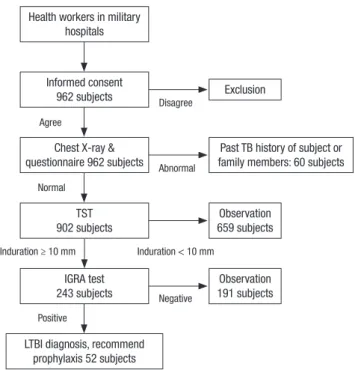
A total of 962 of the 14 chosen military hospitals finished the screening and survey of the study. However, 60 people were ex- cluded based on past TB history and TB history of family mem- bers to identify the relationship of recent TB infection and oc- cupational exposures. In the survey, we collected the following information from the subjects: sex, age, smoking history, alco- hol intake, comorbidities at present, weight, height, profession, work duration, and work duration of TB patient care. After the study, we recommended subjects with LTBI to get proper man- agement and treatments. Fig. 1 describes the study protocol.
Fig. 1. Latent TB infection screening process of military health workers.
TB = tuberculosis, TST = tuberculin skin test, IGRA = interferon-gamma release as- say, LTBI = latent tuberculosis infection.
TST 902 subjects Chest X-ray &
questionnaire 962 subjects
IGRA test 243 subjects Health workers in military
hospitals
Agree
Disagree
Abnormal Normal
Induration ≥ 10 mm Induration < 10 mm
Negative Positive
Informed consent 962 subjects
LTBI diagnosis, recommend prophylaxis 52 subjects
Exclusion
Past TB history of subject or family members: 60 subjects
Observation 659 subjects
Observation 191 subjects
Ethics statement
The protocol of this study was reviewed and approved by the Institutional Review Board of the Korean Institute of Tubercu- losis (2014-KIT-IRB-01). Written informed consents were pro- vided by all participants.
RESULTS
A total of 962 health workers from the 14 military hospitals par- ticipated in the study. No active TB was identified in the screen- ing, and inactive TB lung lesions were found in 21 subjects. No one reported TB symptoms at the moment of the screening. We underwent TST and IGRA to identify LTBI cases and collected completed questionnaires from 902 subjects (Table 1). The mean
age of participants was 24.4 ± 5.6 (men: 23.1 ± 4.6; women: 28.5
± 6.5), and 75.7% (683/902) of subjects were men. A third (33.8%) of all subjects reported having provided TB patient care and 19.5% of all subjects had been involved in the care for one year or more in the past.
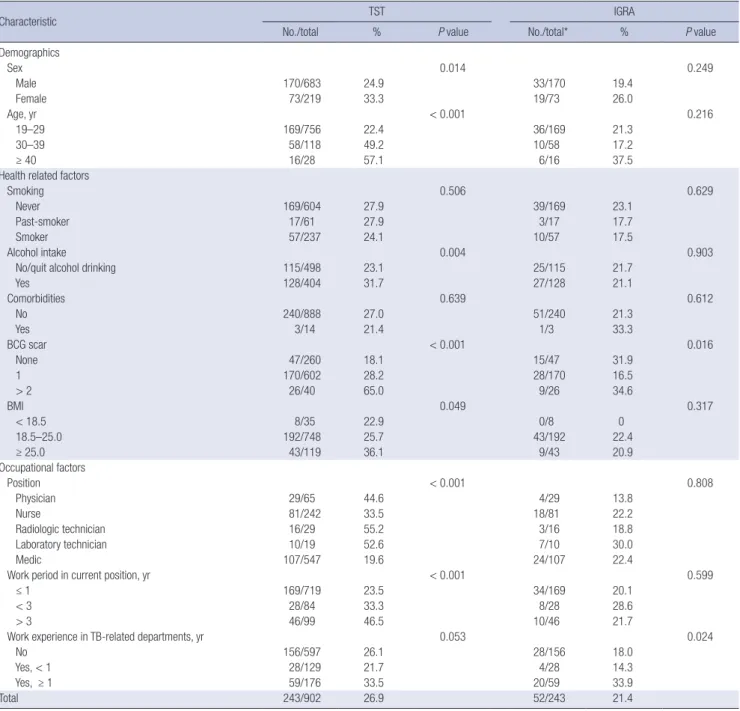
Positive TST results were found in 26.9% of all subjects and positive IGRA results were identified in 21.4% of positive TST subjects (Table 2). Overall, the proportion of those who were diagnosed as LTBI in the study group was 5.8% (52/902). Old age, comorbidity, a higher number of BCG scars, and having provided TB patient care were found to be associated with LTBI in the univariate analysis. In the multivariate analysis, control- ling for demographic and health-related variables (Table 3), work experience in TB-related departments for 1 year or more was Table 1. General characteristics of study participants
Characteristic Total (n = 902) Male (n = 683) Female (n = 219)
P value
No. % No. % No. %
Demographics
Age, yr < 0.001
Mean ± SD 24.4 ± 5.6 23.1 ± 4.6 28.5 ± 6.5
19–29 756 83.8 601 87.9 155 70.8
30–39 118 13.1 73 10.7 45 20.6
≥ 40 28 3.1 9 1.3 19 8.7
Health related factors
Smoking < 0.001
Never 604 67.0 388 56.8 216 98.6
Past-smoker 61 6.8 59 8.6 2 0.9
Smoker 237 26.3 236 34.6 1 0.5
Alcohol intake < 0.001
No/quit alcohol drinking 498 55.2 401 58.7 97 44.3
Yes 404 44.8 282 41.3 122 55.7
Comorbidities 0.802
No 888 98.5 672 98.4 216 98.6
Yes 14 1.6 11 1.6 3 1.4
BCG scar < 0.001
None 260 28.8 210 30.8 50 22.8
1 602 66.7 454 66.5 148 67.6
> 2 40 4.4 19 2.8 21 9.6
BMI < 0.001
< 18.5 35 3.9 15 2.2 20 9.1
18.5–25.0 748 82.9 556 81.4 192 87.7
≥ 25.0 119 13.2 112 16.4 7 3.2
Occupational factors
Position < 0.001
Physician 65 7.2 64 9.4 1 0.5
Nurse 242 26.8 41 6.0 201 91.8
Radiologic technician 29 3.2 23 3.3 6 2.7
Laboratory technician 19 2.1 8 1.2 11 5.0
Medic 547 80.1 547 80.1 0 0
Work period in current position, yr < 0.001
≤ 1 719 79.7 633 92.7 86 39.3
< 3 84 9.3 31 4.5 53 24.2
> 3 99 11.0 19 2.8 80 36.5
Work experience in TB-related departments, yr < 0.001
No 597 66.2 510 74.7 87 39.7
Yes, < 1 129 14.3 85 12.5 44 20.1
Yes, ≥ 1 176 19.5 88 12.9 88 40.2
SD = standard deviation, BCG = Bacillus Calmette-Guerin, BMI = body mass index, TB = tuberculosis.
Table 2. Result of LTBI test and related factors
Characteristic TST IGRA
No./total % P value No./total* % P value
Demographics
Sex 0.014 0.249
Male 170/683 24.9 33/170 19.4
Female 73/219 33.3 19/73 26.0
Age, yr < 0.001 0.216
19–29 169/756 22.4 36/169 21.3
30–39 58/118 49.2 10/58 17.2
≥ 40 16/28 57.1 6/16 37.5
Health related factors
Smoking 0.506 0.629
Never 169/604 27.9 39/169 23.1
Past-smoker 17/61 27.9 3/17 17.7
Smoker 57/237 24.1 10/57 17.5
Alcohol intake 0.004 0.903
No/quit alcohol drinking 115/498 23.1 25/115 21.7
Yes 128/404 31.7 27/128 21.1
Comorbidities 0.639 0.612
No 240/888 27.0 51/240 21.3
Yes 3/14 21.4 1/3 33.3
BCG scar < 0.001 0.016
None 47/260 18.1 15/47 31.9
1 170/602 28.2 28/170 16.5
> 2 26/40 65.0 9/26 34.6
BMI 0.049 0.317
< 18.5 8/35 22.9 0/8 0
18.5–25.0 192/748 25.7 43/192 22.4
≥ 25.0 43/119 36.1 9/43 20.9
Occupational factors
Position < 0.001 0.808
Physician 29/65 44.6 4/29 13.8
Nurse 81/242 33.5 18/81 22.2
Radiologic technician 16/29 55.2 3/16 18.8
Laboratory technician 10/19 52.6 7/10 30.0
Medic 107/547 19.6 24/107 22.4
Work period in current position, yr < 0.001 0.599
≤ 1 169/719 23.5 34/169 20.1
< 3 28/84 33.3 8/28 28.6
> 3 46/99 46.5 10/46 21.7
Work experience in TB-related departments, yr 0.053 0.024
No 156/597 26.1 28/156 18.0
Yes, < 1 28/129 21.7 4/28 14.3
Yes, ≥ 1 59/176 33.5 20/59 33.9
Total 243/902 26.9 52/243 21.4
LTBI = latent tuberculosis infection, TST = tuberculin skin test, IGRA = interferon-gamma release assay, BCG = Bacillus Calmette-Guerin, BMI = body mass index, TB = tuberculosis.
Table 3. Result of multivariate logistic analysis
Duration of TB patient care, yr Model I Model II Model III
aOR 95% CI aOR 95% CI aOR 95% CI
No Reference - Reference - Reference -
< 1 0.72 0.24–2.14 0.76 0.25–2.28 0.78 0.26–2.36
≥ 1 2.38* 1.25–4.55 2.36* 1.23–4.55 2.27* 1.13–4.56
Model I: adjusted for sex and age; Model II: model I + adjusted for smoking, alcohol intake, comorbidities, number of BCG scars, and BMI; Model III: model II + adjusted for job position and duration of current position.
TB = tuberculosis, aOR = adjusted odds ratio, CI = confidence interval, BCG = Bacillus Calmette-Guerin, BMI = body mass index.
*P < 0.050.
the only factor significantly associated with LTBI (adjusted odds ratio [aOR], 2.27; 95% CI, 1.13–4.56). The associations between
LTBI and other occupational factors such as occupation and duration of employment were not significant.
DISCUSSION
This study sought to identify LTBI cases in military health work- ers with TST and IGRA. A third of subjects reported work expe- rience in TB-related departments. We conducted IGRA for sub- jects with positive TST results to exclude false-positive cases that had been vaccinated for BCG in the NIP. Positive TST re- sults were identified in 26.9% (243/902) of subjects by a cut-off of 10 mm diameter skin duration. Of the subjects with positive TST results, positive IGRA results were found in 21.4% (52/243).
We applied IGRA only to subjects with positive TST results, con- sidering cost effectiveness of the test since high negative results are expected from TST negative reactors.
According to the study protocol, the prevalence of LTBI in the study population was 5.8%. An occupational risk, having been in TB patient care for one year or more, was significantly associ- ated with LTBI, controlling for demographic and health-related variables in the multivariate analysis. This result emphasizes the importance of annual LTBI screenings as a certain portion of health workers are always exposed to TB patients in the prac- tice. The guidelines for TB control in the health facility developed by Korea Centers for Disease Control and Prevention (KCDC) recommend that every health worker in health facilities should be examined by chest radiography annually to detect active lung lesion of TB (15,16,19). However, this study suggests the appli- cation of TST and IGRA to identify health workers who might be infected with TB during the practice. This provides a chance of treating LTBI in the early stage before the disease would de- velop to the active form.
Nosocomial TB infection has been a concerning issue in both hospital infection control and public health (20,21). As TB can be transmitted via aerosolized droplet nuclei from infectious TB patients and the diagnosis for the disease may require inva- sive and non-invasive examinations, TB can spread to other pa- tients and health workers in outpatient and inpatient settings.
After developed countries recognized TB as an occupational hazard since the 1950s, effective control measures were intro- duced to reduce the risk of TB infection in healthcare settings (6).
In Korea, a country with an intermediate TB burden, TB in- fection in health workers has been a serious issue in occupa- tional health. Chung et al. (22) reviewed annual occupational safety and health reports to determine common occupational infections that had occurred in employees. From 2000 to 2007, M. tuberculosis was the most common infectious disease in com- pensation claims. Several studies were conducted to identify specific occupations being involved with increased risk of TB infection in hospitals. Jo et al. (8) analyzed medical records of health workers in a tertiary hospital to investigate TB incidence, using prevalence ratios adjusted by age and sex, compared with that of general population. The prevalence ratio was 3.4 (95%
CI, 1.52–8.25) for nurses working in TB-related departments.
However, those who work in non-TB-related departments did not show a significant difference with that of the general popu- lation. Lee et al. (23) followed up 196 newly employed nurses in a teaching hospital, using TST and IGRA to screen for LTBI. It showed that the nurses were exposed to 3% of the annual risk of TB infection. A study involving 173 laboratory personnel in a tertiary hospital demonstrated significant associations between working in microbiology sections and positivity in IGRA (7). Park et al. (9) also presented that 3.3–5.7 of the 244 health workers who were IGRA negative upon recruitment were infected after the first year of employment, depending on department. In a study by Kim et al. (10), the proportion of positive IGRA in a high- exposure group in a general hospital was 1.2 times higher than that of a low-exposure group.
A number of limitations should be noted. Firstly, as we ap- plied the dual strategy, TST followed by IGRA, we could not conclude the proportion of only IGRA positive cases with TST negative results in all subjects. Nonetheless, it may have little influence on identifying occupational risks of LTBI as TST nega- tive but IGRA positive cases are expected to be few. Secondly, we used self-reported information to exclude subjects with past TB history and TB history of family members. This was done to identify only LTBI cases infected during professional practice.
However, it might have created a recall bias that systematically influenced the response. Thirdly, BCG vaccination and nontu- berculous mycobacterium infection may increase the number of TST positive cases that are false-positive (24). As the vaccina- tion has been implemented since 1948, the government of Ko- rea has tried to maintain a high vaccination coverage rate to prevent TB infection in general population (25). With regard to the effect of the vaccination, we examined BCG scars on their arms, revealing that 71.1% of all subjects had been vaccinated in their lifetime. BCG revaccination policy for year one students in elementary school with no scar had been in effect until 2008 (4). In addition, a revaccination policy for year 6 children with negative TST results had been implemented until 1996 (25-27).
To minimize false-positive results in TST, we set 10 mm of cut- off to judge the positivity, considering high BCG immunization rate. In this regard, the application of IGRA helps to minimize the number of false-positives. Farhat et al. (28) reported only 1%
difference between unvaccinated subjects and subjects who had been vaccinated 10 years earlier as infants younger than 1 year old. A study of Korean elementary school students found no significant difference in TST prevalence between subjects with BCG scars and those without (26). Thus, those support that this study identified the prevalence of LTBI in the study popula- tion with rare false-positive cases.
In conclusion, we examined the LTBI prevalence in military health workers working in 14 military hospitals and occupation risk factors significantly associated with LTBI in the hospital set-
tings. Of the 902 subjects, 26.9% (243/902) were positive for the TST, and the proportion of LTBI in the study population was 5.8%
(52/902). We demonstrated that providing TB patient care for 1 year or more was the only statistically significant risk of LTBI in the multivariate analysis. This result calls for policy makers to implement a regular TB screening program including TST and IGRA to provide immediate chemoprophylaxis treatments for health workers when they are found to be exposed to contagious TB patients in workplaces.
DISCLOSURE
The authors have no potential conflicts of interest todisclose.
AUTHOR CONTRIBUTION
Conceptualization: Yoon CG, Oh SY, Yang J, Bae KJ, Yang ES, Kim HJ. Investigation: Yoon CG, Oh SY, Yang J, Bae KJ, Yang ES, Kim HJ. Formal analysis: Yoon CG, Oh SY, Lee JB, Kim MH, Seo Y, Bae KJ, Hong S, Kim HJ. Visualization: Yoon CG, Oh SY, Lee JB, Kim MH, Seo Y, Bae KJ, Hong S, Kim HJ. Writing - original draft: Yoon CG, Kim HJ.
ORCID
Chang-gyo Yoon https://orcid.org/0000-0002-1543-4659 Soo Yon Oh https://orcid.org/0000-0003-4371-0793 Jin Beom Lee https://orcid.org/0000-0002-4495-3116 Mi-Hyun Kim https://orcid.org/0000-0003-1905-1759 Younsuk Seo https://orcid.org/0000-0002-3595-5064 Juyoun Yang https://orcid.org/0000-0003-1771-0642 Kyu-jung Bae https://orcid.org/0000-0002-5061-5893 Seoyean Hong https://orcid.org/0000-0002-9813-655X Eun-Suk Yang https://orcid.org/0000-0002-6700-6154 Hee Jin Kim https://orcid.org/0000-0002-0128-2789 REFERENCES
1. World Health Organization. Global Tuberculosis Report 2016. Geneva, World Health Organizaition, 2016.
2. Korea Centers for Disease Control and Prevention. 2017 National Tuber- culosis Control Guideline. Cheongju, Korea Centers for Disease Control and Prevention, 2017.
3. Statistics Korea. Causes of Death Statistics in 2015. Daejeon, Statistics Ko- rea, 2016.
4. Korea Centers for Disease Control and Prevention. 2013 National Tuber- culosis Control. Cheongwon, Korea Centers for Disease Control and Pre- vention, 2013.
5. World Health Organization. WHO Policy on TB Infection Control in Health- care Facilities, Congregate Settings and Households. Geneva, World Health Organization, 2009.
6. Jensen PA, Lambert LA, Iademarco MF, Ridzon R; CDC. Guidelines for
preventing the transmission of Mycobacterium tuberculosis in health- care settings, 2005. MMWR Recomm Rep 2005; 54: 1-141.
7. Moon HW, Kim H, Hur M, Yun YM, Lee A. Latent tuberculosis infection screening for laboratory personnel using interferon-γ release assay and tuberculin skin test in Korea: an intermediate incidence setting. J Clin Lab Anal 2011; 25: 382-8.
8. Jo KW, Woo JH, Hong Y, Choi CM, Oh YM, Lee SD, Kim WS, Kim DS, Kim WD, Shim TS. Incidence of tuberculosis among health care workers at a private university hospital in South Korea. Int J Tuberc Lung Dis 2008; 12:
436-40.
9. Park HY, Jeon K, Suh GY, Kwon OJ, Chung DR, Yoonchang SW, Kang ES, Koh WJ. Interferon-γ release assay for tuberculosis screening of healthcare workers at a Korean tertiary hospital. Scand J Infect Dis 2010; 42: 943-5.
10. Kim SY, Park MS, Kim YS, Kim SK, Chang J, Kang YA. Conversion rates of an interferon-γ release assay and the tuberculin skin test in the serial mon- itoring of healthcare workers. Infection 2013; 41: 511-6.
11. Kang CI, Choi CM, Kim DH, Kim CH, Lee DJ, Kim HB, Kim NJ, Oh MD, Choe KW. Pulmonary tuberculosis in young Korean soldiers: incidence, drug resistance and treatment outcomes. Int J Tuberc Lung Dis 2006; 10:
970-4.
12. Korea Centers for Disease Control and Prevention. Annual Report on the Notified Tuberculosis Patients in Korea 2009. Seoul, Korea Centers for Disease Control and Prevention, 2010.
13. Ministry of National Defense. Military Healthcare Act. Seoul, Ministry of National Defense, 2015.
14. World Health Organization. Guidelines on the Management of Latent Tuberculosis Infection. Geneva, World Health Organization, 2015.
15. Korea Centers for Disease Control and Prevention. Health Facility Tuber- culosis Control Guideline. Cheongju, Korea Centers for Disease Control and Prevention, 2016.
16. Joint Committee for the Revision of Korean Guidelines for Tuberculosis;
Korea Centers for Disease Control and Prevention. Korean Guidelines for Tuberculosis. 2nd ed. Cheongju, Korea Centers for Disease Control and Prevention, 2014.
17. Joung SM, Ryoo S. BCG vaccine in Korea. Clin Exp Vaccine Res 2013; 2:
83-91.
18. Mazurek GH, Jereb J, Vernon A, LoBue P, Goldberg S, Castro K; IGRA Ex- pert Committee; Centers for Disease Control and Prevention (CDC). Up- dated guidelines for using interferon gamma release assays to detect My- cobacterium tuberculosis infection - United States, 2010. MMWR Recomm Rep 2010; 59: 1-25.
19. Korea Centers for Disease Control and Prevention. Guidelines for Tuber- culosis Control in Health Facility 2016. Cheongju, Korea Centers for Dis- ease Control and Prevention, 2016.
20. Menzies D, Fanning A, Yuan L, Fitzgerald M. Tuberculosis among health care workers. N Engl J Med 1995; 332: 92-8.
21. Baussano I, Nunn P, Williams B, Pivetta E, Bugiani M, Scano F. Tuberculo- sis among health care workers. Emerg Infect Dis 2011; 17: 488-94.
22. Chung YK, Ahn YS, Jeong JS. Occupational infection in Korea. J Korean Med Sci 2010; 25: S53-61.
23. Lee K, Han MK, Choi HR, Choi CM, Oh YM, Lee SD, Kim WS, Kim DS, Woo JH, Shim TS. Annual incidence of latent tuberculosis infection among newly employed nurses at a tertiary care university hospital. Infect Con- trol Hosp Epidemiol 2009; 30: 1218-22.
24. Herrera V, Perry S, Parsonnet J, Banaei N. Clinical application and limita-
tions of interferon-gamma release assays for the diagnosis of latent tuber- culosis infection. Clin Infect Dis 2011; 52: 1031-7.
25. Lee JK, Choi WS. Immunization policy in Korea. Infect Chemother 2008;
40: 14-23.
26. Kim HJ, Oh SY, Lee JB, Park YS, Lew WJ. Tuberculin survey to estimate the prevalence of tuberculosis infection of the elementary schoolchildren under high BCG vaccination coverage. Tuberc Respir Dis 2008; 65: 269-
76.
27. Jung YJ, Shim TS. In reply to “TB contact screening: which way to go” [Cor- respondence]. Int J Tuberc Lung Dis 2009; 13: 1577-8.
28. Farhat M, Greenaway C, Pai M, Menzies D. False-positive tuberculin skin tests: what is the absolute effect of BCG and non-tuberculous mycobac- teria? Int J Tuberc Lung Dis 2006; 10: 1192-204.