INTRODUCTION
Atopic dermatitis (AD) is a common chronic inflammatory skin disease frequently accompanied by other atopic diseases and has a substantial impact on the quality of life of affected pa- tients and their families.1 Mild AD can be adequately controlled with basic skin care, environmental control and topical medi- cations. However, moderate-to-severe disease requires more comprehensive and systemic management.2 To date, there has been a paucity of published evidence to guide such approach-
es. Although there are reports and guidelines regarding the man- agement of AD in Korea,3,4 differences in the patterns of AD man- Allergy Asthma Immunol Res. 2018 May;10(3):253-259.
https://doi.org/10.4168/aair.2018.10.3.253 pISSN 2092-7355 • eISSN 2092-7363
Current Management of Moderate-to-Severe Atopic Dermatitis:
A Survey of Allergists, Pediatric Allergists and Dermatologists in Korea
Hye Yung Yum,
1Hyun Hee Kim,
1Hyun Jung Kim,
2Woo Kyung Kim,
3So-Yeon Lee,
4Kapsok Li,
5Dong Hun Lee,
6* The KAAACI Work Group on Severe/Recalcitrant Atopic Dermatitis
1Department of Pediatrics, Seoul Medical Center, Seoul, Korea
2Department of Dermatology, Seoul Medical Center, Seoul, Korea
3Department of Pediatrics, Inje University School of Medicine, Seoul, Korea
4Department of Pediatrics, Asan Medical Center, Seoul, Korea
5Department of Dermatology, Chung-Ang University College of Medicine, Seoul, Korea
6Department of Dermatology, Seoul National University College of Medicine, Seoul, Korea
This is an Open Access article distributed under the terms of the Creative Commons Attribution Non-Commercial License (http://creativecommons.org/licenses/by-nc/4.0/) which permits unrestricted non-commercial use, distribution, and reproduction in any medium, provided the original work is properly cited.
Purpose: There is an unmet need for the treatment of moderate-to-severe atopic dermatitis (AD), leading to variation in management strategies. To investigate distinct features and treatment modalities according to physicians’ specialties, we collected data on the current treatment approach to moderate-to-severe AD among allergists, pediatric allergists and dermatologists in Korea. Methods: This questionnaire-based study was adminis- tered to physicians from the Korean Academy of Asthma, Allergy and Clinical Immunology (KAAACI), Korean Academy of Pediatric Allergy and Re- spiratory Disease (KAPARD), and Korean Atopic Dermatitis Association (KADA). Results: A total of 93 physicians participated in the study; 64.5%
were pediatric allergists and 31.2% were dermatologists. The major patient age groups were “less than 5 years” for 100% of pediatric allergists and “6-12 years old” for 38% of dermatologists. The proportion of patients with moderate-to-severe AD was higher for dermatologists and aller- gists compared to pediatric allergists. Physicians agreed on the necessity of education including demonstration of basic skin care and application of topical therapies (88.2%), nutritional consultation (83.9%) and psychological counseling (75.3%). However, less than half were able to educate and counsel their patients in real practice. There were noticeable differences in first-line treatment among physician groups. For pediatric allergists, the order of preferred systemic treatment was wet wrap therapy, systemic corticosteroids and oral cyclosporin. Dermatologists ranked cyclosporin, pho- totherapy, and systemic corticosteroids as first-line treatment regimens. Major reported barriers to proper management were steroid phobia, un- proven complementary and alternative medicine, lack of education, and the unreasonable insurance system. Conclusions: Our findings suggest there are distinct differences in moderate-to-severe AD treatment according to physicians’ specialties. Medical policy changes along with govern- mental supports are required in order to implement the ideal approach in real practice. For moderate-to-severe AD, a consensus on the approach to optimal management should be reached for the best outcomes, based on further randomized controlled trials.
Key Words: Atopic dermatitis; management; questionnaire
Correspondence to: Dong Hun Lee, MD, PhD, Department of Dermatology, Seoul National University College of Medicine, 103 Daehak-ro, Jongno-gu, Seoul 03080, Korea.
Tel: +82-2-2072-2415; Fax: +82-2-742-7344; E-mail: [email protected] Received: December 21, 2017; Revised: February 12, 2018;
Accepted: February 23, 2018
•Hye Yung Yum and Hyun Hee Kim contributed equally to this paper.
•There are no financial or other issues that might lead to conflict of interest.
agement according to physicians’ specialties have never been investigated.
The present study was conducted to identify management patterns in Korea for moderate-to-severe AD, including diag- nostic tools, use of laboratory tests and treatment strategies, ac- cording to the physician’s specialty, namely, allergists, pediatric allergists and dermatologists.
MATERIALS AND METHODS Study subjects
This questionnaire study was administered to physicians from the Korean Academy of Asthma, Allergy and Clinical Immunol- ogy (KAAACI), Korean Academy of Pediatric Allergy and Respi- ratory Disease (KAPARD), and Korean Atopic Dermatitis Asso- ciation (KADA). This study was approved by the Institutional Review Board of Seoul Medical Center (approval No. 2016-028).
Contents
The questionnaire consisted of 31 questions divided into 7 sec- tions. We obtained data regarding the demographic and profes- sional characteristics of the respondents, including age, sex, specialty and type of practice hospital. Subjects were asked to report the proportion of pediatric patients they treated (0-5, 6-12, and 13-18 years old) and whether they used skin or serologic testing for specific immunoglobulin E (IgE). For severity assess- ment, the Eczema Area and Severity Index (EASI) or SCORing Atopic Dermatitis index (SCORAD) was employed.
Survey participants were asked to denote the necessity and feasibility of treatment options including basic skin care of bath- ing with moisturizing, and avoidance of triggering factors. In
addition, education and consultation by medical staff, psychol- ogists or dietitians, and use of topical medications and oral an- tihistamines were included in the treatment options. Further- more, providers were asked whether they prescribe nutritional supplements with probiotics, vitamin D, essential fatty acids and zinc. Providers were also asked to indicate their preference for the following systemic treatment options: wet wrap therapy, systemic corticosteroids, cyclosporin, azathioprine, methotrex- ate, mycophenolate mofetil, interferon-γ and phototherapy.
Finally, the questionnaire explored the use of various treatment guidelines to direct the management of AD as well as perceived barriers to comprehensive treatment of AD.
Statistical analysis
Data analysis was performed using STATA version 10.0 (Stata- Corp., College Station, TX, USA).
RESULTS
Study population, practice site and physician characteristics Ninety-three participants completed the full survey. The de- mographic and professional characteristics of the respondents are depicted in Table. In total, 40.9% were women; the majority were pediatric allergists (64.5%), 31.2% were dermatologists, and the remaining 4.3% were allergists. Regarding age, 33.3%
were in their forties, 28% in their thirties, another 28% in their fifties, and 10.8% in their sixties. Most of the participants (87.1%) worked in university teaching hospitals, and 12.9% in other types of hospitals.
Distribution of patient age groups and proportion of moderate-to-severe AD
A total of 68 respondents (73.1%) reported that their major pa- tient age group was “less than 5 years,” while 12 (12.9%), 8 (8.6%), and 5 (5.4%) respondents reported that their major patient age group was “6-12 years old,” “more than 19 years old”, and “13-18 years old,” respectively (Fig. 1). All of the pediatric allergists re- Table. Demographic and professional characteristics of the participants
Variables Value (N=93)
Sex
Male 55 (59.1)
Female 38 (40.9)
Age (year)
30-39 26 (28.0)
40-49 31 (33.3)
50-59 26 (28.0)
≥60 10 (10.7)
Primary specialty
Internal Medicine 4 (4.3)
Pediatrics 60 (64.5)
Dermatology 29 (31.2)
Practice location
University teaching hospital 81 (87.1)
Other types of hospital 12 (12.9)
Values are presented as the number of participants (%). Fig. 1. Distribution of patient age.
N
0-5 6-12 12-18 ≥19
Age group (year) 80
70 60 50 40 30 20 10 0
68
12 5 8
sponded that their major patient age group was aged “less than 5 years” (100%, 60/60). The major age groups were “6-12 years old” for dermatologists (38%, 11/29), and “more than 19 years old” for allergists (75%, 3/4).
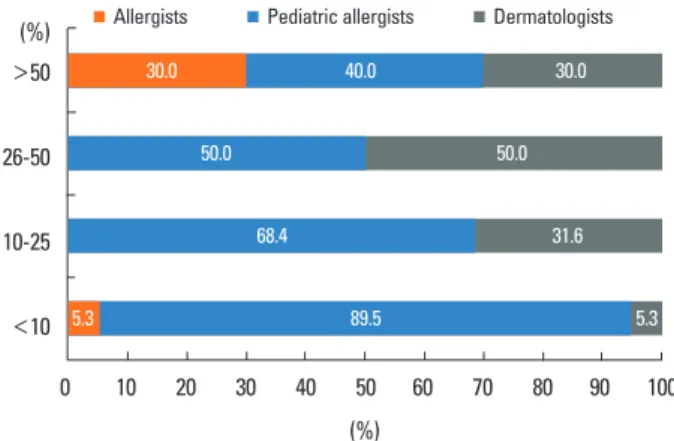
Thirty-nine respondents (40.8%) reported the proportion of moderate-to-severe AD in their practice as “10%-25%,” while 24 (25.8%), 19 (20.4%), and 1 (1.1%) respondents reported the pro- portion as “26%-50%,” “<10%”, and “>51%,” respectively.
The proportion of moderate-to severe AD was higher in the practices of dermatologists and allergists, compared to pediat- ric allergists. Twenty-six pediatric allergists (43.3%) reported that the proportion of moderate-to-severe AD in their practice was “10%-25%,” and 30% (18/60) reported the proportion was
“<10%.” On the other hand, 41% of dermatologists reported that the proportion of moderate-to-severe AD they treated was
“10%-25%,” and another 41% answered that the proportion was
“26%-50%.” In the case of allergists, 75% (3/4) reported that the proportion of moderate-to-severe AD in their practice was “>51%,”
while 25% (1/4) reported that the proportion was “<10%.”
The percentages of respondents who reported that the pro- portion of patients with moderate-to-severe AD in their prac-
tice was “less than 10%” were 89.5% for pediatric allergists, 5.3%
for dermatologists and 5.3% for allergists. The percentages who reported that the proportion of such patients they saw was “10%- 25%” were 68.4% for pediatric allergists, 31.6% for dermatolo- gists and none for allergists (Fig. 2).
Fig. 2. Proportion of moderate-to-severe atopic dermatitis patients grouped by the physician’s specialty.
0 10 20 30 40 50 60 70 80 90 100 (%)
>50
26-50
10-25
<10 (%)
30.0 50.0
68.4 31.6
5.3 89.5 5.3
50.0
40.0 30.0
Allergists Pediatric allergists Dermatologists
Fig. 3. Necessary and actually employed treatment modalities.
(%)
Bathing Moisturization Avoidance of risk factors Basic therapies
100 90 80 70 60 50 40 30 20 10 0
91.4 80.6
93.5 92.5 94.6 90.3
Necessary Applied in real practice
(%)
Topical corticosteroid Topical calcineurin
inhibitor Antihistamines Topical agents and antihistamines 100
90 80 70 60 50 40 30 20 10 0
94.6 92.5 89.2 90.3 93.5 92.5
Necessary Applied in real practice
(%)
Probiotics Vitamin D Essential fatty acid Zinc Others
100 90 80 70 60 50 40 30 20 10 0
62.455.9
43
33.3 33.3
20.4 36.6
24.7 Necessary Applied in real practice
(%)
Demonstration and education about essential therapies and topical agents by
nurse specialists or residents
Clinical counseling for psychological
aggravating factors
Nutrition consultation for associated food
allergy
Consultation and education 100
90 80 70 60 50 40 30 20 10 0
88.2
43
75.3
11.8
83.9
38.7 Necessary Applied in real practice
Outcome measures for severity assessment and allergy tests Most respondents (76.3%) utilized the EASI for measuring AD severity, whereas some (19.4%) preferred the SCORAD. To de- tect allergen-specific IgE in serum, ImmunoCAP (Phadia, Up- psala, Sweden), the multiple-antigen simultaneous test (MAST) (Hitachi Chemical Diagnostics Inc., Mountain View, CA, USA) and skin prick testing were performed in 82 (88.2%), 70 (75.3%), and 57 (61.3%) participants, respectively.
Gap between ideal and real-world practice for AD treatment modalities
Basic skin care including proper bathing, moisturizing and avoidance of triggers are appreciated as the necessary treatment modalities by most respondents. However, the perceived ne- cessity and the actual application of proper bathing were 91.4%
and 80.6%, respectively.
Respondents agreed on the necessity of education including the demonstration of basic skin care and application of topical therapies (88.2%), nutritional consultation (83.9%), and psycho- logical counseling (75.3%). However, less than half of physicians conducted education and counseling in real practice.
The percentages of respondents who regarded topical corti- costeroids and topical calcineurin inhibitors as necessary were 94.6% and 89.2%, respectively, and the percentages who pre- scribed them in real practice were 92.5% and 90.3%, respective- ly. Regarding antihistamines, 93.5% of respondents thought they were necessary and 92.5% actually prescribed them in real practice. For other supplementary measures including probiot- ics, vitamin D, essential fatty acids and zinc, 62.4%, 43.0%, 36.6%, and 24.7% of the respondents considered each of them neces- sary, and 55.9%, 33.3%, 33.3%, and 20.4% of the respondents used them in real practice, respectively (Fig. 3).
Preferred systemic treatments for severe AD according to specialty
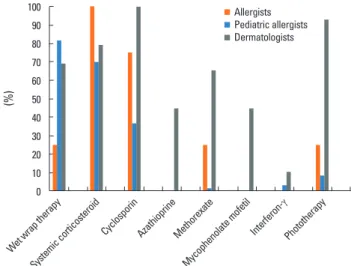
Among all respondents, preferred systemic treatments for mod- erate-to-severe AD were wet wrap therapy (75.3%), systemic corticosteroids (74.2%), cyclosporin (58.1%), and phototherapy (35.5%) (Fig. 4).
For pediatric allergists, the order of preferred systemic treat- ment was wet wrap therapy (81.7%), systemic corticosteroids (70.0%), and cyclosporin (36.7%). However, dermatologists ranked cyclosporin (100%), phototherapy (93.1%), and systemic corti- costeroid (79.3%) as first-line treatment regimens for moderate- to-severe AD. Allergists preferred systemic corticosteroids (100%), followed by cyclosporin (75%) (Fig. 5).
Preferred guidelines for AD management
The KAPARD guidelines for the management of AD5 were pre- ferred by the greatest number of pediatric allergists (96.5%), fol- lowed by the guidelines from the European Academy of Allergy and Clinical Immunology (EAACI)6 (89.7%), and the guidelines from the American Academy of Allergy, Asthma and Immunol-
Fig. 4. Preferred systemic treatment of severe atopic dermatitis in real practice.
N
Wet wrap therapy Systemic cortiosteroid
Cyclosporin Azathioprine Methorexate Mycophenolate mofetil
Interferon- γ
Phototherapy 80
70 60 50 40 30 20 10 0
75.3 74.2 58.1
14 14
5.4 35.5 22.6
Fig. 5. Preferred systemic treatment of moderate-to-severe AD according to the physician’s specialty.
(%)
100 90 80 70 60 50 40 30 20 10 0
Wet wrap therapy Systemic corticosteroid
Cyclosporin AzathioprineMethorexate Mycophenolate mofetil
Interferon- γ
Phototherapy Allergists
Pediatric allergists Dermatologists
Fig. 6. Preferred guidelines for treatment of AD according to the physician’s specialty. EADV, European Academy of Dermatology and Venereology; EAACI, European Academy of Allergy and Clinical Immunology; AAD, American Acade- my of Dermatology; AAAAI, American Academy of Allergy, Asthma and Immu- nology; KADA, Korean Atopic Dermatitis Association; KAPARD, Korean Acade- my of Pediatric Allergy and Respiratory Disease.
0 10 20 30 40 50 60 70 80 90 100 (%)
EADV EAACI AAD AAAAI KADA KAPARD
5.9 35.3 58.8
3.4
43.3 56.7
6.0 86.0 8.0
4.1 38.8 57.1
3.5 96.5
89.7 6.9
Allergists Pediatric allergists Dermatologists
ogy (AAAAI)7 (86%).
In contrast, the greatest number of dermatologists favored the guidelines of the European Academy of Dermatology and Ve- nereology (EADV)8 (58.8%), followed by the KADA guidelines9 (57.1%), and the guidelines from the American Academy of Der- matology (AAD)10-13 (56.7%) (Fig. 6).
Barriers to comprehensive treatment of AD
The major factors quoted as barriers to the proper manage- ment of AD were steroid phobia (88.2%), unproven comple- mentary and alternative medicine (76.3%), the unreasonable insurance system (69.9%), and a lack of education (67.7%). In addition, some respondents also regarded deficiency of special clinics for AD (46.2%) and a lack of proper Korean guidelines (20.4%) as barriers to the comprehensive management of AD (Fig. 7).
DISCUSSION
The pathophysiology of AD is highly complex, and heteroge- neous phenotypes are described in terms of different features such as age of onset, severity, IgE sensitization, comorbidity and variable response to conventional treatment.14,15 Although there is a lack of consensus regarding management for patients with moderate-to-severe AD, difficult-to-manage patients should be referred to an AD specialist.7 Based on the heterogeneity of this disease and its variable clinical presentation, cooperation be- tween allergists, pediatric allergists and dermatologists is im- portant in the implementation of strategies for the care of pa- tients with moderate-to-severe AD. The KAAACI Work Group on Severe/Recalcitrant Atopic Dermatitis previously suggested the necessity of personalized and comprehensive approaches to severe/recalcitrant AD in a previous report.3 However, there have been significant barriers to proper management in real practice. The present survey provides insight into practical AD management according to physicians’ specialties in Korea. As the members of the KAAACI and KAPARD were invited to par- ticipate in this questionnaire-based survey, the data obtained in this study might represent the current management practic- es of consultant physicians in Korea.
Our data showed distinct differences in the age groups and AD severity of the patient populations according to respondents’
specialties. Younger children aged less than 5 years are the ma- jor patients for pediatric allergists, and 89.5% of pediatric aller- gists reported that the proportion of moderate-to-severe AD in their practice was less than 10%. On the other hand, the major patient group for dermatologists was “older than 5 years,” and the proportion of moderate-to-severe AD in their practice was relatively higher.
In a previous questionnaire-based survey in Korea, physicians working in secondary and tertiary hospitals were found to per- form more allergy tests compared to primary care physicians (89.0% vs 45.8%, respectively), irrespective of their specialties.16 Although most clinicians and patients agreed on the necessity of measuring allergen-specific IgE in the initial assessment of AD,17,18 in vivo (skin prick test) or in vitro (ImmunoCAP and MAST) tests were performed in only 59.9% of patients as report- ed in our other previous study.17 In the present study, 88.2% of respondents employed ImmunoCAP, a finding comparable to previous results focused on secondary or tertiary hospitals.
Saavedra et al.19 reported that significant and distinct differ- ences in AD management patterns exist among physicians ac- cording to specialty. Allergists reported greater use of laborato- ry tests (IgE, skin prick and elimination diet) compared to pedi- atric allergists and dermatologists. For infants and toddlers with AD, most pediatric allergists and allergists employed formula change as a strategy in some populations, whereas dermatolo- gists favor a pharmacologic approach. Dermatologists utilized higher-potency anti-inflammatory agents more frequently than pediatric allergists or allergists. In comparison, as the present study shows, Korean physicians tend to prescribe short-term systemic therapy more frequently for the treatment of acute ex- acerbation of early onset AD.
Although there is no universal agreement on the definition of severe/recalcitrant AD, severe disease can be regarded as AD recalcitrant to potent anti-inflammatory topical medications and associated with a considerable impact on quality of life from a clinical point of view. There is a wide variation in prescribing practices or approaches to severe AD, according to a European survey.20 In a recent systematic review, strong recommendation was only possible for the short-term use of cyclosporin A among 12 different interventions for moderate-to-severe AD in 34 ran- domized controlled trials.21 The present survey identified dis- tinct variations in prescribing patterns of systemic treatment for moderate-to-severe AD. Pediatric allergists preferred wet wrap therapy, systemic corticosteroids and cyclosporin, in decreas- ing order of frequency. Dermatologists prescribed cyclosporin, phototherapy and systemic corticosteroids as first-line treat- ment regimens. Although in our study, allergists most strongly preferred systemic corticosteroids, which requires confirma- tion due to the small sample size. We found that wet wrap ther- apy was mostly employed by pediatric allergists and dermatol- Fig. 7. Barriers to comprehensive treatment in patients with atopic dermatitis.
(%)
Unproven complementary and alternative
medicine Steroid
phobia Deficiency of special clinic Lack of
Korean guideline
Unavailable professional counseling or education
Issues of health care
system 10090
8070 6050 4030 2010 0
76.3 88.2
46.2
20.4
67.7 69.9
ogists. Regardless of physicians’ specialties, systemic corticoste- roids are chosen by most respondents as a first-line treatment regimen; however, phototherapy is mainly preferred by derma- tologists. Some dermatologists prescribed azathioprine, meth- otrexate, mycophenolate modefil and interferon-γ as first-line treatment regimens, but pediatric allergists and allergists rarely used these treatment options. Considering age group and se- verity of patients according to physician specialty, pediatric al- lergists may deal with more cases of acute exacerbation rather than chronic persistent lesions. In addition, the questionnaire did not clearly distinguish acute exacerbation and moderate- to-severe cases. Nevertheless, these results confirmed that sys- temic corticosteroids are still the major systemic treatment reg- imen in Korea for moderate-to-severe AD, consistent with those of previous surveys in patients.16,17
As expected, the preferred referral guidelines for the manage- ment of AD varied according to specialty. This finding reflects the differences in approach depending on the physician’s spe- cialty. For example, diluted bleach bath, vitamin D, and envi- ronmental intervention are more emphasized in the AAAAI guidelines than in the AAD guidelines. In a recent European survey20 investigating the use of systemic therapy in children with severe/recalcitrant atopic eczema (AE), dermatologists were significantly more likely to initiate systemic agents com- pared to pediatric allergists. The researchers also reported that the first-line systemic agents of choice were cyclosporin and oral corticosteroids, comparable to our results.
Our previous study17 showed that appropriate explanation and education based on the test results were not provided to patients and caregivers. Therefore, the accuracy in determining trigger factors and patient satisfaction fell short of expectations.
The reasons for hesitating to perform allergy testing in primary clinics could be lack of testing personnel or facilities, lack of be- lief regarding the clinical importance of allergy testing in the treat- ment, and difficulty in explaining the test results to patients.16,17 The significant burden of chronic diseases on the quality of life of patients and their caregivers as well as the relative complexi- ty of the treatment frequently result in therapeutic failure due to poor adherence. Therapeutic patient education and a compre- hensive approach to the treatment of AD are aimed at improv- ing the therapeutic adherence of patients and their caregivers.22,23 Many patients acquire indiscriminate or inadequate disease in- formation through various forms of media, without expert su- pervision.24 However, 70.1% of patients surveyed in a previous study demonstrated willingness to participate in an expert-led education program in a hospital.17 By means of in-depth coun- seling and education, factors that reduce compliance could be identified and reflected in treatment strategies through multi- disciplinary approaches in AD management.25,26 In the present study, basic skin care including bathing, moisturization avoid- ance of risk factors was relatively well employed in real practice.
However, demonstration and education about essential thera-
pies and topical agents, clinical counseling for psychological aggravating factors, and nutritional consultation for associated food allergy were not actually implemented well, although they were thought to be essential. Experts have limitations in realiz- ing this ideal approach, associated with insufficient time for ed- ucation about the disease due to low economic compensation compared to physician’s effort. Therefore, medical policy chang- es and institutional/governmental support are required, con- sidering the high prevalence and psychosocial burden of AD.
There have been compelling but unproven and false beliefs regarding AD and, in particular, a misleading belief on steroid use (steroid phobia) is still widespread.24 Aubert-Wastiaux et al.27 reported that topical corticosteroid phobia was present in 80.7% of AD patients/parents, regardless of disease severity and duration. In a survey on the topical steroid prescriptions of der- matologists,28 45% of the respondents assumed that more than half of the outpatients have topical steroid phobia, and 73% of the respondents in private clinics and 62% in secondary and tertiary hospitals were influenced by patients’ negative attitudes toward topical steroid prescription. Concordant with the previ- ous patients/parents survey,27 our study showed that 82% of the respondents ranked steroid phobia as the biggest hurdle to com- prehensive treatment of AD, followed by unproven complemen- tary and alternative medicine, an issue related to the unreason- able healthcare system, and absence of professional counseling education. These barriers could lead to poor compliance with treatment and may impact disease outcome. Thus, well-orga- nized patient education should be provided to encourage treat- ment adherence.
There are several weaknesses of this study. First, our sample size is small and the proportion of moderate-to-severe cases is not high. Secondly, there may be bias in the selection of respon- dents as we did not perform random sampling.
In summary, we found that there are distinct differences in preferred treatments for moderate-to-severe AD in real practice according to physicians’ specialties. Even experts experience many limitations in implementing the ideal approach; there- fore, medical policy changes and institutional/governmental support are needed considering the high prevalence and psy- chosocial burden of AD. We suggest that there is an unmet need for a personalized, evidence-based and multidisciplinary ap- proach including therapeutic patient education in AD in real practice.
ORCID
Hye Yung Yum https://orcid.org/0000-0002-3997-4094 Hyun Hee Kim https://orcid.org/0000-0002-4905-9391 Hyun Jung Kim https://orcid.org/0000-0001-5125-667X Woo Kyung Kim https://orcid.org/0000-0001-8730-010X So-Yeon Lee https://orcid.org/0000-0002-2499-0702 Kapsok Li https://orcid.org/0000-0002-1333-1680
Dong Hun Lee https://orcid.org/0000-0002-2925-3074
REFERENCES
1. Weidinger S, Novak N. Atopic dermatitis. Lancet 2016;387:1109-22.
2. Boguniewicz M, Leung DY. The ABC’s of managing patients with severe atopic dermatitis. J Allergy Clin Immunol 2013;132:511-2.e5.
3. Park JS, Kim BJ, Park Y, Lee SY, Kim WK, Kim JE, et al. KAAACI work group report on the treatment of severe/recalcitrant atopic derma- titis. Korean J Asthma Allergy Clin Immunol 2010;30:255-70.
4. Kim JE, Kim HJ, Lew BL, Lee KH, Hong SP, Jang YH, et al. Consen- sus guidelines for the treatment of atopic dermatitis in Korea (part II): systemic treatment. Ann Dermatol 2015;27:578-92.
5. Kim DH, Kang KH, Kim KW, Yoo IY. Management of children with atopic dermatitis. Pediatr Allergy Respir Dis 2008;18:148-57.
6. Akdis CA, Akdis M, Bieber T, Bindslev-Jensen C, Boguniewicz M, Eigenmann P, et al. Diagnosis and treatment of atopic dermatitis in children and adults: European Academy of Allergology and Clini- cal Immunology/American Academy of Allergy, Asthma and Im- munology/PRACTALL Consensus Report. Allergy 2006;61:969-87.
7. Schneider L, Tilles S, Lio P, Boguniewicz M, Beck L, LeBovidge J, et al. Atopic dermatitis: a practice parameter update 2012. J Allergy Clin Immunol 2013;131:295-299.e1-27.
8. Wollenberg A, Oranje A, Deleuran M, Simon D, Szalai Z, Kunz B, et al. ETFAD/EADV Eczema task force 2015 position paper on diag- nosis and treatment of atopic dermatitis in adult and paediatric pa- tients. J Eur Acad Dermatol Venereol 2016;30:729-47.
9. Kim JE, Kim HJ, Lew BL, Lee KH, Hong SP, Jang YH, et al. Consen- sus guidelines for the treatment of atopic dermatitis in Korea (part I): general management and topical treatment. Ann Dermatol 2015;
27:563-77.
10. Eichenfield LF, Tom WL, Chamlin SL, Feldman SR, Hanifin JM, Simp- son EL, et al. Guidelines of care for the management of atopic der- matitis: section 1. Diagnosis and assessment of atopic dermatitis. J Am Acad Dermatol 2014;70:338-51.
11. Eichenfield LF, Tom WL, Berger TG, Krol A, Paller AS, Schwarzen- berger K, et al. Guidelines of care for the management of atopic der- matitis: section 2. Management and treatment of atopic dermatitis with topical therapies. J Am Acad Dermatol 2014;71:116-32.
12. Sidbury R, Davis DM, Cohen DE, Cordoro KM, Berger TG, Berg- man JN, et al. Guidelines of care for the management of atopic der- matitis: section 3. Management and treatment with phototherapy and systemic agents. J Am Acad Dermatol 2014;71:327-49.
13. Sidbury R, Tom WL, Bergman JN, Cooper KD, Silverman RA, Berg- er TG, et al. Guidelines of care for the management of atopic der- matitis: section 4. Prevention of disease flares and use of adjunc- tive therapies and approaches. J Am Acad Dermatol 2014;71:1218- 33.
14. Garmhausen D, Hagemann T, Bieber T, Dimitriou I, Fimmers R, Diepgen T, et al. Characterization of different courses of atopic der-
matitis in adolescent and adult patients. Allergy 2013;68:498-506.
15. Bieber T, D’Erme AM, Akdis CA, Traidl-Hoffmann C, Lauener R, Schäppi G, et al. Clinical phenotypes and endophenotypes of atop- ic dermatitis: where are we, and where should we go? J Allergy Clin Immunol 2017;139:S58-64.
16. Park Y. Status of clinical practice on diagnosis and management of atopic dermatitis in Korea: a questionnaire survey of physicians.
Allergy Asthma Respir Dis 2013;1:257-65.
17. Lee DH, Doh EJ, Lee JY, Park Y, Oh JW, Lee MH, et al. Multicenter questionnaires on the current management of atopic dermatitis in Korea. Allergy Asthma Respir Dis 2016;4:271-5.
18. Lee JH, Son SW, Cho SH. A comprehensive review of the treatment of atopic eczema. Allergy Asthma Immunol Res 2016;8:181-90.
19. Saavedra JM, Boguniewicz M, Chamlin S, Lake A, Nedorost S, Czer- kies LA, et al. Patterns of clinical management of atopic dermatitis in infants and toddlers: a survey of three physician specialties in the United States. J Pediatr 2013;163:1747-53.
20. Proudfoot LE, Powell AM, Ayis S, Barbarot S, Baselga Torres E, De- leuran M, et al. The European TREatment of severe Atopic eczema in children Taskforce (TREAT) survey. Br J Dermatol 2013;169:901-9.
21. Roekevisch E, Spuls PI, Kuester D, Limpens J, Schmitt J. Efficacy and safety of systemic treatments for moderate-to-severe atopic derma- titis: a systematic review. J Allergy Clin Immunol 2014;133:429-38.
22. Barbarot S, Bernier C, Deleuran M, De Raeve L, Eichenfield L, El Hachem M, et al. Therapeutic patient education in children with atopic dermatitis: position paper on objectives and recommenda- tions. Pediatr Dermatol 2013;30:199-206.
23. Rubel D, Thirumoorthy T, Soebaryo RW, Weng SC, Gabriel TM, Villafuerte LL, et al. Consensus guidelines for the management of atopic dermatitis: an Asia–Pacific perspective. J Dermatol 2013;40:
160-71.
24. Kim JE, Lee YB, Lee JH, Kim HS, Lee KH, Park YM, et al. Disease awareness and management behavior of patients with atopic der- matitis: a questionnaire survey of 313 patients. Ann Dermatol 2015;
27:40-7.
25. Cho SE, Jeon JE, Cho H, Son DK, Kim HO, Lee SH, et al. Psycholog- ical intervention in an integrated health care service for children with atopic dermatitis. Korean J Asthma Allergy Clin Immunol 2010;
30:100-9.
26. Yum HY, Han KO, Park JA, Kang MY, Chang SI, Cho SH, et al. Im- provement in disease knowledge through an education program of atopic dermatitis. Korean J Asthma Allergy Clin Immunol 2012;32:
21-5.
27. Aubert-Wastiaux H, Moret L, Le Rhun A, Fontenoy AM, Nguyen JM, Leux C, et al. Topical corticosteroid phobia in atopic dermati- tis: a study of its nature, origins and frequency. Br J Dermatol 2011;
165:808-14.
28. Ju HY, Kim HS, Lim SH, Lee SD, Kang H, Kim HO, et al. A survey on the topical steroid prescriptions of dermatologists. Korean J Der- matol 2009;47:1004-11.