INTRODUCTION
Renal insufficiency is a common and significant lung trans- plantation (LTx) complication. Acute kidney injury (AKI) occurs in 52.5% of LTx, especially severe AKI requiring renal replacement therapy that occurs in 9.3% [1]. Further- more, stage IV chronic kidney disease (CKD) develops in approximately 8% of patients 1 year after transplantation,
and the overall incidence of CKD after 5 years is reported to be 15.8%–68.6% [2-4]. Preoperative CKD is considered to be a risk factor for redo LTx [5]. Combined lung-kidney transplantation can counteract these complications, but it should be performed only when kidney damage is irrevers- ible.
Currently, although it is not frequently performed due to donor organ shortage, transplant centers worldwide are
Successful combined second redo lung- kidney transplantation in a patient who developed end-stage renal disease after a previous lung transplantation
Jin-hee Noh
1, Dohyung Kim
2, Woo Hyun Cho
1, Hye Ju Yeo
11Division of Pulmonary, Allergy and Critical Care Medicine, Department of Internal Medicine, Pusan National University Yangsan Hospital, Yangsan, Korea
2Department of Thoracic and Cardiovascular Surgery, Pusan National University Yangsan Hospital, Yangsan, Korea
Several lung transplantation (LTx) patients develop end-stage renal disease (ESRD) and often need a kidney transplant. Recently, the number of multiorgan transplantation cases has increased; however, no successfully combined redo lung-kidney transplantation has been reported in Korea. We present the first case of combined second redo lung-kidney transplantation in a patient with ESRD after LTx. In November 2018, a 40-year-old man with dyspnea was admitted to our hospital. Seventeen years ago, he underwent right pneumonectomy owing to refractory extensive drug-resistant tuberculosis. Four years ago, he underwent left single-LTx due to chronic respiratory failure. He was diagnosed with chronic lung allograft dysfunction and ESRD (glomerular filtration rate, <15). He un- derwent a second LTx that resulted in acute graft failure. Despite the empirical manage- ment, he was not responsive to treatment. He was required to use a home ventilator, but was able to maintain good muscle strength and to walk. However, regular dialysis was required. In January 2019, he underwent combined second redo lung-kidney transplan- tation and was discharged. At 1-year follow-up, his pulmonary and renal functions were stable without rejection. Combined lung-kidney transplantation could be an effective treatment for selective young patients with respiratory and renal failure who have under- gone LTx.
Keywords: Lung transplantation; Kidney transplantation; Multiorgan transplantation
Received February 21, 2020 Revised April 29, 2020 Accepted June 15, 2020 Corresponding author: Hye Ju Yeo Division of Pulmonary, Allergy and Critical Care Medicine, Department of Internal Medicine, Pusan National University Yangsan Hospital, 20 Geumo- ro, Mulgeum-eup, Yangsan 50612, Korea Tel: +82-55-360-2120
Fax: +82-55-360-2127 E-mail: [email protected]
© The Korean Society for Transplantation This is an Open Access article distributed under the terms of the Creative Commons Attribution Non-Commercial License (http://creativecommons.org/licenses/
by-nc/4.0/) which permits unrestricted non-commercial use, distribution, and reproduction in any medium, provided the original work is properly cited.
pISSN 2671-8790
eISSN 2671-8804
experiencing cases of simultaneously combined organ transplantations in adults (i.e., heart-lung, heart-kidney, and lung-kidney transplants). Conversely, the experience with combined lung-kidney transplantation has been limited. In the United States, only 65 cases were reported to the Or- gan Procurement and Transplantation Network from 1995 to 2019 [6]. In Korea, only three lung-kidney transplantation cases were reported from 2000 to 2019 [7]. Despite the few cases of lung-kidney transplantation, increasing de- mand for this procedure is expected as the number of lung transplantations increases. In addition, the number of redo transplant cases is also prevalent, mostly with younger recipients [6,7], thereby increasing the risk of renal insuf- ficiency and the long-term use of calcineurin inhibitors, which can be an obstacle for redo lung transplantations.
Therefore, lung-kidney transplantation is rare but neces- sary for select cases. To share this clinical experience, we report a rare case of combined second redo lung-kidney transplantation in a patient who developed ESRD after pre- vious LTx.
The Institutional Review Board of Pusan National Uni- versity Yangsan Hospital gave written approval for the study and waived the need for informed consent (05-2020- 027).
CASE REPORT
A 40-year-old man visited Pusan National University Yang- san Hospital complaining of dyspnea. Seventeen years ago, he underwent right pneumonectomy owing to re- fractory extensive drug-resistant tuberculosis. Four years prior, he underwent left single-LTx due to chronic respira- tory failure. He developed AKI (creatinine, 1.36 mg/dL) 6 months after the first LTx and did not recover despite the reduced tacrolimus level from 12 to 10 ng/mL. The patient was evaluated for other possible causes of renal injury,
including hemolytic uremia syndrome due to thrombotic microangioapathy secondary to calcineurin inhibitor use, other drug toxicities, contrast nephropathy, obstructive ne- phropathy secondary to nephrolithiasis, atheroembolism, and polyomavirus BK virus infection, but no abnormalities were noted. Despite stopping all possible nephrotoxic drugs, except for the immunosuppressants, and lowering the tacrolimus level from 10 to 8, he progressed to stage III CKD (creatinine, 1.54 mg/dL) at 1 year after first LTx. He could not use alternative immunosuppressants of mTOR inhibitors or interleukin-2 inhibitor to replace or minimize calcineurin inhibitors due to high cost; thus, he lowered the tacrolimus level from 8 to 6, and increased the doses of steroid and mycophenolate mofetil (MMF) to 30 mg and 1,500 mg, respectively. We aggressively treated the associated comorbidities that can worsen renal failure such as hypertension, diabetes, and hyperlipidemia. De- spite all those efforts, he progressed to the stage IV CKD (creatinine, 2.67 mg/dL) at 32 months. At 39 months after first LTx, he had stopped taking his tacrolimus medication.
He was diagnosed with chronic lung allograft dysfunction 11 months before his visitation to our hospital due to dys- pnea, and was listed as a waiting recipient for a redo LTx.
The patient was required home oxygen treatment (2 L/
min). The initial blood test results at admission were as follows: hematocrit, 36.2%; creatinine, 4.56 mg/dL (glo- merular filtration rate [GFR] <15); urea, 43.3 mg/dL; Na, 135 mEq/L; K, 4.8 mEq/L; and high-sensitivity C-reactive protein (blood), 9.38 mg/dL. The arterial blood gas results were as follows: pH, 7.39; pO
2, 56 mmHg; and pCO
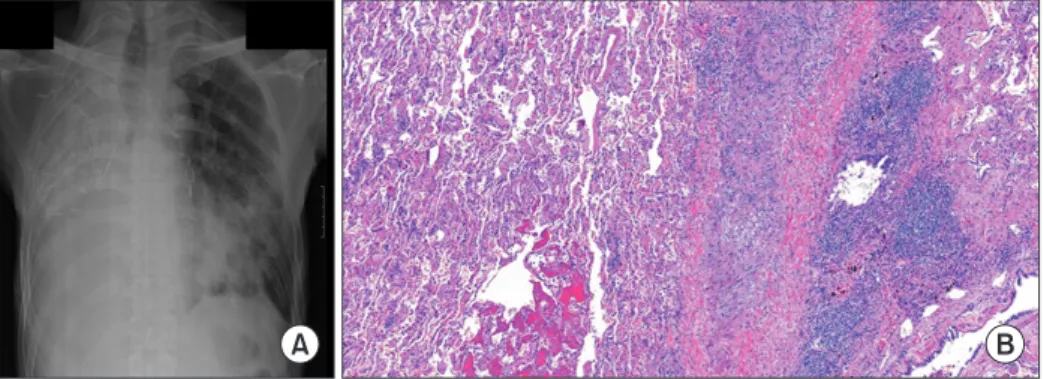
2, 61 mmHg. The initial chest radiograph revealed left lower lung field consolidation (Fig. 1A), although sputum culture was negative. Despite intravenous antibiotic treatment (pipera- cillin/tazobactam and levofloxacin) with mechanical ven- tilator support, carbon dioxide retention continued and his chest radiograph showed no improvement. On admission day 8, he underwent left single-LTx from a deceased donor.
The lung transplant tissue pathology showed features of chronic lung allograft dysfunction (Fig. 1B). He did not have any kind of donor-specific antibodies. He was admin- istered with basiliximab and steroid as induction therapy in the same way as the first LTx, followed by steroids, MMF and tacrolimus as maintenance therapy.
On postoperative day (POD) 7 of the redo LTx, multi- drug-resistant Acinetobacter baumannii and Pseudomonas aeruginosa were detected in a bronchial wash specimen.
Intravenous antibiotics (colistin and meropenem), pro- phylactic trimethoprim/sulfamethoxazole, and an inhaled HIGHLIGHTS
• Combined lungkidney transplantation can offer the best possibility for cure in young patients with end
stage lung and kidney disease.
• Decisions must be made on a casetocase basis con
sidering patient and donorrelated factors.
antifungal agent (amphotericin B) were administered.
However, acute lung rejection was suspected, which was subsequently treated with steroid pulse therapy (methyl- prednisolone 1,000 mg/day) for 3 days starting on POD 13.
Due to recurrence of CO
2retention, the patient could not be weaned from mechanical ventilation. On POD 19, con- tinuous renal replacement therapy was initiated due to oli- guria (urine output of <400 mL/day, GFR <15). On POD 21, a chest computed tomography scan was performed, which showed interval aggravation of acute lung rejection (Fig.
2A), and a second round of steroid pulse therapy (meth- ylprednisolone 1 g/day) was administered for 3 days. On POD 28, the patient developed fever with hypotension, and the blood cytomegalovirus polymerase chain reaction titer was elevated to 2,670 copies/mL; therefore, we added an antiviral agent (ganciclovir). Despite the empirical man- agement of early graft dysfunction, he was not responsive to treatment and remained dependent on mechanical ventilation. He continued active rehabilitation at bedside, and aggressive nutritional therapy through a nasogastric
tube (2,400 kcal/day). On POD 44 of the redo LTx, the continuous renal replacement therapy was converted to regular hemodialysis. He was required to maintain a home ventilator (pressure control mode, positive end-expiratory pressure of 4 cm H
2O, inspiratory positive airway pressure of 32 cm H
2O, respiratory rate of 22 breaths/min, and frac- tion of inspired oxygen of 35%), but was able to ambulate, thus maintained good muscle strength with a medical research council sum score of 57 points. We believed that he is in an irreversible state since he showed continuously deteriorating renal function since the first LTx and reached ESRD before the redo LTx. However, he was young with well-preserved muscle mass. We finally decided combined second redo LTx with simultaneous kidney transplantation.
On POD 64 of the redo LTx, left single second redo LTx was performed followed by right kidney transplantation from a deceased donor. The dissection was performed without left lung ventilation under venovenous (VV) extracorporeal membrane oxygenation (ECMO) support because the pa- tient was in the right pneumonectomy. The right femoral
A B
Fig. 2. (A) Chest computed tomography image obtained on postoperative day 21 after redo lung transplantation showing increased multiple patchy areas
of consolidation and ground-glass opacity on the left lower lung basal segment with a small amount of left pleural effusion, which may indicate interval aggravation of acute rejection. (B) Pathology of re-lung transplantation tissue showing organizing pneumonia, acute cellular rejection, diffuse alveolar damage, and fibrosis. H&E, ×100.
A B
Fig. 1. (A) Chest radiograph showing right pneumonectomy and left lower lung field consolidation. (B) Pathology of the first lung transplantation tissue,