• 검색 결과가 없습니다.

Optimization of culture media of pathogenic Mycoplasma hyopneumoniae by a response surface methodology

N/A
N/A
Protected

Academic year: 2022

Share "Optimization of culture media of pathogenic Mycoplasma hyopneumoniae by a response surface methodology"

Copied!
6
0
0

로드 중.... (전체 텍스트 보기)

전체 글

(1)

Veterinary Science

DOI: 10.4142/jvs.2010.11.4.327

Received: 03 Jun. 2009, Accepted: 18 Aug. 2010

Original Article

*Corresponding author

Tel: +82-53-950-5964; Fax: +82-53-950-5955 E-mail: [email protected]

The first two authors contributed equally to this work.

Optimization of culture media of pathogenic Mycoplasma hyopneumoniae by a response surface methodology

Mi-Hyun Hwang

1,†

, Dereje Damte

1,†

, Min-Hee Cho

2

, Young-Hoan Kim

2

, Seung-Chun Park

1,

*

1

College of Veterinary Medicine, Kyungpook National University, Daegu 702-701, Korea

2

Gyeongbuk Veterinary Service Laboratory, Daegu 702-210, Korea

Composition of culture medium for mass production of

Mycoplasma hyopneumoniae was optimized using a response

surface methodology (RSM). Initially, the influence of glucose, thallium acetate, fresh yeast extract, horse serum, and porcine serum on the production of mycoplasmal protein was assessed using a ‘one factor at a time’ technique.

Next, factors with a significant effect, including fresh yeast extract, and horse and porcine sera, were selected for further optimization using a central composite design (CCD) of RSM. The experimental results were fitted into a second order polynomial model equation. Estimated optimal condition of the factors for maximum production of mycoplasmal protein (i.e., triple-fold increase from 0.8 mg/L produced by basal mycoplasma media to 2.5 mg/L) was 10.9% fresh yeast extract, 15% horse serum, and 31.5%

porcine serum (v/v). For the optimized conditions, a 2.96 mg/L experimental result was observed, similar to the estimated optimal conditions result of the CCD.

Keywords: fresh yeast extract, horse serum, Mycoplasma hyopneumoniae, optimization, response surface analysis

Introduction

Mycoplasma (M.) hyopneumoniae is recognized as the causative agent of enzootic pneumonia, and is a primary contributor to the porcine respiratory disease complex resulting in considerable economic losses [5]. Concurrent infection with M. hyopneumoniae and viral pathogens, including porcine reproductive and respiratory syndrome virus or porcine circovirus type 2, increases the severity and duration of mycoplasmal pneumonia. Due to the importance of M. hyopneumoniae in respiratory disease, eradication is often a goal and making an accurate

diagnosis of the organisim important [16]. However, more than 60% of Korean pigs are infected with this organism [11]. We also confirmed that polyclonal antibodies produced by mycoplasma vaccination do not prevent M.

hyopneumoniae-induced increases in [Ca

2+

]

i

[9,14].

Vaccination and antibacterial therapy are therefore the essential strategies for the prevention and control of mycoplasmal pneumonia.

The surface protein of intact M. hyopneumoniae is clearly critical for the interaction of these organisms with their host cells [15]. These bacteria are known to colonize respiratory ciliated epithelial cells, thereby inducing an inflammatory response [1,3,9]. Intact pathogenic M.

hyopneumoniae have been used as a vaccine but culturing the organism is difficult due to its requirements for specific and elaborate culture media and prolonged incubation period [8,17].

Optimization of culture medium is a very important aspect in the field of food microbiology and fermentation to improve product yield and reduce process variability, as well as reducing development time and overall costs [13].

Due to the complexity of the culture media, long growth time, and slow agitation for producing M. hyopneumoniae, it is practically impossible for a one-dimensional search to identify an optimum combination of culturing conditions using a finite number of experiments [4]. Response surface methodology (RSM) is another approach that can be used to study the effect of several variables and to seek the optimum conditions for a multivariable system. Therefore, the aim of this investigation was to search for the optimal medium composition of intact pathogenic M. hyopneumoniae for mass production by using the statistical tools mentioned above.

Materials and Methods Media

Glucose, thallium acetate, and yeast extract were obtained

from Sigma-Aldrich (USA), and horse and porcine serum

(2)

Table 1. Levels of factors chosen for the experimental design

Independent variables (unit) Levels

󰠏

α

󰠏 1 0 1 +α

Fresh yeast extract (mL) 65.7 87.5 109.5 131.4 153

Horse serum (mL) 90 120 150 180 210

Porcine serum (mL) 135 180 225 270 315

Table 2. Experimental design and results of central composite design

No. Fresh yeast extract Horse serum Porcine serum Bacterial protein production (mg/L)

Experimental Predicted

1 󰠏 1 󰠏 1 󰠏 1 2.379978 2.164604

2 1 󰠏 1 1 2.423579 2.275802

3 󰠏 1 1 󰠏 1 2.389777 2.297528

4 1 1 1 2.574283 2.485103

5 󰠏 1 󰠏 1 󰠏 1 2.373901 2.350316

6 1 󰠏 1 1 2.481764 2.461248

7 󰠏 1 1 󰠏 1 2.362887 2.397898

8 1 1 1 2.482600 2.585208

9 󰠏

α

0 0 1.775716 1.989405

10 +α 0 0 2.392207 2.275222

11 0 󰠏

α

0 1.935308 2.075131

12 0 +α 0 2.373977 2.383745

13 0 0 󰠏

α

2.410058 2.494282

14 0 0 +α 2.779148 2.792789

15 0 0 0 2.442265 2.529431

16 0 0 0 2.413704 2.529431

17 0 0 0 2.334174 2.529431

18 0 0 0 2.837029 2.529431

were purchased from Gibco (USA). Fresh yeast extract was prepared by boiling and filtration, and porcine serum was prepared by acidification and filtration.

Mycoplasma culture and protein determination Pathogenic M. hyopneumoniae (ATCC 25934) was cultured in Friis medium [4] to logarithmic phase, and harvested by centrifugation at 15,000 × g for 30 min at 4

o

C.

The pellets were washed three times in PBS and then dispersed through a 27-gauge needle [4,13]. As measured by the bicinchoninic acid method (Pierce, USA), 0.3 mg/

mL protein corresponded to 10

11

CCU (colour changing units)/mL. CCU representing the mycoplasma number in the culture were determined by serial dilutions in tubes containing Friis medium [14].

One factor at a time (OFAT) technique

This initial step served as a screening test to identify

which defined factors of the medium had a significant effect on the production of M. hyopneumoniae. In this step beginning with a base line set of factor levels and measuring the response for each experimental factor in turn, the level of each factor was changed while all other experimental factors remained constant. In this case, responses to five experimental factors (glucose, thallium acetate, fresh yeast extract, and horse and porcine sera) were measured at five base line set factors levels with one additional basal mycoplasmal media culture as the control.

Experimental design

RSM was applied to optimize the production of

mycoplasmal protein with the intent of simultaneously

evaluating the influence of three pre-selected variables

which had been found to have significant effects on protein

production of mycoplasma through a preliminary study

using the OFAT technique. The independent variables

(3)

included fresh yeast extract, horse serum, and porcine serum with a dependent variable of mycoplasmal protein production. A central composite design (CCD) was used for optimizing the independent variables at each of the five levels (Table 1). A factorial design for three variables 2

3

factorial design was combined with four replications of the center point and six axial points where one factor was set at an extreme level (± α ) and the other two factors were set at center point level. With this arrangement, a set of 18 experiments was performed. The ranges of the extreme and central points were based from OFAT results in this study.

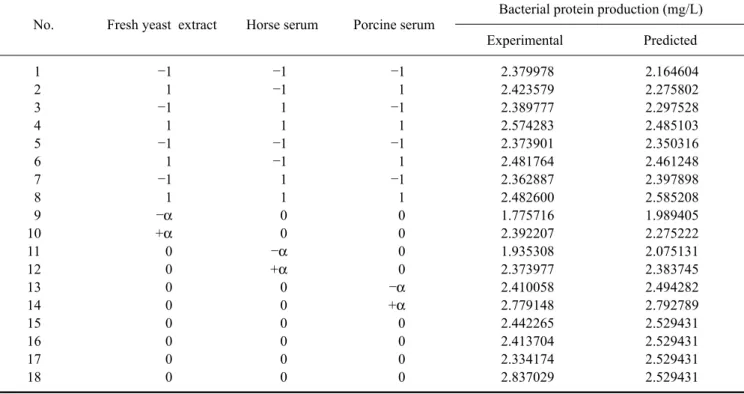
The CCD is given in Table 2 with the results of the experimental and predicted values from the actual variables. A statistical test for the data generated from the CCD was performed using ANOVA. For calculating the optimal point, a second order polynomial equation was fitted to the experimental results of CCD as it represents the behavior of such a system more appropriately.

This equation was:

Y = β

0

+ β

1

X

1

+ β

2

X

2

+ β

3

X

3

+ β

1

β

1

X

12

+ β

2

β

2

X

22

+ β

3

β

3

X

32

+ β

1

β

2

X

1

X

2

+ β

1

β

3

X

1

X

3

+ β

2

β

3

X

2

where Y is the response variable, β

0

is the intercept/

constant; β

1

, β

2

and β

3

are the linear coefficients; β

12

, β

22

and β

32

are the squared/quadratic coefficients; β

1

β

2

, β

1

β

3

and β

2

β

3

are the interaction coefficients; and X

1

, X

2

, X

3

, X

12

, X

22

, X

32

, X

1

X

2

, X

1

X

3

and X

2

X

3

are the levels of the independent variables.

Data analysis

SAS/Statistics software (Version 9.2; SAS, USA) was used for the regression analysis of the experimental data obtained. The quality of the fit of the polynomial model equation was expressed by the coefficient of determination R2, and its statistical significance was verified by an F-test.

The significance of the regression coefficient was determined by a t-test. The significance was defined as p < 0.05. A differentiation calculation was then employed for predicting the optimum point.

Results

OFAT approach

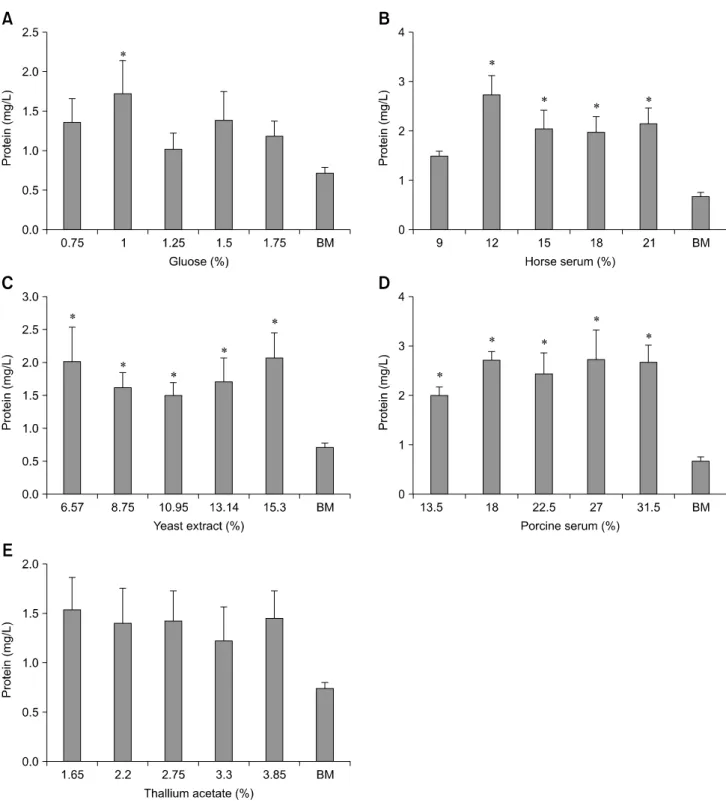
The preliminary screening tests for bacterial mycoplasmal protein production defined the variables that most affected protein production, i.e., fresh yeast extract, horse serum, and porcine serum. Glucose and thallium acetate had insignificant effects on the production of bacterial mycoplasmal protein (p < 0.05).

Fig. 1 shows the effect of five factors on mycoplasmal protein yield by a OFAT approach. In this procedure, when the effect of one factor was examined, the other four factors were kept constant. With this approach, each factor effect was studied at five different concentration levels. The approximated values were set at a middle level in the CCD

for further optimization.

CCD The approximately optimized values determined by a OFAT approach were set at central levels for further optimization of three variables: fresh yeast extracts, horse serum, and porcine serum concentrations. CCD of RSM was used to optimize the culture conditions for the production of mycoplasmal protein. A total of 18 experimental runs with different combinations of the three factors were performed (Table 2). For each run, the experimental responses along with the predicted responses from the actual variables obtained from the regression equation of the 18 combinations are shown. The regression analysis of the transformed data obtained after the experiment resulted in a final response equation of the second order polynomial that represented a suitable model equation for mycoplasmal protein production. The equation is:

Y = 0.053482X

1

+ 0.029669X

2

󰠏 0.006795X

3

󰠏 0.000207X

12

󰠏 0.000032474X

1

X

2

󰠏 0.000090516X

22

󰠏 6.73516E-8X

1

X

3

+ 0.000014144X

2

X

3

+ 0.000014087X

32

󰠏 2.385201

where Y is the concentration of bacterial protein; and X

1

, X

2

, and X

3

represent the coded levels of fresh yeast extract, horse serum, and porcine serum, respectively.

The model equation adequacy was assessed by the lack of fit (F-test) and the coefficient of determination, R

2

. The F-value of 0.74 at the 99% level was insignificant, indicating that the obtained model was adequate. The coefficient of determination (R

2

) was 0.8119 for mycoplasmal protein production, indicating that equations of the statistical model could explain 81.19% of variability in the response. This proved that the model equation provided a suitable model to describe the response of the experiment pertaining to M. hyopneumoniae protein production. The experimental and predicted values in Table 2 show higher resemblance demonstrating the validity of the response model.

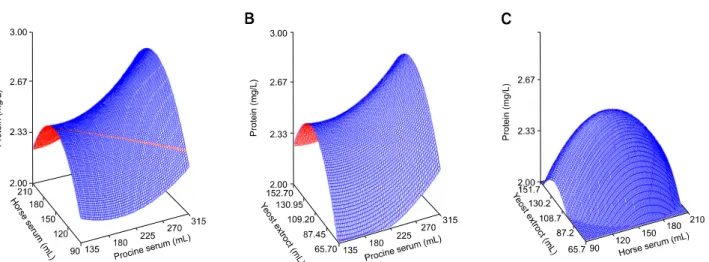
The conical analysis of the response surface for mycoplasmal protein production showed that the estimated surface does not have a unique optimum, having saddle points as a maximum, which was predicted to have a value of 2.5 mg/L. However, three dimensional response surface plots for any two of the three factors, drawn with a vertical line (Z-axis) representing mg/L of mycoplasmal protein production and two horizontal lines (X and Y axes) representing the actual values of the two experimental explanatory factors, had shown a range of optimized area.

In each plot, the factor which did not represent the two horizontal axes was fixed at the actual optimum level.

All three response surface plots were made (Figs. 2A-C).

It is evident from the analysis of the response surface (Fig.

2C) that yeast extract and horse serum supplementation

(4)

Fig. 1. Effect of five experimental factors on mycoplasmal protein production (A) 50% glucose solution, (B) horse serum, (C) fresh yeast extract, (D) porcine serum, and (E) 2% thallium acetate solution each varying at five levels while all the other factors were kept constant. *p < 0.05, BM: base medium.

had a minimal effect, but still resulted in a better production compared to the basal media, and this production showed its optimum at the ‘0’ level beyond which the protein yield declined. Concentrations of 109.5 mL (10.95%), 150 mL (15%), and 315 mL (31.5%) of the

fresh yeast extract, horse serum, and porcine serum,

respectively, resulted in maximum production (Figs. 2A

and B) which was consistent with the highest results of the

CCD experiment (Table 2) validating the analysis of the

dimensional response surface plots. Separate experiments

(5)

Fig. 2. Response surface plot showing the effect of the three variables/experimental factors on mycoplasmal protein yield; (A) Effect of horse serum and porcine serum, (B) effect of yeast extract and porcine serum, and (C) effect of horse serum and yeast extract.

Fig. 3. Comparison of the base media (BM), and modified and optimized Friis media on mycoplasmal protein production at different time intervals. *p < 0.001, **p < 0.01.

performed with the optimized conditions of CCD resulted in 2.96 mg/L mycoplasmal protein which is a three-fold increase from the basal media and a significant increase compared to the modified Friis media (Fig. 3).

Discussion

The most frequently encountered Mollicutes in pigs are M. hyopneumoniae, M. flocculare, M. hyorhinis, M.

hyosynoviae, and Eperythrozoon suis. Among these Mollicutes, M. hyopneumoniae is of highest concern as the etiological agent of porcine enzootic pneumonia. M.

hyopneumoniae causes chronic respiratory disease and enzootic pneumonia in industrialized livestock resulting in considerable economic losses [10]. Mycoplasma species have been notoriously difficult to cultivate [6]. Making

media for culturing mycoplasma species is important for the control and elimination of the disease through mass production of mycoplasma for vaccination [7]. The RSM that we used for statistical optimizations of mycoplama in our study had been used for several purposes including optimization of medium, metabolites production, and extraction condition. Li et al. [10] reported that optimization of the cultural medium for bacteriocin production by Lactococcus lactis could be accomplished using RSM, and Sunitha et al. [16] set seed and induction conditions to enhance phytase production by recombinant Escherichia coli [16].

With the OFAT technique, thallium acetate and glucose were determined to have insignificant effects on the growth and/or production of M. hyopneumoniae. This coincides with other studies indicating that thallium acetate is associated with high toxicity, and other selective substitutes for thallium acetate are being investigated for selective growth of mycoplasma [2]. The central composite result from our study also showed optimized culture media conditions with a significant increase in mycoplasmal protein production compared to the basal media. Experimenting alone with the optimized conditions determined by CCD resulted in a 2.96 mg/L yield, which is a three-fold increase from the basal media. Compared to the results of the enhancement of propagation of M.

hyopneumoniae by culture in a biphasic medium [7], the optimized yield show similar fold increment to the base media.

In summary, we confirmed for the first time that the CCD

of the response surface analysis is a useful tool to

determine the optimum levels of fresh yeast extract, horse

serum, and porcine serum for mycoplasmal protein

production. A high similarity was observed between the

predicted and experimental yields which reflected the

(6)

accuracy and applicability of RSM for such optimization.

Among five variables (glucose, thallium acetate, fresh yeast extract, horse serum, and porcine serum) tested in this investigation, fresh yeast extract and horse serum at their 0 coded levels (10.9% and 15%, respectively) and porcine serum at its 1.68 coded level (31.5%) were the major factors influencing mycoplasmal protein production.

Acknowledgments

This study was supported in part by the Technology Development Program for Agriculture and Forestry, Ministry for Agriculture, Forestry and Fisheries, and in part by a Korea Research Foundation (KRF) grant (No.

2009-0071490) funded by the Korea government.

References

1. Amass SF, Clark LK, Van Alstine WG, Bowersock TL, Murphy DA, Knox KE, Albregts SR. Interaction of Mycoplasma hyopneumoniae and Pasteurella multocida infections in swine. J Am Vet Med Assoc 1994, 204, 102- 107.

2. Angulo AF, Jacobs MV, van Damme EH, Akkermans AM, de Kruijff-Kroesen I, Brugman J. Colistin sulfate as a suitable substitute of thallium acetate in culture media intended for mycoplasma detection and culture. Biologicals 2003, 31, 161-163.

3. DeBey MC, Jacobson CD, Ross RF. Histochemical and morphologic changes of porcine airway epithelial cells in response to infection with Mycoplasma hyopneumoniae.

Am J Vet Res 1992, 53, 1705-1710.

4. Duta FP, De França FP, Sérvulo EF, De Almeida Lopes LM, Da Costa AC, Barros A. Effect of process parameters on production of a biopolymer by Rhizobium sp. Appl Biochem Biotechnol 2004, 113-116, 639-652.

5. Fischer O. Enhancement of propagation of Mycoplasma hyopneumoniae by culture in a biphasic medium. Acta Vet Brno 1995, 64, 243-247.

6. Friis NF. Some recommendations concerning primary isolation of Mycoplasma suipneumoniae and Mycoplasma flocculare a survey. Nord Vet Med 1975, 27, 337-339.

7. Friis NF, Szancer J. Sensitivity of certain porcine and

bovine mycoplasmas to antimicrobial agents in a liquid medium test compared to a disc assay. Acta Vet Scand 1994, 35, 389-394.

8. Garner CM, Hubbold LM, Chakraborti PR.

Mycoplasma detection in cell cultures: a comparison of four methods. Br J Biomed Sci 2000, 57, 295-301.

9. Hwang MH, Lim JH, Yun HI, Kim JC, Jung BY, Hsu WH, Park SC. The effect of polyclonal antibody on intracellular calcium increase induced by Mycoplasma hyopneumoniae in porcine tracheal cells. Vet J 2006, 172, 556-560.

10. Li C, Bai J, Cai Z, Ouyang F. Optimization of a cultural medium for bacteriocin production by Lactococcus lactis using response surface methodology. J Biotechnol 2002, 93, 27-34.

11. Lim YT, Seok HB. Studies on the mycoplasmal pneumonia in slaughter pigs. 1. Seasonal detection by gross finding of lung lesion and dot-ELISA technique. Korean J Vet Res 2002, 42, 219-224.

12. McGowin CL, Ma L, Martin DH, Pyles RB. Mycoplasma genitalium-encoded MG309 activates NF-κB via Toll-like receptors 2 and 6 to elicit proinflammatory cytokine secretion from human genital epithelial cells. Infect Immun 2009, 77, 1175-1181.

13. Mu W, Chen C, Li X, Zhang T, Jiang B. Optimization of culture medium for the production of phenyllactic acid by Lactobacillus sp. SK007. Bioresour Technol 2009, 100, 1366-1370.

14. Park SC, Yibchok-Anun S, Cheng H, Young TF, Thacker EL, Minion FC, Ross RF, Hsu WH. Mycoplasma hyopneumoniae increases intracellular calcium release in porcine ciliated tracheal cells. Infect Immun 2002, 70, 2502-2506.

15. Rogers MJ, Simmons J, Walker RT, Weisburg WG, Woese CR, Tanner RS, Robinson IM, Stahl DA, Olsen G, Leach RH, Maniloff J. Construction of the mycoplasma evolutionary tree from 5s rRNA sequence data. Proc Natl Acad Sci USA 1985, 82, 1160-1164.

16. Sunitha K, Chung BH, Jang KH, Song KB, Kim CH, Rhee SK. Refolding and purification of Zymomonas mobilis levansucrase produced as inclusion bodies in fed-batch culture of recombinant Escherichia coli. Protein Expr Purif 2000, 18, 388-393.

17. Thacker EL. Diagnosis of Mycoplasma hyopneumoniae.

Anim Health Res Rev 2004, 5, 317-320.

수치

Table 2. Experimental design and results of central composite design
Fig. 1. Effect of five experimental factors on mycoplasmal protein production (A) 50% glucose solution, (B) horse serum, (C) fresh  yeast extract, (D) porcine serum, and (E) 2% thallium acetate solution each varying at five levels while all the other facto
Fig. 2. Response surface plot showing the effect of the three variables/experimental factors on mycoplasmal protein yield; (A) Effect of horse serum and porcine serum, (B) effect of yeast extract and porcine serum, and (C) effect of horse serum and yeast e

참조

관련 문서

4-8 Evaluation of rail corrugation for artificial specimen A (30 mm wavelength); (a) LVDT signal, (b) FFT analysis, (c) STFT analysis and (d) digitizing result

HPLC profile of cell culture supernatant of Methylosinus JR31 (a), and effect of HPLC fractions on the growth of vitamin-requiring Methylomonas JR29...

A and E, In control group, a small amount of new bone was observed at the margin of bone defect (40×); B and F, In experimental group 1, a large amount of new bone was formed

근래에 연구되는 격자형 모델은 각 경계범위에서 각기 다른 변수의 영향을 정확 하게 산출하지 못하고 있으나 , 수용모델링을 병행하는 경우 높은 정확도를 추정할

Effect of pain control and improve function of knee joint applied to osteoarthritis by carbon surface-heating... Diagram of

The number of migrating individuals of the Oriental Honey Buzzard by hour (A: Hong island, B: Eocheong island, C: Socheong island, D: Busan and Geoje island) ···92

Effect of amino acid addition in culture media on the mycelial growth and g-aminobutyric acid (GABA) production of Sparassis latifolia..

A,B Gradual lengthening with external fixator, C,D Lateral angulation of 4th metatarsal bone and 4th MTP joint subluxation, valgus deformity of 4th toe, E,F Corrective