ABSTRACT
BACKGROUND/OBJECTIVES: Many studies have suggested that Rhus verniciflua Stokes (RVS) and its extract are anticancer agents. However, RVS had limited use because it contains urushiol, an allergenic toxin. By improving an existing allergen-removal extraction method, we developed a new allergen-free Rhus verniciflua Stokes extract (RVSE) with higher flavonoid content. In this study, we examined whether RVSE inhibits the ability of AGS gastric cancer cells to migrate and invade.
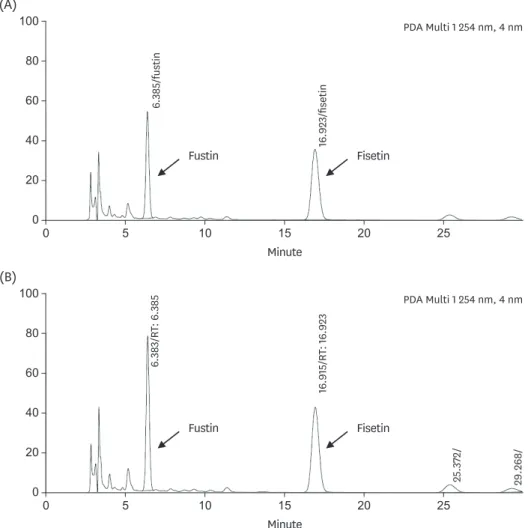
MATERIALS/METHODS: The flavonoids content of RVSE was analyzed by HPLC. The effects of RVSE on migration and invasion in AGS cells were analyzed by each assay kit. Matrix metalloproteinase (MMP)-9, plasminogen activator inhibitor-1 (PAI-1) and urokinase-type plasminogen activator (uPA) protein expression was analyzed by protein antibody array. The Phosphorylation of signal transducer and activator of transcription (STAT) 3 were assayed by Western blot analysis.
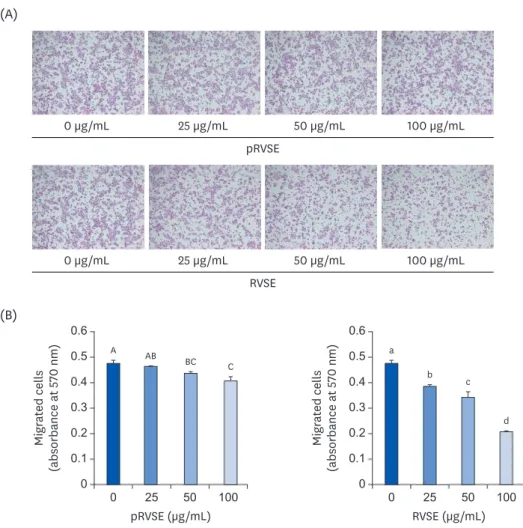
RESULTS: RVSE treatment with 0–100 μg/mL dose-dependently reduced the ability of AGS cells to migrate and invade. Notably, treatment with RVSE strongly inhibited the expression of MMP-9 and uPA and the phosphorylation of STAT3. In contrast, RVSE treatment dramatically increased the expression of PAI-1. These results indicate that the inhibition of MMP-9 and uPA expression and STAT3 phosphorylation and the stimulation of PAI-1 expression contributed to the decreased migration and invasion of AGS cells treated with RVSE.
CONCLUSIONS: These results suggest that RVSE may be used as a natural herbal agent to reduce gastric cancer metastasis.
Keywords: Gastric cancer; metastasis; matrix metalloproteinases; urokinase-type plasminogen activator; plasminogen activator inhibitors
INTRODUCTION
Despite a decrease in incidence in the recent decade, gastric cancer is still one of the most common causes of cancer death worldwide [1]. In South Korea, gastric cancer is the most frequent cancer and the fourth most common cause of cancer death. In countries with a high
Original Research
Received: Jan 29, 2020 Revised: Mar 27, 2020 Accepted: May 20, 2020
§
Corresponding Author:
Eun Ji Kim
Regional Strategic Industry Innovation Center, Hallym University, 1 Hallymdaehak-gil, Chuncheon 24252, Korea.
Tel. +82-33-248-3106 Fax. +82-33-244-3107 E-mail. [email protected]
*These authors contributed equally to this work.
©2020 The Korean Nutrition Society and the Korean Society of Community Nutrition This is an Open Access article distributed under the terms of the Creative Commons Attribution Non-Commercial License (https://
creativecommons.org/licenses/by-nc/4.0/) which permits unrestricted non-commercial use, distribution, and reproduction in any medium, provided the original work is properly cited.
ORCID iDs Hyun Sook Lee
https://orcid.org/0000-0002-8642-1978 Jae In Jung
https://orcid.org/0000-0002-4475-1434 Kyeong-Hee Kim
https://orcid.org/0000-0003-3739-4157 Sang Jae Park
https://orcid.org/0000-0003-1340-7881 Eun Ji Kim
https://orcid.org/0000-0001-9305-4769
Hyun Sook Lee 1* , Jae In Jung 2* , Kyeong-Hee Kim 3 , Sang Jae Park 3 , and Eun Ji Kim 2§
1
Department of Food Science & Nutrition, Dongseo University, Busan 47011, Korea
2
Regional Strategic Industry Innovation Center, Hallym University, Chuncheon 24252, Korea
3