• 검색 결과가 없습니다.

Inhibition of Cell Invasion by Ethyl Alcohol Extracts of Hizikia fusiforme in AGS Human Gastric Adenocarcinoma Cells

N/A
N/A
Protected

Academic year: 2021

Share "Inhibition of Cell Invasion by Ethyl Alcohol Extracts of Hizikia fusiforme in AGS Human Gastric Adenocarcinoma Cells"

Copied!
8
0
0

로드 중.... (전체 텍스트 보기)

전체 글

(1)

Inhibition of Cell Invasion by Ethyl Alcohol Extracts of Hizikia fusiforme in AGS Human Gastric Adenocarcinoma Cells

Yung Hyun Choi*

Department of Biochemistry, College of Oriental Medicine, Research Institute of Oriental Medicine, Blue-Bio Industry Regional Innovation Center and Department of Biomaterial Control (BK21 program), Graduate School, Dongeui University, Busan 614-052, Korea

Received October 27, 2010 /Accepted November 2, 2010

In this study, we investigated the effects of ethyl alcohol extracts of Hizikia fusiforme (EHF) on the cor- relation between tightening of tight junctions (TJs) and anti-invasive activity in human gastric ad- enocarcinoma AGS cells. Inhibitory effects of EHF on cell proliferation, motility, and invasiveness were found to be associated with increased tightness of the TJs, which was demonstrated by an in- crease in transepithelial electrical resistance. Activities of matrix metalloprotease (MMP)-2 and -9 in AGS cells were dose-dependently inhibited by treatment with EHF, and this was also correlated with a decrease in expression of their mRNA and proteins; however, tissue inhibitor of metalloproteinase (TIMP)-1 and -2 mRNA levels were increased. Additionally, immunoblotting results indicated that EHF repressed the levels of claudin proteins (claudin-1, -3, and -4), major components of TJs that play key roles in control and selectivity of paracellular transport. Furthermore, EHF decreased expression of insulin such as growth factor-1 receptor proteins, while concurrently increasing that of thrombo- spondin-1 and E-cadherin. In conclusion, these results suggest that EHF treatment may inhibit tumor cell motility and invasion, and therefore act as a dietary source to decrease the risk of cancer metastasis.

Key words : Hizikia fusiforme, invasion, tight junction, MMPs

*Corresponding author

*Tel:+82-51-850-7413, Fax:+82-51-853-4036

*E-mail : [email protected]

Introduction

Epidemiological studies have indicated that ubiquitous consumption of seaweeds, which are important dietary com- ponents in Asian communities, is a protective factor against some types of cancer [4,26]. Previous results showed that extracts of various edible seaweeds exhibited suppressive ef- fects against chemically induced tumorigenesis through sup- pression at the initiation and promotion phases [10,22,28,29].

Of these, Hizikia fusiforme, a kind of brown seaweed, which mainly grows in the temperate seaside areas of the north- west Pacific, including Korea, Japan, and China, has been used widely as a health food for hundreds of years [7,26].

However, the biochemical mechanisms underlying H. fusi- forme-mediated anti-cancer activity, including anti-metastatic effect, have not yet been clarified.

Tumors are characterized by a high rate of proliferation, turnover, and polarization, with a structurally distinct apical side. Two parameters, movement and invasiveness of cancer cells, are important for their ability to spread or metastasize

to other sites [21]. During metastasis, cancer cells undergo disruption of the cell-cell junction and also dysregulation of junctional complex proteins [9,14]. Gastric adenocarcinoma is one of the most common malignancies and the leading cause of cancer deaths worldwide [11]. Despite recent efforts in the search for molecular mechanisms responsible for de- velopment of this cancer, the pathways that are important for initiation and development of stomach malignant trans- formation have remained elusive. In addition, gastric ad- enocarcinoma cells characteristically lack tight junctions (TJs) [13,23], which is consistent with the idea that loss of cell–

cell adhesion is essential for tumor invasion. However, only a relatively small number of papers investigating the func- tion of TJs in human gastric cancer cells have been published.

As part of an ongoing study to isolate chemopreventive or therapeutic compounds from seaweeds, we isolated sev- eral extracts of H. fusiforme that caused cell growth inhibition in various human cancer cell lines. In this study, [16] L.

Zhang, J. Shi, J. Feng, H. Klocker, C. Lee and J. Zhang, Type IV collagenase (matrix metalloproteinase-2 and -9) in pros- tate cancer, Prostate Cancer Prostatic Dis. 7 (2004), pp. 327–

332. View Record in Scopus Cited By in Scopus (18) we ex-

(2)

amined the effects of ethyl alcohol extracts of H. fusiforme (EHF) on invasive parameters, including cell motility, ma- trigel membrane invasion, zymography for matrix metal- loproteases (MMP) activities, and gene expression for TJ- and metastasis-associated proteins, in human gastric ad- enocarcinoma AGS cells.

Materials and Methods

Preparation of ethyl alcohol extracts of H. fusiforme, cell culture, and cell viability

Ethyl alcohol extract of H. fusiforme was prepared as previously described [12]. Briefly, dried H. fusiforme were extracted in 80% ethyl alcohol at a ratio of 10 ml/g for 24 hr in a refrigerator at 4°C. Extracts (ethyl alcohol ex- tracts of H. fusiforme, EHF) were vacuum-filtered through a Whatman #2 filter and lyophilized, yielding a dried residue, and then kept at -80°C. The powder was dis- solved in dimethyl sulfoxide (DMSO) as a stock solution at 100 μg/ml and stored in aliquots at –20°C. The hu- man gastric adenocarcinoma AGS cell line was obtained from the American Type Culture Collection (ATCC, Rockville, MD) and cultured in DMEM medium (Invitrogen Corp., Carlsbad, CA) supplemented with 10%

heat-inactivated fetal bovine serum (FBS, GIBCO-BRL, Gaithersburg, MD), 2 mM glutamine, 100 U/ml pen- icillin, and 100 μg/ml streptomycin (GIBCO-BRL) at 37°C in a 5% CO

2

incubator. For the cell viability study, AGS cells were grown to 70% confluence and treated with EHF. Control cells were supplemented with complete media containing 0.1% DMSO (vehicle control). Following treatment, cell viability was determined by MTT [3-(4,5- Dimethyl-2 thiazolyl)-2,5-diphnyl-2H-tetrazolium bromide, MTT, Sigma, St Louis, MO] assay, which is based on conversion of MTT to MTT-formazan by mitochondria.

Cell motility assay

AGS cells were grown to confluency on 30-mm cell cul- ture dishes coated with rat tail collagen (20 μg/ml, BD Biosciences, Bedford, MA). Confluent cells were wounded by scraping with a pipette tip. After wounding, cultures were washed twice with PBS and control cells were exposed to medium alone. Cells were incubated with 1% FBS-con- taining medium supplemented with 300 μg/ml of EHF for 48 hr. Wound closure of cells was observed and photo- graphed under the microscope at 40X magnification. Culture

treatments were repeated twice and each sample was as- sayed in triplicate.

Measurement of transepithelial electrical resistance

Transepithelial electrical resistance (TER) was measured using an EVOM Epithelial Tissue Voltohmmeter (World Precision Instruments, FL) equipped with a pair of STX-2 chopstick electrodes. Briefly, AGS cells were seeded into the 8.0 μm pore size insert (upper chamber) of a Transwell

®

(Corning Costar Corp., NY) and allowed to reach full con- fluence, after which fresh medium was replaced for further experiments. Inserts without cells, inserts with cells in me- dium, and inserts with cells with EHF were treated for 48 hr. Electrodes were placed at the upper and lower chambers, and resistance was measured with the voltohmmeter.

In vitro invasiveness assay

Matrigel invasion assays were used to assess the ability of AGS cells to penetrate the extracellular matrix in the pres- ence or absence of EHF, as previously described [5]. Briefly, cells were exposed to EHF for 6 h, and treated cells (50,000) were then plated onto the apical side of Matrigel-coated fil- ters in serum-free medium containing either DMSO or EHF.

Medium containing 20% FBS was placed in the basolateral chamber to function as a chemoattractant. After 48 hr, cells on the apical side were wiped off with a Q-tip. Cells on the bottom of the filter were stained with hematoxylin (Sigma) and counted (three fields of each triplicate filter) with an inverted microscope.

RNA extraction and reverse transcription-PCR

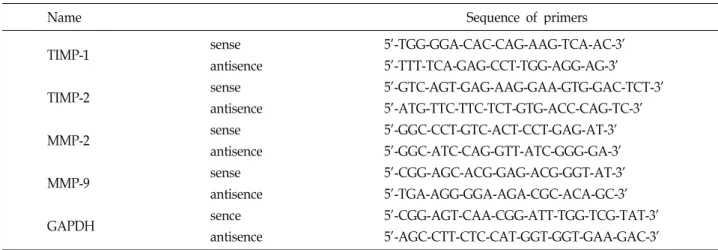
Total RNA was prepared using an RNeasy kit (Qiagen, La Jolla, CA) and primed with random hexamers for syn- thesis of complementary DNA using AMV reverse tran- scriptase (Amersham Corp., Arlington Heights, IL) accord- ing to the manufacturer's instructions. Polymerase chain re- action (PCR) was performed in a Mastercycler (Eppendorf, Hamburg, Germany) with the primers indicated in Table 1.

Amplification products obtained by PCR were separated on a 1% agarose gel and visualized by ethidium bromide (EtBr) staining.

Protein extraction and Western blot analysis

Total cell lysates were prepared in an extraction buffer

[25 mM Tris-Cl (pH 7.5), 250 mM NaCl, 5 mM ethyl-

endiaminetetra acetic acid, 1% nonidet P-40, 0.1 mM sodium

(3)

Table 1. Sequences of the primer pairs employed in the RT-PCR reactions

Name Sequence of primers

TIMP-1

TIMP-2 MMP-2

MMP-9

GAPDH

sense antisence sense antisence sense antisence sense antisence sence antisence

5'-TGG-GGA-CAC-CAG-AAG-TCA-AC-3' 5'-TTT-TCA-GAG-CCT-TGG-AGG-AG-3' 5'-GTC-AGT-GAG-AAG-GAA-GTG-GAC-TCT-3' 5'-ATG-TTC-TTC-TCT-GTG-ACC-CAG-TC-3' 5'-GGC-CCT-GTC-ACT-CCT-GAG-AT-3' 5'-GGC-ATC-CAG-GTT-ATC-GGG-GA-3' 5'-CGG-AGC-ACG-GAG-ACG-GGT-AT-3' 5'-TGA-AGG-GGA-AGA-CGC-ACA-GC-3' 5'-CGG-AGT-CAA-CGG-ATT-TGG-TCG-TAT-3' 5'-AGC-CTT-CTC-CAT-GGT-GGT-GAA-GAC-3'

orthovanadate, 2 μg/ml leupeptin, and 100 μg/ml phenyl- methylsulfonyl fluoride]. Protein concentration was de- termined using a Bio-Rad protein assay kit (Bio-Rad, Laboratories, Hercules, CA). For Western blot analysis, pro- teins were separated by 8~13% sodium dodecyl sulfate (SDS)-polyacrylamide gel electrophoresis and then electro- transferred to a nitrocellulose membrane (Schleicher &

Schuell, Keene, NH). Membranes were blocked with 5%

skim milk for 1 hr, and membranes then were subjected to immunoblot analysis with the desired antibodies. Proteins were then visualized by the enhanced chemiluminescence (ECL) method, according to the recommended procedure (Amersham Co.). Primary antibodies were purchased from Santa Cruz Biotechnology Inc. (Santa Cruz, CA) and Calbiochem (Cambridge, MA). Peroxidase-labeled donkey anti-rabbit immunoglobulin and peroxidase-labeled sheep an- ti-mouse immunoglobulin were purchased from Amersham Co.

Gelatin zymographic analysis of secreted MMPs

Following incubation with EHF, cell culture supernatants were collected and centrifuged at 400x g for 5 min. Cell-free supernatant was mixed with 2X sample buffer (Invitrogen) and zymography was performed using precast gels (10%

polyacrylamide and 0.1% gelatin). Following electrophoresis, gels were washed twice at room temperature for 30 min in 2.5% Triton X-100, and subsequently washed in buffer con- taining 50 mM Tris-HCl, 150 mM NaCl, 5 mM CaCl

2

, 1 μM ZnCl

2

, and 0.02% NaN

3

at pH 7.5, and incubated in this buf- fer at 37°C for 24 hr. Thereafter, gels were stained with 0.5%

(w/v) Coomassie brilliant blue G-250 (Bio-Rad) for 1 hr, then lightly destained in methanol:acetic acid:water (3:1:6). Clear

bands appear on the Coomassie stained blue background in the areas of gelatinolytic activity. Gels were scanned and images were processed for extraction of the blue channel signal, converting it to black and white, and inverting it for quantification of gelatinolytic activities from the integrated optical density.

Statistical analysis

All data are presented as mean±SD. Significant differ- ences among the groups were determined using the un- paired Student’s t-test. A value of *p<0.05 was accepted as an indication of statistical significance. All of the figures shown in this article were obtained from at least three in- dependent experiments.

Results

Inhibition of cell growth and motility by EHF in AGS cells

To investigate the effects of EHF on cell viability, AGS

cells were treated with various concentrations of EHF and

subjected to MTT assay. We found that EHF had strong in-

hibitory effects on cell proliferation in a dose-dependent

manner (Fig. 1A). When compared with the controls, treat-

ment with 300 μg/ml and 500 μg/ml of HEF resulted in

approximately 27% and 40% inhibition of cell growth,

respectively. To determine whether or not EHF inhibits mo-

tility of AGS cells, wound healing experiments were

performed. Results demonstrated that 300 μg/ml of EHF de-

layed the motility of AGS cells compared to that of control

cells (Fig. 1B).

(4)

A) B)

Fig. 1. Effects of EHF on cell viability and motility of AGS cells. (A) AGS cells were plated at a concentration of 1x10

5

cells per 60-mm plate and then incubated for 24 hr, after which they were treated with various concentrations of EHF for 48 hr;

cell viability was estimated by MTT assay. Each point represents the mean±SD of three independent experiments. Significance was determined using a Student’s t -test (* p <0.05 versus untreated control). (B) Cells were grown to confluency on 30-mm cell culture dishes; a scratch was then made though the cell layer using a pipette tip. After washing with PBS, serum free media (to prevent cell proliferation) containing either vehicle or 300 μg/ml of EHF was added for 48 hr. Photographs of the wounded area were taken immediately after the scratch was made for evaluation of cell movement into the wounded area.

A) B)

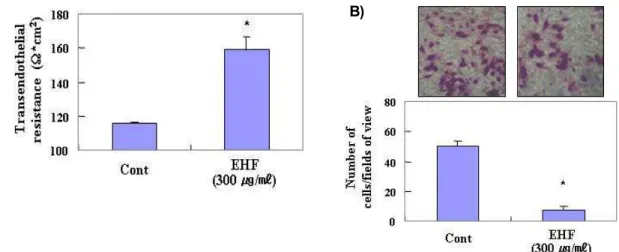
Fig. 2. Increased TER values and decreased invasion by EHF in AGS cells. (A) AGS cells were treated with or without 300 μg/ml of EHF for 48 hr and TER values were measured as described in the materials and methods section. Results are shown as the mean±SD of three independent experiments. Significance was determined using a Student’s t -test (*, p <0.05 versus untreated control). (B) Cells pretreated with or without 300 μg/ml of EHF for 6 hr were plated onto the apical side of matrigel coated filters in serum-free medium containing either vehicle or EHF. Medium containing 20% FBS was placed in the basolateral chamber to act as a chemoattractant. After 48 hr, cells on the apical side were wiped off using a Q-tip.

Next, cells on the bottom of the filter were stained using hematoxylin and Eosin Y, and then counted. Data are shown as the mean of triplicate samples and represent invasive cell numbers compared with those of control cells. Significance was determined using a Student’s t-test (*, p <0.05 versus untreated control).

Increased TER values and decreased cell invasion by EHF in AGS cells

TER (a measure of tight junction formation) [21] values were measured for examination of the relationship between

tightening of TJs and invasive activity of AGS cells treated

with EHF. As shown in Fig. 2A, incubation of AGS cells

with EHF increased their TER levels, suggesting that EHF

increased TJ function in AGS cells (approximately 1.5-fold

(5)

by 300 μg/ml of EHF). Using a Boyden chamber invasion assay, we next examined the question of whether or not EHF decreases the activity of cell invasion. As shown in Fig. 2B, treatment of cells with 300 μg/ml of EHF reduced cell in- vasion through the Matrigel chamber (approximately 0.16-fold by 300 μg/ml of EHF). These results indicated that up-regulation of TER by EHF was associated with inhibition of cell invasion in AGS cells.

Modulation of expression levels of TJ- and metastasis-related proteins by EHF in AGS cells

To elucidate the question of whether or not EHF reduces levels of TJ components and TJ regulators, AGS cells were treated with EHF and levels of their key proteins, such as claudins, E-cadeherin, IGF-1R, and TSP-1, were examined using Western blot analyses. As shown in Fig. 3, EHF treat- ment time-dependently decreased levels of claudin proteins (claudin-1, -3, and -4), the most important components of the TJ [9,20], suggesting that this modulation contributed to TJ tightening. EHF treatment also decreased protein levels of IGF-1R, a promoter of tumor invasion and metastasis in various human cancers [3,17], but increased levels of E-cad- herin, an adherent junction protein that regulates TJ for- mation [2]. In addition, EHF treatment time-dependently in-

Fig. 3. Effects of EHF on expression of claudins, E-cadherin, IGF-1R, and TSP-1 proteins in AGS cells. Cells were treated with 300 μg/ml of HEF for the indicated times.

Cells were lysed and equal amounts of cell lysate were separated by electrophoresis on SDS–polyacrylamide gels and transferred to nitrocellulose membranes. Next, the membranes were probed with the indicated anti- bodies, and the proteins were visualized using an ECL detection system. Actin was used as an internal control.

creased expression of TSP-1, which limits tumor growth [6,31].

Inhibition of activities and expression of MMP-2 and -9 by EHF in AGS cells

Because cell migration plays an important role in the metastasis process and since invasion of the basement mem- brane is primarily mediated by gelatinase MMPs [8,25], we tested the effects of EHF on TIMPs and MMPs mRNA levels

A)

B)

C)

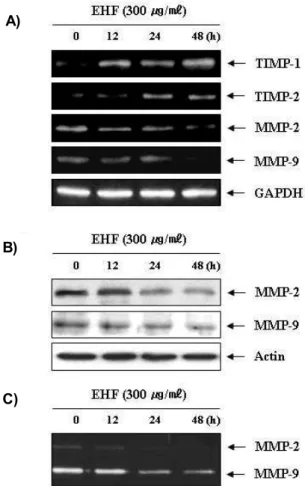
Fig. 4. Effects of EHF on expression and activity of TIMPs and MMPs in AGS cells. (A) AGS cells were grown under the same conditions, as shown in Fig. 3, and total RNAs were isolated and reverse-transcribed. Resulting cDNAs were then subjected to PCR and the reaction products were subjected to electrophoresis in a 1% agarose gel and visualized by EtBr staining. GAPDH was used as an in- ternal control. (B) Cells were lysed and proteins were separated by electrophoresis on SDS-polyacrylamide gels. Western blotting was then performed using an- ti-MMP-2 and anti-MMP-9 antibodies, and an ECL de- tection system. Actin was used as an internal control.

(B) Following incubation with 300 μg/ml of EHF for the

indicated times, the medium was collected, and the activ-

ities of MMP-2 and -9 were measured by zymography.

(6)

by RT-PCR. As shown in Fig. 4A, EHF treatment increased TIMP-1 and -2 mRNA levels, but decreased MMP-2 and -9 levels in a time-dependent manner. We next investigated the effects of EHF on protein levels and activities of MMPs using Western blot and gelatin zymography. Data indicated that activities of MMP-2 and -9 in AGS cells were significantly decreased by EHF treatment in a dose-dependent manner, which was connected with a concurrent down-regulation of their mRNA and protein levels (Fig. 4). These results suggest that the anti-invasive effect of EHF is associated with in- creased TIMP-1 and -2 levels, as well as inhibition of MMP-2 and -9 mRNA, protein expression, and activity in AGS cells.

Discussion

Cell migration and invasion are critical steps in metastasis. Therefore, inhibition of tumor cell migration and invasion are important mechanisms in the anti-metastatic effects of anti-cancer drugs. In the present study, we investigated the effects of ethyl alcohol extract of H. fusiforme (EHF) on cell migration and invasion of gastric cancer cells using an AGS cell line. We found that EHF markedly inhibited cell motility and invasive activity by tightening TJs and decreasing MMP activity.

Changes in permeability properties and loss of cell polar- ity are hallmarks of epithelial cell tumorigenesis. Modulation of TJs, which are structures critical for maintenance of these functions in epithelial cells, in a number of epithelial cancers, including gastric adenocarcinoma, has been demonstrated [1,13,20,21,23]. Thus, TJ disruption and dysregulation of its composite proteins play critical roles in cancer progression, invasion, and metastasis, particularly epithelial cancers [6,27]. For example, Soler et al. [24] first demonstrated that TER of colon carcinoma tissue was significantly lower than that of normal colon tissues but showed higher trans- epithelial paracellular permeability, which confirmed the loss of TJs. In this study, EHF treatment increased the TER of AGS cells in a concentration-dependent manner, which was associated with lower cell motility and invasiveness (Fig. 1 and 2). Since TJ leakiness is associated with cancer progression, TJ tightening may have anti-cancer activity [20,21]. Thus, our results indicate that the anti-invasive activ- ity of HEF may be due, in part, to its ability to enhance TJ activity.

Many components of TJs have recently been identified.

Among these, the members of claudin family, which are

transmembrane proteins with extracellular domains, interact with other claudins associated with adjacent cells for regu- lation of paracellular permeability [9,14]. Emerging evidence indicates that TJ disruption and dysregulation of TJ protein are early events in cancer cell invasion and metastasis [1,6,27,31]. These observations also indicate that claudins are dysregulated in many types of cancers and that the nature of the dysregulation is highly type-specific for given cancers.

In addition, these data suggest that claudin proteins may prove to be useful biomarkers for detection and diagnosis of certain cancers. In the present study, EHF treatment mark- edly down-regulated claudin levels (-1, -3, and -4), indicating that down-regulation of claudin expression by EHF relates to increased TJ tightening.

In addition, we measured the effects of EHF on metastasis and TJ proteins such as E-cadherin, IGF-1R, and TSP-1.

E-cadherin is an adherent junction protein and type I trans- membrane glycoprotein, and low expression is associated with cancer invasion and metastasis [2]. Expression of TSP-1 is decreased in tumor cells, resulting in suppression of tumor growth, and high TSP-1 expression is inversely correlated with invasiveness and lymph node metastasis [15,30].

However, IGF-1R is highly expressed in many types of hu- man cancer and promotes tumor invasion and metastasis in vivo [3,17]. In the present study, EHF markedly increased levels of E-cadherin and TSP-1, but decreased IGF-1R in a time-dependent manner (Fig. 3), indicating a potential mech- anism for change of TER values and TJ permeability.

MMPs are important proteolytic enzymes during organ

development and tissue regeneration; however, they also

play important roles in cancer invasion and metastasis. In

particular, MMP-2 and -9 play important roles in tumor in-

vasion and angiogenesis; therefore, tumor metastasis can be

inhibited by blocking MMPs synthesis and activity. MMP-2

and -9 in particular play important roles in tumor invasion

and angiogenesis, and tumor metastasis can be inhibited by

blocking MMPs synthesis and activity [8,25]. MMPs activity

is tightly controlled by transcriptional activation, by a com-

plex proteolytic activation cascade, and by an endogenous

system of TIMPs. TIMPs inhibit MMPs by formation of 1:1

stoichiometric complexes for regulation of matrix turnover

[18,19]. As shown in Fig. 4, EHF markedly inhibited the lev-

els of MMP-2 and -9 mRNA, as well as protein levels and

expression of TIMP1- and -2 mRNA. Data suggest that the

anti-invasive activity of HEF in AGS cells was associated

with inhibition of MMP-2 and -9 activities through elevation

(7)

of TIMPs expression, and increased TIMPs/MMPs ratio is a key factor in regulation of the anti-metastatic process.

Although this study will require validation, we tentatively suggest that EHF inhibits cell motility and invasion in AGS cells through an influence on expression of several important tumor invasiveness and metastasis-related genes, and MMPs activity. Taken together, the data indicate that H. fusiforme may be a promising new dietary source for decreasing the risk of cancer cell metastasis.

Acknowledgment

This research was a part of the project funded by the Ministry of Land, Transport and Maritime Affairs, Korea.

References

1. Anderson, J. M. 2006. Molecular structure of tight junctions and their role in epithelial transport. News Physiol. Sci. 16, 126-130.

2. Battle, E., E. Sancho, C. Franci, D. Dominguez, M. Monfar, J. Braulidia, and A. G. Herreros. 2001. The transcription fac- tor Snail is a repressor of E-cadherin gene expression in epi- thelial tumor cells. Nat. Cell Biol. 2,84-89.

3. Brodt, P., L. Fallavollita, A. M. Khatib, A. A. Samini, and D. Zhang. 2001. Cooperative regulation of the invasive and metastatic phenotypes by different domains of the type I insulin-like growth factor receptor β subunit. J. Biol. Chem . 276, 33608-33615.

4. Carper, J. 1989. Seaweed, or Kelp. In The Food Pharmacy.

pp. 264-268, Bantan Books, New York.

5. Choi, W. Y., C. Y. Jin, M. H. Han, G. Y. Kim, N. D. Kim, W. H. Lee, S. K. Kim, and Y. H. Choi. 2009. Sanguinarine sensitizes human gastric adenocarcinoma AGS cells to TRAIL-mediated apoptosis via down-regulation of AKT and activation of caspase-3. Anticancer Res. 29, 4457-4465.

6. de Oliveira, S. S., I. M. de Oliveira, W. de Souza, and J.

A. Morgado-Diaz. 2005. Claudins upregulation in human colorectal cancer. FEBS Lett. 579, 6179-6185.

7. Dobashi, K., T. Nishino, M. Fujihara, and T. Nagumo. 1989.

Isolation and preliminary characterization of fucose-contain- ing sulfated polysaccharides with blood-anticoagulant activ- ity from the brown seaweed Hizikia fusiforme . Carbohydr. Res.

194, 315-320. 

8. Egeblad, M. and Z. Werb. 2002. New functions for the matrix metalloproteinases in cancer progression. Nat. Rev. Cancer 2, 161-174.

9. Hewitt, K. J., R. Agarwal, and P. J. Morin. 2006. The claudin gene family: expression in normal and neoplastic tissues.

BMC Cancer 6, 186-193.

10. Hiqashi-Okaj, K., S. Otani, and Y. Okai. 1999. Potent sup- pressive effect of a Japanese edible seaweed, Enteromorpha

prolifera (Sujiao-nori) on initiation and promotion phases of chemically induced mouse skin tumorigenesis. Cancer Lett.

140, 21-25.

11. Hyatt, B. J., P. E. Paull, and W. Wassef. 2009. Gastric oncol- ogy: an update. Curr. Opin. Gastroenterol. 25, 570-578.

12. Kim, T. Y., C. Y. Jin, G. Y. Kim, I. W. Choi Y. K. Jeong, T. J. Nam, S. K. Kim, and Y. H. Choi. 2009. Ethyl alcohol extracts of Hizikia fusiforme sensitize AGS human gastric ad- enocarcinoma cells to tumor necrosis factor-related apopto- sis-inducing ligand-mediated apoptosis. J. Med. Food 12, 782-787.

13. Kimura, Y., H. Shiozaki, M. Hirao, Y. Maeno, Y. Doki, M.

Inoue, T. Monden, Y. Ando-Akatsuka, M. Furuse, S. Tsukita, and E. Monden. 1997. Expression of occludin, tight-junc- tion-associated protein, in human digestive tract. Am. J.

Pathol. 151, 45-54.

14. Kominsky, S. L., P. Argani, D. Korz, E. Evron, V. Raman, E. Garrett, A. Rein, G. Sauter, O. P. Kallioniemi, and S.

Sukumar. 2003. Loss of the tight junction protein Claudin-7 correlates with histological grade in both ductal carcinoma in situ and invasive ductal carcinoma of the breast. Oncogene 22, 2021-2033.

15. Lawler, J. 2002. Thrombospondin-1 as an endogenous in- hibitor of angiogenesis and tumor growth. J. Cell Mol. Med.

6, 1-12.

16. Li, B., X. J. Wei, Y. L. Sun, and S. Y. Xu. 2006. Structural investigation of a fucoidan containing a fucose-free core from the brown seaweed, Hizikia fusiforme . Carbohydr. Res.

341, 1135-1146.

17. Long, L., R. Rubin, and P. Brodt. 1998. Enhanced invasion and liver colonization by lung carcinoma cells over- expressing the type 1 insulin-like growth factor receptor.

Exp. Cell Res. 238, 116-121.

18. Malemud, C. J. 2006. Matrix metalloproteinases (MMPs) in health and disease: an overview. Front Biosci. 11, 1696-1701.

19. Mannello, F., G. Tonti, and S. Papa. 2005. Matrix metal- loproteinase inhibitors as anticancer therapeutics. Curr.

Cancer Drug Targets 5, 285-298.

20. Morin, P. 2005. Claudin proteins in human cancer: promising new targets for diagnosis and therapy. Cancer Res. 65, 9603-9606.

21. Mullin, J. M., N. Agostino, E. Rendon-Huerta, and J. J.

Thornton. 2005. Keynote review: epithelial and endothelial barriers in human disease. Drug Discov. Today 10, 395-408.

22. Okai, Y., K. Higashi-Okai, S. Nakamura, Y. Yano, and S.

Otani. 1994. Suppressive effects of the extracts of Japanese edible seaweeds on mutagen-induced umu C gene ex- pression in Salmonella typhhimurium (TA 1535/pSK 1002) and tumor promotor-dependent ornithine decarboxylase in- duction in BALB/c 3T3 fibroblast cells. Cancer Lett. 87, 8725-8732.

23. Ouban, A. and A. A. Ahmed. 2010. Claudins in human can- cer: a review. Histol. Histopathol. 25, 83-90.

24. Soler, A. P., K. V. Laughlin, and J. M. Mullin. 1993. Effects

of epidermal growth factor versus phorbol ester on kidney

epithelial (LLC-PK1) tight junction permeability and cell

(8)

초록:AGS 인체 위암세포에서 톳 에탄올 추출물에 의한 침윤성 저해 최영현*

(동의대학교 한의과대학 생화학교실, 한의학연구소, 블루바이오 소재개발센터 및 대학원 바이오물질제어학과) 본 연구에서는 AGS 인체 위암세포에서 톳 에탄올 추출물(EHF)의 항침윤성과 tight junctions (TJs)의 tighten- ing과의 관계를 조사하였다. EHF에 의한 AGS 위암세포의 증식억제와 연관된 세포이동성 및 침윤성의 감소는 transepithelial electrical resistance의 증가와 연계된 Js의 tightness 증가와 연관성이 있었다. EHF는 matrix met- alloprotease (MMP)-2 및 -9의 활성을 억제하였으며, 이는 MMPs의 mRNA 및 단백질 발현 감소에 의한 것이었으 나 tissue inhibitor of metalloproteinase (TIMP)-1 및 -2의 mRNA 발현은 증가시켰다. 또한 EHF는 TJs의 주요 조절인자인 claudin family 단백질들(claudin-1, -3 및 -4)의 발현을 감소시켰으며, insulin like growth factor-1 re- ceptor 단백질은 감소된 반면 thrombospondin-1 및 E-cadherin의 발현은 증가되었다. 본 연구의 결과는 톳 추출 물이 암의 전이를 효과적으로 억제하는 효능이 있음을 보여주는 결과이다.

division. Exp. Cell Res. 207, 398-406.

25. Sternlicht, M. D. and Z. Werb. 2001. How matrix metal- loproteinases regulate cell behavior. Annu. Rev. Cell Dev.

Biol. 17, 463-516.

26. Tokudome, S., K. Kuriki, and M. A. Moore. 2001. Seaweed and cancerprevention. Jpn. J. Cancer Res . 92, 1008-1009.

27. van Itallie, C. M. and J. M. Anderson. 2006. Claudins and epithelial paracellular transport. Annu. Rev. Physiol 68, 403- 28. Yamamoto, I., H. Maruyama, and M. Moriguchi. 1987. The 429.

effect of dietary seaweeds on 7,12-dimethylbenz[a]an- thracene-induced mammary tumorigenesis in rats. Cancer Lett. 35, 109-118.

29. Yamamoto, I. and H. Maruyama. 1985. Effect of dietary sea- weed preparations on 1,2-dimethylhydrazine-induced in- testinal carcinogenesis in rats. Cancer Lett. 26, 241-251.

30. Yao, L., Y. L. Zhao, S. Itoh, S. Wada, L. Yue, and I. Furuta.

2000. Thrombospondin-1 expression in oral squamous cell carcinomas: correlations with tumor vascularity, clin- icopathological features and survival. Oral Oncol. 36, 539-544.

31. Yokoyama, K., N. Kamata, E. Hayashi, T. Hoteiya, N. Ueda,

R. Fujimoto, and M. Ngayama. 2001. Reverse correlation of

E-cadherin and Snail expression in oral squamous cell carci-

noma cells in vitro . Oral Oncol. 37, 65-71.

수치

Table 1. Sequences of the primer pairs employed in the RT-PCR reactions
Fig. 2. Increased TER values and decreased invasion by EHF in AGS cells. (A) AGS cells were treated with or without 300 μg/ml of EHF for 48 hr and TER values were measured as described in the materials and methods section
Fig. 3. Effects of EHF on expression of claudins, E-cadherin, IGF-1R, and TSP-1 proteins in AGS cells

참조

관련 문서

The expression levels of apoptotic related proteins and caspase dependent proteins by the ostreolysin purified from P.ostreatus on cell viability in FaDu human

Caffeic acid phenethyl ester induces E2F-1-mediated growth inhibition and cell-cycle arrest in human cervical cancer cells.

In this study, the expression profiles of miRNAs were compared and analyzed for establishment of miRNAs related cancer cell growth inhibition in normal human oral

Concentration-Dependent inhibition of cell viability by adenosine in human oral fibroblast and FaDu human head and neck squamous cell carcinoma · · ·

1) Effects of methanol extracts of Capsella bursa-pastoris on cyclooxygenase-2 (COX-2) and Inducible Nitric oxide synthase (iNOS) expression in human prostate cancer cell

It considers the energy use of the different components that are involved in the distribution and viewing of video content: data centres and content delivery networks

After first field tests, we expect electric passenger drones or eVTOL aircraft (short for electric vertical take-off and landing) to start providing commercial mobility

1 John Owen, Justification by Faith Alone, in The Works of John Owen, ed. John Bolt, trans. Scott Clark, &#34;Do This and Live: Christ's Active Obedience as the