23(4) : 274-280 (2017)
https://doi.org/10.20307/nps.2017.23.4.274
274
Phenolic Compounds from the Leaves of Homonoia riparia and their Inhibitory Effects on Advanced Glycation End Product Formation
Ik-Soo Lee
1, Seung-Hyun Jung
2, Chan-Sik Kim
1, and Jin Sook Kim
1,*
1
KM Convergence Research Division, Korea Institute of Oriental Medicine, Daejeon 34054, Republic of Korea
2
Division of Marine-Bio Research, National Marine Biodiversity Institute of Korea, Seocheon-gun 33662, Republic of Korea
Abstract − In a search for novel treatments for diabetic complications from natural resources, we found that the ethyl acetate-soluble fraction from the 80% ethanol extract of the leaves of Homonoia riparia has a considerable inhibitory effect on advanced glycation end product (AGE) formation. Bioassay-guided isolation of this fraction resulted in identification of 15 phenolic compounds (1 – 15). These compounds were evaluated in vitro for inhibitory activity against the formation of AGE. The majority of tested compounds, excluding ethyl gallate (15), markedly inhibited AGE formation, with IC
50values of 2.2 – 89.9 µM, compared with that of the positive control, aminoguanidine (IC
50= 962.3 µM). In addition, the effects of active isolates on the dilation of hyaloid-retinal vessels induced by high glucose (HG) in larval zebrafish was investigated; (−)-epigallocatechin-3-O-gallate (6), corilagin (7), and desmanthine-2 (11) significantly decreased HG-induced dilation of hyaloid–retinal vessels compared with the HG-treated control group.
Keywords − Homonoia riparia, Euphorbiaceae, Advanced glycation end product, Zebrafish, Diabetic complication
Introduction
Natural products have been a source of medicinal agents for thousands of years, and numerous currently prescribed drugs are derived either directly or indirectly from natural products.
1,2These products exhibit enormous structural and chemical diversity, exceeding those of synthetic libraries. Approximately 40% of chemical scaffolds found in natural products are absent in the current medicinal chemistry repertoire. Thus, natural products represent an important source of new structural leads, which could provide drugs for all major disease areas.
The major classes of plant phytochemicals include phenolics, terpenoids and essential oils, alkaloids, and polypeptides.
3Among these, phenolic compounds are the most numerous and structurally diverse plant phytochemicals that exist in nature.
Homonoia riparia Lour. (Euphorbiaceae) is a small genus of shrubs or small trees with a widespread distribution from India to China, Taiwan, and throughout Malesia to New Guinea, and it is found commonly in groups along riverbanks. The leaves and fruits of the plant
have depurative and antiseptic properties and are used for the treatment of wounds, ulcers, and skin diseases.
4The roots exhibit laxative, diuretic, refrigerant, depurative, and emetic properties, and a decoction of the roots is used to treat bladder stones, chest pain, gonorrhea, hemorrhoids, syphilis, and thirst.
4Earlier phytochemical investigation of H. riparia afforded sterols, fatty acids, triterpenoids, and flavonoids.
5–7Recently, six new cycloartane-type triterpenes purified from this plant were shown to exhibit inhibitory activity against VEGF-induced angiogenesis.
8In our continuing efforts to identify effective, naturally sourced therapeutic agents for diabetic complications, we found that the ethyl acetate (EtOAc)-soluble fraction from the 80% ethanol (EtOH) extract of the leaves of H. riparia exhibits a considerable inhibitory effect on advanced glycation end product (AGE) formation. Bioassay-guided isolation of this fraction resulted in the isolation of 15 phenolic compounds (1 – 15). This report describes the isolation and structural elucidation of these phenolic compounds, as well as the characterization of their inhibitory effects on AGE formation. We further inves- tigated the effects of active isolates on the dilation of high glucose (HG)-induced hyaloid-retinal vessels in larval zebrafish.
*Author for correspondence
Dr. Jin Sook Kim, KM Convergence Research Division, Korea Insti- tute of Oriental Medicine, Daejeon, 34054, Republic of Korea.
Tel: +82-42-868-9465; E-mail: [email protected]
Experimental
General experimental procedures −
1H-NMR (300 MHz) and
13C-NMR (75 MHz) spectra were obtained using the Bruker DRX-300 spectrometer with tetramethy- lsilane as an internal standard. ESI-MS was performed using the Shimadzu LCMS-IT-TOF spectrometer. Column chromatography was performed using silica gel (70 – 230 mesh and 230 – 400 mesh, Merck), YMC-gel ODS-A (S- 75 µm, YMC), and Sephadex LH-20 (Amersham Phar- macia Biotech). Thin-layer chromatography was performed on pre-coated silica gel 60 F
254(0.25 mm, Merck) and RP-18 F
254splates (0.25 mm, Merck). Spots were detected by UV light (254 nm) and spraying 10% H
2SO
4followed by heating.
Plant material − The leaves of H. riparia were collected in Hanoi, Vietnam, in June 2012 and identified by Prof.
J.-H. Kim, Gachon University, Republic of Korea. A voucher specimen (no. VN-118) has been deposited in the Herbarium of Korea Institute of Oriental Medicine, Republic of Korea.
Extraction and isolation − Air-dried H. riparia leaves (5.0 kg) were extracted using 80% EtOH (3 × 50 L) at room temperature for 7 days by maceration, after which they were filtered and concentrated to yield an 80% EtOH extract (650 g). This extract (300 g) was suspended in H
2O (5 L) and then partitioned successively using n- hexane (3 × 5 L), EtOAc (3 × 5 L), and n-BuOH (3 × 5 L) to afford n-hexane- (10.1 g), EtOAc- (78.0 g), and n- BuOH-soluble fractions (50.2 g), respectively. The EtOAc- soluble fraction (50 g), which significantly inhibited AGE formation, was subjected to silica gel column chromato- graphy (70 – 230 μm, 60 × 15 cm) and eluted using a CH
2Cl
2–MeOH solvent gradient (50:1 → 0:1) to generate five fractions (A–E).
Fraction A (5.5 g) was subjected to YMC RP-18 column chromatography (50 × 5 cm) and eluted using a MeOH–H
2O gradient (1:10 → 10:1) to afford three subfractions (A1–A3). Subfraction A2 (0.9 g) was subjected to further chromatography using a Sephadex LH-20 column (60 × 3 cm) and a MeOH–H
2O gradient (1:5 → 2:1) to obtain 1 (30 mg), 2 (18 mg), and 3 (8 mg).
Chromatography of fraction B (13.5 g) on a silica gel column (70 – 230 mesh, 50 × 10 cm), eluting using a CH
2Cl
2–MeOH gradient (50:1 → 0:1), yielded three subfractions (B1–B3). Subfraction B1 (3.2 g) was further purified on a Sephadex LH-20 column (60 × 3 cm) using a MeOH–H
2O gradient (1:2 → 2:1) to obtain 4 (18 mg) and 5 (45 mg). Chromatography of fraction B2 (5.5 g) on a YMC RP-18 column (50 × 5 cm) using a MeOH–H
2O
gradient (1:1 → 4:1) afforded 6 (85 mg), 7 (10 mg), 8 (15 mg), and 9 (80 mg). Fraction C (8.8 g) was subjected to silica gel column chromatography (70 – 230 mesh, 50 × 10 cm) using a CH
2Cl
2–MeOH gradient (50:1 → 0:1) to afford three fractions (C1–C3). Subfraction C2 (2.0 g) was chromatographed separately on a Sephadex LH-20 column (60 × 3 cm), eluting using a MeOH–H
2O gradient (1:2 → 2:1) to yield 10 (10 mg), 11 (9 mg), and 12 (7 mg). Chromatography of fraction E (3.5 g) on a YMC RP-18 column (50 × 5 cm) using a MeOH–H
2O gradient (1:10 → 10:1) afforded four subfractions (E1–E4), of which E2 (0.8 g) was further chromatographed on a Sephadex LH-20 column (60 × 3 cm), eluting using a MeOH–H
2O gradient (1:4 → 2:1) to obtain 13 (40 mg), 14 (13 mg), and 15 (15 mg).
Amentoflavone (1) − Yellow powder; ESI-MS m/z : 539 [M+H]
+;
1H-NMR (300 MHz, DMSO-d
6): δ 8.01 (1H, d, J = 2.0 Hz, H-6'''), 7.99 (1H, d, J = 2.0 Hz, H-2'''), 7.58 (2H, d, J = 8.0 Hz, H-2'/6'), 7.15 (1H, d, J = 8.0 Hz, H-5'''), 6.82 (1H, s, H-3''), 6.78 (1H, s, H-3), 6.72 (2H, d, J = 8.0 Hz, H-3'/5'), 6.45 (1H, d, J = 2.0 Hz, H-8''), 6.39 (1H, s, H-6), 6.18 (1H, d, J = 2.0 Hz, H-6'');
13C-NMR (75 MHz, DMSO-d
6): δ 182.2 (C-4), 181.8 (C-4''), 164.2 (C-2''), 163.9 (C-2), 163.9 (C-7''), 161.9 (C-7), 161.6 (C- 4'), 161.1 (C-5''), 160.6 (C-5), 160.6 (C-4'''), 159.6 (C-9''), 154.6 (C-9), 131.5 (C-6'''), 128.3 (C-2'/6'), 127.9 (C-2''), 121.5 (C-3'''), 121.1 (C-1'''), 120.1 (C-1'), 116.3 (C-5'''), 115.9 (C-3'/5'), 103.8 (C-10), 103.8 (C-10''), 103.6 (C-8), 103.1 (C-3''), 102.7 (C-3), 98.9 (C-6), 98.7 (C-6''), 94.1 (C-8'').
Astragalin (2) − Yellow powder; ESI-MS m/z : 446 [M–H]
–;
1H-NMR (300 MHz, DMSO-d
6): δ 8.00 (2H, d, J = 8.5 Hz, H-2'/6'), 6.85 (2H, J = 9.0 Hz, H-3'/5'), 6.18 (1H, d, J = 2.2 Hz, H-8), 5.99 (1H, d, J = 2.2 Hz, H-6), 5.40 (1H, d, J = 7.0 Hz, H-1"), 3.57 (1H, d, J = 11.0 Hz, H-6a"), 3.36 (1H, dd, J = 12.0, 4.5 Hz, H-6b"), 3.23–3.06 (4H, m, H-2"/3"/4"/5");
13C-NMR (75 MHz, DMSO-d
6):
δ 176.4 (C-4), 161.0 (C-7), 161.1 (C-5), 160.2 (C-4'), 156.9 (C-9), 155.1 (C-2), 132.8 (C-3), 130.6 (C-2'/6'), 120.8 (C-1'), 115.1 (C-3'/5'), 105.0 (C-10'), 101.3 (C-1"), 100.3 (C-6), 94.3 (C-8), 77.3 (C-3"), 76.5 (C-5"), 74.2 (C- 2"), 69.8 (C-4"), 61.8 (C-6").
Avicularin (3) − Yellow powder; ESI-MS m/z : 435 [M+H]
+;
1H-NMR (300 MHz, CD
3OD): δ 7.52 (1H, d, J = 2.0 Hz, H-2'), 7.50 (1H, dd, J = 8.5, 2.0 Hz, H-6'), 6.90 (1H, d, J = 8.5 Hz, H-5'), 6.39 (1H, d, J = 2.0 Hz, H- 8), 6.21 (1H, d, J = 2.0, H-6), 5.47 (1H, d, J = 1.0 Hz, H- 1"), 4.33 (1H, J = 2.0 Hz, H-2"), 3.92–3.86 (2H, m, H-3"/
4"), 3.51–3.49 (2H, m, H-5");
13C-NMR (75 MHz,
CD
3OD): δ 180.1 (C-4), 166.3 (C-7), 163.2 (C-5), 159.4
(C-2), 158.7 (C-9), 150.0 (C-4'), 146.5 (C-3'), 135.0 (C- 3), 123.2 (C-6'), 123.1 (C-1'), 116.9 (C-5'), 116.5 (C-2'), 109.6 (C-1"), 105.7 (C-10), 100.0 (C-6), 94.9 (C-8), 88.1 (C-4"), 83.4 (C-2"), 78.8 (C-3"), 62.7 (C-5").
Quercitrin (4) − Yellow powder; ESI-MS m/z : 471 [M+Na]
+; δ
1H-NMR (300 MHz, CD
3OD): δ 7.33 (1H, d, J = 2.0 Hz, H-2'), 7.30 (1H, dd, J = 8.0, 2.0 Hz, H-6'), 6.90 (1H, d, J = 8.0 Hz, H-5'), 6.34 (1H, d, J = 2.1 Hz, H- 8), 6.20 (1H, d, J = 2.1 Hz, H-6), 5.34 (1H, d, J = 1.5 Hz, H-1"), 4.22 (1H, dd, J = 3.0, 1.7 Hz, H-2"), 3.44–3.30 (3H, m, H-3"/4"/5"), 0.94 (3H, d, J = 6.0 Hz, H-6");
13C- NMR (75 MHz, CD
3OD): δ 179.5 (C-4), 165.7 (C-7), 163.1 (C-5), 159.2 (C-2), 158.4 (C-9), 149.7 (C-4'), 146.3 (C-3'), 136.2 (C-3), 122.9 (C-6'), 122.8 (C-1'), 116.9 (C- 2'), 116.3 (C-5'), 105.8 (C-10), 103.5 (C-1"), 99.7 (C-6), 94.7 (C-8), 73.2 (C-4"), 72.1 (C-2"), 72.0 (C-3"), 71.8 (C- 5"), 17.6 (C-6").
Hyperoside (5) − Yellow powder; ESI-MS m/z : 465 [M+H]
+;
1H-NMR (500 MHz, DMSO-d
6): δ 7.66 (1H, dd, J = 8.4, 2.1 Hz, H-6'), 7.54 (1H, d, J = 2.1 Hz, H-2'), 6.82 (1H, d, J = 8.4 Hz, H-5'), 6.39 (1H, d, J = 1.8 Hz, H- 8), 6.18 (1H, d, J = 1.8 Hz, H-6), 5.35 (1H, d, J = 7.8 Hz, H-1''), 3.27–3.66 (5H, m, H-2''/3''/4''/5''/6'');
13C NMR
(125 MHz, DMSO-d
6): δ 177.5 (C-4), 164.2 (C-7), 161.3 (C-5), 156.34 (C-2), 156.2 (C-9), 148.5 (C-4'), 144.9 (C- 3'), 133.5 (C-3), 122.0 (C-6'), 121.1 (C-1'), 116.0 (C-5'), 115.2 (C-2'), 104.0 (C-10), 101.8 (C-1"), 98.7 (C-6), 93.5 (C-8), 75.9 (C-5"), 73.2 (C-3"), 71.3 (C-2"), 68.0 (C-4"), 60.2 (C-6").
(−)-Epigallocatechin-3-O-gallate (6) − Yellow powder;
ESI-MS m/z : 459 [M+H]
+;
1H-NMR (300 MHz, acetone- d
6): δ 7.02 (2H, s, H-2''/6''), 6.60 (2H, s, H-2'/6'), 6.10 (1H, d, J = 1.8 Hz, H-8), 6.01 (1H, d, J = 1.8 Hz, H-6), 5.53 (1H, m, H-3), 5.02 (1H, d, J = 7.5 Hz, H-2), 3.00 (dd, J = 16.8, 4.4 Hz, H-4
ax), 2.90 (dd, J = 16.8, 3.5 Hz, H-4
eq);
13C-NMR (75 MHz, CD
3OD): δ 165.6 (COO), 157.3 (C-9), 156.3 (C-7), 156.1 (C-5), 146.5 (C-3''/5''), 145.8 (C-3'/5'), 139.1 (C-4''), 133.1 (C-4'), 128.9 (C-1'), 119.3 (C-1''), 109.0 (C-2''/6''), 105.3 (C-2'/6'), 97.7 (C-10), 95.7 (C-8), 94.3 (C-6), 77.3 (C-2), 69.3 (C-3), 26.8 (C-4).
Corilagin (7) − Yellowish powder; ESI-MS m/z : 633 [M–H]
–;
1H-NMR (300 MHz, acetone-d
6): δ 7.07 (2H, s, galloyl-H), 6.70, 6.84 (each 1H, s, hexahydroxydiphenoyl- H), 6.38 (1H, d, J = 2.0 Hz, H-1), 5.0 (2H, m, H-6), 4.55 – 4.00 (4H, m, H-2/3/4/6);
13C-NMR (75 MHz, acetone-d
6): δ 170.2/168.7/166.8 (ester carbonyl C), 146.5/
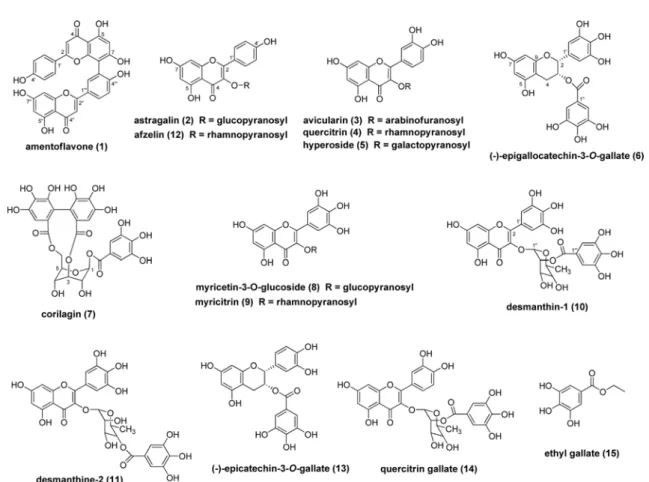
Fig. 1. The chemical structures of isolated compounds (1 – 15) from the leaves of H. riparia.
146.1/145.7/145.6/145.5/140.5 (hydroxylated carbon atoms), 126.2/125.8/122.1 (the ester link carbons on the aromatic rings), 120.7/117.4 (C atoms linking the diphenyl rings of the diphenoyl), 111.1 (galloyl-C), 110.3/108.4 (hexahy- droxydiphenoyl-C), 95.1 (C-1), 76.3 (C-5), 71.7 (C-3), 69.6 (C-2), 65.1 (C-6), 62.6 (C-4).
Myricetin-3- O-glucoside (8) − Yellow powder; ESI- MS m/z : 481 [M+H]
+;
1H-NMR (300 MHz, CD
3OD): δ 7.31 (2H, s, H-2'/6'), 6.37 (1H, d, J = 2.1 Hz, H-8), 6.18 (1H, d, J = 2.1 Hz, H-6), 5.18 (1H, d, J = 6.8 Hz, H-1''), 3.57 (1H, d, J = 11.0 Hz, H-6a"), 3.36 (1H, dd, J = 12.0, 4.5 Hz, H-6b"), 3.63–3.06 (4H, m, H-2"/3"/4"/5");
13C- NMR (75 MHz, CD
3OD): δ 179.5 (C-4), 166.1 (C-7), 163.3 (C-5), 159.7 (C-2), 158.8 (C-9), 146.9 (C-3'/5'), 138.1 (C-4'), 136.5 (C-3), 122.2 (C-1'), 109.8 (C-2'/6'), 109.6 (C-1"), 105.9 (C-10), 99.9 (C-6), 94.8 (C-8), 88.1 (C-4"), 83.4 (C-2"), 78.8 (C-3"), 62.7 (C-5").
Myricitrin (9) − Yellow powder; ESI-MS m/z : 465 [M+H]
+;
1H-NMR (300 MHz, CD
3OD): δ 6.92 (2H, s, H- 2'/6'), 6.32 (1H, d, J = 2.1 Hz, H-8), 6.16 (1H, d, J = 2.1 Hz, H-6), 5.29 (1H, d, J = 1.1 Hz, H-1"), 4.19 – 3.30 (4H, m, H-2"/3"/4"/5"), 0.94 (3H, d, J = 6.3 Hz, H-6");
13C- NMR (75 MHz, CD
3OD): δ 179.7 (C-4), 166.0 (C-7), 163.2 (C-5), 159.5 (C-2), 158.6 (C-9), 146.9 (C-3'/5'), 138.0 (C-4'), 136.4 (C-3), 122.0 (C-1'), 109.7 (C-2'/6'), 105.9 (C-10), 103.7 (C-1"), 99.9 (C-6), 94.8 (C-8), 73.4 (C-4"), 72.2 (C-3"), 72.1 (C-5"), 72.0 (C-2"), 17.7 (C-6").
Desmanthin-1 (10) − Yellow powder; ESI-MS m/z : 617 [M+H]
+;
1H-NMR (300 MHz, CD
3OD): δ 6.96 (2H, s, galloyl-H), 6.93 (2H, s, H-2'/6'), 6.34 (1H, d, J = 2.1 Hz, H-8), 6.18 (1H, d, J = 2.1 Hz, H-6), 5.30 (1H, d, J = 1.1 Hz, H-1"), 4.21–3.30 (4H, m, H-2"/3"/4"/5"), 0.94 (3H, d, J = 6.3 Hz, H-6");
13C-NMR (75 MHz, CD
3OD):
δ 178.7 (C-4), 166.7 (COO), 165.2 (C-7), 162.5 (C-5), 159.7 (C-2), 157.8 (C-9), 146.2 (C-3'/5'), 145.7 (C-3"'/
5"'), 139.3 (C-4"'), 137.4 (C-4'), 135.4 (C-3), 121.4 (C-1'), 121.2 (C-1"'), 109.9 (C-2'/6'), 109.1 (C-2"'/6"'), 105.4 (C- 10), 99.5 (C-6), 99.4 (C-1"), 94.2 (C-8), 73.4 (C-4"), 72.8 (C-2"), 71.7 (C-5"), 70.2 (C-3"), 17.1 (C-6").
Desmanthine-2 (11) − Yellow powder; ESI-MS m/z : 617 [M+H]
+;
1H-NMR (300 MHz, CD
3OD): δ 6.98 (2H, s, galloyl-H), 6.94 (2H, s, H-2'/6'), 6.35 (1H, d, J = 2.1 Hz, H-8), 6.17 (1H, d, J = 2.1 Hz, H-6), 5.31 (1H, s, H- 1"), 4.21–3.30 (4H, m, H-2"/3"/4"/5"), 0.94 (3H, d, J = 6.3 Hz, H-6");
13C-NMR (75 MHz, CD
3OD): δ 179.2 (C-4), 168.2 (COO), 165.4 (C-7), 162.8 (C-5), 159.1 (C- 2), 158.2 (C-9), 146.4 (C-3'/5'), 146.1 (C-3"'/5"'), 139.5 (C-4"'), 137.5 (C-4'), 136.2 (C-3), 121.7 (C-1"'), 121.4 (C- 1'), 109.9 (C-2'/6'), 109.5 (C-2"'/6"'), 105.6 (C-10), 103.2 (C-1"), 99.5 (C-6), 94.4 (C-8), 75.4 (C-4"), 71.8 (C-2"),
70.7 (C-3"), 69.4 (C-5"), 17.1 (C-6").
Afzelin (12) − Yellow powder; ESI-MS m/z : 433 [M+H]
+;
1H-NMR (300 MHz, CD
3OD): δ 7.75 (2H, d, J = 8.1 Hz, H-2'/6'), 6.93 (2H, d, J = 8.1 Hz, H-3'/5'), 5.38 (1H, brs, H-1"), 4.24 (1H, brs, H-2"), 3.72 (1H, brs, H- 3"), 3.33 (2H, m, H-4"/5"), 0.93 (3H, s, H-6");
13C-NMR (75 MHz, CD
3OD): δ 179.5 (C-4), 163.1 (C-7), 161.6 (C- 5), 159.2 (C-2/4'), 159.6 (C-9), 136.2 (C-3), 131.9 (C-2'/
6'), 122.7 (C-1'), 116.6 (C-3'/5'), 105.6 (C-10), 103.6 (C- 1"), 99.9 (C-6), 95.2 (C-8), 73.3 (C-4"), 72.2 (C-3"), 72.1 (C-5"), 72.0 (C-2"), 17.7 (C-6").
(−)-Epicatechin-3-O-gallate (13) − Yellow powder;
ESI-MS m/z : 443 [M+H]
+;
1H-NMR (300 MHz, CD
3OD):
δ 7.04 (1H, d, J = 1.8 Hz, H-2'), 7.01 (2H, s, H-2''/6''), 6.90 (1H, dd, J = 7.8, 1.8 Hz, H-2'), 6.02 (1H, d, J = 1.8 Hz, H-6), 6.06 (1H, d, J = 1.8 Hz, H-8), 5.52 (1H, m, H- 3), 5.10 (1H, d, J = 7.5 Hz, H-2), 3.02 (1H, dd, J = 16.2, 4.0 Hz, H-4
ax), 2.91 (1H, dd, J = 16.4, 3.4 Hz, H-4
eq);
13C- NMR (75 MHz, CD
3OD): δ 166.4 (COO), 157.8 (C-9), 157.5 (C-7), 156.8 (C-5), 146.2 (C-3''/5''), 145.8 (C-4'), 145.5 (C-3'), 139.0 (C-4''), 131.4 (C-1'), 121.3 (C-1''), 119.2 (C-5'), 115.3 (C-3'), 114.8 (C-2'), 109.4 (C-2''/6''), 98.7 (C-10), 96.7 (C-8), 95.3 (C-6), 77.8 (C-2), 69.3 (C-3), 26.8 (C-4).
Quercitrin gallate (14) − Yellow powder; ESI-MS m/z : 601 [M+H]
+;
1H-NMR (300 MHz, DMSO-d
6) δ
1H-NMR (300 MHz, CD
3OD): 7.38 (1H, d, J = 2.0 Hz, H-2'), 7.32 (1H, dd, J = 2.0, 8.0 Hz, H-6'), 7.10 (2H, s, H-2'''/6'''), 6.94 (1H, d, J = 8.0 Hz, H-5'), 6.34 (1H, d, J = 2.1 Hz, H- 8), 6.22 (1H, d, J = 2.1 Hz, H-6), 5.64 (1H, d, J = 1.5 Hz, H-1"), 5.52 (1H, t, J = 2.0 Hz, H-2"), 4.02-3.40 (3H, m, H-3", 4", 5"), 0.98 (3H, d, J = 6.0 Hz, H-6");
13C-NMR (75 MHz, DMSO-d
6): δ 179.5 (C-4), 167.5 (C-7), 166.0 (C-7'''), 163.3 (C-5), 159.4 (C-9), 158.6 (C-2), 150.0 (C- 4'), 146.6 (C-3'''/5'''), 146.5 (C-3'), 140.1 (C-4'''), 135.8 (C- 3), 123.0 (C-6'), 122.9 (C-1'), 121.4 (C-1'''), 117.0 (C-5'), 116.6 (C-2'), 110.5 (C-2'''/6'''), 106.0 (C-10), 100.6 (C-6'), 100.0 (C-1"), 94.8 (C-8), 73.9 (C-4"), 73.6 (C-2"), 72.3 (C-5"), 70.8 (C-3"), 17,9 (C-6").
Ethyl gallate (15) − White powder; ESI-MS m/z : 199 [M+H]
+;
1H-NMR (300 MHz, CD
3OD): δ 6.89 (2H, s, H- 2/6), 4.14 (2H, q, J = 7.3 Hz, H-8), 1.21 (3H, t, J = 7.3 Hz, H-9);
13C-NMR (75 MHz, CD
3OD): δ 168.7 (COO), 146.6 (C-3/5), 139.7 (C-4), 121.8 (C-1), 110.1 (C-2/6), 61.8 (C-8), 14.8 (C-9).
Inhibition of AGE formation assay − In accordance
with a well-established method, a reaction mixture of
bovine serum albumin (10 mg/mL, 700 μL; Sigma) in 50
mM phosphate buffer (pH 7.4) with 0.02% sodium azide
was added to 0.2 M fructose and glucose (100 μL). In
screw-cap tubes (1.5 mL), the reaction mixture was then mixed with 200 μL of serially diluted compounds or AG (99% purity; Sigma). After incubating at 37
oC for 7 days, the fluorescent reaction products (200 μL) were transferred to 96-well plates and assayed on a spectrofluorometric detector (Synergy HT; excitation wavelength, 350 nm, emission wavelength, 450 nm). The AGE assay was performed in triplicate. The IC
50values were obtained by regression analysis using the GraphPad 5.0 Prism software.
Measurement of vessel dilation in larval zebrafish − All experimental protocols for animal care and use were approved by the local ethics board (South Korean Institute of Oriental Medicine Animal Care and Use Committee) Committee, and animal husbandry and procedures were performed in accordance with institutional guidelines.
Adult zebrafish were maintained under standard conditions at 28.5
oC under a 14 h light/10 h dark cycle. Embryos were obtained from crosses between flk:EGFP transgenic fish and raised in egg water (sea salt, 0.06 g/L). One-day- old flk:EGFP embryos were placed in a 24-well plate (five embryos per well) and maintained in 2 mL egg water containing 130 mM glucose. HG-induced embryos were treated with 6, 7, and 11 (10 or 20 μM) from 1 to 6 days post-fertilization (dpf). At 6 dpf, HG-induced embryos were fixed with 4% paraformaldehyde, and the lens con- taining the hyaloid-retinal vessels was isolated. Fluorescence was visualized using the Olympus SZX16 stereomicroscope, and diameters were measured using ImageJ software.
Experiments were performed in triplicate.
Statistical analysis − Statistical significance was assessed using one-way analysis of variance (ANOVA) and Dunnett’s multiple comparison tests with the GraphPad 5.0 Prism software.
Result and Discussion
EtOH extracts of leaves of H. riparia showed greater than 70% inhibition on AGE formation in vitro at a concentration of 10 µg/mL. Thus, this extract was further fractionated using n-hexane, EtOAc, and n-BuOH to isolate components showing strong inhibitory effects on AGE formation. These fractions were tested for their inhibitory effects on AGE formation in vitro; the EtOAc- soluble fraction showed the most potent inhibitory activity on AGE formation, with an IC
50value of 4.3 µg/mL, followed by the n-BuOH fraction (IC
50= 5.8 µg/mL), water fraction (IC
50= 8.5 μg/mL), and n-hexane fraction (IC
50> 50 μg/mL), respectively. Thus, the EtOAc-soluble fraction was subjected to a series of chromatographic separation steps guided by the inhibitory activity on AGE
formation, leading to isolation of compounds 1 – 15. Based on a comparison of the spectral data of these compounds with those of compounds in the literature, the following isolates were identified: amentoflavone (1),
9astragalin (2),
10avicularin (3),
11quercitrin (4),
12hyperoside (5),
13( −)- epigallocatechin-3-O-gallate (6),
14corilagin (7),
15myricetin- 3-O-glucoside (8),
16myricitrin (9),
17desmanthin-1 (10),
18desmanthine-2 (11),
18afzelin (12),
19( −)-epicatechin-3-O- gallate (13),
14quercitrin gallate (14),
20and ethyl gallate (15).
21All of these isolates are phenolic compounds, a class of chemicals consisting of a hydroxyl group bonded directly to an aromatic hydrocarbon group. These phenolic compounds are classified into a simple phenol [ethyl gallate (15)], flavonoids [amentoflavone (1), astragalin (2), avicularin (3), quercitrin (4), hyperoside (5), myricetin- 3-O-glucoside (8), myricitrin (9), desmanthin-1 (10), desmanthine-2 (11), afzelin (12), and quercitrin gallate (14)], a condensed tannin [corilagin (7)], and hydrolysable tannins [( −)-epigallocatechin-3-O-gallate (6) and (−)-epi- catechin-3-O-gallate (13)].
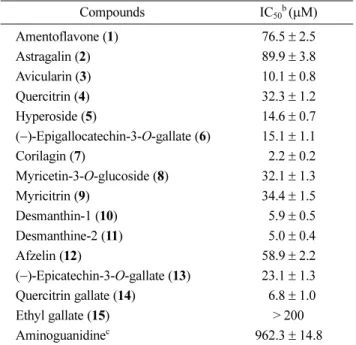
The inhibitory effects of the isolated compounds (1 –15) on AGE formation in vitro were examined, and the results are presented in Table 1. The majority of these compounds, excluding ethyl gallate (15), markedly inhibited AGE formation, with IC
50values of 2.2 – 89.9 µM, compared
Table 1. Inhibitory effects of compounds 1 - 15 from the leaves of H. riparia against AGE formation
aCompounds IC
50b(µM)
Amentoflavone (1) 76.5 ± 2.5
Astragalin (2) 89.9 ± 3.8
Avicularin (3) 10.1 ± 0.8
Quercitrin (4) 32.3 ± 1.2
Hyperoside (5) 14.6 ± 0.7
( −)-Epigallocatechin-3-O-gallate (6) 15.1 ± 1.1
Corilagin (7) 2.2 ± 0.2
Myricetin-3-O-glucoside (8) 32.1 ± 1.3
Myricitrin (9) 34.4 ± 1.5
Desmanthin-1 (10) 5.9 ± 0.5
Desmanthine-2 (11) 5.0 ± 0.4
Afzelin (12) 58.9 ± 2.2
( −)-Epicatechin-3-O-gallate (13) 23.1 ± 1.3
Quercitrin gallate (14) 6.8 ± 1.0
Ethyl gallate (15) > 200
Aminoguanidine
c962.3 ± 14.8
a
Results are expressed as means ± SEM (n = 3).
b
IC
50indicates the concentration (µM) at which the inhibition per- centage of the AGEs formation was 50%, and the values were determined by regression analysis.
c