• 검색 결과가 없습니다.

Five-Year Outcomes of Successful Percutaneous Coronary Intervention with Drug-Eluting Stents versus Medical Therapy for Chronic Total Occlusions

N/A
N/A
Protected

Academic year: 2022

Share "Five-Year Outcomes of Successful Percutaneous Coronary Intervention with Drug-Eluting Stents versus Medical Therapy for Chronic Total Occlusions"

Copied!
9
0
0

로드 중.... (전체 텍스트 보기)

전체 글

(1)

INTRODUCTION

Many recent trials have investigated the relationship between the presence of chronic total occlusion (CTO) and mortality in various populations. It has been found that the presence of CTO is associated with a higher mortality rate in patients with acute myocardial infarction, multi-vessel disease (MVD), or left main disease.

1-6

The presence of CTO has also been shown to be associated with a reduced left ventricular ejection frac- tion (LVEF; <40%) and further deterioration of LVEF in ST- segment elevation myocardial infarction (STEMI) patients.

5

In Received: September 25, 2017 Revised: March 22, 2018

Accepted: April 23, 2018

Corresponding author: Seung-Woon Rha, MD, PhD, FACC, FAHA, FESC, FSCAI, FAPSIC, Cardiovascular Center, Korea University Guro Hospital, 148 Gurodong-ro, Guro-gu, Seoul 08308, Korea.

Tel: 82-2-2626-3020, Fax: 82-2-864-3062, E-mail: [email protected]

*Seung-Woon Rha and Byoung Geol Choi contributed equally to this work.

•The authors have no financial conflicts of interest.

© Copyright: Yonsei University College of Medicine 2018

This is an Open Access article distributed under the terms of the Creative Com- mons Attribution Non-Commercial License (http://creativecommons.org/licenses/

by-nc/4.0) which permits unrestricted non-commercial use, distribution, and repro- duction in any medium, provided the original work is properly cited.

Five-Year Outcomes of Successful Percutaneous

Coronary Intervention with Drug-Eluting Stents versus Medical Therapy for Chronic Total Occlusions

Seung-Woon Rha

1

*, Byoung Geol Choi

1,2

*, Man Jong Baek

3

, Yang gi Ryu

3

, Hu Li

1,4

, Se Yeon Choi

1,5

, Jae Kyeong Byun

1,5

, Ahmed Mashaly

1

, Yoonjee Park

1

, Won Young Jang

1

, Woohyeun Kim

1

, Jah Yeon Choi

1

, Eun Jin Park

1

, Jin Oh Na

1

, Cheol Ung Choi

1

,

Hong Euy Lim

1

, Eung Ju Kim

1

, Chang Gyu Park

1

, Hong Seog Seo

1

, and Dong Joo Oh

1

1

Cardiovascular Center, Korea University Guro Hospital, Seoul;

2

Research Institute of Health Sciences, Korea University College of Health Science, Seoul;

3

Department of Thoracic and Cardiovascular Surgery, Korea University Guro Hospital, Seoul, Korea;

4

Department of Medicine, The Second Affiliated Hospital of Kunming Medical University, Kunming, China;

5

Department of Medicine, Korea University Graduate School, Seoul, Korea.

Purpose: Many recent studies have reported that successful percutaneous coronary intervention (PCI) with drug-eluting stents (DESs) for chronic total occlusion (CTO) has more beneficial effects than failed CTO-PCI; however, there are only limited data available from comparisons of successful CTO-PCI with medical therapy (MT) in the Korean population.

Materials and Methods: A total of 840 consecutive CTO patients who underwent diagnostic coronary angiography, receiving ei- ther PCI with DESs or MT, were enrolled. Patients were divided into two groups according to the treatment assigned. To adjust for potential confounders, propensity score matching (PSM) analysis was performed using logistic regression. Individual major clini- cal outcomes and major adverse cardiac events, a composite of total death, myocardial infarction (MI), stroke, and revasculariza- tion, were compared between the two groups up to 5 years.

Results: After PSM, two propensity-matched groups (265 pairs, n=530) were generated, and the baseline characteristics were bal- anced. Although the PCI group showed a higher incidence of target lesion and vessel revascularization on CTO, the incidence of MI tended to be lower [hazard ratio (HR): 0.339, 95% confidence interval (CI): 0.110 to 1.043, p=0.059] and the composite of total death or MI was lower (HR: 0.454, 95% CI: 0.224 to 0.919, p=0.028), compared with the MT group up to 5 years.

Conclusion: In this study, successful CTO PCI with DESs was associated with a higher risk of repeat PCI for the target vessel, but showed a reduced incidence of death or MI.

Key Words: Chronic total occlusion, percutaneous coronary intervention, drug-eluting stent, medical therapy

pISSN: 0513-5796 · eISSN: 1976-2437 Yonsei Med J 2018 Jul;59(5):602-610

https://doi.org/10.3349/ymj.2018.59.5.602

(2)

the CONFIRM (COronary CT Angiography EvaluatioN For Clinical Outcomes: An InteRnational Multicenter) registry, 61% of CTO patients were treated with medical therapy (MT), while only one third (39%) were treated with early coronary revascularization by percutaneous coronary intervention (PCI;

24%) or coronary artery bypass graft surgery (CABG; 15%).

7

Similarly, according to the NCDR (National Cardiovascular Data Registry) database in the United States, the CTO-PCI at- tempt rate was below -15% between 2004 and 2007, whereas the CABG rate was 18.3%.

8,9

Recently, it has been reported that successful CTO-PCI is associated with improvements in left ventricular function, re- ducing angina symptoms and reducing the need for CABG, compared with failed CTO-PCI.

9-11

Additionally, there are stud- ies that report successful CTO-PCI may have an edge on long- term survival.

11-16

Nonetheless, only limited data on compari- sons of successful CTO-PCI with conservative MT are available, particularly in the drug-eluting stent (DES) era.

17

The aim of this study was to compare the long-term clinical outcomes of suc- cessful CTO-PCI with DESs to those of CTO-MT, particularly in a series of the Korean population.

MATERIALS AND METHODS

The design of this registry has been introduced before.

17

We obtained data from the CTO registry of Korea University Guro Hospital (KUGH), Seoul, Korea. In brief, it is a single-center, prospective, all-comer registry designed to reflect “real-world”

practice since 2004, after the introduction of DESs. Data were collected by a trained study-coordinator with a standardized case report form. The participants or their legal guardians were given a thorough literal and verbal explanation of the study procedures before granting written consent to participate in the study. The study protocol was approved by the Medical Device Institutional Review Board of KUGH. The authors of this manuscript have certified that the information contained herein is true and correct as reflected in the records of the Med- ical Device Institutional Review Board (#MD07014).

Data source and population

A total of 4909 consecutive patients were diagnosed with signif- icant coronary artery disease (≥70% of coronary stenosis) by coronary angiography. Among these, 840 patients who had CTO lesion on the coronary main vessels were enrolled in KUGH- CTO registry from January 2004 to November 2015. 20.9%

(176/840) of all CTO patients had a CTO lesion when they vis- ited acute myocardial infarction and were treated conservative- ly with MT or staged PCI for CTO lesions.

Study definitions

A CTO lesion was defined as a complete obstruction of the coronary vessel by thrombolysis in myocardial infarction (MI)

flow grade 0 for at least 3 months. The coronary main vessels were defined as having a reference vessel diameter (RVD) of

>2.5 mm, and CTO lesion must be located on the main vessel at left main, left arterial descending (LAD), left circumflex, right coronary, and ramus artery. Patients were excluded if they had CTO in a small vessel (RVD, ≤2.5 mm) or located on side branch vessels, such as an acute marginal, diagonal, septal and obtuse marginal artery. Major adverse cardiovascular events (MAC- Es) were defined as the composite of total death, MI, and revas- cularization, including PCI and CABG. Total deaths were con- sidered cardiac unless an unequivocal non-cardiac cause of death could be confirmed. MI after discharge and in-hospital fatal MI were termed as recurrent MI, defined as either the development of pathological Q wave in at least two contiguous leads or an elevation of serum creatine kinase levels. After the CTO procedure, the periprocedural MI (p-MI), simply in- creased the cardiac marker, was not included.

Statistical analysis

For continuous variables, differences between groups were evaluated using the unpaired t-test or Mann-Whitney rank test.

Data are expressed as mean±standard deviations. For discrete variables, differences are expressed as counts and percentages, and were analyzed with the χ

2

or Fisher’s exact test. To adjust for any potential confounders, propensity score matching (PSM) analysis was performed using the logistic regression model.

We tested all available variables that could be of potential rel- evance: age, male, cardiovascular risk factors (hypertension, diabetes, dyslipidemia, cerebrovascular disease peripheral ar- tery disease, chronic kidney disease, heart failure and smok- ing), and angiographic and procedural characteristics (signifi- cant coronary lesion artery, CTO lesion artery, lesion locations).

Matching was performed via 1:1 matching protocol using the nearest neighbor matching algorithm, with a caliper width equal to 0.05 of the standard deviation of the propensity score, yielding 265 well-matched pairs. Various clinical outcomes up to 5 years were estimated by the Kaplan-Meier analysis, and differences between groups were compared with the log-rank test before and after PSM. Proportional hazard models were used to assess the hazard ratio (HR) of the CTO-PCI group in comparison to the CTO-MT group among the matched popu- lation. For all analyses, a two-sided p<0.05 was considered sta- tistically significant. All data were processed with SPSS (ver- sion 20.0, IBM Corp., Armonk, NY, USA).

Study endpoints

Primary endpoint was total death, MI, revascularization, such

as PCI and CABG, and MACE. The secondary endpoint was

the level of change in left ventricular function before and after

CTO-PCI within 6 months and 2 years. In this study, the mean

follow-up period was 1466±586 days (after PSM: 1446±587),

and we could follow up on the clinical data of all enrolled pa-

tients through face-to-face interviews at regular outpatient

(3)

visits, medical chart reviews, and telephone contacts.

RESULTS

In the present study, 17.1% (840/4909) of patients with signifi- cant coronary artery disease diagnosed by coronary angiogra- phy had a CTO lesion. Of the 59% of the CTO patients, 479 (57%) of them underwent an early coronary revascularization by PCI and 18 (2%) underwent a CABG. Finally, 412 patients were enrolled in the successful CTO-PCI group and 410 were enrolled in the CTO-MT group, which included 343 patients with conservative MT, 40 patients with failed CTO-PCI and 27 patients who underwent a successful CTO-PCI, but with re- sidual CTO in the multi-CTO lesion (≥2 vessel) (Fig. 1). The overall procedural success rate of CTO-PCI was 85% (452/532 lesion).

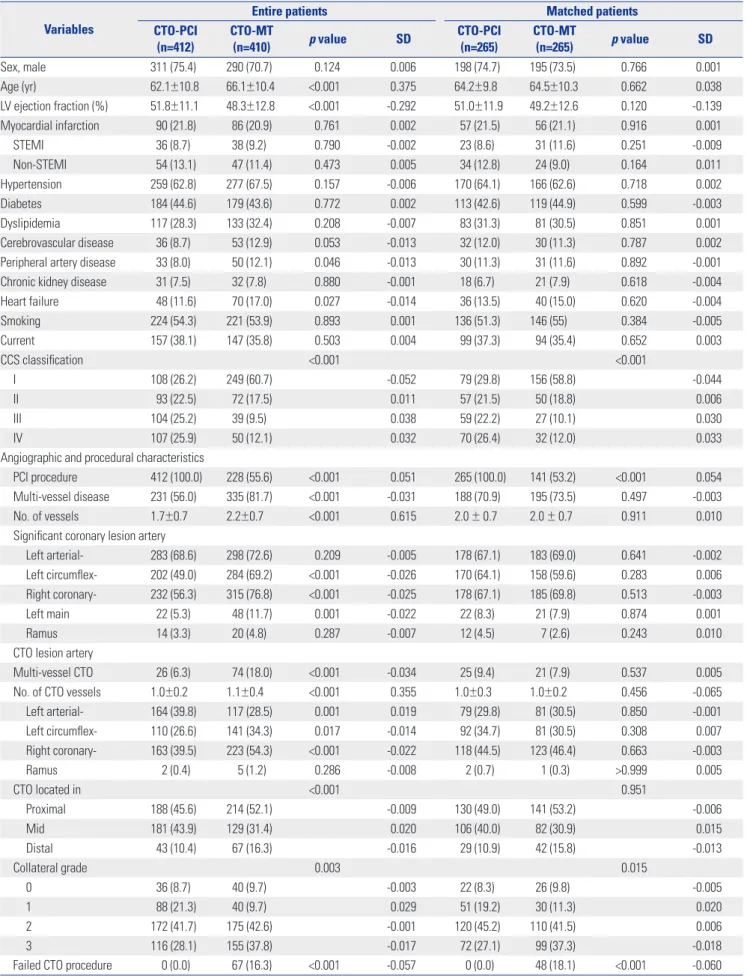
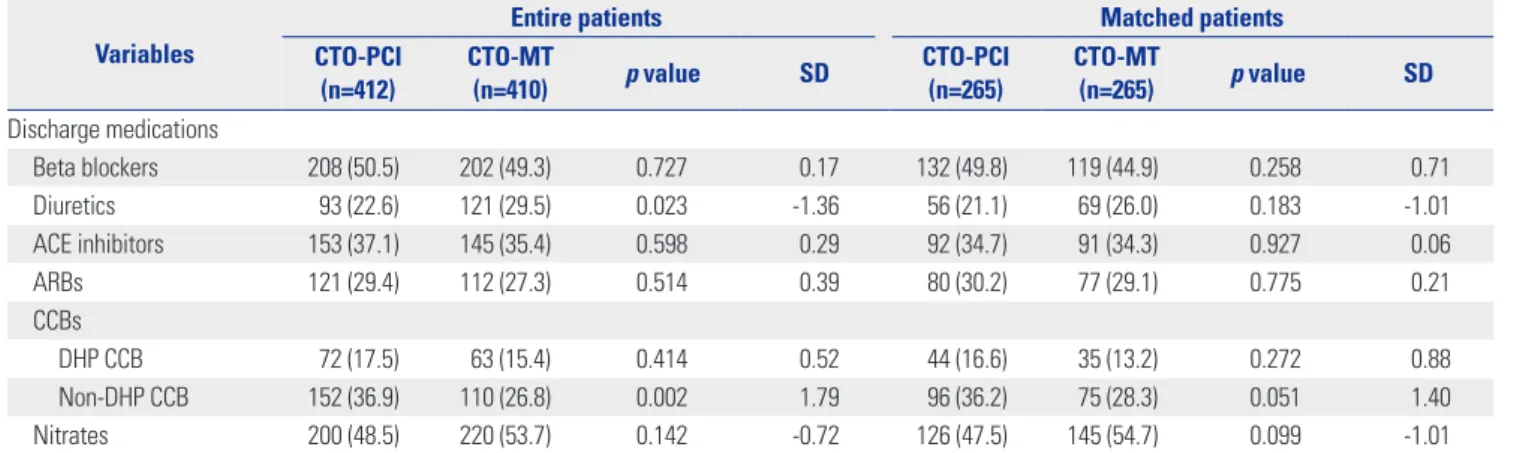
Baseline clinical, angiographic and procedural characteris- tics are shown in Table 1. In the entire cohort, unfavorable risks, such as old age, lower LVEF, peripheral artery disease, heart failure, MVD, multi-vessel CTO and proximal-CTO, were more common in the CTO-MT group, whereas angina symptom (Ca- nadian Cardiovascular Society class, CCS ≥II), LAD-CTO, and lower collateral grade were more prevalent in the CTO-PCI group, reflecting real-world clinical practice. After PSM analy- sis, two propensity-matched groups (265 pairs, n=530) were generated, and the baseline characteristics were balanced, ex- cept that angina symptom and collateral grade were more fa- vorable in the CTO-MT group.

Various clinical outcomes of the 5-year follow up (mean du- ration: 4.0±1.5 years) were analyzed by Cox-proportional haz- ard ratio model analysis and Kaplan-Meier curved analysis, as shown in Table 2. In the entire cohort, the CTO-PCI group ex- hibited a lower incidence of total death, MI, and a composite of total death and MI, but had a higher incidence of revascu-

larization, including target CTO-lesion (target lesion revascu- larization, TLR) and target CTO-vessel (target vessel revascu- larization, TVR). After propensity-matching, although the CTO- PCI group demonstrated a higher incidence of revascularization (TLR and TVR), it showed a lower incidence of MI and com- posite of total death or MI, compared with the CTO-MT group.

In the Cox-proportional hazard ratio model analysis, com- pared with the CTO-MT group, the CTO-PCI group tended to exhibit a lower risk of MI [HR: 0.339, 95% confidence interval (CI): 0.110 to 1.043, p=0.059], and a significantly reduced risk of composite total death and MI (HR: 0.454, 95% CI: 0.224 to 0.919, p=0.028) (Table 2, Supplementary Fig. 1, only online).

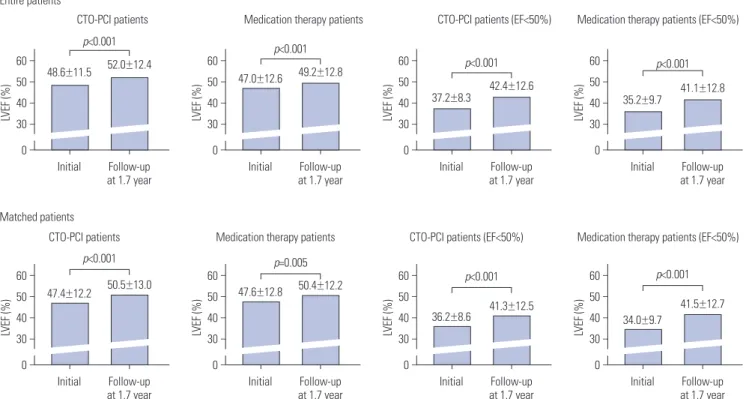
To evaluate changes in LVEF in the first 1.7 years, paired t- test analysis was applied. Both the successful CTO-PCI group and CTO-MT group were associated with a significant im- provement in mean LVEF from 48.6% to 52.0% and from 47.0%

to 49.2%, respectively. The two groups also showed a signifi- cant improvement in mean LVEF among individuals with re- duced LVEF (<50%) (Fig. 2).

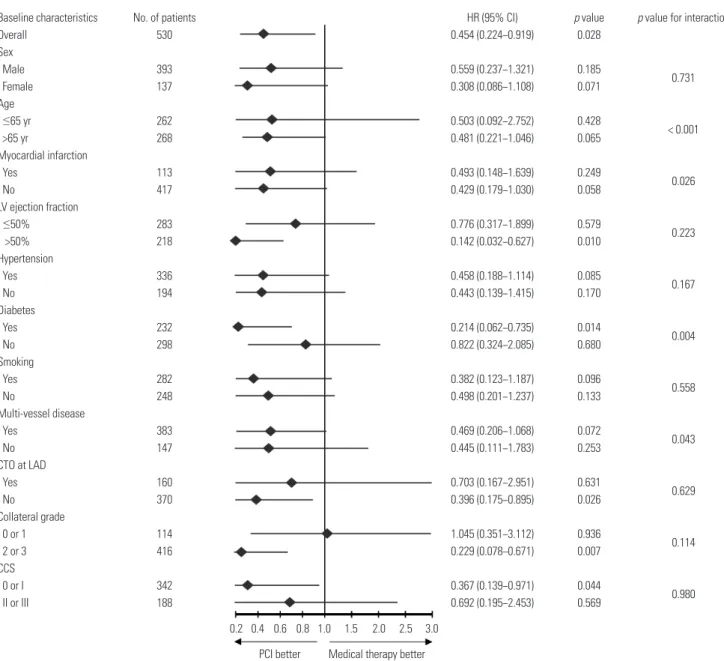
Subgroup analyses were performed to compare the com- posite of total death and MI of the successful CTO-PCI and CTO-MT groups with Cox-proportional hazard ratio model analysis (Fig. 3). The CTO-PCI group showed a more benefi- cial effect in individuals with preserved LVEF (>50%), diabe- tes, non-LAD CTO, well-developed collateral vessel (grade≥2), and lower grade CCS (≤Class I).

DISCUSSION

The main findings of this study are as follows: 1) successful CTO-PCI with DESs, as compared with CTO-MT, reduced the incidence of MI and composite of death or MI over 5 years of follow up. However, 2) during the 1.7 years of follow up, LVEF significantly improved in both the CTO-PCI group and the A total of 4909 consecutive patients were diagnosed with significant coronary artery disease

(≥70% of coronary stenosis) by coronary angiogram from January 2004 to November 2015

- Failed CTO-PCI (n=40)

-Successful CTO-PCI but with residual CTO in multi-CTO (n=27)

840 patients with CTO lesion in coroary main vessels were enrolled in KUGH-CTO registry

PCI group (n=479)

Successful CTO-PCI (n=412)

MT group (n=343)

MT group (n=410)

Fig. 1. Flow chart of group distribution. CTO, chronic total occlusion; PCI, percutaneous coronary intervention; MT, medical therapy; KUGH, Korea Uni-

versity Guro Hospital.

(4)

Table 1. Baseline Characteristics of the Entire Cohort and Propensity-Matched Groups Variables

Entire patients Matched patients

CTO-PCI

(n=412) CTO-MT

(n=410) p value SD CTO-PCI

(n=265) CTO-MT

(n=265) p value SD

Sex, male 311 (75.4) 290 (70.7) 0.124 0.006 198 (74.7) 195 (73.5) 0.766 0.001

Age (yr) 62.1±10.8 66.1±10.4 <0.001 0.375 64.2±9.8 64.5±10.3 0.662 0.038

LV ejection fraction (%) 51.8±11.1 48.3±12.8 <0.001 -0.292 51.0±11.9 49.2±12.6 0.120 -0.139

Myocardial infarction 90 (21.8) 86 (20.9) 0.761 0.002 57 (21.5) 56 (21.1) 0.916 0.001

STEMI 36 (8.7) 38 (9.2) 0.790 -0.002 23 (8.6) 31 (11.6) 0.251 -0.009

Non-STEMI 54 (13.1) 47 (11.4) 0.473 0.005 34 (12.8) 24 (9.0) 0.164 0.011

Hypertension 259 (62.8) 277 (67.5) 0.157 -0.006 170 (64.1) 166 (62.6) 0.718 0.002

Diabetes 184 (44.6) 179 (43.6) 0.772 0.002 113 (42.6) 119 (44.9) 0.599 -0.003

Dyslipidemia 117 (28.3) 133 (32.4) 0.208 -0.007 83 (31.3) 81 (30.5) 0.851 0.001

Cerebrovascular disease 36 (8.7) 53 (12.9) 0.053 -0.013 32 (12.0) 30 (11.3) 0.787 0.002

Peripheral artery disease 33 (8.0) 50 (12.1) 0.046 -0.013 30 (11.3) 31 (11.6) 0.892 -0.001

Chronic kidney disease 31 (7.5) 32 (7.8) 0.880 -0.001 18 (6.7) 21 (7.9) 0.618 -0.004

Heart failure 48 (11.6) 70 (17.0) 0.027 -0.014 36 (13.5) 40 (15.0) 0.620 -0.004

Smoking 224 (54.3) 221 (53.9) 0.893 0.001 136 (51.3) 146 (55) 0.384 -0.005

Current 157 (38.1) 147 (35.8) 0.503 0.004 99 (37.3) 94 (35.4) 0.652 0.003

CCS classification <0.001 <0.001

I 108 (26.2) 249 (60.7) -0.052 79 (29.8) 156 (58.8) -0.044

II 93 (22.5) 72 (17.5) 0.011 57 (21.5) 50 (18.8) 0.006

III 104 (25.2) 39 (9.5) 0.038 59 (22.2) 27 (10.1) 0.030

IV 107 (25.9) 50 (12.1) 0.032 70 (26.4) 32 (12.0) 0.033

Angiographic and procedural characteristics

PCI procedure 412 (100.0) 228 (55.6) <0.001 0.051 265 (100.0) 141 (53.2) <0.001 0.054

Multi-vessel disease 231 (56.0) 335 (81.7) <0.001 -0.031 188 (70.9) 195 (73.5) 0.497 -0.003

No. of vessels 1.7±0.7 2.2±0.7 <0.001 0.615 2.0 ± 0.7 2.0 ± 0.7 0.911 0.010

Significant coronary lesion artery

Left arterial- 283 (68.6) 298 (72.6) 0.209 -0.005 178 (67.1) 183 (69.0) 0.641 -0.002

Left circumflex- 202 (49.0) 284 (69.2) <0.001 -0.026 170 (64.1) 158 (59.6) 0.283 0.006

Right coronary- 232 (56.3) 315 (76.8) <0.001 -0.025 178 (67.1) 185 (69.8) 0.513 -0.003

Left main 22 (5.3) 48 (11.7) 0.001 -0.022 22 (8.3) 21 (7.9) 0.874 0.001

Ramus 14 (3.3) 20 (4.8) 0.287 -0.007 12 (4.5) 7 (2.6) 0.243 0.010

CTO lesion artery

Multi-vessel CTO 26 (6.3) 74 (18.0) <0.001 -0.034 25 (9.4) 21 (7.9) 0.537 0.005

No. of CTO vessels 1.0±0.2 1.1±0.4 <0.001 0.355 1.0±0.3 1.0±0.2 0.456 -0.065

Left arterial- 164 (39.8) 117 (28.5) 0.001 0.019 79 (29.8) 81 (30.5) 0.850 -0.001

Left circumflex- 110 (26.6) 141 (34.3) 0.017 -0.014 92 (34.7) 81 (30.5) 0.308 0.007

Right coronary- 163 (39.5) 223 (54.3) <0.001 -0.022 118 (44.5) 123 (46.4) 0.663 -0.003

Ramus 2 (0.4) 5 (1.2) 0.286 -0.008 2 (0.7) 1 (0.3) >0.999 0.005

CTO located in <0.001 0.951

Proximal 188 (45.6) 214 (52.1) -0.009 130 (49.0) 141 (53.2) -0.006

Mid 181 (43.9) 129 (31.4) 0.020 106 (40.0) 82 (30.9) 0.015

Distal 43 (10.4) 67 (16.3) -0.016 29 (10.9) 42 (15.8) -0.013

Collateral grade 0.003 0.015

0 36 (8.7) 40 (9.7) -0.003 22 (8.3) 26 (9.8) -0.005

1 88 (21.3) 40 (9.7) 0.029 51 (19.2) 30 (11.3) 0.020

2 172 (41.7) 175 (42.6) -0.001 120 (45.2) 110 (41.5) 0.006

3 116 (28.1) 155 (37.8) -0.017 72 (27.1) 99 (37.3) -0.018

Failed CTO procedure 0 (0.0) 67 (16.3) <0.001 -0.057 0 (0.0) 48 (18.1) <0.001 -0.060

(5)

CTO-MT group. 3) According to the results of sub-group anal- ysis, CTO-PCI may be more effective in patients with diabetes, preserved myocardial viability, such as preserved LVEF (>50%), CTO located in non-LAD arteries, well-developed collateral vessel (>grade 1), and mild chest pain (<CCS class II).

The aim of the present study was to compare CTO-PCI with DESs and CTO-MT in regards to risk of major individual and

composite clinical outcomes, as well as the impact of revascu- larization on serial LV function. Many trials have investigated the relationship between the risk of mortality and CTO in vari- ous populations.

1-6

The HORIZONS-AMI trial reported that the presence of CTO was an independent predictor of both in- creased early (within 30 days, HR: 2.88, 95% CI: 1.41−5.88, p=

0.004) and late mortality (from 30 days to 3 years, HR: 1.98, 95%

Table 1. Baseline Characteristics of the Entire Cohort and Propensity-Matched Groups (Continued) Variables

Entire patients Matched patients

CTO-PCI

(n=412) CTO-MT

(n=410) p value SD CTO-PCI

(n=265) CTO-MT

(n=265) p value SD

Discharge medications

Beta blockers 208 (50.5) 202 (49.3) 0.727 0.17 132 (49.8) 119 (44.9) 0.258 0.71

Diuretics 93 (22.6) 121 (29.5) 0.023 -1.36 56 (21.1) 69 (26.0) 0.183 -1.01

ACE inhibitors 153 (37.1) 145 (35.4) 0.598 0.29 92 (34.7) 91 (34.3) 0.927 0.06

ARBs 121 (29.4) 112 (27.3) 0.514 0.39 80 (30.2) 77 (29.1) 0.775 0.21

CCBs

DHP CCB 72 (17.5) 63 (15.4) 0.414 0.52 44 (16.6) 35 (13.2) 0.272 0.88

Non-DHP CCB 152 (36.9) 110 (26.8) 0.002 1.79 96 (36.2) 75 (28.3) 0.051 1.40

Nitrates 200 (48.5) 220 (53.7) 0.142 -0.72 126 (47.5) 145 (54.7) 0.099 -1.01

CTO, chronic total occlusion; PCI, percutaneous coronary intervention; MT, medical therapy; SD, standardized difference; STEMI, ST-segment elevation myocar- dial infarction; CCS, Canadian Cardiovascular Society; ACE, angiotensin converting enzyme; ARB, angiotensin receptor blockers; CCB, calcium channel blockers;

DHP, dihydropyridine.

Data are presented as n (%) or mean±standard deviation.

Table 2. Clinical Outcomes in Cox-proportional Hazard Ratio Model Analysis and Kaplan-Meier Curved Analysis

Outcomes No. of events at 4 years (%)

HR (95% CI) p value

CTO-PCI CTO-MT Log rank

Entire cohort

Total death 16 (4.3) 33 (8.6) 0.020 0.499 (0.275−0.908) 0.023

Cardiac death 10 (2.6) 17 (4.5) 0.203 0.604 (0.276−1.321) 0.207

Myocardial infarction 7 (1.8) 20 (5.5) 0.015 0.359 (0.151−0.850) 0.020

Revascularization 74 (20.7) 52 (14.2) 0.018 1.532 (1.074−2.185) 0.018

Target lesion (CTO lesion) 44 (12.3) 15 (4.0) <0.001 3.142 (1.748−5.649) <0.001

Target vessel (CTO vessel) 53 (14.7) 17 (4.6) <0.001 3.376 (1.954−5.833) <0.001

Non-target vessel (non-CTO vessel) 37 (10.4) 47 (12.9) 0.321 0.804 (0.522−1.237) 0.322

Stroke 3 (0.8) 6 (1.6) 0.348 0.521 (0.130−2.084) 0.357

Total MACE 88 (24.0) 82 (21.3) 0.353 1.153 (0.853−1.558) 0.353

Total death or myocardial infarction 18 (4.8) 45 (11.8) 0.001 0.409 (0.237−0.707) 0.001

Propensity-matched groups

Total death 11 (4.6) 17 (6.7) 0.349 0.696 (0.326−1.488) 0.351

Cardiac death 7 (3.1) 10 (4.0) 0.585 0.764 (0.290−2.010) 0.586

Myocardial infarction 4 (1.6) 13 (5.6) 0.048 0.339 (0.110−1.043) 0.059

Revascularization 44 (19.8) 35 (14.5) 0.133 1.404 (0.900−2.190) 0.135

Target lesion (CTO lesion) 28 (12.7) 8 (3.2) <0.001 3.925 (1.787−8.619) 0.001

Target vessel (CTO vessel) 33 (14.9) 9 (3.6) <0.001 4.168 (1.992−8.720) <0.001

Non-target vessel (non-CTO vessel) 24 (10.8) 34 (14.2) 0.302 0.759 (0.450−1.282) 0.303

Stroke 3 (1.3) 3 (1.4) 0.855 1.161 (0.233−5.766) 0.855

Total MACE 54 (23.6) 49 (19.5) 0.302 1.225 (0.832−1.805) 0.303

Total death or myocardial infarction 11 (4.6) 26 (10.5) 0.025 0.454 (0.224−0.919) 0.028

CTO, chronic total occlusion; PCI, percutaneous coronary intervention; MT, medical therapy; HR, hazard ratio; CI, confidence interval.

Major adverse cardiac events (MACE) was defined as the composite of total death, myocardial infarction, stroke and revascularization.

Data are presented as incidences (%).

(6)

CI: 1.19−3.29, p=0.009) in STEMI patient.

2

The PL-ACS study, reported CTO was an independent predictor of 1-year mortal- ity (HR: 1.42, 95% CI: 1.01−2.00, p=0.047) in patients with non- STEMI.

3

In addition, Claessen, et al.

5

reported that CTO is as- sociated with reduced LVEF (<40%) and further deterioration of LVEF, as well as an increased risk of long-term mortality, in STEMI patients.

To date, compared with CTO-MT, the effects of CTO-PCI are controversial, and data on a fair comparative assessment of successful CTO-PCI and CTO-MT are limited. Recent studies concluded that successful CTO-PCI is associated with a better long-term survival rate than failed CTO-PCI.

11-16

Mehran, et al.

14

reported that successful CTO-PCI reduced long-term cardiac death by 60% during a 5-year follow-up. The Multicenter Kore- an-Chronic Total Occlusion (K-CTO) registry indicated that successful CTO-PCI reduces the risk of composite cardiac death or MI to 49% during 2 year follow-up study.

18

However, these studies had some limitations for application in the real world:

CTO-PCI attempt rates were below 15% on average,

9

and CTO- PCI exhibited a considerably low procedural success rate (60%

to 86%), compared with PCI for non-CTO (98%).

14,19-21

Also, compared with CTO-MT, failed CTO-PCI may have a higher risk for worse clinical outcomes due to procedural coronary injuries, procedural complications, and p-MI.

22-25

The inci- dence of p-MI was reported in 5.4% to 13.8% of CTO patients.

22-25

Lo, et al.

25

reported that p-MI raised the risk of MACEs (HR:

2.25, p<0.01) during 2.3 years. Godino, et al.

26

showed that failed CTO-PCI was associated with a higher incidence of CABG (6.0% vs. 0.7%, p=0.01), but not with death or MACEs over 4

years, compared with CTO-MT.

Comparing the aforementioned trials with the present study, we recorded similar long-term clinical outcomes.

11-16,18

Com- pared with CTO-MT, in the propensity-matched cohort, CTO- PCI reduced the risk of a composite of death or MI by 55% (95%

CI: 9−78%, p=0.028) up to 5 years of follow up. Also, LVEF sig- nificantly improved in the CTO-PCI group, as well as in the CTO-MT group in the first 1.7 years of follow up. Claessen, et al.

5

reported that CTO is associated with a reduced LVEF (HR:

3.5, 95% CI: 1.6 to 7.8) and further deterioration of LVEF (HR:

1.9, 95% CI: 1.3 to 2.8), whereas MVD alone is not associated with reduced LVEF in STEMI patients.

However, we failed to estimate the survival benefits of CTO- PCI, compared with CTO-MT, which may have been due to the insufficient sample size (matched pair=265, total=530), and PCI for the non-CTO lesion. In the present study, the incidence of MVD was 69% (matched population in 72%). 55.6% of CTO- MT patients received PCI procedures (matched population in 53.2%). We speculate that almost all of the CTO patients were treated for clinically-significant non-CTO lesion at their physi- cians’ discretion. Published data have shown that CTO and MVD are reliable independent predictors of long-term mor- tality.

2,4,6

Therefore, complete revascularization or CABG may confer a long-term survival benefit in CTO patients.

15,27

Also, PCI for a non-CTO lesion in CTO patients with MVD may be helpful for the development of collateral vessels, which may be of relevance for myocardial recovery.

10,28

Therefore, we care- fully suggest that PCI can improve the quality of life for both non-CTO and CTO lesion patients through dyspnea and symp- Entire patients

Matched patients

LVEF (%)

Initial Follow-up at 1.7 year p<0.001 60

50 40 30

− 0 −

CTO-PCI patients

48.6±11.5 52.0 ±12.4

LVEF (%)

Initial Follow-up at 1.7 year p<0.001 60

50 40 30

− 0 −

CTO-PCI patients

47.4 ±12.2 50.5 ±13.0

LVEF (%)

Initial Follow-up at 1.7 year p<0.001 60

50 40 30

− 0 −

Medication therapy patients

47.0 ±12.6 49.2±12.8

LVEF (%)

Initial Follow-up at 1.7 year p=0.005 60

50 40 30

− 0 −

Medication therapy patients

47.6±12.8 50.4 ±12.2

LVEF (%)

Initial Follow-up at 1.7 year p<0.001 60

50 40 30

− 0 −

CTO-PCI patients (EF<50%)

37.2 ±8.3 42.4 ±12.6

LVEF (%)

Initial Follow-up at 1.7 year p<0.001 60

50 40 30

− 0 −

CTO-PCI patients (EF<50%)

36.2 ±8.6 41.3±12.5

LVEF (%)

Initial Follow-up at 1.7 year p<0.001 60

50 40 30

− 0 −

Medication therapy patients (EF<50%)

35.2 ±9.7 41.1±12.8

LVEF (%)

Initial Follow-up at 1.7 year p<0.001 60

50 40 30

− 0 −

Medication therapy patients (EF<50%)

34.0±9.7

41.5 ±12.7

Fig. 2. Paired t-test analysis to evaluate changes in LVEF in the first 1.7 years. CTO; chronic total occlusion, PCI; percutaneous coronary intervention;

LVEF, left ventricular ejection fraction.

(7)

tom relief via improving left ventricular function.

Although CTO-PCI with DESs in this study reduced the risk of the composite of death or MI, it raised the risk of repeat re- vascularization: TVR (HR: 4.16, 95% CI: 1.99−8.72) for treated CTO. The incidences of TLR and TVR were 12.7% and 14.9%, respectively, for treated CTO. Published data have shown that the incidences of TVR for stent-treated CTO were 11.6% for DESs and 15.6% for bare-metal stents at 3 years.

29

The re-oc- clusion problems of stents still remained for CTO-PCI.

In subgroup analyses of the composite of total death and MI in propensity-matched groups, CTO-PCI showed a more beneficial effect in individuals with preserved LVEF (>50%), diabetes, non-LAD CTO, well developed collateral vessels (grade ≥2), and a lower grade of CCS (≤Class I). Commonly,

patients with diabetes have high mortality risk and prevalence of MVD.

4

As previously mentioned, successful CTO-PCI im- proves left ventricular function, which may be helpful to CTO patients with diabetes.

5

Also, patient population groups of pre- served LVEF (>50%), CTO located in non-LAD, well-developed collateral vessel (>grade 1), and mild chest pain (<CCS class II) are at a relatively lower risk for mortality or MI, compared with their respective counterparts. In these patient groups, successful CTO-PCI may be offered for protective effects against further events. However, further observational studies, sub-analyses, and well-designed randomized trials with larger study populations are needed to confirm these findings.

There are some limitations to this study. First, the present study was analyzed retrospectively, although PSM analysis was

Baseline characteristics No. of patients HR (95% CI) p value p value for interaction

Overall 530 0.454 (0.224−0.919) 0.028

Sex

Male 393 0.559 (0.237−1.321) 0.185

0.731

Female 137 0.308 (0.086−1.108) 0.071

Age

≤65 yr 262 0.503 (0.092−2.752) 0.428

< 0.001

>65 yr 268 0.481 (0.221−1.046) 0.065

Myocardial infarction

Yes 113 0.493 (0.148−1.639) 0.249

0.026

No 417 0.429 (0.179−1.030) 0.058

LV ejection fraction

≤50% 283 0.776 (0.317−1.899) 0.579

0.223

>50% 218 0.142 (0.032−0.627) 0.010

Hypertension

Yes 336 0.458 (0.188−1.114) 0.085

0.167

No 194 0.443 (0.139−1.415) 0.170

Diabetes

Yes 232 0.214 (0.062−0.735) 0.014

0.004

No 298 0.822 (0.324−2.085) 0.680

Smoking

Yes 282 0.382 (0.123−1.187) 0.096

0.558

No 248 0.498 (0.201−1.237) 0.133

Multi-vessel disease

Yes 383 0.469 (0.206−1.068) 0.072

0.043

No 147 0.445 (0.111−1.783) 0.253

CTO at LAD

Yes 160 0.703 (0.167−2.951) 0.631

0.629

No 370 0.396 (0.175−0.895) 0.026

Collateral grade

0 or 1 114 1.045 (0.351−3.112) 0.936

0.114

2 or 3 416 0.229 (0.078−0.671) 0.007

CCS

0 or I 342 0.367 (0.139−0.971) 0.044

0.980

II or III 188 0.692 (0.195−2.453) 0.569

PCI better Medical therapy better 1.0

0.6 2.0

0.4

0.2 0.8 1.5 2.5 3.0

Fig. 3. Predictions of composite events regarding total death and MI by Cox-proportional hazard ratio model analysis. MI, myocardial infarction; HR,

hazard ratio; CI, confidence interval; CTO, chronic total occlusion; LAD, left arterial descending artery; PCI, percutaneous coronary intervention; CCS,

Canadian Cardiovascular Society.

(8)

performed to minimize confounding factors that might have influenced the results otherwise. Also, the registry was de- signed with an all-comer prospective registry from 2004. How- ever, we could not adjust for all limiting factors not shown through medical records or collected through telephone con- tacts. Second, CTO-PCI requires a high level of procedural skill, and the effects of treatment are controversial. Therefore, treat- ment selection of CTO lesions, such as CTO-MT or CTO-PCI, depended on physician discretion in this study. Also, while PSM was used to minimize selection bias, it is impossible to eliminate these biases completely. Third, the CTO-MT group included 67 patients of unsuccessful CTO-PCI. These patients were survivors who were discharged after PCI, which also might have influenced the results. We only included patients with failed CTO-PCI without major procedure-related com- plications to minimize bias. Also, in the present study, we failed to identify any clinical differences up to 5 years between the failed CTO-PCI group and the CTO-MT group (Supple- mentary Fig. 1, only online). Lastly, the present study was un- dertaken as an observational study, and therefore, well-de- signed randomized trials are needed to confirm these findings.

ORCID

Seung-Woon Rha https://orcid.org/0000-0001-9456-9852 Byoung Geol Choi https://orcid.org/0000-0002-6090-869X

REFERENCES

1. Takagi K, Ielasi A, Chieffo A, Basavarajaiah S, Latib A, Montorfano M, et al. Impact of residual chronic total occlusion of right coro- nary artery on the long-term outcome in patients treated for un- protected left main disease: the Milan and New-Tokyo registry.

Circ Cardiovasc Interv 2013;6:154-60.

2. Claessen BE, Dangas GD, Weisz G, Witzenbichler B, Guagliumi G, Möckel M, et al. Prognostic impact of a chronic total occlusion in a non-infarct-related artery in patients with ST-segment elevation myocardial infarction: 3-year results from the HORIZONS-AMI tri- al. Eur Heart J 2012;33:768-75.

3. Gierlotka M, Tajstra M, Ga˛sior M, Hawranek M, Osadnik T, Wilc- zek K, et al. Impact of chronic total occlusion artery on 12-month mortality in patients with non-ST-segment elevation myocardial infarction treated by percutaneous coronary intervention (from the PL-ACS Registry). Int J Cardiol 2013;168:250-4.

4. Claessen BE, Hoebers LP, van der Schaaf RJ, Kikkert WJ, Engstrom AE, Vis MM, et al. Prevalence and impact of a chronic total occlu- sion in a non-infarct-related artery on long-term mortality in dia- betic patients with ST elevation myocardial infarction. Heart 2010;

96:1968-72.

5. Claessen BE, van der Schaaf RJ, Verouden NJ, Stegenga NK, Eng- strom AE, Sjauw KD, et al. Evaluation of the effect of a concurrent chronic total occlusion on long-term mortality and left ventricu- lar function in patients after primary percutaneous coronary in- tervention. JACC Cardiovasc Interv 2009;2:1128-34.

6. Bataille Y, Déry JP, Larose E, Déry U, Costerousse O, Rodés-Cabau J, et al. Prevalence, predictors and clinical impact of unique and multiple chronic total occlusion in non-infarct-related artery in patients presenting with ST-elevation myocardial infarction.

Heart 2012;98:1732-7.

7. Opolski MP, Ó Hartaigh B, Berman DS, Budoff MJ, Achenbach S, Al-Mallah M, et al. Current trends in patients with chronic total occlusions undergoing coronary CT angiography. Heart 2015;

101:1212-8.

8. Brindis RG, Fitzgerald S, Anderson HV, Shaw RE, Weintraub WS, Williams JF. The American College of Cardiology-National Car- diovascular Data Registry (ACC-NCDR): building a national clini- cal data repository. J Am Coll Cardiol 2001;37:2240-5.

9. Grantham JA, Marso SP, Spertus J, House J, Holmes DR Jr, Ruther- ford BD. Chronic total occlusion angioplasty in the United States.

JACC Cardiovasc Interv 2009;2:479-86.

10. Werner GS, Surber R, Kuethe F, Emig U, Schwarz G, Bahrmann P, et al. Collaterals and the recovery of left ventricular function after recanalization of a chronic total coronary occlusion. Am Heart J 2005;149:129-37.

11. Joyal D, Afilalo J, Rinfret S. Effectiveness of recanalization of chronic total occlusions: a systematic review and meta-analysis.

Am Heart J 2010;160:179-87.

12. Valenti R, Marrani M, Cantini G, Migliorini A, Carrabba N, Vergara R, et al. Impact of chronic total occlusion revascularization in pa- tients with acute myocardial infarction treated by primary percu- taneous coronary intervention. Am J Cardiol 2014;114:1794-800.

13. George S, Cockburn J, Clayton TC, Ludman P, Cotton J, Spratt J, et al. Long-term follow-up of elective chronic total coronary occlu- sion angioplasty: analysis from the U.K. Central Cardiac Audit Da- tabase. J Am Coll Cardiol 2014;64:235-43.

14. Mehran R, Claessen BE, Godino C, Dangas GD, Obunai K, Kanwal S, et al. Long-term outcome of percutaneous coronary interven- tion for chronic total occlusions. JACC Cardiovasc Interv 2011;4:

952-61.

15. Valenti R, Migliorini A, Signorini U, Vergara R, Parodi G, Carrabba N, et al. Impact of complete revascularization with percutaneous coronary intervention on survival in patients with at least one chronic total occlusion. Eur Heart J 2008;29:2336-42.

16. Hoye A, van Domburg RT, Sonnenschein K, Serruys PW. Percuta- neous coronary intervention for chronic total occlusions: the Tho- raxcenter experience 1992-2002. Eur Heart J 2005;26:2630-6.

17. Choi SY, Choi BG, Rha SW, Baek MJ, Ryu YG, Park Y, et al. Percu- taneous coronary intervention versus optimal medical therapy for chronic total coronary occlusion with well-developed collater- als. J Am Heart Assoc 2017;6:e006357.

18. Kim BK, Shin S, Shin DH, Hong MK, Gwon HC, Kim HS, et al.

Clinical outcome of successful percutaneous coronary interven- tion for chronic total occlusion: results from the multicenter Ko- rean Chronic Total Occlusion (K-CTO) registry. J Invasive Cardiol 2014;26:255-9.

19. Hannan EL, Zhong Y, Jacobs AK, Stamato NJ, Berger PB, Walford G, et al. Patients with chronic total occlusions undergoing percu- taneous coronary interventions: characteristics, success, and out- comes. Circ Cardiovasc Interv 2016;9:e003586.

20. Prasad A, Rihal CS, Lennon RJ, Wiste HJ, Singh M, Holmes DR Jr.

Trends in outcomes after percutaneous coronary intervention for chronic total occlusions: a 25-year experience from the Mayo Clinic. J Am Coll Cardiol 2007;49:1611-8.

21. Shah PB. Management of coronary chronic total occlusion. Cir- culation 2011;123:1780-4.

22. Morino Y, Kimura T, Hayashi Y, Muramatsu T, Ochiai M, Noguchi Y, et al. In-hospital outcomes of contemporary percutaneous cor- onary intervention in patients with chronic total occlusion insights from the J-CTO Registry (Multicenter CTO Registry in Japan).

JACC Cardiovasc Interv 2010;3:143-51.

23. Patel VG, Brayton KM, Tamayo A, Mogabgab O, Michael TT, Lo N,

(9)

et al. Angiographic success and procedural complications in pa- tients undergoing percutaneous coronary chronic total occlusion interventions: a weighted meta-analysis of 18,061 patients from 65 studies. JACC Cardiovasc Interv 2013;6:128-36.

24. Sapontis J, Christopoulos G, Grantham JA, Wyman RM, Alaswad K, Karmpaliotis D, et al. Procedural failure of chronic total occlu- sion percutaneous coronary intervention: insights from a multi- center US registry. Catheter Cardiovasc Interv 2015;85:1115-22.

25. Lo N, Michael TT, Moin D, Patel VG, Alomar M, Papayannis A, et al. Periprocedural myocardial injury in chronic total occlusion percutaneous interventions: a systematic cardiac biomarker eval- uation study. JACC Cardiovasc Interv 2014;7:47-54.

26. Godino C, Bassanelli G, Economou FI, Takagi K, Ancona M, Gala- verna S, et al. Predictors of cardiac death in patients with coronary

chronic total occlusion not revascularized by PCI. Int J Cardiol 2013;168:1402-9.

27. Damluji AA, Pomenti SF, Ramireddy A, Al-Damluji MS, Alfonso CE, Schob AH, et al. Influence of total coronary occlusion on clin- ical outcomes (from the Bypass Angioplasty Revascularization Investigation 2 DiabetesTrial). Am J Cardiol 2016;117:1031-8.

28. Werner GS, Ferrari M, Betge S, Gastmann O, Richartz BM, Figulla HR. Collateral function in chronic total coronary occlusions is re- lated to regional myocardial function and duration of occlusion.

Circulation 2001;104:2784-90.

29. De Felice F, Fiorilli R, Parma A, Nazzaro M, Musto C, Sbraga F, et al. 3-year clinical outcome of patients with chronic total occlusion treated with drug-eluting stents. JACC Cardiovasc Interv 2009;2:

1260-5.

수치

Fig. 1. Flow chart of group distribution. CTO, chronic total occlusion; PCI, percutaneous coronary intervention; MT, medical therapy; KUGH, Korea Uni- Uni-versity Guro Hospital.
Table 1. Baseline Characteristics of the Entire Cohort and Propensity-Matched Groups Variables
Table 1. Baseline Characteristics of the Entire Cohort and Propensity-Matched Groups (Continued) Variables
Fig. 2. Paired t-test analysis to evaluate changes in LVEF in the first 1.7 years. CTO; chronic total occlusion, PCI; percutaneous coronary intervention;
+2

참조

관련 문서

We herein sought to investigate whether initial TB mea- sured at the time of presentation is prognostic for in-hospital and long-term clinical outcomes in patients with

In a study of pooled angiographic evaluation of the PERSEUS (Prospective Evaluation in a Randomized Trial of the Safety and Efficacy of the Use of the TAXUS