Incidence, Predictors, and Clinical Outcomes of New-Onset
Diabetes Mellitus after Percutaneous Coronary Intervention with Drug-Eluting Stent
We investigated the incidence, predictors, and long-term clinical outcomes of new-onset diabetes mellitus (DM) after percutaneous coronary intervention (PCI) with drug-eluting stent (DES). A total of 6,048 patients treated with DES were retrospectively reviewed and divided into three groups: 1) known DM (n = 2,365; fasting glucose ≥ 126 mg/dL, glycated hemoglobin ≥ 6.5%, already receiving DM treatment, or previous history of DM at the time of PCI); 2) non-DM (n = 3,247; no history of DM, no laboratory findings suggestive of DM at PCI, and no occurrence of DM during follow-up); and 3) new-onset DM (n = 436; non-DM features at PCI and occurrence of DM during follow-up). Among 3,683 non-DM patients, 436 (11.8%) patients were diagnosed with new-onset DM at 3.4 ± 1.9 years after PCI. Independent predictors for new-onset DM were high-intensity statin therapy, high body mass index (BMI), and high level of fasting glucose and triglycerides. The 8-year cumulative rate of major adverse cardiac events (a composite of cardiovascular death, myocardial infarction, stent thrombosis, or any revascularization) in the new-onset DM group was 19.5%, which was similar to 20.5% in the non-DM group (P = 0.467), but lower than 25.0% in the known DM group (P = 0.003). In conclusion, the incidence of new-onset DM after PCI with DES was not low. High-intensity statin therapy, high BMI, and high level of fasting glucose and triglycerides were independent predictors for new-onset DM. Long-term clinical outcomes of patients with new-onset DM after PCI were similar to those of patients without DM.
Keywords: Diabetes Mellitus; Percutaneous Coronary Intervention; Coronary Artery Disease
Kyeong-Hyeon Chun,1* Eui Im,2* Byeong-Keuk Kim,1,3 Dong-Ho Shin,1,3 Jung-Sun Kim,1,3 Young-Guk Ko,1,3 Donghoon Choi,1,3 Yangsoo Jang,1,3,4 and Myeong-Ki Hong1,3,4
1Division of Cardiology, Department of Internal Medicine, Severance Cardiovascular Hospital, Yonsei University College of Medicine, Seoul, Korea;
2Department of Internal Medicine, Yongin Severance Hospital, Yonsei University College of Medicine, Yongin, Korea; 3Cardiovascular Research Institute, Yonsei University College of Medicine, Seoul, Korea;
4Severance Biomedical Science Institute, Yonsei University College of Medicine, Seoul, Korea
* Kyeong-Hyeon Chun and Eui Im contributed equally to this work.
Received: 2 February 2017 Accepted: 1 July 2017 Address for Correspondence:
Myeong-Ki Hong, MD, PhD
Division of Cardiology, Department of Internal Medicine, Severance Cardiovascular Hospital, Yonsei University College of Medicine, 50-1 Yonsei-ro, Seodaemun-gu, Seoul 03722, Korea E-mail: [email protected]
Funding: This study was supported by a grant from the Korea Healthcare Technology Research & Development Project, Korean Ministry of Health, Welfare & Family Affairs (No. A085136 and HI15C1277), the Mid-career Researcher Program through a National Research Foundation of Korea (NRF) grant funded by the Ministry of Education, Science and Technology (MEST), Republic of Korea (No. 2015R1A2A2A01002731), and the Cardiovascular Research Center (Seoul, Korea).
https://doi.org/10.3346/jkms.2017.32.10.1603 • J Korean Med Sci 2017; 32: 1603-1609
INTRODUCTION
Diabetes mellitus (DM) is a strong risk factor for coronary artery disease (1,2). Previous prospective studies have shown that patients with DM have a 2-fold increased risk of developing coronary artery disease (3), and 2 to 4 times higher risk of mortality caused by coronary artery disease (3,4). Patients with DM comprised approximately 30% of patients who underwent percutaneous coronary intervention (PCI) in the era of drug- eluting stents (DESs) (5). Post-PCI clinical outcomes were worse in patients with DM than in those without DM (6). In daily clinical practice, new-onset DM in some DES- treated patients is often encountered during long-term follow-up after PCI. Although the etiologies of DM are diverse, metabolic derangements maybe related with devel- opment of new-onset DM (7). Intensive lipid-lowering therapy might also contribute to occurrence of new-onset DM (8). There have been multiple studies regarding post- PCI clinical outcomes in patients with previously known DM. However, data regarding the incidence, predictors, and long-term clinical outcomes of new-onset DM in pa- tients who underwent PCI, particularly DES implantation, are insufficient. Therefore, we sought to investigate the incidence, predictors, and long-term clinical outcomes of new-onset DM in DES-treated patients.
ORIGINAL ARTICLE
Cardiovascular Disorders
2017-03-16 https://crossmark-cdn.crossref.org/widget/v2.0/logos/CROSSMARK_Color_square.svg
MATERIALS AND METHODS Study population
Between July 2007 and December 2011, 6,777 consecutive pa- tients received DES implantation. Among those patients, 729 patients were excluded from this analysis due to the following reasons: loss of follow-up or follow-up duration less than 1 year (n = 58), incomplete medical records with missing data on fast- ing plasma glucose or hemoglobin A1C (HbA1C) (n = 124), ex- pected survival less than 1 year (n = 79), emergent PCI with he- modynamic compromise (n = 75), use of steroid medications (n = 18), renal dialysis (n = 62), major non-cardiac surgery with- in 3 months following DES implantation (n = 60), and predia- betes (n = 253) according to impaired fasting glucose and glu- cose tolerance. Because prediabetes could be a strong confoun- der, it was excluded from analysis in this study. Ultimately, 6,048 patients were enrolled. PCI procedures with DES implantation were performed according to current standard techniques (9).
At least 12 hours prior to DES implantation, all patients received loading doses of aspirin (100 mg) and clopidogrel (300 mg). How- ever, if this loading dose of clopidogrel was not administered, the patient instead received a 600 mg loading dose in the cathe- terization laboratory immediately prior to PCI. Unfractionated heparin was administered to maintain an activated clotting time longer than 250 seconds. Glycoprotein IIb/IIIa inhibitors were used at the operator’s discretion. Post-procedure treatment in- cluded a 12-month prescription for dual antiplatelet therapy with 100 mg of aspirin and 75 mg of clopidogrel daily. The in- tensity of lipid-lowering therapy with statin was classified ac- cording to American College of Cardiology and American Heart Association guidelines (10).
Definitions of DM and study end-point
Each patient’s diabetic status was determined using medical records and baseline laboratory data at the index procedures, and was defined in accordance with criteria from the American Diabetes Association (11). Because an oral glucose tolerance test was not performed in all patients, the laboratory diagnosis was made with fasting plasma glucose or glycated hemoglobin (HbA1c) levels. Patients who had previous history of DM, abnor- mal laboratory results (fasting plasma glucose ≥ 126 mg/dL or HbA1c≥ 6.5%), or were already receiving DM treatment (such as oral hypoglycemic agents or insulin) at the index procedure, were assigned to the known DM group. Patients without previ- ous history of DM and abnormal laboratory findings suggestive of DM at the index procedure were divided into two groups:
non-DM group without occurrence of DM during follow-up and new-onset DM group with occurrence of DM during fol- low-up. If the patient without previous history of DM showed abnormal laboratory findings suggestive of DM during follow- up, a second laboratory test was recommended for the confir-
mation. After DM diagnosis, patients were usually treated with metformin in combination with lifestyle changes and continu- ing timely augmentation of therapy with additional agents to achieve and maintain HbA1c< 7.0% according to the American Diabetes Association guideline (11).
Major adverse cardiac event (MACE) was a composite of car- diovascular death, myocardial infarction (MI), stent thrombo- sis, or any revascularization. Clinical events were defined using criteria from the Academic Research Consortium (12). All deaths were considered cardiac deaths unless a definite non-cardiac cause could be established. During follow-up after hospital dis- charge, MI was defined as the presence of consistent clinical symptoms, electrocardiographic changes, or abnormal imaging findings, combined with a creatine kinase myocardial band fraction increase greater than the upper normal limit or an in- crease in troponin-T/troponin-I to > 99th percentile of the up- per normal limit (12,13). Definite, probable, and possible stent thrombosis was defined using Academic Research Consortium recommendations (12,13). Any revascularization was defined as a PCI or bypass surgery of the DES-treated or de novo lesions.
Revascularization was usually performed when clinically indi- cated (angiography shows diameter stenosis ≥ 50% by quanti- tative coronary angiographic analysis with ischemic symptoms or positive stress test results, or diameter stenosis ≥ 70% with- out ischemic symptoms or positive stress test results) (12).
Statistical analysis
Continuous variables were described as mean (± standard de- viation [SD]) or median (interquartile ranges) values. Intergroup comparisons (new-onset DM group vs. non-DM group or known DM group) for continuous variables were performed using Stu- dent’s t-test. Categorical variables were expressed as number (%) and the χ2 test was performed for intergroup comparison.
Univariate and multivariate Cox proportional hazard regression analyses were performed to identify the independent predic- tors of new-onset DM, and to compare the risk of clinical events between the groups. Variables with P values < 0.5 from univari- ate analyses and clinically important variables were included in multivariate analyses. The cumulative rates of MACE in each group were obtained using Kaplan-Meier plots and compared using the log-rank test. Patients who were lost to follow-up were assessed at the time they were last known to be event-free. A P value < 0.05 was considered statistically significant. All analyses were performed using SPSS® Statistics 21 software (IBM®, Ar- monk, NY, USA).
Ethics statement
The present study protocol was reviewed and approved by the Institutional Review Board of Yonsei University College of Med- icine (IRB No. 4-2015-1094). Informed consent was submitted by all subjects when they were enrolled.
RESULTS
A total of 2,365 patients were in the known DM group, account- ing for 39.1% of the total study group. During the follow-up pe-
Table 1. Baseline characteristic among three groups categorized by diabetic status
Characteristics Non-DM(1)
(n = 3,247) New-onset DM(2)
(n = 436) Known DM(3)
(n = 2,365) P value
(1) vs. (2)/(2) vs. (3)
Male 2,250 (69.3) 300 (68.8) 1,527 (64.6) 0.836/0.088
Age, yr 62.7 ± 10.7 61.9 ± 10.1 64.6 ± 9.4 0.117/ < 0.001
BMI, kg/m2 24.5 ± 3.0 25.5 ± 2.9 24.9 ± 3.2 < 0.001/0.001
Ejection fraction, % 61.2 ± 11.9 60.9 ± 12.1 59.0 ± 13.8 0.629/0.009
Hypertension 1,868 (57.5) 265 (60.8) 1,749 (74.0) 0.197/ < 0.001
Estimated glomerular filtration rate < 30 mL/min/1.73 m2 166 (5.1) 19 (4.4) 333 (14.1) 0.498/ < 0.001
Prior history of MI 224 (6.9) 31 (7.1) 206 (8.7) 0.870/0.270
Clinical presentation 0.275/0.105
Acute coronary syndrome 1,310 (40.3) 164 (37.6) 988 (41.8)
Stable angina 1,937 (59.7) 272 (62.4) 1,377 (58.2)
No. of diseased vessels 0.418/ < 0.001
Single-vessel disease 1,362 (41.9) 174 (39.9) 691 (29.2)
Multi-vessel disease 1,885 (58.1) 262 (60.1) 1,674 (70.8)
Total No. of stents 1.58 ± 0.83 1.66 ± 0.84 1.70 ± 0.88 0.081/0.409
Stent diameter, mm 3.05 ± 0.39 3.04 ± 0.40 2.98 ± 0.37 0.370/0.003
Total stent length, mm 37.3 ± 23.0 39.4 ± 22.8 40.9 ± 24.3 0.068/0.246
Low-density lipoprotein cholesterol, mg/dL 101.0 ± 35.6 100.7 ± 34.9 93.0 ± 34.8 0.851/ < 0.001
Triglycerides, mg/dL 133.6 ± 84.2 160.6 ± 104.2 152.3 ± 104.9 < 0.001/0.131
Fasting glucose, mg/dL 102.7 ± 14.6 108.5 ± 15.2 173.3 ± 81.6 < 0.001/ < 0.001
Creatinine, mg/dL 1.10 ± 1.04 1.08 ± 1.02 1.33 ± 1.37 0.719/ < 0.001
Statin intensity < 0.001/0.002
High-intensity 207/3,136 (6.6) 38/428 (8.9) 178/2,267 (7.9)
Moderate-intensity 2,677/3,136 (85.4) 381/428 (89.0) 1,943/2,267 (85.7)
Low-intensity 252/3,136 (8.0) 9/428 (2.1) 146/2,267 (6.4)
Data are expressed as number (%) or mean ± standard deviation.
DM = diabetes mellitus, BMI = body mass index, MI = myocardial infarction.
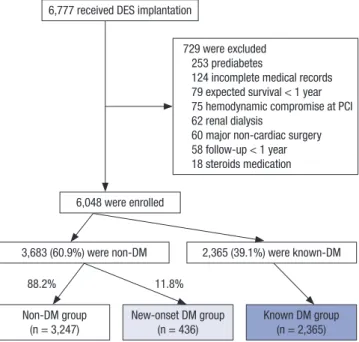
Fig. 1. Patients flow.
DES = drug-eluting stent, PCI = percutaneous coronary intervention, DM = diabetes mellitus.
6,777 received DES implantation
6,048 were enrolled
3,683 (60.9%) were non-DM 2,365 (39.1%) were known-DM 729 were excluded
253 prediabetes
124 incomplete medical records 79 expected survival < 1 year 75 hemodynamic compromise at PCI 62 renal dialysis
60 major non-cardiac surgery 58 follow-up < 1 year 18 steroids medication
Non-DM group
(n = 3,247) New-onset DM group
(n = 436) Known DM group
(n = 2,365)
88.2% 11.8%
riod, 436 (11.8%) of the 3,683 non-DM patients were newly di- agnosed with DM at 3.4 ± 1.9 years after DES implantation and subsequently included in the new-onset DM group. The remain- ing 3,247 patients were assigned to the non-DM group. Fig. 1 shows patients flow. Baseline characteristics of these 3 groups (non-DM, new-onset DM, and known DM) are shown in Table 1. Compared with the non-DM group, the new-onset DM group had higher body mass index (BMI), higher serum triglycerides or fasting glucose level, and higher frequency of high-intensity statin therapy. In addition, compared to the known DM group, the new-onset DM group was younger, had higher BMI, higher ejection fraction, higher serum low-density lipoprotein choles- terol level, lower serum fasting glucose or creatinine level, lower frequencies of hypertension or multi-vessel disease, and higher frequency of high-intensity statin therapy.
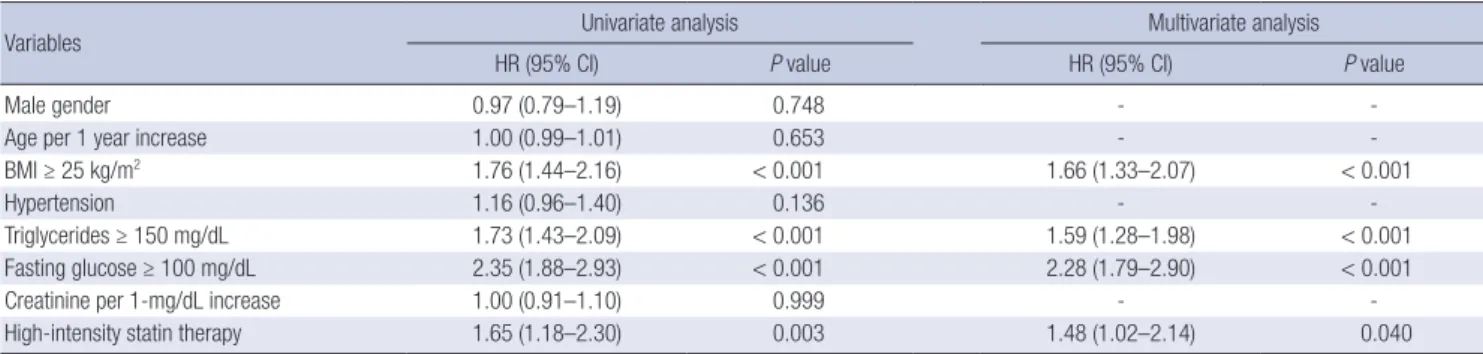
Predictors of new-onset DM were determined based on data from patients without DM at index procedure (n = 3,683 exclud- ing 2,365 known DM patients). As shown in Table 2, univariate analysis revealed that high BMI, high serum triglycerides level, high serum fasting glucose level, and high-intensity statin ther- apy were associated with an increased risk of new-onset DM. In the multivariate analysis, all of these variables were also shown to be independent predictors of new-onset DM.
Mean follow-up duration in this study was 4.0 ± 2.1 years in overall patients. The risks (hazard ratio [HR]) for clinical events during the follow-up period after DES implantation were calcu-
lated between the groups using the Cox proportional regression analysis (Table 3). Two separate analyses were performed be- tween new-onset DM group vs. non-DM group and new-onset DM group vs. known DM group. Compared to the non-DM group, the new-onset DM group showed similar risks for an individual cardiovascular event and MACE. However, when compared to the known DM group, the new-onset DM group showed lower risk for MI, any revascularization, and MACE. After being ad- justed with various clinical and procedural characteristics, the new-onset DM group still showed lower risk for MACE, com- pared to the known DM group (HR, 0.71; 95% confidence inter- val [CI], 0.51–0.99, P = 0.045). Fig. 2 shows the cumulative rate of MACE in the 3 groups by the Kaplan-Meier method. The 8-year cumulative rate of MACE was 19.5% in the new-onset DM group, which was similar to the cumulative rate (20.5%) in the non-DM group (P = 0.467), but lower than the rate (25.0%) in the known DM group (P = 0.003).
DISCUSSION
The main findings of the present study are as follows: 1) in non- DM patients, the incidence of new-onset DM was 11.8% during the follow-up period after DES implantation; 2) the predictors of new-onset DM after DES implantation include high-intensity statin therapy, high BMI, and high level of fasting triglycerides and glucose; and 3) patients with new-onset DM after DES im- plantation showed similar clinical outcomes compared to non- DM patients, and better clinical outcomes compared with known DM patients. Although evidence from multiple studies have in- dicated that DM is a strong risk factor for coronary artery dis- ease and DM patients show worse clinical outcomes after PCI, the data regarding new-onset DM after DES implantation has been limited. Results from this study provide new data on the incidence, predictors, and clinical outcomes of new-onset DM in DES-treated patients in real-world clinical practice.
In previous statin trials involving patients with stable coro- nary artery disease or stroke/transient ischemic attack, the inci- Table 2. Univariate and multivariate analysis of predictors for new-onset DM
Variables Univariate analysis Multivariate analysis
HR (95% CI) P value HR (95% CI) P value
Male gender 0.97 (0.79–1.19) 0.748 - -
Age per 1 year increase 1.00 (0.99–1.01) 0.653 - -
BMI ≥ 25 kg/m2 1.76 (1.44–2.16) < 0.001 1.66 (1.33–2.07) < 0.001
Hypertension 1.16 (0.96–1.40) 0.136 - -
Triglycerides ≥ 150 mg/dL 1.73 (1.43–2.09) < 0.001 1.59 (1.28–1.98) < 0.001
Fasting glucose ≥ 100 mg/dL 2.35 (1.88–2.93) < 0.001 2.28 (1.79–2.90) < 0.001
Creatinine per 1-mg/dL increase 1.00 (0.91–1.10) 0.999 - -
High-intensity statin therapy 1.65 (1.18–2.30) 0.003 1.48 (1.02–2.14) 0.040
HR = hazard ratio, CI = confidence interval, BMI = body mass index.
Table 3. Cardiovascular event rate and HR according to diabetic status and comparison with new-onset DM*
Total (n = 6,048) Non-DM(1) (n = 3,247)
New-onset DM(2) (n = 436)
Known DM(3) (n = 2,365)
HR (95% CI) P value Adjusted HR† (95% CI) P value (1) vs. (2)
(2) vs. (3)
(1) vs. (2) (2) vs. (3)
(1) vs. (2) (2) vs. (3)
(1) vs. (2) (2) vs. (3)
Mean follow-up duration, yr 4.0 ± 2.1 4.0 ± 1.8 3.9 ± 2.1 - - - 0.539
0.454
Cardiovascular death 12 (0.5) 2 (0.8) 25 (1.6) 1.01 (0.22–4.50) 0.995 1.72 (0.35–8.54) 0.505
0.34 (0.08–1.43) 0.139 0.65 (0.14–2.92) 0.572
MI 37 (2.7) 2 (0.5) 37 (3.2) 0.31 (0.07–1.27) 0.103 0.37 (0.09–1.55) 0.171
0.22 (0.05–0.91) 0.037 0.32 (0.08–1.37) 0.124
Stent thrombosis 18 (0.9) 2 (0.5) 5 (0.5) 0.67 (0.15–2.87) 0.585 0.74 (0.17–3.27) 0.688
1.65 (0.32–8.55) 0.552 2.05 (0.34–12.45) 0.438
Any revascularization 343 (18.9) 53 (19.0) 320 (23.7) 0.93 (0.70–1.25) 0.645 0.89 (0.63–1.25) 0.498
0.69 (0.51–0.92) 0.012 0.74 (0.53–1.03) 0.072
MACE 361 (20.5) 54 (19.5) 344 (25.0) 0.90 (0.68–1.20) 0.467 0.88 (0.63–1.24) 0.471
0.65 (0.49–0.87) 0.003 0.71 (0.51–0.99) 0.045
MACE was a composite of cardiovascular death, MI, stent thrombosis, or any revascularization.
HR = hazard ratio, DM = diabetes mellitus, CI = confidence interval, MI = myocardial infarction, MACE = major adverse cardiac event, BMI = body mass index.
*Data are expressed as number of patients (8-year cumulative event rates). †Adjusted with gender, age, BMI, hypertension, triglycerides level, creatinine level, ejection fraction, acute coronary syndrome, multivessel disease, stent number, stent diameter, and total stent length.
dence of new-onset DM was 6.1%–9.2% (14,15). Furthermore, in patients without coronary artery disease, the incidence of new-onset DM was as low as 2.3%–3.0% (16,17). In the present study, the incidence of new-onset DM was 11.8% in patients with DES implantation. Compared to previous studies, the high- er incidence of new-onset DM in this study may be explained that the present study exclusively enrolled patients with severe coronary artery disease, which is sufficient to require DES im- plantation. Of course, these patients may have higher frequen- cies of obesity, hypertension, and abnormal serum glucose or lipid profile, all of which are well-known predisposing factors of DM as well as coronary artery disease (7).
Similar to results from previous studies (18), identified pre- dictors of new-onset DM in this study included high BMI, high serum triglycerides, or high fasting glucose level. These factors are the main components of metabolic syndrome (19) with in- sulin resistance and endothelial dysfunction, which are the pre- cursors of DM (7,20,21). Also, high-intensity statin therapy was identified as a predictor of new-onset DM after DES implanta- tion. Statins have been widely used for the primary and second- ary prevention of cardiovascular diseases and play a major role in preventing the long-term vascular events in patients with DM (22). However, there have been several reports that statins may have diabetogenic potential (8,16,18). According to the meta-analysis, this adverse effect is statin dose-dependent (23).
Several possible mechanisms for the diabetogenic potential of
statins have been suggested, including the finding that statins have been shown to inhibit glucose-induced Ca2+ signaling and insulin secretion by blocking Ca2+ channels in β-cells (24). In clinical practice, the majority of DES-treated patients received statin therapy for the secondary prevention of adverse cardio- vascular events. In the present study, almost all (96%) study pa- tients received statin therapy after DES implantation and 7%
were prescribed high-intensity statin therapy. The current guide- lines recommend high-intensity statin therapy in high-risk pa- tients because more intensive statin therapy more effectively decreases cardiovascular events (14). However, when prescrib- ing high-intensity statin therapy to non-DM patients after DES implantation, watchful follow-up for occurrence of new-onset DM may be warranted, especially in patients with some traits of metabolic syndrome such as high BMI, serum triglycerides, or fasting glucose level.
In the current era of DES, data for long-term clinical outcomes of new-onset DM in patients who underwent DES implantation are limited. In the present study, patients with new-onset DM after DES implantation showed similar clinical outcomes com- pared to non-DM patients, and better clinical outcomes com- pared with known DM patients. When compared to the known DM group, the new-onset DM group had a lower risk of MI, any revascularization, and MACE. Of note, new-onset DM may have negative effects on patient outcomes in the future. However, as shown in the present study, the 8-year cumulative rate of MACE in the new-onset DM group was not inferior to that in the non- DM group. Although not presented in the Results section, the 8-year cumulative rate of MACE in patients with prediabetes (n = 253, who were excluded from this study) was 18.4%, which was also similar with the rate of MACE in the new-onset DM group (P = 0.417). Taking all the results of the present study into consideration, physicians should keep patients with severe cor- onary artery disease requiring DES implantation under con- stant vigilance, particularly if patients have features of metabol- ic syndrome. However, physicians should not hesitate to pre- scribe high-intensity statins on account of their potential diabe- togenic effects, because of the high benefits that statins have on the outcomes of cardiovascular disease by modifying metabolic derangement. Based on results from a previous primary preven- tion study, the cardiovascular and mortality benefits of statin therapy exceed the risks from new-onset DM (25). Therefore, even though patients may be diagnosed with new-onset DM after DES implantation, we expect that their clinical outcomes may not be worse compared to those of non-DM patients, and may even be better than those of known DM patients.
This study had several limitations. First, this analysis was a retrospective study. Second, fasting plasma glucose and HbA1C
levels were the only serologic markers used to assess DM status.
If regular check-ups with an oral glucose tolerance test were per- formed during the follow-up period, the number of patients di- Fig. 2. Kaplan-Meier survival curves for MACEs. Estimated 8-year cumulative rates
of MACEs (composite of cardiovascular death, MI, stent thrombosis, or any revascu- larization) were 19.5% in the new-onset DM group, 20.5% in the non-DM group, and 25.0% in the known DM group.
MACE = Major adverse cardiac event, MI = myocardial infarction, DM = diabetes mellitus.
Cumulative rate of events, %
Years after the index procedure No. at risk
Known DM Non-DM New-onset DM
2,365 2,244 2,163 2,114 2,075 2,045 2,032 2,024 2,021 3,247 3,118 3,023 2,973 2,946 2,921 2,904 2,894 2,886 436 418 407 399 395 388 386 385 382 0 1 2 3 4 5 6 7 8 40
30
20
10
0
Known DM Non-DM New-onset DM
Non-DM vs. new-onset DM: P = 0.467 by log rank Known-DM vs. new-onset DM: P = 0.003 by log rank
25.0%
19.5%
20.5%
Major adverse cardiac events
agnosed with new-onset DM may have differed. Third, although a second laboratory test was recommended for the confirma- tion if the patient without previous history of DM showed ab- normal laboratory findings suggestive of DM, not all patients underwent the second test. Fourth, we could not collect data on some markers of metabolic syndrome including abdominal circumstance. Fifth, patients’ vital status was not validated us- ing the national data.
In conclusion, the incidence of new-onset DM was 11.8% in non-DM patients during the follow-up period after DES implan- tation. Predictors of new-onset DM after DES implantation in- cluded high-intensity statin therapy, high BMI, and high serum triglycerides or fasting glucose level. Patients with new-onset DM after DES implantation showed similar clinical outcomes compared to non-DM patients, and better clinical outcomes compared with known DM patients.
DISCLOSURE
The authors have no potential conflicts of interest to disclose.
AUTHOR CONTRIBUTION
Conceptualization: Jang Y, Hong MK. Data curation: Kim BK, Shin DH, Kim JS, Ko YG. Formal analysis: Kim BK, Kim JS, Ko YG. Funding acquisition: Hong MK. Investigation: Chun KH, Im E, Shin DH. Writing - original draft: Chun KH, Im E. Writing - review & editing: Choi D, Jang Y, Hong MK.
ORCID
Kyeong-Hyeon Chun https://orcid.org/0000-0002-7798-658X Eui Im https://orcid.org/0000-0002-5333-7593
Byeong-Keuk Kim https://orcid.org/0000-0003-2493-066X Dong-Ho Shin https://orcid.org/0000-0002-7874-5542 Jung-Sun Kim https://orcid.org/0000-0003-2263-3274 Young-Guk Ko https://orcid.org/0000-0001-7748-5788 Donghoon Choi https://orcid.org/0000-0002-2009-9760 Yangsoo Jang https://orcid.org/0000-0002-2169-3112 Myeong-Ki Hong https://orcid.org/0000-0002-2090-2031
REFERENCES
1. Hammoud T, Tanguay JF, Bourassa MG. Management of coronary artery disease: therapeutic options in patients with diabetes. J Am Coll Cardiol 2000; 36: 355-65.
2. Grundy SM, Benjamin IJ, Burke GL, Chait A, Eckel RH, Howard BV, Mitch W, Smith SC Jr, Sowers JR. Diabetes and cardiovascular disease: a state- ment for healthcare professionals from the American Heart Association.
Circulation 1999; 100: 1134-46.
3. Folsom AR, Szklo M, Stevens J, Liao F, Smith R, Eckfeldt JH. A prospective study of coronary heart disease in relation to fasting insulin, glucose, and
diabetes. The Atherosclerosis Risk in Communities (ARIC) Study. Diabe- tes Care 1997; 20: 935-42.
4. Becker A, Bos G, de Vegt F, Kostense PJ, Dekker JM, Nijpels G, Heine RJ, Bouter LM, Stehouwer CD. Cardiovascular events in type 2 diabetes: com- parison with nondiabetic individuals without and with prior cardiovas- cular disease. 10-year follow-up of the Hoorn Study. Eur Heart J 2003; 24:
1406-13.
5. Stone GW, Witzenbichler B, Weisz G, Rinaldi MJ, Neumann FJ, Metzger DC, Henry TD, Cox DA, Duffy PL, Mazzaferri E, Gurbel PA, Xu K, Parise H, Kirtane AJ, Brodie BR, Mehran R, Stuckey TD; ADAPT-DES Investiga- tors. Platelet reactivity and clinical outcomes after coronary artery im- plantation of drug-eluting stents (ADAPT-DES): a prospective multicen- tre registry study. Lancet 2013; 382: 614-23.
6. Barsness GW, Peterson ED, Ohman EM, Nelson CL, DeLong ER, Reves JG, Smith PK, Anderson RD, Jones RH, Mark DB, Califf RM. Relationship between diabetes mellitus and long-term survival after coronary bypass and angioplasty. Circulation 1997; 96: 2551-6.
7. Grundy SM. Obesity, metabolic syndrome, and coronary atherosclerosis.
Circulation 2002; 105: 2696-8.
8. Sattar N, Preiss D, Murray HM, Welsh P, Buckley BM, de Craen AJ, Sesha- sai SR, McMurray JJ, Freeman DJ, Jukema JW, Macfarlane PW, Packard CJ, Stott DJ, Westendorp RG, Shepherd J, Davis BR, Pressel SL, Marchioli R, Marfisi RM, Maggioni AP, Tavazzi L, Tognoni G, Kjekshus J, Pedersen TR, Cook TJ, Gotto AM, Clearfield MB, Downs JR, Nakamura H, Ohashi Y, Mizuno K, Ray KK, Ford I. Statins and risk of incident diabetes: a collab- orative meta-analysis of randomised statin trials. Lancet 2010; 375: 735- 42.
9. Kim S, Yun KH, Kang WC, Shin DH, Kim JS, Kim BK, Ko YG, Choi D, Jang Y, Hong MK. Comparison of full lesion coverage versus spot drug-eluting stent implantation for coronary artery stenoses. Yonsei Med J 2014; 55:
584-91.
10. Stone NJ, Robinson JG, Lichtenstein AH, Bairey Merz CN, Blum CB, Eckel RH, Goldberg AC, Gordon D, Levy D, Lloyd-Jones DM, McBride P, Schwartz JS, Shero ST, Smith SC Jr, Watson K, Wilson PW, Eddleman KM, Jarrett NM, LaBresh K, Nevo L, Wnek J, Anderson JL, Halperin JL, Albert NM, Bozkurt B, Brindis RG, Curtis LH, DeMets D, Hochman JS, Kovacs RJ, Ohman EM, Pressler SJ, Sellke FW, Shen WK, Smith SC Jr, Tomaselli GF; American Col- lege of Cardiology/American Heart Association Task Force on Practice Guidelines. 2013 ACC/AHA guideline on the treatment of blood choles- terol to reduce atherosclerotic cardiovascular risk in adults: a report of the American College of Cardiology/American Heart Association Task Force on Practice Guidelines. Circulation 2014; 129: S1-45.
11. American Diabetes Association. Standards of medical care in diabetes-- 2011. Diabetes Care 2011; 34 Suppl 1: S11-61.
12. Cutlip DE, Windecker S, Mehran R, Boam A, Cohen DJ, van Es GA, Steg PG, Morel MA, Mauri L, Vranckx P, McFadden E, Lansky A, Hamon M, Krucoff MW, Serruys PW; Academic Research Consortium. Clinical end points in coronary stent trials: a case for standardized definitions. Circu- lation 2007; 115: 2344-51.
13. Thygesen K, Alpert JS, Jaffe AS, Simoons ML, Chaitman BR, White HD, Katus HA, Lindahl B, Morrow DA, Clemmensen PM, Johanson P, Hod H, Underwood R, Bax JJ, Bonow RO, Pinto F, Gibbons RJ, Fox KA, Atar D, New- by LK, Galvani M, Hamm CW, Uretsky BF, Steg PG, Wijns W, Bassand JP, Menasché P, Ravkilde J, Ohman EM, Antman EM, Wallentin LC, Armstrong PW, Simoons ML, Januzzi JL, Nieminen MS, Gheorghiade M, Filippatos
G, Luepker RV, Fortmann SP, Rosamond WD, Levy D, Wood D, Smith SC, Hu D, Lopez-Sendon JL, Robertson RM, Weaver D, Tendera M, Bove AA, Parkhomenko AN, Vasilieva EJ, Mendis S; Joint ESC/ACCF/AHA/WHF Task Force for the Universal Definition of Myocardial Infarction. Third universal definition of myocardial infarction. Circulation 2012; 126: 2020- 35.
14. LaRosa JC, Grundy SM, Waters DD, Shear C, Barter P, Fruchart JC, Gotto AM, Greten H, Kastelein JJ, Shepherd J, Wenger NK; Treating to New Tar- gets (TNT) Investigators. Intensive lipid lowering with atorvastatin in pa- tients with stable coronary disease. N Engl J Med 2005; 352: 1425-35.
15. Amarenco P, Bogousslavsky J, Callahan A 3rd, Goldstein LB, Hennerici M, Rudolph AE, Sillesen H, Simunovic L, Szarek M, Welch KM, Zivin JA; Stroke Prevention by Aggressive Reduction in Cholesterol Levels (SPARCL) In- vestigators. High-dose atorvastatin after stroke or transient ischemic at- tack. N Engl J Med 2006; 355: 549-59.
16. Ridker PM, Danielson E, Fonseca FA, Genest J, Gotto AM Jr, Kastelein JJ, Koenig W, Libby P, Lorenzatti AJ, MacFadyen JG, Nordestgaard BG, Shep- herd J, Willerson JT, Glynn RJ; JUPITER Study Group. Rosuvastatin to pre- vent vascular events in men and women with elevated C-reactive protein.
N Engl J Med 2008; 359: 2195-207.
17. Downs JR, Clearfield M, Weis S, Whitney E, Shapiro DR, Beere PA, Lan- gendorfer A, Stein EA, Kruyer W, Gotto AM Jr. Primary prevention of acute coronary events with lovastatin in men and women with average choles- terol levels: results of AFCAPS/TexCAPS. Air Force/Texas Coronary Ath- erosclerosis Prevention Study. JAMA 1998; 279: 1615-22.
18. Waters DD, Ho JE, DeMicco DA, Breazna A, Arsenault BJ, Wun CC, Kast- elein JJ, Colhoun H, Barter P. Predictors of new-onset diabetes in patients treated with atorvastatin: results from 3 large randomized clinical trials. J Am Coll Cardiol 2011; 57: 1535-45.
19. Grundy SM, Cleeman JI, Daniels SR, Donato KA, Eckel RH, Franklin BA, Gordon DJ, Krauss RM, Savage PJ, Smith SC Jr, Spertus JA, Costa F; Amer- ican Heart Association; National Heart, Lung, and Blood Institute. Diag-
nosis and management of the metabolic syndrome: an American Heart Association/National Heart, Lung, and Blood Institute Scientific State- ment. Circulation 2005; 112: 2735-52.
20. Nesto RW. Correlation between cardiovascular disease and diabetes mel- litus: current concepts. Am J Med 2004; 116 Suppl 5A: 11S-22S.
21. Alberti KG, Eckel RH, Grundy SM, Zimmet PZ, Cleeman JI, Donato KA, Fruchart JC, James WP, Loria CM, Smith SC Jr; International Diabetes Fed- eration Task Force on Epidemiology and Prevention; Hational Heart, Lung, and Blood Institute; American Heart Association; World Heart Federa- tion; International Atherosclerosis Society; International Association for the Study of Obesity. Harmonizing the metabolic syndrome: a joint inter- im statement of the International Diabetes Federation Task Force on Epi- demiology and Prevention; National Heart, Lung, and Blood Institute;
American Heart Association; World Heart Federation; International Ath- erosclerosis Society; and International Association for the Study of Obe- sity. Circulation 2009; 120: 1640-5.
22. Collins R, Armitage J, Parish S, Sleigh P, Peto R; Heart Protection Study Collaborative Group. MRC/BHF Heart Protection Study of cholesterol- lowering with simvastatin in 5963 people with diabetes: a randomised placebo-controlled trial. Lancet 2003; 361: 2005-16.
23. Preiss D, Seshasai SR, Welsh P, Murphy SA, Ho JE, Waters DD, DeMicco DA, Barter P, Cannon CP, Sabatine MS, Braunwald E, Kastelein JJ, de Lemos JA, Blazing MA, Pedersen TR, Tikkanen MJ, Sattar N, Ray KK. Risk of inci- dent diabetes with intensive-dose compared with moderate-dose statin therapy: a meta-analysis. JAMA 2011; 305: 2556-64.
24. Xia F, Xie L, Mihic A, Gao X, Chen Y, Gaisano HY, Tsushima RG. Inhibition of cholesterol biosynthesis impairs insulin secretion and voltage-gated calcium channel function in pancreatic beta-cells. Endocrinology 2008;
149: 5136-45.
25. Ridker PM, Pradhan A, MacFadyen JG, Libby P, Glynn RJ. Cardiovascular benefits and diabetes risks of statin therapy in primary prevention: an analysis from the JUPITER trial. Lancet 2012; 380: 565-71.