• 검색 결과가 없습니다.

Intravascular Ultrasound-Guided Percutaneous Coronary Intervention Improves the Clinical Outcome in Patients Undergoing Multiple Overlapping Drug-Eluting Stents Implantation

N/A
N/A
Protected

Academic year: 2022

Share "Intravascular Ultrasound-Guided Percutaneous Coronary Intervention Improves the Clinical Outcome in Patients Undergoing Multiple Overlapping Drug-Eluting Stents Implantation"

Copied!
8
0
0

로드 중.... (전체 텍스트 보기)

전체 글

(1)

Korean Circulation Journal

Introduction

The use of drug-eluting stents (DES) has been rapidly increasing in the treatment of coronary artery disease, as the superiority of DES

Print ISSN 1738-5520 • On-line ISSN 1738-5555

Intravascular Ultrasound-Guided Percutaneous Coronary Intervention Improves the Clinical Outcome in Patients Undergoing Multiple

Overlapping Drug-Eluting Stents Implantation

Sung Gyun Ahn, MD, Junghan Yoon, MD, Joong Kyung Sung, MD, Ji-Hyun Lee, MD, Jun-Won Lee, MD, Young-Jin Youn, MD, Min-Soo Ahn, MD, Jang-Young Kim, MD, Byung-Su Yoo, MD,

Seung-Hwan Lee, MD, and Kyung-Hoon Choe, MD

Division of Cardiology, Wonju College of Medicine, Yonsei University, Wonju, Korea

Background and Objectives: Stented segment length is a predictive factor for restenosis and stent thrombosis still in the drug-eluting stent (DES) era, and the benefit of routine intravascular ultrasound (IVUS) is still unclear. The aim of the present study was to investigate whether IVUS-guided percutaneous coronary intervention (PCI) improved the vascular outcomes as compared with conventional PCI in the treatment of diffuse coronary artery disease.

Subjects and Methods: From our registry database from January 2006 to May 2009, we identified 85 consecutive patients with de novo coronary lesions treated with at least 64 mm of multiple, overlapping DES. The 2-year rate of major adverse cardiovascular events (MACE), defined as the composite of cardiovascular death, non-fatal myocardial infarction, target lesion revascularization (TLR), or stent thrombo- sis, was compared according to the use of IVUS.

Results: The 2-year MACE rate was lower in the IVUS-guided group than that of the angiography-guided group (8% vs. 33.3%, p=0.005).

The incidence of TLR was lower in patients with IVUS use than in those without IVUS use (0% vs. 27.8%, p<0.001). On Cox proportional hazard analysis, no IVUS use {hazard ratio (HR) 5.917, 95% confidence interval (CI) 1.037-33.770, p=0.045} and age (HR 1.097, 95% CI 1.006-1.138, p=0.032) were unfavorable predictors for the 2-year MACE.

Conclusion: The use of IVUS may improve the effectiveness and safety of multiple overlapping drug-eluting stenting for long, diffuse coronary lesions. (Korean Circ J 2013;43:231-238)

KEY WORDS: Intravascular ultrasonography; Coronary stenosis; Drug-eluting stents; Percutaneous coronary intervention; Thrombosis.

Received: September 18, 2012 Revision Received: November 14, 2012 Accepted: December 10, 2012

Correspondence: Junghan Yoon, MD, Division of Cardiology, Wonju Col- lege of Medicine, Yonsei University, 20 Ilsan-ro, Wonju 220-701, Korea Tel: 82-33-741-0917, Fax: 82-33-741-1219

E-mail: [email protected]

• The authors have no financial conflicts of interest.

This is an Open Access article distributed under the terms of the Creative Commons Attribution Non-Commercial License (http://creativecommons.

org/licenses/by-nc/3.0) which permits unrestricted non-commercial use, distribution, and reproduction in any medium, provided the original work is properly cited.

over bare metal stents has been proven for the reduction of in-stent restenosis.

1)2)

It is reported that DES also seem to be safe and effec- tive in multiple overlapping stenting for diffuse coronary lesions.

3)4)

Even in the DES era, however, stented length is an unfavorable pre- dictor for in-stent restenosis

5)6)

and stent thrombosis.

7)

The use of intravascular ultrasound (IVUS) has become popular for percutaneous coronary intervention (PCI), as it provides additional information in comparison to coronary angiography regarding the vessel size and lesion length, the degree of calcium in a plaque, the stability of the atheroma plate, stent expansion, stent-vessel appo- sition, and stent-related complications such as edge dissections.

8)

It remains unclear whether the strategy of IVUS-guided PCI leads to better clinical outcomes in patients with coronary artery disease un- dergoing DES implantation, especially for the high-risk subsets of coronary artery disease.

9-13)

It is hypothesized that stent optimization using IVUS may improve

(2)

clinical outcomes in patients with diffuse coronary lesions under- going metal jacket stenting. The aim of the present study was to compare the vascular and clinical outcomes of IVUS-guided PCI to those of conventional PCI in the treatment of diffuse coronary ar- tery disease, using multiple overlapping DES.

Subjects and Methods

Study population

Clinical, laboratory, and angiographic data were collected conse- cutively and prospectively in 2920 subjects who had undergone PCI with DES for de novo coronary artery stenosis at the Wonju Chris- tian Hospital between January 1, 2006 and May 30, 2009. Twenty- nine patients expired during the procedure or the hospital stay. The patients presenting with ST-segment elevation myocardial infarc- tion (MI) and who had coronary lesions involving left main vessel or bifurcation lesions requiring two stents were excluded from the stu- dy. Other exclusion criteria were: severe left ventricular dysfunction (ejection fraction <30%), cardiogenic shock, neoplastic disease, pl- atelet count <150000/mL, and hemoglobin <10 g/L. Thus, the total study cohort included 85 consecutive patients with de novo coro- nary lesions treated with at least 64 mm of multiple overlapping DES.

IVUS was not used for 36 patients who underwent stenting from Ja- nuary 1, 2006 to December 30, 2007. From January 1, 2008, IVUS was routinely performed at pre-intervention and/or post-intervention. Tr- eatment by IVUS guidance was performed in 49 patients who un- derwent stenting from January 1, 2008 to May 30, 2009. A proce- dure was considered IVUS-guided when IVUS examinations were done during PCI for optimal stent implantation. Pre-PCI IVUS exami- nation was done in 41 patients (83.7%) of the IVUS-guided group to evaluate the characterization of plaque and to estimate the refer- ence diameter or the length of the lesion. Post-PCI IVUS examination was performed in all patients of the IVUS-guided group to detect suboptimal stent deployment, such as stent malapposition, stent underexpansion, and edge dissection. All patients gave written con- sent for the PCI procedure, and the study was conducted under the local Institutional Review Board approval.

Antithrombotic regimen

All patients received 300 mg of aspirin and at least 300-600 mg of clopidogrel before arriving to the catheterization room. A bolus of unfractionated heparin (70 U/kg) was administered immediately be- fore coronary angiography through the introducer sheath. A second bolus of unfractionated heparin (70 U/kg) was delivered just prior to the PCI, and the additional heparin was administered to achieve an activated clotting time of 250-300 seconds. Aspirin and clopido- grel were required at a dose of 100 mg and 75 mg daily, respectively,

for 1 year after PCI, followed by aspirin 100 mg indefinitely there- after. The use of glycoprotein IIb/IIIa inhibitor and cilostazol in addi- tion to the dual antiplatelet therapy were at the discretion of the primary physician.

Procedures

PCI was performed using balloon predilatation, followed by DES deployment via transradial or transfemoral arteries. Four types of DES were implanted as follows: 1) sirolimus-eluting stents (SES, Cypher, Cordis, Johnson & Johnson, Miami Lakes, FL, USA); 2) paclitaxel-elut- ing stents (PES, Taxus, Boston Scientific, MA, USA); 3) everolimus- eluting stents (EES, Xience V, Abbot Vascular, IL, USA); and 4) zotaro- limus-eluting stents (ZES, Endeavor, Medtronic, Minneapolis, MN, USA). The choice regarding the specific type of DES was left to the operator’s discretion. Procedural success was defined as a final diam- eter stenosis of <30% by quantitative coronary angiography (QCA) with normal flow. Adjuvant balloon dilation after stenting was per- formed in the following: if post-procedural angiography of the in- volved vessel showed a percent diameter stenosis ≥30%; if there was stent under-expansion defined as <5.0 mm

2

of minimum stent area; or with malapposition on IVUS.

One of the two commercially available systems was used: iLAB (Boston Scientific Corp/SCIMED, Minneapolis, MN, USA); or Eagle Eye (Volcano Therapeutics Inc., Rancho Cordova, CA, USA). A dose of 100- 200 µg of nitroglycerin was administered through the guiding cath- eter before IVUS examination. The IVUS catheter was positioned at more than 10 mm beyond the lesion/stent and was pulled back to a point more than 10 mm proximally to the lesion/stent using an au- tomatic transducer pullback device at the speed of 0.5 mm/s or 1 mm/s. IVUS images were interpreted by the operator and at least one experienced IVUS technician. The treating physician decided if any additional treatment after IVUS examination was necessary.

All data concerning QCA parameters were measured and analyz- ed off-line using a primary diagnostic image review and analysis wo- rkstation (Centricity CA1000, GE Healthcare, United Kingdom) by a technician who was incognizant of the clinical information.

Clinical endpoints and data collection

The patients presented to follow-up at 1, 3, and 6 months, 1 year,

and then yearly after the index procedure. Follow-up coronary angi-

ography was not mandatory but recommended. The primary end

point was the 2-year incidence of major adverse cardiovascular ev-

ents (MACE) defined as the composite of death from cardiovascular

(CV) causes, non-fatal MI, ischemia-driven target lesion revascula-

rization (TLR), and stent thrombosis. All deaths were considered CV

unless an unequivocal non-CV cause could be confirmed. The MI was

defined according to the American College of Cardiology criteria as

(3)

a rise in serum troponin I or an increase in creatine kinase-MB iso- enzyme level of at least twice the upper normal limits, with at least one of the following: acute onset of prolonged (at least 20 minutes) typical ischemic chest pain; ST-segment elevation of at least 1 mm in two or more contiguous electrocardiography leads or ST-segment depression of at least 0.5 mm in at least two contiguous leads; and T-wave inversion more than 1 mm in leads with predominant R wa- ves.

14)

Stent thrombosis was defined as definite or probable accord- ing to the Academic Research Consortium definitions.

15)

A revascularization was considered ischemia-driven if angiogra- phy at follow-up showed a percent diameter stenosis ≥50% and if one of the following occurred: 1) a positive history of recurrent an- gina pectoris, presumably related to the target vessel; 2) objective signs of ischemia at rest or during exercise test, presumably related to the target vessel; 3) abnormal results of any invasive functional di- agnostic test.

15)

Statistical analysis

All continuous variables are presented as means±(SD) or the me- dians plus the range and the categorical variables as frequencies (per- centage). Continuous variables were compared using the Student’s t-test. The chi-square test was used for categorical variables, and Fi- sher’s exact test was used when any expected cell count was lower than 5.

Major adverse cardiovascular event free survival curves for pa- tients with and without the use of IVUS were generated by the Ka- plan-Meier method and compared by the log-rank test. Predictors of clinical outcomes were identified using multivariate Cox regression models, including factors demonstrated on univariate analysis to predict the frequency of the event outcome at a significance level of p<0.1 and parameters associated with the event outcome from the previous studies (age, diabetes, chronic kidney disease, duration of dual anti-platelet therapy, acute MI, reduced left ventricular ejection fraction, multi-vessel PCI, total stent length, the use of SES or PES, and the use of IVUS). Significance level was defined as p<0.05. All analyses were performed with Statistical Package for the Social Sci- ences (SPSS) 18.0 (SPSS Inc., Chicago, IL, USA).

Results

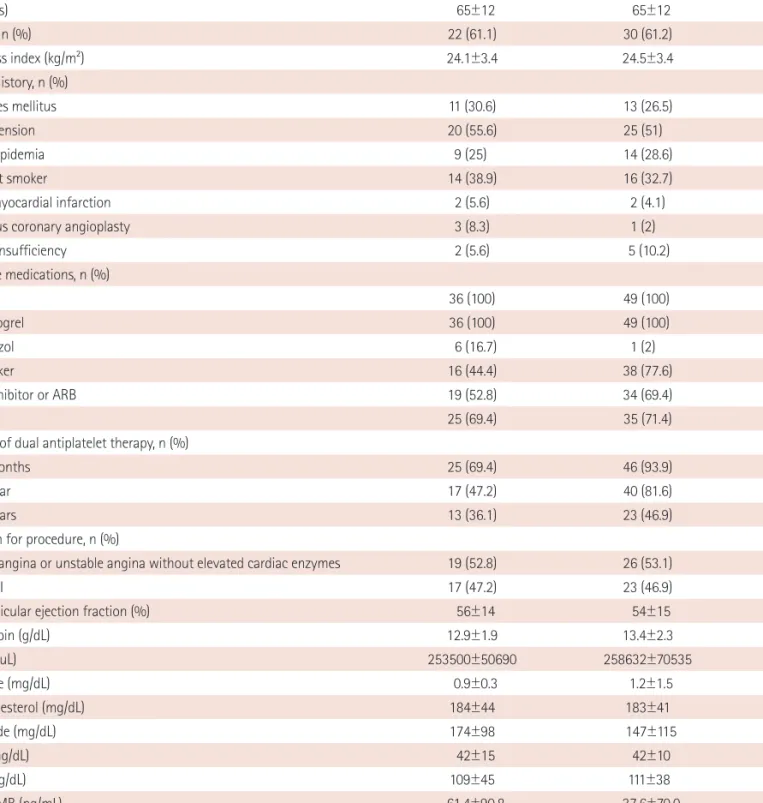
Baseline clinical and laboratory characteristics on the basis of the use of IVUS are presented in Table 1. Treatment using DES under IVUS guidance was performed on 49 patients (57.6%), whereas 36 pa- tients (42.4%) were treated without IVUS use. Both groups were ba- lanced in mean age, history of diabetes mellitus, hypertension, hy- perlipidemia, current smoking status, prior MI, and chronic kidney disease. The distribution of discharge medication use between the

two groups was relatively similar, except for cilostazol (Pletaal, Ot- suka Pharmaceutical, Tokyo, Japan) and β-blockers. Cilostazol was taken more frequently and β-blockers less frequently by patients without the use of IVUS (16.7% vs. 2%, p=0.038 for cilostazol, 44.4%

vs. 77.6% for β-blockers, p=0.002). At 1-year follow-up, the patients with IVUS use had a better adherence to dual antiplatelet therapy than those without IVUS use (81.6% vs. 47.2%, p=0.002). The indi- cation for PCI, the left ventricular ejection fraction, the level of B- type natriuretic peptide, and peak cardiac isoenzymes were not dif- ferent between the two groups.

Quantitative coronary angiography and percutaneous coronary intervention data

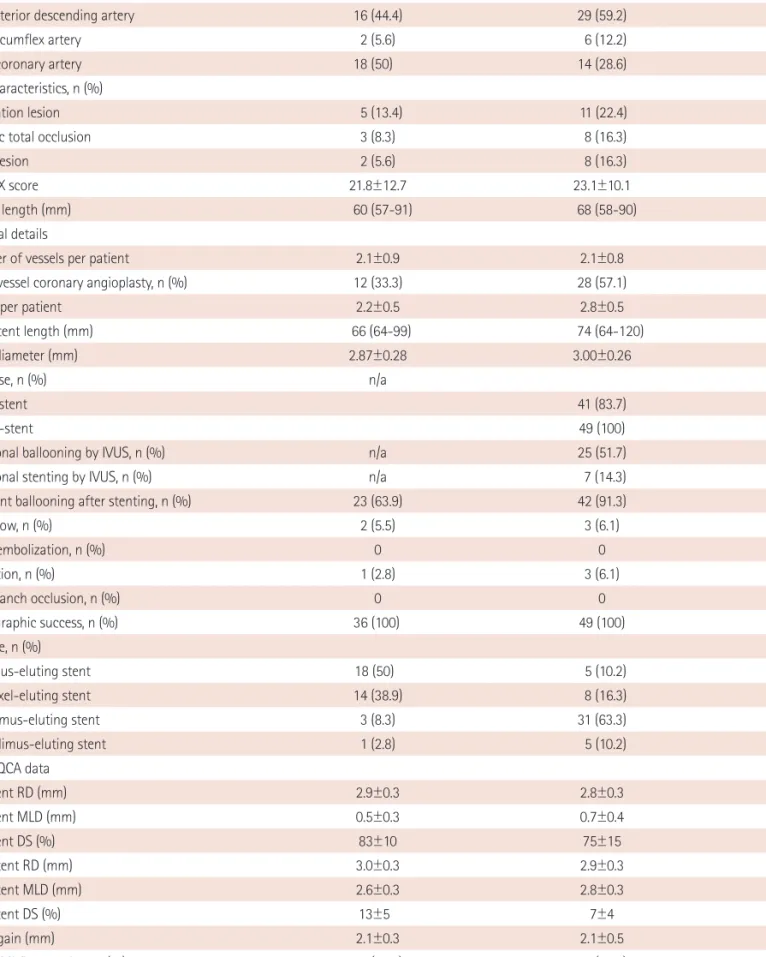
Table 2 depicts QCA and PCI data. Approximately 50% of the pa- tients underwent PCI for coronary lesion in the left anterior de- scending artery. All lesions were the American Heart Association/

American College of Cardiology classification type C. There was no difference on SYNTAX score between the groups (21.8±12.7 vs.

23.1±10.1, p=0.611). Lesion characteristics concerning the ostial lesions, bifurcation lesions, and chronic total occlusion were similar in the two groups. The mean number of stents per lesion was 2.2±

0.5 and 2.8±0.5 in the angiography-guided and IVUS-guided group, respectively (p<0.001). The median stent length was 66 mm (range 64-99 mm) and 74 mm (range 64-120 mm) in patients without and with IVUS guidance, respectively (p=0.006). Multi-vessel PCI and post-stent adjuvant ballooning were performed less frequently in patients treated by coronary angiography alone (33.3% vs. 57.1%, p=0.03 for multi-vessel PCI; 63.1% vs. 91.3%, p=0.959 for adjuvant ballooning, respectively).

Stent-related complications such as no reflow, distal emboliza- tion, dissection, and side branch occlusion occurred with similar fre- quency in both groups. SES (50%) and PES (38.9%) were used more frequently for coronary lesions treated with only angiography, while EES (63.3%) was used more frequently for lesions treated under IVUS guidance (p<0.001).

Baseline QCA data revealed that pre-stent and post-stent minimal luminal diameters (MLD) were smaller in the angiography-guided group than the IVUS-guided group (0.5±0.3 mm vs. 0.7±0.4 mm, p=0.023 for pre-stent MLD; 2.6±0.3 mm vs. 2.8±0.3 mm, p=0.044).

Acute gain was attained similarly in the two groups (2.1±0.3 mm vs. 2.1±0.5 mm, p=0.534). Final Thrombolysis in Myocardial Infarc- tion flow grade 3 was achieved in almost all lesions (95.3%). Fol- low-up coronary angiography was done in 63.9% of the patients in the angiography-guided group and for 75.5% of the patients in the IVUS-guided group (p=0.045). Late loss was higher in the angiog- raphy-guided group than in the IVUS-guided group (1.3±0.9 mm vs.

0.4±0.3 mm, p<0.001) (Fig. 1).

(4)

Clinical outcomes at two years in patients stratified by the use of IVUS

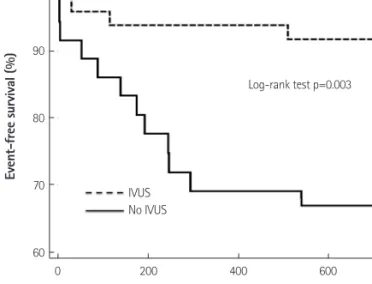
The 2-year MACE rate was lower in the IVUS-guided group than in the angiography-guided group (8% vs. 33.3%, p=0.001) (Fig. 2).

No difference was found regarding CV death in the two groups (5.6%

vs. 6.1%, p>0.999). Non-fatal MI and stent thrombosis occurred si- milarly in both groups (13.9% vs. 2.0%, p=0.079 for non-fatal MI;

11.1% vs. 2%, p=0.158 for stent thrombosis, respectively). In con- trast, TLR was performed in 10 patients (27.8%) without IVUS gu- idance and none in the IVUS-guided group (p<0.001).

Table 1. Baseline clinical and laboratory characteristics according to the use of IVUS

Characteristics No IVUS (n=36) IVUS (n=49) p

Age (years) 65±12 65±12 0.951

Male sex, n (%) 22 (61.1) 30 (61.2) 0.992

Body mass index (kg/m

2

) 24.1±3.4 24.5±3.4 0.553

Medical history, n (%)

Diabetes mellitus 11 (30.6) 13 (26.5) 0.684

Hypertension 20 (55.6) 25 (51) 0.679

Hyperlipidemia 9 (25) 14 (28.6) 0.714

Current smoker 14 (38.9) 16 (32.7) 0.552

Prior myocardial infarction 2 (5.6) 2 (4.1) >0.999

Previous coronary angioplasty 3 (8.3) 1 (2) 0.307

Renal insufficiency 2 (5.6) 5 (10.2) 0.694

Discharge medications, n (%)

Aspirin 36 (100) 49 (100)

Clopidogrel 36 (100) 49 (100)

Cilostazol 6 (16.7) 1 (2) 0.038

β-blocker 16 (44.4) 38 (77.6) 0.002

ACE inhibitor or ARB 19 (52.8) 34 (69.4) 0.450

Statin 25 (69.4) 35 (71.4) 0.843

Duration of dual antiplatelet therapy, n (%) 0.002

At 6 months 25 (69.4) 46 (93.9)

At 1 year 17 (47.2) 40 (81.6)

At 2 years 13 (36.1) 23 (46.9)

Indication for procedure, n (%) 0.199

Stable angina or unstable angina without elevated cardiac enzymes 19 (52.8) 26 (53.1)

NSTEMI 17 (47.2) 23 (46.9)

Left ventricular ejection fraction (%) 56±14 54±15 0.473

Hemoglobin (g/dL) 12.9±1.9 13.4±2.3 0.268

Platelet (/uL) 253500±50690 258632±70535 0.711

Creatinine (mg/dL) 0.9±0.3 1.2±1.5 0.300

Total cholesterol (mg/dL) 184±44 183±41 0.873

Triglyceride (mg/dL) 174±98 147±115 0.260

HDL-C (mg/dL) 42±15 42±10 0.947

LDL-C (mg/dL) 109±45 111±38 0.741

Peak CK-MB (ng/mL) 61.4±90.8 37.6±70.0 0.175

Peak troponin I (ng/mL) 14.8±18.6 14.6±19.2 0.955

hs-CRP (mg/L) 2.5±3.7 2.2±2.5 0.748

BNP (pg/mL) 164.5±208.7 253.3±499.6 0.275

Values are expressed as number (%) or mean±SD. IVUS: intravascular ultrasound, ACE: angiotensin-converting enzyme, ARB: angiotensin receptor blocker,

BNP: B-type natriuretic peptide, CK-MB: creatine kinase, muscle and brain, HDL-C: high density lipoprotein-cholesterol, hs-CRP: high sensitivity C-reactive

protein, LDL-C: low density lipoprotein-cholesterol, NSTEMI: non-ST-segment elevation myocardial infarction

(5)

Table 2. Baseline and follow-up coronary angiographic and procedural parameters

No IVUS (n=36) IVUS (n=49) p

Target vessel, n (%) 0.113

Left anterior descending artery 16 (44.4) 29 (59.2)

Left circumflex artery 2 (5.6) 6 (12.2)

Right coronary artery 18 (50) 14 (28.6)

Lesion characteristics, n (%)

Bifurcation lesion 5 (13.4) 11 (22.4) 0.318

Chronic total occlusion 3 (8.3) 8 (16.3) 0.342

Ostial lesion 2 (5.6) 8 (16.3) 0.179

SYNTAX score 21.8±12.7 23.1±10.1 0.611

Legion length (mm) 60 (57-91) 68 (58-90) 0.013

Procedural details

Number of vessels per patient 2.1±0.9 2.1±0.8 0.926

Multi-vessel coronary angioplasty, n (%) 12 (33.3) 28 (57.1) 0.03

Stents per patient 2.2±0.5 2.8±0.5 <0.001

Total stent length (mm) 66 (64-99) 74 (64-120) 0.006

Stent diameter (mm) 2.87±0.28 3.00±0.26 0.028

IVUS use, n (%) n/a

Pre-stent 41 (83.7)

Post-stent 49 (100)

Additional ballooning by IVUS, n (%) n/a 25 (51.7)

Additional stenting by IVUS, n (%) n/a 7 (14.3)

Adjuvant ballooning after stenting, n (%) 23 (63.9) 42 (91.3) 0.019

No reflow, n (%) 2 (5.5) 3 (6.1) 0.913

Distal embolization, n (%) 0 0

Dissection, n (%) 1 (2.8) 3 (6.1) 0.472

Side branch occlusion, n (%) 0 0

Angiographic success, n (%) 36 (100) 49 (100)

Stent type, n (%) <0.001

Sirolimus-eluting stent 18 (50) 5 (10.2)

Paclitaxel-eluting stent 14 (38.9) 8 (16.3)

Everolimus-eluting stent 3 (8.3) 31 (63.3)

Zotarolimus-eluting stent 1 (2.8) 5 (10.2)

Baseline QCA data

Pre-stent RD (mm) 2.9±0.3 2.8±0.3 0.363

Pre-stent MLD (mm) 0.5±0.3 0.7±0.4 0.023

Pre-stent DS (%) 83±10 75±15 0.004

Post-stent RD (mm) 3.0±0.3 2.9±0.3 0.532

Post-stent MLD (mm) 2.6±0.3 2.8±0.3 0.044

Post-stent DS (%) 13±5 7±4 <0.001

Acute gain (mm) 2.1±0.3 2.1±0.5 0.534

Final TIMI flow grade 3, n (%) 34 (94.4) 47 (95.9) 0.751

Follow-up QCA data

Follow-up coronary angiography, n (%) 23 (63.9) 37 (75.5) 0.245

Days 244 (50-730) 278 (115-964) 0.859

(6)

Predictors of major adverse cardiovascular events

Age, no use of IVUS, acute MI, use of 1st generation DES (SES or PES), shorter duration of dual antiplatelet therapy, and smaller st- ent diameter were univariate associated factors for higher 2-year MACE rate (Table 4). However, stent length was not associated with higher 2-year MACE rate {hazard ratio (HR) 1.012, 95% confidence interval (CI) 0.980-1.064, p=0.312}. On multivariate Cox propor- tional hazard analysis, no IVUS use (HR 5.917, 95% CI 1.037-33.770, p=0.045) and age (HR 1.097, 95% CI 1.006-1.138, p=0.032) were un-

favorable predictive factors for 2-year MACE.

Discussion

The main findings of the present study are that the incidence of adverse events in multiple overlapping stenting are still high in the DES era, and that IVUS use decreased those events in the treatment of diffuse coronary lesions.

The use of IVUS during PCI has been gaining in popularity with the interventional cardiology specialists, as it provides more detail- ed information than the conventional coronary angiography on the coronary lesions to be treated and the adequacy of the stent depl- oyment. However, routine use of IVUS during PCI is not recommend- ed in the current guidelines.

17)18)

Although there are few observatio- nal studies showing the superiority of IVUS use in the DES era,

9)10)18)

no randomized trial has yet been done to demonstrate whether IVUS-guided PCI improves clinical outcome in comparison to angi- ography-guided coronary angioplasty alone.

The benefits of IVUS may vary according to the clinical and le- sional subsets. The event rate after PCI in patients with stable angina Table 2. Continued

No IVUS (n=36) IVUS (n=49) p

RD (mm) 3.0±0.3 3.0±0.4 0.747

MLD (mm) 1.3±1.0 2.4±0.4 <0.001

DS (%) 56±33 20±8.3 <0.001

Late loss (mm) 1.3±0.9 0.4±0.3 <0.001

Values are expressed as number (%), mean±SD, or median (range). DS: diameter stenosis, IVUS: intravascular ultrasound, MLD: minimal luminal diameter, RD: reference diameter, QCA: quantitative coronary angiography, TIMI: Thrombolysis in Myocardial Infarction

Table 3. Two-year major adverse cardiovascular events (MACE) according to the use of intravascular ultrasound (IVUS)

No IVUS (n=36)

IVUS

(n=49) p

All MACE, n (%) 12 (33.3) 4 (8) 0.005

Cardiovascular death 2 (5.6) 3 (6.1) >0.999 Non-fatal myocardial infarction 5 (13.9) 1 (2.0) 0.079 Target lesion revascularization 10 (27.8) 0 <0.001

Stent thrombosis 4 (11.1) 1 (2.0) 0.158

Values are expressed as number (%)

Fig. 1. Cumulative frequency distribution curves for analysis segment per- cent diameter stenosis. At 9 months, the reduction in mean percent diame- ter stenosis for the IVUS-guided group relative to the angiography-guided group was -35.9% (95% confidence interval, -21.4% to -50.3%; p<0.001).

IVUS: intravascular ultrasound.

100

80

60

40

20

0

Analysis segment diameter stenosis (%)

Cu m ul at iv e fr eq ue nc y (% )

0 20 40 60 80 100 IVUS

No IVUS Post-

intervention

9-month follow-up

Pre-intervention

Fig. 2. Kaplan-Meier event-free 2-year survival curves for the composite of cardiovascular death, myocardial infarction, target-lesion revasculariza- tion, and stent thrombosis in the intravascular ultrasound (IVUS) and no IVUS groups. The 2-year event rate was lower in the IVUS-guided group than that of the angiography-guided group (8% vs. 33.3%, p=0.003).

100

90

80

70

60

Time (days)

Ev en t- fr ee s ur vi va l ( % )

0 200 400 600 800 IVUS

No IVUS

Log-rank test p=0.003

(7)

is relatively reduced, with the recent advances in PCI skills along with the advent of novel biocompatible DES and optimal medical therapy, including the use of statins and antiplatelet agents.

2)

One may ex- pect a beneficial role of IVUS especially in patients with acute MI due to higher clinical event occurrence than in those with stable co- ronary disease. However, IVUS had not improved the clinical out- comes in patients with acute MI in a recent series of studies.

11-13)

The uncertainty in the usefulness of IVUS in acute MI setting may be due to the fact that there are many other clinical predictors for morbidity and mortality such as ischemia time, location of MI, in- farct size, Killip classification, and treatment modalities. In contrast to the acute MI setting, IVUS-guided PCI seemed beneficial in the left main

19)

and bifurcation coronary lesions.

19)20)

Clinical outcomes in these lesions following DES implantation can be affected with similar importance by procedural as well as clinical factors. The th- eoretical benefit of IVUS over conventional coronary angiography may translate into better clinical outcomes in the treatment of so- phisticated coronary lesions such as left main and bifurcation dis- ease. The benefit of IVUS use in the treatment of long diffuse lesions has not been tested as yet. The present study revealed that IVUS- guided PCI showed better clinical outcomes than angiography-gu- ided PCI in this study population who had diffuse coronary artery occlusive disease and who received at least 64 mm of overlapping DES. No use of IVUS was independently associated with higher MACE rate. As such, although the benefit of routine IVUS during PCI remains unclear, its usefulness may be maximized in certain lesion subsets, such as left main disease, bifurcation lesion and long diffuse lesion, in which the procedural factors can be more prominent.

The mechanism allowing IVUS-guided PCI to have a better clini- cal outcome in the treatment of long diffuse lesion in comparison to angiography-guided PCI is not evident. Stent length and stent diameter are still important predictors of in-stent restenosis and stent thrombosis following PCI in the DES era.

22)23)

Patients with IVUS-guided PCI had longer stents and used more stents compared with those with angiography-guided PCI in the present study. When treating diffuse coronary occlusive disease, full coverage of the dis-

eased segment by the help of IVUS may obtain a better outcome, because the residual disease can cause subsequent stent thrombo- sis following PCI.

24)

The use of IVUS may have helped the treating physicians to detect inflow and/or outflow residual disease leading to the selection of a longer stent or additional stents. The IVUS- guided group also had a wider stent diameter, one of the possible explanations for the benefits of IVUS. The treating interventional cardiology specialists could have chosen the proper size of the st- ent as well as optimal stent length through IVUS interrogation be- fore stent implantation. IVUS-guided PCI could optimize coronary stenting, avoiding stent underexpansion, malapposition, and resid- ual lesion, a possible cause of stent thrombosis or in-stent reste- nosis. In fact, adjuvant ballooning was performed more frequently in the IVUS-guided group in this study. Other potential mechanisms for the better outcomes in the IVUS-guided group are the early de- tection of stent edge dissection, intra-stent thrombus, and tissue prolapse.

Limitations

There are several limitations in the present study. First, this is a single-center observational study in a small-sized population. Sec- ond, the periods of PCI with and without IVUS were different. This difference may cause various factors to impact on PCI outcomes, in- cluding the operator’s skills, alteration of PCI strategy, and stents used etc. The DES type may have influenced the poor outcome in an- giography-guided PCI group, as the patients in this group received more 1st generation DES such as SES or PES as compared to the IVUS-guided group. However, no IVUS use and age were the only predictors for poor clinical outcome on multiple Cox regression analysis. Third, the rates of follow-up angiography were around 60- 70% in both groups. These rates are too low to precisely evaluate the follow-up parameters in QCA. Fourth, quantitative IVUS assess- ment was not performed. For this reason, the mechanism responsi- ble for the superiority of IVUS-guided PCI over angiography-guid- ed PCI is lacking. Fifth, since we excluded the high-risk patients, such as those with ST-segment elevation MI, our findings could not be ex- Table 4. Univariate and multivariate predictors of poor clinical outcome on Cox proportional hazard analysis

Univariate analysis Multivariate analysis

Hazard ratio Confidence interval p Hazard ratio Confidence interval p

Age 1.063 1.009-1.119 0.021 1.070 1.006-1.138 0.032

No use of IVUS 7.159 2.108-24.312 0.002 5.917 1.037-33.770 0.045

AMI 3.621 1.158-11.323 0.027 3.612 0.922-14.160 0.065

Use of SES or PES 6.167 1.631-23.313 0.007 1.947 0.327-11.613 0.464

<1 year of DAPT 3.403 1.161-9.973 0.026 1.238 0.315-4.872 0.760

Stent diameter 0.092 0.009-0.939 0.044 0.234 0.018-3.070 0.269

AMI: acute myocardial infarction, DAPT: dual antiplatelet therapy, IVUS: intravascular ultrasound, PES: paclitaxel-eluting stent, SES: sirolimus-eluting stent

(8)

trapolated to every PCI patient.

Conclusions

In summary, the use of IVUS may improve efficiency and safety in multiple overlapping DES for long diffuse coronary lesions. To certify this hypothesis, further randomized, controlled trials are warranted.

References

1. Stettler C, Wandel S, Allemann S, et al. Outcomes associated with drug-eluting and bare-metal stents: a collaborative network meta- analysis. Lancet 2007;370:937-48.

2. Hannan EL, Racz M, Holmes DR, et al. Comparison of coronary artery stenting outcomes in the eras before and after the introduction of drug- eluting stents. Circulation 2008;117:2071-8.

3. Aoki J, Ong AT, Rodriguez Granillo GA, et al. “Full metal jacket” (stented length > or =64 mm) using drug-eluting stents for de novo coronary artery lesions. Am Heart J 2005;150:994-9.

4. Lee CW, Park KH, Kim YH, et al. Clinical and angiographic outcomes after placement of multiple overlapping drug-eluting stents in diffuse coronary lesions. Am J Cardiol 2006;98:918-22.

5. Dangas GD, Claessen BE, Caixeta A, Sanidas EA, Mintz GS, Mehran R.

In-stent restenosis in the drug-eluting stent era. J Am Coll Cardiol 2010;

56:1897-907.

6. Hong SJ, Kim MH, Ahn TH, et al. Comparison of the predictors of coro- nary restenosis after drug-eluting stent implantation in diabetic and nondiabetic patients. Korean Circ J 2007;37:530-7.

7. Tin-Hay EL, Poh KK, Lim YT, et al. Clinical predictors of stent thrombosis in the “real world” drug-eluting stent era. Int J Cardiol 2010;145:422-5.

8. Brugaletta S, Costa JR Jr, Garcia-Garcia HM. Assessment of drug-elut- ing stents and bioresorbable stents by grayscale IVUS and IVUS-based imaging modalities. Int J Cardiovasc Imaging 2011;27:239-48.

9. Roy P, Steinberg DH, Sushinsky SJ, et al. The potential clinical utility of intravascular ultrasound guidance in patients undergoing percutane- ous coronary intervention with drug-eluting stents. Eur Heart J 2008;

29:1851-7.

10. Claessen BE, Mehran R, Mintz GS, et al. Impact of intravascular ultra- sound imaging on early and late clinical outcomes following percuta- neous coronary intervention with drug-eluting stents. JACC Cardio- vasc Interv 2011;4:974-81.

11. Ahmed K, Jeong MH, Chakraborty R, et al. Role of intravascular ultra- sound in patients with acute myocardial infarction undergoing percu- taneous coronary intervention. Am J Cardiol 2011;108:8-14.

12. Youn YJ, Yoon J, Lee JW, et al. Intravascular ultrasound-guided primary percutaneous coronary intervention with drug-eluting stent implanta- tion in patients with ST-segment elevation myocardial infarction. Clin Cardiol 2011;34:706-13.

13. Maluenda G, Lemesle G, Ben-Dor I, et al. Impact of intravascular ultra-

sound guidance in patients with acute myocardial infarction undergo- ing percutaneous coronary intervention. Catheter Cardiovasc Interv 2010;75:86-92.

14. Cannon CP, Battler A, Brindis RG, et al. American College of Cardiology key data elements and definitions for measuring the clinical manage- ment and outcomes of patients with acute coronary syndromes. A re- port of the American College of Cardiology Task Force on Clinical Data Standards (Acute Coronary Syndromes Writing Committee). J Am Coll Cardiol 2001;38:2114-30.

15. Kappetein AP, Head SJ, Généreux P, et al. Updated standardized end- point definitions for transcatheter aortic valve implantation: the Valve Academic Research Consortium-2 consensus document. J Am Coll Car- diol 2012;60:1438-54.

16. Task Force on Myocardial Revascularization of the European Society of Cardiology (ESC) and the European Association for Cardio-Thoracic Surgery (EACTS); European Association for Percutaneous Cardiovascu- lar Interventions (EAPCI), Winjs W, et al. Guidelines on myocardial re- vascularization. Eur Heart J 2010;31:2501-55.

17. Levine GN, Bates ER, Blankenship JC, et al. 2011 ACCF/AHA/SCAI Guide- line for Percutaneous Coronary Intervention: a report of the American College of Cardiology Foundation/American Heart Association Task Force on Practice Guidelines and the Society for Cardiovascular An- giography and Interventions. Circulation 2011;124:e574-651.

18. Hur SH, Kang SJ, Kim YH, et al. Impact of intravascular ultrasound- guided percutaneous coronary intervention on long-term clinical out- comes in a real world population. Catheter Cardiovasc Interv 2011.

[Epub ahead of print]

19. Park SJ, Kim YH, Park DW, et al. Impact of intravascular ultrasound guidance on long-term mortality in stenting for unprotected left main coronary artery stenosis. Circ Cardiovasc Interv 2009;2:167-77.

20. Kim SH, Kim YH, Kang SJ, et al. Long-term outcomes of intravascular ultrasound-guided stenting in coronary bifurcation lesions. Am J Car- diol 2010;106:612-8.

21. Kim JS, Hong MK, Ko YG, et al. Impact of intravascular ultrasound guidance on long-term clinical outcomes in patients treated with drug-eluting stent for bifurcation lesions: data from a Korean multi- center bifurcation registry. Am Heart J 2011;161:180-7.

22. Hong MK, Mintz GS, Lee CW, et al. Intravascular ultrasound predictors of angiographic restenosis after sirolimus-eluting stent implantation.

Eur Heart J 2006;27:1305-10.

23. Okabe T, Mintz GS, Buch AN, et al. Intravascular ultrasound parameters associated with stent thrombosis after drug-eluting stent deployment.

Am J Cardiol 2007;100:615-20.

24. Cook S, Ladich E, Nakazawa G, et al. Correlation of intravascular ultra-

sound findings with histopathological analysis of thrombus aspirates

in patients with very late drug-eluting stent thrombosis. Circulation

2009;120:391-9.

수치

Table 1. Baseline clinical and laboratory characteristics according to the use of IVUS
Table 2. Baseline and follow-up coronary angiographic and procedural parameters
Fig. 1. Cumulative frequency distribution curves for analysis segment per- per-cent diameter stenosis

참조

관련 문서

First, after the Group Art Therapy, the scale of hopelessness depression in the test group decreased significantly in comparison with that before the group

In 4-week group, the group filled with bone graft with decortication revealed larger new bone formation area than shown in the group that had a defect area

In the region of Auerbach’s plexus (AP) of small intestine, the staining intensity of the ICC-IR cells was reduced in the HFD group compared to the control group.. The numbers

The index is calculated with the latest 5-year auction data of 400 selected Classic, Modern, and Contemporary Chinese painting artists from major auction houses..

In this group of high-risk patients with severe COVID-19 pneumonia, treatment with lenzilumab was associated with a significantly shorter time to clinical improvement compared

1 John Owen, Justification by Faith Alone, in The Works of John Owen, ed. John Bolt, trans. Scott Clark, &#34;Do This and Live: Christ's Active Obedience as the

Prevention of coronary and stroke events with atorvastatin in hypertensive patients who have average or lower-than-average cholesterol concentrations, in

8 No attenuation of light by semi-transparent metal electrodes, 8 Absorption of wave-guided light is dramatically reduced through. the use of highly reflective metallization