• 검색 결과가 없습니다.

P2 Receptor-mediated Inhibition of Vasopressin-stimulated Fluid Transport and cAMP Responses in AQP2-transfected MDCK Cells

N/A
N/A
Protected

Academic year: 2022

Share "P2 Receptor-mediated Inhibition of Vasopressin-stimulated Fluid Transport and cAMP Responses in AQP2-transfected MDCK Cells"

Copied!
6
0
0

로드 중.... (전체 텍스트 보기)

전체 글

(1)

9

ABBREVIATIONS: AQP2, aquaporin-2; ATP, adenosine 5'-triphosp- hate; ATP-γS, adenosine 5'-O-3-thiotriphosphate; AVP, [Arg

8

]- vasopressin; DPCPX, 8-cyclopentyl-1,3-dipropylxanthine; MeATP, β, γ -methylene-ATP; MeSATP, 2-methylthio-ATP; PPADS, pyridoxal- phosphate-2'4'-disulphonic acid; UTP, uridine 5'-triphosphate.

Corresponding to: Jae Suk Woo, Department of Physiology, Pusan National University School of Medicine, Ami-dong, Seo-gu, Busan 602-739, Korea. (Tel) 82-51-510-8072, (Fax) 82-51-510-8076, (E-mail) [email protected]

P2 Receptor-mediated Inhibition of Vasopressin-stimulated Fluid Transport and cAMP Responses in AQP2-transfected MDCK Cells

Yang Hoo Kim

1

, Young Jin Choi

1

, Hae Rahn Bae

2

, and Jae Suk Woo

1

Department of Physiology,

1

Pusan National University School of Medicine, Busan 609-739,

2

Dong-A University College of Medicine, Busan 602-714, Korea

W e cultured canine kidney (MDCK) cells stably expressing aquaporin-2 (AQP2) on collagen-coated permeable membrane filters and examined the effect of extracellular ATP on arginine vasopressin (AVP)-stimulated fluid transport and cAMP production. Exposure of cell monolayers to basolateral AVP resulted in stimulation of apical to basolateral net fluid transport driven by osmotic gradient which was formed by addition of 500 mM mannitol to basolateral bathing solution. Pre-exposure of the basolateral surface of cell monolayers to ATP (100 µM) for 30 min significantly inhibited the AVP-stimulated net fluid transport. In these cells, AVP-stimulated cAMP production was suppressed as well. Profile of the effects of different nucleotides suggested that the P2Y

2

receptor is involved in the action of ATP. ATP inhibited the effect of isoproterenol as well, but not that of forskolin to stimulate cAMP production. The inhibitory effect of ATP on AVP-stimulated fluid movement was attenuated by a protein kinase C inhibitor, calphostin C or pertussis toxin. These results suggest that prolonged activation of the P2 receptors inhibits AVP-stimulated fluid transport and cAMP responses in AQP2 transfected MDCK cells. Depressed responsiveness of the adenylyl cyclase by PKC-mediated modification of the pertussis-toxin sensitive G

i

protein seems to be the underlyihng mechanism.

Key Words: P2 receptor, ATP, Vasopressin, Adenylyl cyclase, Cyclic AMP

INTRODUCTION

Extracellular ATP acts as an autocrine and paracrine regulator of a broad range of physiological processes by in- teracting with the P2 receptors (Dubyak & El-Moatassim, 1993; North & Barnard, 1997; Williams & Burnstock, 1997). The IUPHAR Purine Nomenclature Subcommittee grouped the P2 receptors into 2 families (Fredholm et al, 1997), P2X and P2Y. The P2X is a ligand-gated ion channel receptor family, whereas the P2Y is a G protein-coupled receptor family. Among the P2Y receptors, the P2Y

1

and P2Y

2

have most widely been studied in relation with their expression and functions in various tissues.

The P2Y receptors are expressed in the inner medullary collecting duct cells (McCoy et al, 1999; Kishore et al, 2000;

Vallon, 2008), and are involved in regulation of ion trans- port across the epithelium. Studies with gene knockout mice provided insights including an antihypertensive activ- ity of P2Y

2

receptors that is linked to an inhibitory effect on renal Na

and water reabsorption (Rieg et al, 2007).

Upon activation of P2Y receptors, G protein-dependent activation of phospholipase C and subsequent increase of intracellular Ca

2+

have been believed to be a major signal- ing mechanism to evoke cellular responses (Dubyak &

El-Moatassim, 1993; Harden et al, 1995). However, there is accumulating evidence indicating that adenylyl cyclase

is also involved in the signaling mechanism of the P2Y re- ceptor-mediated responses in a certain type of cells.

Inhibition of cAMP accumulation by activation of the P2 receptor was reported in rat hepatocytes (Okajima et al, 1987), mouse ventricular myocytes (Yamada et al, 1992), FRTL-5 thyroid cells (Sato et al, 1992), and C6 glioma cells (Pianet et al, 1989; Lin & Chuang, 1993). In contrast, how- ever, it was reported that the P2 receptor agonists enhance cAMP production in cells of distal nephron origin (Post et al, 1996; Post et al, 1998; Woo et al, 1998). These contra- dictory results make it difficult to predict the precise effect of P2 receptor activation on different cell or tissue functions in relation with cAMP-dependent signaling.

In the course of our preliminary study using several types

of cells derived from the distal nephron, it was observed

that a prolonged exposure to ATP modifies the responsive-

ness of adenylyl cyclase to certain agonists. This finding

appears to have a wide range of physiological significance

because of the fact that cAMP is an important mediator

of hormonal regulation of urinary concentrating mechanism

in the distal nephron. In the present study, therefore, we

cultured MDCK cells stably expressing aquaporin-2 (AQP2)

on permeable membrane filters and examined the effect of

extracellular ATP on AVP-dependent fluid transport and

cAMP responses.

(2)

the filters were coated with 1% Vitrogen 100 (Collagen, Palo Alto, CA) and 1 mg/ml human fibronectin (Collabor- ative Research, Bedford, MA) dissolved in MEM supple- mented with 1% FBS. Cells which were plated on Snapwells were evaluated for formation of tight junctions by measur- ing transepithelial resistance using transepithelial voltoh- meter (EVOM, World Precision Instruments, Sarasota, FL) and chopstick electrodes. Usually, transepithelial resist- ance reached its peak (4,310±730 ohmㆍcm

2

) 5 to 6 days after plating. Experiments were carried out on the 6th to 8th day after plating. Cells used for this study were be- tween passages of 86 to 110.

Preparation of AQP2-transfected cells

Full length cDNA (1.2 Kb) of AQP2 was subcloned first into a mammalian expression vector pcDNA3.1/Neo using HindIII and XbalI site, and then transfected into MDCK cells using lipofectamine plus (Gibco). AQP2 trasnfected cells were maintained in culture media containing G418 (Gibco). Expression of AQP2 was assayed by Western blot analysis.

Western blot analysis

Cells were washed twice with ice-cold phosphate-buffered saline at 4

o

C and resuspended in 1 ml of extraction buffer (50 mM PIPES, pH 7.0, 50 mM KCl, 5 mM MgCl

2

, 5 mM EGTA, 1 mM phenylmethylsulfonyl fluoride, 10 μg/ml leu- peptin and 10 μg/ml pepstatin A). Cells were lysed by five cycles of freezing in liquid nitrogen and thawing at 37

o

C.

After verifying by microscopic examination that more than 90% of cells were lysed, the lysates were centrifuged at 100,000 g for 1 hr at 4

o

C. The resulting supernatant, which consisted of the cytosol, was separated from the pellet con- taining the cellular membrane and organelles, and was an- alyzed for aquaporin 2 by Western blots using polyclonal anti-AQP2 antibody.

Measurement of transepithelial fluid movement Transepithelial fluid movement was measured in cells grown as confluent monolayers on Snapwell filters.

Monolayers were used only when transepithelial resistance reached over 4,000 ohmㆍcm

2

. Culture medium bathing the cell monolayer was replaced with MEM supplemented with 2% FBS. Apical to basolateral transepithelial fluid move- ment was measured under osmotic gradient. The osmotic gradient was formed by addition of 500 mM mannitol into the basolateral bathing medium. Net apical to basolateral fluid movement was measured by monitoring the increase

mersed in ice-cold ethanol-HCl (ethanol solution containing 20 mM HCl and 0.2% Triton X-100) for 2 hr to disrupt cell membranes and to precipitate proteins. Disrupted cell ex- tracts were then transferred to microcentrifuge tubes and sonicated to completely disrupt the cell membrane and ex- tract intracellular cAMP. The cell suspension was then cen- trifuged (12,000 g) for 10 min at 4

o

C to precipitate the pro- tein, and the supernatant was collected. The supernatant was freeze-dried and dissolved in an adequate volume of 50 mM Tris/1 mM EDTA (pH 7.5). Cyclic AMP content was determined by radioimmunoassay using [

3

H]cAMP assay kit.

Chemicals

[

14

C]inulin and [

3

H]cAMP assay kit were obtained from Amersham international (Amersham, UK). Adenosine 5'-triphosphate (ATP, disodium salt), uridine 5'-triphos- phate (UTP, sodium salt), adenosine 5'-O-3-thiotriphos- phate (ATP-γS, tetralithium salt), [Arg

8

]-Vasopressin (AVP) and forskolin were purchased from Sigma Chemical (St. Louis, MO). 2-methylthio-ATP (MeSATP), β,γ-methylene- ATP (MeATP), pyridoxal-phosphate-2'4'-disulphonic acid (PPADS), 8-cyclopentyl-1,3-dipropylxanthine (DPCPX) per- tussis toxin and calphostin C were obtained from Calbiochem (La Jolla, CA).

Statistical analysis

Data are expressed as mean±S.E. Comparison between two groups was made using the unpaired t test. Multiple group comparison was done using one-way analysis of var- iance followed by the Tukey post hoc test. p values lower than 0.05 were considered statistically significant.

RESULTS

Effect of AVP on fluid movement in AQP2 trasnsected cells

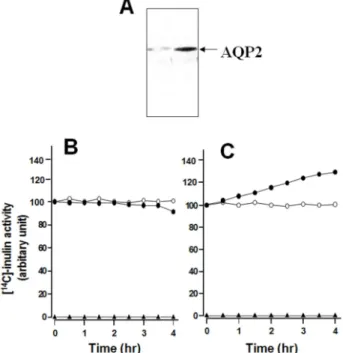
Enhanced and stable expression of AQP2 in cells trans-

fected with full length cDNA (1.2 Kb) of AQP2 was con-

firmed by Western blot analysis. In control MDCK cells,

there was negligible expression of AQP2 and AVP-stimu-

lated response (Fig. 1A left lane, and B). In AQP2-transfected

MDCK cells, however, there was a remarkable increase in

the expression of AQP2 (Fig. 1A right lane). In these cells,

the radioactivity of [

14

C]-inulin in the apical bathing media

increased significantly when stimulated with AVP

(basolateral side, 10

−6

M) in the presence of a osmotic gra-

(3)

Fig. 1. (A) Western blot analysis of AQP2 expression in control (left lane) and AQP2 transfected (right lane) MDCK cells. Cells were transfected with full length cDNA of AQP2. (B, C) Changes in [

14

C]inulin activity in the apical bathing medium were monitored as an index of net apical to basolateral fluid movement in the presence (closed circle) and absence (open circle) of 10

−6

M AVP in control (B) and AQP2 transfected (C) cells. Each point represents mean of 5 experiments.

Fig. 2. Effect of AVP on net apical to basolateral fluid movement in control and AQP2 transfected MDCK cells. Net apical to basolateral fluid movement was calculated from the changes in [

14

C]inulin activity in the apical bathing medium. (A) In control cells, in the presence (clsed circle) and absence (open circle) of 10

−6

M AVP. (B) In AQP2 transfected cells, in the presence (closed circle) and absence (open circle) of 10

−6

M AVP. Each point represents mean±S.E. of 5 experiments.

Fig. 3. Effect of ATP on AVP-stimulated net apical to basolateral fluid movement. Net apical to basolateral fluid movement was calculated from the changes in [

14

C]inulin activity in the apical bathing medium in control (A) and AQP2 transfected (B) cells. ATP (10

−4

M) was added to basolateral bathing medium 30 min prior to the stimulation with AVP. Data are mean±S.E. of 6 experiments.

*p<0.01 vs. without ATP.

dient (basolaterlal>apical, 500 mOsm) which was formed by addition of mannitol into the basolateral bathing media (Fig. 1B). Apical to basilateral leak of [

14

C]-inulin radio- activity was negligible throughout the experimental period, indicating that there was no signifiant paracellular leak of the solutes or fluid, thus confirming that the increase of the [

14

C]-inulin radioactivity in the apical bathing media reflects net apical to basolateral fluid movement.

Net fluid movement which was estimated from the changes in the apical [

14

C]-inulin radioactivity, was pre- sented in Fig. 2. There was a time-dependent increase in the apical to basolateral fluid movement in AQP2 trans- pected MDCK cells when stimulated with AVP in the pres- ence of a osmotic gradient. We used the 10

−6

M AVP con- centration which showed maximum effect in the prelimi- nary studies (data not shown). It stimulated net apical to basolateral fluid movement in a time-dependent manner up to 4 hr of incubation. We did not determine the fluid move- ment for longer than 4 hr, because some monolayers tended to lose the functional integrity of their tight junction when exposed to experimental procedures for longer than 4 hr.

We used 10

−6

M AVP and 3 hr of incubation time for the fluid movement studies in the following study.

Effect of ATP on AVP-stimulated fluid movement To determine whether activation of P2 purinergic re- ceptors affects AVP-stimulated fluid movement, the ability of AVP (basolateral, 10

−6

M) to stimulate the net apical to basolateral fluid movement was measured in the pres-

ence of ATP (basolateral, 10

−4

M). Fig. 3B shows that ATP significantly attenuated the AVP-induced stimulation of the net apical to basolateral fluid movement (27.2±4.8 to 4.3±1.9 μl/cm

2

/3 hr) in AQP2-transpecetd cells. In control cells, there was no significant changes in the fluid move- ment by either AVP or ATP (Fig. 3A).

Effect of ATP on cellular cAMP

As AVP-induced stimulation of the fluid movement is

mediated by an enhancement of cellular cAMP production,

the effect of ATP on AVP-stimulated cAMP production was

determined. Treatment of cells with AVP alone resulted in

(4)

Fig. 4. Effect of ATP on cAMP production in AQP2 transfected cells stimulated with AVP, isoproterenol and forskolin. The magnitude of stimulation in cellular cAMP production by exposure for 5 min to 10

−6

M each of AVP, isoproterenol (ISP) and froskolin was measured in the presence and absence of ATP (10

−4

M). Data are mean±S.E. of 4 experiments. *p<0.01 vs. without ATP.

Fig. 5. Effects of different P2 nucleotide receptor agonists on AVP-stimulated responses. The magnitude of inhibition of AVP-stimulated responses by each nucleotide (10

−4

M) was measured via 3-hr fluid movement and 5-min cAMP production.

Data are mean±S.E. of 5 experiments. ATP-γS, 5'-O-3-thiotri- phosphate; UTP, uridine 5'-triphosphate; MeSATP, 2-methylthio- ATP; MeATP, β,γ-methylene-ATP.

Fig. 6. Effects of purinergic antagonists on the ATP-induced inhibition of AVP-stimulated responses. The magnitude of ATP-induced inhibition of AVP-stimulated responses of 3-hr fluid movement and 5-min cAMP production was measured in the presence and absence of the P2 receptor antagonist pyridoxal- phosphate-24-disulphonic acid (PPADS, 10

−5

M) and the P1 recep- tor antagonist 8-cyclopentyl-1,3-dipropylxanthine (DPCPX, 10

−5

M).

The data represent mean±S.E. of 4 experiments. *p<0.01 compared to the respective control.

nitudes of inhibition by these nucleotides were in decreas- ing order: ATP ≥ ATPγS ≥ UTP >> MeSATP = MeATP suggesting the involvement of the P2Y

2

receptor (Fig. 5).

Effect of P1 and P2 receptor blockers

The P1 receptor is not likely to be responsible for the inhibitory effect of ATP, because ATP-γS showed an equi- potent effect. Nevertheless, we tested this possibility by de- termining the effect of the P2 receptor blocker (PPADS) and P1 receptor blocker (DPCPX) on the action of ATP to inhibit AVP-stimulated fluid movement and cAMP production.

PPADS or DPCPX by itself did not affect the basal or

AVP-stimulated cAMP production. PPADS, when present

during pre-exposure of cells to ATP and subsequent stim-

ulation by AVP, significantly attenuated the inhibitory ef-

fect of ATP on AVP-stimulated fluid movement and cAMP

production. In contrast, DPCPX did not affect the action

of ATP to inhibit the AVP-stimulated responses (Fig. 6).

(5)

Fig. 7. Effects of calphostin C and pertussis toxin on ATP-induced inhibition of AVP-stimulated fluid movement. AVP-stimulated fluid movement was measured in the presence and absence of ATP (10

−4

M) in cells pretreated with calphostin C (20 μM) or with pertussis toxin (PTX, 1 μg/ml) for 2 hr. Data are mean±S.E. of 5 experiments.

*p<0.01 vs. the respective values without ATP.

Role of PKC and G

i

protein

The fact that ATP did not affect forskolin-stimulated cAMP suggested that underying mechanism of the ATP-in- duced inhibition of AVP-stimulated cAMP responses did not involve the catalytic subunit of adenylyl cyclase. Several investigators have suggested that activation of protein kin- ase C can modify G

i

protein and result in inhibition of the responsiveness of adenylyl cyclase to agonists (Beckner &

Farrar, 1987; Budnik & Mukhopadhyay, 1987; Teitelbaum, 1993). Furthermore, evidence indicates that activation of protein kinase C occurs upon activation of P2Y receptors and subsequent stimulation of phospholipase C (Dubyak &

El-Moatassim, 1993; Harden et al, 1995). Therefore, we evaluated the possible role of protein kinase C and G

i

pro- tein in the ATP-induced attenuation of the AVP-stimulated responses, by determining the effect of a well-known PKC inhibitor, calphostin-C (Kobayashi et al, 1989), and the ef- fect of ATP on cells treated with pertussis toxin as well.

As shown in Fig. 7, pretreatment of cells with calphostin C or pertussis toxin significantly blocked the inhibitory ef- fect of ATP on the AVP-stimulated fluid movement.

DISCUSSION

Arginine vasopressin (AVP) plays a major role in main- taining body fluid volume and blood pressure by regulation of renal water and solute transport. The biologic action of AVP to increase water permeability is mediated through the AVP type 2 (V2) receptors in the collecting duct cells (Knepper, 1997). The short-term regulation involves rapid AVP-dependent increase of water permeability as a con- sequence of shuttling AQP2 into the apical membrane. AVP also mediates long-term regulation of water and solute transport in collecting duct cells through a transcrip- tional/translational mechanism.

In this study, we tried to reconstitute the short-term reg-

ulation of water permeability by AVP using MDCK cells stably expressing AQP2. MDCK cells are a polarized cell line derived from canine kidney collecting duct, and they have been shown to express V2 receptor in a polarized man- ner (Andersen-Beckh et al, 1999). Western blot analysis demonstrated negligible expression of AQP2 in control cells, whereas enhanced and stable expression in AQP2-trasn- fected cells. It has earlier been demonstrated that these AQP2-transfected MDCK cells have normal AQP2 routing to apical membrane when treated with AVP and could pro- vide a valuable model to study the regulation of AVP on AQP2 (Deen et al, 1997). In these cells, net apical to baso- lateral fluid movement is significantly increased when stimulated with AVP in the presence of an osmotic gra- dient, whereas there is no significant AVP-induced re- sponses in the absence of a osmotic gradient. These results indicate that the AVP-stimulated fluid movement can be ascribed to a osmosis-driven transcellular water movement through AQP2 water channel, but not to a fluid movement secondary to a solute transport or paracelluar leak.

In the present study, the ability of extracellular ATP to modify the AVP-stimulated fluid movement and cAMP pro- duction was evaluated. In cells pretreated with ATP, AVP-stimulated fluid movement was remarkably inhibited.

Likewise, AVP-stimulated cAMP production was sig- nificantly suppressed in these cells. In this study, the exact nature of the receptors involved in the stimulatory and an- tagonizing effect of ATP were not examined, nevertheless, the results with different nucleotides and antagonists sug- gest that the P2 receptors might be responsible for the ac- tion of ATP. Furthermore, the ability of UTP, a P2Y

2

re- ceptor agonist (Fredholm et al, 1997; Heilbronn et al, 2000), to attenuate the AVP-stimulated responses suggests that the P2Y

2

or a P2Y

2

-like receptor is the major transducer to mediate the effect of ATP.

In this study, it is clear that the attenuation of AVP-stimulated responses by ATP is mediated via a mecha- nism involving adenylyl cyclase. Catalytic subunit of ad- enylyl cyclase is not a site responsible for the inhibition by P2 receptor activation with ATP, because it did not affect the stimulation of cAMP generation by direct activation of the enzyme by forskolin. Our results strongly suggested the role of G

i

protein and PKC in the attenuation of AVP-stimu- lated responses by ATP. In pertussis toxin-treated cells, ATP-induced inhibition of AVP response was significantly attenuated. The effect of pertussis toxin is not likely due to stimulation of basal cAMP production, because pertussis toxin by itself did not change the basal cAMP content (data not shown). It has been reported that activation of G

i

protein might be an important target for several hormones and au- tacoids that antagonize the Gs protein-coupled effects of AVP. G

αi1

, G

αi2

and G

αi3

are known to be present in the nephron cells (Buhl et al, 1992). It seems, therefore, very likely that these pertussis toxin-sensitive species constitute underlying desensitization mechanism of ATP-stimulated cAMP reponses. The present study also suggested that PKC might be the mediator responsible for the modification of adenylyl cyclase upon activation of P2 receptors, because the effect of ATP to attenuate the AVP-stimulated response was significantly blocked by calphostin C. This finding is in good agreement on the role of PKC to inhibit AVP-stimulated cAMP production with the report by Teitelbaum (1993).

It has become clear that the P2 receptors play important

roles in the regulation of the renal solute and fluid trans-

port (Vallon, 2008). Studies with gene knockout mice pro-

(6)

via the above routes is stimulated. Furthermore, in certain pathological conditions following massive cell destruction such as ischemic strokes, there should be abrupt increase in extracellular ATP concentration.

The present finding that the activation of the P2 receptor could modify the AVP-stimulated adenylyl cyclase activity and fluid transport provided us an insight into the mecha- nism of the P2 receptor-mediated regulation of the renal solute and water transport. It might also provide a clue to understanding of the mechansim of defective renal con- cenrtrating ability in some pathological conditions includ- ing acute renal failure. Moreover, as adenylyl cyclase is an important mediator of hormonal regulation of renal tubular function not only for AVP but also for other diverse hor- mones such as parathyroid hormone and catecholamines, our present finding has wide range of physiological and pathophysiological relevance.

In conclusion, our results suggest that prolonged activa- tion of the P2 receptors inhibits AVP-stimulated fluid transport and cAMP responses in AQP2 transfected MDCK cells. Depressed responsiveness of adenylyl cyclase by PKC-mediated modification of the pertussis-toxin sensitive G

i

protein seems to be the underlying mechanism.

ACKNOWLEDGEMENT

This work was supported for two years by Pusan National University Research Grant.

REFERENCES

Andersen-Beckh B, Dehe M, Schülein R, Wiesner B, Rutz C, Liebenhoff U, Rosenthal W, Oksche A. Polarized expression of the vasopressin V2 receptor in Madin-Darby canine kidney cells.

Kidney Int 56: 517−527, 1999

Beckner SK, Farrar WL. Inhibition of adenylate cyclase by IL 2 in human T lymphocytes is mediated by protein kinase C.

Biochem Biophys Res Commun 145: 176−182, 1987

Budnik LT, Mukhopadhyay AK. Desensitisation of LH-stimulated cyclic AMP accumulation in isolated bovine luteal cells-effect of phorbol ester. Mol Cell Endocrinol 54: 51−61, 1987

Buhl AM, Sheikh MI, Steensgaard J, Roigaard-Petersen H, Jacobsen C. GTP-binding proteins in luminal and basolateral membranes from pars convoluta and pars recta of rabbit kidney proximal tubule. FEBS Lett 304: 179−183, 1992

Deen PM, Rijss JP, Mulders SM, Errington RJ, Van Baal J, Van Os CH. Aquaporin-2 transfection of Madin–Darby canine kidney cells reconstitutes AVP-regulated transcellular osmotic water transport. J Am Soc Nephrol 8: 1493−1501, 1997.

Dubyak GR, El-Moatassim C. Signal transduction via P2-purinergic receptors for extracellular ATP and other nucleotides. Am J

mechanism: regulation of aquaporin water channels by vasopressin. Am J Physiol 272: F3−F12, 1997

Kobayashi E, Nakano H, Morimoto M, Tamaoki T. Calphostin C (UCN-1208C), a novel microbial compound, is a highly potent and specific inhibitor of protein kinase C. Biochem Biophys Res Commun 159: 548−553, 1989

Lin WW, Chuang DD. Endothelin- and ATP-induced inhibition of adenylyl cyclase activity in C6 glioma cells: Role of G

i

and calcium. Mol Pharmacol 44: 158−165, 1993

McCoy DE, Taylor AL, Kudlow BA, Karlson K, Slattery MJ, Schwiebert LM, Schwiebert EM, Stanton BA. Nucleotides regulate NaCl transport in mIMCD-K2 cells via P2X and P2Y purinergic receptors. Am J Physiol 277: F552−F559, 1999 North RA, Barnard EA. Nucleotide receptors. Curr Opin Neurobiol

7: 346−357, 1997

Okajima F, Tokumitsu Y, Kondo Y, Ui M. P2-purinergic receptors are coupled to two signal transduction systems leading to inhibition of cAMP generation and to production of inositol triphosphate in rat hepatocytes. J Biol Chem 262: 13483−13490, 1987

Pianet I, Merle M, Labouesse J. ADP and indirectly, ATP are potent inhibitors of cAMP production in intact isoproterenol- stimulated C6 glioma cells. Biochem Biophys Res Commun 163: 1150−1157, 1989

Post SR, Jacobson JP, Insel PA. P2 purinergic receptor agonists enhance cAMP production in Mardin-Darby canine kidney epithelial cells via autocrine/paracrine mechanism. J Biol Chem 271: 2029−2032, 1996

Post SR, Rump LC, Zambon A, Hughes RJ, Buda MD, Jacobson JP, Kao CC, Insel PA. ATP activates cAMP production via multiple purinergic receptors in MDCK-D1 epithelial cells.

Blockade of an autocrine/paracrine pathway to define receptor preference of an agonist. J Biol Chem 273: 23093−23097, 1998 Rieg T, Bundey RA, Chen Y, Deschenes G, Junger W, Insel PA,

Vallon V. Mice lacking P2Y2 receptors have salt-resistant hypertension and facilitated renal Na

and water reabsorption.

FASEB J 21: 3717−3726, 2007

Sato K, Okajima F, Kondo Y. Extracellular ATP stimulates three different receptor-signal transduction systems in FRTL-5 thyroid cells. Biochem J 283: 282−287, 1992

Teitelbaum I. Protein kinase C inhibits arginine vasopressin- stimulated cAMP accumulation via a G

i

-dependent mechanism.

Am J Physiol 264: F216−220, 1993

Vallon V. P2 receptors in the regulation of renal transport mechanisms. Am J Physiol 294: F10−F27, 2008

Williams M, Burnstock G. Purinergic neurotransmission and neuromodulation: a historical perspective. In: Jacobson KA, Jarvis MF ed, Purinergic Approaches in Experimental Therapeutics. 1st ed. Wiley-Liss, Inc, New York, p 3−26, 1997 Woo JS, Inoue CN, Hanaoka K, Schwiebert EM, Guggino SE,

Guggino WB. Adenylyl cyclase is involved in desensitization and recovery of ATP-stimulated Cl- secretion in MDCK cells. Am J Physiol 274: C371−C378, 1998

Yamada M, Hamamori Y, Akita H, Yokoyama M. P2-purinoceptor

activation stimulates phosphoinositide hydrolysis and inhibits

accumulation of cAMP in cultured ventricular myocytes. Circ

Res 70: 477−485, 1992

수치

Fig. 2.  Effect  of  AVP  on  net  apical  to  basolateral  fluid  movement  in control and AQP2 transfected MDCK cells
Fig. 4. Effect of ATP on cAMP production in AQP2 transfected cells stimulated with AVP, isoproterenol and forskolin
Fig. 7. Effects of calphostin C and pertussis toxin on ATP-induced inhibition of AVP-stimulated fluid movement

참조

관련 문서

• 이명의 치료에 대한 매커니즘과 디지털 음향 기술에 대한 상업적으로의 급속한 발전으로 인해 치료 옵션은 증가했 지만, 선택 가이드 라인은 거의 없음.. •

Nonlinear Optics Lab...

The proposal of the cell theory as the birth of contemporary cell biology Microscopic studies of plant tissues by Schleiden and of animal tissues by Microscopic studies of

웹 표준을 지원하는 플랫폼에서 큰 수정없이 실행 가능함 패키징을 통해 다양한 기기를 위한 앱을 작성할 수 있음 네이티브 앱과

_____ culture appears to be attractive (도시의) to the

이하선의 실질 속에서 하악경의 후내측에서 나와 하악지의 내측면을 따라 앞으로 간다. (귀밑샘 부위에서 갈라져 나와

On his part, CEO of Express Roads Authority, Saud Al-Naqqi said that the heavy rains of the previous day led to clogging parts of the express

Kuwait will celebrate on Sunday the fourth anniversary of the UN honoring and proclamation of His Highness the Amir, Sheikh Sabah Al-Ahmad Al-Jaber Al-Sabah as