• 검색 결과가 없습니다.

Prospective, Randomized Study of Ropivacaine Wound Infusion Versus Intrathecal Morphine With Intravenous Fentanyl for Analgesia in Living Donors for Liver Transplantation

N/A
N/A
Protected

Academic year: 2021

Share "Prospective, Randomized Study of Ropivacaine Wound Infusion Versus Intrathecal Morphine With Intravenous Fentanyl for Analgesia in Living Donors for Liver Transplantation"

Copied!
10
0
0

로드 중.... (전체 텍스트 보기)

전체 글

(1)

ORIGINAL ARTICLE

Prospective, Randomized Study of Ropivacaine Wound Infusion Versus Intrathecal Morphine With Intravenous Fentanyl for Analgesia in Living Donors for Liver Transplantation

Sang Hyun Lee, 1,3 Mi Sook Gwak, 1 Soo Joo Choi, 1 Hui Gyeong Park, 1 Gaab Soo Kim, 1 Myung Hee Kim, 1 Hyun Joo Ahn, 1 Jieae Kim, 1 Choon Hyuck Kwon, 2 and Tae Seok Kim 4 Departments of 1 Anesthesiology and Pain Medicine and 2 Surgery, Samsung Medical Center,

Sungkyunkwan University School of Medicine, Seoul, Republic of Korea; 3 Department of Anesthesiology and Pain Medicine, Dongtan Sacred Heart Hospital, Hallym University College of Medicine, Hwasung City, Republic of Korea; and 4 Department of Surgery, Uljeongbu St. Mary’s Hospital, Catholic University of Korea, Seoul, Republic of Korea

Postoperative analgesia and care for living liver donors have become particular interests for clinicians as the use of living donor liver transplantation has increased. Local anesthetic–based analgesia has been known to provide effective pain con- trol. In this prospective, randomized study, we compared the postoperative analgesic efficacy of local anesthetic–based analgesia (PainBuster) with the efficacy of opioid-based analgesia [intrathecal morphine (ITM) with intravenous (IV) fentanyl]

in liver donors. Forty adult donors were randomly allocated to 1 of 2 groups: an ITM/IV fentanyl group (n 5 21) and a Pain- Buster group (n 5 19). Donors in the PainBuster group received 0.5% ropivacaine via a multi-orifice catheter (ON-Q Pain- Buster) placed at the wound. Donors in the ITM/IV fentanyl group received ITM sulfate (400 lg) preoperatively and a continuous IV fentanyl infusion postoperatively. A visual analogue scale (VAS) at rest and with coughing and rescue IV fen- tanyl and meperidine consumption were assessed for 72 hours after the operation. Side effects, including sedation, dizzi- ness, nausea, vomiting, pruritus, respiratory depression, wound seroma or hematoma, and the first time to flatus, were recorded. The VAS score at rest during the first 12 postoperative hours was significantly lower for the ITM/IV fentanyl group.

At other times, the VAS scores were comparable between the groups. In the PainBuster group, rescue IV fentanyl and meperidine use was significantly reduced 24 to 48 hours and 48 to 72 hours after surgery in comparison with the first 24 postoperative hours. The time to first flatus was significantly reduced in the PainBuster group. There were no differences in side effects. In conclusion, analgesia was more satisfactory with ITM/IV fentanyl versus PainBuster during the first 12 hours after surgery, but they became comparable thereafter, with a shortened bowel recovery time in the PainBuster group. The concurrent use of ITM with PainBuster may be considered in a future investigation. Liver Transpl 19:1036-1045, 2013.

V

C

2013 AASLD.

Received March 24, 2013; accepted May 30, 2013.

Substantial advances in the medical and surgical management of living donors for liver transplantation have provided an alternative source of livers to meet the increasing demand for liver transplantation.

1-5

In

some Asian countries such as South Korea, living donor liver transplantation predominates over deceased donor liver transplantation.

6-9

Donors are previously healthy individuals who have volunteered

Abbreviations: CONSORT, Consolidated Standards of Reporting Trials; ERAS, enhanced recovery after surgery; ITM, intrathecal morphine; IV, intravenous; PCA, patient-controlled analgesia; VAS, visual analogue scale.

This study received no grant or financial support, and the authors have no conflict of interests to disclose.

Address reprint requests to Soo Joo Choi, M.D., Ph.D., Department of Anesthesiology and Pain Medicine, Samsung Medical Center, Sung- kyunkwan University School of Medicine, Seoul, Republic of Korea. Telephone: 182-2-3410-2470; FAX: 182-2-3410-0361; E-mail:

[email protected] DOI 10.1002/lt.23691

View this article online at wileyonlinelibrary.com.

LIVER TRANSPLANTATION.DOI 10.1002/lt. Published on behalf of the American Association for the Study of Liver Diseases

V

C

2013 American Association for the Study of Liver Diseases.

(2)

to participate in this major surgery out of altruistic motivations. They have high expectations for a fast recovery and are less tolerant of postoperative pain;

therefore, their goodwill and spontaneous participa- tion need to be energized throughout the perioperative period by the provision of adequate analgesia, by the achievement of a safe and fast recovery, and by the restoration of normal physiological function and psy- chological stability. Postoperative pain can disrupt normal physical and psychological activity, so provid- ing effective postoperative analgesia is a major area for the enhanced recovery of donors.

3,10,11

Postoperative analgesia has been accomplished via several modalities, including epidural analgesia,

12,13

a single dose of intrathecal morphine (ITM) with intra- venous (IV) patient-controlled analgesia (PCA), and IV PCA alone.

14

However, because the extensive right hepatectomy of the donor surgery can be accompa- nied by transient postoperative hepatic dysfunction, decreased hepatic metabolism, delayed excretion of drugs, and coagulopathy, an alternative analgesic method that could further ensure patients’ safety against potential side effects is desirable.

15

Patient- controlled epidural analgesia can provide excellent analgesia but requires extreme caution against the possible risk of epidural hematoma because a tran- sient coagulopathy can ensue after the liver resec- tion.

12,13,16

According to Ko et al.,

17

ITM is a safe and potent alternative analgesic method, but caution is required for prolonged respiratory depression, postop- erative nausea and vomiting, and pruritus. IV PCA alone can be instituted for pain control but may cause the systemic side effects of opioids if it is used as much as required for adequate analgesia.

18

A continuous wound infusion of local anesthetics has been investigated as a potential alternative to regional or systemic analgesia in colorectal surgery and orthostatic spine and joint replacement sur- gery.

19-21

Local anesthetics exert analgesia via a reversible block of action potential propagation in axons by preventing the entry of sodium or via a block of the postsynaptic ionotropic receptor function in the spinal cord by extracellular receptor–activated kinase.

22

A continuous infusion of local anesthetics can be used to treat acute postoperative pain and pre- vent the development of nociceptive or neuropathic pain.

22

Some previous studies did not convey consis- tency in the analgesic effect, partly because the cathe- ter was not placed at the target plane of nocireceptors and innervations.

23

However, with the successful tar- get placement of the catheter, continuous local anes- thetics at the wound have been reported to provide effective analgesia with less systemic opioid consump- tion and fewer side effects.

19

The use of this technique in open hepatic surgery was studied in 2 randomized controlled trials, and it was considered an effective analgesic method (diminishing the need for opioids) and a clinically acceptable alternative to epidural analgesia.

24,25

We hypothesized that a continuous infusion of a local anesthetic might also be considered as an alter-

native way of managing postoperative pain in liver donors. In the face of altered hepatic function, this local anesthetic–based analgesia method might facili- tate safe and effective analgesia at the wound and reduce systemic drug administration.

In this prospective, randomized study, we compared the efficacy and safety of 2 different analgesic regi- mens: a continuous wound infusion of 0.5% ropiva- caine (local anesthetic–based analgesia) and single- dose ITM with IV fentanyl (opioid-based analgesia), which is our institution’s current pain management protocol.

PATIENTS AND METHODS

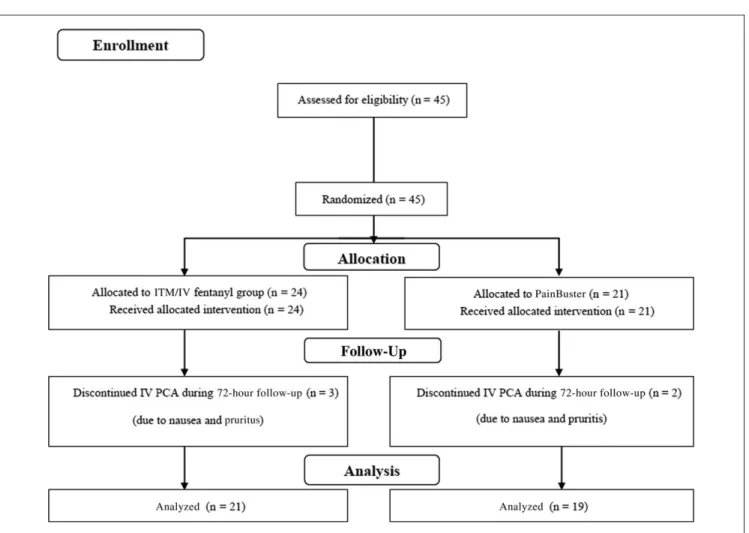
The institutional review board approved this study, and all donors provided written informed consent. This randomized controlled trial conformed to the Consoli- dated Standards of Reporting Trials (CONSORT) guide- lines with a CONSORT checklist and a diagram (Fig.

1). It was registered with the Australian New Zealand Clinical Trial Registry (ACTRN12612000530820).

Forty-five adults, 18 to 60 years old, who were under- going right hepatectomy were enrolled and randomly allocated via computer-generated randomization (Research Randomizer) to 1 of 2 groups: an ITM/IV fentanyl group or a PainBuster group. The ITM/IV fen- tanyl group received a single preoperative dose of ITM (400 lg) and a continuous postoperative infusion of IV fentanyl. The PainBuster group received ropivacaine wound infusion at the end of surgery.

The exclusion criteria were bleeding diathesis, neu- rological dysfunction (a preexisting lower limb neuro- logical deficit), recent systemic or local infections, a history of drug use, and treatment with opioids due to chronic pain.

Anesthesia monitoring included electrocardiogra-

phy; radial arterial and central pressure monitoring

(via an internal jugular catheter); pulse oximetry; cap-

nography; urine output, neuromuscular blockade,

and esophageal core temperature measurements. Pre-

medications were not given to the donors. Anesthesia

was induced with thiopental sodium (5 mg/kg), remi-

fentanil (0.1 lg/kg/minute), sevoflurane, and vecuro-

nium (0.15 mg/kg). Anesthesia was maintained with

isoflurane (1 MAC) in oxygen (inspired oxygen fraction

5 0.5) and with remifentanil (0.02-0.2 lg/kg/minute)

through an infusion pump. Additional vecuronium

was administered as appropriate. Ventilation was con-

trolled with a tidal volume of 6 to 8 mL/kg, and the

respiratory rate (8-10/minute) was adjusted to main-

tain an end tidal carbon dioxide pressure of 35 to 40

mm Hg. Intraoperative normothermia was maintained

by means of a warm blanket, a humidifier, and warm

IV fluids. Anesthetic drugs were titrated to maintain

the intraoperative blood pressure and heart rate

within 20% of the preoperative values. Hypotension

was defined as a decrease in the systolic arterial blood

pressure > 30% of the baseline value and was treated

with volume replacement or IV ephedrine (5 mg) as

necessary. Bradycardia (<50 bpm) was treated with

(3)

0.5 mg of atropine if it was needed. All operations were performed by the same surgical team. The surgi- cal incision was made along the right subcostal area with a medial extension to the xiphoid process (a J- shaped or hockey stick–shaped incision; Fig. 2).

26,27

In the ITM/IV fentanyl group, before the induction of anesthesia, an intrathecal injection of morphine sulfate (400 lg in 4 mL of a preservative-free 0.9%

saline solution) was made at the L3-L4 or L4-L5 level with a 27-gauge Whitacre spinal needle. At the end of surgery, a continuous IV fentanyl infusion (1500 lg of fentanyl in 100 mL of normal saline) was side- connected to the donor’s IV line to deliver fentanyl at 1 mL/hour.

In the PainBuster group, 2 soaker catheters [10-in., 20-gauge, multiholed ON-Q PainBuster (PS12507), I- Flow Corp., Lake Forest, CA] were inserted just before the closure of the peritoneal membrane. The catheters were inserted via the Seldinger method with introduc- ing needles and were located in the space along 2 sur- gical margins (subcostal and midline); the catheters were placed between the internal oblique and transver- salis fascia on the lateral side of the abdomen and in the preperitoneal plane at the midline (Fig. 2). An anes- thesiologist prepared the elastomeric pump [ON-Q PainBuster (PS12507I), I-Flow], which was preset to

deliver 300 mL of 0.5% ropivacaine at a constant rate of 4 mL/hour for 72 hours [infusion pressure 5 10 psi (corresponding to 517 mm Hg)]. After the placement of the catheter, a bolus dose of 0.75% ropivacaine (10 mL) was given, and the prefilled elastomeric pump was connected. Thereafter, the surgeon closed the fascia layer and skin, secured the infusion catheters to the skin, and fixed them with a transparent dressing.

After the operation, all donors were transferred to the postanesthesia care unit. They were monitored for the assessment of pain, nausea or vomiting, and sur- gical bleeding. Oxygen (5 L/minute) was provided to all donors via a facial mask for at least 24 hours after surgery. A visual analogue scale (VAS; 0-100) at rest and with coughing was used for donor pain assess- ment 4, 8, 12, 24, 48, and 72 hours after surgery.

The respiratory rate, saturation of peripheral oxygen, sedation, dizziness, nausea, vomiting, and pruritus were assessed.

In both groups, for rescue analgesic purposes, a 15- lg bolus of IV fentanyl was set to be delivered with a 15-minute lockout time for all donors. Rescue IV demerol (0.5 mg/kg) was administered if the VAS score was >50 despite rescue IV fentanyl administra- tion. Rescue IV opioid consumption was assessed 24, 48, and 72 hours after surgery.

Figure 1. CONSORT diagram.

(4)

The functional vital capacity and the forced expira- tory volume in 1 second were measured with a porta- ble spirometer (Micro, Micro Medical, Ltd., Rochester, United Kingdom) before surgery and on the first 3 postoperative days.

Wound complications, including hematoma, seroma, and wound discharge, were assessed. Occurrences of nausea and vomiting requiring IV ondansetron (4 mg), dizziness, headache, pruritus, atelectasis, backache, and postoperative ileus were counted. Sedation was assessed on a 5-point scale [(1) completely awake with eyes open, (2) drowsy, (3) dozing, (4) mostly sleeping, and (5) not responding]. The rescue medications were IV diphenhydramine (25 mg) every 8 hours on pruritus and IV ondansetron (4 mg) every 8 hours for nausea.

The total liver volume, graft volume, remnant liver volume, surgical and anesthetic times, time to extuba- tion from the end of surgery, first time to flatus, amounts of administered fluids, estimated blood loss, urine output, infused doses of remifentanil, postopera- tive hospital stay, and donor satisfaction scores were investigated. Aspartate aminotransferase, alanine ami- notransferase, and total bilirubin levels and prothrom- bin times (international normalized ratios) were analyzed immediately after the operation and on post- operative days 1 to 3.

The primary outcome was the VAS score at rest and with coughing. The secondary outcome measure was opioid consumption. We did not find any previous studies comparing PainBuster to ITM/IV fentanyl that were suitable for sample size calculations for this study. Therefore, the sample size was analyzed on the basis of a study comparing ITM/IV fentanyl PCA to IV fentanyl PCA alone in living liver donors

17

with a

power of 80% and a type I error of 5%, and the size was calculated to be 16 donors per group to detect a between-group VAS difference of 20 (with a standard deviation of 20) 48 hours after the operation. We decided to enroll at least 19 donors per group in this study in anticipation of a 20% dropout rate during the postoperative follow-up.

The normality of the data was tested with the Shapiro-Wilk test. The results are presented as means and standard deviations for normally distributed parameters and as medians and interquartile ranges for nonnormally distributed parameters. The Student t test or the Mann-Whitney rank-sum test was employed to compare intergroup differences, and the chi-square test was adopted for categorical variables.

The paired t test or the Wilcoxon signed-rank test with Bonferroni correction was used to compare IV fentanyl and meperidine consumption according to postoperative days within a group. A difference was regarded to be statistically significant when P < 0.05.

RESULTS

In all, 45 donors were enrolled in this study. Five

donors were excluded from the study (3 in the ITM/IV

fentanyl group and 2 in the PainBuster group) because

of nausea and pruritus during follow-up (Fig. 1). All

donors had an American Society of Anesthesiologists

physical status of I or II, and there were no significant

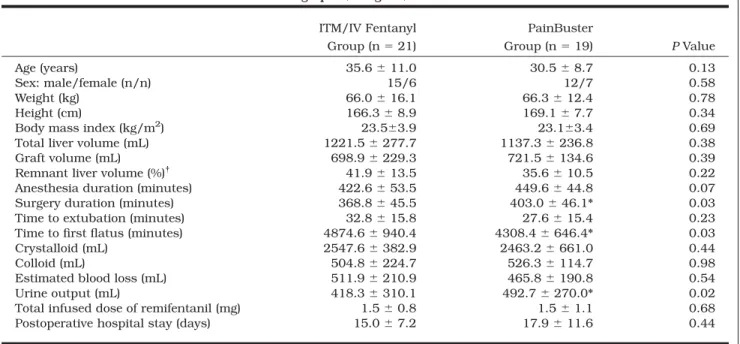
differences in the demographic data (Table 1). The sur-

gical and anesthetic data were similar between the

groups except for the surgical time: the duration was

significantly longer for the PainBuster group because

of the time required for PainBuster catheter insertion

Figure 2. Schematic diagram of wound catheter (PainBuster) placement (A) along the subcostal and midline incisional wound and

(B) at the transversus abdominis plane. The thick, solid lines in panel A delineate the cephalad-directed catheter placement with

the distal tips placed 2 to 3 cm below the xiphoid process. The asterisks in panel B delineate the transversus abdominis plane, and

the slashed, thick arrow indicates the insertion site of the catheter.

(5)

(P 5 0.03). The time to bowel recovery (manifested as the time to first flatus after surgery) was significantly shorter for the PainBuster group (P 5 0.03). Urine out- put during surgery was significantly higher in the PainBuster group (P 5 0.02; Table 1).

During the first 12 postoperative hours, the VAS score at rest was significantly lower for the ITM/IV

fentanyl group. The VAS scores at rest thereafter were similar between the groups. The VAS scores with coughing were similar between the groups throughout the study time period (Table 2).

Rescue IV meperidine consumption was similar between the groups, and the number of patients requiring rescue IV meperidine did not differ between TABLE 1. Demographic, Surgical, and Anesthetic Data

ITM/IV Fentanyl Group (n 5 21)

PainBuster

Group (n 5 19) P Value

Age (years) 35.6 6 11.0 30.5 6 8.7 0.13

Sex: male/female (n/n) 15/6 12/7 0.58

Weight (kg) 66.0 6 16.1 66.3 6 12.4 0.78

Height (cm) 166.3 6 8.9 169.1 6 7.7 0.34

Body mass index (kg/m

2

) 23.563.9 23.163.4 0.69

Total liver volume (mL) 1221.5 6 277.7 1137.3 6 236.8 0.38

Graft volume (mL) 698.9 6 229.3 721.5 6 134.6 0.39

Remnant liver volume (%)

41.9 6 13.5 35.6 6 10.5 0.22

Anesthesia duration (minutes) 422.6 6 53.5 449.6 6 44.8 0.07

Surgery duration (minutes) 368.8 6 45.5 403.0 6 46.1* 0.03

Time to extubation (minutes) 32.8 6 15.8 27.6 6 15.4 0.23

Time to first flatus (minutes) 4874.6 6 940.4 4308.4 6 646.4* 0.03

Crystalloid (mL) 2547.6 6 382.9 2463.2 6 661.0 0.44

Colloid (mL) 504.8 6 224.7 526.3 6 114.7 0.98

Estimated blood loss (mL) 511.9 6 210.9 465.8 6 190.8 0.54

Urine output (mL) 418.3 6 310.1 492.7 6 270.0* 0.02

Total infused dose of remifentanil (mg) 1.5 6 0.8 1.5 6 1.1 0.68

Postoperative hospital stay (days) 15.0 6 7.2 17.9 6 11.6 0.44

NOTE: The data are presented as means and standard deviations unless otherwise noted. The P values compare ITM/IV fentanyl to PainBuster.

*represents P < 0.05

Remnant liver volume 5 [(Total liver volume 2 Graft volume)/Total liver volume] 3 100

TABLE 2. VAS Results at Rest and With Coughing and Patient Satisfaction

Postoperative Time (Hours)

ITM/IV Fentanyl Group PainBuster Group

VAS at Rest

VAS With

Coughing VAS at Rest P Value

VAS With

Coughing P Value*

4 20.0 (0.0–30.0) 30.0 (20.0–50.0) 30.0 (20.0–50.0) 0.02* 50.0 (30.0–60.0) >0.99 8 10.0 (7.5–20.0) 30.0 (10.0–40.0) 30.0 (20.0–47.5) 0.02* 40.0 (30.0–60.0) 0.06 12 20.0 (7.5–30.0) 30.0 (17.5–42.5) 30.0 (20.0–47.5) 0.048* 40.0 (30.0–67.5) >0.99 24 20.0 (20.0–32.5) 40.0 (30.0–50.0) 30.0 (20.0–37.5) >0.99 50.0 (40.0–57.5) >0.99 48 20.0 (10.0–40.0) 40.0 (20.0–50.0) 20.0 (12.5–30.0) >0.99 40.0 (32.5–57.5) >0.99 72 10.0 (10.0–22.5) 30.0 (18.8–40.0) 20.0 (12.5–30.0) >0.99 30.0 (22.5–40.0) >0.99 Satisfaction

Postoperative Time (Hours)

ITM/IV Fentanyl Group

PainBuster

Group P Value

24 6.4 6 2.5 6.2 6 1.7 >0.99

48 6.4 6 2.2 6.3 6 1.7 >0.99

72 6.4 6 1.9 6.1 6 1.6 >0.99

NOTE: The data are presented as medians and interquartile ranges or as means and standard deviations.

The P values compare ITM/IV fentanyl to PainBuster.

*represents P < 0.05.

(6)

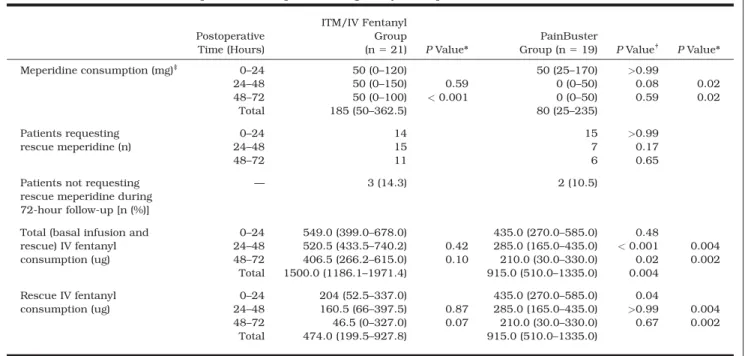
the groups. Rescue IV fentanyl requirements were sig- nificantly higher in the PainBuster group during the first 24 hours after surgery, but they became similar to the requirements in the ITM/IV fentanyl group 24 to 48 and 48 to 72 hours after surgery (Table 3).

With respect to IV opioid requirements and postop- erative times, the PainBuster group showed signifi- cantly reduced rescue IV fentanyl and meperidine consumption at 24 to 48 and 48 to 72 hours after

surgery versus 0 to 24 hours after surgery. In the ITM/IV fentanyl group, rescue IV fentanyl and meper- idine consumption 24 to 48 hours after surgery was not reduced significantly in comparison with their consumption 0 to 24 hours after surgery (Table 3).

The rates of wound complications, nausea and vom- iting requiring IV ondansetron, dizziness, and head- ache were not different for the 2 groups. Pruritus was more pronounced in the ITM/IV fentanyl group, TABLE 3. Opioid Consumption During Every Postoperative 24-Hour Time Interval

Postoperative Time (Hours)

ITM/IV Fentanyl Group

(n 5 21) P Value*

PainBuster

Group (n 5 19) P Value

P Value*

Meperidine consumption (mg)

0–24 50 (0–120) 50 (25–170) >0.99

24–48 50 (0–150) 0.59 0 (0–50) 0.08 0.02

48–72 50 (0–100) < 0.001 0 (0–50) 0.59 0.02

Total 185 (50–362.5) 80 (25–235)

Patients requesting rescue meperidine (n)

0–24 14 15 >0.99

24–48 15 7 0.17

48–72 11 6 0.65

Patients not requesting rescue meperidine during 72-hour follow-up [n (%)]

— 3 (14.3) 2 (10.5)

Total (basal infusion and rescue) IV fentanyl consumption (ug)

0–24 549.0 (399.0–678.0) 435.0 (270.0–585.0) 0.48

24–48 520.5 (433.5–740.2) 0.42 285.0 (165.0–435.0) < 0.001 0.004 48–72 406.5 (266.2–615.0) 0.10 210.0 (30.0–330.0) 0.02 0.002

Total 1500.0 (1186.1–1971.4) 915.0 (510.0–1335.0) 0.004 Rescue IV fentanyl

consumption (ug)

0–24 204 (52.5–337.0) 435.0 (270.0–585.0) 0.04

24–48 160.5 (66–397.5) 0.87 285.0 (165.0–435.0) >0.99 0.004

48–72 46.5 (0–327.0) 0.07 210.0 (30.0–330.0) 0.67 0.002

Total 474.0 (199.5–927.8) 915.0 (510.0–1335.0)

*The P values compare total or rescue IV fentanyl consumption with the initial 24-hour period (0–24 hours) within the group.

The P values compare ITM/IV fentanyl to PainBuster.

The data are presented as medians and interquartile ranges.

TABLE 4. Postoperative Complications

Side Effects or Complications

ITM/IV Fentanyl Group (n 5 21)

PainBuster

Group (n 5 19) P Value

Wound complication:

hematoma, seroma, or wound discharge (n)

5 6 0.58

Nausea (n) 4 5 0.58

Vomiting (n) 0 1 >0.99

Dizziness (n) 3 1 0.61

Headache (n) 1 0 >0.99

Pruritus (n) 10 5 0.17

Atelectasis (n) 1 0 >0.99

Backache (n) 1 4 0.17

Postoperative ileus (n) 1 0 >0.99

Sedation score at 6 hours* 2.0 (1.0–2.0) 2.0 (1.0–2.0) >0.99

Sedation score at 24 hours* 1.0 (1.0–1.0) 1.0 (1.0–1.0) 0.85

Sedation score at 48 hours* 1.0 (1.0–1.3) 1.0 (1.0–1.0) >0.99

*The data are presented as medians and interquartile ranges.

(7)

although this difference was without statistical signifi- cance. One donor in the ITM/IV fentanyl group showed atelectasis on a chest X-ray but recovered without complications. Backache due to prolonged bed rest was noticed in 1 donor in the ITM/IV fen- tanyl group and in 4 donors in the PainBuster group.

One patient in the ITM/IV fentanyl group showed postoperative ileus. The sedation scores were similar for the 2 groups (Table 4).

Serial changes in the perioperative aspartate amino- transferase and alanine aminotransferase levels, international normalized ratios, and total bilirubin levels were between the groups, and the median val- ues of these parameters reached a maximum on post- operative day 1 and showed gradual reductions thereafter (data not shown).

Pulmonary function tests were carried out for 16 donors in the ITM/IV fentanyl group and for 14 donors in the PainBuster group, and no significant intergroup differences were found in the forced expir- atory volume in 1 second or the functional vital capacity before surgery or on postoperative days 1, 2, and 3 (data not shown).

None of the donors in this study experienced sus- tained hepatic dysfunction or hepatic failure, renal failure, thromboembolism, sepsis, or death.

DISCUSSION

The clinical significance of this study lies in the fact that we evaluated whether PainBuster (local anes- thetic–based analgesia) could facilitate effective anal- gesia and be a substitute for ITM/IV fentanyl (an opioid-based analgesic method). A fast postoperative recovery and effective analgesia are crucial to living liver donors because they are previously healthy indi- viduals undergoing hepatectomy out of altruistic moti- vations.

3,10,11

In a recent meta-analysis,

28

multimodal enhanced recovery after surgery (ERAS) or fast-track pathways are reported to have been successfully implemented for hepatic surgery. Because severe postoperative pain can cause physically and psycho- logically significant distress in donors and impair the early recovery of normal daily activities, adequate pain control should be an imperative part of ERAS or fast-track pathways for liver donors. In a systematic review of 7 select studies using ERAS for hepatic sur- gery, epidural analgesia was used for pain control.

28

However, we believe that other safe and effective post- operative analgesic techniques may be used as part of future ERAS in liver donors.

Local anesthetic–based analgesia, if effective, can be beneficial because of fewer opioid side effects and fast postoperative bowel movement recovery. Postoperative bowel recovery is clinically important because pro- longed bowel immobility or postoperative ileus can contribute to complications such as delayed surgical wound healing, delayed ambulation, atelectasis, pneumonia, and deep vein thrombosis, which increase postoperative morbidities and lengthen the hospital stay.

29

Among several factors affecting post-

operative ileus, opioids contribute to its pathogenesis by depressing gastrointestinal transit.

29,30

Therefore, in addition to adequate postoperative pain manage- ment, the time to first flatus and the bowel recovery time are major concerns for liver donor surgery.

This study shows that PainBuster was less effective for analgesia during the first 12 postoperative hours, but it was comparable 12 to 72 hours after the opera- tion as manifested by VAS scores.

With respect to rescue analgesic use, PainBuster did not reduce rescue IV fentanyl or meperidine con- sumption significantly in comparison with the ITM/IV fentanyl regimen. Rescue IV opioid requirements with respect to postoperative times were also compared within each group. The PainBuster group demanded significantly less rescue IV fentanyl and meperidine at 24 to 48 and 48 to 72 hours after surgery versus 0 to 24 hours after surgery. In the ITM/IV fentanyl group, rescue fentanyl use was not reduced significantly at 24 to 48 or 48 to 72 hours after the operation in com- parison with 0 to 24 hours after surgery, and rescue IV meperidine consumption was significantly reduced only at 48 to 72 hours after the operation in compari- son with 0 to 24 hours after the operation. The ITM/

IV fentanyl regimen used IV fentanyl as the main supply of analgesia because the effect of ITM faded beyond the first 12 to 24 postoperative hours; there- fore, the rescue analgesic requirements were not reduced with the postoperative time. In the Pain- Buster group, local anesthetics were provided throughout the first 72 hours after the operation, and the rescue IV opioid requirements were reduced in comparison with those for the initial 24 hours.

Therefore, total opioid use was significantly higher in the ITM/IV fentanyl group versus the PainBuster group (Table 3). In the local anesthetic–based regi- men, the donors who were administered PainBuster received less total systemic opioid during the study period than the donors in the ITM/IV fentanyl group.

Therefore, the PainBuster group showed a signifi- cantly reduced first time to flatus in comparison with the ITM/IV fentanyl group.

31-34

However, the short- ened time to first flatus in the, the assignment of the values for the time to first flatus are reversed for the 2 groups. please make reassignments of the values. The clinical significance of this briefly reduced time to first flatus in the PainBuster group may be downsized if the analgesic efficacy of PainBuster does not prove to be as potent as that of ITM/IV fentanyl.

In the ITM/IV fentanyl regimen, neuraxial morphine can provide excellent and prolonged analgesia for up to 24 hours

35

because morphine is poorly lipophilic and tends to stay in the cerebrospinal fluid; therefore, it can spread to spinal cord dorsal horn opioid recep- tors and produce excellent selective spinal analgesia.

According to a previous study by Ko et al.,

17

who

compared ITM/IV fentanyl to IV fentanyl PCA alone,

ITM/IV fentanyl significantly reduced VAS scores at

rest and with coughing for up to 30 and 24 hours,

respectively. Our study compared ITM/IV fentanyl to

PainBuster, and the VAS score at rest was

(8)

significantly reduced in the ITM/IV fentanyl group up to 12 hours. Despite the superior quality of the anal- gesia, caution is required because ITM can reach cen- tral nervous system centers such as the respiratory center and chemoreceptor trigger zone and cause sig- nificant adverse effects such as respiratory depression and postoperative nausea and vomiting. None of the donors presented with respiratory depression, and the rates of postoperative nausea and vomiting were not significantly different between the groups. Pruritus happened more in the ITM/IV fentanyl group, although without statistical significance.

In the PainBuster group, 4 donors complained of back pain, and 2 requested rescue IV fentanyl analge- sia mainly for the subsidence of back pain and not for pain at the wound. In contrast to neuraxial analgesia by ITM, local anesthetic wound infusion can provide analgesia to the localized wound only. PainBuster also does not cover visceral pain. This may indicate that although the PainBuster regimen can spare total opioid use, any discomfort or pain caused by a periop- eratively prolonged still position and viscerally origi- nating pain may not be well controlled. On the other hand, 2 donors in the PainBuster group were effec- tively managed with PainBuster (resting VAS scores <

30 and coughing VAS scores < 40) with the consump- tion of only 45 to 75 lg of IV fentanyl throughout the study period. Analgesia via PainBuster showed a wide range of efficacy with variations in rescue IV opioid requirements, and this may be attributed to individ- ual differences in patients’ pain thresholds and the position of the catheters.

19

Proper catheter placement is a prerequisite for PainBuster to be effective.

19

Although catheter placement is not a highly demand- ing skill, it is important for catheters to be positioned at the target innervated site. The donors’ body builds may also have affected the analgesic efficacy because two 10-in. catheters may not have been long enough to cover some robust donors’ wound incisions. In this study, 2 PainBuster catheters were placed with refer- ence to the intercostal nerve innervations of the ante- rior abdominal wall. The anterior abdominal wall (skin, muscles, and parietal peritoneum) is innervated by the anterior rami of the lower 6 thoracic nerves (T7-T12) and the first lumbar nerve (L1). The terminal branches of these somatic nerves course through the lateral abdominal wall within a plane between the internal oblique and transversalis abdominis muscles, and they finally approach the preperitoneal space at the anterior abdominal wall.

36

We deliberately designed the wound catheters to be placed along the subcostal margin within a plane similar to that of a transversus abdominis plane block.

37

Therefore, we considered PainBuster to have a regional nerve block component along with wound infiltration by the local anesthetics. We expected one catheter along the sub- costal margin to cause the right-side, unilateral anal- gesia and the other catheter along the midline to control pain at the anterior abdominal wall (T7-T10), caused by the midline extension of the right subcostal incision and the retraction of the wound during sur-

gery. The wound incision in this study was innervated mainly by T7-T10 intercostal nerves, so the 10-in.

catheters were inserted at the skin, from which point the distal tips of catheters were located 2 to 3 cm below the xiphoid process. In this way, local anes- thetics may spread downward with a gravity effect and provide analgesia from the upper to the lower intercostal nerve branches, should the catheter not be long enough in comparison with the donor’s body.

Coagulopathy is a major concern for liver donor analgesia. This is the reason that many clinicians are reluctant to use epidural analgesia, and we also used ITM in our regimen. However, ITM with IV opioid–

based analgesia carries the potential risk of respira- tory depression, so this alternative regimen of local anesthetic pain control has been sought to reduce systemic opioid consumption and eliminate neuraxial opioid use. Recently, Chan et al.

24

reported that a continuous infusion of ropivacaine at the wound in right hepatectomy for hepatocellular carcinoma, was effective in controlling postoperative pain and sparing opioid consumption. Chan et al. used a continuous infusion of 0.25% ropivacaine at 4 mL/hour and observed a peak plasma ropivacaine concentration at 48 to 68 hours without toxic side effects. The subcos- tal incision and the plane of catheter insertion were similar to those in our study. They also reported a beneficial effect of PainBuster on respiratory mechan- ics, but our results did not reveal such. In our study, pulmonary function tests (the forced expiratory vol- ume in 1 second and the functional vital capacity), which required a painful force of exertion, were not affected by the 2 methods of analgesia (data not shown). Our results may be different from those of Chan et al.’s because of individual variations in pain thresholds or the different pain perceptions of the patients with hepatocellular carcinoma and previously healthy liver donors.

38

Other alternative approaches to liver donor analge- sia without the need for a neuraxial block include a subcostal transversus abdominis plane block per- formed at the end of surgery or a preoperatively per- formed thoracic paravertebral block.

37,39,40

These techniques may also be used as a part of a multimo- dal approach to pain control in future ERAS pathways.

There are a few limitations to this study. First, this study was a randomized, open-label study. Two differ- ent regimens were compared, and we considered it unethical to administer saline-filled PainBuster to the ITM/IV fentanyl group to blind this study. Donors in the groups were not aware of the alternative analgesia regimen. Second, the plasma concentration of ropiva- caine was not investigated. Ropivacaine is metabo- lized via the hepatic cytochrome P-450 pathway (cytochrome P450 3A4 and cytochrome P450 1A2);

therefore, the concentration of ropivacaine in plasma

may accumulate in liver donors.

24

Two recent studies

reported local anesthetic plasma concentrations in

hepatic resection.

24,41

One study reported a peak con-

centration of 2.05 6 0.78 lg/mL 68 hours after the

(9)

operation (the termination of instillation) from a bolus administration of 20 mL of 0.25% ropivacaine fol- lowed by a 4 mL/hour continuous infusion of 0.25%

ropivacaine via PainBuster.

24

No one in that study showed signs of toxicity even though 2 patients showed a plasma concentration > 3 lg/mL. Another study of epidural analgesia reported that the plasma concentration was elevated with 0.2% levobupivacaine close to the lower limits of toxic ranges but far below cardiac toxicity and without clinical adversity.

41

We administered 555 mg of ropivacaine during the first 24 hours (a bolus administration of 10 mL of 0.75%

ropivacaine followed by a continuous infusion of 0.5%

ropivacaine at a rate of 4 mL/hour) and 480 mg/24 hours thereafter. This dosage has been chosen for clinical use at our hospital and does not cause any neurological or cardiovascular complications. Local anesthetic dose adjustments for patients with hepatic dysfunction have not been established yet, nor has an exact threshold for the plasma concentration at which local anesthetic intoxication occurs. Many reports of ropivacaine intoxication have been based on inadver- tent intravascular injections of ropivacaine.

42-45

Therefore, despite the limitation of not measuring the ropivacaine concentration in plasma, we believe that 0.5% ropivacaine at 4 mL/hour can be safely instituted.

In conclusion, PainBuster may provide postopera- tive pain control comparable to that of ITM/IV fen- tanyl with a faster bowel recovery time, but its analgesic efficacy is less satisfactory than that of ITM/IV fentanyl during the first 12 postoperative hours. PainBuster has also shown inter-individual variability in its analgesic quality. Therefore, in future investigations, local anesthetic–based analgesia via PainBuster may be considered not as the sole means of pain control but rather as an analgesic tool bridg- ing the patient to 24-hour-lasting ITM analgesia.

REFERENCES

1. Chhibber A, Dziak J, Kolano J, Norton JR, Lustik S. Anes- thesia care for adult live donor hepatectomy: our experien- ces with 100 cases. Liver Transpl 2007;13:537–542.

2. Hashikura Y, Ichida T, Umeshita K, Kawasaki S, Mizokami M, Mochida S, et al.; for Japanese Liver Trans- plantation Society. Donor complications associated with living donor liver transplantation in Japan. Transplanta- tion 2009;88:110–114.

3. Wen TF, Chen ZY, Yan LN, Li B, Zeng Y, Zhao JC, et al.

Measures for increasing the safety of donors in living donor liver transplantation using right lobe grafts. Hepa- tobiliary Pancreatic Dis Int 2007;6:590–595.

4. Cammu G, Troisi R, Cuomo O, de Hemptinne B, Di Florio E, Mortier E. Anaesthetic management and outcome in right-lobe living liver-donor surgery. Eur J Anaesthesiol 2002;19:93–98.

5. Belghiti J. Will improved donor safety increase liver don- ations? Transplantation 2009;88:19–20.

6. de Villa V, Lo CM. Liver transplantation for hepatocellular carcinoma in Asia. Oncologist 2007;12:1321–1331.

7. Lee S, Ahn C, Ha T, Moon D, Choi K, Song G, et al. Liver transplantation for hepatocellular carcinoma: Korean expe- rience. J Hepatobiliary Pancreat Sci 2010;17:539–547.

8. Lee SG. Asian contribution to living donor liver trans- plantation. J Gastroenterol Hepatol 2006;21:572–574.

9. Lee SG, Hwang S, Kim KH, Ahn CS, Moon DB, Ha TY, et al. Toward 300 liver transplants a year. Surg Today 2009;39:367–373.

10. Sato Y, Kurosaki I, Yamamoto S, Nakatsuka H, Oya H, Shirai Y, et al. Postoperative management for donor safety in living related donor liver transplantation. Hepa- togastroenterology 2003;50:196–200.

11. Hwang GS, McCluskey SA. Anesthesia and outcome after partial hepatectomy for adult-to-adult donor transplanta- tion. Curr Opin Organ Transplant 2010;15:377–382.

12. Choi SJ, Gwak MS, Ko JS, Kim GS, Ahn HJ, Yang M, et al. The changes in coagulation profile and epidural catheter safety for living liver donors: a report on 6 years of our experience. Liver Transpl 2007;13:62–70.

13. Clarke H, Chandy T, Srinivas C, Ladak S, Okubo N, Mitsakakis N, et al. Epidural analgesia provides better pain management after live liver donation: a retrospective study. Liver Transpl 2011;17:315–323.

14. Callum JL, Karkouti K, Lin Y. Cryoprecipitate: the cur- rent state of knowledge. Transfus Med Rev 2009;23:177–

188.

15. Schumann R, Zabala L, Angelis M, Bonney I, Tighiouart H, Carr DB. Altered hematologic profiles following donor right hepatectomy and implications for perioperative analgesic management. Liver Transpl 2004;10:363–368.

16. Borromeo CJ, Stix MS, Lally A, Pomfret EA. Epidural catheter and increased prothrombin time after right lobe hepatectomy for living donor transplantation. Anesth Analg 2000;91:1139–1141.

17. Ko JS, Choi SJ, Gwak MS, Kim GS, Ahn HJ, Kim JA, et al. Intrathecal morphine combined with intravenous patient-controlled analgesia is an effective and safe method for immediate postoperative pain control in live liver donors. Liver Transpl 2009;15:381–389.

18. Yong BH, Tsui SL, Leung CC, Lo CM, Liu CL, Fan ST, Young K. Management of postoperative analgesia in liv- ing liver donors. Transplant Proc 2000;32:2110.

19. Beaussier M, El’Ayoubi H, Schiffer E, Rollin M, Parc Y, Mazoit JX, et al. Continuous preperitoneal infusion of ropivacaine provides effective analgesia and accelerates recovery after colorectal surgery: a randomized, double- blind, placebo-controlled study. Anesthesiology 2007;

107:461–468.

20. Bianconi M, Ferraro L, Ricci R, Zanoli G, Antonelli T, Giulia B, et al. The pharmacokinetics and efficacy of ropivacaine continuous wound instillation after spine fusion surgery. Anesth Analg 2004;98:166–172.

21. Bianconi M, Ferraro L, Traina GC, Zanoli G, Antonelli T, Guberti A, et al. Pharmacokinetics and efficacy of ropiva- caine continuous wound instillation after joint replace- ment surgery. Br J Anaesth 2003;91:830–835.

22. Heavner JE. Pharmacology of local anesthetics. In: Long- necker DE, Brown DL, Newman MF, Zapol WM, eds.

Anesthesiology. 2nd ed. New York, NY: McGraw-Hill Med- ical; 2012:767.

23. Fredman B, Zohar E, Tarabykin A, Shapiro A, Mayo A, Klein E, Jedeikin R. Bupivacaine wound instillation via an electronic patient-controlled analgesia device and a double-catheter system does not decrease postoperative pain or opioid requirements after major abdominal sur- gery. Anesth Analg 2001;92:189–193.

24. Chan SK, Lai PB, Li PT, Wong J, Karmakar MK, Lee KF, Gin T. The analgesic efficacy of continuous wound instil- lation with ropivacaine after open hepatic surgery.

Anaesthesia 2010;65:1180–1186.

25. Revie EJ, McKeown DW, Wilson JA, Garden OJ, Wigmore

SJ. Randomized clinical trial of local infiltration plus

patient-controlled opiate analgesia vs. epidural analgesia

(10)

following liver resection surgery. HPB (Oxford) 2012;14:

611–618.

26. Heisterkamp J, Kazemier G. A J-shaped subcostal inci- sion reduces the incidence of abdominal wall complica- tions in liver transplantation. Liver Transpl 2009;15:453.

27. Heisterkamp J, Marsman HA, Eker H, Metselaar HJ, Tilanus HW, Kazemier G. A J-shaped subcostal incision reduces the incidence of abdominal wall complications in liver transplantation. Liver Transpl 2008;14:1655–1658.

28. Coolsen MM, Wong-Lun-Hing EM, van Dam RM, van der Wilt AA, Slim K, Lassen K, Dejong CH. A systematic review of outcomes in patients undergoing liver surgery in an enhanced recovery after surgery pathways. HPB (Oxford) 2013;15:245–251.

29. Story SK, Chamberlain RS. A comprehensive review of evidence-based strategies to prevent and treat postopera- tive ileus. Dig Surg 2009;26:265–275.

30. Holte K, Kehlet H. Postoperative ileus: progress towards effective management. Drugs 2002;62:2603–2615.

31. Harvey KP, Adair JD, Isho M, Robinson R. Can intrave- nous lidocaine decrease postsurgical ileus and shorten hospital stay in elective bowel surgery? A pilot study and literature review. Am J Surg 2009;198:231–236.

32. Marret E, Rolin M, Beaussier M, Bonnet F. Meta-analysis of intravenous lidocaine and postoperative recovery after abdominal surgery. Br J Surg 2008;95:1331–1338.

33. Sun Y, Li T, Wang N, Yun Y, Gan TJ. Perioperative sys- temic lidocaine for postoperative analgesia and recovery after abdominal surgery: a meta-analysis of randomized controlled trials. Dis Colon Rectum 2012;55:1183–1194.

34. Wang LW, Wong SW, Crowe PJ, Khor KE, Jastrzab G, Parasyn AD, Walsh WR. Wound infusion with local anaesthesia after laparotomy: a randomized controlled trial. ANZ J Surg 2010;80:794–801.

35. Slevin KA, Ballantyne JC. Management of acute postop- erative pain. In: Longnecker DE, Brown DL, Newman

MF, Zapol WM, eds. Anesthesiology. 2nd ed. New York, NY: McGraw-Hill Medical; 2012:1297–1310.

36. Moore KL. Clinically Oriented Anatomy. 3rd ed. Philadel- phia, PA: Williams & Wilkins; 1992:137–142.

37. Niraj G, Kelkar A, Jeyapalan I, Graff-Baker P, Williams O, Darbar A, et al. Comparison of analgesic efficacy of subcostal transversus abdominis plane blocks with epi- dural analgesia following upper abdominal surgery.

Anaesthesia 2011;66:465–471.

38. Cywinski JB, Parker BM, Xu M, Irefin SA. A comparison of postoperative pain control in patients after right lobe donor hepatectomy and major hepatic resection for tumor. Anesth Analg 2004;99:1747–1752.

39. Ho AM, Karmakar MK, Cheung M, Lam GC. Right tho- racic paravertebral analgesia for hepatectomy. Br J Anaesth 2004;93:458–461.

40. Moussa AA. Opioid saving strategy: bilateral single-site thoracic paravertebral block in right lobe donor hepatec- tomy. Middle East J Anesthesiol 2008;19:789–801.

41. Lauprecht AE, Wenger FA, El Fadil O, Walz MK, Groeben H. Levobupivacaine plasma concentrations following major liver resection. J Anesth 2011;25:369–375.

42. Iwama H. A case of normal ropivacaine concentration causing grand mal seizure after epidural injection. Eur J Anaesthesiol 2005;22:322–323.

43. Dernedde M, Furlan D, Verbesselt R, Gepts E, Boogaerts JG. Grand mal convulsion after an accidental intravenous injection of ropivacaine. Anesth Analg 2004;98:521–523.

44. Satsumae T, Tanaka M, Saito S, Inomata S. Convulsions after ropivacaine 300 mg for brachial plexus block. Br J Anaesth 2008;101:860–862.

45. M€ uller M, Litz RJ, H€ uler M, Albrecht DM. Grand mal

convulsion and plasma concentrations after intravascu-

lar injection of ropivacaine for axillary brachial plexus

blockade. Br J Anaesth 2001;87:784–787.

수치

Figure 1. CONSORT diagram.
TABLE 2. VAS Results at Rest and With Coughing and Patient Satisfaction
TABLE 4. Postoperative Complications

참조

관련 문서

(2002) Blinded, randomized, multicenter study to evaluate single administration pegfilgrastim once per cycle versus daily filgrastim as an adjunct to chemotherapy in

Alveolar ridge augmentation with titanium mesh and a combination of autogenous bone and anorganic bovine bone: a 2-year prospective study.. Corinaldesi G, Pieri F, Sapigni

In conclusion, as the TDRD7 gene expression levels of the cataract patients found in the test conducted for 70 objects living in local region in this

This study deals with the collection of solar energy and its storage in all-glass solar vacuum tubes for different types of header design, flow passage

For this, the study presented a methodology to evaluate the driving safety and mobility of personal mobility devices, and measured acceleration and speed in

In this paper, the strains of a filament wound pressure tank were monitored using a number of embedded FBG sensors in real time during the

Through a functional study using pharmacologic depletion of macrophages as well as histophathologic evaluation of the flap wound margin, we found a unique phenotypic

Grape S, Kirkham KR, Akiki L, Albrecht E: Transversus abdominis plane block versus local anesthetic wound infiltration for optimal analgesia after