Open Access
Treatment Outcomes of Rituximab Plus Hyper-CVAD in
Korean Patients with Sporadic Burkitt or Burkitt-like Lymphoma:
Results of a Multicenter Analysis
Original Article
Purpose
This study was conducted to evaluate outcomes in adult patients with Burkitt lymphoma (BL) or Burkitt-like lymphoma treated with an rituximab plus hyper-CVAD (R-hyper-CVAD) regimen by focusing on tolerability and actual delivered relative dose intensity (RDI).
Materials and Methods
Patients 20 years of age and pathologically diagnosed with BL or Burkitt-like lymphoma were treated with at least one cycle of R-hyper-CVAD as the first-line treatment in this study. Eligible patients’ case report forms were requested from their physicians to obtain clinical and laboratory data for this retrospective study.
Results
Forty-three patients (median age, 51 years) from 14 medical centers in Korea were analyzed, none of which were infected with human immunodeficiency virus. The majority of patients had advanced diseases, and 24 patients achieved a complete response (75.0%).
After a median follow-up period of 20.0 months, 2-year event-free and overall survival rates were 70.9% and 81.4%, respectively. Eleven patients (25.6%) were unable to complete the R-hyper-CVAD regimen, including six patients due to early death. The RDIs of adriamycin, vincristine, methotrexate, and cytarabine were between 60% and 65%, which means less than 25% of patients received greater than 80% of the planned dose of each drug. Poor performance status was related to the lower RDIs of doxorubicin and methotrexate.
Conclusion
R-hyper-CVAD showed excellent treatment outcomes in patients who were suitable for dose-intense chemotherapy. However, management of patients who are intolerant to a dose-intense regimen remains problematic due to the frequent occurrence of treatment- related complications.
Key words
Burkitt lymphoma, Rituximab, CVAD protocol + + + + + + + + + + + + + + + + + + + +
+ + + + + + + + + + + + + + + + + + + + + + + + + + + + + + + + + + + + + + + + + + + + + + + + + + + + + + + + + + + + + + + + + + + + + + + + + + + + + + + + + + + + + + + + + + + + + + + + + + + + + + + + + + + + + + + + + + + + + + + + + + + + + + + + + + + + + + + + + + + + + + + + + + + + + + + + + + + + + + + + + + + + + + + + + + + + + + + + + + + + + + + + + + + + + + + + + + + + + + + + + + + + + + + + + + + + + + + + + + + + + + + + + + + + + + + + + + + + + + + +
Correspondence: Seok Jin Kim, MD, PhD Division of Hematology-Oncology,
Department of Medicine, Samsung Medical Center, Sungkyunkwan University School of Medicine, 81 Irwon-ro, Gangnam-gu, Seoul 135-710, Korea Tel: 82-2-3410-1766
Fax: 82-2-3410-1754 E-mail: [email protected] Received March 3, 2014 Accepted March 25, 2014 Published online October 28, 2014
Junshik Hong, MD1 Seok Jin Kim, MD2 Jae-Sook Ahn, MD3 Moo Kon Song,MD4 Yu Ri Kim, MD5 Ho Sup Lee,MD6 Ho-Young Yhim, MD7 Dok Hyun Yoon, MD8 Min Kyoung Kim, MD9 Sung Yong Oh, MD10 Yong Park, MD11 Yeung-Chul Mun, MD12 Young Rok Do, MD13 Hun-Mo Ryoo, MD14 Je-Jung Lee, MD3 Jae Hoon Lee,MD1 Won Seog Kim, MD2 Cheolwon Suh, MD8
1Department of Internal Medicine,
Gachon University Gil Medical Center, Incheon,
2Department of Medicine, Samsung Medical Center, Sunkyunkwan University School of Medicine, Seoul,
3Department of Hematology-Oncology, Chonnam National University Hwasun Hospital, Hwasun, 4Department of Hematology-Oncology, Pusan National University Hospital, Busan,
5Department of Internal Medicine, Gangnam Severance Hospital,
Yonsei University College of Medicine, Seoul,
6Department of Internal Medicine, Kosin University Gospel Hospital, Busan,
7Department of Internal Medicine, Chonbuk National University Hospital, Jeonju,
8Department of Oncology, Asan Medical Center, University of Ulsan College of Medicine, Seoul,
9Department of Internal Medicine, Yeungnam University Medical Center, Daegu,
10Department of Internal Medicine, Dong-A University Hospital, Busan,
11Department of Internal Medicine, Korea University College of Medicine, Seoul,
12Department of Internal Medicine,
Ewha Womans University Mokdong Hospital, Seoul,
13Department of Hematology-Oncology, Keimyung University Dongsan Medical Center, Keimyung University School of Medicine, Daegu,
14Department of Internal Medicine, Daegu Catholic University Medical Center, Daegu, Korea
Introduction
Burkitt lymphoma (BL) is a highly aggressive B-cell lymphoma accounting for 1%-5% of all non-Hodgkin lymphomas (NHL) in adults [1,2]. BL was first identified as a childhood endemic tumor with a geographical distribution [3]. Since then, worldwide and sporadic occurrence of BL has been reported, and BL has become a well-known human immunodeficiency virus (HIV)–associated malignancy [3].
As BL tumor cells are characterized by rapid cellular growth, conventional regimens for NHL have shown disappointing results [4]. On the other hand, dose-intense, multi-fraction- ated chemotherapeutic regimens have been shown to improve treatment outcomes [5-7]. A recent population- based study [8] demonstrated the impact of regimen intensity on treatment outcome of adult BL patients, reporting a 2-year overall survival (OS) rate of only 38.8% for cyclophosphamide, adriamycin, vincristine, and prednisone (CHOP) or CHOP-like regimens, whereas survival rates of 68.6% to 82.8% were achieved for dose-intense regimens.
In addition to BL, other lymphomas morphologically resembling BL were classified as “atypical BL/Burkitt-like lymphoma” by the 2001 World Health Organization (WHO) classification, and these morphologically similar lymphomas are thought to lie on a continuum between BL and diffuse large B-cell lymphoma (DLBCL) [9]. In the 2008 WHO classfication, classification of these atypical BL/Burkitt-like lymphomas was more refined, including a new provisional entity, “B-cell lymphoma, unclassifiable, with features intermediate between BL and DLBCL,” which we define as BL-U in this report [9]. Despite these changes in classifica- tion, there are no established treatment guidelines for these lymphomas. Thus, dose-intense treatment strategies similar to those used for BL are typically used for aggressive lymphomas with overlapping features of BL and DLBCL [10].
Among dose-intense treatment regimens, hyper-CVAD regimen (hyper-fractionated cyclophosphamide, adriamycin, vincristine, and dexamethasone alternated with methotrex- ate plus cytarabine) has been proposed for treatment of highly aggressive lymphoid malignancies by the MD Anderson Cancer Center [6].
Since addition of rituximab to hyper-CVAD regimen (R- hyper-CVAD) has been shown to improve treatment outcomes [11], R-hyper-CVAD has been used as a primary treatment option for BL. Using this approach, a complete remission (CR) rate of 86% and 3-year OS rate of 89% without any induction death were observed [11]. However, significant toxicity, delayed treatment, and treatment-related early death are not uncommon in actual clinical practice since patient characteristics often differ from those in clinical trials.
As elderly and frail patients are commonly treated in clinical practice, information on real-life outcomes of the regimen could be a useful reference for physicians who treat BL. In addition, although ethnic differences might affect drug tolerability and efficacy, outcomes of R-hyper-CVAD in Asian patients have never been reported. Thus, we analyzed the outcomes of adult Korean patients with sporadic BL or BL-U treated with R-hyper-CVAD regimen [11] by focusing on tolerability and delivered dose intensity.
Materials and Methods
1. Patients
We reviewed the medical records of 14 hospitals belonging to the Consortium for Improving Survival of Lymphoma (CISL) [12] and selected patients who fulfilled the following inclusion criteria: 1) age 20 years, 2) pathologically diag- nosed as BL or BL-U according to the 2008 WHO criteria, and 3) treated with at least one cycle of R-hyper-CVAD as the first-line systemic treatment. The Institutional Review Boards of each participating center approved this study and waived informed consent since no actual intervention was performed due to its retrospective nature.
2. Case report forms
Case report forms (CRF) for eligible patients were requested from physicians who treated the patients in this retrospective study (CISL-1201) from March 2012 to March 2013. The CRF contained a fill-in section on patient characteristics such as gender, age at diagnosis, anti-HIV antibody status, the International Prognostic Index (IPI) factors, bone marrow involvement, and crucial laboratory data, including complete blood cell counts and serum lactate dehydrogenase, among other values. Patient height, weight, accurate dose of each administered drug, and date of drug administration were obtained in order to calculate relative dose intensity (RDI). Hematologic toxicity and grade 3 or greater non-hematologic toxicity was reviewed for each cycle in the CRF. Special events during immunochemotherapy, such as tumor lysis syndrome, cerebellar ataxia due to cytarabine, and infectious episodes, were investigated in detail. The results of the interim and final treatments according to the revised response criteria for malignant lymphomas [13] were collected along with data on relapse, progression, or death of patients.
3. Statistical analysis
Event-free survival (EFS) denotes survival free from progressive disease or discontinuation of therapy for any reason. To eliminate the impact of early death on overall treatment outcomes, we also used disease-free survival (DFS), which is the same parameter as EFS except that death by any cause other than progression of lymphoma is not considered. OS denotes survival free from death by any cause. The Kaplan-Meier method and log-rank test were used for survival analysis. Univariate and multivariate analyses were performed by using a backward Cox regres- sion model with variables of p < 0.1 in the univariate analysis. Mann-Whitney tests were used to compare means between the two groups. All values were two-sided, and statistical significance was accepted at a level of p < 0.05.
Results
1. Patient characteristics
Data on 43 patients from 14 medical centers were collected and analyzed. All patients had sporadic BL or BL-U (i.e., no patients had HIV-associated lymphoma) and were of a median age of 51 years. Dates of initial diagnosis ranged from February 2006 to March 2013, and the majority of patients had advanced diseases at the time of diagnosis.
More than half of patients were in Ann Arbor stage IV (n=29, 67.4%), had two or more extranodal sites (n=23, 53.5%), and were at high or high-intermediate risk (n=25, 58.1%) according to the standard IPI. A summary of patients’
characteristics is shown in Table 1.
2. Treatment and tumor response
Prophylactic measures, doses and intervals of cytotoxic drugs, number of planned cycles, central nervous system (CNS) prophylaxis, and overall schedule of the regimen were as those in a previous study [11], except for administration of rituximab (two patients received 375 mg/m2of rituximab on the first and eighth days of each cycle, whereas others received the same dose of rituximab on the first day of each cycle only). According to the recommendations of the Korean National Health Insurance Guideline, granulocyte-colony stimulating factor (G-CSF) was administered daily starting the first day patients showed an absolute neutrophil count (ANC) < 1,000/µL until the third consecutive day patients showed an ANC > 3,000/µL in each cycle. Of the 32 evaluable patients, 24 patients (75%) achieved a CR, and six patients experienced disease progression in the final response evaluation (Table 2).
3. Survival analysis
Seven patients experienced relapse after CR, with two patients experiencing CNS involvement and five showing extra-CNS sites (two patients with skin and subcutaneous nodules, two patients with bone marrow involvement, and one patient with right inguinal lymph node involvement).
After a median follow-up period of 20.0 months, the 2-year DFS, EFS, and OS rates of patients were 78.6%, 70.9%, and 81.4%, respectively (Fig. 1). According to univariate analysis, bone marrow involvement, an absolute lymphocyte count (ALC) < 1,200/µL, and being a member of the standard IPI- defined high-risk group were all associated with poorer EFS.
Among IPI factors, age > 60 years and a poor Eastern Cooperative Oncology Group performance status (ECOG PS) contributed to lower EFS, whereas more than one extranodal Table 1. Patient characteristics
Parameter No. (%) (n=43)
Gender
Male 29 (67.4)
Age (yr)
Median (range) 51 (20-83)
20-40 14 (32.6)
41-60 17 (39.5)
> 60 12 (27.9)
Ann Arbor stage
I 3 (7.0)
II 7 (16.3)
III 4 (9.3)
IV 29 (67.4)
ECOG performance status
2 13 (30.2)
3 4 (9.3)
Lactate dehydrogenase
Elevated 32 (74.4)
Extranodal lesion
2 sites 23 (53.5)
Standard international prognostic index
Low risk 9 (20.9)
Low-intermediate risk 9 (20.9)
High-intermediate risk 12 (27.9)
High risk 13 (30.2)
B Symptoms
Present 16 (37.2)
Bone marrow involvement
Involved 9 (20.9)
Bulky lesion
Present 10 (23.3)
ECOG, Eastern Cooperative Oncology Group.
Table 2. Results of interim and final response evaluations according to the revised criteria
Interim Final
Complete response 26 24
Partial response 7 1
Stable disease 2 1
Progressive disease 1 6
Not evaluable (NE) 7 11
Causes of NE Six early deaths Seven patients NE in the interim response evaluation One discontinuation of therapy due to Three discontinuations of therapy due to
intolerant toxicity and impaired intolerant toxicity and impaired PS
performance status (PS) One could not complete the treatment schedule due to delayed marrow recovery
Table 3. Univariate and multivariate analyses of event-free survival in the 43 patients Parameter
For event-free survival For disease-free survival
Hazard ratio 95% CI p-value Hazard ratio 95% CI p-value Univariate analysis
High risk by standard IPI 5.7 2.0-16.4 0.001 2.9 0.8-10.6 0.1
Age > 60 yr 3.1 1.1-8.5 0.034 1.7 0.4-6.6 0.452
> 1 extranodal site 2.0 0.7-5.9 0.208 1.5 0.4-5.4 0.525
Elevated serum lactate 1.5 0.4-5.2 0.553 0.9 0.2-3.5 0.872
dehydrogenase
Ann Arbor stage III/IV 2.2 0.5-9.6 0.31 1.4 0.3-6.4 0.706
ECOG PS 2 6.3 2.2-18.1 0.001 3.2 0.9-11.7 0.073
Age > 40 yr 3.5 0.8-15.6 0.101 2.3 0.5-11.0 0.294
Bulky lesion 0.8 0.2-3.0 0.786 0.8 0.2-4.0 0.836
B Symptoms 1.6 0.6-4.4 0.652 1.8 0.5-6.1 0.374
Bone marrow involvement 3.4 1.2-9.6 0.021 2.3 0.6-9.0 0.228
Absolute lymphocyte 3.5 1.2-10.2 0.021 2.6 0.7-9.5 0.141
count < 1,200/µL Multivariate analysis
With individual IPI factors
Age > 60 yr 3.9 1.3-12.1 0.018 For disease-free survival,
ECOG PS 2 7.4 2.4-23.3 0.001 multivariate analysis could not be
Absolute lymphocyte 3.7 1.2-11.4 0.022 performed since most parameters had a p-value of 0.1 count < 1,200/µL
High risk standard IPI as - - -
a single parameter
High risk by standard IPI 5.8 2.0-16.6 0.001
Absolute lymphocyte 3.5 1.2-10.3 0.022
count < 1,200/µL
CI, confidence interval; IPI, International Prognostic Index; ECOG PS, Eastern Cooperative Oncology Group performance status.
site, stage III or IV, and elevated serum lactate dehydroge- nase levels did not. According to multivariate analysis, ALC
< 1,200/µL and being a member of the high-risk group were independent risk factors (Table 3). In contrast to the Cox regression test for EFS, most parameters did not have an impact on DFS (Table 3).
4. Toxicities
Early deaths were reported in cycles 1A (n=2; age, 51 and 64 years, respectively), 1B (n=1; age, 66 years), 2A (n=2; age, 67 and 72 years, respectively), and 2B (n=1; age, 47 years).
Five of them (except for one 47-year-old patient) had an
ECOG PS 2. Causes of treatment-related mortality (TRM) were bacterial septicemia (n=5) and tumor lysis syndrome (n=1; age, 51 years). In cycle 1A, four patients (9.3%) experi- enced tumor lysis syndrome. Two patients recovered from tumor lysis syndrome with the support of hemodialysis, one patient recovered with only hydration and oral allopurinol use, and the other patient died of rapidly progressing tumor lysis syndrome during preparation for continuous renal replacement therapy. Cerebellar ataxia also occurred in four patients during cycle 1B. All of these patients recovered, but re-introduction of cytarabine was limited thereafter, and one patient could not complete R-hyper-CVAD. Most patients had grade 3 or 4 hematologic toxicity. Of these patients, 34 patients (79.1%) experienced anemia, 42 patients (97.7%) had neutropenia, and 28 patients (86.0%) had thrombocytopenia.
Eight patients experienced grade 3 or 4 non-hematologic toxicity, such as alanine transaminase elevation (n=4), nausea (n=2), diarrhea (n=1), and rituximab-induced pneumonitis (n=1). Thirty-nine patients (90.7%) had febrile neutropenia, and bacterial growth was reported in the blood cultures of 16 patients (41.0%).
5. Dose intensities
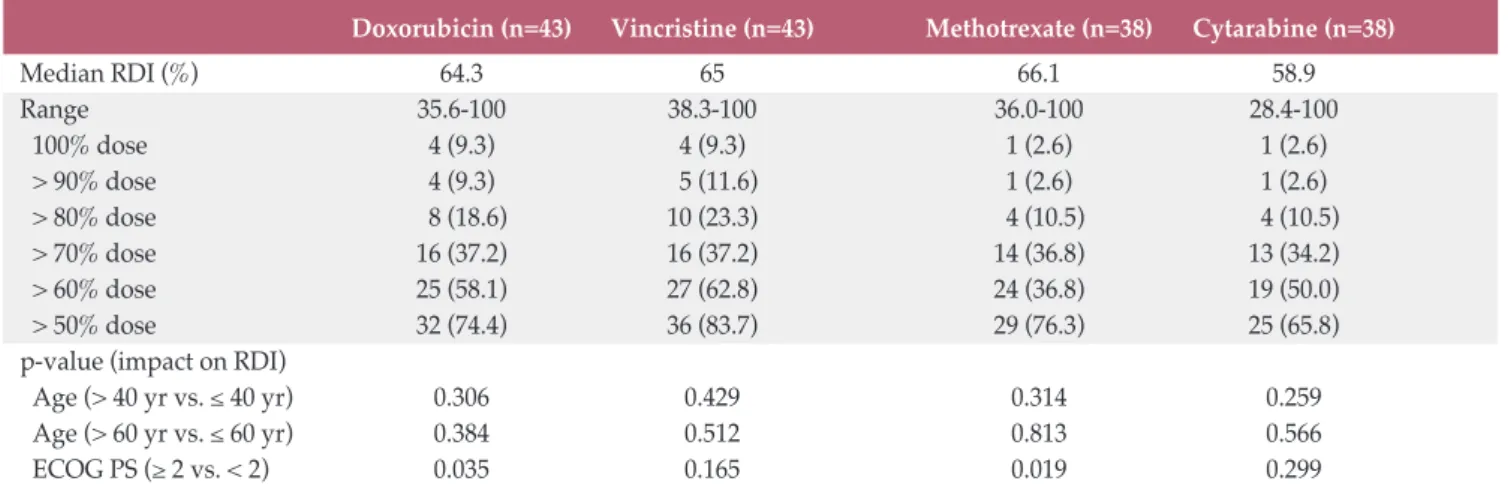
The median RDIs of adriamycin, vincristine, methotrexate, and cytarabine were 64.3%, 65.0%, 66.1%, and 58.9%, respectively. Only 10.5% to 23.3% of patients received greater than 80% of the planned doses of chemotherapeutic agents.
When we analyzed patients according to age (> 40 years vs.
40 years, or > 60 years vs. 60 years), there were no differences in RDIs. However, PS was related to differences in RDIs of doxorubicin and methotrexate (Table 4). The
Probability of survival
0.0 0.2 0.4 0.6 0.8 1.0
0 10 20 30 40 50 60
Time (mo)
Overall survival Disease-free suvival Event-free survival
Fig. 1. Kaplan-Meier curves of time to progression, event-free survival, and overall survival of the analyzed patients.
Table 4. Dose intensities of doxorubicin, vincristine, methotrexate, and cytarabine in the analyzed patients
Doxorubicin (n=43) Vincristine (n=43) Methotrexate (n=38) Cytarabine (n=38)
Median RDI (%) 64.3 65 66.1 58.9
Range 35.6-100 38.3-100 36.0-100 28.4-100
100% dose 4 (9.3) 4 (9.3) 1 (2.6) 1 (2.6)
> 90% dose 4 (9.3) 5 (11.6) 1 (2.6) 1 (2.6)
> 80% dose 8 (18.6) 10 (23.3) 4 (10.5) 4 (10.5)
> 70% dose 16 (37.2) 16 (37.2) 14 (36.8) 13 (34.2)
> 60% dose 25 (58.1) 27 (62.8) 24 (36.8) 19 (50.0)
> 50% dose 32 (74.4) 36 (83.7) 29 (76.3) 25 (65.8)
p-value (impact on RDI)
Age (> 40 yr vs. 40 yr) 0.306 0.429 0.314 0.259
Age (> 60 yr vs. 60 yr) 0.384 0.512 0.813 0.566
ECOG PS ( 2 vs. < 2) 0.035 0.165 0.019 0.299
Values are presented as number (%) unless otherwise indicated. RDI, relative dose intensity; ECOG PS, Eastern Cooperative Oncology Group performance status.
Table 5.Treatment outcomes of Burkitt or Burkitt-like lymphoma in adults from previous studies SourceStudy typeRegimenNo.Median ageComplete ED rateEvent-freeOverall (yr)remission rate (%)survival (%)survival (%) Without rituximab Soussain et al. RetrospectiveLMB pediatric6526893/6564 (3 yr)74 (3 yr) (1995) [14]protocol Thomas et al. ProspectiveHyper-CVAD2648815/26No report49 (3 yr) (1999) [6]regimen Lee et al. ProspectiveCALGB 92515444807/54No reportMedian 3.6 yr (2001) [15] Mead et al. ProspectivemCODOX-M/IVAC5337No reportNo report64 (2 yr)67 (2 yr) (2008) [16] Choi et al.RetrospectiveLMB pediatric3847744/3875 (5 yr)68 (5 yr) (2009) [17]protocol With rituximab Thomas et al. ProspectiveHyper-CVAD3146860/3180 (3 yr)89 (3 yr) (2006) [11]regimen Barnes et al. RetrospectivemCODOX-4046904/4074 (3 yr)77 (3 yr) (2011) [18]M/IVAC Corazzelli et al. ProspectivemCODOX-M/IVAC15No report1000/1592 (4 yr)No report (2012) [10] Intermesoli et al. ProspectiveGMALL protocol105477912/10567 (3 yr)75 (3 yr) (2013) [19] Present study RetrospectiveHyper-CVAD regimen4351756/4370.9 (2 yr)81.4 (2 yr) (2014) ED, early death.
median number of days required for a complete cycle of immunochemotherapy for each patient was 31.0 days (range, 21 to 54.8 days). There was no difference in the number of days required for a cycle of R-hyper-CVAD among patients
60 years versus > 60 years old (p=1.000). Patients with an ECOG PS of 2 tended to have longer cycles compared to those with a PS of 0 or 1. However, these results were not sta- tistically significant (p=0.065).
Discussion
In the current study, R-hyper-CVAD showed overall treatment outcomes comparable to those of previous retrospective and prospective studies of dose-intense regi- mens (Table 5).
However, the result was not as excellent as a clinical trial reported by Thomas et al. [11]: in the current study, a substantial number of patients could not complete immunochemotherapy due to toxicities or impaired PS, including six episodes of TRM (14.0%). It is contrast to the patient characteristics of study by Thomas et al. [11], in which the patients were relatively younger (median age, 46 years), including three patients (9.7%) with a resected disease, and in particular, there were no patients with an ECOG PS of 3 or 4. These results imply that the treatment outcome of R-hyper-CVAD can be affected by patient suitability for dose-intense chemotherapy. Similar findings were also reported in a recent population-based analysis of 3,691 patients [7]. In that study, which was outside the context of clinical trials, the Surveillance Epidemiology and End Results (SEER) data analysis estimated time trends for outcomes of BL in the United States. According to the results, more effective therapies are needed for older patients with BL despite improvements in survival from the 1973-2001 era to 2002-2008 era [7].
To escape early death, excellent supportive care is essen- tial. Considering an incidence of febrile neutropenia of over 90% with five episodes of death due to bacterial septic shock in the current study, as well as frequent infectious complica- tions in other studies [5,10,11,18,20], prophylactic antibiotics and G-CSF should be utilized [21]. In addition, prophylaxis with rasburicase can reduce fatal consequences of tumor lysis syndrome [22]. A gap between DFS and EFS in the current study strongly suggests that survival could be substantially improved by reducing early death. Therefore, supportive care should be strictly and routinely performed.
Despite the fact that higher IPI scores and lower ALCs were shown to be poor prognostic factors of EFS, their significance was lost in terms of DFS. Therefore, they might
be risk factors for fatal complications of dose-intense treatment, rather than risk factors for treatment failure.
However, as the prognostic factors in this study are only exploratory, these findings should be interpreted cautiously.
Poorer PS had a significant impact on the unsatisfactory RDIs of doxorubicin and methotrexate. Concerns regarding development of peripheral neuropathy and cerebellar ataxia might mitigate the effect of poor PS on the reduced RDIs of vincristine and cytarabine. Overall, poor PS seems to keep patients from maintaining an adequate RDI of several drugs.
Since treatment of acute lymphoblastic leukemia is determined according to a patient’s age (adults vs. young and adolescents) due to tolerability of the protocols [23], a similar question may be raised in the case of BL. It is reasonable to question whether or not a particular treatment protocol is as suitable for patients in their 20s as those applied to patients older than 60. Considering that age was one of the independent prognostic factors in the current study, R-hyper-CVAD might not be an optimal treatment for elderly patients. However, in our study, there were no significant differences in RDI or number of days required for a complete cycle of R-hyper-CVAD according to age. These results suggest that some elderly patients can tolerate R-hyper-CVAD well. A review article in 2009 on treatment of adult patients with BL [24] concluded that a part of patients over 40 years of age could have highly favorable outcomes to modern dose-intense, multi-agent chemother- apy. Their conclusion is also in line with a previous study on R-hyper-CVAD in BL by Thomas et al. [11], in which nine of 31 patients (29%) were 60 years, and all were in continuous CR except for only one episode of later death due to infection. Therefore, selection of patients according to chronological age seems not to be an ideal strategy. Instead, other tools such as comprehensive geriatric assessment can be performed in patients with BL or Burkitt-like lymphoma in the future.
For those who are clearly intolerant to dose-intense regimens, alternative therapeutic strategies should be sought. A recent uncontrolled prospective study conducted by Dunleavy et al. [25] reported that lower-dose, short- course chemotherapy consisting of infused etoposide, dox- orubicin, and cyclophosphamide along with vincristine, prednisone, plus a double dose of rituximab (SC-EPOCH- RR) showed promising outcomes among 11 patients with HIV-associated BL. In that study, 100% progression-free survival and 90% OS were achieved after a median follow- up time of 73 months, and toxicities were manageable.
Although patients receiving SC-EPOCH-RR were older (median age, 44 years vs. 25 years; p=0.03) than the 19 patients treated with standard dose-adjusted EPOCH-R, and patients receiving SC-EPOCH-RR also showed poorer PS (55% vs. 16% of patients with ECOG PS 2, p=0.04), the
outcomes were comparable [25]. Therefore, focusing on exposure-concentration time of drugs rather than peak con- centration can be a reasonable strategy, and future studies are warranted, especially in a subgroup of patients who are not suitable for dose-intense chemotherapy.
Although the activity of rituximab has been demonstrated in most B-cell malignancies, data on the role of rituximab in BL or BL-U are limited. Two phase II studies [10,11] and several retrospective studies [18,20] have demonstrated that rituximab contributes to the improvement of OS in patients with BL or Burkitt-like lymphoma. A retrospective popula- tion-based study compared OS between patients on ritux- imab (n=111) to those without rituximab therapy (n=52), and according to their univariate analysis, addition of rituximab confirmed an association with improved OS, mainly in the cohort of patients aged 40-65. However, when adjusted for age and chemotherapy regimen, this association failed to maintain significance [8]. Compared to the MD Anderson study, a lower dose of rituximab was administered in the current study due to limitations in national insurance cover- age, which might have an impact on outcomes. However, upon assessing the results of previous studies with or with- out rituximab, the role of rituximab does seems to be, at least, not absolute. Rather, more refined patient selection, maxi- mization of supportive care, and efforts to improve dose intensity are more important considerations and future efforts should focus on how to solve these problems.
Since we did not conduct a central pathologic review and did not analyze outcomes according to fluorescence in situ hybridization due to the scarcity of tested patients, other high-grade mature B-cell lymphomas such as DLBCL may be included in this patient population, and the poor prognosis of double-hit B-cell lymphoma may not be reflected, which is an obvious weakness of this study.
Notwithstanding, we believe that our assertion on the
limitation of R-hyper-CVAD in terms of toxicity and its resultant insufficient dose intensity in certain frail patients is still appropriate.
Conclusion
R-hyper-CVAD is an effective treatment regimen for highly aggressive B-cell lymphomas such as BL. However, due to its significant toxicity and unsatisfactory RDI among more frail Korean patients, a more tolerable regimen with preserved efficacy is required for frail patients with BL or Burkitt-like lymphomas, even in the rituximab era.
Conflicts of Interest
Conflict of interest relevant to this article was not reported.
Acknowledgments
This study was supported by a grant from the Samsung Biomedical Research Institute (CB02111), and by the Basic Science Research Program through the National Research Foundation of Korea (NRF), funded by the Ministry of Education, Science and Technology (NRF-2012R1A1A200857 3).
1. Linch DC. Burkitt lymphoma in adults. Br J Haematol.
2012;156:693-703.
2. Huh J. Epidemiologic overview of malignant lymphoma. Ko- rean J Hematol. 2012;47:92-104.
3. Magrath I. The pathogenesis of Burkitt's lymphoma. Adv Cancer Res. 1990;55:133-270.
4. Ostronoff M, Soussain C, Zambon E, Ibrahim A, Bosq J, Bayle C, et al. Burkitt's lymphoma in adults: a retrospective study of 46 cases. Nouv Rev Fr Hematol. 1992;34:389-97.
5. Mead GM, Sydes MR, Walewski J, Grigg A, Hatton CS, Pescosta N, et al. An international evaluation of CODOX-M and CODOX-M alternating with IVAC in adult Burkitt's lym-
phoma: results of United Kingdom Lymphoma Group LY06 study. Ann Oncol. 2002;13:1264-74.
6. Thomas DA, Cortes J, O'Brien S, Pierce S, Faderl S, Albitar M, et al. Hyper-CVAD program in Burkitt's-type adult acute lym- phoblastic leukemia. J Clin Oncol. 1999;17:2461-70.
7. Costa LJ, Xavier AC, Wahlquist AE, Hill EG. Trends in sur- vival of patients with Burkitt lymphoma/leukemia in the USA: an analysis of 3691 cases. Blood. 2013;121:4861-6.
8. Wasterlid T, Brown PN, Hagberg O, Hagberg H, Pedersen LM, D'Amore F, et al. Impact of chemotherapy regimen and rituximab in adult Burkitt lymphoma: a retrospective popu- lation-based study from the Nordic Lymphoma Group. Ann
References
Oncol. 2013;24:1879-86.
9. Thomas DA, O'Brien S, Faderl S, Manning JT Jr, Romaguera J, Fayad L, et al. Burkitt lymphoma and atypical Burkitt or Burkitt-like lymphoma: should these be treated as different diseases? Curr Hematol Malig Rep. 2011;6:58-66.
10. Corazzelli G, Frigeri F, Russo F, Frairia C, Arcamone M, Es- posito G, et al. RD-CODOX-M/IVAC with rituximab and in- trathecal liposomal cytarabine in adult Burkitt lymphoma and 'unclassifiable' highly aggressive B-cell lymphoma. Br J Haematol. 2012;156:234-44.
11. Thomas DA, Faderl S, O'Brien S, Bueso-Ramos C, Cortes J, Garcia-Manero G, et al. Chemoimmunotherapy with hyper- CVAD plus rituximab for the treatment of adult Burkitt and Burkitt-type lymphoma or acute lymphoblastic leukemia.
Cancer. 2006;106:1569-80.
12. Suh C, Kim WS, Kim JS, Park BB. Review of the clinical re- search conducted by the Consortium for Improving Survival of Lymphoma of the Korean Society of Hematology Lym- phoma Working Party. Blood Res. 2013;48:171-7.
13. Cheson BD, Pfistner B, Juweid ME, Gascoyne RD, Specht L, Horning SJ, et al. Revised response criteria for malignant lym- phoma. J Clin Oncol. 2007;25:579-86.
14. Soussain C, Patte C, Ostronoff M, Delmer A, Rigal-Huguet F, Cambier N, et al. Small noncleaved cell lymphoma and leukemia in adults. A retrospective study of 65 adults treated with the LMB pediatric protocols. Blood. 1995;85:664-74.
15. Lee EJ, Petroni GR, Schiffer CA, Freter CE, Johnson JL, Barcos M, et al. Brief-duration high-intensity chemotherapy for pa- tients with small noncleaved-cell lymphoma or FAB L3 acute lymphocytic leukemia: results of cancer and leukemia group B study 9251. J Clin Oncol. 2001;19:4014-22.
16. Mead GM, Barrans SL, Qian W, Walewski J, Radford JA, Wolf M, et al. A prospective clinicopathologic study of dose-modi- fied CODOX-M/IVAC in patients with sporadic Burkitt lym- phoma defined using cytogenetic and immunophenotypic criteria (MRC/NCRI LY10 trial). Blood. 2008;112:2248-60.
17. Choi MK, Jun HJ, Lee SY, Kim KH, Lim DH, Kim K, et al.
Treatment outcome of adult patients with Burkitt lymphoma:
results using the LMB protocol in Korea. Ann Hematol.
2009;88:1099-106.
18. Barnes JA, Lacasce AS, Feng Y, Toomey CE, Neuberg D, Michaelson JS, et al. Evaluation of the addition of rituximab to CODOX-M/IVAC for Burkitt's lymphoma: a retrospective analysis. Ann Oncol. 2011;22:1859-64.
19. Intermesoli T, Rambaldi A, Rossi G, Delaini F, Romani C, Pogliani EM, et al. High cure rates in Burkitt lymphoma and leukemia: a Northern Italy Leukemia Group study of the Ger- man short intensive rituximab-chemotherapy program.
Haematologica. 2013;98:1718-25.
20. Maruyama D, Watanabe T, Maeshima AM, Nomoto J, Taniguchi H, Azuma T, et al. Modified cyclophosphamide, vincristine, doxorubicin, and methotrexate (CODOX-M)/ifos- famide, etoposide, and cytarabine (IVAC) therapy with or without rituximab in Japanese adult patients with Burkitt lym- phoma (BL) and B cell lymphoma, unclassifiable, with features intermediate between diffuse large B cell lymphoma and BL.
Int J Hematol. 2010;92:732-43.
21. Freifeld AG, Bow EJ, Sepkowitz KA, Boeckh MJ, Ito JI, Mullen CA, et al. Clinical practice guideline for the use of antimicro- bial agents in neutropenic patients with cancer: 2010 update by the infectious diseases society of america. Clin Infect Dis.
2011;52:e56-93.
22. Goldman SC, Holcenberg JS, Finklestein JZ, Hutchinson R, Kreissman S, Johnson FL, et al. A randomized comparison be- tween rasburicase and allopurinol in children with lymphoma or leukemia at high risk for tumor lysis. Blood. 2001;97:2998- 3003.
23. Alvarnas JC, Brown PA, Aoun P, Ballen KK, Bellam N, Blum W, et al. Acute lymphoblastic leukemia. J Natl Compr Canc Netw. 2012;10:858-914.
24. Kelly JL, Toothaker SR, Ciminello L, Hoelzer D, Holte H, La- Casce AS, et al. Outcomes of patients with Burkitt lymphoma older than age 40 treated with intensive chemotherapeutic reg- imens. Clin Lymphoma Myeloma. 2009;9:307-10.
25. Dunleavy K, Pittaluga S, Shovlin M, Steinberg SM, Cole D, Grant C, et al. Low-intensity therapy in adults with Burkitt's lymphoma. N Engl J Med. 2013;369:1915-25.