韓藥作誌(Korean J. Medicinal Crop Sci.) 18(6) : 405 − 408 (2010)
405
수집 조 종자의 지방산 조성
김성민*·장경우**·허진우**·윤성탁**†·지승진**·김정봉***
*공주대학교 산업과학대학, **단국대학교 생명자원과학대학, ***농촌진흥청 국립농업과학원
Fatty Acids Composition of Foxtail millet ( Setaria italica BEAUVOIS) Seeds Collected in South Korea
Seong Min Kim*, Qing yu Zhang**, Xu Zhen Yu**, Seong Tak Yoon**†, Soung Jin Ji** and Jung Bong Kim***
*College of Industrial Science, Kongju National University, Yesan 340-802, Korea.
**College of Bio-resources Science, Dankook Univ.,Cheonan 330-714, Korea.
***National Agrobiodiversity Center, NAAS, RDA, Suwon 441-853, Korea
ABSTRACT : Some fatty acids(palmitic acid, stearic acid, oleic acid, linoleic acid and linolenic acid) in foxtail millet seeds were evaluated. In this study, 32 varieties of accession collected from different place of South Korea were used in order to evaluate their fatty acid composition and concentration. These samples were analyzed by GC with HP20 column. Significant variability in individual fatty acids was observed. The palmitic acid ranged from 10.9 to 13.5%, stearic acid from 2.5 to 8.3%, oleic acid from 10.0 to 15.8%, linoleic acid from 62.5 to 67.9% and linolenic acid ranged from 3.0 to 5.2%. This vari- ability can be exploited for selection of plant and for studying the genetic variability in millet. These selections can also be utilized for genetic improvement of the crops.
Key Words : Fatty Acid, Gas Chromatographic, Foxtail Millet, Seeds
INTRODUCTION
Fatty acid include saturated and unsaturated acid and It depends on the presence of unsaturated double bond in the fatty acid chain (De Geus et al., 2001). Different Double bond at different place is named different acids.
Essential fatty acids are polyunsaturated fatty acid.
Linoleic acid (C18:2) and a-linolenic acid (C18:3) are the parent compounds of the mega-6( ω -6) and omega-3( ω -3) fatty acid series, respectively (De Geus et al., 2001).
They are very important for human health, because they cannot be synthesized inside the body. The essential fatty acids are very important to human immune system to help regulate blood pressure. Linolenic acid and linoleic acid are found in some foods such as fish, shellfish flaxseed (linn seed), soya oil, canola (rapeseed) oil, hemp oil, chia seed, pumkin seed, sunflower seed, cotton seed oil, leafy vegetables and walnut. The importance of fatty acid analysis has gained much attention because of the
nutritional and health implications. The most common procedure for the analysis is the conversion of fatty acid components to methylester in order to improve their volatility. Essential fatty acids are verified to prevent coronary heart disease, hypertension, type 2 diabetes, and in some patients with renal disease, rheumatoid arthritis, ulcerative colitis crohn’s disease, and chronic obstructive pulmonary disease (Simopoulos, 1991).
There are many papers focusing the analysis of fatty acid in plant seed such as flaxseed (Degenhardt et al ., 2002), grape seed oil (Cao And Ito, 2003), Thai Durian aril (Phutdhawong, 2005), Australian purlane (Liu et al , 2000), Calodendrum capense thumb (Munavu, 1983), rapeseed(Daun and Mazur, 1983), Tamaridus indica L. (Andriamanantena, et al ., 1982), and China chestnut (Berry, 1982).
Therefore, the objective of this research is to evaluate the composition of palmitic acid, stearic acid, linoleic acid, a- linolenic acid and oleic acid in foxtail millet seeds.
†
Corresponding author: (Phone) +82-41-550-3623 (E-mail) [email protected]
Received 2010 November 11 / 1st Revised 2010 December 15 / 2nd Revised 2010 December 21 / Accepted 2010 December 27
김성민·장경우·허진우·윤성탁·지승진·김정봉
406
MATERIALS AND METHODS
1. Sample and chemicals
Fatty acids analyzed from foxtail millet seeds by the Gas Chromatographic (model and made in country). The seeds stored at 4-5 ℃ refrigerator before the experiment. Chemicals of chloroform methanol Petroleum Ether Toluene NaCl NaOH and 14% BF
3in methanol were used for analysis.
Reagent grade for GC (Mallinck rodt Baker. Lnc.phillopsbur.
NJ 08865 USA) and pentadcanoic acids ordered from SIGMA chemical (CO.P.O. Box st. louis, Mo 63178 USA) used as an internal standard.
2. Internal standard
The Internal standard solution was prepared by dissolving 100 ㎎ in 100 ㎖ of methanol.
3. Sample protocol
The sample flour of 0.2 g is weighed in a 50 ㎖ conical centrifuge tube and mixed with 5 ㎖ solvent [chloroform : methanol = 1 : 1(v/v)] and Internal standard 1 ㎖ . It is then vortex-mixed for 10s and sonication 60 mins and mixed with 5 ㎖ 0.5% NaCl solution. After vortex-mixed sonication of 10min., centrifuged for 15 min. Allowed to reach a speed of 2000 rpm and temperature 4 ℃ and then stopped imme- diately. Great care was taken during this transfer to avoid the lower layer. After collecting the down tier liquid cover the conical centrifuge tube with foil and shaked by hand lightly. Dried under a stream of nitrogen (shake speed 250 rpm and temperature 45 ℃ ) in a pume hood. 0.5 ㎖
toluene and 2 ㎖ 0.5 N NaOH added in methanol solution vortex-mixed and heated for 5 min at 85 ℃ . After cooling in hume hood, 2 ㎖ of BF
3are added and then Vortex-mixed and heated for 5 min at 85 ℃ . The mixture is cooled and subsequent portions of 10 ㎖ petroleum ether and 10 ㎖ of water added. vortex-mixed for 15s by hand was heavily placed in a centrifuge allowed to reach a speed of 2000 rpm and make sure temperature 4 ℃ after 10min and then stopped immediately. After collecting up tier liquid, we used filter paper and Sodium sulfide (Na
2SO
4) and made sure that there is no water in the liquid. Dried the liquid under a stream of nitrogen in the hume hood. 1 ㎖ of petroleum ether added in the glass tube, collected all the liquid and put them in cap vial and submitted to GC analysis.
RESULTS
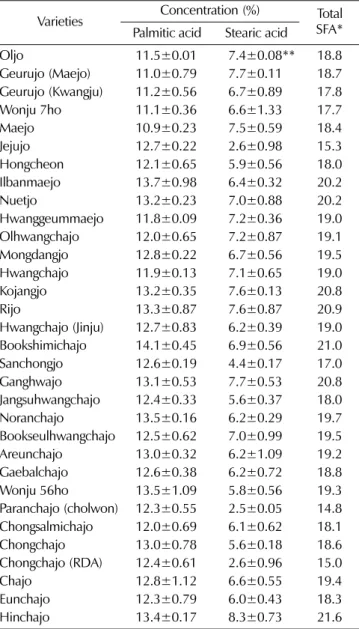
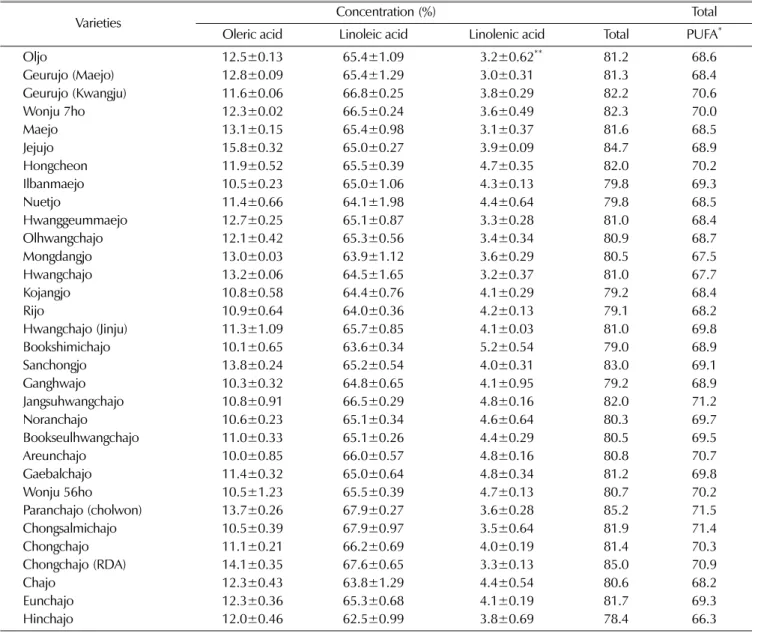
The comparison of saturated and unsaturated fatty acids from millet seeds (Tables 1 and 2) by GC are given in this section. We analyzed five fatty acids in the foxtail millet seeds. They are palmitic acid, stearic acid, oleic acid, linoleic acid and linolenic acid. All of the accessions contain oleic acid, linoleic acid and linolenic acid as a major unsaturated fatty acids when analyzed by GC (Fig.
1). Total amount of unsaturated fatty acids in foxtail millet
Table 1.
Percentage (%)of saturated fatty acids analyzed by GC.
Varieties Concentration (%) Total Palmitic acid Stearic acid SFA*
Oljo 11.5±0.01 7.4±0.08** 18.8
Geurujo (Maejo) 11.0±0.79 7.7±0.11 18.7 Geurujo (Kwangju) 11.2±0.56 6.7±0.89 17.8
Wonju 7ho 11.1±0.36 6.6±1.33 17.7
Maejo 10.9±0.23 7.5±0.59 18.4
Jejujo 12.7±0.22 2.6±0.98 15.3
Hongcheon 12.1±0.65 5.9±0.56 18.0
Ilbanmaejo 13.7±0.98 6.4±0.32 20.2
Nuetjo 13.2±0.23 7.0±0.88 20.2
Hwanggeummaejo 11.8±0.09 7.2±0.36 19.0 Olhwangchajo 12.0±0.65 7.2±0.87 19.1
Mongdangjo 12.8±0.22 6.7±0.56 19.5
Hwangchajo 11.9±0.13 7.1±0.65 19.0
Kojangjo 13.2±0.35 7.6±0.13 20.8
Rijo 13.3±0.87 7.6±0.87 20.9
Hwangchajo (Jinju) 12.7±0.83 6.2±0.39 19.0 Bookshimichajo 14.1±0.45 6.9±0.56 21.0
Sanchongjo 12.6±0.19 4.4±0.17 17.0
Ganghwajo 13.1±0.53 7.7±0.53 20.8
Jangsuhwangchajo 12.4±0.33 5.6±0.37 18.0
Noranchajo 13.5±0.16 6.2±0.29 19.7
Bookseulhwangchajo 12.5±0.62 7.0±0.99 19.5
Areunchajo 13.0±0.32 6.2±1.09 19.2
Gaebalchajo 12.6±0.38 6.2±0.72 18.8
Wonju 56ho 13.5±1.09 5.8±0.56 19.3
Paranchajo (cholwon) 12.3±0.55 2.5±0.05 14.8 Chongsalmichajo 12.0±0.69 6.1±0.62 18.1
Chongchajo 13.0±0.78 5.6±0.18 18.6
Chongchajo (RDA) 12.4±0.61 2.6±0.96 15.0
Chajo 12.8±1.12 6.6±0.55 19.4
Eunchajo 12.3±0.79 6.0±0.43 18.3
Hinchajo 13.4±0.17 8.3±0.73 21.6
*SFA: saturated fatty acid
**Values represent the average of three replicates±standard deviation (SD).
수집 조 종자의 지방산 조성
407 Table 2.
Percentage*(%)of unsaturated fatty acids analyzed by GC.
Varieties Concentration (%) Total
Oleric acid Linoleic acid Linolenic acid Total PUFA
*Oljo 12.5±0.13 65.4±1.09
3.2±0.62
**81.2 68.6
Geurujo (Maejo) 12.8±0.09 65.4±1.29 3.0±0.31 81.3 68.4
Geurujo (Kwangju) 11.6±0.06 66.8±0.25 3.8±0.29 82.2 70.6
Wonju 7ho 12.3±0.02 66.5±0.24 3.6±0.49 82.3 70.0
Maejo 13.1±0.15 65.4±0.98 3.1±0.37 81.6 68.5
Jejujo 15.8±0.32 65.0±0.27 3.9±0.09 84.7 68.9
Hongcheon 11.9±0.52 65.5±0.39 4.7±0.35 82.0 70.2
Ilbanmaejo 10.5±0.23 65.0±1.06 4.3±0.13 79.8 69.3
Nuetjo 11.4±0.66 64.1±1.98 4.4±0.64 79.8 68.5
Hwanggeummaejo 12.7±0.25 65.1±0.87 3.3±0.28 81.0 68.4
Olhwangchajo 12.1±0.42 65.3±0.56 3.4±0.34 80.9 68.7
Mongdangjo 13.0±0.03 63.9±1.12 3.6±0.29 80.5 67.5
Hwangchajo 13.2±0.06 64.5±1.65 3.2±0.37 81.0 67.7
Kojangjo 10.8±0.58 64.4±0.76 4.1±0.29 79.2 68.4
Rijo 10.9±0.64 64.0±0.36 4.2±0.13 79.1 68.2
Hwangchajo (Jinju) 11.3±1.09 65.7±0.85 4.1±0.03 81.0 69.8
Bookshimichajo 10.1±0.65 63.6±0.34 5.2±0.54 79.0 68.9
Sanchongjo 13.8±0.24 65.2±0.54 4.0±0.31 83.0 69.1
Ganghwajo 10.3±0.32 64.8±0.65 4.1±0.95 79.2 68.9
Jangsuhwangchajo 10.8±0.91 66.5±0.29 4.8±0.16 82.0 71.2
Noranchajo 10.6±0.23 65.1±0.34 4.6±0.64 80.3 69.7
Bookseulhwangchajo 11.0±0.33 65.1±0.26 4.4±0.29 80.5 69.5
Areunchajo 10.0±0.85 66.0±0.57 4.8±0.16 80.8 70.7
Gaebalchajo 11.4±0.32 65.0±0.64 4.8±0.34 81.2 69.8
Wonju 56ho 10.5±1.23 65.5±0.39 4.7±0.13 80.7 70.2
Paranchajo (cholwon) 13.7±0.26 67.9±0.27 3.6±0.28 85.2 71.5
Chongsalmichajo 10.5±0.39 67.9±0.97 3.5±0.64 81.9 71.4
Chongchajo 11.1±0.21 66.2±0.69 4.0±0.19 81.4 70.3
Chongchajo (RDA) 14.1±0.35 67.6±0.65 3.3±0.13 85.0 70.9
Chajo 12.3±0.43 63.8±1.29 4.4±0.54 80.6 68.2
Eunchajo 12.3±0.36 65.3±0.68 4.1±0.19 81.7 69.3
Hinchajo 12.0±0.46 62.5±0.99 3.8±0.69 78.4 66.3
*PUFA: polyunsaturated fatty acid.
**Values represent the average of three replicates±standard.
Fig. 1.
Chromatogram of fatty acid free from different foxtail millet seeds by HP-20 capillary column (50 m*0.2
㎜I.d.).
김성민·장경우·허진우·윤성탁·지승진·김정봉
408