http://dx.doi.org/10.12925/jkocs.2017.34.3.666
압착식, 압출식 착유 대마 종실유의 색깔과 주요성분 비교
문윤호
*1․송연상
1․김광수
1․이지은
1․유경단
1․이영화
1․이경보
1․최인성
1․차영록
1✝1농촌진흥청 국립식량과학원 바이오에너지작물연구소
(2017년 8월 22일 접수: 2017년 9월 2일 수정: 2017년 9월 12일 채택)
Comparison of color and major components of hempseed oils extracted with pressuring and extruding methods
Youn-Ho Moon1*․Yeon-Sang Song1․Kwang-Soo Kim1․Ji-Eun Lee1․Gyeong-Dan Yu1 Young-Hwa Lee1․Kyeong-Bo Lee1․In-Seong Choi1․Young-Lok Cha1✝
1
Bioenergy Crop Research Institute, National Institute of Crop Science, RDA 199, Muan-ro, Muan, Jeonnam, 58545, Rep. of Korea
(Received August 22, 2017; Revised September 2, 2017; Accepted September 12, 2017)
요 약 : 대마[
Cannabis sativa
L.]는 오랫동안 섬유작물로 재배되었지만 종실의 기름 함량이 많고 불포 화지방산 비율이 높아 식용유 원료작물로 유망하다. 오랫동안 대마 종실유를 이용해온 유럽의 여러 나라에 서는 압출식으로 착유하는데, 이용 역사가 짧은 우리나라에서는 대마 종실유에 대한 정보 부족으로 소비자 기호도가 낮은 편이다. 본 연구는 압착식과 압출식으로 착유한 대마 종실유의 성분을 분석하여 소비자들에 게 올바른 정보를 제공하기 위해 수행하였다. 압출식 착유기로 착유하면 착유량이 압착식에 비해 많았다.착유 부산물인 유박은 압출식에서는 으깨어져 얇고 납작하게 배출되지만, 압착식은 종실이 다소 납작해졌 으나 종실의 형상을 유지하였다. 압출식 착유 종실유는 압착식에 비해 Chlorophyll A, B 및 Carotenoid 함 량이 높아 명도(L)는 낮고 녹색과 황색은 진하였다. 지방산 조성에서 Palmitic acid, Stearic acid, Oleic aicid, γ-Linolenic acid 비율은 압출식 착유 종실유가 압착식에 비해 다소 높았으나, Linoleic acid와
α
-Linolenic acid는 낮았다. 대마 종실유는 총 토코페롤 함량이 많고 그 중 γ-Tocopherol 함량이 많은 것 이 특징이었는데 압출식 착유 종실유가 압착식에 비해 다소 적었다.주제어 : 대마, 압착식, 압출식, 종실유, 색차, 토코페롤
Abstract : Hemp [
Cannabis sativa
L.] has been cultivated as a fiber crop for long history, but it was a good oil crop because its seed contain plenty of lipid which is high ratio of unsaturated fatty acid. Hemp seed oil was extracted with a extruding method in many countries including Europe. The color of oil extracted with extruding method is dark green which could be difficult to attract consumer’s interest in Korea because of insufficient information about hemp seed oil. This study was
✝
Corresponding author
(E-mail: [email protected])
conducted to know correct information about hemp seed oils which were extracted with pressuring and extruding methods. In extruding method, seeds were crushed during the extracting process and discharged oil cake in shape of thin ribbon, but maintained seed shape although the seed were slightly flatted in pressuring method. Oil yield were higher in the extruding method in comparison with pressuring method. The oil have lower degree of lightness but higher degree of greenness and yellowness in the extruding method in comparison with pressuring method because of higher content of chlorophyll A, B and carotenoid. In fatty acid composition, the ratio of palmitic acid, stearic acid, oleic acid and γ-linolenic acid were higher but linoleic acid and
α
-linolenic acid were lower in the extruding method in comparison with pressuring method. The content of total tocopherol and γ -tocopherol were lower in the extruding method in comparison with pressuring method.Keywords : Hemp, pressuring, extruding, seed oil, oil color, tocopherol
1. 서 론
대마(
Cannabis sativa
L.)는 중앙아시아가 원산 으로 환경적응성이 강한 작물이다. 우리나라에서 는 섬유를 얻기 위해 오랫동안 재배되어 왔다 [1]. 대마 종실에는 30% 내외의 기름이 함유되어 있는데 [2] 풍미가 호두 또는 땅콩기름과 유사하 여 기름작물로서 가능성이 높다 [3]. 최근 대마 종실유는 불포화지방산 함량이 높고 참깨 등 다 른 유료작물에는 없는 γ-Linolenic acid가 함유 되어있어 유럽과 북미에서는 건강보조제 및 화장 품 원료로 활용되고 있다 [4]. 그러나 대마의 잎 과 포엽에는 환각효과를 유발하는 THC (Δ
-9-Tetrahydrocannabinol)가 함유되어 마약류로 오용될 수 있는 작물이기도 하다[5]. 이러한 이유 로 최근까지 대마 종실의 식품이용이 허용되지 않았으나 대마 종실의 THC 함량은 환각효과를 유발하기 어려울 정도로 극미량이고 종실 식품의 유용 성분과 효능이 알려짐에 따라 종실과 종실 유의 THC 함량이 각각 5㎎/㎏, 10㎎/㎏ 이하인 제품의 제조와 판매가 허용되었다 [5, 6]. 대마 종실은 딱딱한 종피를 제거한 내용물(떡잎과 배 축 부분) 또는 종실유를 식품으로 활용한다 [2, 4]. 종피를 제거하는 각피기는 우리나라에서는 아 직 제작되지 않아 도입 비용이 많이 소요되는 반 면, 착유기는 유채 등 기존 기름작물의 착유기를 활용할 수 있어 종실 가공산업 초기단계에 유리 할 것으로 판단된다. 기름작물의 착유방법은 원재 료를 압착해서 짜내는 압착유와 원재료를 압착해 서 짜낸 후 정제과정을 거치는 정제유로 크게 두 가지로 나눌 수 있다 [7]. 일반적으로 사용하는착유기는 원 재료를 누르는 압착식과, 종실박을 강제로 배출시키는 압출식이 있는데, 대마 종실유 를 상용하는 유럽과 북미에서는 압출식을 이용한 다 [2]. 그러나 압착식에 비해 압출식으로 착유한 종실유는 내용물이 으깨어져 착유되기 때문에 여 러 유용 성분이 많이 함유된 반면, 색깔이 진하 여 대마 기름을 처음 접해보는 소비자들이 선호 하지 않을 수 있다. 따라서 본 연구는 이러한 소 비자들의 오해를 불식하기 위해 압착식과 압출식 착유 대마 종실유의 색차 (명도, 적색도, 황색도) 와 클로로필 A, 카로티노이드, 토코페롤 함량과 지방산 조성 등 종실유의 이화학적 특성을 평가 하였다.
2. 실 험
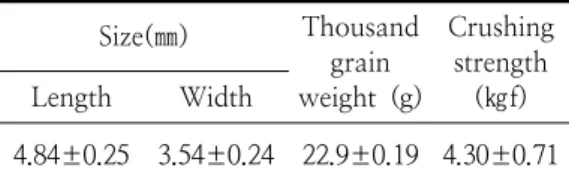
2.1. 실험재료와 착유본 연구에 사용된 대마 종실은 2016년 국립식 량과학원 바이오에너지작물연구소 시험포장에서 생산된 것 (품종명: 청삼)을 5일 동안 양건하고 선풍기로 정선 후 맑은 물로 세척 후 50 ℃ Dry oven에서 48시간 건조하여 사용하였는데 그 물리 적 특성은 Table 1과 같다. 종실 크기는 문서 복 사기(FX DocuCentre-Ⅲ 3007 PCL 6, 한국후지 제록스, Korea)에 종실 20개를 놓고 200% 확대 복사 후 길이와 폭을 측정하였다. 천립중은 종실 1,000개의 무게를 5반복으로 측정였고, 파쇄강도 는 물성시험기(TA XT Plus, Stable Micro System, Korea)로 20립을 측정하여 평균하였다.
Table 1. Physical characteristics of hemp seed Size(㎜) Thousand
grain weight (g)
Crushing strength
(㎏f) Length Width
4.84±0.25 3.54±0.24 22.9±0.19 4.30±0.71 Values are mean±SD
압착식은 3마력 삼상모터가 장착된 반자동 유 압 착유기(DB-600, Dongbang Machine, Korea) 에 대마 종실 4㎏을 투입 후 약 10분 동안 600
㎏f/㎠ 압력을 5회 가하여 착유하였고, 압출식은 3마력 삼상모터가 장착된 스크류식 착유기 (National ENG, Korea)로 착유부위 온도를 약 70℃로 조정하여 착유하였다. 각각의 착유기에서 추출된 종실유는 자기 깔대기 (Porcelain funnel) 와 4.08 bar/60PSI 진공흡입기 (DOA-9704-AC, GAST Manufacturing Inc., USA)를 이용하여 No.2 여과지에 여과하여 착유량을 측정한 후 이 화학적 특성과 색소함량을 조사하였다.
2.2. 착유한 기름의 색차와 색소함량
압착식 및 압출식 착유 대마 기름의 색차는 직 경과 높이가 각각 35㎜, 10㎜인 패트리디쉬에 시 료 2mL를 넣고 Super color SP-80 Colormeter (Tokyo Denshoku Co., Japan)를 이용하여 명도 (lightness, L), 적색도 (redness, a), 황색도 (yellowness, b)를 측정하였다 [7].
기름에 함유된 클로로필, 카로티노이드 등 식 물성 색소 함량은 UV-Vis Spectrophotometer (Biochrom Libra S22, UK)를 이용하여 470nm, 648nm과 664nm 파장에서의 흡광도를 측정한 후 클로로필 A, B 및 카로티노이드 함량을 산출 하였다 [7].
2.3. 지방산 조성 분석
대마 기름 (50 μL)을 pear-shaped flask에 넣 고, methanol (15 mL)과 sodium methoxide (1 mL)을 넣은 후, 100℃에서 2시간 동안 반응시켰 다. 반응물을 상온에서 냉각시킨 후, 15 mL 95% n-Hexane (HPLC급, Avantor, USA)을 첨 가, 혼합한 후 추출하고 상층액을 필터링하여 가 스크로마토그래피 (Agilent 7890)를 이용하여 분 석하였다. 지방산 조성 분석 시 칼럼은
HP-Innowax (30m x 0.32mm x 0.25μm)를 사 용하였고, 주입부 및 검지부 온도는 200℃와 25 0℃로 하였으며, 오븐 온도는 150℃에서 1분간 유지한 후, 분당 5℃씩 250℃ 까지 상승시켰다 [7].
2.4. 토코페롤 분석
압착 및 압출 대마 기름 시료를 식약처 식품공 전 제 9. 일반시험법의 1.2.2.6 비타민E 정량방법 으로 분석하였다 [8]. 대마 기름 1g을 95%
n-Hexane (HPLC급, Avantor, USA) 에 녹여 50 mL로 맞춘 후 1 mL를 취하여 동량의 5 mg/mL Tocol 용액과 혼합 후, 10 μL를 취하여 HPLC (1200 Series, Agilent, USA)로 분석하였 다. 분석 컬럼은 Novapak-Silica (3.9×150 mm, Waters)를 사용하였고 분석 시 유속은 0.5 mL/min 이었다.
3. 결과 및 고찰
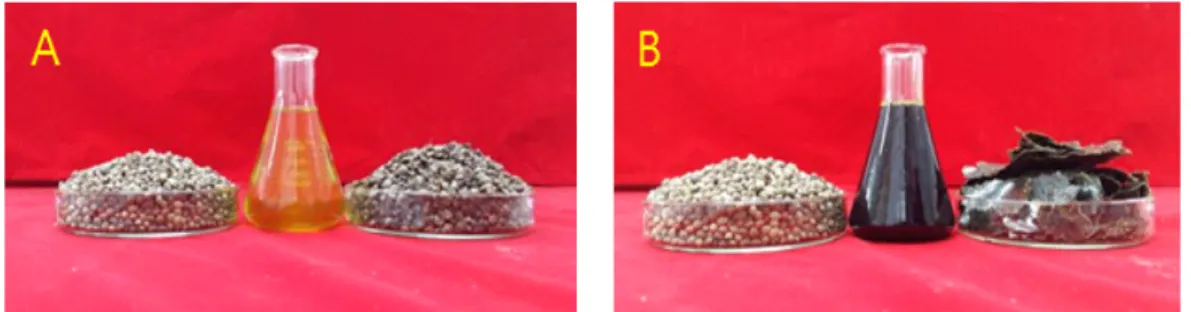
3.1. 착유 방법별 대마 종실유 착유량 차이 대마 종실을 압출식 및 압착식 착유기로 착유 하여 착유량을 조사하였다 (Fig. 1). 압출식 착유 기로 착유하면 착유량이 209 mL/㎏로 압착식의 172 mL/㎏에 비해 37 mL/㎏ 많았다. 종실유의 착유 수율은 압착온도, 압력에 비례하고 원료의 크기와 오일 케익의 두께에 반비례한다 [9]. 압착 식 착유는 착유시 종자의 크기를 크게 변화시키 지 않으면서 오일 케익이 두껍게 형성된다. 압출 식은 스크류로 종자를 으깨면서 압축하는 방식으 로 착유하기 때문에 종자가 잘게 부스러지고 케 익도 얇게 형성되기 때문에 (Fig. 2) 착유량이 많 은 것으로 판단된다.
3.2. 착유방법별 대마 종실유의 색차와 색소함량 착유 방법별 종실유의 색깔은 압착식은 옅은 황색이고 압출식은 진한 녹색이었다 (Fig. 2). 착 유 방법별 대마 종실유의 색차를 알기 위해 명도 (L), 적색도 (a), 황색도 (b)를 측정하였다 (Table 2). 압출식으로 착유한 종실유는 명도 (L)가 42.4 로 압착식에 비해 낮고, 적색도 (a)와 황색도 (b) 는 각각 –3.42, 17.43으로 녹색과 황색이 진하였 다. 압출식 착유 종실유에서 녹색과 황색이 진한 원인을 알기 위해 착유 방법별 색소 함량을 측정
Fig. 2. Color distinction between pressuring and extruding methods in extraction of hemp seed oil. Photo were hemp seed (right), hemp oil (center) and oil cake (left) by pressuring and extruding methods, respectively. (A) Pressuring, (B) Extruding.
하였다 (Table 3). 압출식으로 착유하면 종실유의 Chlorophyll A, B 및 Carotenoid 함량이 각각 12.02, 3.54, 1,475 ㎍/mL로 압착식의 3.76, 0.52, 377 ㎍/mL에 비해 높았다. 대마 종자 내부 에서 자엽과 배축을 싸고 있는 부드러운 내종피 에는 색소가 많이 함유되어 있다 [10]. 이것은 압 착식으로 착유하면 내종피가 손상되지 않은 채로 자엽과 배축의 기름이 추출되는 반면, 압출식으로 착유하면 내종피가 스크류 회전으로 으깨지면서 기름이 추출될 때 지용성인 Chlorophyll과 Carotenoid 가 기름에 녹아들어 갔기 때문인 것 으로 판단된다. Chlorophyll은 지질의 자동산화 방지 등 여러 생물학적 활성이 있고, Carotenoid 는 비타민 A 전구물질 역할을 하는 색소이기 때 문에 [11] 영양학적인 면에서 압착식 착유 종실 유에 비해 압출식 착유 종실유가 유리할 것으로 판단된다.
Fig. 1. Yield of hemp seed oil by pressuring and extruding methods. Values and scale bars in the figure are mean oil yield and standard deviation, respectively (n=3).
Table 2. Chromaticity of hemp seed oils by pressuring and extruding methods Chromaticity Extracting methods
Pressuring Extruding L 44.4±0.68 42.4±0.40 a -1.76±0.01 -3.42±0.08 b 4.82±0.34 17.43±0.79 L : Degree of lightness
(white +100 ~ 0 black) a : Degree of redness (red +100 ~ -80 green) b : Degree of yellowness (yellow +70 ~ -80 blue) Values are mean±SD (n=3)
Table 3. Pigment content of hemp seed oils by pressuring and extruding methods
Pigment content (㎍/mL)
Extracting methods Pressuring Extruding Chlorophyll A 3.76±0.01 12.02±0.01 Chlorophyll B 0.52±0.02 3.54±0.01 Carotenoid 377±3.1 1,475±1.0 Values are mean±SD (n=3).
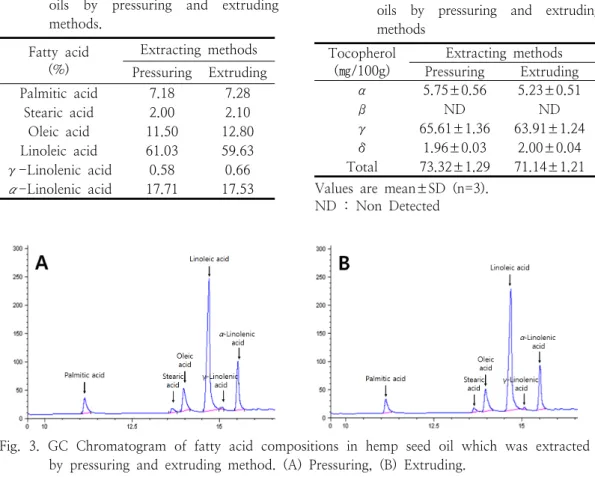
Fig. 3. GC Chromatogram of fatty acid compositions in hemp seed oil which was extracted by pressuring and extruding method. (A) Pressuring, (B) Extruding.
3.3. 착유 방법별 대마 종실유의 지방산 조성 착유 방법별 종실유의 지방산 조성차이를 알기 위해 가스크래마토그래피 분석을 수행하였다 (Table 4, Fig. 3). 지방산 조성은 착유 방법별로 큰 차이는 없었다. 압출식 착유 종실유의 Palmitic acid, Stearic acid, Oleic aicid, γ -Linolenic acid 비율은 각각 7.28%, 2.10%, 12.80%, 0.66%로 압착식의 7.18%, 2.00%, 11.50%, 0.58% 보다 다소 높았으나, Linoleic acid와
α
-Linolenic acid는 압출식이 59.63%, 17.53%로 압착식의 61.03%, 17.71%에 비해 낮 았다. 지방산 중 γ-Linolenic acid는 항염증 작 용을 하여 아토피 피부염 등 여러 만성 질환에 효과가 있다 [12]. 대마 종실은 참깨 등 다른 기 름작물에 함유되지 않은 γ-Linolenic acid를 함 유하여 기능성 식품 원료로 유망하다 [13]. 대마 종실을 압출식으로 착유하면 γ-Linolenic acid 비율을 높아져 소비자의 관심을 끄는데 유리할 것으로 판단된다.Table 4. Fatty acid composition of hemp seed oils by pressuring and extruding methods.
Fatty acid (%)
Extracting methods Pressuring Extruding Palmitic acid 7.18 7.28
Stearic acid 2.00 2.10 Oleic acid 11.50 12.80 Linoleic acid 61.03 59.63 γ-Linolenic acid 0.58 0.66
α
-Linolenic acid 17.71 17.533.4. 착유 방법별 대마 종실유의 Tocopherol 함량
착유 방법별 대마 종실유의 총 Tocopherol 함 량은 Table 5와 같다. 압착식과 압출식 착유 종 실유의 총 Tocopherol 함량은 각각 73.32 ㎎ /100g, 71.14 ㎎/100g으로 압출식이 약간 많았 다. 대마 종실유는 γ-Tocopherol 함량이 많은 것이 특징이었는데 압착식이 65.61 ㎎/100g 으로 압출식의 63.91 ㎎/100g에 비해 많았다. 식물성 유지의 총 Tocopherol 함량은 유채유 61~70 ㎎ /100g, 해바라기유 63 ㎎/100g, 옥수수기름 66
㎎/100g 참기름 45 ㎎/100g 이었다 [14]. 천연 항산화제인 Tocopherol은 알츠하이머 등 퇴행성 뇌 질환을 억제하는 효과가 있다고 알려져 비타 민 E 제재 형태의 토코페롤이 소비되고 있으나 대부분 α-Tocopherol 단일 성분이다 [15]. 그러 나 α-Tocopherol 단일 성분보다는 기능성 식품 을 통한 여러 형태 Tocopherol의 동시 섭취가 알츠하이머 예방에 유리하다 [16].
Table 5. Tocopherol contents of hemp seed oils by pressuring and extruding methods
Tocopherol
(㎎/100g) Extracting methods Pressuring Extruding α 5.75±0.56 5.23±0.51
β ND ND
γ 65.61±1.36 63.91±1.24 δ 1.96±0.03 2.00±0.04 Total 73.32±1.29 71.14±1.21 Values are mean±SD (n=3).
ND : Non Detected
4. 결론
대마 종실을 압출식 및 압착식 착유기로 착유 한 착유량과 종실유의 주요 특성을 조사하였다.
압출식 착유기로 착유하면 착유량이 209 mL/㎏
로 압착식의 172 mL/㎏에 비해 37 mL/㎏ 많았 다. 압출식으로 착유한 종실유는 명도 (L)가 42.4 로 압착식에 비해 낮고, 적색도 (a)와 황색도 (b) 는 각각 –3.42, 17.43으로 녹색과 황색이 진하여 종실유의 Chlorophyll A, B 및 Carotenoid 함량 이 각각 12.02, 3.54, 1,475 ㎍/mL로 압착식의 3.76, 0.52, 377 ㎍/mL에 비해 높았다. 압출식 착유 종실유의 Palmitic acid, Stearic acid, Oleic aicid, γ-Linolenic acid 비율은 각각 7.28%, 2.10%, 12.80%, 0.66%로 압착식의 7.18%, 2.00%, 11.50%, 0.58% 보다 다소 높았으나, Linoleic acid와
α
-Linolenic acid는 압출식이 59.63%, 17.53%로 압착식의 61.03%, 17.71%에 비해 낮았다. 대마 종실유는 γ-Tocopherol 함량 이 많은 것이 특징이었는데 압착식이 65.61 ㎎ /100g 으로 압출식의 63.91 ㎎/100g에 비해 많 았다. 본 연구의 결과로 대마 종실유는 다른 기 름작물에는 부족한 γ-Linolenic acid 및 γ -Tocopherol 공급원으로 활용하면 유리할 것으 로 판단된다.감사의 글
본 연구는 농촌진흥청 연구사업 (세부과제번 호: PJ01197503)의 지원에 의해 이루어진 것임.
References
1. Y. H. Moon, B. H. Lee, B. C. Jeong, Y.
U. Kim and K. Y. Kim, Breeding history of non-drug type hemp variety
‘Cheungsam’ and its characteristics,
Korean J. of Intl. Agri
., 14, 119 (2002).2. M. Kiralan, V. Gül and S. Metin Kara, Fatty acid composition of hempseed oils from different locations in Turkey,
Spanish Journal of Agricultural Research
, l.8, 385 (2010).3. Y. H. Moon, Y. S. Song, B. C. Jeong and J. K. Bang, Variation on fatty acid profile including gamma linolenic acid among Hemp (
Cannabis sativa
L.) accessions,Korean Journal of Medicinal Crop Science
, 13, 190 (2005).4. J. C. Callaway, T. Tennil and D. W. Pate, Occurrence of omega-3 stearidonic acid(cis-6,9,12,15-octadecatetraenoic acid) in hemp(
Cannabis sativa
L.) seed,J. of International Hemp Association
, 3, 61 (1996).5. Y. H. Moon, Reviews for Legislation of industrial hemp regulation: The proposal to Legislate industrial hemp(Cannabis sativa L.) and their research review and regulations in Korea,
Korean J. of Intl.
Agri.
, 20, 203 (2008).6. Ministry of food and drug safety, Korea.
Official announcement on the amendment of food standard
. 2015-4, (3nd Feb.2015).
7. Y. H. Lee, W. Park, T. S. Lee, K. S. Kim, Y. S. Jang and K. B. Lee, Bleaching of cold-pressed rapeseed oil using activated clay,
J. of Korean Oil Chemists' Soc.
, 33, 560 (2016).8. H. J. Kim, S. A. Yang, N. K. Im, K. H.
Jhee and I. S. Lee, Antioxidant effect of oil containing cellulase-treated red ginseng, J
ournal of Life Science
, 18, 323 (2008).9. Y. K. Min and H. S. Jeong, Effect of temperature and pressure on the oil expression of perilla seed,
Korean J. Food Sci. Technol
., 25, 28 (1993).10. E. Small, Evolution and classification of
Cannabis sativa
(Marijuana, Hemp) in relation to human utilization,Bot. Rev
., 81, 189 (2015).11. M. L. Park, Y. J. Lee, N. Kozukue, J. S.
Han, S. H. Choi, S. M. Huh, G. P. Han and S. K. Choi, Changes of vitamin C and chlorophyll contents in Oi-Kimchi with storage time,
Korean J. Food Culture
, 19, 556 (2004).12. Y. Y. Fan and R. S. Chapkin, Importance of Dietary g-Linolenic Acid in Human Health and Nutrition,
The Journal of Nutrition
, 128, 1411 (1998).13. J. C. Callaway, Hempseed as a nutritional resource: An overview,
Euphytica
, 140, 65 (2004).14. H. Schwartz, V. Ollilainen, V. Piironen and A. M. Lampi, Tocopherol and plant sterol contents of vegetable oils and industrial fats,
Journal of Food Composition and Analysis
, 21, 152 (2008).15. S. H. Choi, Vitamin E: α-tocopherol and the other forms of vitamin E,
Korean J.
Nutr.
, 43, 304 (2010).16. M. C. Morris, D. A. Evans, C, C.
Tangney, J. L. Bienias, R. W. Wilson, N.
T. Aggarwal and P. A. Scherr, Relation of the tocopherol forms to incident Alzheimer disease and to cognitive change,