찰옥수수는 1989년 일대교잡종(F1 hybrid)인 찰옥1호가 국내최초로 개발되어 농가에 보급되면서 신품종 개발을 비 롯한 재배․생리 및 수확후 품질관리 연구가 본격적으로 이 루어지기 시작하였다. 지금까지 찰옥수수와 관련된 연구는 수량이 많고 조숙성이며, 각종 내재해성 및 기능성이 높은 품종개발 등에 연구가 집중되어 왔다. 재배생리 및 품질관
리 연구로는 표준재배법 및 조기재배법을 비롯한 기후변화 에 따른 2기작재배 연구를 비롯한 풋옥수수의 고품질 유지 를 위한 수확후관리 연구 등이 이루지고 있다. 찰옥수수의 부가가치 향상을 위한 기능성 연구로는 유색 찰옥수수의 안토시아닌, 카로티노이드 및 페놀성 물질 등에 관한 연구 가 이루어지고 있으나, 최근 식물성 스테롤로 주목받고 있
가을재배 찰옥수수의 등숙에 따른 지방산 조성 및 Phytosterol 함량 변화
김선림
1,†
・ 김미정2
・ 정건호3
・ 이진석4
・ 손범영4
・ 김정태4
・ 배환희4
・ 고영삼4
・ 백성범1
Changes in Fatty Acid Composition and Phytosterol Content During Ripening Period of the Autumn-Sown Waxy Corn
Sun-Lim Kim
1,†
, Mi-Jung Kim2
, Gun-Ho Jung3
, Jin-Seok Lee4
, Beom-Young Son4
, Jung-Tae Kim4
, Hwan-Hee Bae4
, Young-Sam Go4
, and Seong-Bum Baek1
ABSTRACT This study was carried out to investigate the changes in fatty acid composition and phytosterol content of the autumn sowing waxy corn during its ripening period for the production of high quality and value-added fresh ears. The content of crude oil in the waxy corn kernels steadily increased with days after pollination(DAP); the crude oil content in Heukjinjuchal (HC) was higher than that in Ilmichal (IC). The composition of fatty acids according to DAP showed a statistically significant change;
palmitic and linoleic acid composition gradually decreased, but oleic acid increased, and the composition of unsaturated fatty acids in HC was higher than that in IC. The phytosterol content was increased until 33 DAP, and was 937.7 mg/100g and 867.9 mg/100g in IC and HC, respectively, but there was no statistically significant difference between the varieties. The phytosterol contents in IC varied in the following order: β-sitosterol > stigmasterol > campesterol, but that in HC varied in the order β-sitosterol >
campesterol > stigmasterol. The campesterol content did not show significant differences between the varieties, but the stigmasterol and ß-sitosterol content was significantly higher in HC than in IC. Palmitic, linolieic, and linolenic acid were significantly correlated with campesterol and β-sitosterol, and stearic acid was positively correlated with stigmasterol. Oleic acid was positively correlated with campesterol and β-sitosterol but negatively correlated with stigmasterol. As a result, it was suggested that fatty acids may affect the variation in phytosterol contents during the ripening period in waxy corn.
Keywords : autumn sowing, days after pollination, fatty acid, phytosterol, waxy corn DOI : https://doi.org/10.7740/kjcs.2019.64.1.025
Original Research Article
ⓒ 본 학회지의 저작권은 한국작물학회지에 있으며, 이의 무단전재나 복제를 금합니다.
This is an Open-Access article distributed under the terms of the Creative Commons Attribution Non-Commercial License (http://creativecommons.org/licenses/by-nc/3.0) which permits unrestricted non-commercial use, distribution, and reproduction in any medium, provided the original work is properly cited.
1)농촌진흥청 국립식량과학원 중부작물부 중부작물과 농업연구관 (Senior Research Scientist, Central Area Crop Breeding Division, Department of Central Area Crop Science, National Institute of Crop Science, Rural Development Administration, Suwon, 16429, Republic of Korea)
2)농촌진흥청 연구정책국 연구운영과 농업연구사 (Junior Research Scientist, Research Policy Bureau of Rural Development Administration, Jeonju 54875, Korea)
3)농촌진흥청 국립식량과학원 중부작물부 재배환경과 농업연구사 (Junior Research Scientist, Crop Cultivation and Environment Research Division, Department of Central Area Crop Science, National Institute of Crop Science, Rural Development Administration, Suwon 16429, Korea)
4)농촌진흥청 국립식량과학원 중부작물부 중부작물과 농업연구사 (Junior Research Scientist, Central Area Crop Breeding Division, Department of Central Area Crop Science, National Institute of Crop Science, Rural Development Administration, Suwon, 16429, Republic of Korea)
†
Corresponding author: Sun-Lim Kim; (Phone) +82-31-695-4041; (E-mail) [email protected]
<Received 23 January, 2019; Revised 14 March, 2019; Accepted 14 March, 2019>
물질로서 생체막 구성에 관여하며 투과성 조절 및 막의 견 고성 유지 등의 생체기능에 관여(Piironen et al., 2000)할 뿐 만 아니라 위와 장에서 콜레스테롤의 흡수조절, lipoprotein (HDL, LDL) profile 개선, 면역증강, 전립선 건강, 혈당조 절 및 동맥경화증 예방효과 등의 생리활성이 알려져 있다 (Jiang & Wang, 2005; Moreau et al., 2002; Nes 1987;
Ostlund et al., 2002; Rouf et al., 2016; Silbernagel et al., 2013; St-Onge et al., 2003). Phytosterol은 작물에 널리 함 유되어 있으나 함량 등 실용성이 낮은 반면 옥수수는 phy- tosterol 함량이 높고 가공부산물도 이용이 가능하여 산업 적가치가 높은 것으로 평가된다(Chung & Ohms, 2000; Ryan et al., 2007; Weihrauch & Gardner, 1978).
여름철 간식으로 선호하는 찰옥수수는 식이섬유함량이 높고 다중불포화 지방산인 linolenic acid를 다량으로 함유 하고 있어 영양학적 가치가 높다. 일반적으로 찰옥수수는 4 월에 파종하여 7월 중하순에 수확하는 재배법이 보편화되어 있는데, 수확기에 풋옥수수가 일시에 홍수출하되기 때문에 가격이 폭락하는 유통상 문제점이 지적되고 있다(Kim et al., 2015). 최근 지구온난화현상에 의해 무상일수가 증가하 여 농작물의 재배 기간이 늘어나는 현상에 부응하여 찰옥 수수 2기작 재배기술이 개발되었는데, 가을재배시 10월 중 하순까지 풋옥수수 수확이 가능하다(Jung et al., 2012).
따라서 본 연구에서는 최근 재배기술이 확산되고 있는 찰옥수수 가을재배시 출사후 일수에 따른 종실의 지방산 조성 및 phytosterol의 함량변이를 검토하여 풋옥수수의 부 가가치 제고를 위한 기초자료로 활용하고자 하였다.
재료 및 방법 시험재료
출사후 등숙에 따른 찰옥수수의 지방산 조성과 phytosterol 함량의 변화를 검토하기 위하여 농촌진흥청 국립식량과학 원에서 육성된 찰옥수수 일대 교잡종인 일미찰과 흑진주찰 2품종을 사용하였다. 일미찰은 단교잡종으로 출사일수가 72일인 중만숙종 백색 찰옥수수이고, 흑진주찰은 출사일수 가 74일인 중만숙종으로 안토시아닌 색소를 다량으로 함유 한 검정찰옥수수이다(Fig. 1) 찰옥수수의 파종은 수원시 권 선구 소재 국립식량과학원 밭작물시험연구포장에 2013년 7
월 20일 노지직파(가을재배) 하고, 옥수수이삭에서 수염이 출현된 출사기 이후 출사후 일수 경과에 따라 5회(21, 24, 27, 30, 33일) 이삭을 채취하여 동결건조 후 이삭에서 종실 을 분리하여 분석시료로 사용하였다.
조지방 및 지방산 분석
동결건조된 찰옥수수는 시험용 분쇄기(Brabender, Duisburg Germany)로 분쇄시켜 분석시료로 사용하였다. 조지방 분석 은 지방자동분석기(Gerhardt Soxtherm 2000, Hoffmannstre, Germany)를 사용하였고, 지방산의 분석은 Kim et al. (2018) 의 방법에 따라 시료 0.5 g에 methanol : heptane : benzene : 2,2-dimethoxypropane : H2SO4 (37 : 36 : 20 : 5 : 2, v/v)을 가하고 80°C로 1시간 가열 후 FAMEs (fatty acid methyl ester)을 취해 gas chromatography (6890 N series, Agilent Technologies Inc., Wilmington, DE, USA) 및 HP-Innowax capillary column (30 m × 0.25 mm × 0.25 µm, Agilent J&W, Wilmington, DE, USA)으로 분석을 하였고, 지방산 조성의 확인은 Supelco (Bellefonte, PA, USA) FAME mix (C14-C22) 제품을 사용하였다.
Days after pollination
Fig. 1. Changes in two waxy corn ears, Ilmichal and Heukjin-
juchal, during the ripening period.
불검화물의 phytosterol 분석
찰옥수수의 불검화물 제조는 시료에 10% KOH-MeOH 용액을 가하고 60°C에서 90분간 검화(saponification) 후 탈 지면으로 여과시킨 여액을 hexane으로 분액하여 불검화물 (unsaponifiables)을 얻었다. Phytosterol의 분석은 Kim et al.
(2018)의 방법에 따라 불검화물에 BSA[N,O-bis(trimethylsilyl) acetamide], pyridine, hexane을 가하여 TMS 유도체화(trim- ethylsilyl derivatization) 시킨후 GC의 Injector는 260°C, FID는 310°C, chamber는 150°C부터 320°C까지 10°C/min를 상승시키면서 HP-5ms capillary column (30 m × 0.25 mm, 0.25 µm, Agilent J&W, Wilmington, DE, USA)으로 분석 을 하였다(Fig. 2). Phytosterol의 조성을 확인하기 위한 표준 campesterol, stigmasterol 및 β-sitosterol은 Wako (Tokyo, Japan)사 제품을 사용하였다.
통계분석
본 시험을 통하여 얻어진 결과는 SAS 프로그램(Ver. 9.4, Statistical Analysis Systems Institute Inc., Raleigh, NC, USA) 으로 통계분석을 하였다.
결과 및 고찰 백립중, 조지방 및 지방산 변화
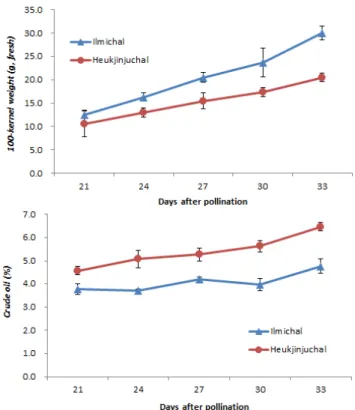
본 시험에 사용된 일미찰과 흑진주찰의 출사후 일수에 따른 종실의 백립중 및 조지방 함량은 Fig. 3 및 Fig. 4에 나타낸 바와 같다.
출사후 21일 경과후 일미찰의 백립중은 12.6 g 흑진주찰 은 10.5 g으로 품종간 1.1g의 차이를 보였고, 시료채취가 종료된 출사후 33일에 일미찰은 30.0 g, 흑진주찰은 20.5 g 으로 품종간 9.5 g의 차이를 보였다. 출사후 21일~33일까 지 3일 간격으로 5회 조사하였을 때 종실중 증가율은 일미 찰이 24.4%였으나 흑진주찰은 18.1%로서 일미찰의 종실 중 증가율이 흑진주찰 보다 약 6.3% 높은 것으로 나타났다.
출사후 일수에 따른 찰옥수수의 조지방 함량은 출사후 21일에 일미찰은 3.78%, 흑진주찰은 4.51%로서 품종간 약 0.73%의 차이가 있었고, 출사후 33일에 일미찰은 4.77%, 흑진주찰은 6.89%로서 품종간 약 2.12%의 함량차이를 보 였다. 따라서 일미찰은 출사후 21일 대비 출사후 33일에 약 1.26배 조지방이 증가된 반면 흑진주찰은 1.52배 증가되는 것으로 나타나 흑진주찰의 조지방 증가율이 더 컸음을 알 수 있었다.
Poneleit & Davis (1972)는 3종의 옥수수 자식계통을 대 상으로 출사후 10일부터 40일까지 일정 간격으로 종실의 지방함량을 측정한 결과 등숙이 진행되면서 지방함량은 지 속적으로 증가되었다고 하였는데, 본 시험의 결과도 이들 의 보고와 일치 하였다.
Table 1은 일미찰과 흑진주찰의 출사후 일수에 따른 종
Fig. 2. Schematic representation of the BSA[N,O-bis(trimethylsilyl)
acetamide] silylation process using unsaponifiables in waxy corn kernels.
Fig. 3. Changes in 100-kernel weights and crude oil contents
in two waxy corn varieties, Ilmichal and Heukjinjuchal,
during the ripening period.
Fig. 4. Comparison of phytosterol chromatogram profiles in two waxy corn varieties, Ilmichal and Heukjinjuchal, at 30 days after pollination.
Table 1. Comparison of fatty acid compositions in two waxy corn varieties, Ilmichal and Heukjinjuchal, during the ripening period.
Varieties DAP
†Fatty acid composition (%) Palmitic
(C16:0)
Stearic (C18:0)
Oleic (C18:1)
Linoleic (C18:2)
Linolenic
(C18:3) USFA
‡Ilmichal (A)
21 21.01 ±0.31
a§3.05 ±0.15
c25.57 ±0.28
d48.35 ±0.22
a2.03 ±0.03
a75.94 ±0.20
d24 20.70 ±0.18
a3.18 ±0.08
c28.07 ±0.12
c46.52 ±0.15
b1.52 ±0.01
b76.12 ±0.18
d27 19.73 ±0.05
b3.42 ±0.07
b30.37 ±0.29
b45.18 ±0.30
d1.30 ±0.03
c76.85 ±0.06
c30 19.15 ±0.15
c3.37 ±0.03
b30.01 ±0.03
b46.15 ±0.08
c1.32 ±0.02
c77.48 ±0.12
b33 18.33 ±0.02
d3.84 ±0.06
a32.31 ±0.23
a44.38 ±0.20
e1.15 ±0.01
d77.83 ±0.04
amean of Ilmichal 19.78 ±1.03 3.37 ±0.29 29.26 ±2.37 46.12 ±1.40 1.46 ±0.32 76.84 ±0.77
Heukjinjuchal (B)
21 19.46 ±0.71
a2.46 ±0.02
a29.98 ±0.35
b46.81 ±0.38
a1.29 ±0.05
a78.08 ±0.71
a24 19.05 ±0.37
a1.94 ±0.61
a31.27 ±0.27
b46.57 ±0.95
a1.17 ±0.04
ab79.01 ±0.80
a27 17.41 ±0.50
a2.10 ±0.66
a34.59 ±0.23
a44.92 ±0.99
b0.97 ±0.12
c80.48 ±3.05
a30 18.65 ±0.40
a2.31 ±0.33
a35.23 ±0.04
a42.78 ±0.61
c1.04 ±0.06
c79.04 ±0.64
a33 18.62 ±0.27
a2.03 ±0.04
a35.20 ±0.44
a43.07 ±0.23
c1.07 ±0.03
c79.04 ±0.27
amean of Heukjinjuchal 18.64 ±1.23 2.17 ±0.41 33.25 ±2.44 44.83 ±1.85 1.11 ±0.13 79.19 ±1.48
aLSD(0.05)
between A & B 0.851 0.266 1.79 1.23 0.18 0.88
†
DAP : days after pollination,
‡USFA(unsaturated fatty acid)
§
Means in a column by with different superscript letters are significantly different according to Duncan's multiple-range test at p < 0.05.
실의 지방산 조성의 변화를 나타낸 것이다.
본 시험에 사용된 찰옥수수의 지방산 조성비율은 linoleic
> oleic > palmitic > stearic > linolenic acid 순으로 높게 나타났는데, 이러한 특성은 출사후 일수에 무관하게 지방 산 조성비율이 일정하게 유지되었다.
Kim et al. (2018)은 국내육성 옥수수 7품종의 지방산 조 성을 검토한 결과 linoleic 51.66% > oleic 29.52% > palmitic 14.33% > linolenic 2.30% > stearic acic 2.18% 순으로 지 방산 조성이 높다고 하였는데, 본 시험의 결과는 Kim et al.
(2018)의 보고와 다소 상이한 것으로 나타났다. 이와 같은 차이는 일반옥수수와 찰옥수수의 유전적 특성이 가장 중요 한 변이의 요인으로 작용하였을 것으로 판단되며, Kim et al. (2018)이 검토한 옥수수 7품종은 일반옥수수를 대상으 로 얻어진 결과인 반면, 본시험은 등숙이 진행중인 찰옥수 수를 대상으로 하였기 때문에 본 시험이 수행된 2013년 가 을철 기상조건 등 재배환경도 지방산 조성에 다소간의 영 향을 미쳤을 것으로 사료된다.
일반적으로 옥수수의 지방산은 palmitic, stearic, oleic, linoleic 및 linolenic acid 등으로 구성되어 있으며 이들의 조성비율 및 함량은 옥수수의 유전자형뿐만 아니라 재배지 역, 파종기 및 재배환경 등이 영향을 미친다고 한다(Davis
& Poneleit, 1975; Jellum & Marion, 1966). Jellum (1967) 은 옥수수의 지방산 조성은 종실의 이삭내 부착위치에 따 라서도 조성에 차이가 있다고 하였는데, 이삭의 기저부에 서 상부로 갈수록 palmitic과 linoleic acid는 증가되지만 oleic acid는 감소되는데, 이는 동일이삭에서 종실의 위치에 따라 등숙정도에 차이가 있기 때문이라 하였다.
Curtis et a1. (1968)은 유전자형이 다른 옥수수 5종을 대 상으로 출사후 24일 및 완숙된 종실의 지방산을 검토한 결 과 완숙된 종실은 palmitic 및 oleic acid는 감소되고 linoleic acid는 증가된다고 하였다. Poneleit & Davis (1972)는 자식 계통 3종의 지방산 조성을 검토한 결과 palmitic과 linolenic acid은 등숙이 경과됨에 따라 감소되지만 oleic과 stearic acid는 증가된다고 하였고, 옥수수의 유전자형은 지방산 조 성 및 steryl ester 축적에도 영향을 미친다고 하였다.
본 시험에서 찰옥수수 품종은 출사후 일수에 따라 palmitic, linoleic 및 linolenic acid는 감소되고 oleic acid는 증가되었 으며, 흑진주찰에서 palmitic acid는 통계적으로 유의성이 없었다. Stearic acid는 품종간 차이를 보였는데, 일미찰은 출사후 일수에 따라 stearic acid의 조성비가 유의적으로 증 가되었으나, 흑진주찰은 뚜렷한 차이를 보이지 않았다. 따 라서 기존의 보고와 본시험에서 얻어진 결과를 종합적으로 고찰하여 볼 때 옥수수의 지방산은 품종은 물론 등숙 정도
에 따라 그 조성에 다양한 변이가 있음을 알 수 있었다.
출사후 일수에 따른 찰옥수수의 불포화지방산은 품종간 뚜렷한 차이를 보였는데, 일미찰은 출사후 21부터 33일까 지 불포화지방산이 75.94%~77.83% 범위였고, 흑진주찰은 78.08%~80.48%의 범위를 보였는데, 일미찰은 출사후 33 일까지 지속적으로 증가되었으나 흑진주찰은 출사후 27일 에 최고치(80.48%)에 도달 후 감소되어 품종간 특성의 차 이를 보였다.
지방산은 세포막의 미세구조 형성 및 막의 투과성 조절 에 영향을 미치며 각종 심혈관질환의 예방에 관여하는 것 으로 알려져 있으며(Gillingham et al., 2011; Moreau et al., 2002), 식물성 유지의 지방산 조성 및 포화지방산과 불포화 지방산의 비율은 유지고유의 특성과 용도를 좌우하는 주요 요인이 된다. 특히 옥수수는 다중불포화 지방산인 linolenic acid를 다량으로 함유하고 있는데, linolenic acid는 인체에 서 합성되지 않아 반드시 음식물로부터 섭취해야 하는 필 수지방산이기 때문에 풋옥수수로 소비되고 있는 찰옥수수 의 영양학적 가치는 매우 높다고 할 수 있으며 찰옥수수의 불포화지방산 특성은 풋옥수수의 상품성 향상 및 부가가치 제고를 위한 주요 품질 특성으로 기초 활용이 가능할 것으 로 판단된다.
Phytosterol 함량 변화
Fig. 4는 출사후 30일에 수확된 일미찰과 흑진주찰에서 추출된 불검화물을 HP-5ms 컬럼으로 분석하여 얻어진 phy- tosterol의 chromatogram을 나타낸 것이다. Chromatogram 에서 보는 바와 같이 출사후 30일에 도달한 찰옥수수에는 주요 phytosterol로 campesterol, stigmasterol 및 β-sitosterol 이 검출되었고, 품종간 불검화물의 chromatogram을 비교 하여 볼 때 이들의 화학적 조성에는 뚜렷한 차이가 없으나 peak의 abundance로 볼 때 phytosterol의 함량은 품종간의 차이가 있음을 알 수 있었다(Kim et al., 2018).
Table 2는 찰옥수수의 출사후 일수에 따른 phytosterol 함 량의 변화를 나타낸 것이다. 일미찰과 흑진주찰은 등숙이 진 행됨에 따라 phytosterol 함량은 지속적으로 증가하여 출사후 33일에 함량의 최대치를 보였는데, 일미찰의 총 phytosterol 함량은 937.7 mg/100 g이었고 흑진주찰은 867.9 mg/100 g 이었다.
Davis, & Poneleit (1974)은 등숙중인 옥수수의 총 sterol 중 99%가 sitosterol, campesterol 및 stigmasterol이며 이들 은 free sterol 및 steryl ester결합 형태로 존재한다고 하였 다. Harrabi et al. (2007)은 등숙중인 옥수수에서 sterol 및 stanol의 변화를 검토한 결과 4-desmethyl sterol류인 β-
sitosterol, campesterol 및 stigmasterol이 90% 이상이고, Δ7- avenasterol 4%, Δ5-avenasterol 3%, Δ7-stigmasterol 2%가 함유되어 있다고 하였는데, 본 연구의 결과도 이들의 보고 와 일치하는 경향이었다.
Phytosterol의 구성성분으로 볼 때 일미찰은 β-sitosterol >
stigmasterol > campesterol 순으로 함량이 높았고 출사후 21 일~33일까지 그 특성이 유지된 반면, 흑진주찰은 β-sitosterol
> campesterol > stigmasterol 순으로 함량이 높았으며 출사 후 21일~33일까지 그 특성이 유지되어 품종간 phytosterol 의 조성에 뚜렷한 차이가 있음을 알 수 있었다.
Phytosterol은 식물의 종에 따른 유전적 변이는 물론 재 배환경에 따른 다양한 변이를 나타내지만 이들의 화학적 조성은 식물의 종에 따라 비교적 안정적으로 분포한다고 한다(Phillips et al., 2005; Rivera et al., 2004).
Phytosterol은 콜레스테롤 흡수를 조절하며(Moreau et al., 2002; Silbernagel et al., 2013) 및 종양세포 사멸을 촉진하 여 항암작용(결장암, 전립선 암, 폐)을 하는 것으로 알려져 있다(Woyengo et al., 2009). 옥수수는 타작물에 비해 phyto- sterol을 풍부하게 함유하고 있는 작물로서 소비자들이 선호 하는 찰옥수수에 함유된 phytosterol은 부가가치 제고를 위 한 주요 기능성 특성으로 활용이 가능할 것으로 판단된다.
조지방, 지방산 및 phytosterol의 상관성
Table 3은 찰옥수수의 조지방과 지방산 및 phytosterol과 의 상관관계를 나타낸 것이다. Fig. 3에서 설명한 바와 같이 일미찰과 흑진주찰은 출사후 등숙이 진행됨에 따라 조지방 함량이 증가되었는데, 지방산과의 관계를 살펴볼 때 oleic acid (r=0.843)는 정(+)상관관계가 있었으나 palmitic, stearic, linolieic, 및 linolenic acid는 부(-)상관을 나타내었다.
Ilmichal (A)
24 123.8 ±6.1 129.9 ±5.9 449.6 ±32.2 703.2 ±44.2
27 133.7 ±7.5
b140.3 ±6.6
bc485.5 ±37.1
b759.5 ±48.8
b30 135.4 ±8.6
b142.0 ±7.5
b491.5 ±34.1
b768.9 ±53.2
b33 165.1 ±8.8
a173.2 ±7.3
a599.4 ±40.3
a937.7 ±56.4
amean of Ilmichal 134.7 ±18.5 141.3 ±19.0 489.1 ±69.7 765.1 ±107.1
Heukjinjuchal (B)
21 119.7 ±5.9
c45.3 ±4.1
b503.3 ±36.9
c668.2 ±46.9
c24 122.8 ±8.1
c46.5 ±5.8
b516.3 ±33.7
c685.6 ±47.6
c27 129.0 ±9.4
bc48.8 ±4.5
b542.5 ±47.9
bc720.3 ±61.8
bc30 141.4 ±7.9
ab53.6 ±5.1
ab594.8 ±38.8
ab789.7 ±51.8
ab33 155.4 ±7.4
a58.9 ±6.3
a653.6 ±41.3
a867.9 ±55.0
amean of Heukjinjuchal 133.6 ±15.2 50.6 ±6.8 562.1 ±66.5 746.4 ±88.4
LSD(0.05)
between A & B ns
§10.7 50.9 ns
†
DAP : days after pollination.
‡
Means in a column by with different superscript letters are significantly different according to Duncan's multiple-range test at p < 0.05,
§
ns : not significant
Table 3. Relationship among crude oil, phytosterols, and fatty acids during the ripening period of waxy corns.
Compounds Crude oil
Fatty acid
Palmitic acid -0.577**
Stearic acid -0.629**
Oleic acid 0.843**
Linoleic acid -0.718**
Linolenic acid -0.686**
Phytosterol
Campesterol 0.467*
Stigmasterol -0.606**
β-sitosterol 0.787**
*,** statistically significant at p < 0.05 and p < 0.01,
respetively.
Curtis et al. (1968)은 등숙중인 옥수수에서 지방과 지방 산과의 관계를 검토한 결과 oleic acid는 정상관(r=0.947), linoleic (r=-0.931) 및 palmitic acid (r=-0.767)와는 부상관 을 보였다고 하였으며, Orhun & Korkut (2011)은 28종의 옥 수수를 대상으로 검토한 결과 oleic acid는 정상관, linolieic 및 linolenic acid는 부상관을 보고하여 본 연구의 결과와 일치하는 경향 이었다.
등숙중인 찰옥수수 종실의 조지방과 모든 phytosterol 성 분은 통계적으로 유의한 정상관을 나타내었는데, 이와 같 은 결과는 등숙중 찰옥수수 종실의 조지방 및 phytosterol 함량이 지속적으로 증가되었기 때문인 것으로 판단되었다.
Table 4는 찰옥수수의 지방산과 phytosterol과의 상관관 계를 나타낸 것이다.
지방산중 palmitic, linolieic 및 linolenic acid는 campesterol 및 β-sitosterol과 유의한 부상관이 있었고, stearic acid는 stigmasterol과 정상관이 인정되었다. Oleic acid는 campesterol 및 β-sitosterol과 정상관이 있었으나 stigmasterol과는 부상 관이 인정되어 찰옥수수 등숙중 종실의 지방산 조성은 phyto- sterol의 함량의 변이에 영향을 미치는 것으로 판단되었다 (Davis & Poneleit, 1975).
Ayerdi et al. (2015)은 해바라기에서 지방산과 phytosterol 과의 관계를 검토한 결과 campesterol은 stearic acid와 정상관, linolenic acid와는 부상관이 있으며 stigmasterol은 palmitic acid와 부상관이 있다고 하였고, Kemp & Mercer (1968)는 옥수수의 steryl ester에서 분리된 지방산이 C12~C22 이상 의 물질로서 대부분이 palmitic, palmitoleic, lauric, myristic 및 linolenic acid라 하였다. Davis & Poneleit (1975)는 등숙 중인 옥수수에서 steryl ester는 지방산의 담체(carrier) 및 안 정성 유지의 역할을 하는 것으로 제안한바 있어 이들의 생 화학적 기능에 대한 구체적인 연구가 이루어진다면 풋옥수 수를 비롯한 각종 식량작물의 부가가치 향상에 유용한 기 초자료가 될 것으로 판단되었다.
적 요
찰옥수수 가을재배시 등숙에 따른 종실의 지방산조성과 phytosterol의 함량변화를 검토하여 고품질 풋옥수수 생산 을 위한 기초자료로 활용하고자 본 연구를 수행하여 얻어 진 결과를 요약하면 다음과 같다.
1. 찰옥수수 출사후 일수가 경과할수록 종실의 조지방 함량 은 지속적으로 증가 하였고, 흑진주찰은 일미찰보다 조 지방 함량이 높았다.
2. 출사후 일수에 따른 지방산의 조성비는 뚜렷한 변화를 보였는데, palmitic acid 및 linoleic acid는 점차 감소되 었으나 oleic acid는 증가되었고, 흑진주찰은 일미찰에 비해 불포화지방산의 조성비가 다소 높았다.
3. 출사후 일수가 경과할수록 총 phytosterol의 함량은 증가 하여 출사후 33일에 함량의 최대치를 보였는데, 일미찰 의 총 phytosterol 함량은 937.7 mg/100 g, 흑진주찰은 867.9 mg/100 g이었으나 품종간 통계적 함량의 차이는 없었다.
4. Phytosterol의 조성은 품종간 차이를 보였는데, 일미찰은 β- sitosterol > stigmasterol > campesterol 순으로 함량이 높 았으나, 흑진주찰은 β-sitosterol > campesterol > stigma- sterol 순으로 함량이 높았고, 성분별로 볼 때 campesterol 함량은 품종간 차이가 없었으나 stigmasterol 및 ß-sitosterol 은 흑진주찰이 일미찰에 비해 함량이 높았다.
5. Palmitic, linolieic, linolenic acid는 campesterol 및 β- sitosterol과 유의한 부(-)상관이 있었고, stearic acid는 stigmasterol과 정(+)상관이 인정되었다. Oleic acid는 campesterol 및 β-sitosterol과 정상관이 있었으나 stigma- sterol과는 부상관이 인정되어 찰옥수수 등숙중 종실의 지방산 조성은 phytosterol의 함량의 변이에 영향을 미 치는 것으로 판단되었다.
사 사
본 논문은 농촌진흥청 작물시험연구사업(ATIS 과제번 호: PJ012497012018)의 지원으로 수행된 결과입니다.
인용문헌(REFERENCES)