http://dx.doi.org/10.9724/kfcs.2014.30.5.556
한국 재래흑우 및 한우의 지방산 조성 및 영양성분 비교
박경숙 ․ 박현숙 ․ 최영준 ․ 이재상1 ․ 박성숙2 ․ 정인철†
대구공업대학교 호텔외식조리계열, 1(주)롯데호텔, 2세화요리아카데미
Comparison of Fatty Acid and Nutritional Composition of Korean Native Black Cattle and Hanwoo
Kyung-Sook Park ․ Hyun-Suk Park ․ Young-Joon Choi ․ Jae-Sang Lee1 ․ Sung-Suk Park2 ․ In-Chul Jung† Division of Hotel Culinary Arts, Daegu Technical College, Daegu 704-721, Korea
1Lotte Hotel Co., Seoul 100-721, Korea
2Sehwa Cooking Academy, Daegu 700-819, Korea
Abstract
The nutritional composition of Korean native black cattle (KNBC) and Hanwoo beef were compared. According to the results, there were no significant differences in moisture, protein, ash, calorie and collagen content, but the fat content of KNBC was significantly higher than that of Hanwoo (p<0.05). The P, Na and Cu content of KNBC were significantly higher than that of Hanwoo (p<0.05). The KNBC and Hanwoo had total mineral amounts of 4,052.34 and 3,214.44 ppm, respectively, with the KNBC being significantly higher than Hanwoo (p<0.05). The vitamin B1 content of KNBC was significantly higher than that of Hanwoo (p<0.05), but there was no significant difference in B2 content between the samples. The total structural amino acid contents was not significantly different between KNBC (12.35%) and Hanwoo (12.58%). The KNBC and Hanwoo had total free amino acid amounts of 752.698 and 661.795 ppm, respectively, with the KNBC being significantly higher than Hanwoo (p<0.05). The stearic acid (10.631%), linoleic acid (2.271%), linolenic acid (0.065%) and tricosanoic acid (0.038%) contents of KNBC were lower than those of Hanwoo (p<0.05). However, their palmitoleic acid (5.292%), oleic acid (48.815%), γ-linolenic acid (0.094%), eicosenoic acid (0.042%) and docosadienoic acid (0.099%) contents were higher than those of Hanwoo (p<0.05). There was no significant difference between the KNBC and Hanwoo in the saturated fatty acid : unsaturated fatty acid ratio.
Key words: Korean native black cattle, Hanwoo, nutritional composition
†Corresponding author: In-Chul Jung, Division of Hotel Food Service and Culinary Arts, Daegu Technical College, 205 Songhyun-Ro, Dalseo-gu, Daegu 704-721, Korea
Tel: +82-53-560-3851 Fax: +82-53-560-3859 E-mail: [email protected]
Ⅰ.
서 론현재 우리나라에서 사육하고 있는 소는 털의 색깔을 기준으로 했을 때 가장 많은 황갈색의 한우, 황갈색 바탕 에 흑색의 호랑이 무늬를 하고 있는 호반우(칡소), 그리 고 흑색을 띄는 흑우 등 세 종류의 재래 한우가 있다(Lee SS 등 2009). 일제 강점기에는 황갈색 한우 90%, 흑우 8%, 칡소 2%가 사육되었으나(Lee HJ 등 2011) 육질향상 을 위한 우수 품종 형질개량의 목적으로 잡종화되면서 흑우는 현재 멸종 위기에 처해 있다. 최근에는 재래가축 의 혈통보존 및 복원사업이 이루어지면서 제주도를 중심 으로 흑우의 대량증식을 위한 연구들이 이루어지고 있다
(Kim EY 등 2010, Choi SH 등 2011). 우리나라는 1995년 발효된 우루과이라운드의 관세무역일반협정(GATT)과 그 이후 여러 국가들과의 FTA 체결에 따라 축산물 시장이 개방되면서 품질개선, 생산비 절감, 사육환경 개선과 같 은 국제 경쟁력 확보가 시급하게 되었다. 이에 따라 각 지방자치단체에서는 한우 품질 고급화 및 브랜드화를 위 하여 축산농가에 다양한 지원책을 제시하고 있으며, 제주 도를 중심으로 흑우도 수입 쇠고기와의 차별화를 시도하 고 있다.
흑우의 외형은 한우와 비슷하지만 체형이 작고 털의 색이 전반적으로 흑색을 나타낸다. 흑우에 관한 기록 중 세종실록에 의하면 고려시대부터 왕실에 진상될 만큼 우 수하다고 알려져 있다(Moon YH와 Jung IC 2012). 그러 나 개체수와 유통물량이 적어 국내 소비자들에게 잘 알 려져 있지 않지만 사육두수를 늘리고, 체계적인 육질분석 이 이루어지면 국제적인 경쟁력을 갖춘 상품으로 개발할 수 있다. 그러므로 흑우에 대한 사양관리방법 개선, 기능
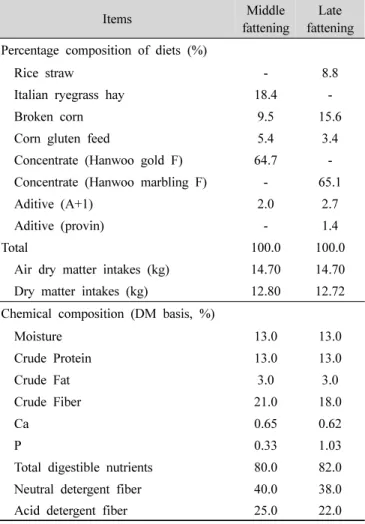
Items Middle fattening
Late fattening Percentage composition of diets (%)
Rice straw - 8.8
Italian ryegrass hay 18.4 -
Broken corn 9.5 15.6
Corn gluten feed 5.4 3.4
Concentrate (Hanwoo gold F) 64.7 - Concentrate (Hanwoo marbling F) - 65.1
Aditive (A+1) 2.0 2.7
Aditive (provin) - 1.4
Total 100.0 100.0
Air dry matter intakes (kg) 14.70 14.70 Dry matter intakes (kg) 12.80 12.72 Chemical composition (DM basis, %)
Moisture 13.0 13.0
Crude Protein 13.0 13.0
Crude Fat 3.0 3.0
Crude Fiber 21.0 18.0
Ca 0.65 0.62
P 0.33 1.03
Total digestible nutrients 80.0 82.0
Neutral detergent fiber 40.0 38.0
Acid detergent fiber 25.0 22.0
Table 1. Chemical composition of experimental diets
성 부여, 육질에 대한 기초연구 등 고급화를 위한 많은 연구가 이루어져 흑우고기에 대한 많은 정보들을 축적해 야 한다. 흑우에 관한 연구는 이루어지고 있지만 대부분 이 번식기능에 관한 연구(Lee TH 등 2006), 흑우 보존을 위한 동결정액 제조법(Choi SH 등 2011), 유전자 분석(Jin S 등 2011) 등이 대부분이고, 흑우고기의 영양성분이나 육질에 관한 연구는 거의 찾아볼 수 없다. 그나마 흑우고 기에 관한 연구로서는 냉장한 제주 흑우육, 한우육 및 호 주산 수입우육의 품질비교(Moon YH 2012), 인진쑥 첨가 사료를 급여한 흑우육의 이화학적 품질특성(Moon YH와 Jung IC 2012) 등이 있을 뿐이다. 따라서 본 연구는 흑우 와 한우의 영양적 품질을 비교하여 흑우고기의 품질에 관한 기초자료를 축적하기 위하여 실시하였다.
Ⅱ.
재료 및 방법 1. 실험재료흑우(37~38개월령)와 한우(31~32개월령)는 Table 1과 같은 조건으로 사육하였다. 흑우는 37~38개월, 한우는 31~32개월령의 거세우 각각 5두를 공시하였으며, 사양관
리는 제주도 서귀포시의 S시험 목장의 관행사육에 의하 였다. 육질 분석용 시료채취는 도축 후 12시간 동안 2°C 로 예비 냉각한 지육에서 등심부위를 분할하여 진공포장 한 것을 제주동물산업연구기술센터에서 공급받아 실험에 이용하였다. 흑우의 생체중량은 평균 660 kg, 도체중량은 평균 365 kg이고, 한우의 생체중량은 680 kg, 도체중량은 375 kg이었다.
2. 일반성분
수분 함량은 105°C 상압가열건조법으로, 조단백질 함 량은 단백질분석기(Tecator kjeltec auto 1030 analyzer, Tecator, Hoganas, Sweden)를 이용하여 semi micro Kjeldahl 법으로, 조지방 함량은 지방분석기(Soxtec system 1046, Tecator, Hoganas, Swden)를 이용하여 Soxhlet법으로, 그리고 조회분은 550°C에서 직접회화법으로 분석하였다 (KFDA 2002).
3. 열량
열량측정은 열량계(PARR 1351 Bomb calorimeter, Parr Instrument Co., Rockford, IL, USA)를 이용하고, kcal/kg 으로 표시하였다.
4. 콜라겐 함량
콜라겐 함량 측정은 분쇄한 시료 4 g과 3.5 M H2SO4
30 mL를 105°C로 맞춘 오븐에서 16시간 동안 가열한 후 가열용액을 500 mL로 정용하고, 그 중 5 mL를 100 mL 로 희석하였다. 시험관에 희석용액 2 mL와 chloramine T 용액 1 mL를 첨가하여 20분간 상온에서 방치하고, 각 시 험관에 1 mL의 4-dimethyl-aminobenzaldehyde 용액을 넣 고 혼합한 후 60°C 항온수조에서 15분간 가열하고 흐르는 물에서 3분 이상 냉각하였다. 콜라겐 함량 계산을 위하여 558 nm에서 흡광도를 측정하고 검량선에 대입하여 계산 하였다. 검량선은 0, 2, 4, 6, 8, 10 μg/mL hydroxyproline을 이용하였다(Silva JA 등 1999).
5. 무기질 함량
무기질 함량 분석은 시료의 무게를 정확히 칭량하여 660°C의 회화로에서 2시간 동안 회화하고, HCl:H2O 1:1 (v:v) 용액에 녹여 하룻밤 방치한 후 여과하여 ICP-OES 2000DV (Perkin Elmer Inc., Waltham, MA, USA)로 분석 하였다(Lee CH 등 1980).
6. 비타민 B1 및 B2 함량
비타민은 KFDA(2002)의 방법으로 분석하였다. 비타민 B1은 시료 10 g을 0.1 N H2SO4로 침출한 후 takadiastase (Sigma-Aldrich Co., St Louis, MO, USA)로 가수분해하여
Items Native black cattle Hanwoo Moisture (%) 66.87±5.60
1)68.83±1.33 Crude protein (%) 15.54±1.24 15.61±1.17 Crude fat (%) 16.59±0.32
*2)14.60±0.01
Crude ash (%) 0.72±0.03 0.68±0.01
Calorie (kcal/kg) 2,514.6±458.3 2,136.9±582.6 Collagen (g/100 g) 0.205±0.039 0.201±0.043
1)
Mean±SD.
2)
Significant difference (p<0.05) between native black cattle and Hanwoo.
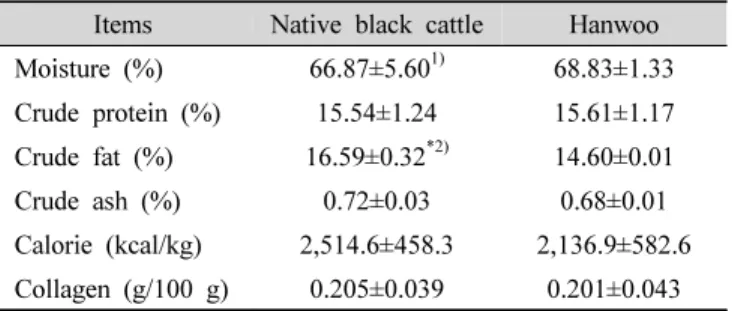
Table 2. Proximate composition, calorie and collagen content native black cattle and Hanwoo
결합형의 비타민 B1을 유리시킨 다음 permutit 흡착 column 으로 분리하였다. 이것을 ferrocyanide potassium으로 산화 시켜 강한 형광을 내는 thiochrome을 형성시킨 후 형광광 도계(Fluorescence, LB-500, Perkin Elmer Inc., Waltham, MA, USA)로 측정하고, 비타민 B2는 시료 10 g을 소량의 증류수와 함께 미세하게 균질기(Polytron RT 2500E, Kinematica AG, Luzern, Switzerland)로 분쇄한 후 70~80°C 의 욕조에서 추출한 다음 냉각시켰다. 이것을 여과하여 HPLC (Agilent 1200 series, Agilent Technologies Inc., Santa Clara, CA, USA)로 분석하였다. 사용한 column은 μ -Bondapak C18 (3.9×300 mm, 5 μm), Mobile phase 20 mM KH2PO4, flow late 0.8~1.0 mL/min, oven 온도 30°C, injection volumn 20 μL로 하였다.
7. 아미노산 조성 및 유리아미노산 함량
아미노산 조성은 시료 0.02 g에 6 N HCl 15 mL를 넣고 110°C에서 24시간 동안 가수분해하였다. 이 분해물을 55°C 에서 감압농축하고 pH 2.2 (citric acid) dilution buffer를 이 용하여 25 mL로 정용한 후 아미노산분석기(Amino acid analyzer S433, Sykam, Eresing, Germany)로 분석하였다. 분 석에 사용한 column (Nova-Pak C18, Waters, Milford, MA, USA) 및 조건은 column size 4 mm × 150 mm, absorbance 570 nm and 440 nm, reactor temperature 120°C이었다.
유리아미노산 분석은 시료 0.2 g을 75% ethanol로 30분 간 진탕한 것을 21,000×g에서 10분간 원심분리하여 얻어 진 상층액을 모아 두고, 남은 잔사에 다시 75% ethanol로 추출한 것을 원심분리하여 얻어진 상층액을 앞에서 얻어 진 상층액과 함께 감압농축으로 ethanol을 제거하였다. 이 농축물에 25% trichloroacetic acid (TCA)를 가하여 단백 질을 제거하고 ethyl ether로 농축물 중의 TCA를 제거한 다음 다시 감압농축으로 잔류한 ethyl ether를 제거하였다.
이 농축물을 Amberlite IR 120 (H+) 수지가 충전된 column(Merck Millipore, Darmstadt, Germany)에 통과시켜 아미노산을 흡착시킨 다음 0.2 N lithium citrate buffer (pH 2.2)로 녹여 여과하고, 아미노산자동분석기(LKB 4150 Alpha plus, Pharmacia, Uppsala, Sweden)로 분석하였다.
Column은 cation exchange column 4151 series II (200×4.6 mm, Pharmacia, Uppsala, Sweden)를 사용하였다. 이동상 용매는 methanol:tetrahydrofuran:0.02 M sodium acetate buffer (pH 5.9)를 A는 20:2.5:77.5 (v:v:v), B는 80:2.5:17.5 (v:v:v)를 이용하여, 검출파장은 338 nm, flow rate 1.5 mL/min, column 온도 40°C, 주입량 10 μL로 하여 분석하 였다(Lee HJ 등 2000).
8. 지방산 조성
지방산 조성은 Folch법(Folch J 등 1957)으로 추출, 정
제하고, 14% BF3-methanol 용액을 사용하여 methylation 시켰으며, 이것을 GC (8610C, SRI Ins., Santa Clara, CA, USA)로 분석하였다. 사용된 column은 30 m×0.25 mm I.D. 0.25 μm (007-1 PHATTM, Quadrex Co., Bethany, CT, USA)이었다. Carrier gas는 He으로 0.7 mL/min으로 하고, injector 온도는 225°C, detector 온도는 285°C로 하였으며, split ratio는 200:1의 비율로 하였다.
9. 통계처리
각 실험은 3회 이상 반복 측정한 후 SPSS 14.0 (statistical package for social science, SPSS Inc., Chicago, IL, USA) 을 사용하여 통계처리 하였으며, 각각의 시료에 대하여 평균±표준편차로 나타내었다. 각 시료에 대한 유의성 검 정은 분산분석을 한 후 p<0.05 수준에서 Student's t-test를 실시하였다.
Ⅲ.
결과 및 고찰 1. 일반성분, 열량 및 콜라겐 함량흑우 및 한우고기의 일반성분, 열량 및 콜라겐 함량을 측정하고 그 결과를 Table 2에 나타내었다. 흑우 및 한우 의 수분(66.87% 및 68.83%), 조단백질(15.54% 및 15.61%), 조회분(0.72% 및 0.68%), 열량(2,514.6 및 2,136.9 kcal/kg) 및 콜라겐(0.205 및 0.201 g/100 g)은 유의한 차이가 없었 다. 그러나 조지방 함량은 흑우가 16.59%로 한우의 14.60%
보다 유의하게 높았다(p<0.05). 우육의 일반성분은 등급 이 높아 마블링이 잘 형성되면 조지방 함량이 높아지고, 수분함량이 낮아진다(Lee JM 등 2009). 등급 이외에도 우 육의 일반성분은 품종, 암수, 연령 등에 따라 차이가 있 는 것으로 알려져 있다(Moon YH 등 2011). 본 연구의 결 과 흑우의 조지방 함량이 한우보다 높은 것은 마블링이 한 우보다 잘 형성되어서 나타난 결과로 사료된다. 한편 열량 은 Jung IC 등(2007)이 보고한 2,493~2,558 kcal/kg과는
Items Native black cattle Hanwoo
Calcium 40.97±0.31
1)40.92±0.34
Phosphorus 1,414.77±17.88
*2)1,028.27±10.22 Kalium 1,801.38±236.01 1,524.44±36.65 Natrium 570.54±60.74
*367.46±37.92 Magnesium 154.97±0.50 186.16±0.64
*Mangan 0.18±0.02 -
Iron 23.82±0.11 24.65±3.34
Copper 1.93±0.03
*0.99±0.11
Zink 43.78±0.13 41.55±4.55
Total 4,052.34±345.52
*3,214.44±295.71
1)
Mean±SD.
2)
Significant difference (p<0.05) between native black cattle and Hanwoo.
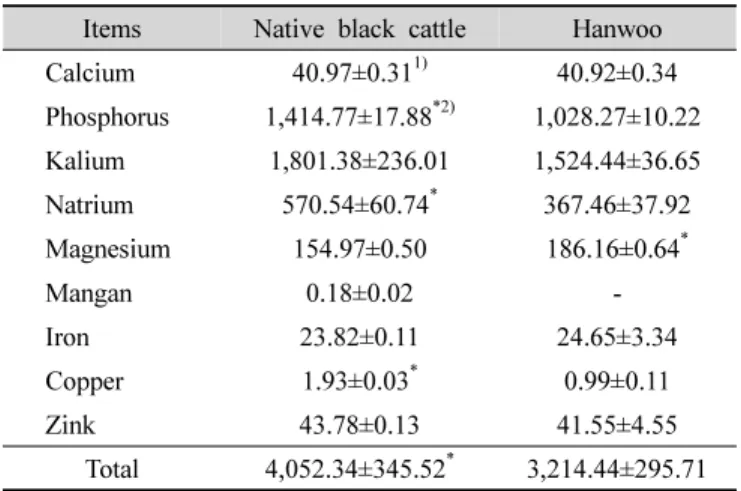
Table 3. Mineral content of native black cattle and Hanwoo (ppm)
Items Native black cattle Hanwoo Vitamin B
15.089±0.021
1)*2)2.702±0.073 Vitamin B
20.016±0.009 0.012±0.005
1)
Mean±SD.
2)
Significant difference (p<0.05) between native black cattle and Hanwoo.
Table 4. Vitamin B1 and B2 content of native black cattle and Hanwoo (mg/100 g)
비슷하였으나 Cho SH 등(2007)이 보고한 1,735.4 kcal/kg 보다는 높았다. 그리고 콜라겐 함량은 Cho SH 등(2008) 이 보고한 0.14 g/100 g보다 높은 경향이었으며, 콜라겐 함 량은 등급에 따라 다소 차이가 있는 것으로 알려져 있다.
2. 무기질 함량
흑우 및 한우의 무기질 함량을 분석한 결과는 Table 3 과 같다. 흑우 및 한우에서 공통으로 가장 많이 함유되어 있는 무기질은 칼륨으로 흑우 및 한우가 각각 1,801.38 및 1,524.44 ppm이었으며, 다음으로 많은 무기질은 인으 로 흑우가 1,414.77 ppm으로 한우의 1,028.27 ppm보다 유의하게 높았다(p<0.05). 그 외에 흑우에 많이 함유된 무 기질은 나트륨과 구리였으며, 한우에 많이 함유된 것은 마그네슘이었다. 한편 칼슘, 칼륨, 철 및 아연은 시료들 사이에 유의한 차이가 없었다. 그리고 무기질 총 함량은 흑우가 4,052.34 ppm으로 한우의 3,214.44 ppm보다 유의 하게 많이 함유되어 있었다(p<0.05). 따라서 흑우는 한우 보다 무기질 공급에 있어서 더 우수할 것으로 판단된다.
무기질은 인체에서 소화, 흡수 등 여러 가지 대사과정에 서 반드시 필요한 물질로서 영양권장량에 따라 섭취하여 야 하지만 최근의 다이어트, 탄산음료, 가공식품, 과다한 육류섭취 등으로 한국인의 영양섭취 기준에 미치지 못하 는 것으로 보고되고 있다(Cheng SH 등 2007, You JS 등 2008). 특히 칼슘은 골밀도를 높여 뼈를 건강하게 하고 (Choi MJ와 Kim SM 2008), 동물성 철은 생체 이용률이 높은 헴(heme)철의 형태로 존재하고, 동물성 아연도 식물 성 아연보다 체내 이용률이 높아 인체의 여러 가지 기능에 중요한 역할을 하는 미량 무기질이다(Cho SH 등 2008).
Moon YH(2012)는 제주흑우의 칼슘, 철 및 아연이 각각
36.47, 29.85 및 48.13 ppm이라고 보고하여 본 연구보다 칼슘함량은 낮고, 철 및 아연함량은 높은 경향이었다.
3. 비타민 B1 및 B2 함량
흑우와 한우의 비타민 B1 및 B2 함량은 Table 4와 같다.
흑우 및 한우의 비타민 B1은 각각 5.089 및 2.702 mg/100 g으로 흑우가 유의하게 높았다. 그러나 비타민 B2는 흑우 및 한우가 각각 0.016 및 0.012 mg/100 g으로 시료들 사 이에 유의한 차이가 없었다. 비타민 B1은 세포 표면의 삼 투압유지, 신경전달물질 합성, 포도당 대사 등에 필요하 며(Kim JY 등 2013), 비타민 B2는 여러 가지 신진대사의 조효소, 산화환원반응의 촉매역할, 약물대사 및 지질대사, 에너지 생성 등 중요한 대사과정에 필요한 미량영양소이 다(Kwak BM 등 2006). Moon YH 등(2011)은 한우의 비 타민 B1이 0.711~1.810 mg/100 g이라고 하여 본 연구의 결과보다 함량이 낮았으나 B2 함량은 0.011~0.015 mg/100 g으로 보고하여 본 연구와 비슷하였다. 본 연구의 결과 흑우는 비타민 B1 공급에 있어서 한우보다 유리한 것으 로 사료된다.
4. 아미노산 함량
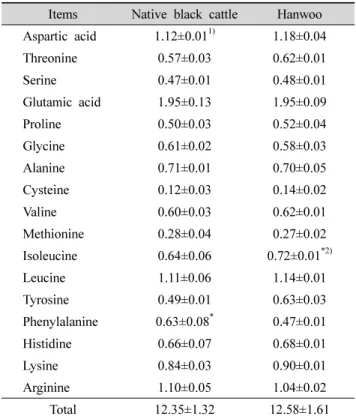
구성아미노산과 유리아미노산 함량을 분석한 결과는 Table 5 및 6과 같다. 구성아미노산의 총량은 흑우 및 한 우가 각각 12.35% 및 12.58%로 두 시료 사이에 유의한 차 이가 없었다. Isoleucine은 한우가 0.72%로 흑우의 0.64%
보다 유의하게 높았고, phenylalanine은 흑우 및 한우가 각각 0.63% 및 0.47%로 흑우가 유의하게 높았다(p<0.05).
그러나 그 외의 다른 모든 구성아미노산은 두 시료 사이 에 유의한 차이가 없었다. 아미노산은 단백질을 구성하고 있으며, 소고기와 같은 동물성 식품이 단백질의 주요 공 급원이다. 인체 내에서 합성되지 않거나 합성되는 양이 필요량보다 적은 것을 필수아미노산이라 하고, 인체가 구 성되고 정상적인 기능을 하기 위해서는 필수아미노산은 반드시 섭취해야 한다. 필수아미노산인 threonine, valine, methionine, isoleucine, leucine, phenylalanine, lysine, histidine, arginine은 흑우 및 한우가 각각 6.43% 및 6.46%로 비슷 한 수준이었다. 그리고 가장 많이 함유된 구성아미노산은
Items Native black cattle Hanwoo Aspartic acid 1.12±0.01
1)1.18±0.04
Threonine 0.57±0.03 0.62±0.01
Serine 0.47±0.01 0.48±0.01
Glutamic acid 1.95±0.13 1.95±0.09
Proline 0.50±0.03 0.52±0.04
Glycine 0.61±0.02 0.58±0.03
Alanine 0.71±0.01 0.70±0.05
Cysteine 0.12±0.03 0.14±0.02
Valine 0.60±0.03 0.62±0.01
Methionine 0.28±0.04 0.27±0.02
Isoleucine 0.64±0.06 0.72±0.01
*2)Leucine 1.11±0.06 1.14±0.01
Tyrosine 0.49±0.01 0.63±0.03
Phenylalanine 0.63±0.08
*0.47±0.01
Histidine 0.66±0.07 0.68±0.01
Lysine 0.84±0.03 0.90±0.01
Arginine 1.10±0.05 1.04±0.02
Total 12.35±1.32 12.58±1.61
1)
Mean±SD.
2)
Significant difference (p<0.05) between native black cattle and Hanwoo.
Table 5. Amino acid composition of native black cattle and Hanwoo (%)
Items Native black cattle Hanwoo Phosphoserine 40.269±15.06
1)26.602±10.23 Taurine 266.077±9.13
*2)193.811±11.96 Aspartic acid 2.935±0.66 3.293±0.26
Threonine 14.163±3.76 20.110±4.12
Serine 9.074±1.65 12.457±3.86
Glutamic acid 79.900±6.45 79.635±7.88
Proline 10.123±3.12 17.511±5.76
Glycine 17.466±4.53 18.391±6.11
Alanine 200.118±25.74
*155.522±20.62
Valine 19.711±3.66 23.596±5.81
Isoleucine 6.477±1.29 17.279±4.76
*Leucine 8.994±0.16 28.567±1.19
*Tyrosine 22.466±4.56
*12.554±6.01 Phenylalanine 9.890±2.14 14.371±5.76
Lysine 13.894±3.19
*7.483±0.99
1-M-Histidine 20.945±5.62 19.751±3.87
Histidine 10.199±0.96 10.860±0.81
Total 752.698±15.93
*661.795±18.19
1)
Mean±SD.
2)
Significant difference (p<0.05) between native black cattle and Hanwoo.
Table 6. Free amino acid content of Korean native black cattle and Hanwoo (ppm)
glutamic acid, aspartic acid, leucine, arginine의 순이었다.
Cho SH 등(2008)은 한우 구성아미노산 총량이 16.34%라 고 보고하였으며, Moon YH(2012)는 흑우 16.81%, 한우 16.92%로 본 연구의 결과보다 높았다.
한편 유리아미노산 총 함량은 흑우 및 한우가 각각 752.698 및 661.795 ppm으로 흑우가 유의하게 높았다 (p<0.05). 흑우에서 함량이 높은 유리아미노산은 taurine, alanine, tyrosine, lysine이였으며, 한우에서 함량이 높은 것은 isoleucine, leucine이였다(p<0.05). 그리고 가장 많은 유리아미노산은 taurine으로 흑우 및 한우가 각각 266.077 및 193.811 ppm이었으며, 그 다음이 alanine으로 각각 200.118 및 155.522 ppm, glutamic acid가 각각 79.900 및 79.635 ppm이었다. 유리아미노산은 단백질 분해효소에 의하여 생성되는데(Nowak A와 Piotrowska M 2012), 종 류에 따라서 각각 다른 맛을 나타낸다. 단맛은 serine, alanine, threonine, proline, glycine, 신맛은 aspartic acid, 쓴맛은 leucine, isoleucine, methionine, phenylalanine, lysine, valine, histidine, arginine, 감칠맛은 glutamic acid 로 알려져 있다(Kim SI 등 2011, Lee SW 등 2011). 식육 의 맛은 유리아미노산, 펩티드, 당, 유기산, 핵산 등이 영 향을 미치고, 풍미는 유리아미노산, 지방산, 저분자 펩티
드, IMP 등의 혼합물이 가열에 의하여 형성된다(Cambero MI 등 1992). 이와 같이 식육의 기호성은 여러 가지 물질 들이 복합적으로 작용하여 나타나지만 본 연구의 결과에 의하면 흑우가 한우보다 유리아미노산의 함량이 높으므 로 관능적인 맛과 풍미가 더 우수할 것으로 판단되며, 관 능특성을 고려한 다양한 연구가 지속되어야 할 것으로 사료된다.
5. 지방산 조성
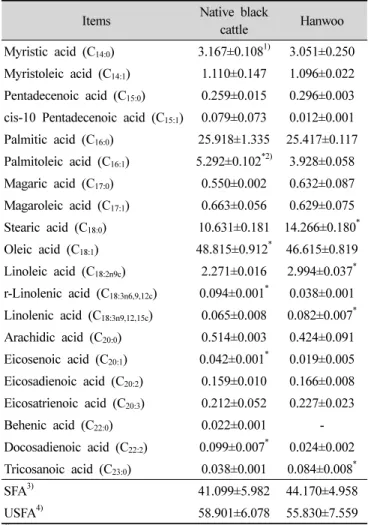
흑우와 한우의 지방산 조성을 실험한 결과를 Table 7에 나타내었다. 포화지방산(saturated fatty acid):불포화지방산 (unsaturated fatty acid)의 비율은 흑우 41.099:58.901, 한 우 44.170:55.830으로 유의적인 차이가 없었으나 흑우의 불포화지방산이 다소 높았다. 흑우에서 더 높은 함량을 나타낸 지방산은 palmitoleic acid, oleic acid, γ-linolenic acid, eicosenoic acid, docosadienoic acid이었으며, 한우에 서 더 높은 것은 stearic acid, linoleic acid, linolenic acid, tricosanoic acid이었다(p<0.05). 가장 많이 함유된 포화지 방산은 palmitic acid로 흑우 및 한우가 각각 25.918% 및 25.417%이었고, 그 다음이 stearic acid로 각각 10.631% 및 14.266%이었다. 불포화지방산 중 가장 많이 함유된 것은
Items Native black
cattle Hanwoo Myristic acid (C
14:0) 3.167±0.108
1)3.051±0.250 Myristoleic acid (C
14:1) 1.110±0.147 1.096±0.022 Pentadecenoic acid (C
15:0) 0.259±0.015 0.296±0.003 cis-10 Pentadecenoic acid (C
15:1) 0.079±0.073 0.012±0.001 Palmitic acid (C
16:0) 25.918±1.335 25.417±0.117 Palmitoleic acid (C
16:1) 5.292±0.102
*2)3.928±0.058 Magaric acid (C
17:0) 0.550±0.002 0.632±0.087 Magaroleic acid (C
17:1) 0.663±0.056 0.629±0.075 Stearic acid (C
18:0) 10.631±0.181 14.266±0.180
*Oleic acid (C
18:1) 48.815±0.912
*46.615±0.819 Linoleic acid (C
18:2n9c) 2.271±0.016 2.994±0.037
*r-Linolenic acid (C
18:3n6,9,12c) 0.094±0.001
*0.038±0.001 Linolenic acid (C
18:3n9,12,15c) 0.065±0.008 0.082±0.007
*Arachidic acid (C
20:0) 0.514±0.003 0.424±0.091 Eicosenoic acid (C
20:1) 0.042±0.001
*0.019±0.005 Eicosadienoic acid (C
20:2) 0.159±0.010 0.166±0.008 Eicosatrienoic acid (C
20:3) 0.212±0.052 0.227±0.023 Behenic acid (C
22:0) 0.022±0.001 - Docosadienoic acid (C
22:2) 0.099±0.007
*0.024±0.002 Tricosanoic acid (C
23:0) 0.038±0.001 0.084±0.008
*SFA
3)41.099±5.982 44.170±4.958
USFA
4)58.901±6.078 55.830±7.559
1)
Mean±SD.
2)
Significant difference (p<0.05) between native black cattle and Hanwoo.
3)
Saturated fatty acid
4)
Unsaturated fatty acid
Table 7. Fatty acid composition native black cattle and Hanwoo (%)
oleic acid로 흑우와 한우가 각각 48.815% 및 46.615%이 었으며, 그 다음이 palmitoleic acid로 각각 5.292% 및 3.928%이었다. 우육의 지방산 조성은 영양적 가치 외에 도 풍미형성에 관여하며(Rule DC 등 1995, Moon YH 2012), 품종, 성별, 급여 사료의 종류 등 사양조건에 따라 서 지방산 조성의 차이가 있는 것으로 보고되고 있다 (Cho SH 등 2005). Oleic acid는 풍미를 증진시키는 지방 산으로 급여사료에 의하여 그 함량이 증가한다는 보고가 있지만(Chu GM 등 2003, Kook K와 Kim KH 2003, Jung IC 등 2007), 본 연구에서는 동일한 시료로 동일한 장소 에서 사육한 흑우의 oleic acid 함량이 한우보다 높은 것 으로 보아 품종에 따라서 차이가 있음을 암시한다. 그리 고 stearic acid는 지방의 경도를 조절하며(Wood JD 등 2004), 함량이 높으면 관능특성이 저하된다고 알려져 있
어(Westering DB와 Hedrick HB 1979) 흑우는 한우보다 oleic acid가 많고, stearic acid가 적어 기호성이 우수할 것 으로 판단되었다. 또한 palmitoleic acid는 혈중 콜레스테 롤 함량을 낮추어 고지혈증을 예방하며, 신경통, 관절염, 빈혈 등에 효과가 있다(Maedler K 등 2001, Salas JJ 등 2007, Jeon SW와 Choi SC 2014). 따라서 흑우를 구성하 고 있는 지방산이 한우와는 차별되어 품종에 따른 특이 성이 있는 것으로 사료된다.
이상의 결과에서 흑우는 한우보다 조지방, 총무기질, 비타민 B1, 유리아미노산 함량이 높으며, 불포화지방산 중에서 palmitoleic acid 및 oleic acid 함량이 높아서 영양 적 가치가 높을 뿐만 아니라 관능특성도 한우보다 우수 할 것으로 예상되었다. 따라서 본 연구의 경과 국내산 흑 우를 이용한 고품질의 축산물 생산이 가능할 것으로 판 단되며, 경쟁력 강화를 위하여 관능특성을 포함한 이화학 적 특성들도 연구되어 흑우에 대한 체계적인 연구가 꾸 준히 이루어져야 하겠다.
Ⅳ.
결 론본 연구는 한국 재래흑우와 한우의 영양성분을 비교하 였다. 수분, 조단백질, 조회분, 열량 및 콜라겐 함량은 흑 우와 한우 사이에 유의한 차이가 없었지만 조지방 함량 은 흑우가 한우보다 유의하게 높았다. 한우보다 흑우에 많이 함유된 무기질은 인, 나트륨, 구리였으며, 총 무기질 함량은 흑우 및 한우가 각각 4,052.34 및 3,214.44 ppm으 로 흑우가 더 높았다. 비타민 B1은 흑우가 한우보다 높았 으며, B2는 흑우와 한우 사이에 유의한 차이가 없었다. 구성 아미노산 총량은 흑우 및 한우가 각각 12.35% 및 12.58%로 유의한 차이가 없었다. 유리아미노산 총량은 흑우 및 한우 가 각각 752.698 및 661.795 ppm으로 흑우가 한우보다 유의 하게 높았다. 흑우는 한우에 비하여 stearic acid (10.631%), linoleic acid (2.271%), linolenic acid (0.065%) 및 tricosanoic acid (0.038%)가 낮은 반면, palmitoleic acid (5.292%), oleic acid (48.815%), γ-linolenic acid (0.094%), eicosenoic acid (0.042%) 및 docosadienoic acid (0.099%)가 높았다.
그리고 흑우(41.099:58.901)와 한우(44.170:55.830)의 포화 지방산:불포화지방산의 비율은 유의한 차이가 없었다.
References
Cambero MI, Seuss I, Honikel KO. 1992. Flavor compounds of beef broth as affected by cooking temperature. J Food Sci 57(6):1285-1290
Cheng SH, Na YJ, Lee EH, Chang KJ. 2007. Anthropometric
measurement, dietary behaviors, health-related behaviors
and nutrient in take according to lifestyles of college
students. J Korean Soc Food Sci Nutr 36(12):1560-1570
Cho SH, Kim JH, Seong PN, Cho YM, Chung WT, Park BY, Chung MO, Kim DH, Lee JM, Ahn CN. 2008. Physico- chemical meat quality properties and nutritional composition of Hanwoo steer beef with 1
++quality grade. Korean J Food Sci Ani Resour 28(4):422-430
Cho SH, Park BY, Kim JH, Choi YH, Seong PN, Chung WT, Chung MO, Kim DH, Ahn CN. 2007. Nutritional composition and physico-chemical meat quality properties of Korean Hanwoo bull beef. Korean J Anim Sci Technol 49(6):871-880
Cho SH, Park BY, Kim JH, Hwang IH, Kim JH, Lee JM. 2005.
Fatty acid profiles and sensory properties of longissimus dorsi, triceps brachii, and semimembranosus muscles from Korean Hanwoo and Australian Angus beef. Asian- Australian J Anim Sci 18(6):1786-1793
Choi MJ, Kim SM. 2008. The effect of vitamin D supplementa- tion on bone mineral density and bone mineral content in ovariectomized rats. Korean J Nutr 41(2):127-134
Choi SH, Ko MH, Kang TY, Cho SR, Park YS, Oh SA. 2011.
Effect of ethylene glycol concentration and freezing speed on post-thawed semen viability and acrosome integrity in Korean Jeju black bull. Reported Dev Biol 35(3):377-383 Chu GM, Lee HJ, Park JS, Cho HW, Ahn BH. 2003. Effect of
garlic stalk silage on performance and carcass characteristics of Hanwoo Steers. Korean J Anim Sci Technol 45(6):1007- 1018
Folch J, Lees M, Sloane-Stanley GH. 1957. A simple method for the isolation and purification of total lipids from animal tissues. J Biol Chem 226(1):497-507
Jeon SW, Choi SC. 2014. Market segmentation and choice attributes on horse meat market. Korea Food Market Assoc 31(1):1-23
Jin S, Shim JM, Seo DW, Jung WY, Ryoo SH, Kim JH, Lee JH.
2011. Analysis of MC1R genotypes in three different colored Korean cattle (Hanwoo). CNU J Agric Sci 38(3):
453-458
Jung IC, Yang SJ, Moon YH. 2007. Feeding effect of citrus by-product TMR forage on the nutritional composition and palatability of Hanwoo loin. J Korean Soc Food Sci Nutr 36(5):578-583
Korean Food & Drug Administration (KFDA). 2002. Food Code.
Munyoungsa, Seoul, pp 212-251
Kim EY, Kim YO, Kim JY, Park MJ, Mun SH, Oh CE, Kim YH, Lee SS, Ko MS, Park SP. 2010. In vitro development of somatic cell nuclear transfer embryo treated with flavonoid and production of cloned Jeju black cattle. Reported Dev Biol 34(3):127-134
Kim JY, Heo DW, Lee HJ, Lee YH. 2013. A case of thiamine (vitamin B
1) deficient neuropathy associated with Wernicke’s encephalopathy. J Korean Ophthalmol Soc 54(12):1954- 1959
Kim SI, Jung KK, Kim DY, Kim YJ, Choi CB. 2011. Effects of
supplementation of rice bran and roasted soybean in the diet on physico-chemical and sensory characteristics of M.
longissimus dorsi of Hanwoo steers. Korean J Food Sci Ani Resour 31(3):451-549
Kwak BM, Kim SH, Kim KS, Lee KW, Ahn JH, Jang CH. 2006.
Composition of vitamin A, E, B
1and B
2contents in Korean cow’s raw milk in Korea. Korean J Food Sci Ani Resour 26(2):245-251
Kook K, Kim KH. 2003. The effect of supplemental levels of bamboo vinegar on growth performance, serum profile and meat quality in fattening Hanwoo cow. Korean J Anim Sci Technol 45(1):57-68
Lee CH, Shim SC, Park H, Han KW. 1980. Distribution and relation of mineral nutrients in various parts of Korea ginseng (Panax ginseng C.A. Meyer). Korean J Ginseng Sci 4(1):55-64
Lee HJ, Kim SH, Lee KT, Yoon JT. 2011. Characteristics of coat color distribution of offsprings produced by embryo transfer in Korean native brindle cattle. Development & Reproduction 15(4):325-329
Lee HJ, Yoo BS, Byun SY. 2000. Differences in phenolic acids between Korean ginsengs and mountain ginsengs. Korean J Biotechnol Bioeng 15(3):323-328
Lee JM, Kim TW, Kim JH, Cho SH, Seong PN, Jung MO, Cho YM, Park BY, Kim DH. 2009. Comparison of chemical, physical and sensory traits of Longissimus lumborum Hanwoo beef and Australian Wagyu beef. Korean J Food Sci Ani Resour 29(1):91-98
Lee SS, Yang YH, Cho IC, Kim NY, Ko MS, Jung HY, Han SH.
2009. Relation of expression level of melanin synthesis genes according to the MC1R genotypes with the coat color patterns in Hanwoo, Jeju black cattle and Holstein.
Korean J Life Sci 19(3):384-389
Lee SW, Yoon SR, Kim GR, Kyung HK, Jeong YJ, Yeo SH, Kwon JH, 2011. Effect of Nuruks and crude amylolytic enzyme on free amino acid and volatile components of brown rice vinegar prepared by static culture. Korean J Food Sci Technol 43(5):570-576
Lee TH, Kang SY, Kim HS, Kang MS, Yun YM, Lee JM, Kang TY. 2006. Changes of hormonal level and blood biochemistry following superovulation treatments of Jeju black cow.
Korean J Emb Trans 21(3):225-231.
Maedler K, Spinas GA, Dyntar D, Moritz W, Kaiser N, Donath MY. 2001. Distinct effects of saturated and mono-unsaturated fatty acids on beta-cell turnover and function. Diabetes 50(1):69-76
Moon YH. 2012. Comparison of quality characteristics among chilled loins obtained from Jeju black cattle, Hanwoo and imported Australian beef. J East Asian Soc Dietary Life 22(4):497-505
Moon YH, Jung IC. 2012. Physicochemical characteristics of
Korean black cattle-fed mugwort. Korean J Life Sci 22(5):
587-594
Moon YH, Yang SJ, Jung IC. 2011. Effect of feeding mugwort (Artemisia capillaris) TMR fodder on nutritional composi- tion of Hanwoo beef. Korean J Life Sci 21(4):568-575 Nowak A, Piotrowska M. 2012. Biochemical activities of
Brochothrix thermosphacta. Meat Sci 90(2):410-413 Rule DC, Smith SB, Romans JR. 1995. Fatty acid composition of
muscle and adipose tissue of meat animal. In: The biology of fat in meat animal. Smith SB, Smith DR (eds) American Society of Animals Science, Champaign, IL, pp 144-165 Salas JJ, Moreno-Pèrez AJ, Martínez-Force E, Garcès R. 2007.
Characterization of the glycerolipid composition of a high- palmitoleic acid sunflower mutant. Eur J Lipid Sci Technol 109(6):591-599
Silva JA, Patarata L, Martins C. 1999. Influence of ultimate pH on bovine meat tenderness during ageing. Meat Sci
52(4):453-459
Westerling DB, Hendrick HB. 1979. Fatty acid composition of bovine lipids as influenced by diet, sex and anatomical location and relationship to sensory characteristics. J Anim Sci 48(6):1343-1348
Wood JD, Richardson RI, Nute GR, Fisher AV, Campo MM, Kasapidou E, Sheard PR, Enser M. 2004. Effect of fatty acids on meat quality: A review. Meat Sci 66(1):21-32 You JS, Chin JH, Kim MJ, Chang KJ. 2008. College students’
dietary behavior, health-lifestyes and nutrient intake status by physical activity levels using international physical activity questionnaire (IPAQ) in Incheon area. Korean J Nutr 41(8):818-831
Received on Aug.4, 2014/ Revised on Aug.27, 2014/ Accepted on Sep.12, 2014