파종시기에 따른 유채(
Brassica napus
L.) 기름함량 및 지방산 조성 특성이태성1*, 이영화1, 김광수1, 이후관1, 장영석1, 최인후1, 김관수2
1농촌진흥청 국립식량과학원 바이오에너지작물센터, 2목포대학교 한약자원학과
Effect of Sowing Time on Oil Content and Fatty Acid Composition Characteristics in Rapeseed Cultivars
Tae Sung Lee1*, Yong Hwa Lee1, Kwang Soo Kim1, Hoo Kwan Lee1, Young Seok Jang1, In Hu Choi1 and Kwan Su Kim2
1Bioenergy Crop Research Center, National Institute of Crop Science, RDA, Muan 533-831, Korea
2Department of Medicinal Plant Resources, Mokpo National University, Muan 534-729, Korea
Abstract - This study was carried out to find the effect of sowing time on oil content and fatty acid composition of 6 domestic rapeseed cultivars, ‘Sunmang’, ‘Tammiyuchae’, ‘Tamlayuchae’, ‘Naehanyuchae’, ‘Yongsanyuchae’ and‘Hallayuchae’.
The delaying sowing date was negatively correlated with oil content (-0.471**), indicating that oil content was higher with earlier sowing date. Fatty acid composition was similar in all cultivars. The delaying sowing date was positively correlated with the increment of stearic acid (0.268*) and linoleic acid (0.263*), while was inversely correlated with palmitic acid (-0.278*) across all 6 cultivars.
Key words - Rapeseed, Sowing date, Cultivar, Fatty acid composition, Oil content
*
교신저자(E-mail) :[email protected]서 언
유채(Brassica napus L.)는 십자화과 배추속(Brassica)에 속 하는 1년생 또는 2년생 초본이며 종실에는 35〜45%의 지질이 함유되어 있다. 우리나라의 재배내력은 1643년에 발간된 산림 경제에 ‘운대(蕓薹)’로 기록되어 있으며 기름생산을 위해 1960 년대에 전남북, 경남 및 제주도에 일본 도입종이 보급되면서 시 작되었다. 유채기름에 함유된 지방산 중 에루진산(erucic acid;
C22:1)과 유채박의 글루코시놀레이트(glucosinolate)의 함량이 낮은 양질유는 식용, 바이오디젤 원료로 이용되며, 에루진산의 함량이 높은 저급유는 공업용으로 이용하고 있다. 유채 기름은 불포화지방산(Unsaturated fatty acid) 중에서도 산화안정성 (Oxidation stability)과 저온유동성(Cold filter plugging point)이 우수한 단일불포화지방산인 올레인산(Oleic acid;
C18:1)의 함량이 높아 관심이 높아지고 있다(Petukhov et al.,
1999; Demirbas, 2007). 반면 리놀레익산(Linoleic acid; C18:2) 과 리놀레닉산(Linolenic acid; C18:3) 등의 다가 및 고도불포화 지방산의 경우는 빨리 산패가 진행되어 바이오에너지 원료로서 는 불리하다(Jang et al., 2010). 이러한 특성을 지닌 두 지방산 은 유채기름의 품질과 이용분야를 결정짓는 중요한 요소가 될 수 있다. 일반적으로 팔미틱산(Palmitic acid; C16:0)와 스테아르 산(Stearic acid; C18:0)의 함량이 7.5%이하 일 때 저 포화지방산 으로 분류 할 수 있다(Fehr, 2007). 포화지방산 함량이 적고 올 레인산 함량이 높아 겨울철에 기름이 굳지 않은 장점이 있어 독 일, 프랑스 등에서는 유채를 원료로 하여 바이오디젤을 중점적 으로 개발, 실용화하고 있으며(Wright, 2006), 종실을 착유하 고 남은 부산물인 유채박은 단백질과 필수아미노산인 라이신 (lysine)이 함유되어 있어 가축사료나 비료로 이용 가능하다. 또 한 유채의 생산과 소비의 확대를 위해서는 재배를 확대하는 노 력과 재배법 개선, 작부체계 확립 등이 요구되고 있는 실정이다 (Sticklen, 2006; Walsh et al., 2003). 아울러 유채의 생육과 수
Original Research Article
량성, 지방성분에 영향을 미치는 파종시기는 개화시기, 생육일 수, 성숙기와 품종간의 다양성에 영향을 주므로 적절한 파종시 기와 품종의 선택이 매우 중요하다고 할 수 있다. 따라서 본 연 구에서는 유채의 파종시기를 조절하여 파종시기에 따른 기름함 량 및 지방산 조성 등 품질 변화를 알아보기 위해 수행하였다.
재료 및 방법
시험재료 및 재배방법
농촌진흥청 국립식량과학원 바이오에너지작물센터(전 농촌 진흥청 작물과학원 목포시험장)에서 육성된 품종인 1대 잡종
‘선망’과 고정종인 ‘탐미유채’, ‘탐라유채’, ‘내한유채’, ‘영산유 채’, ‘한라유채’를 시험품종으로 사용하였다. 시험포장은 2010 년 9월부터 2011년 6월까지 전라남도 무안군 청계면 청천리에 위치한 농촌진흥청 국립식량과학원 바이오에너지작물센터 실 험 포장에서 수행되었다. ‘선망’, ‘탐미유채’, ‘탐라유채’, ‘내한 유채’, ‘영산유채’, ‘한라유채’ 등 6품종은 9월 25일, 10월 5일, 10월 15일, 10월 25일 및 11월 5일로 10일 간격으로 5회 파종하였 다. 파종은 3.3 ㎡의 실험구에 휴폭 40 ㎝ × 파폭 10 ㎝로 2립씩 점파하고, 본 잎이 5~6매 출현 후 1주당 1본씩만 남기고 솎아주 었다. 파종 전 관행 시비법에 따라 N-P2O5-K2O를 4.6-8.0-7.8/
10a를 시용하였고, 완숙퇴비 1,000 ㎏/10a와 붕소 2 ㎏/10a를 주었다. 생육기간 중 중경제초를 실시하였으며 추대기인 2월 하 순경에 웃거름으로 N 10.1 ㎏/10a를 시용하였다.
지방산 조성 전처리 및 분석조건
시료조제는 종자 0.2g을 막자사발에서 분쇄 후, pear-shape flask (50 mL)에 넣고, methyl alcohol (Daejung Co., Korea) 15 mL, sodium methoxide 30 wt% solution in methanol (Samchun Chemicals) 1 mL 넣은 후, 100℃ water bath에서 2 시간동안 methylation시켰다. 반응물을 상온에서 1시간 정도 냉각시킨 후, n-hexane (Burdick & Jackson) 15 mL을 첨가하 여 혼합한 후 추출하고 상층액을 여과하여 GC용 vial에 옮겨 넣 고 gas chromatography (Agilent 7890A, USA)를 이용하여 지 방산 조성을 분석하였다. 분석조건은 Silica capillary column 으로 HP-INNOWAX (Agilent Co., 19091N-113, 30 m× 0.32 ㎜, 0.25 ㎛)를 사용하였으며, 검출기는 flame ionization detector (FID, Agilent, USA)를 250℃ 조건에서 사용하였다. 주입부 (Inlet)는 200℃로 사용하였으며, spilit mode injector는 10:1 의 spilit mode로 하였다. Oven온도는 140℃에서 1분간 유지한
후, 분당 6℃씩 250℃까지 상승시키고 250℃에서 5분간 유지하 였으며 각 지방산의 머무름 시간을 확인하여 각 peak의 면적을 상대적인 백분율로 나타내었다.
조지방 추출
마쇄한 종자 10g을 원통여지(28 × 100 ㎜, Advantec Co., Japan)에 넣은 후 Dry oven (105℃)에서 2시간 건조 시킨 후 무 게의 변화가 없을 때 까지 건조, 방냉한 후 80℃ waterbath에서 soxhlet 장치를 이용하여 조지방을 추출하였다.
조지방 함량 ( % ) = (W2 - W1 / S) × 100
W1 : 빈 수기의 용량 (g)
W2 : 조지방 추출 후 건조된 수기의 중량 S : 시료의 채취량 (g)
통계처리
모든 시험을 3반복으로 하였으며 자료의 정리 및 통계처리는 Spss (Version 18)와 Excel 2007을 이용하였다. 처리평균간 비 교는 Duncan검정을 하였으며, 유의확률 p값이 5% 미만(p <
0.05)인 경우 통계적으로 유의하다고 인정하였다.
결과 및 고찰
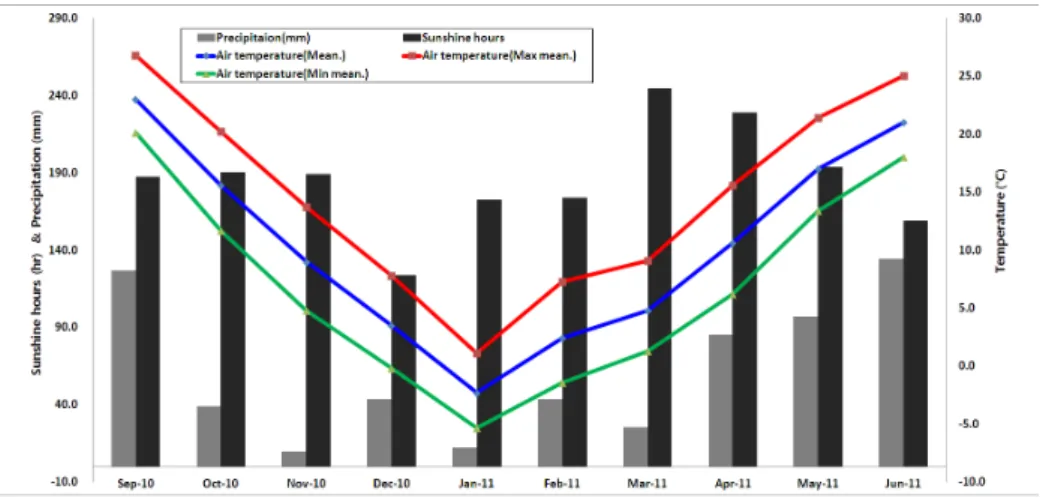
유채 품종별 파종기, 기름함량 및 지방산조성의 분산분석 본 실험기간의 최저기온(℃), 최고기온(℃), 평균기온(℃), 일조시간(hr), 강수량(㎜) 등 기상조건은 Fig. 1과 같다. (기상청 : http://www.kma.go.kr/index.jsp)
파종기부터 개화기까지의 생육기간의 평균기온은 평년에 비 하여 평균 1.6℃가 낮았으며 최고기온도 평균 2.1℃가 낮았다.
최저평균기온은 -5.3℃로 평년최저기온인 -1.5℃보다 3.8℃
가 낮았으며 특히 1월 10일부터 18일까지 일 최저기온이 -5℃이 하로 9일간 지속되었다. 이러한 이상기후는 파종시기가 늦어진 파종구의 경우 월동 전 기본영양생장이 이루어지지 않아 겨울을 나는 데 있어서 동해를 받았을 것으로 생각된다. 또한 본 시험 파종기간의 강수량은 평년의 46.9 ㎜에 비하여 39.2 ㎜로 7.7 ㎜ 적었고, 개화기엔 85.3 ㎜로 평년의 69.3 ㎜에 비하여 16 ㎜더 많았다. 일조량은 평년과 비슷하였다. 유채 품종별 파종시기 및 기름함량, 지방산조성의 분산분석 결과 파종시기는 지방함량 과 stearic acid (C18:0), oleic acid (C18:1), linoleic acid (C18:2)와
Fig. 1. Climatic data during the experimental period in mokpo area.
Table 1. ANOVA for oil content and fatty acid composition of 6 rapeseed cultivars with different sowing dates
d.f. Mean squares
Oil Palmitic Stearic Oleic Linoleic Linolenic SFA UFA Sowing date (A) 4 9.01** 1.38* 0.60** 3.59** 6.97** 0.12 1.37 0.24
Cultivars (B) 5 8.25** 0.20 0.75** 38.95** 23.6** 12.18** 0.94 1.99 A × B 20 1.86** 0.36 0.29** 4.08** 3.24** 0.76** 0.91 1.50
Error 60 0.29 0.46 0.10 0.89 0.64 0.23 0.56 0.94
SFA (Saturated fatty acid), UFA (Unsaturated fatty acid).
*, **Significant at the 0.05 and 0.01 probability levels, respectively.
Table 2. Changes of oil content and fatty acid composition in F1 hybrid cultivar (‘Sunmang’) with different sowing dates
Date
Composition of fatty acids (%) Oil C16:0 C18:0 C18:1 C18:2 C18:3 C20:1 C22:1 UFA/
SFA SFA UFA MUFA PUFA 25-Sep 43.0ab 5.0a 2.0a 62.7ab 18.9a 6.7a 1.9b 1.5cd 13.1a 7.1a 91.7a 66.1b 25.6a
5-Oct 42.6ab 4.9a 1.7a 61.3a 19.6bc 7.0a 2.3b 1.8d 13.9a 6.6a 91.9a 65.3ab 26.6b 15-Oct 43.1b 5.0a 2.1a 62.4ab 19.2ab 6.5a 2.2b 1.2c 12.9a 7.1a 91.4a 65.8ab 25.7a 25-Oct 42.7ab 4.7a 1.7a 62.2ab 20.1c 6.9a 2.2b 0.8b 14.3a 6.4a 92.2a 65.1ab 27.0b 5-Nov 41.6a 4.6a 2.3a 63.1b 20.9d 6.5a 1.2a 0.3a 13.6a 6.9a 92.0a 64.6a 27.4b Mean (%) 42.6 4.8 2.0 62.3 19.7 6.7 2.0 1.1 13.6 6.8 91.8 65.4 26.5 Mean separation within a column by Duncan’s multiple range test, p < 0.05.
C16:0 (Palmitic acid), C18:0 (Stearic acid), C18:1 (Oleic acid), C18:2 (Linoleic acid), C18:3 (Linolenic acid), C20:1 (Eicosenoic acid), C22:1 (Erucic acid), UFA/SFA (Unsaturated fatty acid/Saturated fatty acid), SFA (Saturated fatty acid), UFA (Unsaturated fatty acid), MUFA (Monounsaturated fatty acid), PUFA (Polyunsaturated fatty acid).
고도로 유의한 상호작용을 보였고, 품종 간에는 palmitic acid (C16:0)를 제외한 모든 지방산이 고도로 유의한 상호작용을 보였 다. 파종시기와 품종간의 상호작용 역시 palmitic acid를 제외 한 다른 지방 요인들과 고도의 유의성을 나타내었다(Table 1).
파종기에 따른 품종별 기름함량 및 지방산 조성
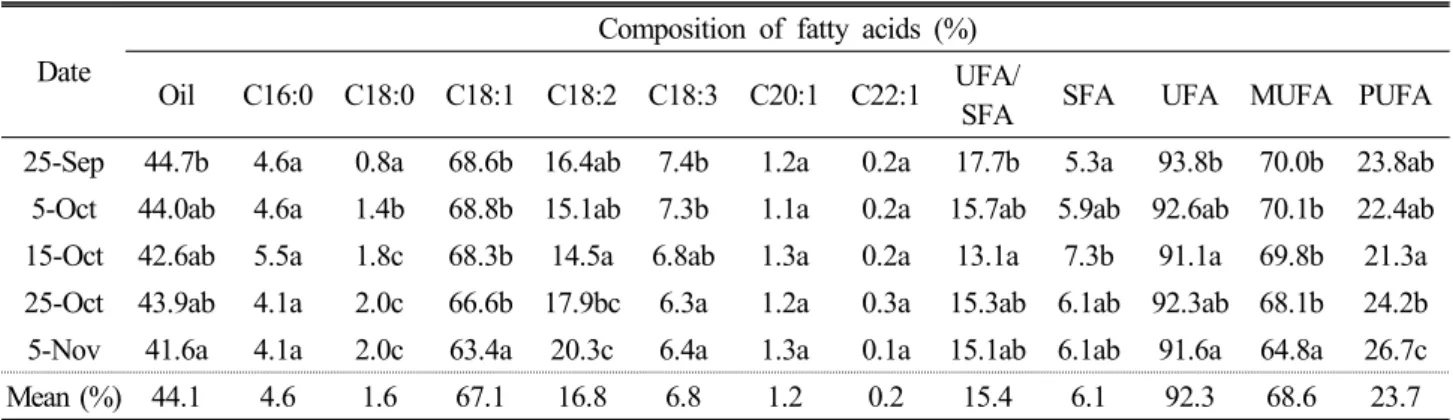
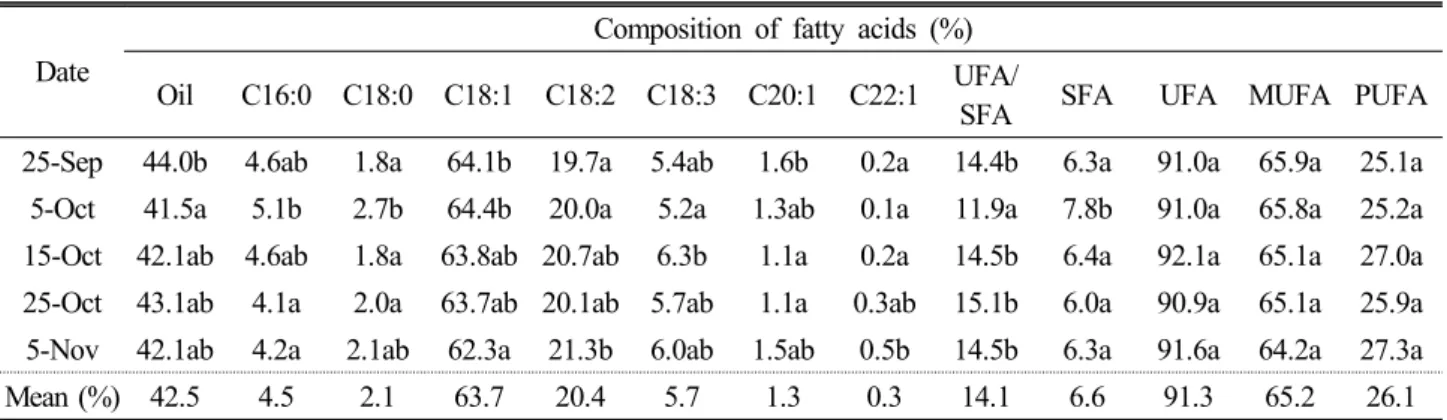
품종별 기름함량 및 지방산 조성은 Table 2, 3, 4, 5, 6, 7에 나타내었다. 전체적으로 기름함량 및 지방산 조성의 변화를 살 펴보면 파종기에 따른 기름함량은 파종시기가 빠를수록 높은
Table 3. Changes of oil content and fatty acid composition in ‘Tammi’ with different sowing dates
Date
Composition of fatty acids (%) Oil C16:0 C18:0 C18:1 C18:2 C18:3 C20:1 C22:1 UFA/
SFA SFA UFA MUFA PUFA 25-Sep 44.9b 4.7ab 1.7a 64.6a 19.6a 6.1a 1.0a 0.3ab 14.4b 6.4a 91.6a 65.9ab 25.7a
5-Oct 42.9ab 5.3b 2.6b 64.3a 18.8a 6.0a 1.2a 0.4b 11.7a 7.9b 90.7a 65.9ab 24.8a 15-Oct 42.9ab 4.5ab 2.3ab 65.0a 19.4a 6.4ab 1.1a 0.3ab 13.7ab 6.8ab 92.2a 66.4b 25.8a 25-Oct 40.8a 4.8ab 2.0ab 64.3a 19.7a 6.7ab 1.0a 0.2ab 13.6ab 6.8ab 91.9a 65.5a 26.4a 5-Nov 41.9a 3.9a 2.1ab 64.2a 19.2a 7.0b 1.5a 0.2a 15.4b 6.0a 92.1a 65.9ab 26.2a Mean (%) 42.7 4.6 2.1 64.5 19.3 6.4 1.2 0.3 13.8 6.8 91.7 65.9 25.8 Mean separation within a column by Duncan’s multiple range test, p < 0.05.
C16:0 (Palmitic acid), C18:0 (Stearic acid), C18:1 (Oleic acid), C18:2 (Linoleic acid), C18:3 (Linolenic acid), C20:1 (Eicosenoic acid), C22:1 (Erucic acid), UFA/SFA (Unsaturated fatty acid/Saturated fatty acid), SFA (Saturated fatty acid), UFA (Unsaturated fatty acid), MUFA (Monounsaturated fatty acid), PUFA (Polyunsaturated fatty acid).
Table 4. Changes of oil content and fatty acid composition in ‘Tamla’ with different sowing dates
Date
Composition of fatty acids (%) Oil C16:0 C18:0 C18:1 C18:2 C18:3 C20:1 C22:1 UFA/
SFA SFA UFA MUFA PUFA 25-Sep 44.7b 4.6a 0.8a 68.6b 16.4ab 7.4b 1.2a 0.2a 17.7b 5.3a 93.8b 70.0b 23.8ab
5-Oct 44.0ab 4.6a 1.4b 68.8b 15.1ab 7.3b 1.1a 0.2a 15.7ab 5.9ab 92.6ab 70.1b 22.4ab 15-Oct 42.6ab 5.5a 1.8c 68.3b 14.5a 6.8ab 1.3a 0.2a 13.1a 7.3b 91.1a 69.8b 21.3a 25-Oct 43.9ab 4.1a 2.0c 66.6b 17.9bc 6.3a 1.2a 0.3a 15.3ab 6.1ab 92.3ab 68.1b 24.2b 5-Nov 41.6a 4.1a 2.0c 63.4a 20.3c 6.4a 1.3a 0.1a 15.1ab 6.1ab 91.6a 64.8a 26.7c Mean (%) 44.1 4.6 1.6 67.1 16.8 6.8 1.2 0.2 15.4 6.1 92.3 68.6 23.7 Mean separation within a column by Duncan’s multiple range test, p < 0.05.
C16:0 (Palmitic acid), C18:0 (Stearic acid), C18:1 (Oleic acid), C18:2 (Linoleic acid), C18:3 (Linolenic acid), C20:1 (Eicosenoic acid), C22:1 (Erucic acid), UFA/SFA (Unsaturated fatty acid/Saturated fatty acid), SFA (Saturated fatty acid), UFA (Unsaturated fatty acid), MUFA (Monounsaturated fatty acid), PUFA (Polyunsaturated fatty acid).
Table 5. Changes of oil content and fatty acid composition in ‘Naehan’ with different sowing dates
Date
Composition of fatty acids (%) Oil C16:0 C18:0 C18:1 C18:2 C18:3 C20:1 C22:1 UFA/
SFA SFA UFA MUFA PUFA 25-Sep 44.2a 4.6a 2.0ab 62.3a 18.8b 9.1b 1.2a 0.2a 13.7a 6.6a 91.5a 63.7a 27.9b
5-Oct 43.1a 4.7a 2.0ab 63.9ab 18.3b 8.9b 1.0a 0.3a 14.0a 6.6a 92.4a 65.2ab 27.2b 15-Oct 44.6a 4.7a 2.3ab 63.3a 18.5b 8.5ab 1.3a 0.1a 13.0a 7.1a 91.7a 64.7ab 27.0b 25-Oct 44.3a 4.7a 1.8a 63.2a 19.1b 8.9b 1.2a 0.2a 14.4a 6.5a 92.6a 64.7ab 28.0b 5-Nov 43.2a 4.4a 2.6b 65.0b 17.2a 7.3a 1.3a 0.2a 13.2a 7.0a 91.0a 66.5b 24.5a Mean (%) 43.8 4.6 2.1 63.5 18.4 8.5 1.2 0.2 13.7 6.7 91.8 65.0 26.9 Mean separation within a column by Duncan’s multiple range test, p < 0.05.
C16:0 (Palmitic acid), C18:0 (Stearic acid), C18:1 (Oleic acid), C18:2 (Linoleic acid), C18:3 (Linolenic acid), C20:1 (Eicosenoic acid), C22:1 (Erucic acid), UFA/SFA (Unsaturated fatty acid/Saturated fatty acid), SFA (Saturated fatty acid), UFA (Unsaturated fatty acid), MUFA (Monounsaturated fatty acid), PUFA (Polyunsaturated fatty acid).
Table 6. Changes of oil content and fatty acid composition in rapeseed cultivar ‘Yongsan’ with different sowing dates
Date
Composition of fatty acids (%) Oil C16:0 C18:0 C18:1 C18:2 C18:3 C20:1 C22:1 UFA/
SFA SFA UFA MUFA PUFA 25-Sep 45.7c 4.7a 2.1a 64.9ab 18.5ab 6.3a 1.3a 0.2a 13.5a 6.9a 91.1ab 66.4ab 24.8ab
5-Oct 45.0bc 4.9a 2.3a 64.6ab 17.2a 7.2b 1.5a 0.1a 12.5a 7.3a 90.6a 66.2ab 24.4a 15-Oct 44.2b 4.3a 1.8a 65.5b 17.9ab 7.0b 1.3a 0.1a 15.2a 6.1a 91.9b 66.9b 25.0abc 25-Oct 43.0a 5.1a 1.8a 63.4a 19.2b 6.9b 1.2a 0.3a 13.6a 6.9a 91.0ab 64.9a 26.1bc
5-Nov 42.5a 4.0a 2.2a 64.2ab 19.2b 7.1b 1.1a 0.1a 14.8a 6.2a 91.8ab 65.4ab 26.3c Mean (%) 44.1 4.6 2.0 64.5 18.4 6.9 1.3 0.2 13.9 6.7 91.3 66.0 25.3 Mean separation within a column by Duncan’s multiple range test, p < 0.05.
C16:0 (Palmitic acid), C18:0 (Stearic acid), C18:1 (Oleic acid), C18:2 (Linoleic acid), C18:3 (Linolenic acid), C20:1 (Eicosenoic acid), C22:1 (Erucic acid), UFA/SFA (Unsaturated fatty acid/Saturated fatty acid), SFA (Saturated fatty acid), UFA (Unsaturated fatty acid), MUFA (Monounsaturated fatty acid), PUFA (Polyunsaturated fatty acid).
Table 7. Changes of oil content and fatty acid composition in ‘Halla’ with different sowing dates
Date
Composition of fatty acids (%) Oil C16:0 C18:0 C18:1 C18:2 C18:3 C20:1 C22:1 UFA/
SFA SFA UFA MUFA PUFA 25-Sep 44.0b 4.6ab 1.8a 64.1b 19.7a 5.4ab 1.6b 0.2a 14.4b 6.3a 91.0a 65.9a 25.1a 5-Oct 41.5a 5.1b 2.7b 64.4b 20.0a 5.2a 1.3ab 0.1a 11.9a 7.8b 91.0a 65.8a 25.2a 15-Oct 42.1ab 4.6ab 1.8a 63.8ab 20.7ab 6.3b 1.1a 0.2a 14.5b 6.4a 92.1a 65.1a 27.0a 25-Oct 43.1ab 4.1a 2.0a 63.7ab 20.1ab 5.7ab 1.1a 0.3ab 15.1b 6.0a 90.9a 65.1a 25.9a
5-Nov 42.1ab 4.2a 2.1ab 62.3a 21.3b 6.0ab 1.5ab 0.5b 14.5b 6.3a 91.6a 64.2a 27.3a Mean (%) 42.5 4.5 2.1 63.7 20.4 5.7 1.3 0.3 14.1 6.6 91.3 65.2 26.1 Mean separation within a column by Duncan’s multiple range test, p < 0.05.
C16:0 (Palmitic acid), C18:0 (Stearic acid), C18:1 (Oleic acid), C18:2 (Linoleic acid), C18:3 (Linolenic acid), C20:1 (Eicosenoic acid), C22:1 (Erucic acid), UFA/SFA (Unsaturated fatty acid/Saturated fatty acid), SFA (Saturated fatty acid), UFA (Unsaturated fatty acid), MUFA (Monounsaturated fatty acid), PUFA (Polyunsaturated fatty acid).
경향을 나타내어 Baghdadi et al. (2012), Sattar et al. (2013)의 연구 결과와 비슷한 경향이었으며, 기름의 함량은 40.8~45.7%
로 높은 편이였다. 유채를 구성하고 있는 주요지방산은 palmitic acid, stearic acid, oleic acid, linoleic acid, linolenic acid로 이루어져 있으며, 지방산 조성의 함량은 oleic acid 61.3~
68.8%로 가장 많은 함량을 보였고, linoleic acid 14.5~21.3%, linolenic acid 5.2~9.1%, palmitic acid 3.9~5.5%, stearic acid 0.7~2.7% 순으로 구성되어 있었다. 이러한 지방산조성 결 과는 Shirani Rad and Zandi (2012)의 보고와 비슷하였다.
유채 파종기 별 지방산 분포는 oleic acid는 탐라유채 10월 5일 파종구가 68.8%로 가장 높았고, 선망유채 10월 5일 파종구가 61.3%로 가장 낮았으며, linoleic acid의 경우 한라유채 11월 5일
파종구가 21.3%로 가장 높았고, 탐라유채 10월 15일 파종구가 14.5%로 가장 낮았다. 한편 고도불포화지방산 중 linolenic acid 의 경우 내한유채 9월 25일 파종구가 9.1%로 가장 높았으며, 한 라유채 10월 5일 파종구가 5.2%로 가장 낮았다. Shirani Rad and Zandi (2012)의 결과를 볼 때 linolenic acid는 변이계수 7.06으로 oleic acid, linoleic acd의 0.31, 0.43에 비하여 크기 때문에 안정성이 낮은 것을 알 수 있었다. 일반적으로 변이계수 가 작을수록 환경에 따른 변이가 작다고 알려져 있다. 포화지방 산 중 palmitic acid는 탐라유채 10월 15일 파종구가 5.5%로 가 장 높았고, 탐미유채 11월 5일 파종구가 3.9%로 가장 낮았다. 같 은 포화지방산인 stearic acid는 한라유채 10월 5일 파종구가 2.7%로 가장 높았으며, 탐라유채 9월 25일 파종구가 0.7%로 가
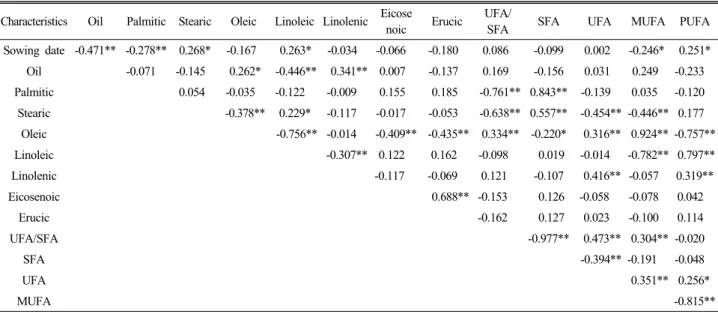
Table 8. Correlation coefficients among sowing date, oil content and fatty acid compositions in 6 rapeseed cultivar
Characteristics Oil Palmitic Stearic Oleic Linoleic Linolenic Eicose
noic Erucic UFA/
SFA SFA UFA MUFA PUFA
Sowing date -0.471** -0.278** 0.268* -0.167 0.263* -0.034 -0.066 -0.180 0.086 -0.099 0.002 -0.246* 0.251*
Oil -0.071 -0.145 0.262* -0.446** 0.341** 0.007 -0.137 0.169 -0.156 0.031 0.249 -0.233 Palmitic 0.054 -0.035 -0.122 -0.009 0.155 0.185 -0.761** 0.843** -0.139 0.035 -0.120
Stearic -0.378** 0.229* -0.117 -0.017 -0.053 -0.638** 0.557** -0.454** -0.446** 0.177 Oleic -0.756** -0.014 -0.409** -0.435** 0.334** -0.220* 0.316** 0.924** -0.757**
Linoleic -0.307** 0.122 0.162 -0.098 0.019 -0.014 -0.782** 0.797**
Linolenic -0.117 -0.069 0.121 -0.107 0.416** -0.057 0.319**
Eicosenoic 0.688** -0.153 0.126 -0.058 -0.078 0.042
Erucic -0.162 0.127 0.023 -0.100 0.114
UFA/SFA -0.977** 0.473** 0.304** -0.020
SFA -0.394** -0.191 -0.048
UFA 0.351** 0.256*
MUFA -0.815**
*, ** Significant at the 0.05 and 0.01 probability levels, respectively.
장 낮은 함량을 보였다. 특히 포화지방산인 palmitic, stearic acid 경우는 환경의 영향을 적게 받는다고 알려져 있다(Wolf et al. 1982; Dornbos and Mullen, 1992). 본 실험에서는 포화지방 산이나 불포화지방산의 변화는 확연하게 나타나지는 않았으나 특히 탐라유채의 oleic acid의 함량은 10월 15일 파종 이후 확연 하게 감소하는 경향이 확인되어 11월 이전에 파종을 하는 것이 좋을 것으로 생각되었으며, 내한 유채의 경우 11월 이후 파종에 서 65%의 올레인산 함량을 보여 탐라유채와 반대되는 결과를 나타내었다. 품종 간 및 파종기에 따라 최대 7.5%의 차이를 보여 식용유나 연료로의 이용에 유리한 방향으로 활용할 가능성이 있을 것으로 판단된다.
파종기 및 기름함량과 지방산조성의 상관분석
파종기와 기름함량, 지방산 조성의 상관분석 결과는 Table 8 과 같다.
파종기의 변화는 기름함량(-0.471) 및 포화지방산 중 palmitic acid (-0.278)와 유의한 부의상관을 보였으며, stearic acid (0.268), linolenic acid (0.263)와는 유의한 정의상관을 보였 다. 이는 파종기 지연에 따라 유채 기름함량의 감소와 저장 중 산패의 주요원인인 linolenic acid가 증가하는 경향을 보이는 것 으로 생각된다.
기름함량의 경우 oleic acid (0.262)와 linolenic acid (0.341) 과 유의한 정의상관을 보였고, linoleic acid (-0.446)와는 유의 한 부의상관을 나타내었다. 따라서 품종의 기름함량 증진을 위
해 oleic acid나 linolenic acid 중 어느 한 지방산의 함량을 높이 면 다른 지방산의 함량도 높아지기 때문에 지방산 조성 개량을 위한 육종 연구 측면에서 유리하리라 판단된다. Stearic acid의 경우는 불포화지방산인 oleic acid (-0.378)와 유의한 부의상관 을 보였고, linoleic acid (0.229)와는 정의상관을 보였다. 단일 불포화지방산인 oleic acid는 linoleic acid (-0.756)와 고도로 유의한 부의상관 계수를 나타내었는데 linoleic acid가 낮아지 면 oleic acid가 높아짐을 알 수 있었다.
반면 Turhan et al. (2011)은 파종기 변화에 따라 oleic acid와 linoleic acid, linolenic acid와 부의상관을 보고하였으며, Liwenbin et al. (2008)은 콩의 상관관계를 분석한 결과 oleic acid는 linoleic acid 및 linolenic acid와 고도의 부의상관이라 하여 본 실험의 결과와 상이한 경향을 보여주었다. Bang et al.
(1991)은 유채에서 기름함량과 palmitic acid, stearic acid, oleic acid와는 정의상관을 보였으며 oleic acid는 linoleic acid 와 정의 상관, linoleic acid는 linolenic acid와 정의상관을 보였 다고 보고한 바 있으나 파종기 및 품종의 영향에서 기인한 것으 로 사료되고 향후 연차의 변화나 다양한 품종을 조사 및 연구를 수행할 필요성이 있는 것으로 판단된다. 한편 총 포화지방산, 총 불포화지방산, 총 포화지방산에 대한 총 불포화지방산의 비 와 총 단일불포화지방산과 총 고도불포화지방산의 경우 유의한 상관을 나타내고 있지만 이러한 계수는 포화지방산과 불포화지 방산으로부터 함량을 계산하였기 때문에 큰 의미는 없는 것으 로 생각되었다.
적 요
유채의 파종기가 늦어질수록 지방함량 (-0.471**)은 감소하 는 경향을 보이고 파종기가 빠를수록 전반적으로 높은 경향을 보였다. 지방산 조성의 경우 파종기가 늦을수록 palmitic acid (-0.278*)는 감소하는 반면, stearic acid (0.268*) 및 linoleic acid (0.263*)는 증가하는 관계를 보였다. 본 실험에서는 유채 품종 간에 차이는 보이나 큰 변화는 보이지 않아 파종기 지연의 영향이 적은 것으로 보였으나 연차간의 추가적인 실험이 필요 하다고 생각되며 무안지역에서의 제한적인 자료이기 때문에 보 다 다양한 환경과 지역에서 광범위한 실험을 통해 지방함량과 지방산조성 함량 변화를 검정하여 평가하는 것이 필요할 것으 로 판단된다.
사 사
본 연구는 농촌진흥청 기관고유 연구사업(PJ008684)에 의해 수행함.
References
Baghdadi, H., S. Taspinar, M. Yousefi and A. Hosseinpour.
2012. Influence of different sowing dates on grain yield of canola (Brassica napus L.) cultivars in Qazvin area. International Journal of Agriculture: Research and Review. 2:1092-1096.
Bang, J.K., J.I. Lee, K.J. Kim and R.K. Park. 1991. Oil content and fatty acid composition of rapeseed. Korean J. of Crop Sci. 3:62-78 (in Korean).
Demirbas, A. 2007. Progress and recent trends in biofuels.
Progress Energy Combus Sci. 33:1-18.
Dornbos, D.L and R.E. Mullen. 1992. Soybean seed protein and oil contents and fatty acid composition adjustments by drought and temperature. J. Am. Oil Chem. Soc. 69:228-231.
Jang, Y.S., K.S. Kim, Y.H. Lee, H.J. Cho and S.J. Suh. 2010.
Review of property and utilization of crop for biodiesel. J.
Plant Biotechnol. 37:25-46 (in Korean).
Li, W.B., Y.H. Zheng and Y.P. Han. 2008. Analysis of fatty acid composition and other quality traits in soybean varieties developed in Heilongjiang Province. Soybean Sci. 27:740-745.
Park, H.W., J.I. Lee, J.K. Bang, B.H. Lee and K.H. Kang. 1991.
Variations of oil ontent and fatty acid composition in groundnut germplasm. Korean J. of Crop Sci. 36:33-47 (in Korean).
Petukhov, I., L.J. Malcolmson, R. Przybylski and L.
Armstrong. 1999. Frying performance of genetically modified canola oils. J. Am. Oil Chem. Soc. 76:627-632.
Sattar, A., M.A. Cheema, M.A. Wahid, M.F. Saleem, M.A.
Ghaffari, S. Hussain and M.S. Arshad. 2013. Effect of sowing time on seed yield and oil contents of canola varities.
J. Glob. Innov. Agric. Soc. Sci. 1(1):1-4.
Shirani Rad, A.H and P. Zandi. 2012. A comparison of fatty acid compounds in winter and spring rapeseed varieties.
Annals of Biological Research 3(3):1408-1414.
Sticklen, M. 2006. Plant genetic engineering to improve biomass characteristics for biofuels. Curr. Opin. Biotechnol.
17:315-319.
Turhan, H., M. K. Gul, C.O. Egesel and F. Kahriman. 2011.
Effect of sowing time on grain yield, oil content, and fatty acids in rapeseed (Brassica napus subsp. oleifera). Turkish Journal of Agriculture and Forestry 26:289-294.
Walsh, M.E., D.G. De La Torre Ugarte, H. Shapouri and S.P.
Slinsky. 2003. Bioenergy crop production in the united states: Potential quantities, land use changes, and economic impacts on the agricultural sector. J. Environmental &
Resource Economics. 24:313-333.
Wolf, R.B., J.F. Cavins, R. Kleiman and L.T. Black. 1982.
Effect of temperature on soybean seed constituents: Oil, protein, moisture, fatty acids, amino acids and sugars. J. Am.
Oil Chem. Soc. 59:230-232.
Wright, L. 2006. Worldwide commercial development of bioenergy with focus on energy crop-based projects. J.
Biomass & Bioenergy 30:706-714.
(Received 4 February 2014 ; Revised 8 April 2014 ; Accepted 9 April 2014)