• 검색 결과가 없습니다.

Development and Evaluation of Fixation Equipment for Transporting Unit Modules

N/A
N/A
Protected

Academic year: 2021

Share "Development and Evaluation of Fixation Equipment for Transporting Unit Modules"

Copied!
10
0
0

로드 중.... (전체 텍스트 보기)

전체 글

(1)

Journal of the Korea Institute of Building Construction, Vol. 13, No. 6

http://dx.doi.org/10.5345/JKIBC.2013.13.6.609 www.jkibc.org

Development and Evaluation of Fixation Equipment for Transporting Unit Modules

Park, Su-Yeul Kim, Kyoon-Tai

*

Park, Nam-Cheon

1)

Construction Management & Economy Research Div, Korea Institute of Construction Technology, Goyang-Si, Gyeonggi–Do, 411-712, Korea

Abstract

The unit modular construction system is a building technique in which unit modules are manufactured at a factory and then assembled at the construction site. It has many benefits, including reduction of the construction period and improvement in quality. For this reason, it is utilized for various purposes in Japan and England. While it has been introduced in Korea, there have been few Korean studies conducted on the unit modular system. In particular, little research has been done on the method of safely fixating the unit modules to a truck. Therefore, this study reviewed the fixation methods of unit modules for transport, analyzed the problems, and designed a fixation device for unit modules. In addition, a device for the fixation of unit modules to a truck was developed, and a structural simulation was implemented for a safety test by considering the maximum stress generated during the transport of the unit modules fixed on a truck. When the device for the fixation of unit modules is manufactured based on the results of the structural simulation done in this study, it is expected to aid the development of a more practical fixation device for unit modules.

Keywords : unit module, unit modular system, fixation equipment for transport, evaluation

1. Introduction

1.1 Research background and objective

In the unit modular construction system, unit modules are made at a factory in cubic steel structures, in which various interior materi- alsmechanical equipment, and electric wiring are installed in advance, and then they are transported to and assembled at construction sites[1]. The unit modular construction system is less dependent on on-site work because most of the structure is produced in advance at a factory, which offers ad-

Received : October 7, 2013

Revision received : November 6, 2013 Accepted : November 7, 2013

* Corresponding author : Kim, Kyoon-Tai [Tel: 82-31-910-0420, E-mail: [email protected]]

ⓒ2013 The Korea Institute of Building Construction, All rights reserved.

vantages such as a reduced construction duration, improved quality, and prevention of material waste[2]. In addition, the unit of a module struc- ture is formulated in a steel box so that it can be reused by moving it to another place. In general, 40%-90% of works of the unit modular system is finished at a factory, and the rest is done at the site. The higher the factory work ratio, the more advantageous the system is. Therefore, it is im- portant to improve the factory completion rate, and to accomplish this the interior and exterior materials should be attached to the unit modular system at the factory[3].

On the other hand, the unit module that is

manufactured at a factory is transported using a

truck. When the factory completion ratio is less

than 50%, which means that only the steel frame

and floor slab are manufactured at a factory, the

(2)

Development and Evaluation of Fixation Equipment for Transporting Unit Modules

unit module is transported using a conventional fixation device including rope and fixation belt.

The problem lies in the fact that in the transport process, the unit module could become deformed[4].

However, when the unit module that is more than 80% finished at a factory, including the installation of interior and exterior materials is fixed with the conventional fixation device, the interior and ex- terior materials could also be broken. In addition, a container-like unit module with dimensions of 3mx3mx6m is difficult to fix with rope or belt, so workers tend to avoid performing fixation due to its difficulty. Therefore, to take advantage of the unit modular construction system, a safe transport system should be developed for the unit module with interior and exterior materials installed.

However, the modular construction system is at an early stage in Korea, and there has been little study on the transport of the unit module.

This study aims to develop a device for the fix- ation of unit modules with a high factory com- pletion rate to a truck. That is, for unit modules with interior and exterior materials installed that are transported with a truck, we try to improve the safety of transport work and the convenience of the fixation work by developing a new fixation device to fix the unit module to a truck without any interior and exterior materials damaged.

1.2 Research scope and method

As mentioned previously, the more the unit module is finished at the factory, the more effec- tive the unit modular technique is in the field.

Therefore, in this study, a unit module means that is finished more than 80% at a factory and in which interior and exterior materials are already installed was selected. The object to be inves- tigated was limited to the device for the fixation of the unit module to a truck. The conventional

rope and fixation block welded on the truck are used, and thus are excluded from the research scope. The research proceeded as follows.

1) Through a review of previous studies and re- lated literature and an interview with experts, problems found in the transport of unit mod- ules using a truck are analyzed.

2) The development direction of the fixation de- vice for the unit module is set, and ideas are derived to improve the fixation device for the unit model.

3) F Select the final plan through an analysis of the improved ideas, and design the device.

4) Review the safety and feasibility of the unit module for the fixation device through an implementation of structural simulation of the device developed in this study

2. Review of the current state of unit module transport

2.1 Fixation of unit module transport

In Korea, unit modules are usually transported

to a construction site using a 5-ton or 25-ton

anti-vibration low bed truck. The transport cost

and safety with these trucks vary greatly, so a

unit modular construction company selects one af-

ter taking into account the factory completion rate

of the unit module, urgency of the work, and the

number of the unit modules. The unit module

made at a factory is usually lifted to the truck

using fork-lift, gantry crane, etc.[5] To transport

a unit module placed on the truck safely, chain,

rope and fixation belt are used to fix it to the

truck. Truck owners usually install the fixing block

on the truck as shown in Figure 1 in order to im-

prove the work efficiency. The fixing block is a

fixation device individually welded to a truck by

the truck owner after the truck has been released

(3)

can be easily hung. Therefore, when the unit module is transported, the rope and fixation belt are hung on the fixing block to fix the module tightly.

Figure 1. Fixation blocks welded to a truck

2.2 Current state of unit module

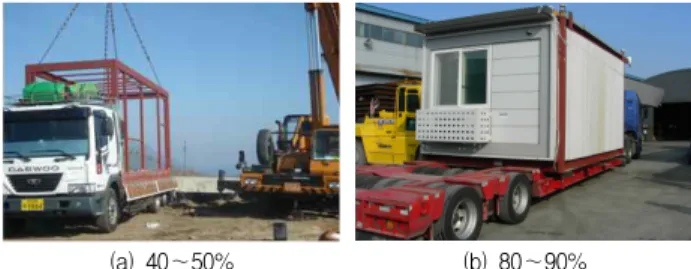
The unit module can be categorized according to the level of completion at a factory. Figure 2(a) shows a module with a 40%-50% level of factory completion, in which only steel frame and floor slab were completed at the factory. Figure 2(b) has 80%-90% factory completion, which means that in addition to the steel frame and floor slab, interior and exterior materials, plumbing, windows and doors are also completed. The dimensions of the unit module differ slightly according to the manu- facturer, but most of them are 3.0m(W)×6.0m(L)

×3.0m(H) on average[6].

(a) 40~50% (b) 80~90%

Figure 2. The manufactured percentage of the unit module at a factory

2.3 Problems in unit module transport

We presented some of the problems in unit modular construction in our previous study[4]. Of

study is based on the problems related with move- ment and transport. In relation to movement and transport of the unit module, the problems that were analyzed included “twisting and sagging of the unit box due to the transport vehicle’s viola- tion of regulation speed,” “contamination of in- terior and exterior materials including ceiling and wall due to bad weather such as rain,” and “need for rework due to a change in transport vehicles caused by insufficient review of the road traffic and the size of the unit.”

To perform a closer analysis of the problems re- lated with unit module transport, we conducted an interview with professionals. The professionals in- terviewed included a professional with more than 10 years of work experience with unit module manufacturer K, and two truck drivers who had the experience of unit module transport. The problems in the process of unit module transport that were discovered through the interview are as follows.

First, the unit module can be damaged when it is transported without being properly fixed. In the past, the factory completion rate of unit modules was usually low. Therefore, there were not many cautions related to handling, and the module was simply put on the truck bed and then transported without fixation. However, when the driver violates the regulation speed and passes over a speed bump or turns a corner, the unit box becomes twist- ed[4,7]. When this occurs with a unit module with a higher factory completion rate, the damage is much greater.

Second, the fixation of a unit module using a

conventional fixation device is very tedious. In the

conventional fixation method using rope and fixing

belt, a fixing belt was fixed tightly on the fixation

blocks installed on a side of the truck. Then, the

(4)

Development and Evaluation of Fixation Equipment for Transporting Unit Modules

fixing belt is passed over the unit module, and then hung on a fixation block on the other side of the truck. Next, the fixing belt is tightened using a ratchet wrench. And then the fixing belt is passed over the unit box again to the other side, and it is also tightened using the ratchet wrench.

However, the dimension of a unit module is 3.0m(W)×6.0m(L)×3.0m(H), which is a size similar to a container box, making both the fixation proc- ess and unfastening work very cumbersome.

Third, when transporting a unit module that has reached a high level of completion at a factory, conventional devices including a fixing belt and rope are used. At this time, the interior and ex- terior materials may be damaged[8]. To fix the unit module safely, the fixing belt should be tightened. However, when the fixing belt is tight- ened, the force of the fixing belt could damage the interior and exterior materials.

Fourth, rainwater can contaminate or damage the interior and exterior materials[4]. For instance, gypsum board and OSB veneer are usually used as interior materials for unit modules built in Korea.

If it rains suddenly in the process of unit module transport, or if the work is done while it is rain- ing, the gypsum board used as an interior material can be damaged or stained on the surface, and thus it will later require repair.

Fifth, the dimensions of a module unit are re- stricted by the size of the truck and the Road Traffic Laws when transporting it using a truck[9].

Sixth, when the unit module is transported using a truck, the access to the construction site is sometimes not sufficiently secured [4,9]. For ex- ample, when the construction site is located on a mountainside in a suburban area, the access to the site is usually very narrow and winding, and thus if there are telephone poles and wires along the access, it is usually very difficult to transport the

unit module to the site.

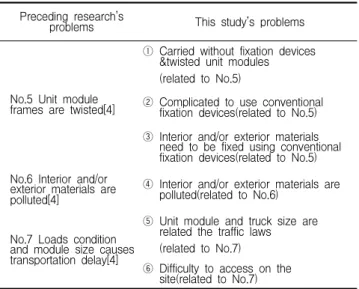
The transport-related problems are indicated in Table 1.

Table 1. Comparing the problems of preceding research and this study

Preceding research’s

problems This study’s problems

No.5 Unit module frames are twisted[4]

① Carried without fixation devices

&twisted unit modules (related to No.5)

② Complicated to use conventional fixation devices(related to No.5)

③ Interior and/or exterior materials need to be fixed using conventional fixation devices(related to No.5) No.6 Interior and/or

exterior materials are

polluted[4] ④ Interior and/or exterior materials are polluted(related to No.6)

No.7 Loads condition and module size causes transportation delay[4]

⑤ Unit module and truck size are related the traffic laws (related to No.7)

⑥ Difficulty to access on the site(related to No.7)

3. Design of a fixation device for a unit module

The first three problems presented above are re-

lated to the fixation of a unit module to a truck,

and these can be resolved through a technical

method such as the development of a new fixation

device. The fourth problem relates to the con-

tamination of interior and exterior materials

caused by rain, and this is usually prevented by

individual wrapping of a unit module by

manufacturer. The fifth problem is related with

laws and regulations, which must be observed as

long as they are not amended, and thus the unit

module is currently produced within a limited

dimension. Finally, the sixth problem is related to

road conditions, and it is technically difficult to

resolve this problem. Therefore, countermeasures

are derived for the first three problems above, as

these can be resolved through a technical

approach.

(5)

for unit module

The direction for the development of the fixation device was derived through the interview with professionals. To set the development direction, the professionals mentioned above, a machine pro- fessional with more than 15 years of work experi- ence in machinery design and production, and the researchers of this study held discussions. The de- velopment directions derived through the discussion are as follows:

1) The unit module should be fixed tightly and safely to a truck, regardless of whether the unit module was installed with interior and exterior materials or wrapped individually.

2) The fixation device should not be affected by the dimensions of the unit module, and should also be easy to attach and detach.

3) The truck should be deformed to the mini- mum extent possible by the unit module, and conventional devices including fixation block should be used as much as possible.

3.2 Deriving ideas for improving the fixation device for unit module

The machine professional and the researchers of this study engaged in a process of developing ideas to improve the fixation device for the unit module while considering earlier improvement direction . The alternatives derived are as follows[9]:

3.2.1 Location fixing pin

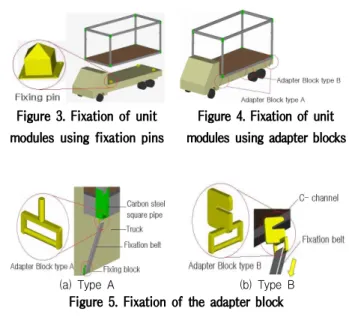
The location fixing pin proposed in this study is, as shown in Figure 3, a pyramid-shaped support attached to each of the four corners of a truck.

The 5-10-ton unit module is on the supports, which would prevent the unit module from moving while the truck is driven.

As shown in Figure 4, the adapter block is a device used to connect the lower block of a unit module and the fixation block. The adapter block consists of Types A and B, as shown in Figure 5.

Adapter block type A is, as shown in Figure 5(a), fixed on the holes of the columns of the unit module with bolt and nut. The adapter block type A was fixed on the fixation block using the fixing belt.

Adapter block type B is, as shown in Figure 5(b), fixed by friction force when placed on the C-shaped lower part installed at the lower part of the unit module. The fixing belt is also used to fix adapter block type B to connect the unit module with the fixation block. However, the fixing belt should be fastened more tightly to increase the friction force when it is connected with adapter block type B.

Figure 3. Fixation of unit modules using fixation pins

Figure 4. Fixation of unit modules using adapter blocks

(a) Type A (b) Type B

Figure 5. Fixation of the adapter block

3.3 Analysis of the improvement plans and selecting the final plan

When using the location fixing pin and the

adapter block, the problem of movement of the

unit module can be prevented while driving. And

since the existing fixation device including rope

(6)

Development and Evaluation of Fixation Equipment for Transporting Unit Modules

and fixing belt is not passed over the unit module, cumbersome work can be avoided. In addition, since the unit module is not fixed using tight pulling force, damage to the interior and exterior materials caused by the fixing belt can be prevented.

In particular, job is easy to handle with the lo- cation fixing pin mentioned above because all that needs to be done is to simply place the unit mod- ule on the truck bed. However, to install the loca- tion fixing pin on a truck, a permanent deforma- tion method such as welding should be used. In addition, there is no device to connect the location fixing pin with the unit module, and the shape of the unit module should be changed. And since the connection of the unit module with a truck cannot be made tightly, the unit module may move, either when the truck passes over a speed bump or when it turns around a corner. For instance, if a truck passes over a speed bump at more than a certain level of speed, the location fixing pin can be pulled out and then fall due to the impact from passing over the bump.

The adapter block is connected with a unit module and a truck through structures already in- stalled, and moreover it can be used without any deformation of the truck or unit module. In an adapter block, type A uses the holes on the square-shaped columns of the unit module, and its installation process is rather cumbersome, while it has great support force. Type B is inserted in the lower part of the C-shaped steel part, and its in- stallation is easy, while it has small support force.

In addition, the adapter block can be utilized in many ways to transport other freight. However, it has a limitation in that the support force of one adapter block is so small that several blocks must be used to get sufficient support force.

Through the review, the adapter block had good

evaluation in terms of least deformation of con- ventional structure, utilization of devices installed on a truck, and applicability of transport for other freight.

3.4 Design of an adapter block

Adapter block types A and B were designed as shown in Figure 6.

(a) Type A

(b) Type B

Figure 6. Drawings of the adapter block

4. Feasibility review

The adapter block designed in this study was

made as a prototype, and it was demonstrated to

the factory manager of Y unit module manu-

facturer, technicians, and the truck driver, in or-

der to confirm its applicability. Through a quanti-

tative evaluation by professionals, its applicability

was evaluated to be good, and we reviewed the

feasibility of the designed adapter block. To review

feasibility in this study, we first checked whether

there were any criteria or standards for existing

fixation devices, including fixing belts. However,

no specific standard for existing devices was

stipulated, and we found that truck drivers select

(7)

freight to be transported. In particular, it should be noted that the unit modular method is in its infancy in Korea, and there are no standards or criteria related with transport. Therefore, structure simulation was used to determine feasibility.

4.1 Simulation conditions

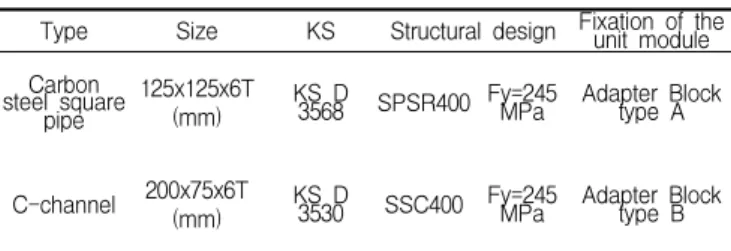
To review structural simulation of the designed adapter block types A and B, a finite element analysis was performed. To conduct a structural simulation through a finite element analysis, the size, thickness, standard and target strength are required [10]. Therefore, the size of the unit mod- ule (to be transported) was set to be 2.99m(W)×6m(L)×3m(H) in this study, and the size and thickness, standard and target strength of the unit module were set as shown in Table 2.

Table 2. Specifications of unit module for the structural simulation

Type Size KS Structural design Fixation of the unit module Carbon

steel square

pipe 125x125x6T

(mm) KS D

3568 SPSR400 Fy=245 MPa Adapter Block type A C-channel 200x75x6T (mm) KS D

3530 SSC400 Fy=245 MPa Adapter Block type B

To fix the adapter block type A, M20 hex- agon-shaped nuts made of SS41 material were ap- plied, while type B was inserted in C-shaped steel part. The fixing belt to fix the unit module was set to be 5cm wide and to have tensile strength of 6 tons. When the unit module is placed on a truck bed, part of the unit module was protruded outside of the truck, and it could not be connected verti- cally with the fixing belt. As shown in Table 3, the installation angle of the fixation belt for the adapter block types A and B measured in this sit- uation was 74° and 44°, respectively.

block Setting the Adapter

Block Type A(load 74°) Type B(load 44°)

4.2 Creation of a mesh of the model

The analysis element of adapter block, light gauge steel, and steel plate has 8 nodes, and a SOLID 186 element that has three degrees of free- dom at each node was used. The coefficient of elasticity, the coefficient of tangential elasticity, yield strength and the Poisson’s ratio were entered as 260GPa, 1.45GPa, 750MPa, 0.3, respectively. The adapter block and part of the unit module attached with the adapter block were modeled using ANSYS 13.0 without using any pre-processor. The model- ing range and element creation are illustrated in Figure 7. To improve the accuracy of the calcu- lation, the mesh was created after setting the line dividing size by using hexahedral mapped mesh, but due to its complexity, free mesh was used for the part where the use of the hexahedral mapped mesh was impossible.

(a) Type A (b) Type B

Figure 7. Finite element analysis and element mesh of the adapter block

For Adapter block type A, it was hypothesized

that the joint between adapter block type A and

light and steel and the joint between steel plates

(8)

Development and Evaluation of Fixation Equipment for Transporting Unit Modules

were steel-welded. Light gauge steel was modeled from the joint with the column up to 300mm width, and all displacements of the light gauge steel were included. Adapter block type B was modeled up to 200mm length on which an adapter block is installed, and all displacements of the light gauge steel were included, as they were for adapter block type A. The node where the fixing belt was installed was coupled in adapter block types A and B, and the applied load was consid- ered though the master node method.

4.3 Analysis results

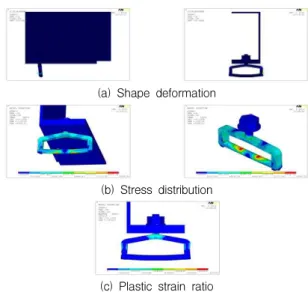
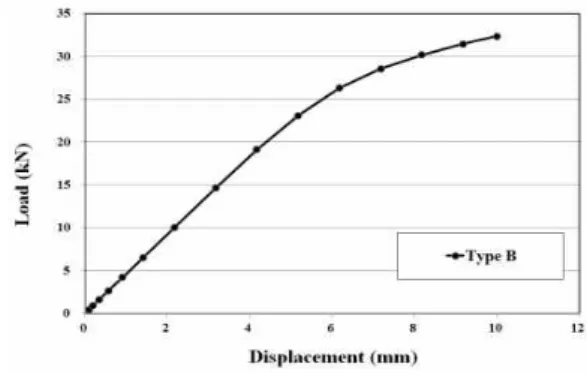
The results of the analysis of adapter block type A are shown in Figure 8. Great stress was found at the bolt and at the part of the adapter block where the belt was installed. As shown in Figure 9, yield was found at the bolt fixed to the adapter block, and the yield weight was about 24.6kN. The results of the analysis of adapter block type B are shown in Figure 10. A great stress was found at the part where the fixing belt was installed and the part where the adapter block was inserted in C-shaped steel. As shown in Figure 11, yield was found at the part of the adapter block where the fixing belt was installed, and the yield load was about 28.5kN.

In the structure simulation through finite ele- ment analysis, it was found that the yield loads of adapter block types A and B were about 24.6 kN and about 28.5kN, respectively. This implies that the difference in steel-welding hypothesized for each adapter block affected the results. In other words, it was assumed that the joint between the adapter block type A and the light gauge steel was steel-welded, and the inserted part of adapter block type B in C-shaped steel was steel-welded.

Therefore, taking into account the time required and added safety achieved by fixing an adapter block to a truck, it is believed that the unit mod-

ule can be fixed efficiently if adapter block types A and B are combined appropriately.

(a) Shape deformation

(b) Stress distribution

(c) Plastic strain ratio

Figure 8. Results of adapter block(Type A)

Figure 9. Load-deflection analysis results of adapter block(Type A)

(a) Shape deformation

(b) Stress distribution

(c) Plastic strain ratio

Figure 10. Results of adapter block(Type B)

(9)

Figure 11. Load-deflection analysis results of adapter block(Type B)

5. Conclusion

When transporting a unit module with a high level of completion from a factory using a truck, a set of device is needed that will allow the shipper to fix the unit module conveniently and safely.

Therefore, this study aims to develop a new fix- ation device for the unit module, while still using the conventional fixation equipment of rope, fixing belt and fixing block as much as possible.

The problems identified in our previous study were analyzed more closely through an interview with professionals, and ideas for a new device were also derived. By analyzing the advantages and disadvantages of the alternatives derived, the adapter block was selected as the final plan after evaluating that it was good in terms of least de- formation of unit module structure, utilization of devices installed on a truck, and applicability for the transport of other freight.

There are no standards and criteria for the adapter block developed in this study; therefore, a review of the structure before prototype production was needed. The structural safety was reviewed through a simulation. In the structural simulation, the yield strength of adapter block type A was about 24.6kN, and the yield strength of adapter block type B was about 28.5kN. Therefore, in ap-

type A should be applied at the lower part of four columns of the unit module, and that adapter block type B should be inserted in C-shaped steel between the columns. In other words, it is believed that considering the installation time and safety of the adapter block, if the two adapter block types are combined appropriately, the unit module can be fixed effectively and transported stably.

The feasibility was assessed based on the struc- ture simulation, and the results have a limitation in that the simulation conditions are different from actual conditions, including module, installation and road conditions. Therefore, the adapter block types A and B should be manufactured as proto- types, and should be applied to actual unit module transport to evaluate their applicability. It is ex- pected that safer and more practical fixation device for unit modules can be developed when the adapter block is complemented, as it is concluded in this study.

Acknowledgement

This paper was supported by the Korea Institute of Construction Technology under the Strategic Research Project (Construction Technology Development for One-day Housing). This paper developed the Korea patent [Apparatus for fixing freight of vehicle, Korean patent, 10-1149599, 2012.05.17.] which was the result of the research.

References

1. Lim SH, Park KS, Chae CU, Kwon BM. A study on factory product system of unit modular housing system in Korea, United Sates, Japan, Europe. Journal of the Korean Housing Association. 2007 Aug;18(4):27-35.

2. Kim KT, Kim CH, Lee DH, Lee YH. Development of a Korean

modular housing construction scenario. Proceedings of the

(10)

Development and Evaluation of Fixation Equipment for Transporting Unit Modules

Korea Institute of Building Construction(Industry); 2011 May 20; Busan (Korea). Seoul (Korea): the Korea Institute of Building Construction; 2011. p. 81-3.

3. Song YH, Lim SH, Lee GK, Lee WH. A study of current state examination for prefab architecture and manufacturer.

Proceedings of Architectural Institute of Korea; 2011 Oct 29;

Gyeongsan (Korea). Seoul (Korea): Architectural Institute of Korea; 2011. p. 65-6.

4. Lee YH, Lee DH, Kim KT. Considerations in the early stage of Designing the Unit Modular Building. Korean Journal of Construction Engineering and Management. 2012 Nov;13(6)133-42.

5. Lee KB, Lim KR, Shin DW, Cha HS. A proposal for optimizing unit modular system process to improve efficiency in off-site manufacture, transportation and on-site installation. Journal of Construction Engineering and Management; 2011 Oct;12(6):14-21.

6. Kim MK, Park MJ. The actual conditions and alternative plans of studio houses in university towns. The Korean Housing Association 3th Academic Seminar; 2013 Sep 14;

Seoul (Korea). Seoul (Korea): The Korean Housing Association; 2013. p. 37-8.

7. Cho BH, Lee SH. Vibration performance of modular units under transportation report. Research Institute of Industrial Science & Technology (Korea); 2007 Sep. Report No.21(3);

213-221 p.

8. Lee JC, Kang YD, Kang HS, Kim BS. A Study on planning guidance of a modular BOQ construction applied to a military facility using a case study. Journal of the Architectural Institute of Korea. 2011 Apr;27(4);87-94.

9. Park SY, Kim KT, Park NC, Chung IS. Study of improved transporting methods on unit module. Proceedings of the Korea Institute of Building Construction(Industry); 2012 Nov 16; Ansan (Korea). Seoul (Korea): the Korea Institute of Building Construction; 2012. p. 243-4.

10. Gho JY. Ansys and finite element analysis. 3th ed.

Seoul(Korea): Sigmapress; 2009. Chapter 4, Ansys boundary

conditions; p. 81-97.

수치

Figure 2. The manufactured percentage of the unit module at a factory
Table 1. Comparing the problems of preceding research and this study
Figure 3. Fixation of unit modules using fixation pins
Figure 6. Drawings of the adapter block
+4

참조

관련 문서

The definitive fixation using Steinmann pin & 4.0, 6.5 cannulated screws was performed(A-D), Postoperative X-ray (A : ankle lateral view, B : Calcaneal axial view, C

High complication rate in locking plate fixation of lower periprosthetic distal femur fractures in patients with total knee arthroplasties.. Management and

Also, the quasi-infraversion is larger for the inferior safe insertion limit direction (Fig. In practical design of a screw guiding device, targeted safe angles can

- flux of solute mass, that is, the mass of a solute crossing a unit area per unit time in a given direction, is proportional to the gradient of solute concentration

3,4 Therefore, to date, studies have been conducted to examine the absorbable fixation plate manufactured using polymer and a fixation screw that can

Conclusion: In Neer type II distal clavicle fracture treatment, both groups showed satisfactory result in clinical and radiological outcomes, but the hook plate

The index is calculated with the latest 5-year auction data of 400 selected Classic, Modern, and Contemporary Chinese painting artists from major auction houses..

1 John Owen, Justification by Faith Alone, in The Works of John Owen, ed. John Bolt, trans. Scott Clark, "Do This and Live: Christ's Active Obedience as the