A Verification of Cosmetic Effect about Anti-oxidant and Anti-wrinkle of 11 Native Plants
Young-Ah Jang*
Department of Cosmeceutical Science, Daegu Haany University, Gyeongsan 712-749, Korea Received April 7, 2016 /Revised May 5, 2016 /Accepted May 10, 2016
To check the possibility of using natural extracts for cosmetic substances, we tested the bioactive ef- fects of 11 crude extracts originating from native plants grown in the Republic of Korea on anti-oxi- dant and anti-wrinkle activities. When DPPH scavenging activities were measured, the crude extracts of Vitex rotundifolia, Scirpus triangulatus, S. wichurae, S. tabernaemontani, and Aeschynomene indica assays had more than 70% of DPPH scavenging activities at 100 μg/ml concentration. The data from the hy- drogen peroxide scavenging assay revealed that the crude extracts from the 10 species, except for Eleocharis mamillata var. cyclocarpa, could scavenge more than 90% at 1,000 μg/ml concentration. The crude extract of V. rotundifolia had the highest xanthine oxidase scavenging activity at a 1,000 μg/ml concentration. Based on the four anti-oxidant assays, the crude extracts of V. rotundifolia, S. triangu- latus, S. wichurae, S. tabernaemontani, and A. indica were shown to have excellent anti-oxidant capacities overall. In addition to the anti-oxidant capacities, the crude extract from S. wichurae exhibited high collagenase inhibitory activity, therefore, it could be a promising candidate for a cosmetic ingredient with anti-oxidant and anti-wrinkle qualities. The results of this study indicate that many wild plants native to the Korea Peninsula can be used as excellent natural substances for cosmetics based on their bioactive effects.
Key words : Aniti-oxidant, anti-wrinkle, cosmetic effect, native plants
*Corresponding author
*Tel : +82-53-819-1749, Fax : +82-53-819-1430
*E-mail : [email protected]
This is an Open-Access article distributed under the terms of the Creative Commons Attribution Non-Commercial License (http://creativecommons.org/licenses/by-nc/3.0) which permits unrestricted non-commercial use, distribution, and reproduction in any medium, provided the original work is properly cited.
Journal of Life Science 2016 Vol. 26. No. 7. 782~788 DOI : http://dx.doi.org/10.5352/JLS.2016.26.7.782
서 론
21세기 고령화 사회로 진입함에 따라 나이가 들어도 젊고 아름다운 피부를 원하는 여성의 수적인 증가로 노화 방지용 화장품에 대한 연구개발이 활발히 진행되고 있다[16, 29]. 최근 인간이 안전하게 오랫동안 섭취하거나 외용으로 사용해왔던 천연물을 이용한 항산화, 항균력, 면역효과 등에 관한 약리학 적 효능에 관심이 집중되고 있으며 이러한 자연친화적인 트렌 드의 소비추세에 맞춰 다양한 천연소재를 이용한 기능성 화장 품의 개발이 활발히 이뤄지고 있다[14, 37]. 산화적 스트레스를 유발시키는 free radical은 화합물의 화학적 반응 및 여러 가지 산화, 환원 반응 등 내적 요인과 흡연, 음주, 스트레스, 대기오 염 등 외적요인에 의해 생성되며, 생체 내에서 free radical 반 응에 의해 생성되는 활성 산소종(reaction oxygen species, ROS)은 DNA분절과 단백질의 불활성화 및 과산화 반응을 일 으켜 세포손상이 시작되게 된다[13, 25, 33]. 생체 내에는 대사 과정에서 생성된 유해 활성산소를 스스로 제거할 수 있는
SOD (superoxide dismutase), catalase, glutathione perox- idase 등의 항산화 효소가 방어시스템 역할을 하지만 ROS가 과다하게 생성되거나 항산화시스템의 균형이 깨지게 되면 노 화가 촉진되며 다양한 질병이 유발될 수 있다[1]. 따라서 노화 와 질병의 예방을 위해 생체 내 항산화시스템을 정상적으로 유지하는 것이 중요하며 산화로 인한 인체의 노화지연과 성인 병 예방을 위해 항산화제를 통해 건강기능을 향상시키고 있다 [19]. 피부노화 및 항산화와 관련이 깊은 물질은 동, 식물계에 널리 분포되어 있으며 이들은 주로 페놀화합물로서 산화생성 을 지연 시키거나 활성을 저해하여 항산화 물질로서의 역할을 하는 것으로 알려져 있다[4]. 이러한 페놀계 합성 항산화제로 는 butylated hydroxyl anisole (BHA)와 butylated hydroxyl toluene (BHT)가 가장 많이 쓰이고 그 외, PG (propyl gallate), TBHQ (t-butyl hydroquinone) 등이 있으며 천연 항산화제로 는 tocopherol, vitamin C, carotenoid, catechin, glutathione 등이 있다[20]. 천연항산화제의 경우 높은 가격과 합성 항산화 제 대비 상대적으로 낮은 항산화 효과를 이유로 문제가 되고 있는 반면 합성항산화제는 화합물이 가질 수 있는 독성 문제 가 있어 새로운 항산화제에 대한 탐색과 개발이 요구되는 실 정이다[12]. 피부노화는 인체의 생리학적 기능이나 면역력에 대한 적응에 문제가 생겨 발생하기 시작하는 퇴행성변화와 자외선에 활성 산소종으로 인해 진피층의 콜라겐, 엘라스틴의 새로운 합성이 저하되어 피부탄력이나 수분 함유량이 줄어들 면서 주름을 생성하게 되는 점진적인 신체변화라 할 수 있다
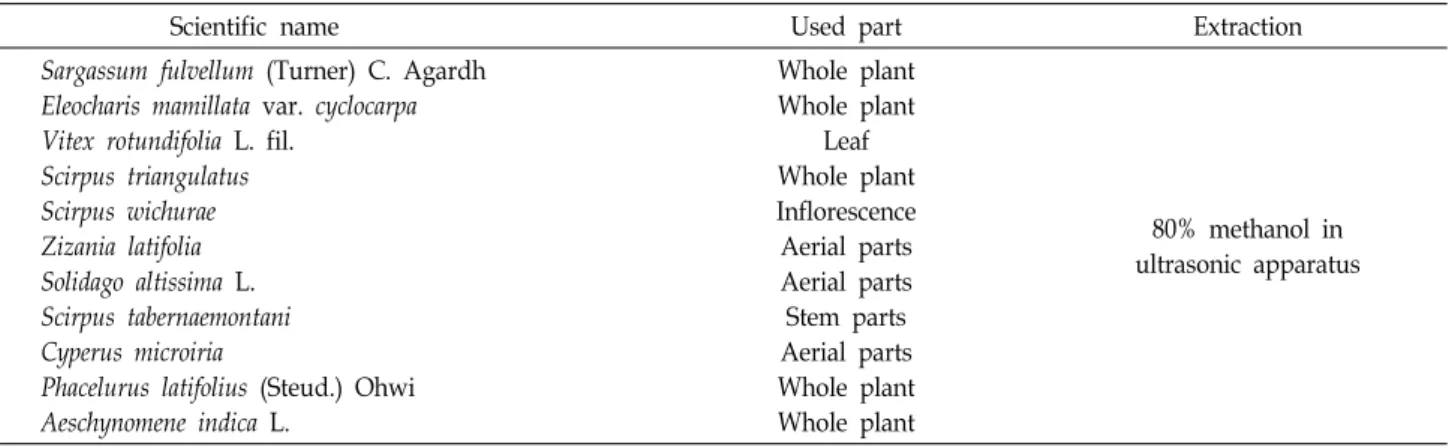
Table 1. Lists of plants used anti-oxidative and anti-aging activity test
Scientific name Used part Extraction
Sargassum fulvellum (Turner) C. Agardh Eleocharis mamillata var. cyclocarpa Vitex rotundifolia L. fil.
Scirpus triangulatus Scirpus wichurae Zizania latifolia Solidago altissima L.
Scirpus tabernaemontani Cyperus microiria
Phacelurus latifolius (Steud.) Ohwi Aeschynomene indica L.
Whole plant Whole plant
Leaf Whole plant Inflorescence Aerial parts Aerial parts Stem parts Aerial parts Whole plant Whole plant
80% methanol in ultrasonic apparatus [28]. 이러한 노화가 진행 될수록 피부 진피에 자리하고 있는
피부를 구성하는 물질인 collagen, elastin, hyaluronic acid 등 의 생성이 감소되며 피부조직을 분해하는 효소인 matrix met- alloproteinase (MMPs)의 생합성이 증가하여 피부 탄력이 감 소하는 것을 내적인 노화라 하고 피부가 두꺼워지고 변형된 탄력섬유가 증가하는 것을 외적인 노화라 한다[21]. 합성 Vitamin A, C, E 등과 AHA (α-hydroxy acids)는 콜라겐의 합성을 증가시키고 표피 각화 과정을 정상화시켜 피부재생에 기여하는 물질로 많이 사용되고 있으나 합성물질의 부작용으 로 인해 천연물을 이용한 노화 피부, 주름개선을 위한 화장품 소재 발굴이 활발하게 연구 중에 있다[17, 36]. 자생식물은 자 연에 저절로 나서 자라는 식물을 의미하며 자연에서 쉽게 접 할 수 있다. 산천이 발달된 우리나라에는 총 8,000 여종의 다양 한 자생식물이 분포하고 있으며 특정 지역의 환경에 대한 높 은 적응성과 생물학적 다양성을 지니고 있어 천연물소재로서 의 잠재적 개발가능성이 매우 크다[18]. 국내 자생식물, 약용식 물 등을 대상으로 이러한 항산화 및 항균활성 등에 관한 연구 는 지속적으로 실시 된 바 있으나 향장활성으로 사용가능한 소재중심의 스크리닝의 연구는 아직까지 보고된 바 없다. 따 라서 본 연구에서는 국내 자생식물 11종의 항산화, 항주름에 효과를 탐색하여 화장품 소재로서 가능성이 있는 소재를 확보 하기 위한 기초자료로 활용하고자 한다.
재료 및 방법
시료 및 추출
본 실험에 사용한 11종 자생식물은 국립생물자원관 생물자 원활용부로 부터 건조된 시료를 제공받아 사용하였으며 각 시료의 추출부위 및 추출방법은 Table 1과 같다.
DPPH radical 소거능
전자공여능(EDA; electron donating ability)은 Blois의 방법 [2]에 따라 측정하였다. 각 시료용액 2 ml에 0.2 mM의 1,1-di- phenyl-2-picrylhydrazyl (DPPH) 1 ml을 넣고 교반한 후 30분
간 방치한 다음 517 nm에서 흡광도를 측정하였다. 전자공여능 은 시료용액의 첨가구와 무첨가구의 흡광도 감소율로 나타내 었다.
Hydrogen peroxide 소거능
Hydrogen peroxide 소거능 측정은 Gulcin 등의 방법[11]에 따라 측정하였다. 희석한 시료 500 μl와 4 mM Hydrogen per- oxide 500 μl를 가한 후 37℃에서 10분 동안 반응시켜 ELISA reader 기를 이용하여 230 nm에서 흡광도를 측정하여 소거능 을 측정하였다.
Xanthine oxidase 저해활성
Xanthine oxidase 저해활성 측정은 Stirpe의 방법[31]에 따 라 측정하였다. 각 시료용액 0.1 ml와 0.1 M potassium phos- phate buffer (pH 7.5) 0.6 ml에 xanthine (2 mM)을 녹인 기질 액 0.2 ml를 첨가하고 xanthine oxidase (0.2 U/ ml) 0.1 ml를 가하여 37℃에서 15분간 반응시킨 후 1 N HCl 1 ml를 가하여 반응을 종료시킨 다음 반응액 중에 생성된 uric acid의 양을 흡 광도 292 nm에서 측정하였다. Xanthine oxidase 저해활성은 시 료용액의 첨가구와 무첨가구의 흡광도 감소율로 나타내었다.
Nitric oxide radical 저해활성
Nitric oxide radical 저해활성은 Marcocci 등의 방법[23]에 따라 측정하였다. Sodium nitroprusside solutions은 10 mM sodium nitroprusside을 20 mM phosphate buffer (pH 7.4)에 녹여 제조하였다. 시료는 20 mM phosphate buffer (pH 7.4)에 녹여 사용하였다. 0.5 ml의 시료와 0.5 ml의 sodium nitroprus- side solutions을 25℃에서 150분간 반응 시켰다. 반응액 1 ml 과 greiss reagent solution을 1:1로 반응시켜 540 nm에서 흡광 도를 측정하였다. Nitric oxide radical 저해활성은 시료용액의 첨가군과 무첨가군의 흡광도 감소율로 나타내었다.
Elastase 저해활성 측정
Elastase 저해활성 측정은 Cannell 등의 방법[3]에 따라 측
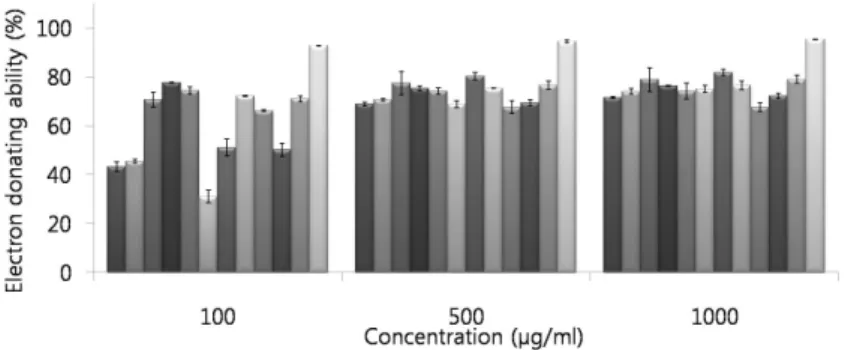
Fig. 1. Electron donating ability of native plants. 1:
Sargassum fulvellum (Turner) C. Agardh, 2:
Eleocharis mamillata var. cyclocarpa, 3: Vitex ro- tundifolia L. f., 4: Scirpus triangulates, 5: Scirpus wichurae, 6: Zizania latifolia, 7: Solidago altissima L., 8: Scirpus tabernaemontani, 9: Cyperus microi- ria, 10: Phragmites japonica Steud., 11: Aeschy- nomene indica L., BHA : butylated hydox- yanisole, Results are expressed as means ± S.D. of triplicate data.
정하였다. 추출물을 실험농도로 조제하여 0.5 ml씩 시험관에 취하고, 50 mM Tris-HCl buffer (pH 8.6)에 녹인 porcine pan- creas elastase (2.5 U/ ml)용액 0.5 ml을 가한 후 50 mM Tris- HCl buffer (pH 8.6)에 녹인 기질 N-succinyl-(L-Ala)3-p-nitro- anilide (0.5 mg/ ml)을 첨가하여 20분간 반응시켜 기질로부터 생성되는 p-nitroanilide의 생성량을 405 nm에서 측정하였다.
Elastase 저해활성은 시료용액의 첨가구와 무첨가구의 흡광도 감소율로 나타내었다.
Collagenase 저해활성 측정
Collagenase 저해활성 측정은 Wűnsch 등의 방법[34]에 따 라 측정하였다. 즉 반응구는 0.1 M Tris-HCl buffer (pH 7.5)에 4 mM CaCl2를 첨가하여 4-phenylazobenzyloxycarbonyl-Pro- Leu-Gly-Pro-D-Arg (0.3 mg/ ml)를 녹인 기질액 0.25 ml 및 시료용액 0.1 ml의 혼합액에 collagenase (0.2 mg/ml) 0.15 ml 를 첨가하여 실온에서20분간 방치한 후 6% citric acid 0.5 ml 을 넣어 반응을 정지 시킨 후, ethyl acetate 1.5 ml을 첨가하여 320 nm에서 흡광도를 측정하였다. Collagenase 저해활성은 시료용액의 첨가구와 무첨가구의 흡광도 감소율로 나타내었 다.
통계처리
각 추출물에 대한 결과는 독립적으로 3회 이상 반복 실시하 여 평균(mean)과 표준편차(standard deviation)로 표시하였다.
결 과
DPPH radical 소거능
DPPH는 비교적 안정한 free radical로써 ascorbic acid, to- copherol, polyhydroxy 방향족 화합물, 방향족 아민류에 의해 환원되어 짙은 자색이 탈색되는 원리를 이용하여 항산화 활성 을 측정한다[5]. 이러한 DPPH assay는 식물 추출물의 항산화 활성을 간단히 측정할 수 있는 동시에 실제 항산화 활성과도 연관성이 매우 높기 때문에 많이 이용되고 있다[6]. 자생식물 11종의 DPPH radical 소거능을 측정한 결과 Fig. 1과 같이 나 타내었다. 추출물의 농도 100 μg/ml에서 모자기(Whole plant;
43.3%), 물꼬챙이골(Whole plant; 45.5%), 순비기나무(Leaf;
70.7%), 송이고랭이(Whole plant; 77.6%), 방울고랭이(Inflor- escence; 74.5%), 줄(Stem parts; 31.1%), 양미역취(Aerial parts;
51.1%), 큰고랭이(Stem parts; 72.2%), 금방동사니(Aerial parts;
66.2%), 모새달(Whole plant; 50.2%), 누린내풀(Stem parts;
56.6%), 자귀풀(Whole plant; 71.1%)이 각각 DPPH radical 소 거능이 나타나 동일농도에서 대조군으로 사용된 합성 항산화 제인 BHA (92.9%)에 대비해서는 활성이 낮았으나 순비기나 무, 송이고랭이, 방울고랭이, 큰고랭이, 자귀풀은 70% 넘는 높 은 활성을 나타내었다.
Hydrogen peroxide 소거능
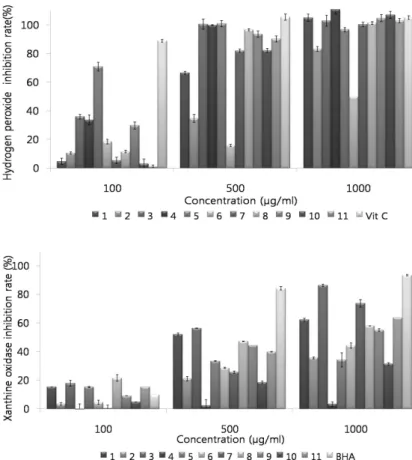
Hydrogen peroxide는 세포 독성 물질로 체내 각 기관들의 DNA에 심각한 손상을 초래해 각종 질병과 노화를 유발한다 고 알려져 있다[27]. 또한 과산화 지질의 생성을 촉진하는 것으 로 알려져 있으며 과산화지질은 동맥경화, 뇌졸중 등과 같은 성인병의 원인이 되고, 간장의 세포막에 과산화지질을 증가시 켜 세포의 기능이 저하되어 염증이 유발되며, 그 결과 간경화, 간염 등을 초래한다고 보고되고 있다[26]. 자생식물 11종의 hydrogen peroxide 소거능을 측정한 결과 Fig. 2와 같이 나타 났다. 500 μg/ml 농도에서 대조군 BHA는98.2%의 소거능을 나타내었고 동일농도에서 대조군 보다 효능이 우수한 자생식 물은 송이고랭이(Whole plant; 99.8%), 방울고랭이(Inflore- scence; 100.1%)로 나타났다. 그 외 추출물은 효능이 비교적 낮았으나 1,000 μg/ml 농도에서는 대조군 BHA (99.8%) 대비 했을 때 줄(Stem parts; 49.7%), 물꼬챙이골(Whole plant; 83.2) 을 제외한 시료에서는 90% 이상의 높은 hydrogen peroxide 소거능을 보였다.
Xanthine oxidase 저해활성
Xanthine oxidase는 생체내의 purine 대사에 관여하는 효 소로서, xanthine 또는 hypoxanthine을 산화시켜 urea를 형성 하며 혈장 내에 과량 존재하게 되면 골절에 축적되어 심한 통증을 유발하는 통풍과 신장에 침착되어 신장질환을 일으키 는 것으로 알려져 있다[35]. 또한 생물조직에 산화적 손상을 일으켜 염증, 동맥경화, 암 및 노화와 같은 여러 가지 질병을
Fig. 2. Inhibition rate of native plants on Hydrogen- peroxide. 1: Sargassum fulvellum (Turner) C.
Agardh, 2: Eleocharis mamillata var. cyclocarpa, 3: Vitex rotundifolia L. f., 4: Scirpus triangulates, 5: Scirpus wichurae, 6: Zizania latifolia, 7: Solidago altissima L., 8: Scirpus tabernaemontani, 9: Cyperus microiria, 10: Phragmites japonica Steud., 11:
Aeschynomene indica L., Vit C : Ascorbic acid, Results are expressed as means ± S.D. of tripli- cate data.
Fig. 3. Inhibition rate of native plants on xanthine oxidase. 1: Sargassum fulvellum (Turner) C.
Agardh, 2: Eleocharis mamillata var. cyclocarpa, 3: Vitex rotundifolia L. f., 4: Scirpus triangulates, 5: Scirpus wichurae, 6: Zizania latifolia, 7:
Solidago altissima L., 8: Scirpus tabernaemontani, 9: Cyperus microiria, 10: Phragmites japonica Steud, 11: Aeschynomene indica L., BHA: buty- lated hydoxyanisole, Results are expressed as means ± S.D. of triplicate data.
Fig. 4. Inhibition rate of native plants on nitric oxide.
1: Sargassum fulvellum (Turner) C. Agardh, 2:
Eleocharis mamillata var. cyclocarpa, 3: Vitex ro- tundifolia L. f., 4: Scirpus triangulates, 5: Scirpus wichurae, 6: Zizania latifolia, 7: Solidago altissima L., 8: Scirpus tabernaemontani, 9: Cyperus microi- ria, 10: Phragmites japonica Steud, 11: Aeschyno- mene indica L., Vit C : Ascorbic acid, Results are expressed as means ± S.D. of triplicate data.
일으킬 수 있는 superoxide radical을 생성한다[8]. Xanthine oxidase 저해활성 측정은 Fig. 3에 결과를 나타냈다. 1,000 μg/
ml 농도에서 순비기나무(Leaf; 86.3%)가 가장 높은 Xanthine oxidase 저해활성을 나타내었고 모자기(Whole plant), 순비기 나무(Leaf), 큰고랭이(Stem parts), 금방동사니(Aerial parts), 자귀풀(Whole plant)은 50%가 넘는 저해활성을 나타내었다.
Nitric oxide radical 저해활성
Nitric oxide (NO)는 인체 내 혈액응고 및 혈압조절 기능, 암세포에 대한 면역기능이 있으나, 과량 존재하면 ROS의 기 능으로 세포독성을 나타내어 염증, 암 그리고 다른 병리학적 병인을 나타낸다고 알려져 있다[30]. 또한 NO는 nitrozation, nitration과 같은 간접적 영향 및 산화반응을 야기하여 조직의
파괴 및 면역체계의 이상을 일으킨다[10]. 11종의 자생식물의 Nitric oxide radical 저해활성을 측정한 결과는 Fig 4와 같다.
1,000 μg/ml 농도에서 대조군 BHA가 98.7%로 높은 활성을 나타낸 반면 자생식물의 활성은 50% 이하의 효능을 나타내 Nitric oxide radical 저해활성은 뛰어난 효능을 나타내지 않았다.
Elastase 저해활성 측정
DPPH radical scavenging assay외 3가지 항산화 실험결과 를 바탕으로 11종의 자생식물의 자유라디칼을 소거하여 항산 화의 효능이 있음을 확인하고 기능성 화장품에 적용 가능한 범위인 항노화의 활성을 알아보기 위해 elastase 저해활성 및 collagenase 저해활성을 평가하기로 하였다. Elastin은 척추동 물의 세포외기질의 중요한 단백질이며 대동맥, 폐, 연골, 인대,
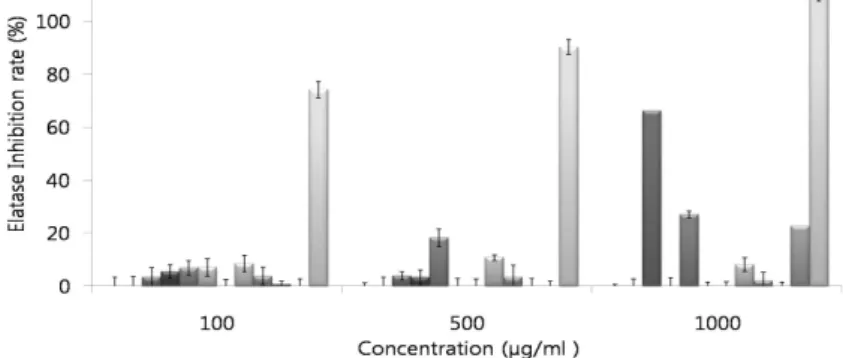
Fig. 5. Inhibition rate of native plants on Elastase. 1:
Sargassum fulvellum (Turner) C. Agardh, 2:
Eleocharis mamillata var. cyclocarpa, 3: Vitex ro- tundifolia L. f., 4: Scirpus triangulates, 5: Scirpus wichurae, 6: Zizania latifolia, 7: Solidago altissima L., 8: Scirpus tabernaemontani, 9: Cyperus microi- ria, 10: Phragmites japonica Steud., 11: Aeschyno- mene indica L.. Results are expressed as means
± S.D. of triplicate data.
Fig. 6. Inhibition rate of native plants on Collagenase.
1: Sargassum fulvellum (Turner) C. Agardh, 2:
Eleocharis mamillata var. cyclocarpa, 3: Vitex ro- tundifolia L. f., 4: Scirpus triangulates, 5: Scirpus wichurae, 6: Zizania latifolia, 7: Solidago altissima L., 8: Scirpus tabernaemontani, 9: Cyperus mi- croiria, 10: Phragmites japonica Steud., 11: Aes- chynomene indica L., EGCG: Epigallocatechin gallate. Results are expressed as means ± S.D.
of triplicate data.
피부 등 많은 조직과 장기에 탄력성 및 인장강도를 나타내고 있다[7]. Elastase는 단백질인 엘라스틴을 분해하는 효소로 다 른 중요한 기질 단백질인 콜라겐을 분해할 수 있는 비특이적 가수분해 효소이다[24]. Elastin이 elastase에 의해 분해되어 피 부의 그물망 구조 결합이 끊어짐으로, elastase는 주름생성의 주원인 효소로 알려져 있다[32]. 따라서 elastase 저해제는 피 부 주름을 개선하여 피부노화를 지연시킬 수 있다는 점에서 지속적으로 연구되어 왔다. Elastase 저해활성 측정결과는 Fig.
5에서 보듯이 순비기나무(Leaf; 66.1%)가 1,000 μg/ml 농도에 서 가장 높은 활성을 나타내었다.
Collagenase 저해활성
Collagen은 세포기질 외 진피를 70% 이상 구성하여 피부를 지탱하고 탄력 및 보습 기능을 하는 것으로 알려져 있다. 그러 나 자연 노화에 따른 세포 활성의 감소 등의 내적인 요인에 의해 콜라겐 생성이 감소되고, 여러 가지 유해 환경에 의한 스트레스, 태양 광선에 의한 활성 산소종의 증가와 같이 외적 요인에 의해 콜라겐 분해가 가속화되어 피부 기질이 파괴되면 서 주름이 생성된다[15]. 자외선 및 활성산소 등에 의해 유발되 는 피부 진피층에 존재하는 matrix-metalloproteinases (MMPs) 는 피부노화, 특히 주름생성과 밀접한 관계가 있다. MMPs를 이루는 주요성분으로 collagenase, gelatinase 및 elastase 등이 있으며, 피부의 탄력감소 및 주름생성에 있어서 elastase 및 collagenase의 활성 감소는 매우 중요하다[22]. Collagenase 저
해활성의 실험결과를 Fig. 6에 나타내었다. 추출물의 1,000 μ g/ml의 농도에서 모자기(Whole plant; 78.3%), 물꼬챙이골 (Whole plant; 82.2%), 순비기나무(Leaf; 63.5%), 송이고랭이 (Whole plant; 85.5%), 방울고랭이(Inflorescence; 99.5%), 줄 (Aerial parts; 52.8%), 양미역취(Aerial parts; 60.1%), 큰고랭이 (Stem parts; 92.9%), 금방동사니(Aerial parts; 78.0%), 모새달 (Whole plant; 51.6%), 자귀풀(Whole plant; 39.9%)의 높은 col- lagenase 저해활성을 나타내었다. 동일농도에서 대조군 EGCG (98.9%)에 대비 활성이 더 높은 식물은 방울고랭이(Inflores- cence)였으며 그 외의 10종은 collagenase 저해활성이 비교적 높게 나타났다.
고 찰
현재까지 알려진 국내 총 8,000종의 자생식물 중 과학적인 검증을 확인한 소재는 5%에 불과하며 한국은 생물자원의 80%
를 수입에 의존하고 있다. 향후 바이오 기능성 소재 개발에 있어서 경쟁력을 갖기 위해서는 특히, 한국에서만 자생하는 소재를 발굴하는 것이 중요하다고 볼 수 있다. 본 연구에서는 11종의 자생식물의 항산화, 항주름에 관한 생리활성 효능을 검증하여 화장품 산업에 적용하기 위한 천연소재로서의 이용 가능성에 대해 살펴보았다. 자생식물 11종의 샘플에 대한 활 성실험의 대한 분석결과는 다음과 같다. DPPH radical 소거능 측정결과, 100 μg/ml의 농도에서 순비기나무(Leaf), 송이고랭
이(Whole Parts), 방울고랭이(Inflorescence), 큰고랭이(Stem Parts), 자귀풀(Whole Parts)이 70% 넘는 높은 활성을 나타내 었다. Hydrogen peroxide 소거능 측정결과 1,000 μg/ml 농도 에서 대조군 BHA (99.8%) 대비했을때 줄(Aerial Parts;49.7%), 물꼬챙이골(Whole Parts; 83.2%)을 제외한 9종의 시료에서 90% 이상의 높은 Hydrogen peroxide 소거능을 보였다. Xan- thine oxidase 저해활성 측정결과 1,000 μg/ml 농도에서 순비 기나무(Leaf; 86.3%)가 가장 높은 xanthine oxidase 저해활성 을 나타내었고 nitric oxide radical 저해활성 결과에서는 1,000 μg/ml 농도에서 대조군 BHA가 98.7%로 높은 활성을 나타낸 반면, 자생식물 11종의 활성은 50% 이하를 나타내 항염증 효 능은 높지 않음을 알 수 있었다. Elastase 저해활성 측정결과 순비기 나무(Leaf; 66.1%)가 1,000 μg/ml 농도에서 가장 높은 활성을 나타내었으며 collagenase 저해활성 측정결과 에서는 동일농도에서 대조군 EGCG (98.9%)에 대비하여 활성이 더 높은 식물은 방울고랭이(Inflorescence)였으며, 그 외의 10종의 시료 또한 collagenase 저해활성이 높게 나타나 피부 주름에 효능이 있는 식물임을 나타내었다. 이와 같은 결과를 종합해 볼 때 11종 자생식물 중 항산화 효능이 높은 식물은 순비기나 무, 송이고랭이, 방울고랭이, 큰고랭이, 자귀풀로 나타났으며 그 중 순비기나무 추출물이 효능이 가장 우수하였다. 11종 자 생식물의 collagenase 저해활성이 높은 것으로 나타나 항주름 에 효능이 있다고 볼 수 있다.
따라서 항산화, 항주름 효능이 있는 순비기나무, 송이고랭 이, 방울고랭이, 큰고랭이, 자귀풀은 화장품 소재로서 개발되 기 위한 기초자료로서 활용이 기대된다. 또한, 향후 우수한 식물종에 대해 유효성분의 확인과 항노화, 항산화의 효능검증 에 대한 추가적인 연구가 더 깊게 진행된다면 새로운 천연물 유래 생리활성 물질로서 활용이 가능할 것으로 기대된다.
감사의 글
본 논문은 2014년도 환경부의 재원으로 국립생물자원관 야 생생물 천연물은행 구축 및 운영 사업의 지원을 받아 수행된 연구임(No. NIBR201417101).
References
1. Block, G. and Langseth, L. 1994. Antioxidant vitamins and disease prevention. Food Technol. 48, 80-85.
2. Blois, M. S. 1958. Antioxidant determination by the use of a stable free radical. Nature 26, 1199-1204.
3. Cannell, R. J., Kellam, S. J., Owsianka, A. M. and Walker, J. M. 1987. Results of a large scale screen of micoalgae for the production of protease inhibitors. Planta. Med. 54, 4-10.
4. Cha, B. C., Lee, S. B., Rhim, T. J. and Kwang, H. L. 2000.
Constituents of antioxidative activity and free radical scav- enging effect from Galla Rhois (Rhus javanica Linne). Kor.
J. Pharmacogn. 31, 185-189.
5. Cha, J. Y., Kim, H. J., Chung, C. H. and Cho, Y. S. 1999.
Antioxidative Activities and contents of polyphenolic com- pound of Cudrania tricuspidata. J. Kor. Soc. Food Sci. Nutr.
28, 1310-1315.
6. Choi, H. J., Lee, W. S., Hwang, S. J., Lee, I. J., Shin, D. H., Kim, H. Y. and Kim, K. U. 2000. Changes in chemical com- positions of green tea (Camellia sinensis L.) under the differ- ent extraction conditions. J. Life Sci. 10, 202-209.
7. Christian, E. H. S., Michael, C. J., Johannes, W., Reinhard, H. H. N. and Andrea, H. 2012. Does human leukocyte elas- tase degrade intact skin elastin. Eur. J. Biochem. 279, 4191-4200.
8. Filha, Z. S., Vitolo, I. F., Fietto, L. G., Lombardi, J. A. and Saúde-Guimarães, D. A. 2006. Xanthine oxidase inhibitory activity of Lychnophora species from Brazil ("Arnica"). J.
Ethnopharmacol. 107, 79-82.
9. Gang, S. R., Min, K. J. and Kim, Y. C. 2009. The inhibitory effects of Saururus chinensis water extract on skin wrinkle in hairless mice. J. Kor. Soc. Cosm. 15, 1389-1398.
10. Grayand, J. L. and Dugan, J. L. R. 1975. Inhibition of N- nitrosamine formation in model food system. J. Food Sci. 40, 981-985.
11. Gulcin, I., Buyukokuroglu, M. E., Oktay, M. and Kufrevio- glu, O. I. 2003. Antioxidant and analgesic activities of tur- pentine of Pinus nigra Arn. subsp. pallsiana (Lamb.) Holm- boe. J. Ethnopharmacol. 186, 51-58.
12. Gupta, V. K. and Sharma, S. K. 2006. Plants as natural antioxidants. Nat. Prod. Radiance 5, 326-334.
13. Halliwell, B. 1996. Antioxidant in human health and disease.
Annu. Rev. Nutr. 16, 33-50.
14. Hyun, S. H., Jung, S. K., Jwa, M. K, Song, C. K., Kim, J.
H. and Lim, S. B. 2007. Screening of antioxidants and cosme- ceuticals from natural plant resources in Jeju Island Korean.
J. Food Sci. Technol. 39, 200-208.
15. Jang, M. J., Jun, D. H., Kim, S. H., Han, S.I. and Lee, J. T.
2013. Anti-wrinkle effect of Chestnut Leaf. J. Life Sci. 23, 751-756.
16. Kang, K. S., Kim, I. D., Kwon, R. H., Heo Y. Y., Oh, S. H., Kim, M. A., Jung, H. J., Kang, H. Y. and Ha, B. J. 2007.
The Evaluation of Anti-wrinkle Effects in oriental herb extract. J. Life Sci. 17, 1147-1151.
17. Kim, E. H., Kim, J. E. and Park, S. N. 2009. Antioxidative and antiaging effects of Persicaria hydropiper L. extracts. J.
Microbiol. Biotechnol. 35, 293-300.
18. Kim, E. J., Choi, J. Y., Yu, M. R., Kim, M. Y., Lee, S. H.
and Lee, B. H. 2012. Total polyphenols, total flavonoid con- tents, and antioxidant activity of Korean natural and medici- nal plants. Kor. J. Food Sci. Technol. 44, 337-342.
19. Kim, H. S., Ahn, J. J., Choi, T. H. and Hwang, T. Y. 2014.
Screening of DPPH radical scavenging and antimicrobial ac- tivity of extracts from local some native plants. Kor. J. Food Preserv. 21, 593-599.
20. Kim, H. S. and Yoon, S. H. 1999. The effect of Leonuri Herba extracts on the benzo[a]pyrene - induced hepatotoxicity in rats. J. Kor. Soc. Hygienic Sciences 5, 93-100.
초록:자생식물 11종의 항산화 및 항주름에 관한 향장효능 검증
장영아*
(대구한의대학교 화장품약리학과)
본 연구에서는 화장품의 천연소재로 사용 가능함을 알아보기 위해 추출부위가 각각 다른 총 11종의 자생식물 의 항산화, 항주름에 관한 생리활성 효능을 스크리닝 하였다. DPPH scavenging assay 측정결과 100 μg/ml 농도 에서 70% 넘는 활성을 나타낸 시료는 순비기나무, 송이고랭이, 방울고랭이, 큰고랭이, 자귀풀이었다. Hydrogen peroxide scavenging assay 측정결과 1,000 μg/ml 농도에서 물꼬챙이골을 제외한 10종이 90%넘는 활성을 나타내 었다. Xanthine oxidase scavenging assay 측정결과 1,000 μg/ml 농도에서 순비기나무(Leaf; 86.3%)가 가장 높은 활성을 나타냈다. 4가지 항산화 실험에서 모두 효능이 우수하게 나온 시료는 순비기나무, 송이고랭이, 방울고랭이, 큰고랭이, 자귀풀이며 그중 collagenase 저해활성 측정결과 방울고랭이가 가장 높은 저해 활성을 나타내어 항산화 및 항주름에 효능이 있는 시료로 나타났다. 이러한 결과를 바탕으로 활성이 높은 자생식물은 화장품에 사용되는 천연소재로 이용이 가능한 좋은 수종으로 판단된다.
21. Kim, M. J., Kim, J. Y., Jung, T. K., Choi, S. W. and Yoon, K. S. 2006. Skin Anti-aging Effect of Forsythia viridissima L. Extract. Kor. J. Biotechnol. Bioeng. 21, 444-450.
22. Kim, Y. G., Lee, Y. H., Kang, M. K., Lee, B. H., Yun, J. K., Kim, S. B. and Kim, C. J. 2009. Preparation of functional cosmetics containing β-carotene derived from recombinant Escherichia coli and evaluation of anti-wrinkle efficacy by clinical testing. J. Microbiol. Biotechnol. 37, 399-404.
23. Marcocci, L., Maguire, J. J., Droylefaix, M. T. and Packer, L. 1994. The nitric oxide-scavenging properties of ginkgo biloba extract EGb 761. Biochem. Biophys. Res. Commun. 201, 748-755.
24. Mauviel, A., Halcin, C., Vasiloudes, P., Parks, W. C., Kurkinen, M. and Uitto, J. 1994. coordinate regulation of collagenase, stromelysin, and tissue inhibitior of metal- loproteinase genes by prostaglandin E2: selective enhance- ment of collagenase gene expression in human dermal fibro- blasts in culture. J. Cell. Biochem. 54, 465-472.
25. Morrissey, P. A. and O'brien, N. M. 1998. Dietary anti- oxidants in health and disease. Int. Dairy. J. 8, 463-472.
26. Muscari, C., Caldarere. and C. M., Guarnieri, C. 1990. Age dependent production of mitochondrial hydrogen peroxide, lipid peroxides and fluorescent pigments in the rat heart.
Basic. Res. Cardiol. 85, 172-178.
27. Park, E. J. and Kang, M. H. 2002. Application of the Alkaline Comet assay for detecting oxidative DNA damage in human biomonitoring. Kor. J. Nutr. 35, 213-222.
28. Pyo, Y. H. 2009. Studies on the dermal bioactive properties of the extracts from Celosia cristata Linne and its cosmetic
application. pp. 6, Graduate School of Kon-Kuk University.
29. Shao, L. X. 2003. Effects of the extract from bergamot and- boxthorn on the delay of skin aging and hair growth inmice.
Zhongguo Zhong Yao Za Zhi 28, 766-772.
30. Sreejayan, N. and Rao, M. N. 1997. Nitric oxide scavenging by curcuminoids. J. Pharm. Pharmacol. 49, 105-107.
31. Stirpe, F. and Corte, E. D. 1969. The regulation of rat liver xanthine oxidase. J. Biol. Chem. 244, 3855-3861.
32. Tsuji, N., Moriwaki, S., Suzuki, Y., Takema, Y. and Imokawa, G. 2001. The role of elastases secreted by fibroblasts in wrin- kle formation: implication through selective inhibition of elastase activity. Photochem. Photobiol. 74, 283-290.
33. Valko, M., Leibfritz, D., Moncol, J., Cronin, M. T., Mazur, M. and Telser, J. 2007. Free radicals and antioxidants in nor- mal physiological functions and human disease. Int. J.
Biochem. Cell. Biol. 39, 44-84.
34. Wűnsch, E. and Heindrich, H. G. 1963. Zur quantitativen Bestimmung der Kollagenase. Bio. Chem. 333, 149-151.
35. Wyngaarden, J. B. and Holmes, E. W. 1977. Molecular na- ture of enzyme regulation in purine biosynthesis. Ciba Found. Symp. 48, 43-64.
36. Yang, E. S., Hong, R. H. and Kang, S. M. 2007. The effects of genistein on the proliferation and type I pN collagen syn- thesis in aged normal human fibroblasts. J. Microbiol.
Biotechnol. 35, 316-324.
37. Yoon, M. Y. and Pyo, Y. H. 2013. Research Paper : A study on the aloe vera extract as the anti-againg cosmetic ingredient. J. Kor. Soc. Cosm. 19, 931-936.