—76— ISSN: 1225-8598
서 론
잉어과의 소형 담수어인 감돌고기는 우리나라에서도 서 한아구인 금강과 만경강 그리고 웅천천의 상류에만 제한 분포하는 고유종으로 최근 환경파괴와 댐 건설 등으로 인 하여 서식지가 매우 축소되었다(Kim et al., 2005). 이중 웅 천천에 서식하는 감돌고기는 돌고기와의 속간 자연교잡 보 고 이후 채집 기록이 없어 절멸된 것으로 추정하고 있다 (Kim et al., 1991). 이처럼 감돌고기는 서식지가 제한되고, 개체수가 줄어들고 있어 멸종위기 야생 동∙식물 I급으로
지정하여 보호하고 있다(Kim et al., 2005).
지금까지 감돌고기에 관한 연구는 분포, 서식처, 먹이생물 등의 전반적인 생태(Jeon, 1977), 초기발생(Kim et al., 1991), 돌고기와 자연잡종(Kim et al., 1991), 산란습성 및 초기 생 활사(Lee et al., 2004), 꺽지 산란장을 이용한 탁란(Kim et al., 2004) 등의 생태학적 연구가 있었으나 유전 다양성, 집 단 구조 조사 등의 집단 유전학적 분석과 관련된 연구는 이 루어진 바 없어 종 보존과 복원 등 연구에 어려움이 많다.
멸종위기종은 개체군의 숫자가 급격히 줄어드는 종으로 근친번식 정도가 증가하게 되고, 개체군들의 유전적 다양성 이 감소함에 따라 열성 호모 유전자의 발현이 증가될 가능 성이 있어 유전 다양성의 분석이 매우 중요하다(Choi et al., 2004). 유전 다양성의 분석은 멸종위기종의 장기적인
금강과 만경강에 서식하는 멸종위기 어류 감돌고기
Pseudopungtungia nigra 의 AFLP에 의한 유전 다양성 및 집단구조
김근식∙윤영은∙강언종1∙양상근1∙방인철*
순천향대학교 해양생명공학과, 1국립수산과학원 남부내수면연구소
Genetic Diversity and Population Structure of the Endangered Fish Pseudopungtungia nigra (Cyprini- dae) from the Geum and Mankyung Rivers Assessed by Amplified Fragment Length Polymorphismby Keun-Sik Kim, Young-Eun Yun, Eon-Jong Kang1, Sang-Geun Yang1and In-Chul Bang*(Department of Marine Biotech- nology, Soonchunhyang University, Asan 336-745, Korea; 1Southern Regional Inland Fisheries Institute, National Fisheries Research and Development Institute, Jinhae 645-806, Korea)
ABSTRACT Genetic diversity and genetic structure within the Geum River and Mankyung River po- pulations of the Korean endangered Black shinner (Pseudopungtungia nigra) were assessed by ampli- fied fragment length polymorphism (AFLP). AFLP analysis using five primer combinations generated 447 AFLP bands with 64.1% polymorphism (Geum River 74.6% and Mankyung River 53.6%). The het- erozygosities within the two populations were calculated to be 0.170 and 0.104, respectively. Their average genetic diversities are 0.240 and 0.147, respectively. The pairwise Fst value (0.150) indicated distinct genetic differentiation between the two populations. A UPGMA dendrogram based on genetic distance among the individuals revealed a division corresponding to geographical regions, with low genetic variation within the Mankyung River population, and low genetic distance (0.026) between the two populations. Consequently, the two populations may have the same genetic origin The Geum River population will be more suitable than the Mankyung River population for conservation plans to increase the population sizes. Genetic and habitat management will be necessary for the Mankyung River popu- lation.
Key words : Pseudopungtungia nigra, endangered fish, AFLP, genetic diversity, genetic structure
*교신저자: 방인철 Tel: 82-41-530-1286, Fax: 82-41-530-1638, E-mail: [email protected]
Accepted : June 26, 2009
http://www.fishkorea.or.kr
보호에 중요한 유전적 상황을 보여주는 도구로서 매우 중 요하며(Frankham et al., 2002), 종 내 개체군의 유전 다양성 이 높을수록 온난화 현상 등 최근의 자연 변화에 적극적으 로 적응할 수 있으므로 중요한 지표이다(Barrett and Kohn, 1991). 멸종위기종의 종 상태 회복을 위한 인공종묘방류사 업은 자원 조성, 종 보존적 측면에서 꼭 필요하지만 방류하 는 개체군의 유전 다양성이 높게 유지되어야 하므로 사전 분석을 통해 수행되어야 한다(Kawamura et al., 2007).
Amplified fragment length polymorphism (AFLP) 유전자 지문 분석 기술은 근연 종간에도 접목시킬 수 있는 고도의 유전적 변이 및 다형성을 나타내는 유용한 실험법으로서 (Roa et al., 1997; Blears et al., 1998), 어류의 집단 유전학 연구에 있어 유용하며(Liu and Cordes, 2004), 멸종위기종의 집단유전학적 연구에도 이용되고 있다(Travis et al., 1996;
Palacios and Gonzalez-Candelas, 1999; Drummond et al., 2000). 국내의 경우 AFLP를 이용하여 멸종위기 어류인 미 호종개(Lee et al., 2008a)와 어름치(Lee et al., 2008b)의 유 전 다양성을 분석한 바 있다.
따라서 본 연구에서는 현재 멸종위기어류 감돌고기가 유 전적으로 처한 상황을 파악하여 효과적인 복원계획의 기초 자료로 이용하고자, 금강과 만경강에 서식하는 감돌고기를 대상으로 AFLP 분석을 이용하여 유전 다양성 및 집단 구 조 분석을 수행하였다.
재료 및 방법
1. 시료의 확보
본 연구에 사용한 감돌고기는 2008년 9월에 금강(충남 금산군 부리면)과 만경강(전라북도 완주군 용진면)에서 각 각 30개체씩 족대(망목 4×4 mm)를 사용하여 직접 채집하 였다. 채집된 개체는 꼬리지느러미를 약 1 cm2내외로 절단 하여 99% ethanol에 담아 실험실로 운반한 후 사용하였다.
2. Genomic DNA의 분리
각 집단 별 꼬리지느러미는 genomic DNA의 추출을 위 해 각각 3× DW로 세정하여, TNES-urea buffer와 100 mg/
mL 농도의 proteinase K (Sigma, USA)가 혼합된 용액에 담 아 55�C에서 12시간 동안 반응한 후, phenol : chloroform : isoamylalcohol (25 : 24 : 1)을 처리하여 단백질을 제거하였으 며, 2-propanol로 DNA를 침전시켰다. 침전시킨 DNA는 70%
ethanol을 이용하여 세척하고 3×DW로 용해시켰다. 준비 한 시료는 spectrophotometer 측정과 0.8% agarose gel 전기 영동을 통해서 DNA의 농도와 순도를 확인한 후 실험에 이용하였다.
3. AFLP지문 분석
AFLP는 Vos et al. (1995)의 방법을 다소 변형하여 이용 하였다. 1μg의 DNA를 EcoRI 제한효소(Biolabs, USA) 5 unit과 MseI 제한효소(Biolabs, USA) 5 unit을 동시에 첨가 하여 37�C에서 4시간 절단한 후 절단 정도를 전기영동상 으로 확인하였고, 에탄올 침전을 이용하여 절단한 DNA를 회수하였다. 회수된 산물에 EcoRI / MseI adapter를 첨가하 여 ligation 반응을 실시하였다. 반응을 마친 DNA를 10배 희석하여 희석산물 5μL를 대상으로 각각 AFLP®pre amp primer mix I (Invitrogen, USA), 1 unit Taq DNA polymerase (Promega, USA), dNTPs (5 mM each), 10×PCR buffer용액 을 첨가하여 pre-amplification 반응을 수행하였다. PCR 반 응조건은 94�C 30초, 56�C 60초, 72�C 60초간 총 20회 반복 하였다. PCR 반응 산물을 TE 완충용액으로 50배 희석한 후 희석산물 5μL를 대상으로 EcoRI selective primer와 MseI selective primer를 이용하여 상기와 동일하게 2차 PCR 조 성물을 제조하였다. 이때 PCR 반응은 touch-down PCR법을 이용하여 94�C 30초, 65~56�C (회당 0.7�C씩 감소) 30초, 72�C 60초간 12회 순환 반응을 실시 후 annealing 온도를 56�C 30초로 고정하여 총 24회 반복 수행하였다. 최종 증폭 산물 20μL에 6 μL의 formamide loading dye (95% formamide;
10 mM EDTA, pH 8.0; 0.05% bromophenol blue; 0.05% xyl- ene cyanol FF)를 첨가한 후 95�C 5분간 가열하고 이중 3 μL를 취하여 6% denaturing polyacrylamide gel을 이용하여 2,000 V에서 2시간 동안 전기영동하였다. 전기영동된 DNA 단편들은 silver staining kit (Promega, USA)를 이용하여 염 색 후 관찰하였다.
4. 분석 및 통계 처리
Gel 상의 각 위치에서 확인된 DNA band의 유무에 따라 0 또는 1로 표시하여 matrix code를 작성 후, 수리분류분석 용 프로그램인 NTSYS-pc 프로그램(Rohlf, 1990)을 이용하 여 각 개체 간의 Unweighted Pair-Group Method using Ari- thmetic means (UPGMA)를 분석하여 각각을 군집하여 den- drogram을 작성하였고, 집단 내 개체 간 유전적 유사도(ge- netic similarity)를 측정하였다. TFPGA 프로그램 (Miller, 1997)의 Nei’s distance method (Nei, 1972)를 이용하여 두 집단 간 유전적 거리(genetic distance) 수준 및 유사도 mat- rix를 UPGMA로 분석하여 각각을 군집화하고 이를 토대로 dendrogram을 작성하였으며, 10,000번의 bootstrap 반복에 의해 통계적으로 분지도의 지지도를 측정하였다. 각 집단 간의 유전적 분화도(genetic differentiation, FST) 및 집단 내 평균 유전 다양성(genetic diversity)은 Arlequin 프로그램 (ver. 2.000; Schneider et al., 2000)을 사용하여 추정하였다.
결과 및 고찰
모두 5개의 primer 조합(E/ACA-M/CTC, E/ACG-M/CCA, E/AAT-M/CAC, E/AAG-M/CTA, E/ACC-M/CCC)으로 AFLP를 수행한 결과 총 447개의 유효 밴드가 생성되었으 나, 두 집단 간 특이 밴드는 탐색되지 않았다. Primer 조합 당 평균 89.4개의 유효밴드가 나타나 제한효소 선택, selec- tive primer 조합에 따라 약 50~100개의 유효밴드가 생성 된다는 보고(Rusell et al., 1997)와 일치하였으며, 본 종에서 도 효과적으로 적용된 것으로 나타났다.
감돌고기의 다형성 밴드 비율은 금강 74.6%, 만경강 53.6
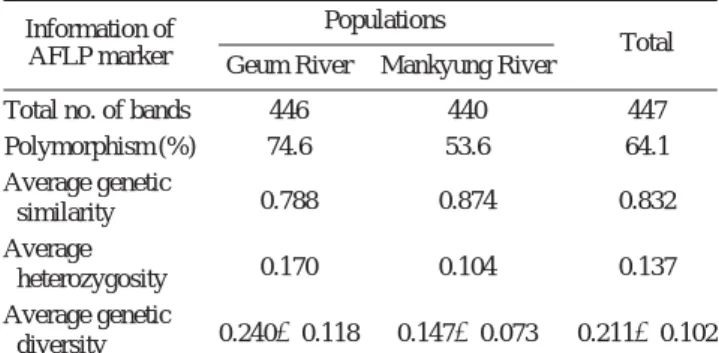
%, 집단 내 유전적 유사도는 금강이 0.788, 만경강이 0.874, 집단 내 이형접합율은 금강집단이 0.170, 만경강 집단이 0.104, 유전 다양성 수치 또한 금강이 0.240, 만경강이 0.147 로 나타나 전체적으로 만경강 집단이 금강 집단에 비해 유 전 다양성이 낮은 것으로 나타났다(Table 1). 감돌고기의 평균 다형성 밴드 비율은 64.1%로 나타나 잉어과 어류인 Schizothorax prenanti 87% (Song et al., 2006)에 비해 낮았 다. 감돌고기 집단의 평균 유전 다양성은 0.211로 나타나 잉어과 어류 Gymnocypris przewalskii의 0.305 (Chen et al.,
2005)에 비해 다소 낮게 나타났으나, 국내의 멸종위기 어류 인 어름치 0.041 (Lee et al., 2008b), 미호종개 0.088 (Lee et al., 2008a)에 비해 높게 나타났다.
감돌고기 두 집단 간 분화도(Fst) 값은 0.150 수준에서 통계적으로 유의하여(P⁄0.05), 만경강과 금강의 감돌고기 두 집단은 보통 수준(0.05~0.15)의 분화를 보였다(Wright, 1978). 이는 어름치 0.039~0.104, 미호종개 0.105~0.132에 비해 다소 높은 분화도 값으로서, 금강과 만경강 집단이 서 식처 분단을 통해 유전적 분화가 일어났음을 의미한다. 우
Table 1. Summary of the detection of AFLP markers in two popula- tions of Pseudopungtungia nigra
Information of Populations
Total AFLP marker Geum River Mankyung River
Total no. of bands 446 440 447
Polymorphism (%) 74.6 53.6 64.1
Average genetic
0.788 0.874 0.832
similarity Average
0.170 0.104 0.137
heterozygosity Average genetic
0.240±0.118 0.147±0.073 0.211±0.102 diversity
Fig. 1. Dendrogram showing phylogenetic relationships between two populations of Pseudopungtungia nigra based on genetic distance data constructed by the UPGMA clustering method.
Mankyung River
Geum River
0.70 0.75 0.80 0.85 0.90 0.95 1.00
리나라 담수어 중 특히 모래무지아과 어류의 종분화는 지 리적 분단사건이 주 원인으로 고려되고 있으며, 이는 고황 하의 지류였던 서부지역과 남부지역 고수계의 분리 역사와 관련되어 계통분류학적으로 논의된 바 있다 (Lee, 1988;
Kang, 1991). 결론적으로 지리적 분단 이후 각 수계에서 유 전적 분화가 일어난 것으로 볼 수 있다.
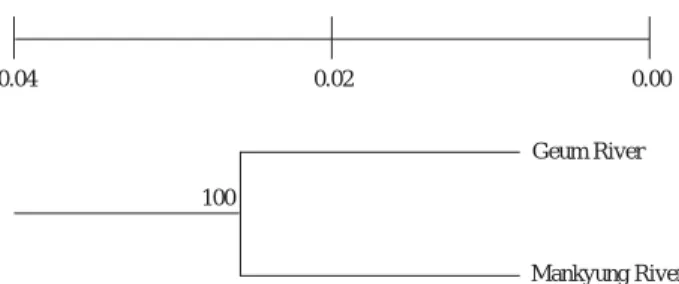
유전적 거리에 따른 감돌고기 2집단 내 개체 간 UPGMA dendrogram을 작성한 결과 만경강 집단의 개체가 금강 집 단의 개체에 비해 낮은 변이를 보이며, 두 집단의 개체들이 서로 명확히 구분되었다(Fig. 1). 집단 간 UPGMA dendro- gram을 작성한 결과 100% 지지율로 두 집단 간 0.026의 유전적 거리로 매우 가깝게 나타나 두 집단은 동일한 집단 으로 판단된다(Fig. 2). 따라서 감돌고기 집단의 유전적 분 화는 개체간의 유전적 변이에 의해 나타난 현상으로 볼 수 있으며, 금강에 비해 만경강 집단의 유전다양성이 낮은 것 으로 나타나고, 두 집단의 유전적 거리가 매우 낮아 서로 동일한 집단으로 판단됨에 따라 만경강 집단은 금강 집단 에서 분리되어 오랫동안 격리된 집단인 것으로 추정된다.
금강과 만경강 집단의 감돌고기 중 금강집단은 동 수계 에 서식하는 미호종개, 어름치 집단들에 비해 유전 다양성 이 비교적 높아 멸종위기 현상이 유전적 다양성 저하에 관 련된 것은 아닌 것으로 추정되나, 만경강 집단의 감돌고기 는 유전 다양성에 다소 문제가 나타났다. 만경강 집단의 감 돌고기는 유전 다양성 수치 및 개체 간 변이가 금강 집단 에 비해 현저히 떨어졌으며, 유전적 다양성을 나타내는 중 요한 측정치인 이형접합율(Xu et al., 2001) 또한 0.104로 나 타나 미호종개 0.086과 유사한 결과를 보여 만경강 집단의 유전적 위험성 및 관리의 필요성을 나타냈다. 만경강 집단 감돌고기의 유전 다양성이 낮은 원인으로는 서식지 축소에 따른 개체군의 유전 다양성 감소에 관한 연구(Leblois et al., 2006)와 같이 금강에 비해 면적이 비교적 좁은 만경강 에 서식지가 좁게 형성되어 나타난 현상으로 사료되나 추 후 수문학적 검증이 필요할 것이다. 웅천천 감돌고기의 경 우 꺽지와 감돌고기가 동시에 전혀 출현하지 않은 보고
(Hong et al., 1999)와 같이 만경강에서도 5~6년 전부터 만 경강 본류에서 꺽지와 감돌고기가 채집되지 않고, 현재는 본 논문의 감돌고기 채집지역인 전북 완주군 용진면에서만 서식하고 있어 감돌고기가 꺽지의 산란장에 탁란하는 번식 메커니즘의 파괴로 인한 번식력 감소, 서식지의 축소 등이 원인으로 판단된다.
따라서 인위적인 증식을 통한 개체수의 증가를 위해서는 만경강 집단에 비해 유전 다양성이 높은 금강 집단의 감돌 고기를 이용한 종묘생산이 바람직하며, 감돌고기 복원을 위 해서는 꺽지와 감돌고기 공동의 서식지 관리 또는 복원이 필요할 것이다. 또한 감돌고기 개체수 증가뿐만 아니라 생 태학적으로 연관된 꺽지의 개체수 증가를 위한 복원사업이 병행되어야 할 것으로 판단된다.
요 약
금강과 만경강에 서식하는 멸종위기어류 감돌고기(Pseu- dopungtungia nigra)의 유전 다양성 및 집단 구조를 amplifi- ed fragment length polymorphism (AFLP)를 이용하여 분석 하였다. AFLP분석은 5개의 primer 조합에서 447개의 유효 밴드가 생성되었으며, 64.1%의 다양성을 보였다 (금강 : 74.6%, 만경강: 53.6%). 집단 내 이형접합율은 금강 집단이 0.170, 만경강 집단이 0.104, 유전 다양성 수치는 금강 집단 이 0.240, 만경강 집단이 0.147로 나타났다. 감돌고기 두 집 단 간 분화도(Fst)는 0.150 수준에서 통계적으로 유의하여 (P⁄0.05), 두 집단 사이에 유전적 분화를 나타내었다. 개체 간의 UPGMA dendrogram을 분석한 결과 만경강 집단이 낮은 유전적 변이를 나타내었고, 지리적 지역에 대응하여 나뉘었으며, 두 집단 간 낮은 유전적 거리를 보였다(0.026).
따라서, 두 집단은 동일한 유전적 기원으로 추정되고, 감돌 고기의 복원을 위한 친어 집단 선정을 위해서는 금강 집단 이 적합하며, 만경강 집단은 유전적 및 서식지의 관리가 필 요할 것으로 판단된다.
인 용 문 헌
Barrett, S.C.H. and J.S. Kohn. 1991. Genetic and evolutionary con- sequences of small population size in plants: implications for conservation. In: Falk D.A., Holsinger K.E. Genetics and conservation of rare plants. Oxford University Press, New York, pp. 3-30.
Blears, M.J., S.A. De Grandis, H. Lee and J.T. Trevors. 1998. Am- plified fragment length polymorphism (AFLP): a review of the procedure and its applications. J. Ind. Microbiol. Biote- chnol., 21: 99-114.
0.04 0.02 0.00
100
Geum River
Mankyung River
Fig. 2. UPGMA consensus dendrogram constructed with the distance estimated by Nei’s method after 1,000 bootstrapping among two popu- lations. Numbers in the tree are bootstrap support values.
Chen, D., C. Zhang, C. Lu, Y. Chang and J. Chang. 2005. Amplifi- ed fragment length polymorphism analysis to identify the genetic structure of the Gymnocypris przewalskii (Kessler, 1876) population from the Qinghai Basin, China. J. Appl.
Ichthyol., 21: 178-183.
Choi, H.S., K.N. Hong, J.M. Chung, B.Y. Kang and W.W. Kim.
2004. Genetic diversity and spatial genetic structure of Em- petrum nigrum var. japonicum in Mt. Halla, South Korea.
J. Kor. for. Soc., 93: 175-180. (in Korean)
Drummond, R.S.M., D.J. Keeling, T.E. Richardson, R.C. Gardner and S.D. Wright. 2000. Genetic analysis and conservation of 31 surviving individuals of a rare New Zealand tree, Met- rosideros bartlettii (Myrtaceae). Mol. Ecol., 9: 1149-1157.
Frankham, R., J.D. Ballou and D.A. Briscoe. 2002. Introduction to conservation genetics. Cambridge, Univ. Press, Cambridge.
Hong, Y.P., M.H. Chang, H. Kang and S.S. Choi. 1999. The fish community of the Ungch’ˇon Stream around new dam intend- ed area. Kor. J. Environ. Biol., 17: 79-88. (in Korean) Jeon, S.R. 1977. Ecological Studies on the Pseudopungtungia nigra
from Korea. Kor. J. Limnol., 10: 33-46. (in Korean) Kang, E.J. 1991. Phylogenetic study on the subfamily Gobioninae
(Pisces: Cyprinidae) from Korea as evidenced by their com- parative osteology and myology. Ph. D. Thesis, Chonbuk National University, p. 108. (in Korean)
Kawamura, K., M. Kubota, M. Furukawa and Y. Harada. 2007. The genetic structure of endangered indigenous populations of the amago salmon, Oncorhynchus masou ishikawae, in Japan.
Conserv. Genet., 8: 1163-1176.
Kim, I.S., S.H. Choi, H.H. Lee and K.H. Han. 2004. Brood parasite of Korean shiner, Pseudopungtungia nigra in the Keum River, Korea. Kor. J. Ichthyol., 16: 75-79. (in Korean) Kim, I.S., Y. Choi and J.H. Shim. 1991. An occurrence of intergener-
ic hybrid cross, Pungtungia herzi X Pseudopungtungia nigra from the Ungcheon River, Korea. Kor. J. Ichthyol., 3: 42-47.
Kim, I.S., Y. Choi, C.L. Lee, B.J. Kim and J. H. Kim. 2005. Illust- rated book of Korean fishes. Kyo-hak Publishing, Korea, pp.
122. (in Korean)
Kim, J.K., Y.P. Hong, K.G. An and S.S. Choi. 1991. Studies on ear- ly embryonic development of Pseudopuntungia nigra, Kor- ean endemic species. Kor. J. Limnol., 24: 129-136.
Leblois, R., A. Estoup and R. Streiff. 2006. Genetics of recent habi- tat contraction and reduction in population size: Does isola- tion by distance matter?. Mol. Ecol., 15: 3601-3615.
Lee, D.S. 1988. Geology of Korea. Geological Society of Korea, Kyohak-sa, Seoul, pp. 389-426.
Lee, I.R., Y.A. Lee, H.C. Shin, Y.K. Nam, W.J. Kim and I.C. Bang.
2008a. Genetic diversity of an endangered fish, Iksookimia choii (Cypriniformes), from Korea as assessed by amplified fragment length polymorphism. Kor. J. Limnol., 41: 97-102.
(in Korean)
Lee, Y.A., Y.E. Yun, Y.K. Nam and I.C. Bang, 2008b. Genetic diver- sity of endangered fish Hemibarbus mylodon (Cyprinidae)
assessed by AFLP. Kor. J. Aquaculture., 21: 196-200. (in Korean)
Lee, S.H., K.H. Han, S.M. Yoon, D.S. Hwang, D.J. Yoo, C.L. Lee, I.S. Kim and Y.M. Son. 2004. Early life history and spawn- ing behavior of Pseudopungtungia nigra. Kor. J. Ichthyol., 16: 309-316. (in Korean)
Liu, Z.J. and J.F. Cordes. 2004. DNA marker technologies and their applications in aquaculture genetics. Aquaculture, 238: 1-37.
Miller, M. 1997. Tools for population genetic analysis (TFPGA) 1.3:
a windows program for the analysis of allozyme and mole- cular population genetic data. Computer software distributed by author. http://www.Marksgenetic software.net/tfpga.htm.
Nei, M. 1972. Genetic distance between populations. American Naturalist, 106(949): 283-292.
Palacios, C. and F. Gonzalez-Candelas. 1999. AFLP analysis of the critically endangered Limonium cavanillesii (Plumbaginace- ae). J. Hered., 90: 485-489.
Roa, A.C., M.M. Maya, M.C. Duque, J. Tohme, A.C. Allem and M.W. Bonierbale. 1997. AFLP analysis of relationships among cassava and other Manihot species. Theor. Appl.
Genet., 95: 741-746.
Rohlf, F.J. 1990. NTSYS-pc: Numerical Taxonomy and Multivariate Analysis System. Applied Biostatistics, Inc., Setauket, New York.
Rusell, J.R., J.D. Fuller, M. Macaulay, B.G. Hatz, A. Jahoor, W.
Powell and R. Waugh. 1997. Direct comparison of levels of genetic variation among barley accessions detected by RFLPs, AFLPs, SSRs, and RAPDs. Theor. Appl. Genet., 95:
714-722.
Song, J., Z. Song, B. Yue, W. Zheng. 2006. Assessing genetic diver- sity of wild populations of Prenant’s schizothoracin, Schi- zothorax prenanti, using AFLP markers. Env. Biol. Fishes., 77: 79-86.
Schneider, S., D. Roessli, and L. Excoffier. 2000. Arlequin ver.
2.000: a software for population genetics data analysis.
Genetics and Biometry Laboratory, University of Geneva, Geneva, Switzerland.
Travis, S.E., J. Maschinski and P. Keim. 1996. An analysis of gene- tic variation in Astragalus cremnophylax var. cremnophylax, a critically endangered plant, using AFLP markers. Mol.
Ecol., 5: 735-745.
Vos, P., R. Rodgers, M. Bleeker, M. Reijans, T. van de Lee, M.
Hornes, A. Frijters, J. Pot, J. Peleman, M. Kuiper and M.
Zabeau, 1995. AFLP, a new technique for DNA fingerprin- ting. Nucleic Acids Res., 23: 4407-4414.
Wright, S. 1978. Evolution and the genetics of populations. A trea- tise in four volumes. Volume 4. Variability within and among natural populations. Chicago Univ. Press, Chicago.
Xu, Z., J.H. Primavera, L.D. De la Pena, P. Pettit, J. Belak and A.
Alcivar-Warren. 2001. Genetic diversity of wild and cultur- ed Black Tiger Shrimp Penaeus monodon in the Philippines using microsatellites. Aquaculture, 199: 13-40.