• 검색 결과가 없습니다.

Use of Terminal Restriction Length Polymorphism (T-RFLP) Analysis to Evaluate Uncultivable Microbial Community Structure of Soil

N/A
N/A
Protected

Academic year: 2021

Share "Use of Terminal Restriction Length Polymorphism (T-RFLP) Analysis to Evaluate Uncultivable Microbial Community Structure of Soil"

Copied!
19
0
0

로드 중.... (전체 텍스트 보기)

전체 글

(1)

Use of Terminal Restriction Length Polymorphism (T-RFLP) Analysis to Evaluate Uncultivable Microbial Community Structure of Soil

Puneet Singh Chauhan, Charlotte C. Shagol, Woojong Yim, Sherlyn C. Tipayno, Chang-Gi Kim

1

, and Tongmin Sa*

Department of Agricultural Chemistry, Chungbuk National University, Cheongju, Chungbuk, 361-763, South Korea,

1

Bio-Evaluation Center, KRIBB, Cheongwon 363-883, South Korea

Various environmental ecosystems are valuable sources for microbial ecology studies, and their analyses using recently developed molecular ecological approaches have drawn significant attention within the scientific community. Changes in the microbial community structures due to various anthropogenic activities can be evaluated by various culture-independent methods e.g. ARISA, DGGE, SSCP, T-RFLP, clone library, pyrosequencing, etc. Direct amplification of total community DNA and amplification of most conserved region (16S rRNA) are common initial steps, followed by either fingerprinting or sequencing analysis.

Fingerprinting methods are relatively quicker than sequencing analysis in evaluating the changes in the microbial community. Being an efficient, sensitive and time- and cost effective method, T-RFLP is regularly used by many researchers to access the microbial diversity. Among various fingerprinting methods T-RFLP became an important tool in studying the microbial community structure because of its sensitivity and reproducibility. In this present review, we will discuss the important developments in T-RFLP methodology to distinguish the total microbial diversity and community composition in the various ecosystems.

Key words: Microbial diversity, Community structure, T-RFLP, 16S rRNA

Received : January 20. 2011 Accepted : February 21. 2011

*Corresponding author : Phone: +82432612561 E-mail: [email protected]

Introduction

Microbial communities are present in diverse envi- ronments and these play an important role in their respective environments. The study of their structure and dynamics is an important, yet intimidating task due to the large number of inhabitant bacterial population in a sample (e.g. approximately 10

8-10

g

-1

in soil). Micro- organisms in soil are critical to the maintenance of soil function in both natural and managed agricultural soils because of their involvement in such key processes as soil structure formation, decomposition of organic matter, toxin removal, and the cycling of carbon, nitrogen, phosphorus, and sulphur (Garbeva et al., 2004). In association with larger organisms these microbial communities play decidedly important role in maintaining the health of soil and host organism. The management or treatment of soil affects microbial

community structures has long been recognized (Islam et al., 2011). The physicochemical properties of soil, soil particle size distribution, the presence and age of specific plant species, and crop rotations are key determinative factors. Application of pesticides, amen- dment with chemical fertilizers, compost or manure, and the introduction of plant growth promoting living microbial inoculants or genetically modified microo- rganisms have all been shown to affect soil microbial community structures (Nautiyal et al., 2010).

Due to the vast importance of bacterial communities it is imperative to understand how they interact with their environment and the changes that take place.

Soil microbial communities are often difficult to fully

characterize, mainly because of their immense phenotypic

and genotypic diversity and heterogeneity. While all of

the cultivation based methods are excellent in being

able to yield actual microorganisms which can be

biochemically characterized, the cultivation methods

miss an estimated 85%-99.9% of the microorganisms

in an environmental sample with many microorganisms

being unculturable (Amann et al., 1995; Hill et al.,

(2)

2002). Various cultivation independent methods are used to determine the diversity of microbial communities [(DGGE/ TGGE (Muyzer et al., 1993), SSCP (Lee et al., 1996), ARDRA/RFLP (Liu et al., 1997), ARISA (Fisher and Triplett, 1999)]. All these molecular methods are now widely used to detect microbe specific genes because they are efficient, time- and cost effective and sensitive compared to conventional cultivation dependent methods. Among these molecular methods, fingerprinting techniques based on 16S rRNA genes have been successfully used in numerous studies to explore microbial diversity of predominant populations in various habitats and offer the advantage that they are more amenable to high throughput and more comprehensive than cultivation-dependent methods (Rappe and Giovannoni, 2003; Torsvik et al., 2002;

Weng et al., 2006). This review will provide the information on the important developments in T-RFLP methodology to discriminate between uncultivable microbial populations in the various ecosystems.

Direct Cultivation Techniques

Identifying the makeup of the microbial communities provides insights into how the microbes interact and what potential metabolic processes are occurring within these communities. There are a plethora of methods available for elucidating the microbial populations in these communities. These methods may be cultivation based, wherein samples are diluted and individual microorganisms are grown in some form of growth media or these may be cultivation independent methods, whereby DNA is extracted from the sample and the microorganisms are identified by molecular markers.

Standard culture techniques have a limited ability to adequately describe microbial communities. Culture techniques are typically time consuming, and cumber- some, requiring a battery of individual biochemical and nutritional tests to characterize each isolate, which may require excessive incubation time for adequate growth.

Most soil microorganisms are not easily grown in the laboratory, if they can be grown at all. Consequently, culture techniques grossly underestimate diversity, only describing approximately 0.3% of a community (Amann et al., 1995). For cultivation methods the media that is used can either be in solid or liquid form, and either a rich media or a defined minimal media. The cultivation

conditions can also be varied depending on the environ- mental requirements to replicate as closely as possible the original environment from where the microorganisms were isolated (Dedysh et al., 2006; Elshahed et al., 2004; Hopkins et al., 2001; Ladapo and Barlaz, 1997;

Nottingham and Hungate, 1968; Spieck et al., 2006;

Wise et al., 1999). While microorganisms have been traditionally isolated and characterized in this manner, there are some drawbacks to these plating and cultivation methods. Many traditional cultivation methods are biased in the microorganisms they select for and some of these viable but non-culturable microorganisms could be cultivated under laboratory conditions by changing the culture media to more accurately reflect their environment. Zengler et al. (2002) used a gel micro-droplet technology to create a high through put cultivation system to allow a greater number of microorganisms to be isolated and characterized from the environment.

Culture-Independent Techniques

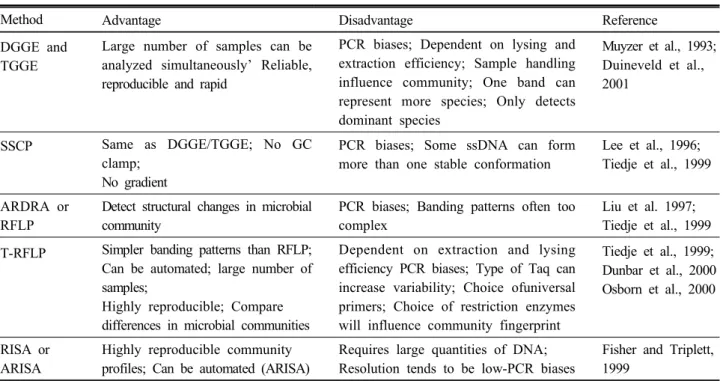
Since the cultivation methods require that the micro- organisms be culturable in growth media, and these methods miss such a large proportion of the microbial communities, cultivation independent methods have been developed to bypass the need for growing the microorganisms in the lab. These methods rely on the use of total community DNA isolated from the environmental sample, followed by amplification with specific genes of interest targeted by polymerase chain reaction. These amplified gene products are then analyzed through various fingerprinting and sequencing methods and identified (Table 1). These identified gene products can then be used to shed some light on the source organisms. Collection of these gene products from the environmental sample, a profile of the microbial community can be developed indicating what micro- organisms are present, which can be used to develop phylogenetic relationships between the sequences. In order to analyze the phylogenetic relationship, gene products need to be chosen that are common among the members of the microbial community in question.

Ribosomal genes are the preferred gene of choice for

microbial community analysis. The ribosomal DNA

genes code for ribosomal RNA (rRNA) which provides

the structural backbone for both the 30S and the 50S

(3)

components of the bacterial ribosome. The rDNA genes are an excellent choice as targets for this type of analysis because the chemistry of protein synthesis is conserved throughout the tree of life. Since the rRNA provides catalytic sites for mRNA association and translocation of the ribosome down the mRNA, these catalytic sites on the rRNA are conserved across phylogenetic groups. These sites make excellent primer targets since their conserved sequences allow for a single set of primers to amplify a vast number of sequences (Olsen et al., 1986). The amplified rDNA genes can then be sequenced and the direct sequence can then be used to identify the organisms in the community. When nucleic acid sequencing was first carried out on ribosomal RNA sequences from bacterial ribosomes, the initial sequencing effort was carried out on the 5S and 5.8S rRNAs from prokaryotic and eukaryotic targets, respectively (Donis-Keller et al., 1977; Krupp and Gross, 1979; MacKay and Doolittle, 1981; Simoncsits et al., 1977; Szymanski et al., 2001;

Tanaka et al., 1980). The 5S rRNA is the smallest of the three bacterial ribosomal RNAs. It is approximately 120 nucleotides in length and is part of the large subunit (50S) of the bacterial ribosome (Blaut et al., 2002;

Olsen et al., 1986), while the 5.8S rRNA serves the same function in the eukaryotes. This rRNA made a good initial sequencing target since it is fairly short in length, and therefore could be readily sequenced, given the state of art of DNA sequencing at the time.

Sequencing of the 5S rRNA was able to provide some sequence information for initial sequence based identification of microorganisms. However, the short length of the 5S rRNA did not contain enough sequence information to support differentiation of the strains from which the 5S rRNA sequences were obtained (Olsen et al., 1986). The 16S rRNA is approximately 1,500 nucleotides in length and compared to the 120 nucleotides of the 5S rRNA giving almost 12.5 fold more sequence information to differentiate the rRNA sequences, cold be use to differentiate the species of microorganisms more easily, the longer 16S rRNA was suggested for use as the next sequencing target (Olsen et al., 1986).

Polymerase chain reaction based cultivation-inde- pendent microbial community analysis methods Once the technology of polymerase chain reaction (PCR) was

developed in 1986 and reported by Kary Mullis (Mullis et al., 1986), the current sequence database could be used to generate primers to amplify the actual DNA sequences which can serve as the templates for the rRNA sequences. PCR now allowed the genomic DNA (gDNA) to be used as the basis for generating sequence data. Using the gDNA as the template, as opposed to having to harvest the ribosomes or target the rRNA, PCR allowed researchers to bypass the need to attempt to cultivate microorganisms from the environment.

Coupling PCR amplification of the 16S rDNA gene from environmental samples with molecular cloning and high throughput sequencing allowed for vast libraries of rDNA genes to be sequenced straight from the environmental sample (Bowman and McCuaig, 2003;

Dunbar et al., 2002; Eckburg et al., 2005; Elshahed et al., 2004; Leser et al., 2002; McGarvey et al., 2005;

McGarvey et al., 2007; Nogales et al., 1999; Nogales et al., 2001; Wright et al., 2004). Since the need for cultivation of microorganisms was now unnecessary, determining the microorganisms that make up any given community became less difficult. This also allowed for more environments to be characterized.

Terminal restriction fragment length polymorphism analysis Terminal restriction fragment length poly- morphism (T-RFLP) analysis is another high through put microbial community analysis method. Like the other methods, it is based on the use of 16S rDNA directed PCR reactions. However, unlike the other methods, sequencing of the rDNA genes is not necessary.

T-RFLP was first developed in 1997 by Liu et al. (1997) to examine the microbial communities associated with environmental samples from activated sludge, bioreactor sludge, aquifer sand and termite intestines. Because of its relative simplicity, T-RFLP analysis has been applied to the analysis of fungal ribosomal genes (Genney et al., 2006; Johnson et al., 2004; Kennedy et al., 2005; Lord et al., 2002), bacterial 16S rRNA genes (Hullar et al., 2006; Katsivela et al., 2005; Noll et al., 2005;

Pérez-Piqueres et al., 2006; Rasche et al., 2006;

Schmidt et al., 2006; Sessitsch et al., 2001; Thies 2007), and archaeal 16S rRNA genes (Kotsyurbenko et al., 2004; Leybo et al., 2006; Lu et al., 2005; Moeseneder et al., 1999; Ramakrishnan et al., 2000; Weber et al., 2001;

Wu et al., 2006). In addition, T-RFLP has been used for

the analysis of functional genes (Horz et al., 2000;

(4)

Table 1. Advantages and disadvantages of different fingerprinting methods to study microbial diversity of soil.

Method Advantage Disadvantage Reference

DGGE and TGGE

Large number of samples can be analyzed simultaneously’ Reliable, reproducible and rapid

PCR biases; Dependent on lysing and extraction efficiency; Sample handling influence community; One band can represent more species; Only detects dominant species

Muyzer et al., 1993;

Duineveld et al., 2001

SSCP Same as DGGE/TGGE; No GC

clamp;

No gradient

PCR biases; Some ssDNA can form more than one stable conformation

Lee et al., 1996;

Tiedje et al., 1999

ARDRA or RFLP

Detect structural changes in microbial community

PCR biases; Banding patterns often too complex

Liu et al. 1997;

Tiedje et al., 1999 T-RFLP Simpler banding patterns than RFLP;

Can be automated; large number of samples;

Highly reproducible; Compare differences in microbial communities

Dependent on extraction and lysing efficiency PCR biases; Type of Taq can increase variability; Choice ofuniversal primers; Choice of restriction enzymes will influence community fingerprint

Tiedje et al., 1999;

Dunbar et al., 2000 Osborn et al., 2000

RISA or ARISA

Highly reproducible community profiles; Can be automated (ARISA)

Requires large quantities of DNA;

Resolution tends to be low-PCR biases

Fisher and Triplett, 1999

DGGE and TGGE denaturing and temperature gradient gel electrophoresis, SSCP single strand conformation polymorphism, ARDRA amplified ribosomal DNA restriction analysis, RFLP restriction fragment length polymorphism, RISA ribosomal intergenic spacer analysis, ARISA automated ribosomal intergenic spacer analysis.

Lueders and Friedrich, 2003; Mintie et al., 2003;

Pérez-Jiménez and Kerkhof, 2005; Rich et al., 2003) such as those encoding for nitrogen fixation (Rösch and Bothe, 2004; Tan et al., 2003) and methane oxidation (Horz et al., 2000; Mohanty et al., 2006). The method, as stated above, is based on PCR directed on the bacterial 16S or 18S rRNA gene. T-RFLP is based on a combination of PCR and subsequent digestion of the PCR product, and relies on the use of fluorescently labeled primers, normally found on the 5’ primer to label each amplified 16S rDNA gene, which is sub- sequently tracked. The resulting mixture of rRNA gene amplicons is then digested with one or more restriction enzymes that have four base-pair recognition sites, and the sizes and relative abundances of the fluorescently labeled T-RFs are determined using an automated DNA sequencer. Since, differences in the sizes of T-RFs reflect differences in the sequences of 16S rRNA genes (i.e., sequence polymorphisms), phylogenetically distinct populations of organisms can be resolved. Thus, the pattern of T-RFs is a composite of DNA fragments with unique lengths that reflects the composition of the numerically dominant populations in the community.

While T-RFLP shares problems inherent to any PCR- based method (Acinas et al., 2004; Becker et al., 2000;

Crosby and Criddle, 2003; Kanagawa, 2003; Kurata

et al., 2004; Lueders and Friedrich, 2003; Polz and

Cavanaugh, 1998; Qiu et al., 2001; Reysenbach et al.,

1992; Suzuki and Giovannoni, 1996; Terahara et al.,

2004; von Wintzingerode et al., 1997; Wang and Wang,

1997), it has been shown to provide a facile means to

assess changes in microbial community structure on

temporal and spatial scales by monitoring the gain or

loss of specific fragments from the profiles (Franklin

and Mills, 2003; Lukow et al., 2000; Mummey and

Stahl, 2003). When coupled with 16S rRNA clone

library construction and clone sequencing, additional

specific information on the composition of microbial

communities can be obtained. Osborn et al. (2000)

undertook a systematic evaluation of T-RFLP based

methods for community analysis by using T-RFLP

to examine the microbial community structures and

dynamics in soil communities. In this work, T-RFLP

analysis was compared to other common high throughput

analysis methods (DGGE, temperature gradient gel

electrophoresis (TGGE), and single strand conforma-

tional polymorphism (SSCP)) for analyzing community

structures. They point out that the main drawback to

these previously used methods is that while they do

allow for a community profile to be generated, the

(5)

profiles do not give immediate taxonomic information (Table 1). In their study they attempted to investigate the variability found at each step of the T-RFLP process, from DNA isolation to PCR amplification, restriction digestion, and subsequent running of the samples on the gels. They also examined the differences caused by varying the DNA template concentration, primer annealing temperatures, number of amplification cycles, and even the differences between Taq polymerases and concentrations of restriction endonucleases used. They pointed out that the use of primers for full length amplification, or near full length amplification of the targeted 16S rDNA gene is preferred since the availability of current 16S rDNA databases with full length products could allow for an automated matching of terminal fragments found in the sample to known 16S rDNA genes. They also analyzed restriction enzymes, focusing on 4 base pair recognition site enzymes and found that primer choice can have an impact on the enzymes that give the best resolution. In examining sample variation, with T-RFLP profiles, it was found that the major source for variation were in the minor peak heights found in the samples indicating that in replicates the major peaks were consistent across the samples. They also showed that using automated systems for the loading of the gels provided more reproducible results in comparison to hand loading of the gels, thus increasing reproducibility. They also showed that as DNA concen- tration of the template was reduced in the PCR reaction, so was the subsequent fluorescent intensity of the associated restriction fragments. By decreasing the amount of restriction enzyme loaded into each digest, it was seen that there was a decrease in the number of smaller sized restriction fragments and an increase in the larger restriction fragments, indicating possibly the lack of complete digestion of the PCR products.

Ultimately they were able to demonstrate that T-RFLP was a robust method for rapidly examining complex microbial systems and that it has the potential to be a very powerful tool to examine these communities (Osborn et al., 2000).

One of the variables affecting the ability of T-RFLP to differentiate the 16S rDNA genes is the choice of enzymes used to digest the PCR products. Osborn et al.

(2000) pointed this out as discussed above, and it was examined again by Engebreston and Moyer (2003). In this study, the authors discussed that by choosing the

correct enzymes and number of enzymes the resulting array of fragments would more accurately reflect the community being examined. Since the restriction endonucleases have different recognition sites, it is possible that certain restriction sites will be distributed more randomly throughout the sequences, thus making certain enzymes better choices for examining communities.

By assaying 4,603 16S rDNA sequences in simulated digests, they found that there were two constraints on the fidelity of the enzymes assayed. One was the ability of the enzyme to digest unique sequence variants and the other was the number of sequence variants that fell within a specific size range. Of the two constraints, the second was more important since the resolving power of the capillary system is potentially unable to detect multiple fragments that have nearly identical fragment sizes (Engebreston and Moyer, 2003).

T-RFLP is highly adaptable, and since it only uses the

terminal fragment of the PCR product, by combining

multiple primer sets, each with a separate fluorescent

marker, it is possible to generate fragment profiles from

across multiple taxa, which is an important advantage

since PCR primers tend to have biases associated with

their ability to amplify across different taxa. Singh et

al. (2006) used this form of “multiplex” T-RFLP, m-

T-RFLP, to examine bacteria, archaea, and fungi in soil

microbial communities. Bacteria, archea, and fungi

were examined using four separate tagged primers They

compared “standard” T-RFLP, one primer set, to their

m-T-RFLP method, pooled primer sets and showed that

both methods were not only comparable in generating

the same peaks for each taxon, but the peak intensities

were comparable. Interestingly, this method can not

only be used for gaining insights into multiple taxa, but

can also be used to more finely differentiate a single

OTU by using multiple primer sets with multiple

fluorescent markers, which could generate four different

terminal fragments that could then be matched to a

specific microorganism (Singh et al., 2006). In another

adaptation of T-RFLP, functional genes can be assayed

as well as 16S rDNA genes. This is an interesting

adaptation of the method since it focuses on specific

metabolic processes of the community as opposed to

determining who is present in the community. Using

more traditional community analysis methods, which

are 16S rDNA based, a profile of the community is

developed but the metabolic capabilities of that

(6)

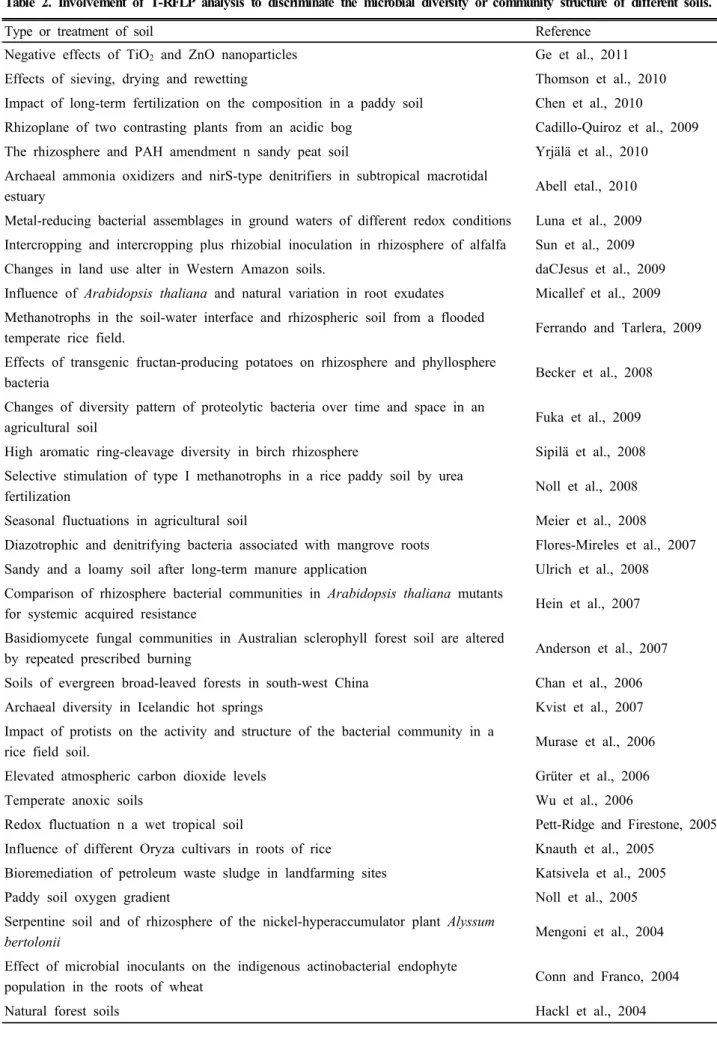
Table 2. Involvement of T-RFLP analysis to discriminate the microbial diversity or community structure of different soils.

Type or treatment of soil Reference

Negative effects of TiO

2

and ZnO nanoparticles Ge et al., 2011

Effects of sieving, drying and rewetting Thomson et al., 2010

Impact of long-term fertilization on the composition in a paddy soil Chen et al., 2010

Rhizoplane of two contrasting plants from an acidic bog Cadillo-Quiroz et al., 2009

The rhizosphere and PAH amendment n sandy peat soil Yrjälä et al., 2010

Archaeal ammonia oxidizers and nirS-type denitrifiers in subtropical macrotidal

estuary Abell etal., 2010

Metal-reducing bacterial assemblages in ground waters of different redox conditions Luna et al., 2009 Intercropping and intercropping plus rhizobial inoculation in rhizosphere of alfalfa Sun et al., 2009

Changes in land use alter in Western Amazon soils. daCJesus et al., 2009

Influence of Arabidopsis thaliana and natural variation in root exudates Micallef et al., 2009 Methanotrophs in the soil-water interface and rhizospheric soil from a flooded

temperate rice field. Ferrando and Tarlera, 2009

Effects of transgenic fructan-producing potatoes on rhizosphere and phyllosphere

bacteria Becker et al., 2008

Changes of diversity pattern of proteolytic bacteria over time and space in an

agricultural soil Fuka et al., 2009

High aromatic ring-cleavage diversity in birch rhizosphere Sipilä et al., 2008 Selective stimulation of type I methanotrophs in a rice paddy soil by urea

fertilization Noll et al., 2008

Seasonal fluctuations in agricultural soil Meier et al., 2008

Diazotrophic and denitrifying bacteria associated with mangrove roots Flores-Mireles et al., 2007 Sandy and a loamy soil after long-term manure application Ulrich et al., 2008 Comparison of rhizosphere bacterial communities in Arabidopsis thaliana mutants

for systemic acquired resistance Hein et al., 2007

Basidiomycete fungal communities in Australian sclerophyll forest soil are altered

by repeated prescribed burning Anderson et al., 2007

Soils of evergreen broad-leaved forests in south-west China Chan et al., 2006

Archaeal diversity in Icelandic hot springs Kvist et al., 2007

Impact of protists on the activity and structure of the bacterial community in a

rice field soil. Murase et al., 2006

Elevated atmospheric carbon dioxide levels Grüter et al., 2006

Temperate anoxic soils Wu et al., 2006

Redox fluctuation n a wet tropical soil Pett-Ridge and Firestone, 2005

Influence of different Oryza cultivars in roots of rice Knauth et al., 2005 Bioremediation of petroleum waste sludge in landfarming sites Katsivela et al., 2005

Paddy soil oxygen gradient Noll et al., 2005

Serpentine soil and of rhizosphere of the nickel-hyperaccumulator plant Alyssum

bertolonii Mengoni et al., 2004

Effect of microbial inoculants on the indigenous actinobacterial endophyte

population in the roots of wheat Conn and Franco, 2004

Natural forest soils Hackl et al., 2004

(7)

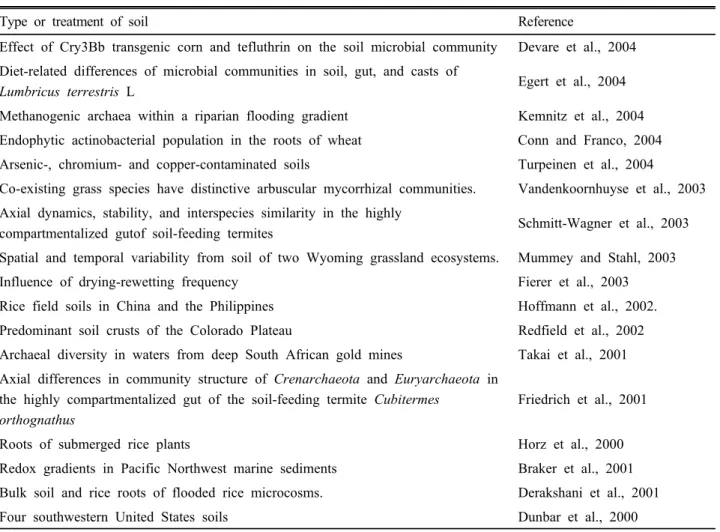
Table 2. Involvement of T-RFLP analysis to discriminate the microbial diversity or community structure of different soils.

Type or treatment of soil Reference

Effect of Cry3Bb transgenic corn and tefluthrin on the soil microbial community Devare et al., 2004 Diet-related differences of microbial communities in soil, gut, and casts of

Lumbricus terrestris L Egert et al., 2004

Methanogenic archaea within a riparian flooding gradient Kemnitz et al., 2004 Endophytic actinobacterial population in the roots of wheat Conn and Franco, 2004

Arsenic-, chromium- and copper-contaminated soils Turpeinen et al., 2004

Co-existing grass species have distinctive arbuscular mycorrhizal communities. Vandenkoornhuyse et al., 2003 Axial dynamics, stability, and interspecies similarity in the highly

compartmentalized gutof soil-feeding termites Schmitt-Wagner et al., 2003

Spatial and temporal variability from soil of two Wyoming grassland ecosystems. Mummey and Stahl, 2003

Influence of drying-rewetting frequency Fierer et al., 2003

Rice field soils in China and the Philippines Hoffmann et al., 2002.

Predominant soil crusts of the Colorado Plateau Redfield et al., 2002

Archaeal diversity in waters from deep South African gold mines Takai et al., 2001 Axial differences in community structure of Crenarchaeota and Euryarchaeota in

the highly compartmentalized gut of the soil-feeding termite Cubitermes orthognathus

Friedrich et al., 2001

Roots of submerged rice plants Horz et al., 2000

Redox gradients in Pacific Northwest marine sediments Braker et al., 2001 Bulk soil and rice roots of flooded rice microcosms. Derakshani et al., 2001

Four southwestern United States soils Dunbar et al., 2000

community can only be inferred from the identification of members of the community. However, identifying the biochemical constituents of the environment as well as the determining community members can lead to insights into what biological processes are occurring, but some of the detection methods are complex and time intensive. The more traditional approach to functional studies is PCR followed by cloning and sequencing of functional genes, in a similar fashion to 16S rDNA based community analysis methods. In this more functionally based T-RFLP approach instead of 16S rDNA genes, the functional gene of interest is amplified and used as the T-RFLP target. T-RFLP analysis has been used to examine many microbial communities (Ayala-del-Rio et al., 2004; Córdova-Kreylos et al., 2006; Friedrich et al., 2001; Grant et al., 2007; Hullar et al., 2006; Junier et al., 2008; Kent et al., 2003; Kraigher et al. 2008; Li et al., 2007; Liu et al., 1997; Nagashima et al., 2003; Scully et al., 2005; Smith et al., 2005).

Since it is a high throughput and quite rapid profiling method it allows for “snapshots” of communities to be

taken each time DNA is isolated. These “snapshots” can then be compared to examine differences between the communities (Table 2).

Important Factors Responsible for Efficient T-RFLP Analysis

Primers and restriction enzyme selection Primer selection is the most critical factor which influence a community fingerprint, by using the 16S rRNA gene phylogenetic diversity of bacteria in a sample is produced. Variable regions of 16S rRNA gene can be used to select for different groups of prokaryotic organisms with different ranges of specificity (Brunk et al., 1996). Ideally, primers chosen for T-RFLP analysis should be specific to the targeted taxonomic group so that they can amplify all bacterial populations. There are no known primers that satisfy both of these criteria.

For example, an in silico analysis of sequences done

using the Probe Match tool of the Ribosomal Database

(8)

Project (RDP) shows that the bacterial primer 8fm potentially amplifies only 76-98% of the bacterial 16S rRNA gene sequences in the RDP database (Marsh et al., 2000). Worse still, this analysis does not take into account that sequence databases only contain a fraction of the extant bacterial diversity, which suggests that commonly used primers such as 8fm are far from universal. In addition, the 8fm primer is not 100%

specific to bacteria because the primer also matches 19 16S rRNA archaeal genes of the 19,300 archaeal 16S rRNA gene sequences that were in GenBank (http://

www.ncbi.nlm.nih.gov/Genbank/) as of June 2007.

Although there is no perfect primer, tools such as the primer-prevalence tool (Shyu et al., 2007) on the Microbial Community Analysis (MiCA) website (http://

mica.ibest.uidaho.edu/) and the Probe Match tool (Marsh et al., 2000) found on the Ribosomal Database Project website (http://rdp.cme.msu.edu/) facilitate the choosing of primers because they allow researchers to compare the specificity and selectivity of different primer sets based on sequences in the database. A limitation is that neither tool is equipped for the analysis of archaeal sequences. The use of only one fluorescently labeled primer may result in underes- timating the microbial diversity in a sample because different bacterial populations can share the same terminal restriction fragment length for a particular primer-enzyme combination (Marsh et al., 2000). This problem is reduced if two labeled primers are used; the premise being that some populations that cannot be resolved with one primer might be distinguished on the basis of additional information provided from the terminal fragment generated by a second labeled primer (Liu et al., 1997). The resolution of populations can be enhanced even further through the use of three or more labeled primers. Zhou et al. (2007), for example, amplified 16S rRNA genes of human vaginal bacterial communities by amplifying 16S rRNA genes in two separate PCR reactions that employed two differentially labeled forward primers in combination with the same reverse primer. After digestion, the restriction products were combined prior to analysis. Multiple primers can also be used in the same PCR reaction to study communities that contain different taxa, and this is referred to as multiplexing.

After selection of primers, the next step is restriction analysis of amplified PCR product. Selection of

restriction enzyme is another critical step in producing a TRF pattern since the conservation of cut sites for each enzyme varies between enzymes and changes for every gene. An enzyme with a cut site in a conserved portion of a gene will produce fewer peaks than an enzyme with cut sites in a variable region of a gene and have a poor ability to differentiate bacteria from different phylogenetic groups. Enzymes that cut less often typically have large peaks that represent broad groups of organisms. The discrimination of bacterial populations by T-RFLP analysis relies on detecting 16S rRNA gene sequence polymorphisms using restriction enzymes (Liu et al., 1997). Typically, enzymes that have four base-pair recognition sites are used due to the higher frequency of these recognition sites. It has been shown by several groups that the use of more than one restriction enzyme facilitates the resolution of bacterial populations (Liu et al., 1997; Marsh, 2000). This is due to the fact that different bacterial populations can share the same terminal restriction fragment length for a particular primer-enzyme combination but not others (Marsh et al., 2000). The ability of different restriction enzymes to resolve unique sequences has been examined in studies of gene sequence databases, communities with different richness, and iterative random sampling from a derived database of T-RFs (Engebretson and Moyer, 2003;

Moyer et al., 1996). Engebretson and Moyer (2003) have evaluated 18 restriction enzymes and found that BstUI, DdeI, Sau961 and MspI most often resolved individual populations in their model communities. For communities with more than 50 operational taxonomic units (OTUs), none of the restriction enzymes resolved more than 70% of the total OTUs.

In silico digestion to evaluate the ability of restriction enzymes to discriminate between sequences can be done using tools such as the T-RFLP analysis program (TAP) T-RFLP (http://rdp8.cme.msu.edu/html/TAP-T- RFLP.html) and MiCA (http://mica.ibest.uidaho.edu/) for 16S rRNA genes and the ARB implemented tool TRF-CUT for functional genes (http://www.mpi-marburg.

mpg.de/downloads/, Ricke et al., 2005). TAP T-RFLP is

located on the RDP website, and it facilitates the choice

of restriction enzymes by an in silico digest of all 16S

rRNA genes in the database while using different

primer-enzyme combinations (Marsh et al., 2000). TAP

T-RFLP matches a chosen forward or reverse primer to

every sequence of the database, and all the sequences

(9)

that match the primer are digested in silico by the chosen restriction enzyme(s). The analysis provides answers to the following questions: (i) what enzyme(s) best discriminate phylotypes for estimates of population diversity, (ii) what enzyme(s) provides the best resolution of the targeted phylogenetic groups, and (iii) what primer-enzyme(s) combinations are best for a particular data set. The default output shows the results within RDP’s phylogenetic hierarchy. In addition, the results can be ordered by sequence name or terminal fragment size. While TAP T-RFLP is a powerful tool to acquire a first impression of how well different restriction enzymes can resolve phylotypes, it also has certain limitations. It only allows one primer-enzyme combination to be specified, the data cannot be sorted, and the output cannot be printed or exported to other programs (Shyu et al., 2007).

Resolution of T-RFs TRF data reported by a sequencer consists of the size (base pairs), peak height, and peak area for each TRF peak in a pattern in a sample are usually determined by capillary or polyacrylamide gel electrophoresis wherein the electrophoretic mobility of the T-RFs are compared to those of known size in an internal standard. Differences in the length and abundance of fluorescently labeled T-RFs in a sample are usually determined by capillary or polyacrylamide gel electrophoresis wherein the electrophoretic mobility of the T-RFs are compared to those of known size in an internal standard. The actual sizes of T-RFs are estimated by interpolation using algorithms such as the Local Southern algorithm that are available in software packages such as GeneScan and GeneMapper.

The abundance of each T-RF is determined based on fluorescence intensity and expressed as either peak height or peak area. Generally speaking, T-RFLP analysis using capillary gel electrophoresis is more precise and reproducible than analyses done using polyacrylamide gels (Behr et al., 1999). Even so, run-to-run variability (generally ± 1 bp) results in small size discrepancies even among terminal fragments of the same bacterial populations and therefore fingerprints need to be aligned. Fragment sizes are generally assigned to categories of operational taxonomic units or “bins”.

Each bin may actually include more than one phylotype depending on the species complexity of the community being analyzed, the phylogenetic relatedness of the

populations present, and the resolving ‘power’ of the primers and enzymes used. A disadvantage of capillary systems is that they employ electrokinetic sample injection, in which charged molecules are injected into capillaries by applying an electric field (Behr et al., 1999). This can result in the preferential injection of smaller molecules, so salts and primers from the PCR reactions (Osborne et al., 2005; Tiquia et al., 2005) or the digestion reactions (Berg et al., 2005; Hoshino et al., 2006) should be removed prior to sample analysis.

Accurate fragment size determination is important, especially if the goal is to infer a plausible community composition from T-RFLP profiles. Plausible community compositions are determined using web-based tools, in which the sizes of T-RFs in a profile are matched with T-RF sizes derived in silico from the 16S rRNA gene sequences of phylotypes in a database. Sometimes, however, this is not straightforward because pseudo T-RFs (partially single-stranded amplicons) may be formed during PCR (Egert and Friedrich, 2003, 2005) and different fluorophores can affect the electrophoretic mobility of fragments in different ways causing errors in determining fragment sizes (Tu et al., 1998). Although DNA fragment analysis by capillary electrophoresis is very precise (± 1 bp), it is not necessarily accurate, a fact that is not widely known. In our experience, DNA fragments labeled with a fluorescein dye, such as 6FAM and HEX, migrate faster than DNA fragments labeled with a rhodamine dye such as ROX. The latter one is often used to label internal size standards. As a result, the sizes of terminal fragments labeled with HEX or 6FAM can be underestimated. Unfortunately, it is not easy to adjust for differences in migration behavior because the magnitude of the discrepancy is not constant across fragment sizes. For fragment sizes smaller than 100 bp, it is up to 11 bp (Hahn et al., 2001), it decreases to 2-3 bp for fragment sizes of about 500 bp, and then increases again for fragment sizes larger than about 700 bp. Discrepancies between true and observed T-RF sizes can also be caused by the purine content (Kaplan and Kitts, 2003). Furthermore, the performance of the algorithms used to size call the T-RFs deteriorates as the DNA fragment size increases.

Currently, there is no solution to correct for these

migration discrepancies that arise due to the use of

different fluorophores, and users should take this into

account when using T-RFLP data to determine the

(10)

community composition.

T-RFs alignment Run-to-run variability in T-RFLP analysis causes slight differences in the estimated sizes of T-RF fragments from the same bacterial phylotype.

Because of this run-to-run variability, fingerprints need to be aligned before further statistical analyses can be done. The methods used to assign fragment sizes to length categories (bins) include nearest integer rounding, manual binning (Blackwood et al., 2007), and clustering- based statistical approaches (Abdo et al., 2006; Dunbar et al., 2001; Hewson and Fuhrman, 2006; Ruan, et al.

2006). The use of statistical approaches is far superior to rounding to the nearest integer or manual binning because so long as parameter choices are made based on empirical data and applied consistently, the automated procedures allow an objective analysis of large data sets with statistical justification. Hewson and Fuhrman (2006) describe a binning technique wherein profiles are aligned based on multiple bin windows of a fixed size. In their example, Hewson and Fuhrman used a bin window of 10 bp. If one excludes fragment sizes smaller than 50 bp due to primer dimer peaks, then the first bin would contain all fragments of 50-59 bp, the second would contain all fragments with a size of 60-69 bp, and so on. The alignment is done several times, and each time the starting point of the window is shifted by 1 bp.

In the second round of alignment, all fragment lengths from 51-60 bp, 61-70 bp, etc., are considered identical.

The number of times the alignment is done equals to the size of the bin window, and in this example, it would be ten times (It should be noted that this method was developed for the analysis of data from fragment analysis using polyacrylamide gels and not capillary gel electrophoresis. This results in a larger run-to-run variability of fragment sizes; thus, large bin windows were proposed). For each frame, all pairwise similarities among the profiles are calculated, an unweighted pair- group method with arithmetic mean (UPGMA) tree is generated based on the maximum pair wise similarities among profiles, and this tree is used to draw conclusions about differences in microbial community. The perfor- mance of the binning method has only been evaluated based on samples with unknown community structure, and therefore, the ability of this approach to determine true differences in microbial communities remains unknown. An extension of this binning method has

been developed by Ruan et al. (2006) to allow different bin window sizes depending on the fragment size because the reproducibility of fragment length measure- ments varies with fragment size (Brown et al., 2005).

Identification of individuals in microbial communities TRF analysis is a powerful tool for describing bacterial community structure and dynamics, but the information is also useful for identifying community members. As described above, each TRF in a pattern represents one or more organisms. There are several web-based tools available that allow users to identify plausible members of microbial communities based on T-RFLP data (Kent et al., 2003; Shyu et al., 2007; Wise and Osborn, 2001).

The tools differ as to whether they automatically combine the results of profiles from several restriction digests, account for both forward and reverse primer, account for the relative abundances of fragments, and allow for mismatches between primer sequence and templates. Allowing for mismatches is important because sequences that have a small number of mismatches with the primer sequence may still amplify in PCR reactions.

What follows are short descriptions of some web-based tools that can be used to identify plausible members of a microbial community based on T-RFLP data. A phylogenetic assignment tool (PAT) developed by Kent et al. (2003) uses a default database produced by using MiCA that contains the T-RFs predicted from an in silico analysis of 16S rRNA sequences using the bacterial 16S rRNA gene primer 8F and one of several restriction enzymes with tetrameric recognition sites.

Custom-generated databases can be used as well. The

T-RFs predicted from when a given primer-enzyme

combination is used to match the empirically determined

fragment lengths to those predicted from various phylo-

types in the database. The ability of PAT to correctly

determine community composition is increased by the

analysis of multiple digests because species that are not

resolved by a given restriction enzyme may be resolved

by a different enzyme. The resolution of PAT could be

further enhanced if T-RF sizes could be predicted from

both the 5′ and 3′ ends of amplified fragments, but

this is not a feature of the program. The method was

validated by using T-RFLP in conjunction with sequencing

cloned 16S rRNA genes to assess the variability of

bacterial community structure throughout the water

column of a humic lake. The taxonomic classes identified

(11)

by T-RFLP and clone library analysis matched well.

TRUFFLER is a program similar to PAT except sequences are retrieved from the European Molecular Biology Laboratory DNA database and mismatches between primer sequences and templates are allowed. The authors reported that there were discrepancies between predicted and actual fragment sizes (1-2 bp) but that overall, there was a good level of agreement (Wise and Osborn, 2001). APLAUS is an algorithm that allows the definition of a bin size to address the problem of size calling errors caused by factors such as differences in migration behavior of the different fluorophores (Shyu et al., 2007). As with PAT, it allows the comparison of one or more T-RFLP profiles to the outcome of an in silico analysis of the database with the same primer-enzyme combination as used in the experiment (Shyu et al., 2007). An important difference is that data from the analysis of samples with multiple primer-enzyme combinations can be evaluated simultaneously, which narrows the possibilities for members of the community.

Although these tools can be used to gain insight to the possible members of microbial communities, there are several caveats one should be cognizant of when implementing them. First, DNA fragments labeled with different fluorophores may differ in electrophoretic mobility (Tu et al., 1998). Second, electrophoretic mobility can be influenced by sequence composition (Kaplan and Kitts, 2003). Both of these will introduce discrepancies between the empirically determined and actual fragment sizes. Third, only a small percentage of 16S rRNA gene sequences are now archived in databases. Therefore, misidentification may result from the fact that known sequences in the database have the same sequence polymorphisms as novel and unknown sequences in the sample (Blackwood and Buyer, 2007).

Even with these limitations, there are certain cases in which data from T-RFLP analysis of microbial communities can be used in conjunction with web- based tools to an advantage. For example, it is possible to presumptively identify and monitor specific bacterial populations within a microbial community so long as the sizes of the corresponding T-RFs are verified a priori. Nilsson and Strom (2002) developed a database that contains 16S rRNA gene sequences of fish pathogens. This database can be searched to presump- tively identify common fish pathogens based on the T-RF lengths obtained with a defined primer pair and

six restriction enzymes.

Visualizing relationships among microbial communities

Principal component analysis (PCA), multidimensional

scaling (MDS), self-organizing map (SOM), and Additive

Main Effects and Multiplicative Interaction (AMMI)

are useful methods to visualize similarities or dissimi-

larities among microbial communities. All four methods

reduce the dimensionality of the data, which are then

plotted in two-three dimensions. PCA uses a set of new

variables (linear combinations of the original variables)

to describe as much of the variance in the data as

possible with as few variables as possible (Johnson,

1998). The so-called first principal component󰠏the

first new variable-embodies the largest amount of

variation in the data. The second principal component,

which is orthogonal to the first principal component,

takes into consideration the second largest amount of

variation and so on (Johnson, 1998). MDS can be

divided into metric and nonmetric procedures. Metric

MDS is also known as principal coordinate analysis. To

construct a plot for metric MDS, all pair-wise distances

of all profiles are first computed. Then, the multidim-

ensional distances are plotted in two-three dimensions

in such a way that the original distances among the

profiles are reflected as accurately as possible. In

contrast to metric MDS, nonmetric MDS is based not on

the metric distances between profiles but on the ranks of

the distances between profiles. Importantly, MDS has

a goodness of fit test that indicates how well the

generated plot reflects the relations among the original

data (Young, 1987). Rees et al. (2004) extended the use

of MDS to test for significant differences among groups

through the analysis of similarity and they implemented

similarity percentage analysis to calculate the contri-

bution of individual T-RFs to the dissimilarity between

samples. SOMs, which have been used in a few studies

to analyze T-RFLP data, organize data onto a two-

dimensional grid (Dollhopf et al., 2001). Each node on

the grid is described by a model, and the models of

neighboring nodes are more similar to each other than

those located further away. Each T-RFLP profile is

associated with a model on the grid that explains the

structure of the profile, and accordingly, similar profiles

will be organized more closely together on the grid than

less similar profiles. In comparison to PCA, SOM

seems better able to detect differences between profiles

(12)

that contain a large number of peaks (Dollhopf et al., 2001). Depending on the objective of the study, AMMI (Gauch, 1992) can be more useful than PCA, MDS, and SOMs because it focuses on the differences in the response of bacterial populations to treatments (Culman et al., 2006). AMMI is a combination of analysis of variance and PCA.

Diversity and distance measures Many statistical approaches discussed above are based on measures that determine the similarity among profiles. There are many different diversity measures to choose from and the choice of these measures may be greatly used to influence the results of the analysis. During T-RFLP data analysis for diversity measures, there are two things to consider: (1) should the abundances of individual phylotypes be included as an important variable or should only the presence or absence of fragments be used and (2) should the absence of a peak in two samples be regarded as a similarity between them or have no impact between two profiles.

Whether abundance is included in the analysis depends on whether the objective of the study is of a purely qualitative or a quantitative nature. If changes in abundance are included in the analysis, only standar- dized abundances should be used due to the run-to-run variation (Liu et al. 1997; Osborn et al. 2000). The number of T-RFs detected considered as species richness and other diversity indices can be calculated based on each T-RFs abundance and their respective total sum.

Diversity of T-RFLP patterns, such as the Shannon index (H), equitability index (J ), richness (d ), and evenness (e ), can be used as means of evaluating microbial diversity of samples using the formula as follows:

Shannon index (H) = C/N Nlog

10

N 󰠏∑ ni log

10

ni,

where C = 2.3; N = sum of peak areas in a given T-RFLP; ni = area of T-RF i; and i = number of T-RFs of each T-RFLP pattern. This calculation was derived on Shannon and Weaver’s formula based on the

Equilitability index (J ) = H/ Hmax,

where H = Shannon-diversity index and Hmax theoretical maximal Shannon index for the T-RFLP examined, assuming that each peak represents only one

member.

Richness (d ) = S – 1/logN,

where S = number of T-RFs, N = sum of all peak areas in a given T-RFLP pattern.

Evenness (e) = H/logS,

where H = Shannon index, S = total number of T-RFs.

For distance measure simple matching coefficient incorporates the absence of a T-RF in two profiles as a similarity, whereas indices such as Jaccard and Bray- Curtis only account for TRFs that are present in two profiles as a similarity between the two profiles. We suggest that similarity indices should be used in which the absence of a bacterial population in one of two profiles does not impact the distance between the profiles. This is because the failure to detect a population in a profile may not mean that it is absent from a sample but rather below the detection threshold. T-RFLP, like any PCR-based method, may underestimate true diversity because only numerically dominant species are detected because of the large quantity of available template DNA. In addition, different species will have different gene copy numbers and this could bias results (Liu et al., 1997). Incomplete digestion by restriction enzymes could also lead to an overestimation of diversity (Osborn et al., 2000). Despite these limitations, some researchers are of the opinion that once standardized, T-RFLP can be a useful tool to study microbial diversity in the environment (Liu et al., 1997; Tiedje et al., 1999;

Osborn et al., 2000), while others feel that it is

inadequate (Dunbar et al., 2000). Dunbar et al. (2000)

reported that the statistics they used detected inconsi-

stencies in DNA banding patterns depending on the

enzyme used and those samples of four different soil

types were not found to be significantly different from

each other. T-RFLP has also been thought to be an

excellent tool with which to compare the relationship

between different samples (Dunbar et al., 2000). T-RFLP

has been used to measure spatial and temporal changes

in bacterial communities (Acinas et al., 1997; Lukow

et al., 2000), to study complex bacterial communities

(Clement et al., 1998; Moeseneder et al., 1999), to

detect and monitor populations (Tiedje et al., 1999)

and to assess the diversity of AMF in the rhizosphere of

Viola calaminaria in a metal-contaminated soil (Tonin

(13)

et al., 2001). Tiedje et al. (1999) reported five times greater success at detecting and tracking specific ribotypes using TRFLP than DGGE. Recently, Bent and Forney (2008) has reported assessment of richness in complex communities is futile without extensive sampling, and that some diversity indices can be estimated with reasonable accuracy through the analysis of clone libraries or pyrosequencing data, but not from community fingerprint data i.e. DGGE or T-RFLP. The data produced by sequencing and fingerprinting methods differ due to the reliance of the latter on proxy information (for example, restriction sites or GC content) rather than full sequence data (Abdo et al., 2006), and both kinds of methods have problems and biases that have been reviewed by Bent and Forney (2008).

Conclusions and Future Prospective

Molecular cultivation independent methods are offering parallel opportunities to characterize Bacteria, Archaea and Eucarya in culture and directly from various environmental samples. Modern molecular techniques developed to study microbial populations finally allow us access to the very large proportion of organisms that are present in the soil that we are currently unable to culture under laboratory conditions.

They are also allowing us to begin to link and identify with function which will lead to a better understanding of how changes in soil management practices may be altering ecosystem dynamics. Great progress has been made in T-RFLP method for analysis of 16S rRNA and functional genes. Technical developments such as implementing capillary gel electrophoresis and the use of multiple labeled primers and restriction enzymes resulted in an improved reproducibility and resolution of T-RFLP profiles, while web-based tools facilitate the choice of primer and enzymes. Continually evolving technical developments open new horizons of research and applications that are enabling a far more complete and less biased view of microbial community structure of various ecosystems.

Acknowledgments

This work was partially supported by the Rural Dev- elopment Administration (RDA), Republic of Korea.

References

Abdo, Z., U.M., Schütte, S.J. Bent, C.J. Williams, L.J. Forney, and P. Joyce. 2006. Statistical methods for characterizing diversity of microbial communities by analysis of terminal restriction fragment length polymorphisms of 16S rRNA genes. Environ. Microbiol. 8:929-938.

Abell, G.C., A.T. Revill, C. Smith, A.P. Bissett, J.K. Volkman, and S.S. Robert. 2010. Archaeal ammonia oxidizers and nirS- type denitrifiers dominate sediment nitrifying and denitrifying populations in a subtropical macrotidal estuary. ISME J. 4:

286-300.

Acinas, S.G., L.A. Marcelino, V. Klepac-Ceraj, and M.F. Ploz.

2004. Divergence and redundancy of 16S rRNA sequences in genomes with multiple rrn operons. J. Bacteriol. 168:

2629-2635.

Amann, R.I., W. Ludwig, and K. Schleifer. 1995. Phlyogenetic identification and in situ detection of individual microbial cells without cultivation. Microbiol. Rev. 59:143-169.

Anderson, I.C., B.A. Bastias, D.R. Genney, P.I. Parkin, and J.W. Cairney. 2007. Basidiomycete fungal communities in Australian sclerophyll forest soil are altered by repeated prescribed burning. Mycol. Res. 111:482-486.

Ayala-del-Rio, H.L., S.J. Callister, C.S. Criddle, and J.M.

Tiedje. 2004. Correspondence between community structure and function during succession in phenol- and phenol-plus- trichloroethene-fed sequencing batch reactors. Appl. Environ.

Microbiol. 70:4950-4960.

Becker, R., P. Böger, R. Oehlmann, and A. Ernst. 2000. PCR bias in ecological analysis: a case study for quantitative Taq nuclease assays in analyses of microbial communities. Appl.

Environ. Microbiol. 66:4945-4953.

Becker, R., U. Behrendt, B. Hommel, S. Kropf, and A. Ulrich.

2008. Effects of transgenic fructan-producing potatoes on the community structure of rhizosphere and phyllosphere bacteria. FEMS Microbiol. Ecol. 66:411-425.

Behr, S., M. Mätzig, A. Levin, H. Eickhoff, and C. Heller.

1999. A fully automated multicapillary electrophoresis device for DNA analysis. Electrophoresis. 20:1492-1507.

Bent, S.J. and L.J. Forney. 2008. The tragedy of the uncommon:

understanding limitations in the analysis of microbial diversity.

ISME J. 2:689-695.

Berg, G., A. Krechel, M. Ditz, R.A. Sikora, A. Ulrich, and J.

Hallmann. 2005. Endophytic and ectophytic potato-associated bacterial communities differ in structure and antagonistic function against plant pathogenic fungi. FEMS Microbiol.

Ecol. 51:215-229.

Blackwood, C.B., D. Huddleston, D.R. Zak, and J.S. Buyer.

2007. Interpreting ecological diversity indices applied to terminal restriction fragment length polymorphism data:

insights from simulated microbial communities. Appl. Environ.

Microbiol. 73:5276-5283.

Blaut, M., M.D. Collins, G.W. Welling, J. Doré, J. van Loo, and W. de Vos. 2002. Molecular biological methods for studying the gut microbiota: the EU human gut flora project.

British J. Nut. 88:S203-S211.

(14)

Bowman, J.P. and R.D. McCuaig. 2003. Biodiversity, community structural shifts, and biogeography of prokaryotes within Antarctic continental shelf sediment. Appl. Environ. Microbiol.

69:2463-2483.

Braker, G., H.L. Ayala-del-Río, A.H. Devol, A. Fesefeldt, and J.M. Tiedje. 2001. Community structure of denitrifiers, bacteria, and archaea along redox gradients in Pacific Northwest marine sediments by terminal restriction fragment length polymorphism analysis of amplified nitrite reductase (nirS) and 16S rRNA genes. Appl. Environ. Microbiol. 67:1893-1901.

Brown, M.V., M.S. Schwalbach, I. Hewson, and J.A. Fuhrman.

2005. Terminal restriction fragment length polymorphism (T-RFLP): an emerging method for characterizing diversity among homologous populations of amplification products.

Environ. Microbiol. 7:1466-1479

Brunk, C.F., E. Avaniss-Aghajani, and C.A. Brunk. 1996. A computer analysis of primer and probe hybridization potential with bacterial small-subunit rRNA sequences. Appl. Environ.

Microbiol. 62:872-879.

Cadillo-Quiroz, H., J.B. Yavitt, S.H. Zinder, and J.E. Thies.

2009. Diversity and community structure of Archaea inhabiting the rhizoplane of two contrasting plants from an acidic bog. Microb. Ecol. 59:757-767.

Chan, O.C., X. Yang, Y. Fu, Z. Feng, L. Sha, P. Casper, and X. Zou. 2006. 16S rRNA gene analyses of bacterial community structures in the soils of evergreen broad-leaved forests in south-west China. FEMS Microbiol. Ecol. 58:

247-259.

Chen, Z., X. Luo, R. Hu, M. Wu, J. Wu, and W. Wei.

2010. Impact of long-term fertilization on the composition of denitrifier communities based on nitrite reductase analyses in a paddy soil. Microb. Ecol. 60:850-861.

Conn, V.M. and C.M. Franco. 2004. Analysis of the endophytic actinobacterial population in the roots of wheat (Triticum aestivum L.) by terminal restriction fragment length polymorphism and sequencing of 16S rRNA clones. Appl.

Environ. Microbiol. 70:1787-1794.

Córdova-Kreylos, A.L., Y.P. Cao, P.G. Green, H.M. Hwang, K.M. Kuivila, M.G. LaMontagne, L.C. Van De Werfhorst, P.A. Holden, and K.M. Scow. 2006. Diversity, composition, and geographical distribution of microbial communities in california salt marsh sediments. Appl. Environ. Microbiol.

72:3357-3366.

Crosby, L.D. and C.S. Criddle. 2003. Understanding bias in microbial community analysis techniques due to rrn operon copy number heterogeneity. Biotechniques. 34:790-764.

Culman, S.W., J.M. Duxbury, T.G. Lauren, and J.E. Thies.

2006. Microbial community response to soil solarization in Nepal’s rice-wheat cropping system. Soil Biol. Biochem.

38:3359-3371.

daCJesus, E., T.L. Marsh, J.M. Tiedje, and F.M. deSMoreira.

2009. Changes in land use alter the structure of bacterial communities in Western Amazon soils. ISME J. 3:1004-1011.

Dedysh, S.V., T. Pankratov, S.E. Belova, I.S. Kulichevskaya, and W. Liesack. 2006. Phylogenetic analysis and in situ identification of bacteria community composition in an acidic

Sphagnum peat bog. Appl. Environ. Microbiol. 72:2110-2117.

Derakshani, M., T. Lukow, and W. Liesack. 2001. Novel bacterial lineages at the (sub) division level as detected by signature nucleotide-targeted recovery of 16S rRNA genes from bulk soil and rice roots of flooded rice microcosms. Appl. Environ. Microbiol. 67:623-631.

Devare, M.H., C.M. Jones, and J.E. Thies. 2004. Effect of Cry3Bb transgenic corn and tefluthrin on the soil microbial community: biomass, activity, and diversity. J. Environ.

Qual. 33:837-843.

Dollhopf, S.L., S.A. Hashsham, and J.M. Tiedje. 2001.

Interpreting 16S rDNA T-RFLP data: application of self- organizing maps and principal component analysis to describe community dynamics and convergence. Microb. Ecol. 42:

495-505

Donis-Keller, H., A.M. Maxam, and W. Gilbert. 1977. Mapping adenines, guanines and pyrimidines in RNA. Nucleic Acids Res. 4:2527-2538.

Duineveld, B.M., G.A. Kowalchuk, A. Keijzer, and J.D.

van Elsas 2001. Analysis of bacterial communities in the rhizosphere of chrysanthemum via denaturing gradient gel electrophoresis of PCR-amplified 16S rRNA as well as DNA fragments coding for 16S rRNA. Appl. Environ.

Microbiol. 67:172- 178.

Dunbar, J., L.O. Ticknor, and C.R. Kuske. 2000. Assessment of microbial diversity in four southwestern United States soils by 16S rRNA gene terminal restriction fragment analysis. Appl. Environ. Microbiol. 66:2943-2950.

Dunbar, J., L.O. Ticknor, and C.R. Kuske. 2001. Phylogenetic specificity and reproducibility and new method for analysis of terminal restriction fragment profiles of 16S rRNA genes from bacterial communities. Appl. Environ. Microbiol. 67:

190-197.

Dunbar, J., S.M. Barns, L.O. Ticknor, and C.R. Kuske.

2002. Empirical and theoretical bacterial diversity in four Arizona soils. App. Environ. Microbiol. 68:3035-3045.

Eckburg P.B., E.M. Bik, C.N. Bernstein, E. Purdom, L.

Dethlefsen, M. Sargent, S.R. Gill, K.E. Nelson, and D.A.

Relman. 2005. Diversity of the human intestinal microbial flora. Science. 308:1635-1638.

Egert, M. and M.W. Friedrich. 2003. Formation of pseudo- terminal restriction fragments, a PCR-related bias affecting terminal restriction fragment length polymorphism analysis of microbial community structure. Appl. Environ. Microbiol.

69:2555-2562.

Egert, M. and M.W. Friedrich. 2005. Post-amplification Klenow fragment treatment alleviates PCR bias caused by partially single-stranded amplicons. J. Microbiol. Meth. 61:69-75.

Egert, M., S. Marhan, B. Wagner, S. Scheu, and M.W.

Friedrich. 2004. Molecular profiling of 16S rRNA genes reveals diet-related differences of microbial communities in soil, gut, and casts of Lumbricus terrestris L. (Oligochaeta:

Lumbricidae). FEMS Microbiol. Ecol. 48:187-197.

Elshahed, M.S., F.Z. Najar, B.A. Roe, A. Oren, T.A. Dewers,

and L.R. Krumholz. 2004. Survey of Archaeal diversity

reveals an abundance of halophilic Archaea in low-salt,

수치

Table 1. Advantages and disadvantages of different fingerprinting methods to study microbial diversity of soil.
Table 2. Involvement of T-RFLP analysis to discriminate the microbial diversity or community structure of different soils.

참조

관련 문서