ISSN 2234-3806 • eISSN 2234-3814
Ann Lab Med 2020;40:27-32
https://doi.org/10.3343/alm.2020.40.1.27
A Novel Mismatched PCR-Restriction Fragment Length Polymorphism Assay for Rapid Detection of gyrA and parC Mutations Associated With Fluoroquinolone
Resistance in Acinetobacter baumannii
Naoki Kakuta , M.D.1,*, Ryuichi Nakano , Ph.D.1,*, Akiyo Nakano , M.S.1, Yuki Suzuki , M.S.1, Ayako Tanouchi , M.S.1, Takashi Masui , M.D.1,2, Saori Horiuchi , M.S.1, Shiro Endo , M.D.3, Risako Kakuta , M.D.4, Yasuo Ono , M.D.5, and Hisakazu Yano , M.D.1
1Departments of Microbiology and Infectious Diseases and 2Otolaryngology-Head and Neck Surgery, Nara Medical University, Nara, Japan; 3International University of Health and Welfare, Shioya Hospital, Tochigi, Japan; 4Department of Otolaryngology-Head and Neck Surgery, Tohoku University Graduate School of Medicine, Miyagi, Japan; 5Department of Microbiology and Immunology, Teikyo University School of Medicine, Tokyo, Japan
Background: Mutations in the quinolone resistance-determining regions (QRDRs) of Aci- netobacter baumannii DNA gyrase (gyrA) and topoisomerase IV (parC) are linked to fluo- roquinolone (FQ) resistance. We developed a mismatched PCR-restriction fragment length polymorphism (RFLP) assay to detect mutations in the gyrA and parC QRDRs associated with FQ resistance in A. baumannii.
Methods: Based on the conserved sequences of A. baumannii gyrA and parC, two primer sets were designed for mismatched PCR-RFLP to detect mutations in gyrA (codons 83 and 87) and parC (codons 80 and 84) by introducing an artificial restriction enzyme clea- vage site into the PCR products. This assay was evaluated using 58 A. baumannii strains and 37 other Acinetobacter strains that have been identified by RNA polymerase β-subunit gene sequence analysis.
Results: PCR amplification of gyrA and parC was successful for all A. baumannii strains.
In 11 FQ -susceptible strains, the gyrA and parC PCR products were digested by the se- lected restriction enzymes at the site containing gyrA (codons 83 and 87) and parC (co- dons 80 and 84). PCR products from 47 FQ-resistant strains containing mutations in gyrA and parC were not digested by the restriction enzymes at the site containing the mutation.
As for the non-baumannii Acinetobacter strains, although amplification products for gyrA were obtained for 28 strains, no parC amplification product was obtained for any strain.
Conclusions: This assay specifically amplified gyrA and parC from A. baumannii and de- tected A. baumannii gyrA and parC mutations with FQ resistance.
Key Words: Quinolone resistance-determining regions, PCR-restriction fragment length polymorphism, Acinetobacter baumannii, Fluoroquinolone resistance
Received: February 15, 2019 Revision received: March 31, 2019 Accepted: July 26, 2019
Corresponding author:
Ryuichi Nakano, Ph.D.
Department of Microbiology and Infectious Diseases, Nara Medical University, 840 Shijo-cho, Kashihara, Nara 634-8521, Japan
Tel: +81-744-29-8839 Fax: +81-744-29-8839
E-mail: [email protected]
* These authors contributed equally to this work.
© Korean Society for Laboratory Medicine This is an Open Access article distributed under the terms of the Creative Commons Attribution Non-Commercial License (http://creativecom- mons.org/licenses/by-nc/4.0) which permits unrestricted non-commercial use, distribution, and reproduction in any medium, provided the original work is properly cited.
INTRODUCTION
Fluoroquinolones (FQs) are widely used to treat various bacterial infections [1, 2]. FQ resistance has increased globally in Acine-
tobacter species, which are clinically important pathogens that frequently cause infections among intensive care unit patients [2-5].
In A. baumannii, FQ resistance occurs mainly through muta-
2017-03-16 https://crossmark-cdn.crossref.org/widget/v2.0/logos/CROSSMARK_Color_square.svg
tions in the quinolone resistance-determining regions (QRDRs) of DNA gyrase (gyrA) and topoisomerase IV (parC), although overexpression of efflux pumps can contribute to FQ resistance [6-10]. The most frequently described mutations in A. bau- mannii are within the QRDRs at Ser-83 in GyrA and at Ser-80 and Glu-84 in ParC [6-8, 11]. In particular, a double mutation, affecting the Ser-83 of GyrA and Ser-80 or Glu-84 of ParC, ren- ders A. baumannii highly FQ resistant [7, 11]. The single muta- tion affecting Glu-87 of GyrA, an important mutation associated with FQ resistance in other gram-negative microorganisms [12], has rarely been found in A. baumannii [8]. Detection of these mutations is therefore important for assessing FQ resis- tance in A. baumannii and epidemiological studies of resistant strains.
Although DNA sequencing is a reliable technique for detect- ing mutations, it is costly, time-consuming, and laborious when analyzing numerous clinical strains. As an alternative, PCR-re- striction fragment length polymorphism (RFLP) has been used to detect mutations associated with FQ resistance in A. bauman- nii [6, 7, 13]. However, this approach was insufficient for identi- fying significant mutations linked to high-level FQ resistance be- cause it determined only the presence or absence of gyrA mu- tations at codon 83 or parC mutations at codon 80.
We have previously reported a mismatched PCR-RFLP assay for detecting gyrA and parC mutations associated with FQ resis- tance in Enterobacteriaceae [14]. We aimed to develop a mis- matched PCR-RFLP assay to detect mutations in gyrA (codons 83 and 87) and in parC (codons 80 and 84) associated with FQ resistance in A. baumannii.
METHODS
Bacterial strainsWe used 58 A. baumannii strains and 37 non-baumannii Aci- netobacter strains, including some of the strains used in previ- ous studies [15, 16]. These strains were collected between 2009 to 2018 and stocked in our laboratory. The 37 non-baumannii Acinetobacter strains included 10 A. nosocomialis, eight A. pit- tii, two A. calcoaceticus, two A. soli, two A. ursingii, two A. colis- tiniresistens, two A. johnsonii, two A. gerneri, one A. radiore- sistens, one A. bereziniae, one A. towneri, one A. grimontii, one A. junii, one A. tandoii, and one A. haemolyticus strain. These strains were identified by RNA polymerase β-subunit gene se- quence analysis [17]. All strains were used to confirm the prac- ticality of the mismatched PCR-RFLP assay. A. baumannii strain ATCC 19606 was used for comparison with the A. baumannii
strains. According to the ethical guidelines for epidemiological studies released by the Ministry of Health, Labour, and Welfare in Japan [18], ethical approval and written or verbal informed consent are not required for this type of study.
Antimicrobial susceptibility testing
Susceptibility was tested using an agar dilution assay according to the Clinical and Laboratory Standards Institute (CLSI) guide- lines [19]. The minimum inhibitory concentrations (MICs) of le- vofloxacin and ciprofloxacin were determined. To examine the effect of efflux pumps in FQ resistance, MICs were also mea- sured in the presence of the efflux pump inhibitor carbonyl cya- nide m-chlorophenylhydrazone (CCCP), which was incorpo- rated into the Mueller–Hinton agar at a concentration of 12.5 μM [20].
Amplification and DNA sequencing of the gyrA and parC QRDRs
The sequence of A. baumannii strain ATCC 19606 was used as the reference susceptible strain. The gyrA and parC QRDRs from 58 A. baumannii strains were amplified using PCR and sequen- ced using Applied Biosystems 3730 DNA analyzer (Applied Bio- systems, Foster City, CA, USA), as previously described [21]. The results were compared with those of the mismatched PCR-RFLP.
Development of the mismatched PCR-RFLP assay
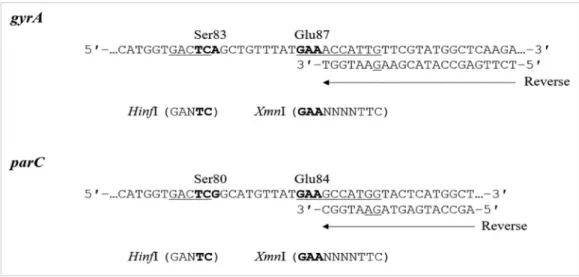
Based on the conserved sequences of A. baumannii gyrA and parC, we designed two sets of mismatched PCR-RFLP primers to detect mutations in gyrA (codons 83 and 87) and parC (co- dons 80 and 84) by introducing an artificial restriction enzyme cleavage site into the PCR products, as described previously [22]. The reverse primers for gyrA and parC are located imme- diately downstream of the nucleotide sequences, corresponding to GyrA87 and ParC84, with mismatched nucleotides to create recognition site (XmnI), respectively (Fig. 1). The primer sequen- ces and PCR conditions were expected to yield 143 and 120 bp DNA fragments for gyrA and parC, respectively. We performed PCR amplification of gyrA or parC from each strain using the AmpliTaq Gold 360 Master Mix (Applied Biosystems, Foster City, CA, USA), according to the manufacturer’s instructions and as described in Table 1. The gyrA and parC PCR products were di- gested with HinfI or XmnI at 37°C for one hour, and the digested products were analyzed by electrophoresis using 3.0% MetaPhor Agarose gels (Takara, Shiga, Japan).
RESULTS
Susceptibility testing and DNA sequencing of the gyrA and parC QRDRs
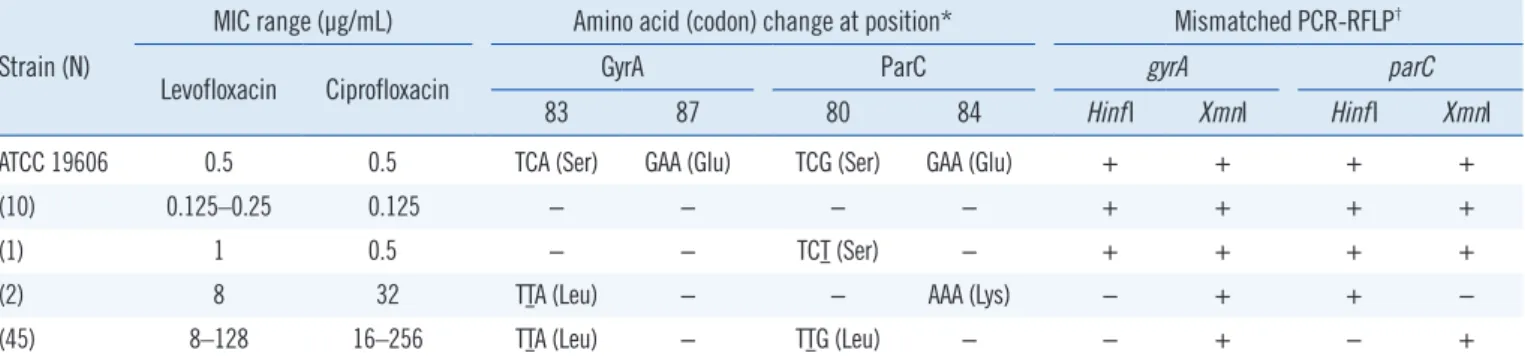
We analyzed 58 A. baumannii strains (47 FQ-resistant and 11 FQ-susceptible). Point mutations were present only in gyrA (co- don 83) and parC (codons 80 and 84). The strains with no mu- tations (N=11) resulting in amino acid changes at Ser-83 and Glu-87 in GyrA and at Ser-80 and Glu-84 in ParC were suscep- tible to levofloxacin and ciprofloxacin. The FQ-resistant strains (N =47) carried two mutations, in gyrA (codon 83) and parC (codon 80 or 84), and all but one strain had ciprofloxacin MICs
≥32 μg/mL (Table 2). Of these 47 FQ-resistant strains, 45 pos-
sessed gyrA codon 83 TCA (Ser)→TTA (Leu) and parC codon 80 TCG (Ser)→TTG (Leu) mutations, and the remaining two pos- sessed gyrA codon 83 TCA (Ser)→TTA (Leu) and parC codon 84 GAA (Glu)→AAA (Lys) mutations. CCCP did not appreciably af- fect the levofloxacin and ciprofloxacin MICs for the A. bauman- nii strains. The FQ-resistant strains were still classified as resis- tant based on the CLSI breakpoints for levofloxacin and cipro- floxacin, even in the presence of this efflux pump inhibitor. The mutations identified in gyrA and parC and the MICs of levofloxa- cin and ciprofloxacin are shown in Table 2.
Mismatched PCR-RFLP
We performed PCR-RFLP on 58 A. baumannii strains and A.
Table 1. Primer sequences and restriction enzymes for mismatched PCR-RFLP Target Primer Oligonucleotide sequence
(5´ to 3´)* PCR conditions Product size
(bp)
Restriction enzyme (Recognition site)†
QRDR amino acid (codon)‡ gyrA Forward GTGCTTTATGCCATGCACGAAT 95°C for five minutes and 35 cycles of 95°C for one
minute, 48°C for one minute, and 72°C for 30 secconds 143 HinfI (GANTC) Ser83 in GyrA (TCA)
Reverse TCTTGAGCCATACGAAGAATGGT XmnI (GAANNNNTTC) Glu87 in GyrA (GAA)
parC Forward GAGCTAGGCTTAAAAAGCAGTGG 95°C for five minutes and 35 cycles of 95°C for one minute, 48°C for one minute, and 72°C for 30 seconds
120 HinfI (GANTC) Ser80 in ParC (TCG)
Reverse AGCCATGAGTAGAATGGC XmnI (GAANNNNTTC) Glu84 in ParC (GAA)
*Boldface represents mismatched nucleotides that introduce artificial restriction sites. Underlined nucleotides indicate restriction sites; †Underlined nucleo- tides correspond to QRDRs in the gyrA or parC genes; ‡Underlined nucleotides indicate restriction sites.
Abbreviations: QRDR, quinolone resistance-determining region; RFLP, restriction fragment length polymorphism.
Fig. 1. Strategy used for mismatched PCR-RFLP of gyrA and parC QRDRs in A. baumannii. The reverse primers for gyrA and parC are lo- cated immediately downstream of the nucleotide sequences corresponding to GyrA87 and ParC84, respectively. The reverse primer for gyrA was designed with one mismatched nucleotide to create an XmnI recognition site (GAANNNNTTC) in the gyrA region containing the codon for Glu-87 (GAA). The reverse primer for parC was designed with two mismatched nucleotides to create an XmnI recognition site in the parC region containing the codon for Glu-84 (GAA). Boldface represents codons 83 and 87 of gyrA and codons 80 and 84 of parC. Un- derlined DNA sequences indicate restriction sites present in the QRDRs of FQ-susceptible strains.
Abbreviations: FQ, fluoroquinolone; QRDR, quinolone resistance-determining region; RFLP, restriction fragment length polymorphism.
baumannii strain ATCC 19606. Amplification products with the expected sizes of 143 bp for gyrA and 120 bp for parC were successfully obtained for all strains. The PCR products of gyrA from FQ-susceptible strains contained both one natural HinfI recognition site and one artificially created XmnI recognition site.
Similarly, the PCR products of parC from FQ-susceptible strains contained both one natural HinfI recognition site and one artifi- cially created XmnI recognition site (Fig. 1). Consequently, HinfI
and XmnI digested the amplified 143 bp fragment to generate two fragments of 103 and 40 bp and of 122 and 21 bp, respec- tively. The 21 bp fragment, which was produced by XmnI diges- tion, was not visible in Fig. 2; however, it was easy to recognize that the amplified 143 bp fragment was digested by XmnI. Simi- larly, HinfI and XmnI digested the amplified 120 bp fragment to generate two fragments of 85 and 35 bp and of 104 and 16 bp, respectively. The 16 bp fragment, produced by XmnI digestion, Table 2. Levofloxacin and ciprofloxacin MIC ranges, amino acid (codon) changes in GyrA and ParC QRDRs, and mismatched PCR-RFLP results for A. baumannii strains
Strain (N)
MIC range (μg/mL) Amino acid (codon) change at position* Mismatched PCR-RFLP†
Levofloxacin Ciprofloxacin GyrA ParC gyrA parC
83 87 80 84 HinfI XmnI HinfI XmnI
ATCC 19606 0.5 0.5 TCA (Ser) GAA (Glu) TCG (Ser) GAA (Glu) + + + +
(10) 0.125–0.25 0.125 − − − − + + + +
(1) 1 0.5 − − TCT (Ser) − + + + +
(2) 8 32 TTA (Leu) − − AAA (Lys) − + + −
(45) 8–128 16–256 TTA (Leu) − TTG (Leu) − − + − +
*Compared with ATCC 19606. Underlining indicates point mutations; −, no change.
†+ indicates PCR products that were digested by the restriction enzyme; − indicates PCR products that were not digested by the restriction enzyme.
Abbreviations: QRDR, quinolone resistance-determining region; RFLP, restriction fragment length polymorphism; MIC, minimum inhibitory concentration.
Fig. 2. PCR-RFLP patterns obtained following digestion with HinfI or XmnI for gyrA and parC. Lanes 1 to 3 and 4 to 6 show PCR-RFLP re- sults for gyrA and parC, respectively. Lane: M, 20 bp DNA ladder marker. (A) PCR-RFLP results for A. baumannii ATCC19606. Lanes: 1, undigested (143 bp); 2, HinfI-digestion (103 bp and 40 bp); 3, XmnI-digestion (122 bp and 21 bp); 4, undigested (120 bp); 5, HinfI-di- gestion (85 bp and 35 bp); and 6, XmnI-digestion (104 bp and 16 bp). (B) PCR-RFLP results for the representative FQ-resistant A. bau- mannii strain possessing mutations in gyrA (83) and parC (80). Lanes: 1, undigested (143 bp); 2, HinfI-digestion (143 bp); 3, XmnI-diges- tion (122 bp and 21 bp); 4, undigested (120 bp); 5, HinfI-digestion (120 bp); and 6, XmnI-digestion (104 bp and 16 bp).
Abbreviations: FQ, fluoroquinolone; RFLP, restriction fragment length polymorphism.
gyrA parC
M 1 2 3 4 5 6 M
143 bp
120 bp 104 bp 85 bp
35 bp
16 bp 122 bp
103 bp
40 bp 21 bp
gyrA parC
M 1 2 3 4 5 6
104 bp 120 bp
16 bp 143 bp
122 bp
21 bp
A B
was not visible in Fig. 2; however, it was easy to recognize that the amplified 120 bp fragment was digested by XmnI. HinfI and XmnI failed to digest the PCR products at the site containing the mutations that resulted in amino acid changes at Ser-83 in GyrA or at Ser-80 or Glu-84 in ParC.
Furthermore, we applied this assay to 37 non-A. baumannii strains. While gyrA amplicons were obtained for 28 strains, namely 10 A. nosocomialis, eight A. pittii, two A. calcoaceticus, two A.
ursingii, two A. gerneri, two A. johnsonii strains, one A. grimon- tii, and one A. tandoii, no parC amplicons were obtained in any of the 37 strains tested.
DISCUSSION
We developed a mismatched PCR-RFLP assay to detect muta- tions in gyrA (codons 83 and 87) and parC (codons 80 and 84), which are associated with FQ resistance in A. baumannii. This assay specifically detected significant mutations associated with reduced susceptibility to FQs in A. baumannii and accurately classified all the FQ-resistant and FQ-susceptible strains accord- ing to the MIC results.
The regions containing the mutation site resulting in amino acid change within the Ser-83 codon in GyrA or Ser 80 codon in ParC have a naturally occurring HinfI restriction site; thus, these regions are amplified by PCR, and the mutations at these posi- tions are detected when the PCR products are not digested with HinfI, as analyzed by electrophoresis on agarose gels [6, 7]. How- ever, the mutation sites within the Glu-87 codon in GyrA and the Glu-84 codon in ParC are not involved at any restriction cleav- age site. To detect mutations in gyrA (codon 87) and parC (co- don 84), we introduced base substitutions near the mutation sites to create XmnI cleavage sites using the primer-specified restriction site modification method [22]. Our results demon- strated that while HinfI and XmnI digested the gyrA and parC amplicons from FQ-susceptible strains, they did not digest those from FQ-resistant strains with mutations in gyrA and parC. The mutations detected by this assay were concordant with the DNA sequencing results shown in Table 2. The high specificity of the restriction enzyme XmnI to each set of the three nucleotides for codon 87 (Glu) of GyrA and codon 84 (Glu) of ParC in FQ-sus- ceptible strains allows our assay to accurately detect mutations at codon 87 in gyrA and at codon 84 in parC. Therefore, our as- say can identify significant mutations in gyrA and parC QRDRs linked to high-level FQ resistance in A. baumannii without the need for DNA sequencing; this assay may thus serve as an al- ternative to other PCR-RFLP assays that are limited by their abil-
ity to detect mutations at only codon 83 of gyrA or codon 80 of parC [6, 7].
Our assay accurately identified FQ-susceptible strains and FQ-resistant strains. When our assay did not detect mutations in gyrA (codons 83 and 87) and parC (codons 80 and 84), the MICs showed susceptibility to FQs. On the other hand, when our as- say detected mutations in both gyrA and parC, the MICs showed FQ resistance. In addition, our assay enables simultaneous anal- ysis of many strains and provides results within four hrs. Thus, it could aid in the rapid identification of FQ-resistant A. baumannii strains in the clinical setting.
Previous studies have reported several rapid assays for de- tecting gyrA and parC mutations associated with FQ resistance in A. baumannii and determining FQ resistance, including PCR followed by electrospray ionization mass spectrometry and pyro- sequencing assay [21, 23]. These assays successfully detected FQ resistance mutations in gyrA (codon 83) and parC (codons 80 and 84) and identified FQ-resistant strains. However, these assays require expensive equipment; our assay does not.
Another important and advantageous finding was that the mismatched PCR-RFLP primers for parC amplified parC from A.
baumannii strains, whereas these primers did not amplify parC from any non-baumannii Acinetobacter strains. This assay may therefore differentiate A. baumannii from other Acinetobacter species in bacterial colonies, and determine FQ resistance for A.
baumannii without the need for precise species identification within the genus Acinetobacter. This could also be an advan- tage of our assay. However, further studies are needed to con- firm this finding.
The limitation of our assay is that it is unable to detect muta- tions at other locations of gyrA and parC or in other genes. Nev- ertheless, our data suggest this assay specifically amplifies gyrA and parC from A. baumannii and allows for simple, specific, rapid, and inexpensive detection of significant FQ resistance mutations.
Thus, this assay may be useful for rapid assessment of FQ re- sistance in A. baumannii and for epidemiological studies of re- sistant strains in the clinical setting; moreover, it might be used to differentiate A. baumannii from other Acinetobacter species.
Author Contributions
The contributions of the authors are as follows: Research con- ception and design: Nakano R, Yano H. Data acquisition: Ka- kuta N, Nakano R, Nakano A, Suzuki Y, Tanouchi A, Masui T, Horiuchi S, Endo S, Kakuta R, Ono Y, Yano H. Data analysis and interpretation: Kakuta N, Nakano R, Nakano A, Suzuki Y, Tanou-
chi A, Masui T, Horiuchi S, Endo S, Kakuta R, Ono Y, Yano H.
Manuscript writing (original draft): Kakuta N, Nakano R. Manu- script writing (review and editing): Nakano R, Yano H. All au- thors have accepted their responsibility for the entire content of this manuscript and approved submission.
Conflict of Interest
None declared.
Research Funding
This work was supported by JSPS KAKENHI (grant No. 17K10027, 18K09935).
ORCID
Naoki Kakuta https://orcid.org/0000-0001-9508-577X Ryuichi Nakano https://orcid.org/0000-0003-2086-2591 Akiyo Nakano https://orcid.org/0000-0003-1379-384X Yuki Suzuki https://orcid.org/0000-0002-2509-8513 Ayako Tanouchi https://orcid.org/0000-0002-6096-7630 Takashi Masui https://orcid.org/0000-0002-9567-2947 Saori Horiuchi https://orcid.org/0000-0002-4143-5807 Shiro Endo https://orcid.org/0000-0003-0103-415X Risako Kakuta https://orcid.org/0000-0002-4594-908X Yasuo Ono https://orcid.org/0000-0002-5211-8102 Hisakazu Yano https://orcid.org/0000-0003-2085-7194
REFERENCES
1. Hooper DC. Clinical applications of quinolones. Biochim Biophys Acta 1998;1400:45-61.
2. Kim ES and Hooper DC. Clinical importance and epidemiology of qui- nolone resistance. Infect Chemother 2014;46:226-38.
3. Dalhoff A. Resistance surveillance studies: a multifaceted problem--the fluoroquinolone example. Infection 2012;40:239-62.
4. Gaynes R, Edwards JR, National Nosocomial Infections Surveillance System. Overview of nosocomial infections caused by gram-negative bacilli. Clin Infect Dis 2005;41:848-54.
5. Wisplinghoff H, Bischoff T, Tallent SM, Seifert H, Wenzel RP, Edmond MB. Nosocomial bloodstream infections in US hospitals: analysis of 24,179 cases from a prospective nationwide surveillance study. Clin In- fect Dis 2004;39:309-17.
6. Vila J, Ruiz J, Goñi P, Marcos A, Jimenez de Anta T. Mutation in the gyrA gene of quinolone-resistant clinical isolates of Acinetobacter bau- mannii. Antimicrob Agents Chemother 1995;39:1201-3.
7. Vila J, Ruiz J, Goñi P, Jimenez de Anta T. Quinolone-resistance muta- tions in the topoisomerase IV parC gene of Acinetobacter baumannii. J Antimicrob Chemother 1997;39:757-62.
8. Wisplinghoff H, Decker M, Haefs C, Krut O, Plum G, Seifert H. Muta- tions in gyrA and parC associated with resistance to fluoroquinolones in epidemiologically defined clinical strains of Acinetobacter baumannii. J Antimicrob Chemother 2003;51:177-80.
9. Coyne S, Courvalin P, Périchon B. Efflux-mediated antibiotic resistance in Acinetobacter spp. Antimicrob Agents Chemother 2011;55:947-53.
10. Correia S, Poeta P, Hébraud M, Capelo JL, Igrejas G. Mechanisms of quinolone action and resistance: where do we stand? J Med Microbiol 2017;66:551-9.
11. Valentine SC, Contreras D, Tan S, Real LJ, Chu S, Xu HH. Phenotypic and molecular characterization of Acinetobacter baumannii clinical iso- lates from nosocomial outbreaks in Los Angeles County, California. J Clin Microbiol 2008;46:2499-507.
12. Ruiz J. Mechanisms of resistance to quinolones: target alterations, de- creased accumulation and DNA gyrase protection. J Antimicrob Che- mother 2003;51:1109-17.
13. Hamouda A and Amyes SG. Novel gyrA and parC point mutations in two strains of Acinetobacter baumannii resistant to ciprofloxacin. J Anti- microb Chemother 2004;54:695-6.
14. Nakano R, Okamoto R, Nakano A, Nagano N, Abe M, Tansho-Nagaka- wa S, et al. Rapid assay for detecting gyrA and parC mutations associ- ated with fluoroquinolone resistance in Enterobacteriaceae. J Microbiol Methods 2013;94:213-6.
15. Endo S, Yano H, Hirakata Y, Arai K, Kanamori H, Ogawa M, et al. Mo- lecular epidemiology of carbapenem-non-susceptible Acinetobacter baumannii in Japan. J Antimicrob Chemother 2012;67:1623-26.
16. Mu X, Nakano R, Nakano A, Ubagai T, Kikuchi-Ueda T, Tansho-Nagaka- wa S, et al. Loop-mediated isothermal amplification: Rapid and sensitive detection of the antibiotic resistance gene ISAba1-blaOXA-51-like in Acinetobacter baumannii. J Microbiol Methods 2016;121:36-40.
17. La Scola B, Gundi VA, Khamis A, Raoult D. Sequencing of the rpoB gene and flanking spacers for molecular identification of Acinetobacter species. J Clin Microbiol 2006;44:827-32.
18. Ministry of Health, Labour and Welfare. Ethical Guidelines for Medical and Health Research Involving Human Subjects. https://www.lifescience.
mext.go.jp/bioethics/ekigaku.html
19. CLSI. Performance standards for antimicrobial susceptibility testing.
CLSI supplement M100-S22. 22nd ed. Wayne, PA: Clinical and Labora- tory Standards Institute, 2012.
20. Pournaras S, Markogiannakis A, Ikonomidis A, Kondyli L, Bethimouti K, Maniatis AN, et al. Outbreak of multiple clones of imipenem-resistant Acinetobacter baumannii isolates expressing OXA-58 carbapenemase in an intensive care unit. J Antimicrob Chemother 2006;57:557-61.
21. Hujer KM, Hujer AM, Endimiani A, Thomson JM, Adams MD, Goglin K, et al. Rapid determination of quinolone resistance in Acinetobacter spp.
J Clin Microbiol 2009;47:1436-42.
22. Haliassos A, Chomel JC, Tesson L, Baudis M, Kruh J, Kaplan JC, et al.
Modification of enzymatically amplified DNA for the detection of point mutations. Nucleic Acids Res 1989;17:3606.
23. Deccache Y, Irenge LM, Savov E, Ariciuc M, Macovei A, Trifonova A, et al. Development of a pyrosequencing assay for rapid assessment of quinolone resistance in Acinetobacter baumannii isolates. J Microbiol Methods 2011;86:115-8.