• 검색 결과가 없습니다.

Review of the Research & Development of

N/A
N/A
Protected

Academic year: 2021

Share "Review of the Research & Development of"

Copied!
10
0
0

로드 중.... (전체 텍스트 보기)

전체 글

(1)

Review of the Research & Development of “New Retailing”

Li-Yan Wu 1 , Jung-Soo Han 2 , Hyung-Ho Kim 3*

1

Professor, Faculty of Machinary, Jilin Engineering Normal University

2

Professor, Faculty of ICT, BaekSeok University

3

Professor, Dep. of Air Transport & Logistics, Sehan University

중국 “신소매(新零售)”에 관한 연구개발 동향 분석

무립염 1 , 한정수 2 , 김형호 3*

1

길림공정기술사범학원 기계공학부 교수,

2

백석대학교 ICT학부 교수,

3

세한대학교 항공교통물류학과 교수

Abstract The development of “New Retailing” is still in its infancy. Theoretical research has just begun, showing the characteristics of practice leading theoretical research, that is, there is more practical exploration but relatively insufficient theoretical research. At present, the theoretical research and practice development of “New Retailing” is gradually clear. The future development trend is large-scale, no boundaries, and wisdom. The academic community should further study in depth with theory and practice, focusing on the deep integration of online and offline, the new logistics under “New Retailing”, and the research direction of “New Retailing” driving supply chain transformation and reconstruction so as to better guide the development of “New Retailing”. The purpose of the research is to sort out the research status and theoretical situation of "new retailing", so as to provide references for further research on "new retail" and guidance for practical development.

Key Words : New Retailing, Theoretical Trend, New Logistics, No Boundaries. Baidu index

요 약 본 연구에서는 "신소매(新零售)"에 대한 연구의 참고자료와 실용적 개발을 위한 지침을 제공하기 위해 "신소매"

의 연구현황과 이론적 상황을 정리하였다. "신소매"의 발전은 아직 걸음마 단계에 있다. 이론 연구는 이제 막 시작되어, 보다 실용적인 탐구는 있지만 상대적으로 이론적 연구가 부족한 상황이다. 현재, "신소매"의 이론적 연구와 실천적 발 전이 점차 명확해지고 있다. 신소매의 급속한 발전은 신소매에 대한 이론적 연구가 강하게 요구되고 있다. “신소매”의 발전 추세는 대규모화, 경계가 없어지며, 지능화 되고 있다. 연구 결과 “신소매” 하에서의 온라인과 오프라인의 심층적 통합, 새로운 물류체계 및 공급망의 전환과 재편을 가속화 되는 것을 알 수 있었다. '신소매업'의 연구방향에 초점을 맞춰 이론과 실천을 더욱 깊이 연구할 필요가 있다.

주제어 : 신소매업, 이론적 트랜드, 신 물류, 무경계, 바이두지수

*This Paper was supported by the Sehan University Research Fund in 2019.

*Corresponding Author : Hyung-Ho Kim([email protected]) Received May 01, 2019

Accepted June 20, 2019

Revised June 4, 2019 Published June 28, 2019

1. Introduction

China’s economy is in a critical period of

transformation and upgrading of new and old

kinetic energy. The consumption-driven economic

development model is increasingly obvious, and

(2)

consumption has become the main driving force for China's economic growth. According to the statistics of the Ministry of Commerce, the contribution rate of final consumption expenditure to GDP growth in 2017 reached 58.8%, which played the main engine of economic growth for four consecutive years. At the same time, with the upgrading of consumption structure and model innovation, its potential will be further released. The fundamental role of consumption has placed high demands on the reform and innovation of the retail industry. In recent years, with the accelerated integration of online and offline development, the retail border has been continuously surpassed and broken, and the original retail concept has been unable to describe the new situation. In October 2016, Ma Yun, Chairman of the Board of Directors of Alibaba Group, put forward the concept of “New Retailing” at the Hangzhou•Yunqi Conference. He believed that the era of pure e-commerce has passed, and the next decade is the era of “New Retailing”. Since then, “New Retailing” has begun to receive widespread attention and quickly became the focus of industry development. 2017 was the first year of China’s “New Retailing”, and core companies such as Alibaba actively deployed “New Retailing”. At the same time, new retail species emerged in an endless stream, and Hema Fresh Seafood and Super Species became a phenomenon of great concern. In 2018, the core enterprises further launched the “New Retailing”

dominance battle. Joe Weyman, an expert in

“cloud economics” in the United States and known as “the godfather of New Retailing”, believes that many of China’s “New Retailing”

practices have become global highlights, and Chinese companies are expected to become the global leader of “New Retailing”[1]. Overall, “New Retailing” has become an irresistible trend in reshaping the retail industry.

However, it should be noted that although

“New Retailing” has become a phenomenon,

some industry amnesties and experts and scholars disagree or even object to this concept.

For example, Liu Qiangdong[2], chairman of the board of directors of JD Group believes that retail does not matter old and new, and the changes in retail formats cannot change the nature of cost, efficiency and experience; the well-known logistics expert Wang Jixiang[3]

believes that retail is only good or bad, there is no new and old, and the new retail format is more importantly defined by the connotation and essence; Zong Qinghou, Chairman of Wahaha Group, Dong Mingzhu, Chairman of Gree Electric Appliances, and Pan Yiqing, President of Five Star Electric, also raised objections to the concept of “New Retailing”. In addition, different retail reform leading companies also use different concepts to define the changes in the current retail format. For example, JD Group calls it “unbounded retail”, and Suning Cloud and Tencent Group calls it “smart retail”. Despite the differences between the title and the focus, they are a depiction of the current “subversive”

changes in the retail industry. Although the concept of “New Retailing” has been subject to dissent, its concept has been called, and the name as an external “phase” does not need to be true. “New Retailing” is not a new thing and old

“new thing”, but a description of the degree of

“subversive change” and “enhanced refactoring”

of the current retail format. It is a stage in the process of accelerating and concentrating the retail industry in the process of social information and digitization of Internet tools.

The concept of “New Retailing” has been proposed for nearly two years, and certain results have been achieved in both theoretical research and practical development. The purpose of this paper is to sort out the research status and theoretical situation of “New Retailing”, in order to provide reference for further research on

“New Retailing” and guide the development of

practice.

(3)

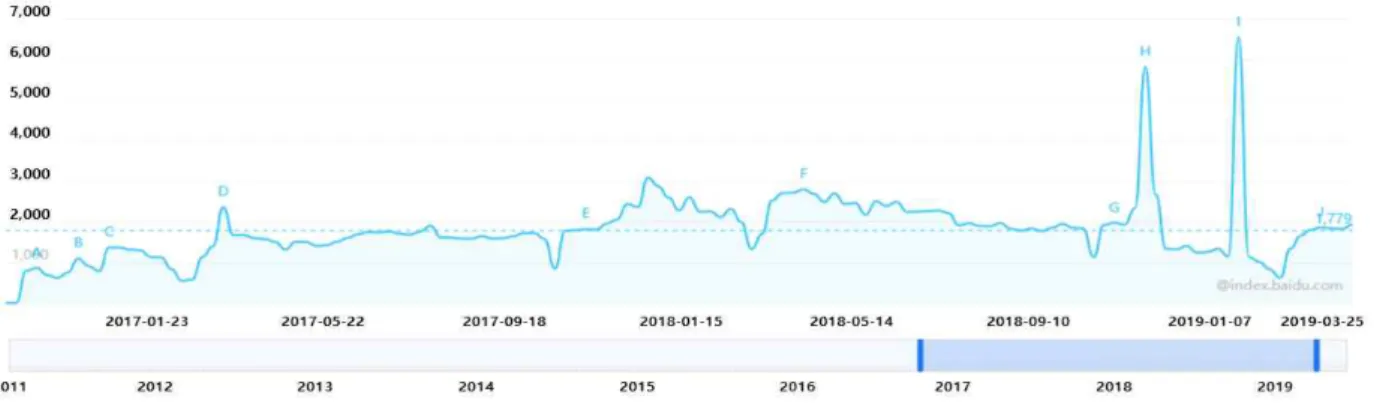
Fig. 1. Baidu search index

2. Previous Researches

“New Retailing” stems from practice and is closely related to social life. It is an important social hot issue related to the reform of retail industry. It has obvious practice and leads the theoretical research characteristics. The following is an analysis of the overall situation in combination with social concerns and related literature.

2.1 Analysis of Social Attention

There are many ways to analyze research trends. Recently, many published the research results of using social network analysis[4,5] and neural network[6] to analyze the research trends in specific fields.

Relying on the principle of big data, the Baidu index tool is used to analyze the social concerns of “New Retailing”. Use Baidu search engine to search with “New Retailing” as the key word, the search time is March 25, 2019. A total of 10.4 million webpage entries were obtained, of which 935,000 were information imparting knowledge and 788,000 were news, reflecting the higher level of concern for “New Retailing”. Furthermore, through the Baidu Index, the attention of the precise group to “New Retailing” is analyzed. The results are shown in Fig. 1. Fig. 1 depicts the dynamic trend of the search index from October 2016 to March 2019 in weekly averages. Overall,

the concept of “New Retailing” has received more attention since its introduction, and the search index has generally shown an upward trend. The average value of the search index from October 2016 to March 2019 was 1807. The average value of the index from October 2016 to December 2017 was 1512, and the average value of the index from January to June 2018 was 2227.

Before 2018, the overall trend showed an upward

trend, and then it showed a certain downward

trend. In 2019, it showed an upward trend. At the

two peaks of H (November 5th to 11th, 2018) and

I (January 07 to 13th, 2019), the index averages

are 5,814 and 6,549 respectively. The average of

the four low-value point indices of D.E.G.J is

547.847.1131.620, which basically corresponds to

the 2017 Chinese New Year holiday, the 2017

National Day holiday, the 2018 Spring Festival,

the 2018 National Day holiday, and the 2019

Spring Festival period. This also reflects the

leisure of long holidays. From the age

distribution of the search population, the age of

19, 20-29, 30-39, 40-49, and 50 accounted for

2%, 20%, 57%, 19%, and 2%, The results are

shown in Fig. 2 respectively. It can be seen that

people aged 30~39 are the key people concerned

about “New Retailing”, and people aged 20~29

and 40~49 are secondary people. According to

the search group portraits, the top ten ranked

provinces are Guangdong, Beijing, Zhejiang,

Shanghai, Jiangsu, Shandong, Henan, Sichuan,

(4)

Hubei, and Fujian. The top ten search cities are Beijing, Shanghai, Hangzhou, Guangzhou, Shenzhen, Chengdu, Wuhan, Zhengzhou, Nanjing and Changsha. From this point of view, the regions with higher searchability are also relatively high-level economic development and relatively good practice of “New Retailing”. In a certain way, it also shows that the research of

“New Retailing” should also be carried out in key areas. In terms of gender, men pay more attention than women, accounting for 66% and 34% respectively. From the overall situation of the demand map, the New Retailing concept and the New Retailing model are highly relevant. At the same time, Jack Ma and his New Retailing model diagrams are also highly relevant at the early stage.

Fig. 2. Baidu searches for portraits of crowds

2.2 Analysis of the overall status of the study

The concept of “New Retailing” originated in China, and theoretical research is still in its infancy, and the results are mainly concentrated in domestic literature.

Relying on China Knowledge Network (CNKI) literature search and measurement and visualization services, the research status is analyzed. The topic is searched accurately with the keyword “New Retailing”. See Table 1 for the results.

year The literature

(Full database)

The journal Core journals

2016 113 35 1

2017 1419 623 31

2018 1394 647 55

Total 2926 1305 87

Note: the scope of core journals includes SCI journals, EI journals, Peking University Chinese core journals, Chinese Citation index of social science journals (CSSCI), China science citation database (CSCD)

Table 1. Related literature statistics of “New Retailing

From the literature, “New Retailing” has received extensive attention, but in general, there are more publicity literatures and less academic journals. At the same time, most journal articles are relatively weak in theory, and there are only 87 core journal articles. Based on the core journals and the theoretical and relevant levels as the basic standards, after several rounds of screening, 41 representative documents were selected from the journal literature. The relevant parameters are shown in Table 2.

indicators Parameter

values indicators Parameter values

Document number 41 The total

number of cited 364

The total number of reference 250

The total number of downloads

78256

References per

article 6.1 Downloads per

article 1908.68

Citations per

article 8.44 Download cited

ratio 226.17:1

Note: the data was collected on September 30, 2018

Table 2. Statistics of representative literature parameters of "New Retailing"

“New Retailing” has been proposed for a short

period of time, and is in the process of constant

change and exploration, with obvious practical

characteristics and practice leading the

theoretical research characteristics. At present,

theoretical research lags behind the development

of practice, and there is a need for theoretical

guidance. In the process of theoretical research,

it is necessary to comprehensively refer to various

types of literature based on the advantages and

(5)

disadvantages of different literatures, so that theory and practice can be effectively combined.

3. Research Status Analysis

Through the collation and analysis of the existing literature, it is found that New Retailing, which is integrated online and offline, has become a new development in the current retail industry. This led to the attention of some experts and scholars to New Retailing, which led to a series of literature research results. His theoretical research mainly focuses on the basic theoretical aspects such as the interpretation of connotation features, the analysis of the causes of development, the development path and trend research. Understanding these issues will not only help to lay the theoretical foundation of the

“New Retailing” research but also help to clarify the dynamics and prospects of the “New Retailing” development.

3.1 Interpretation of the Connotation and Characteristics of “NewRetailing”

The concept of “New Retailing” has become a social hotspot once it has been proposed. The interpretation of its connotation features also presents a pattern of contending and blooming.

There is no consensus at present, but its core and essence are generally focused. In general, the interpretation of “New Retailing” includes consumer centers, data (technology) drivers, channel integration, efficiency goals and other elements or perspectives, and often combined in many aspects. This paper classifies and analyzes them according to their different focuses.

3.1.1 Emphasize full-channel scenario

After the concept of “New Retailing” was proposed, the Ali Institute fully explained “New Retailing” earlier, arguing that the essence of

retail is to always provide consumers with more than expected content. “New Retailing” is a data-driven pan-retail style centered on the consumer experience, with a focus on heart, retail duality, and retail species explosions[7];

Through the deep integration of data and business logic, “New Retailing” realizes the transformation from “goods-field-people” to

“people-goods-field”, and consumers reversely pull production changes, which will hatch new species and reshape the value chain. Fan Peng[8]

believes that “New Retailing” is a omni-channel scenario with user-centered, real-time “online”

features that provide consumers with an upgrade experience based on data empowerment; it has the four connotations of consumer empowerment, supply-side reform, upgrade experience and digital revolution, and has typical feminist characteristics. From the perspective of the “New Retailing” channel scene change, “New Retailing”

has the omni-channel and pan- retail features of online and offline. Therefore, the unbounded retail advocated by JD Group and the omni-channel retail mentioned by many scholars are all portraits of “New Retailing” from the channel perspective.

3.1.2 Emphasis on essential return and efficiency increase

Lei Jun, chairman of Millet Technology,

believes that “New Retailing” is the initial focus

and essence of returning to retail and technology

applications. Its essence is efficient, and it is

related to the efficiency revolution. Through online

and offline integration, the same efficiency is

achieved online. Liu Qiangdong stated in the

article “The Future of Retail: The Fourth Retail

Revolution” that the essence of retail is cost,

efficiency, and experience. Retail reform is the

upgrading of retail infrastructure, and the way of

value creation and acquisition that constantly

changes the nature of retail. He made a clear

definition of the nature of the retail revolution,

(6)

and also predicted the “New Retailing” metamorphosis characteristics. Yan Zhanghua and Liu Lei[9]

believe that “New Retailing” is to achieve comprehensive data through online and offline integration and enhance retail efficiency based on the perspective of consumer experience.

From a combination of perspectives, it can be seen that “New Retailing” is by no means a change in the nature of retail services. It is precisely the confirmation of the return of the retail industry to its service, the most important of which is efficiency.

3.1.3 Emphasis on multi-element collaboration and value chain refactoring

When Jack Ma proposed “New Retailing”, he believed that online and offline logistics must be combined to create a true “New Retailing”. Du Ruiyun and Jiang Kan[10] believe that “New Retailing” is an enterprise that relies on the Internet to upgrade and transform the production, circulation and sales of goods through the use of advanced technologies such as big data and artificial intelligence. In turn, it reshapes the business structure and ecosystem, and realizes a new retail model of online and offline integration with logistics. Lin Yingze, Ge Yu, and Bao Wenbin[11] summarized “New Retailing” as: the close integration of online and offline and logistics. Its core is the comprehensive opening of consumer-centric data. The goal is to provide omni-channel,full-category, full-time, full-experience services for the entire customer base to meet the full range of consumer needs. Zhang Yifu believes that “New Retailing” is a process of re-allocation of factor resources with consumers as the core, relying on resource integration and reconstruction to achieve an online and offline organic combination, which involves the restructuring of the industry chain and value chain. What “New Retailing” is affecting is not just a revolution in retail channels. On the one

hand, it requires upgrading the synergy between e-commerce and logistics advocated by the network retail era into deep integration of online and offline and logistics; on the one hand, it requires upgrading the synergy between e-commerce and logistics advocated by the network retail era into deep integration of online and offline and logistics; in general, almost all viewpoints emphasize the consumer-centered concept, reflecting that retail reform is not a change in the nature of services, it is precisely the strengthening and upgrading of the nature of services; data and technology drivers are an important feature of “New Retailing”, showing the typical characteristics of smart retail; “New Retailing” generally presents business innovation, diverse scenarios, channel fragmentation, and experience-oriented posture, reflecting the deep pursuit of the pursuit of efficiency and the integration of resources and the transformation of supply chain (value chain).

3.2 Reasons for the generation and development of“New Retailing”

The reasons for the “New Retailing” also include an important driving force for its development. To understand the development of New Retailing, we must combine the background of “New Retailing” development from both theoretical and realistic perspectives. To this end, the related research analyzes the reasons for the development of “New Retailing” from the perspectives of retail business change theory and practical problems.

3.2.1 Theoretical interpretation of the generation and development of “New Retailing”

The emergence and development of “New

Retailing” is the process of restructuring and

reforming the retail format. The change of retail

format has certain regularity, and the theoretical

cause of “New Retailing” is investigated based on

(7)

Fig. 3. Interpretation of the new retail theory the theory of retail business change. Representative theories of retail business changes include retail wheel theory, vacuum zone theory, new retailing wheel theory, retail life cycle theory, retail accordion theory, and environmental theory[12].

For different theories, there are also differences in premise assumptions, research perspectives, and focus points, so they are also applicable to different situations. “New Retailing” is different from any previous changes in the retail industry.

It is not the development of a single retail format, but a comprehensive retail format that is related to the reconstruction of retail resources, the reshaping of retail formats, and the reverse traction supply chain. It includes both addition and subtraction. From the point of view of addition, retail species such as Hema Fresh Seafood and Super Species have exploded, enriching existing retail formats; from the perspective of subtraction, the deep integration of online and offline with logistics and even manufacturing has blurred the boundaries of existing retail formats.

This has made the differences in the formats of supermarkets, department stores, convenience stores and other businesses gradually weakened, and the synergy effect of various retail formats has been achieved to the extreme. Overall, the New Retailing Wheel theory has a strong explanatory power for the emergence of “New

Retailing”. Some scholars have used this theory to explain the development of “New Retailing”, such as Liang Yingying[13].

New Retailing Wheel theory suggests that the driving force behind the changes in retail formats comes from technological innovation.

The basic theoretical framework is shown in Fig. 3.

Two key elements of retail are prices and services, and technology boundaries represent a combination of price and service levels in existing retail formats. The cut-off point (E0) between the technical boundary line and the equivalent curve means that the best combination is achieved from the dual perspective of retailers and consumers. Technological innovations such as logistics, information flow, and management will push the technology boundary line to the right (T0 to T1), leading to the emergence of new formats and optimizing the best combination of price and service (E1). Retail technology innovations can be roughly divided into innovations that influence consumer preferences and innovations that reduce circulation costs. From the perspective of the development of e-commerce network retail, it relies on Internet technology to promote two types of innovation: First, the short-chain distribution channels and store rental savings reduce the circulation costs; Second, the retail attributes that break through the limitations of time and space not only meet the diversified and personalized needs of consumers, but also enable the fragmentation time of consumers to be utilized, while also reducing transaction costs.

“New Retailing” is a collaborative optimization

and upgrade of physical retail and online retail,

and its production and development process is

also dependent on two types of innovation: First,

the deep integration of online and offline and

logistics, through technology-driven and big data

empowerment, it greatly enhances the overall

efficiency of the retail industry; Secondly, it

avoids the shortcomings of physical retail and

online retail, realizes the synergy between the

(8)

two, caters to the demands of consumption upgrade for service quality upgrade, and meets the multi-dimensional needs of consumers for shopping, entertainment and socializing

3.2.2 Analysis of realistic factors of "New Retailing"

The cause of “New Retailing” is the foundation to understand the development of “New Retailing”. Many scholars have paid attention to the realistic factors of the development of “New Retailing”. Xu Miao analyzed the causes of “New Retailing” based on internal and external perspectives and believed that the decline of traditional e-commerce dividends and the emergence of e-commerce service malpractices are the internal factors of “New Retailing”

development; and consumption upgrading and information technology innovation are the external causes of its development. Based on the macro development trend of online retail and the drive of “technology-consumption- competition”, Wang Baoyi[14] used a multi- dimensional perspective to interpret the causes of “New Retailing”. Ali Research Institute believes that the birth of “New Retailing” stems from the triple factors of technology-driven, consumption upgrade and industry growth; the Circulation Industry Promotion Center of the Ministry of Commerce believes that the “New Retailing” is a dual-liter drive, that is, the technology upgrade provides the engine, and the consumption upgrade enhances the traction. Based on many viewpoints, industry dilemma and development appeal are the premise of the development of

“New Retailing”. Technology-driven and consumer traction are the basic driving forces for its development. These three aspects explain the reasons for the development of “New Retailing” and also imply the driving force for development.

3.3 Discussion about the Development Path and Trend of “New Retailing”

3.3.1 Development path of “New Retailing”

Xu Miao[15] believes that online and offline integration upgrades, to achieve omni-channel retail. Focusing on customer experience, relying on relationship marketing and service innovation to meet the multi-dimensional needs of consumers, and the integration and reorganization of new technologies, new resources, new finance, etc. is the basic path for its development; Zhao Shumei and Xu Xiaohong[16] believe that the core of

“New Retailing” is the improvement of user experience. It includes online and offline collaboration with logistics, integration of goods and logistics, enhancement of experiential consumer services, realization of consumer scenarios, creation of a platform for effective docking of various entities, and creation of a omni-channel industrial ecosystem chain; Wang Xianqing[17]

believes that online and offline integration, retail + experiential consumption, retail + industrial ecological chain are the three major paths of

“New Retailing”. In general, online and offline logistics and collaborative development, experiential consumption to meet consumer multidimensional needs, supply chain reconstruction and resource re-allocation are the path or mode that most scholars affirm.

3.3.2 Development trend of “New Retailing”

Based on the “three new” perspective, Su Dongfeng[18] believes that “New Retailing” creates multi-functional, hedonic and social shopping value for consumers. This promotes the retail ecosystem to evolve to a higher level, to develop in an updated and more exotic direction, and to achieve the goal of integrating goods, services and experiences; Fan Peng believes that the ultimate form of “New Retailing” is “cloud retail”.

The supply chain and retail channels will all

realize cloud transformation. The supply chain

(9)

platform is the basic business model for small businesses (S2b); Yan Zhanghua and Liu Lei believe that the development of “New Retailing”

will promote the division of labor based on the parallel social framework, promote the datamation of production relations, and zero marginalization of transaction costs such as price comparison, selection and rights protection. According to the existing research and development, overall, “New Retailing” will show a trend of scale, no boundaries and intelligent development.

4. Conclusion

Generally speaking, the “New Retailing”

research is still at the stage of basic theoretical interpretation, and there are many practical explorations, and theoretical research is still relatively insufficient. According to the previous discussion of “New Retailing”, “New Retailing”

will ultimately drive supply chain transformation and restructuring. Combined with the development characteristics and trends of “New Retailing”, its research needs to further expand into several important aspects such as online and offline deep integration, new logistics, supply chain transformation and reconstruction.

“New Retailing” represents the current trend of subversive reform in the retail industry. From questioning to rapid development to social recognition, its theory and practice have achieved certain results, and the context has gradually become clear. But overall, the development of “New Retailing” is still in its infancy, theoretical research has just started, and the rapid development of practice has produced strong demands for theoretical research. The academic community should further expand the

“New Retailing” research in combination with theory and reality to support the development of

“New Retailing”

REFERENCES

[1] L. Wang. (2017). Chinese companies are expected to be new Global retail leader. China youth daily, 24(10).

http://zqb.cyol.com/html/2017-10/17/nw.D110000zgq nb_20171017_2-10.htm

[2] Q. D. Liu. (2017). The future of retail: the fourth retail revolution, Chinese entrepreneurs,24(14),77-84.

http://www.cnki.com.cn/Article/CJFDTotal-ZGQY2017 14023.htm

[3] J. X. Wang. (2017.07.26). What are the core drivers of the new retail revolution?. SOHU.

http://www.sohu.com/a/160040045_473276.

[4] J. Y. Lee & P. S. Jang. (2017). Study on Research Trends in Airline Industry using Keyword Network Analysis : Focused on the Journal Articles in Scopus.

Journal of the Korea Convergence Society, 8(5), 169-178.

DOI:10.15207/JKCS.2017.8.5.169

[5] S. C. Song, S. H. Park & G. T. Yeo. (2018). SNA Approach for Analyzing the Research Trend of China’s Logistics. Journal of Digital Convergence, 16(5), 55-63.

DOI:10.14400/JDC.2018.16.5.055

[6] G. D. Kim & Y. H. Kim. (2017). A Survey on Oil Spill and Weather Forecast Using Machine Learning Based on Neural Networks and Statistical Methods. Journal of the Korea Convergence Society, 8(10), 1-8.

DOI:10.15207/JKCS.2017.8.10.001

[7] E. H. Kim & M. C. Park. (2017). Understanding Omni-channel strategies : Intention to use mobile location-based retail apps at the store. Korea institute of business information 2017 spring academic conference related to business information integration,241-248.

https://www.earticle.net/Article/A303458.

[8] P. Fan. (2018). New retail: sound the horn of the fourth retail revolution. Beijing: citic industry press, electronic industry press,1-104.

ISBN:9787121328459

[9] Z. H. Yan & L. Liu. (2017). Ciuoncept, Research Framework and Trend of "New Retail". China business and market,31(10), 12-19.

DOI:10.14089/j.cnki.cn11-3664/f.2017.10.0020.22156/

JKCS.2018.7.1.001

[10] R. Y. Du & K. Jiang. (2017). New retail: connotation, development motivation and key issues. Price:Theory Practice,37(2),139-141.

http://www.cnki.com.cn/Article/CJFDTotal-JGLS20170 2038.htm

[11] Z. Y. Lin, Y. Ge & W. B. Bao. (2017). The “New Retail”

in the Light of the Strategic Cooperation between Alibaba Group and Bailian Group”. China business and market,31(3), 124-128.

DOI:10.14089/j.cnki.cn11-3664/f.2017.03.014

[12] J. R. Lee & M. J. Choi. (2018). Characteristics of Store

(10)

Changes in Retail Markets by Homogeneous and Heterogeneous Composition of Merchandise. Journal of the Korean Regional Development Association, 137-154.

https://www.earticle.net/Article/A332795

[13] Y. Y. Liang. (2017). Research on the Emergence and Development of "New Retailing" in China Based on the Theory of “the New Retailing Wheel”. Contemporary Economic Management,39(9), 6-11.

DOI:10.13253/j.cnki.ddjjgl.2017.09.002

[14] B. Y. Wang. (2017). Research on the Essence, Causes and Practice Trends of “New Retail”. China business and market,31(7),3-11.

DOI:10.14089/j.cnki.cn11-3664/f.2017.09.003.

[15] M. Xu. (2018). Research on the Motivation and Path of New Retail Business Development.. Journal of Southwest University of Science and Technology (Philosophy and Social Science Edition),35(2), 66-70.

http://kns.cnki.net/kns/brief/default_result.aspx

[16] S. M. Zhao. (2017). The Meaning,Pattern and Development Path of “New Retail”.China business and market,31(5), 12-20.

DOI:10.14089/j.cnki.cn11-3664/f.2017.05.002

[17] Q. X. Wang (2017). New retail: new changes and new opportunities in the retail industry. Beijing: China economic press,15-18.

ISBN:9787513647342

[18] D. F. Su. (2017). Meaning, Supporting Theory and Development Trend of “New Retail” from the Perspective of “Three-new”. China business and market,31(9),16-21.

DOI:10.14089/j.cnki.cn11-3664/f.2017.09.003.

무 립 염(Li-Yan Wu) [정회원]

․ 2000년 7월 : 창춘대학교 기계학과(공 학학사)

․ 2011년 7월 : 창춘이공대학교 기계학 과(공학 석사)

․ 2018년 5월 ~ 현재 : 세한대학교 경 영대학원 박사과정

․ 2000년 9월 ~ 현재 : 길림공정기술사 범학원 기계공학부 교수

․ 관심분야 : 마케팅, 기계, 산업디자인

․ E-Mail : [email protected]

한 정 수(Jung-Soo Han) [종신회원]

․ 1990년 2월 : 경희대학교 전자계산 공학과(공학사)

․ 1992년 2월 : 경희대학교 전자계산공 학과(공학석사)

․ 2000년 2월 : 경희대학교 전자계산공 학과(공학박사)

․ 1998년 3월 ~ 현재 : 백석대학교 ICT학부 교수

․ 관심분야 : UML, 3D 모델링, 지능형 웹

․ E-Mail : [email protected]

김 형 호(Hyung-Ho Kim) [정회원]

․ 1989년 2월 : 경희대학교 전자계산공 학과(공학사)

․ 1992년 8월 : 경희대학교 전자계산공 학과(공학석사)

․ 2018년 2월 : 인천대학교 동북아물류 대학원(물류학박사)

․ 1998년 3월 ∼ 현재 : 세한대학교 항 공교통물류학과 교수

․ 관심분야 : 신경회로망, 항공운송, System Dynamics

․ E-Mail : [email protected]

수치

Fig.  1.  Baidu  search  index
Table 2. Statistics of representative literature parameters of  "New  Retailing"
Fig.  3.  Interpretation  of  the  new  retail    theory  the  theory  of  retail  business  change

참조

관련 문서

Nonlinear Optics Lab...

To review the distinctive features and potential problems of Korean government plans this report analyzes the case of Power Development Plan and Housing Development Plan. In

Bublitz & Ettredge, “The Information in Discretionary Outlays: Advertising, Research and Development”, The Accounting Review, vol.. Cournot, Researches Into

¾ network traffic management according to the network information by means of data transmission between the network resource manager and the network nodes.. Traffic

웹 표준을 지원하는 플랫폼에서 큰 수정없이 실행 가능함 패키징을 통해 다양한 기기를 위한 앱을 작성할 수 있음 네이티브 앱과

_____ culture appears to be attractive (도시의) to the

이하선의 실질 속에서 하악경의 후내측에서 나와 하악지의 내측면을 따라 앞으로 간다. (귀밑샘 부위에서 갈라져 나와

Basic aspects of AUTOSAR architecture and methodology Safety mechanisms supported by AUTOSAR.. Technical safety concepts supported by AUTOSAR Relationship to ISO