Print ISSN: 2288-4637 / Online ISSN 2288-4645 doi:10.13106/jafeb.2021.vol8.no1.901
Factors Influencing Actual Usage of Mobile Shopping Applications:
Generation Y in Thailand
Konrawan RATTANABURI
1, Rawin VONGURAI
2Received: October 01, 2020 Revised: December 06, 2020 Accepted: December 14, 2020
Abstract
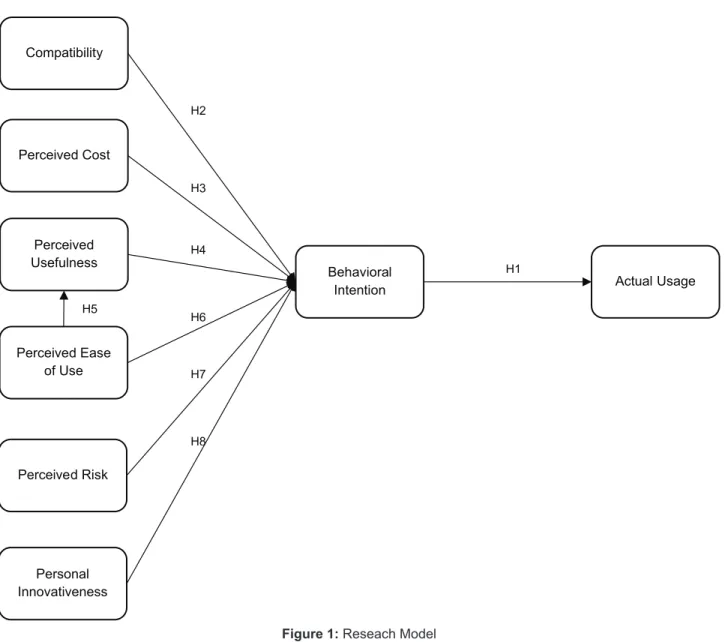
This study examines the factors that influence the actual usage of mobile shopping applications among Generation Y (Gen Y) users in Thailand, determined by behavioral intention, compatibility, perceived cost, perceived ease-of-use, perceived usefulness, perceived risk, and personal innovativeness. The researcher carried out the analysis based on a quantitative approach and used a non-probability sampling as the convenience sampling tool. A total of 502 Gen Y respondents who experienced using the top-four ranking mobile shopping applications in Thailand were invited to participate in the study. The Structural Equation Model (SEM) and Confirmatory Factor Analysis (CFA) were used to analyze the model fit, reliability, and validity of the variables. The primary result revealed that perceived usefulness has the strongest positive significant effect on behavioral intention, followed by personal innovativeness and compatibility. Conversely, the perceived cost has a significant negative influence on behavioral intention. Besides, perceived ease-of-use has a significant positive effect on perceived usefulness. The direct relationship between perceived usefulness and behavioral intention is, however, insignificant. Similarly, the result showed no effect of perceived risk towards behavioral intention. Finally, the result also revealed that behavioral intention determined the actual usage of mobile shopping applications of Gen Y users in Thailand.
Keywords: Actual Usage, Behavioral Intention, Influencing Factors, Mobile Shopping Applications, Generation Y JEL Classification Code: M10, M31, L81, O30
activities as surfing the internet, finding information, making transactions, among others. Therefore, the term m-commerce has become common among consumers to meet the demands of their everyday lives (Vasileiadis, 2014).
Chong (2013) defined mobile commerce (m-commerce) as the use of wireless handheld devices to conduct online transactions such as purchasing products or services, online banking, and bill payment. Although m-commerce covers various activities, they can be further classified among these three categories: mobile banking, mobile payment, and mobile shopping (Mali, 2019).
In Thailand, 93.39 million people use mobile phones, which account for 134 percent of the total population. This means that 90 percent of Thais are Internet users who access the Internet using mobile phones and spend almost five hours daily on their devices. Most of the activity that Thais do with their mobile devices is access to social networking sites, which account for 97 percent. This is followed by visiting online shopping applications that account for 58 percent (Kemp, 2020). With this in hand, the implementation of m-shopping is crucial as a form of marketing strategy as it provides customers with an alternative shopping channel
1
First Author and Corresponding Author. PhD Candidate, Innovative Technology Management, Graduate School of Business, Assumption University, Bangkok, Thailand [Postal Address: 592/3 Soi Ramkhamhaeng 24, Khwaeng Hua Mak, Khet Bang Kapi, Bangkok, 10240, Thailand] Email: [email protected]
2
Program Director, Innovative Technology Management, Graduate School of Business, Assumption University, Bangkok, Thailand.
Email: [email protected]
© Copyright: The Author(s)
This is an Open Access article distributed under the terms of the Creative Commons Attribution Non-Commercial License (https://creativecommons.org/licenses/by-nc/4.0/) which permits unrestricted non-commercial use, distribution, and reproduction in any medium, provided the original work is properly cited.