Print ISSN: 2288-4637 / Online ISSN 2288-4645 doi:10.13106/jafeb.2021.vol8.no10.0327
Bank Restructuring and Financial Performance:
A Case Study of Commercial Banks in Vietnam
Tam Thanh Nguyen DUONG
1, Hoa Quynh NGUYEN
2Received: June 30, 2021 Revised: September 09, 2021 Accepted: September 17, 2021
Abstract
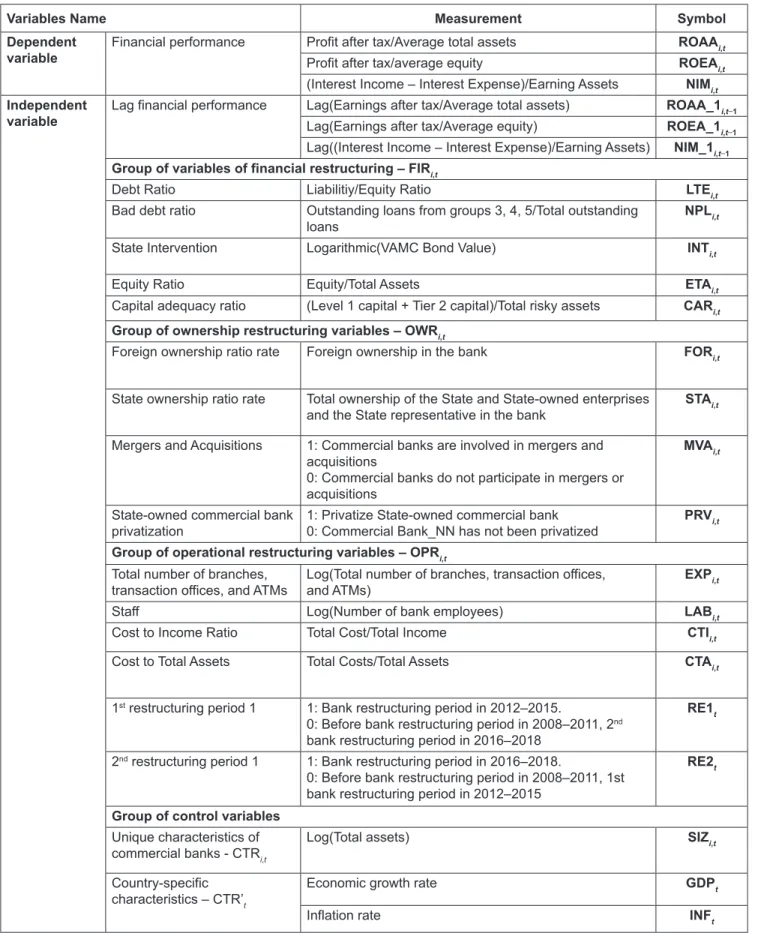
This study examines the impact of bank restructuring on the financial performance of commercial banks in Vietnam. The data for this study was obtained from the audited financial statements of 30 Vietnamese commercial banks from 2007 to 2019. Multiple regression analysis was used for investigation. Financial performance, as evaluated by ROAA, ROEA, and NIM, is the dependent variable. Financial restructuring, ownership restructuring, and operational restructuring are the independent variables. Pooled least squares (Pooled OLS), fixed effects model (FEM), random effects model (REM), and system generalized moment regression model (System GMM) are the estimate methods used to increase the accuracy of the regression coefficient. The research results show that the variables of financial restructuring activities such as government intervention and the ratio of equity to total assets; variables of ownership restructuring such as capital adequacy ratio, privatization of state-owned commercial banks, mergers, and acquisitions; variables of operational restructuring such as employees, branches, the cost to total assets; GDP variables and the second restructuring period have a positive impact on financial performance. Variables such as debt-to-capital ratio, bad debt ratio, state ownership ratio, expense-income ratio, and inflation have a negative effect on financial performance.
Keywords: Ownership Restructuring, Bank Restructuring, Financial Performance, Commercial Banks, Vietnam JEL Classification Code: L25, P47, G34, G32
high of 8.48 percent. However, in the aftermath of the global financial crisis that began in the United States in 2008 and expanded to many other countries, Vietnam’s macroeconomic position faced several challenges. In 2008 and 2009, the pace of economic growth was consistently lower. The economy showed indications of revival in 2010, but since 2011, growth has slowed again.
Along with the economy’s current issues, the Vietnamese banking system’s shortcomings and constraints, which have built up through time, imperil the commercial banking system›s operations and harm the banking system›s macro economy. In response to the economy’s and banking system’s limitations, as well as the demands of the current growth phase, the Vietnamese government has restructured the commercial banking system in two phases. Phase 1 was implemented in accordance with Decision No. 254/QD- TTg dated March 1, 2012, and phase 2 was implemented in accordance with Decision No. 1058/QD-TTg dated July 19, 2017, to improve the bank’s financial position and operational capacity.
The following goals were pursued in this research:
to investigate the impact of the general restructuring
1
First Author and Corresponding Author. Lecturer, Faculty of Accounting and Auditing, Banking University of Ho Chi Minh City, Ho Chi Minh City, Vietnam [Postal Address: 36 Ton That Dam Street, 1 District, Ho Chi Minh City, 700000, Vietnam]
Email: [email protected]
2
Lecturer, Banking University of Ho Chi Minh City, Ho Chi Minh City, Vietnam. Email: [email protected]
© Copyright: The Author(s)
This is an Open Access article distributed under the terms of the Creative Commons Attribution Non-Commercial License (https://creativecommons.org/licenses/by-nc/4.0/) which permits unrestricted non-commercial use, distribution, and reproduction in any medium, provided the original work is properly cited.