Unmodifiable Clinicopathological Risk Factors of Shoulder Tip or Subcostal Pain after Laparoscopic Appendectomy
Bomi Kim, M.D., Jungbin Kim, M.D., Inseok Park, M.D., Hyunjin Cho, M.D., Geumhee Gwak, Ph.D., Keun Ho Yang, Ph.D., Byung-Noe Bae, Ph.D., Kihwan Kim, Ph.D.
Department of General Surgery, Sanggye Paik Hospital, Inje University College of Medicine, Seoul, Korea
Purpose:
Appendectomy, which comprises most benign intra-abdominal surgeries, is currently assisted by laparoscopy in most cases. However, many patients complain of postoperative shoulder or subcostal pain after laparoscopic surgery. In some cases, the pain lasts even several weeks after surgery. This study aimed to analyze unmodifiable clinicopathological factors of patients who underwent laparoscopic appendectomy and to minimize preoperative and postoperative discomfort.Methods:
Patients admitted for laparoscopic appendectomy for acute appendicitis with an American Society of Anesthesiology (ASA) grades I and II, and ages 12~70 years were enrolled in the study.Postoperative shoulder or subcostal pain was assessed using the visual analogue scale (VAS) for pain and analyzed with the clinicopathological factors of the patients, including age, sex, weight, height, body mass index (BMI), and abdominal circumference (AC) difference.
Results:
Of the 124 patients, 40 complained of postoperative shoulder or subcostal pain with a VAS score of ≥4. The risk of the postoperative shoulder or subcostal pain increased in women (p=0.001).From a univariate analysis, the risk of postoperative shoulder or subcostal pain increased with lower height, weight and BMI (p=0.002, p=0.001, p=0.012) and with greater AC difference (p=0.012).
However, a multivariate analysis showed that lower weight was the only risk factor of postoperative pain (p=0.005).
Conclusion:
The risk of postoperative shoulder or subcostal pain after laparoscopic appendectomy was significantly increased with lower weight.Keywords:
Appendectomy, Laparoscopic, Pneumoperitoneum, Shoulder painReceived September 18, 2019 Revised 1st October 21, 2019
2nd November 5, 2019 3rd November 13, 2019 4th November 13, 2019 Accepted November 14, 2019
Corresponding author Inseok Park
Department of General Surgery, Inje University Sanggye Paik Hospital, 1342 Dongil-ro, Nowon-gu, Seoul 01757, Korea
Tel: +82-2-950-1017 Fax: +82-2-950-1429 E-mail: [email protected] ORCID:
https://orcid.org/0000-0002-6415-9307
This is an Open Access article distributed under the terms of the Creative Commons Attribution Non-Commercial License (http://
creativecommons.org/licenses/by-nc/4.0/) which permits unrestricted non-commercial use, distribution, and reproduction in any medium, provided the original work is properly cited.
Copyright © 2020 The Journal of Minimally Invasive Surgery. All rights reserved.
Journal of Minimally Invasive Surgery
J Minim Invasive Surg 2020;23(1):43-48
INTRODUCTION
Appendectomy is one of the most frequently performed sur- gical procedure.
1Although the open method was considered the treatment of choice for acute appendicitis, laparoscopic appendectomy has gained much popularity since Semm
2in- troduced the procedure and is widely performed nowadays.
3,4Compared with open appendectomy, several meta-analyses
have confirmed that laparoscopic appendectomy has its effi- ciency and superiority in terms of less postoperative pain and faster return to daily activities with fewer wound complica- tions.
5-7During the laparoscopic procedure, a pneumoperitoneum at
12 mmHg was induced with a short duration followed by car-
bon dioxide gas automatically regulated by a high-flow insuf-
flator. Many patients complain of post-laparoscopic shoulder
or subcostal pain. In some cases, the pain has been reported to last as long as 7 days or even 5 weeks after surgery.
8-10Its mechanism is commonly assumed to be overstretching of the diaphragmatic muscle fibers due to the pressure of a pneumo- peritoneum or increasing intra-abdominal pressure by CO
2, which causes diaphragmatic irritation.
11,12However, under the same surgical settings, the frequency and intensity of the post- operative shoulder or subcostal pain are considered to differ among patients according to their innate clinicopathological factors. This study aimed to analyze the clinicopathological factors of patients who underwent laparoscopic appendectomy and suggest measures for minimizing preoperative and post- operative discomfort.
MATERIALS AND METHODS
The study protocol was approved by the Inje University Sanggye Paik Hospital Institutional Review Board (IRB; SGP IRB NO.2015-07-007), and informed consent was obtained from all the patients before participation. From October 2015 to September 2016, all consecutive patients who underwent emergency or elective laparoscopic appendectomy were re- cruited for this prospective study. The primary end point of our study was the relationship between postoperative pain and the clinicopathological characteristics of patients. A sample size of 124 patients was estimated to obtain a power of 90%
with α of 0.05, β of 0.10 (correlation coefficient, 0.3), and drop- out rate of 10%.
The inclusion criteria were as follows: (1) patients with ASA grade 1 or 2, and (2) patients aged between 12 and 70 years.
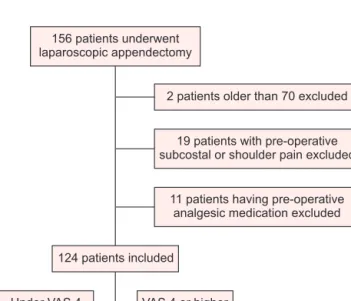
The exclusion criteria ruled out the patients who were un- able to provide informed consent, and those with a previous abdominal surgery, medication history of analgesics including NSAIDs, previous shoulder or subcostal pain before surgery, and pregnancy. Patients who required conversion to laparoto- my and who had operative findings of appendiceal perforation with peritonitis or abscess that required drainage postopera- tively were excluded from the analysis (Fig. 1).
Patients were asked preoperatively about the presence of shoulder or subcostal pain and again on postoperative days 1 and 2. If they had pain, they were asked to quantify it on a visual analogue scale (VAS) between 0 and 10 using a question- naire. Pain management was deemed necessary with a mini- mum score of 4. Patients were divided into two groups, one with a VAS score of ≤4 and one with a VAS score of ≥4. All patients who had postoperative pain were administered intra- venous ketorolac tromethamine (Ketolan
®30 mg) or tramadol hydrochloride (Tridol
®50 mg) every 8 hours from the operation date to postoperative day 2.
In all the patients, 12 mmHg of CO
2was insufflated dur-
ing surgery. The patients ’ clinicopathological characteristics included age, sex, body weight, height, pneumoperitoneum on abdominal radiography, and abdominal circumference (AC) difference before and after the surgery. The end-tidal CO
2(ETCO
2) level was recorded according to end-expiratory PaCO
2level on mechanical ventilation monitoring. Vital sign, blood test results, including hemoglobin, white blood cell count, and C-reactive protein level were recorded preopera- tively and postoperatively for all the patients. Postoperative pain and associated problems such as nausea and vomiting were also recorded.
The categorical variables included sex, ASA grade, and postoperative pneumoperitoneum on plain radiography. The relationship between these variables and postoperative sub- costal or shoulder pain was analyzed using the Pearson χ
2test.
Numerical data including age, height, weight, BMI, AC dif- ference, operation time, and ETCO
2, and were analyzed using analysis of variance with multivariate logistic regression anal- ysis. Statistical significance was defined as a p value of <0.05.
RESULTS
Of the 124 patients who participated in this study, 61 were male and 63 were female, with a sex ratio of 1:1.03. The age range was 12~64 years, with a median of 35 years. The height ranged from 143 to 186 cm, with a median of 164 cm. The weight ranged from 35 to 120.4 kg, with a median of 64 kg.
The median BMI was 23.4 kg/m
2(range, 15.4~38.4 kg/m
2).
Changes in abdominal circumference after the surgery ranged from –1 to 3 cm, with a median of 1 cm. The surgery dura- tion ranged from 12 to 130 minutes, with a median value of
2 patients older than 70 excluded 156 patients underwent
laparoscopic appendectomy
11 patients having pre-operative analgesic medication excluded
19 patients with pre-operative subcostal or shoulder pain excluded
124 patients inc udedl
VAS 4 or higher (n=40) Under VAS 4
(n=84)
Fig. 1. Flowchart on patient selection. VAS = Visual analogue scale.
50 minutes. Postoperative abdominal radiography revealed to have no pneumoperitoneum in 92 patients (74%). ETCO
2ranged from 25 to 45 mmHg with a median value of 33 mmHg. Forty patients complained of pain with a VAS score of ≥4 at some point postoperatively (32.3%; Table 1): Of the 124 patients, 87 (70.2%) had postoperative pain with a VAS score of <4 on day 1; of these 87 patients, 3 (3.4%) complained of postoperative shoulder or subcostal pain with a VAS score of ≥4 on day 2. Thirty-seven patients (29.8%) had postopera- tive pain with a VAS score of ≥4 on day 1; of these, 20 (54.1%) had pain with a VAS score of <4 and 17 out of 37 (45.9%) still complained of pain with a VAS score of ≥4 on day 2.
Patients were controlled by routine IV analgesic medica- tions, with ketorolac tromethamine (Ketolan
®30 mg) being administered every 8 hours. For 40 patients who complained of postoperative shoulder or subcostal pain with a VAS score of ≥4, tramadol hydrochloride (Tridol
®50 mg) was injected intravenously as needed. All participants were discharged from the hospital after 2 nights and 3 days.
According to the study results, the risk of postopera- tive shoulder or subcostal pain is higher among women than among men ( p=0.001; Table 2). Patients who did not show pneumoperitoneum on postoperative abdominal radiography
Table 1. Clinicopathologic characteristics and demographics of patients Characteristic
Sex: n (%)
Male 61 (49.2)
Female 63 (50.8)
Age: years (range) 35 (12~76)
ASA grade: n (%)
I 97 (78.2)
II 27 (21.8)
Height: cm (range) 164 (143~186)
Weight: cm (range) 63 (35~120.4)
BMI: m
2/kg (range) 23.4 (15.4~38.4) AC difference: cm (range) 1 (–1.0~3.0) Duration of operation: minutes (range) 50 (12~130) Pneumoperitoneum on X-ray: n (%)
(+) 92 (74.2)
(–) 32 (25.8)
ETCO
2: mmHg (range) 33 (25~45)
VAS: n (%)
Under VAS 4 84 (67.7)
VAS 4 or higher 40 (32.3)
Values are presented as the median range or number (%). ASA = Ameri- can Society of Anesthesiology; AC = Abdominal circumference; BMI = Body mass index; ETCO
2= End-Tidal CO
2; VAS = Visual analogue scale.
Table 2. Comparison between categorical factors and post-operative pain
Characteristics Under VAS 4 (n=84)
VAS 4 or higher
(n=40)
p value OR
Sex 0.001 0.258
Male 50 (82.0) 11 (18.0) Female 34 (54.0) 29 (46.0)
ASA grade 0.028 0.295
I 61 (62.9) 36 (37.1)
II 23 (85.2) 4 (14.8)
Pneumoperitoneum 0.003 5.830
(–) 55 (59.8) 37 (40.2)
(+) 29 (90.6) 3 (9.4)
Values are presented as the number (%). ASA = American Society of Anesthesiology; VAS = Visual analogue scale.
Table 3. Comparison between numerical variables and post-operative pain by univariate analysis
Characteristics Correlation
coefficient p value 95% CI
Age –0.1005 0.2670 –0.2720~0.07723
Height –0.2711 0.002 –0.4270~–0.09958
Weight –0.2949 0.001 –0.4479~–0.1251
BMI –0.2257 0.012 –0.3866~–0.05138
AC difference 0.1883 0.011 0.01238~0.3529 Duration of operation –0.01975 0.8277 –0.1954~0.1571 AC = Abdominal circumference; BMI = Body mass index.
Table 4. Comparison between numerical variables and post-operative pain by multivariate analysis
Characteristics OR 95% CI p value
Height 1.019 0.778~1.333 0.893
Weight 0.954 0.923~0.986 0.005
BMI 1.151 0.439~3.013 0.775
AC difference 1.540 0.979~2.429 0.064
AC = Abdominal circumference; BMI = Body mass index.
were more likely to have postoperative pain ( p=0.003; Table 2). A univariate analysis showed that the risk of postoperative shoulder or subcostal pain increased with lower height, weight and BMI ( p=0.002, p=0.001, p=0.012, respectively) and greater AC difference ( p=0.011; Table 3). However, a multivariate analysis showed that lower weight was the only risk factor of postoperative pain ( p=0.005; Table 4).
DISCUSSION
Compared with open surgeries, laparoscopic appendecto- mies have relatively faster recovery, shorter admission dura- tion, and faster return to daily activities.
4-6However, patients who have received laparoscopic appendectomies have com- plained of postoperative shoulder and subcostal pain. These pains occur 1 or 2 days after the procedure and last between 7 days to 5 weeks. In some cases, the shoulder or subcostal pain was reported to be greater in intensity than the incisional pain.
13According to Boonstra,
14VAS scores of 3.5~6.4 implied moderate pain with moderate interference with functioning.
We defined a VAS score of 4 as the minimum pain that was necessary for pain management. In general, postoperative shoulder or subcostal pain is minimal, especially in laparo- scopic appendectomy. However, in this study, 32.3% of patients complained of postoperative pain with a VAS score of ≥4. We excluded patients who had operative findings of perforated appendix or abscess, but patients were not otherwise divided according to the type of appendicitis as the final pathology (acute appendicitis with suppurative or gangrenous change) were not reported until approximately 7 days after the surgery.
Several studies have investigated the pathophysiology of the postoperative shoulder and subcostal pains after laparoscopic surgeries. The most accepted explanation states that insuf- flation of the abdominal cavity with carbon dioxide causes excessive stretching of the muscle fibers of the diaphragm, which causes stretch injury on the diaphragmatic nerves and leads to referred pain on the shoulder.
4,8,15A study by Shin in 2010 reported that respiratory volume, that is, the tidal volume for each respiration, increases with insufflation. Increased stretching of the abdominal cavity leads to increased stretch- ing of the diaphragm, where the phrenic nerve is compressed, and the shoulder pain is exacerbated.
16One study reports that the abdominal wall curvature expands in the sagittal plane rather than in the transverse plane during laparoscopic appen- dectomy. This characteristic causes a significant diaphragmat- ic overstretching during insufflation.
17In this study, as direct measurement of the sagittal plane of the abdomen is impos- sible, the transverse plane was measured to indirectly measure changes in abdominal circumference after the surgery. We predicted that as the magnitude of abdominal cavity stretching
increased, the postoperative abdominal circumference would increase.
18,19When the postoperative abdominal circumference was greater than the pre-operative circumference, the inci- dence rates of postoperative shoulder and subcostal pains were increased. This observation corroborates the fact that the pain is caused by diaphragmatic nerve damage secondary to exces- sive stretching (Table 3).
Relative muscle mass (%) is widely known to decrease with age in the 30s.
20,21Initially, postoperative pain intensity was predicted to increase with increasing age because the decreased muscle mass predisposes the abdominal wall to overstretching. However, this theory was found statistically insignificant in this study (Table 2). Hence, we can infer that other clinicopathological factors, such as height, weight, and BMI play a role in determining the intensity of postoperative shoulder or subcostal pain.
Men are known to have more lean mass than women, and women are known to have more fat mass than men. Men are known to have accumulation of adipose tissue in the trunk and abdomen, while women have accumulation of adipose tis- sue in the hip and thigh.
20,22This study showed that the me- dian body weights of the men and women were 74 and 55 kg, respectively. The incidence of abdominal overstretching was relatively lower in the men than in the women, and the mean was predicted to have less-intense postoperative pain. There- fore, significant correlation between sex and pain intensity was observed in this study (Table 2).
When the patients were insufflated with identical CO
2pres- sure, higher incidence rates of postoperative shoulder and sub- costal pains were observed in the patients with lower height, weight, or BMI. Abdominal stretching can be predicted to be higher in patients with lower BMI than in patients with higher BMI when insufflated with identical CO
2pressure.
Another theory states that the postoperative shoulder and subcostal pains are caused by the chemical irritation on the diaphragm due to the insufflation agent, CO
2.
23Another study that investigated the correlation between residual CO
2gas volume and postoperative shoulder pain reported that patients who received gas drainage showed a significant decrease in pain intensity.
24In this study, the amount of residual CO
2gas volume was not measured because the patients did not have a drainage. The presence of pneumoperitoneum in patients was determined using abdominal radiography on postopera- tive day 1, and patients who did not show pneumoperitoneum were more likely to have postoperative pain ( p=0.003; Table 2).
However, as the exact amount of pneumoperitoneum was not
measured, quantification of insufflation through postopera-
tive radiography would be necessary to explain the correlation
between residual CO
2gas volume and postoperative shoulder
or subcostal pain. In addition, the amount of CO
2gas insuf-
flation, insufflation rate, size of the postoperative pneumo- peritoneum, residual gas, and the operator’s surgical technique should be further controlled for better results.
Correlation between the surgery duration and postopera- tive shoulder/subcostal pain was investigated. Although longer surgery duration was predicted to increase the incidence of postoperative shoulder/subcostal pain because it increases the time of overstretching of the abdominal cavity and exposure to CO
2gas irritation, no significant correlation was confirmed (Table 3). The median durations of the laparoscopic appendec- tomy were 50 and 45 minutes in the two groups, respectively, which are insufficient to trigger postoperative pain.
25This study investigated the correlation between postop- erative shoulder or subcostal pain and unmodifiable factors such as height, weight, and BMI. On the basis of the results of the patient’s physical characteristics shown in this study, whether the patient will experience postoperative pain could be predicted. In the future, the insufflation pressure could be adjusted on the basis of the patient ’s clinicopathological char- acteristics; thereby, the incidence of postoperative shoulder or subcostal pain will be reduced.
CONCLUSION
The risk of postoperative shoulder or subcostal pain after laparoscopic appendectomy was significantly increased with lower weight.
ORCID
Bomi Kim, https://orcid.org/0000-0002-0672-585X Jungbin Kim, https://orcid.org/0000-0001-5839-619X Inseok Park, https://orcid.org/0000-0002-6415-9307 Hyunjin Cho, https://orcid.org/0000-0001-9158-3288 Geumhee Gwak, https://orcid.org/0000-0002-7910-1052 Keun Ho Yang, https://orcid.org/0000-0003-1039-4093 Byung-Noe Bae, https://orcid.org/0000-0002-5542-5626 Kihwan Kim, https://orcid.org/0000-0002-2882-4816
AUTHORS’ CONTRIBUTIONS
Conceptualization: Inseok Park, Bomi Kim. Formal analy- sis: Inseok Park. Methodology: Jungbin Kim, Hyunjin Cho.
Writing-original draft: Bomi Kim, Inseok Park, Keun Ho Yang. Writing-review and editing: Geumhee Gwak, Byung- Noe Bae, Kihwan Kim.
CONFLICT OF INTEREST
None.
FUNDING
None.
ACKNOWLEDGMENTS
None.
REFERENCES
1) Dai L, Shuai J. Laparoscopic versus open appendectomy in adults and children: A meta-analysis of randomized controlled trials.
United European Gastroenterol J 2017;5:542-553.
2) Semm K. Endoscopic appendectomy. Endoscopy 1983;15:59-64.
3) Guller U, Hervey S, Purves H, et al. Laparoscopic versus open ap- pendectomy: outcomes comparison based on a large administra- tive database. Ann Surg 2004;239:43-52.
4) Tzovaras G, Baloyiannis I, Kouritas V, et al. Laparoscopic versus open appendectomy in men: a prospective randomized trial. Surg Endosc 2010;24:2987-2992.
5) Ignacio RC, Burke R, Spencer D, Bissell C, Dorsainvil C, Lucha PA. Laparoscopic versus open appendectomy: what is the real difference? Results of a prospective randomized double-blinded trial. Surg Endosc 2004;18:334-337.
6) Chung RS, Rowland DY, Li P, Diaz J. A meta-analysis of ran- domized controlled trials of laparoscopic versus conventional ap- pendectomy. Am J Surg 1999;177:250-256.
7) Garbutt JM, Soper NJ, Shannon WD, Botero A, Littenberg B. Me- ta-analysis of randomized controlled trials comparing laparoscopic and open appendectomy. Surg Laparosc Endosc 1999;9:17-26.
8) Shin HY, Kim SH, Lee YJ, Kim DK. The effect of mechanical ventilation tidal volume during pneumoperitoneum on shoulder pain after a laparoscopic appendectomy. Surg Endosc 2010;24:
2002-2007.
9) Alexander JI, Hull MG. Abdominal pain after laparoscopy: the value of a gas drain. Br J Obstet Gynaecol 1987;94:267-269.
10) Chamberlain G. The recovery of gases insufflated at laparoscopy.
Br J Obstet Gynaecol 1984;91:367-370.
11) Mouton WG, Bessell JR, Otten KT, Maddern GJ. Pain after lapa- roscopy. Surg Endosc 1999;13:445-448.
12) Berberoğlu M, Dilek ON, Ercan F, Kati I, Ozmen M. The effect of CO2 insufflation rate on the postlaparoscopic shoulder pain. J Laparoendosc Adv Surg Tech A 1998;8:273-277.
13) Dixon JB, Reuben Y, Halket C, O’Brien PE. Shoulder pain is a common problem following laparoscopic adjustable gastric band surgery. Obes Surg 2005;15:1111-1117.
14) Boonstra AM, Schiphorst Preuper HR, Balk GA, Stewart RE. Cut- off points for mild, moderate, and severe pain on the visual ana- logue scale for pain in patients with chronic musculoskeletal pain.
Pain 2014;155:2545-2550.
15) Bradley WG, Daroff RB, Fenichel GM, Jankovic J. Diagnosis of neurological disease. In: Bradley WG, Daroff RB, Fenichel GM, Jankovic J, editors. Neurology in clinical practice : Principles of diagnosis management. 4th ed. Philadelphia, PA: Butterworth- Heinemann; 2004. p.3-5.
16) Sarli L, Costi R, Sansebastiano G, Trivelli M, Roncoroni L. Pro- spective randomized trial of low-pressure pneumoperitoneum for reduction of shoulder-tip pain following laparoscopy. Br J Surg 2000;87:1161-1165.
17) Song C, Alijani A, Frank T, Hanna GB, Cuschieri A. Mechanical properties of the human abdominal wall measured in vivo during insufflation for laparoscopic surgery. Surg Endosc 2006;20:987- 990.
18) Tuvayanon W, Toskulkao T, Asdornwised U, Akaraviputh TJT- TJoS. Factors impacting readiness to discharge time from recovery room after laparoscopic cholecystectomy. THAI J Surg 2011;32:
53-59.
19) Ure BM, Niewold TA, Bax NMA, Ham M, van der Zee DC, Essen GJ. Peritoneal, systemic, and distant organ inflammatory responses are reduced by a laparoscopic approach and carbon dioxide versus air. Surg Endosc 2002;16:836-842.
20) Janssen I, Heymsfield SB, Wang ZM, Ross R. Skeletal muscle mass and distribution in 468 men and women aged 18-88 yr. J Appl Physiol (1985) 2000;89:81-88.
21) Wu R, Delahunt E, Ditroilo M, Lowery M, De Vito G. Effects of age and sex on neuromuscular-mechanical determinants of muscle strength. Age (Dordr) 2016;38:57-57.
22) Bredella MA. Sex differences in body composition In: Mauvais- Jarvis F, editor. Sex and gender factors affecting metabolic ho- meostasis, diabetes and obesity. Cham(Switzerland): Springer;
2017. p.9-27.
23) Aitola P, Airo I, Kaukinen S, Ylitalo P. Comparison of N2O and CO2 pneumoperitoneums during laparoscopic cholecystectomy with special reference to postoperative pain. Surg Laparosc Endosc 1998;8:140-144.
24) Abbott J, Hawe J, Srivastava P, Hunter D, Garry R. Intraperitoneal gas drain to reduce pain after laparoscopy: randomized masked trial. Obstet Gynecol 2001;98:97-100.
25) Hua J, Gong J, Yao L, Zhou B, Song Z. Low-pressure versus standard-pressure pneumoperitoneum for laparoscopic cholecys- tectomy: a systematic review and meta-analysis. Am J Surg 2014;
208:143-150.