
Inflorescence Development of Curcuma alismatifolia ‘Chiangmai Pink’
5
0
0
전체 글
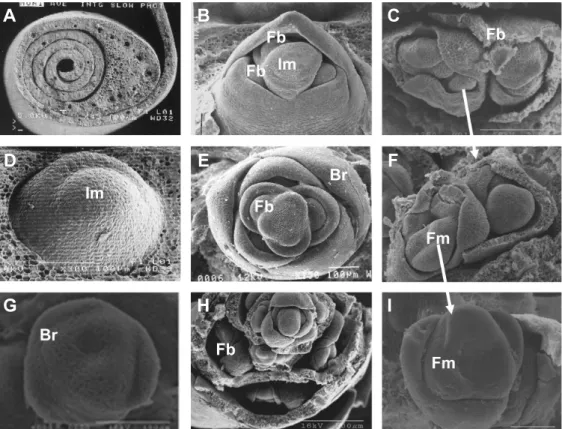
(2) 624. Kor. J. Hort. Sci. Technol. 32(5), October 2014. 재료 및 방법. 결과 및 고찰. 쿠르쿠마 근경에서 자란 맹아의 발육정도에 따른 화아분. 정식 후 구근에서 싹이 자라면서 잎이 하나씩 전개되고. 화 과정과 단계별 화아분화 양상의 형태적 특성을 이해하기. 줄기가 신장하며 이때 줄기 내부에서 화아분화가 일어난다. 위해 화서 및 화아분화 발달과정을 관찰하였다. 4월 초, 근. (Fig. 1). 화아의 위치는 생육단계마다 차이를 보이는데 생육. 경을 베노람수화제(벤레이트티) 500배액에 30분간 침지하. 초기에는 줄기 맨 하단부에 존재하였으나 생육이 진전됨에. 여 소독한 후 유리온실 베드에 20cm 간격으로 정식하여 재. 따라 조금씩 윗부분에서 발견되었다. 생육단계별로 잎 하단. 배하였다. 온실 내 온도는 상온으로 유지하였다(최고: 40°C,. 부에 위치한 줄기의 생장점을 SEM으로 관찰하였던 바 생장. 최저: 20°C). 생육 단계별(Figs. 1A to 1E)로 C. alismatifolia. 점이 생식생장으로 전환되면서 화서가 분화되고 점점 복잡. ‘Chiangmai Pink’의 겉잎을 하나씩 제거하여 줄기 내부 하단쪽. 하게 발달되었다(Figs. 1F to 1J).. 에 위치한 화아를 실체현미경하에서 해부하여 glutaraldehyde. 쿠르쿠마 화서가 완전한 형태로 분화되었을 때 그 절단면. 2.5% 용액에서 고정한 다음 2% osmic acid 용액에 90분 동. (횡단면)을 주사전자현미경으로 관찰하였던 바 Fig. 2와 같. 안 침지하여 이중 고정하였다. 그 후 50, 75, 90, 95, 100%. 이 화아(a) 및 포엽(b)이 잘 분화된 것을 볼 수 있었다.. 에탄올로 각각 탈수시킨 후 isoamyl acetate용액에서 치환시. 정식 후 지상부로부터 싹이 15-20cm 가량 자랐을 때 채취. 키고 임계점 건조기(Hitachi, HCP-2, Japan)에서 CO2 가스. 한 잎의 기부 횡단면(Fig. 3A)에서 생장점은 돔형태로 부풀. 로 건조시켰다. 건조가 끝난 시료는 시료대에 놓고 silver paste. 기 시작하였다(Fig. 3B). 이것의 주변은 점차 여러 겹의 포엽. 로 고정하고 도금한 후 주사전자현미경(Scanning electron. 으로 분화되었고(Figs. 3C and 3D) 포엽내 화아의 형성은. microscope; SEM, Model S-2460N, Hitachi, Japan)으로 관. 지상부 잎이 약 4매 가량 분화되었을 때 시작되었다(Fig. 3E).. 찰하였다. 동일한 방법으로 꽃의 암술과 수술의 형태를 SEM. 포엽 내에 존재하는 화아의 형태는(Fig. 3F) 보통 포엽 내부. 을 통해 관찰하였다.. 에 2개씩 2쌍으로 약 4개가 존재하는데(Fig. 3G) 그 중 Fig. 3H는 Fig. 3G의 좌측 화아의 형태이고 Fig. 3I는 다시 Fig.. A. B. C. D. E. F. G. H. I. J. Fig. 1. Shoot growth and inflorescence development of C. alismatifolia ‘Chiangmai Pink’. A, emergence of shoot; B, emergence of one leaf; C, emergence of two leaf; D, emergence of three leaf; E, emergence of four leaf. Bar = 200 μm for F and H, 100 μm for G, 50 μm for I, and 500 μm for J..
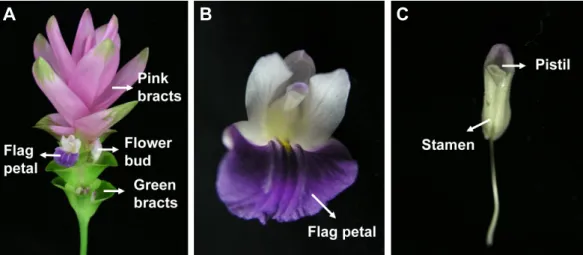
(3) 황선애, 이풍옥, 최목필, 김영아. 3H의 왼쪽 화아를 관찰한 형태이다.. 625. 다(Figs. 4 and 5). 그러나 사실상 쿠르쿠마의 꽃은 녹색의. C. alismatifolia ‘Chiangmai Pink’의 화서를 살펴보면 분. 하위포엽 내 존재하며(Fig. 5) 이들은 작아 눈에 잘 띄지 않. 홍색의 상위포엽과 녹색의 하위포엽이 마치 연꽃처럼 생겼. 고 수명도 1-2일로 매우 짧다. 따라서 쿠르쿠마의 관상 포인 트는 포엽으로 이 논문에서 언급되는 꽃이란 실제의 꽃이 아닌 포엽이다. 이처럼 포엽의 화색과 화형이 독특하여 인 기 있는 화훼작물로는 포인세티아(Castellanos et al., 2006; McAvoy and Bible, 1998)와 부겐빌레아(Chang and Chen, 2001) 등이 있다. 이처럼 포엽 내부에 존재하는 화아들은 먼저 분화가 된 하부부터 상부의 꽃까지 모두 순차적으로 개화되었고(Fig. 4A) 다시 순차적으로 하부의 2번째 화아가 상부 쪽으로 향 하면서 하나씩 개화되는 양상을 보였다(Fig. 4B). 또한 이들 포엽에 존재하는 쿠르쿠마의 꽃은 육안으로도 그 내부에 암 술과 수술이 존재하는 것이 확인되었다(Fig. 5). 수술의 구조 를 더욱 자세하게 SEM으로 관찰하였던 바 화분이 구조적으. Fig. 2. Longitudinal section of an inflorescence of C. alismatifolia ‘Chiangmai Pink’ (a, flower bud; b, bract). Bar = 1 mm.. 로 폐쇄되어 있었다(Fig. 6). 그러나 화분을 둘러싸고 있는 틈이 시간이 경과됨에 따라 점차 벌어지긴 했으나 암술머리. A. B. C. D. E. F. G. H. I. Fig. 3. A scanning electron microscope images of inflorescence development of C. alismatifolia ‘Chiangmai Pink’. Bract (Br), flower bud (Fb), floral meristem (Fm), inflorescence meristem (Im). A, vegetative stage; B-C, floral primordial stage (B, plant height 20 cm; C, plant height 24 cm); D-I, petal stage (D, plant height 40 cm; E, plant height 48 cm; F, plant height 52 cm; G-I, plant height 55 cm). Bar = 1 mm for A, 200 μm for B and D, 100 μm for C, 200 μm for E, 500 μm for F, 400 μm for G and H, 100 μm for I..
(4) 626. Kor. J. Hort. Sci. Technol. 32(5), October 2014. 와 수술은 구조적인 문제로 자가 수정은 어렵지만 인공 수. 과정에 관한 보고는 많이 있으나(Chae, 2002; Yoo and Kim,. 정은 가능할 것으로 판단되었다(Fig. 7A).. 2001) 쿠르쿠마와 유사한 분화과정을 지닌 식물은 찾아보기. 쿠르쿠마의 화분(pollen)은 생강과 식물의 화분과 유사. 어려웠다.. 한 경향을 보였다(Liang, 1990; Mangaly and Nayar, 1990; Saensouk et al., 2009; Theilade et al., 1993). 화분의 모양은 구형(spherical shape)이며, 화분의 크기는 30-40μm 정도였 다(Fig. 7B). Chen and Xia(2011)의 쿠르쿠마 18종류에 대. A. B. 한 화분의 형태와 크기에 대한 보고에 의하면 구형은 C. aromatica와 C. elata에서만 나타나고 대부분 종에서는 난형 (ovoid shape)을 보이는 것으로 보고되었다. 일반적으로 화아 분화는 꽃받침, 꽃잎, 수술, 암술, 자방 순으로 형성되며 화아분화 시기는 화종에 따라 다르나, 꽃 이 진후 신초가 자라면서 형성되는데 대부분 5월 말 또는 6월 초부터 시작하고, 짧게는 2개월 길게는 5개월이면 완료. Fig. 6. A scanning electron microscope images of stamen of C. alismatifolia ‘Chiangmai Pink’. Bar = 2 mm for A, 100 μm for B.. 가 된다(Song and Lee, 2003a, 2003b). 이외에도 화아분화. A A. B. B. Fig. 4. Schematic representation of flowering order (A). Pictures of flowering order of C. alismatifolia ‘Chiangmai Pink’ (B).. A. B. Fig. 7. A scanning electron micrograph of stamen and anther (A), and pollen grains (B) of C. alismatifolia ‘Chiangmai Pink’. Bar = 1 mm for A, 50 μm for B.. C. Fig. 5. Morphology of a flowering stem in C. alismatifolia ‘Chiangmai Pink’ (A, inflorescence; B, floret; C, pistil and stamen)..
(5) 황선애, 이풍옥, 최목필, 김영아. 초 록 Curcuma alismatifolia ‘Chiangmai Pink’의 화아발달 과정 을 SEM을 통해 관찰하였다. 쿠르쿠마 근경에서 자란 맹아 의 발육정도에 따른 화아분화 과정과 단계별 화아분화의 형 태적 특성은 정식 후 식물체의 싹이 15-20cm 가량 자랐을 때 생장점의 중앙부가 돔형으로 비대되는 경정분열조직에 서 포엽이 분화되기 시작하였다. 포엽이 5-7매 가량 분화되 면 포엽과 포엽 사이에서 화아가 형성되기 시작하였고, 보 통 포엽당 화아는 4-6개가 관찰되었다. 화아가 분화되는 순 서는 맨 하위 포엽 내 존재하는 것부터 상부로 올라가면서 하나씩 분화되었고 상부의 것이 분화되면 다시 하부의 4-6 개의 화아 중 또 다른 화아가 상부쪽으로 향하면서 하나씩 순차적으로 되었다. 추가 주요어 : 포엽, 소화, 근경, 주사전자현미경, 경정. 인용문헌 Bunya-Atichart, K., S. Ketsa, and W.G. Van Doorn. 2004. Postharvest physiology of Curcuma alismatifolia flowers. Postharvest Biol. Technol. 34:219-226. Castellanos, M., J.B. Power, and M.R. Davey. 2006. Somatic embryogenesis in red- and white-bract cultivars of poinsettia. Prop. Ornamental Plants 6:61-66. Chae, S.C. 2002. A scanning electron microscope observation of flower bud initiation and development of Dendrobium nobile. Kor. J. Hort. Sci. Technol. 20:356-359. Chang, Y.S and H.C. Chen. 2001. Variability between silver thiosulfate and 1-naphthaleneacetic acid applications in prolonging bract longevity of potted bougainvillea. Sci. Hortic. 87:217-224. Chapman, T.S. 1995. Ornamental ginger: A guide to selection and cultivation. 2nd ed. St. Gabriel, Lousisana. Chen J. and N.-H. Xia. 2011. Pollen morphology of Chinese Curcuma L. and Boesenbergia Kuntz (Zingiberaceae): Taxonomic implications. Flora 206:458-467. Hagiladi, A., N. Umiel, Z. Gilad, and X.-H. Yang. 1997. Curcuma. 627. alismatifolia. I. Plant morphology and the effect of tuberous root number on flowering date and yield of inflorescences. Acta Hortic. 430:747-753. Hwang, S.A., P.O. Lee, M.P. Choi, and J.S. Lee. 2008. Growth and flowering characteristics, and ornamental evaluation of Curcuma. Flower Res. J. 16:275-283. Koh, J.C. 2005. Callus culture and plant regeneration from shoot apex of Iris sanguinea Donn ex. Horn. J. Natural Sci. 3:93-98. Liang, Y.H. 1990. A study on the pollen wall of the Chinese Zingiberaceae. Acta Bot. Austro. Sin. 6:56-65. Mangaly, J.K. and J. Nayar. 1990. Palynology of South Indian Zingibearaceae. Bot. J. Linn. Soc. 103:351-366. McAvoy, R.J. and B.B. Bible. 1998. Poinsettia bract necrosis is affected by scion/rootstock combinations and arrested by a benzyladenine spray. HortScience 33:242-246. Roh, M.S., R. Lawson, J.S. Lee, and J.K. Suh. 2006. Evaluation of Curcuma as potted plants and cut flowers. J. Hortic. Sci. Biotechnol. 81:63-71. Saensouk, P., P. Chantaranothai, and P. Theerakulpisut. 2009. Pollen morphology of the genus Cornukaempferia (Zingiberaceae) in Thailand. J. Syst. Evol. 47:139-143. Song, C.Y. and J.S. Lee. 2003a. Process of flower bud differentiation of Corunus officinalis, Wisteria floribunda, Prunus serrulata var. spontanea, Chaenomeles lagenaria, and Spiraea prunifolia var. simpliciflora native to Korea. J. Kor. Flower. Rec. Soc. 11:37-47. Song, C.Y. and J.S. Lee. 2003b. Process of flower bud differentiation of Rohododendron mucronulatum, Rohododendron schlippenbachii, Forsythia koreana and Syringa dilatata native to Korea. J. Kor. Soc. Hort. Sci. 44:373-380. Theilade, I., M.L. Maersk-Moller, J.T. heilade, and K. Larsen. 1993. Pollen morphology and structure of Zingiber (Zingiberaceae). Grana 32:338-342. Wannakrairot, S. 1997. Curcuma. 2nd ed. Amarin Printing and Publishing, Inc., Bangkok, Thailand. Yoo, Y.K. and H.Y. Kim. 2001. Observation of flower bud differentiation and effect of transferring date to greenhouse on growth and flowering in Bletilla striata. J. Kor. Soc. Hort. Sci. 42:107-110..
(6)
수치

관련 문서
A Study on the Development of Ship’s Ballast Water A Study on the Development of Ship’s Ballast Water A Study on the Development of Ship’s Ballast Water A Study on the
Surface morphology and chemical composition of samples were characterized by field emission scanning electron microscopy (FE-SEM), contact angle measurement and
Therefore, the aim of this study was to investigate the morphologic characteristics of the interalveolar foramen and to analyze according to sex and age using cone
The purpose of this study is to evaluate the marginal and internal fit of coping made by CAD/CAM using different scanning methods.. Zirconia coping was made
This study was conducted to recognize the importance of self - management of dance major students and to understand the relationship between the sub -
This retrospective chart review was conducted to determine the effectiveness of antipsychotics when given as antidepressant augmentation agents to inpatients
The purpose of this study is to define the concept of affordance in multi-media environment and to seek development plan of more efficient interface
Thus, in this regard, this study aims to explore specific ways in which teachers can achieve the right social development of learners by using pictorial
