609
F
ORESTS
OCIETYEcological Indicators of Forest Degradation after Forest Fire and Clear-cutting in the Siberian Larch (Larix sibirica)
Stand of Mongolia
Yeong Dae Park
1*, Don Koo Lee
2, John A. Stanturf
3, Su Young Woo
4and Damdinjav Zoyo
51Institute of Agriculture and Life Sciences, Seoul National University, Seoul 151-921, Korea
2Department of Forest Sciences, Seoul National University, Seoul 151-921, Korea
3SRS-4104, USDA Forest Service, 320 Green Street, Athens, GA 30602, U.S.A.
4Department of Environmental Horticulture, University of Seoul, Seoul 130-143, Korea
5Institute of Botany, Mongolian Academy of Sciences, Ulaanbaatar 51, Mongolia
Abstract :
This study was conducted to investigate ecological indicators of forest degradation after forest fire and clear-cutting in the Siberian larch (
Larix sibiricaLedeb.) stand of Mongolia. The species abundance and biodiversity indices were higher in burned and clear-cut stands than those of reference stand, but boreal understory species, such as
Vaccinium vitis-idaea,
Pyrola incarnata,
Linnea borealisand
Maianthemum bifolium, completely disappeared and was replaced by sedge species, such as
Carex duriuscula, C. lanceolata, C. pediformis, Poa attenuataand
P. pratensis. During the research period, temperature increased by an average of 1.6°C in burned stand and 1.7°C in clear-cut stand compared to reference stand, but RH sharply decreased up to 15.7% in clear-cut stand. This result indicates that
Larix sibiricastand became warmer and drier after forest fire and clear-cutting, and contributed to the abundance of sedge and grass species in the understory. Moreover, intense occupation of tall sedge grass after forest fire and clear-cutting had a vital role as obstacle on natural regeneration of
Larix sibirica. The similarity of species composition between reference and burned stands was higher (73.6%) than between reference and clear-cut stands (63.8%). Soil moisture significantly decreased after forest fire and clear-cutting, and the extent of decrease was more severe in the clear-cut stand. The chemical properties at soil organic layer were significantly affected by forest fire and clear-cutting but not the mineral horizons. Inorganic nitrogen of the forest floor significantly decreased in the clear-cut stand (1.1±0.4 mg·kg
−1) than that of the burned (4.5±2.3 mg·kg
−1) and reference stands (5.0±2.3 mg·kg
−1). Available P of the forest floor significantly increased after fire, whereas it decreased after clear-cutting. These results indicate that existence of boreal understory vegetation, and changes in soil moisture and available P are distinct attributes applicable as ecological indicators for identifying forest degradation in Mongolia.
Key words :clear-cutting, ecological indicators, forest fire, forest degradation, Siberian larch, soil prop- erties, understory vegetation
Introduction
Ecological restoration is an activity that initiates and/
or accelerates the recovery of an ecosystem that has been degraded, damaged, or destroyed (Society of Eco- logical Restoration International: SERI, 2004). The pri- mary goal of ecological restoration is to re-establish self- sustaining ecosystem (Clewell and Aronson, 2006), which is a similar concept for sustainable forest man- agement. Meeting this goal requires analysis of ecolog-
ical factors that determine limits to the ecological composition, structure, and function of an ecosystem (Wyant
et al., 1995).
Ecological indicators are analytical and interpretive tools of ecological dynamics and can be applied to mon- itor forest degradation after disturbance and restoration management in the future (Venturelli and Galli, 2006).
To be effective indicators they should be adequately common and understood, and sensitive to underlying changes in the biophysical environment (Angelstam, 1998). Various studies have shown that understory veg- etation and forest soil properties are used as effective indicators in identifying changes in forest ecosystem
*Corresponding author E-mail: [email protected]
(Ohlson
et al., 1997; McLachlan and Bazely, 2001;
Krzic
et al., 2003). A review of basic concepts of soil and vegetation development indicates that they are mutu- ally associated with each other, both being the product of the same environmental variables.
Forests in Mongolia have been severely degraded by forest fire and clear-cutting (Tsogtbaatar, 2004). During the last decade, Mongolia lost approximately four mil- lion ha of forests, averaging to 40,000 ha annually but between 1990 and 2000, the rate of deforestation increased up to 60,000 ha per year. As a result of this ongoing loss and degradation, 1.6 million ha of forest area have been completely lost between 1974 and 2000 due to forest fire, improper cutting and clear-cutting, overgrazing, mining activities and among others (United Nations Environ- ment Programme: UNEP, 2002).
Most forests in Mongolia are composed of
Larix sibir- icacovering about 59% of the closed forest area (Min- istry of Nature and Environment of Mongolia, 2002).
The pattern of stand development after forest fire and clear-cutting at the
Larix sibiricastands of Mongolia mainly progressed into four stages: 1) secondary
L.sibrica
stand, 2) replaced hardwood stand mainly com- posed of birch and willow species, 3) bush stand, and 4) grassland (steppe), which strongly depends on the inten- sity of disturbance and potential of natural regeneration (Thomas and Agee, 1986). Forest fire and clear-cutting can directly influence plant diversity and sustainability of forest production through soil or forest floor distur- bance, altered habitat structure, removal of nutrients, or altered micro-climate condition in boreal forest ecosys- tem (Reich
et al., 2001). Thus, it is very important to
understand ecological changes in understory vegetation and soil properties after forest disturbance to investigate forest degradation as ecological indicators in Mongolia.
The objectives of this study were: 1) to investigate eco- logical changes in understory vegetation and soil prop- erties after forest fire and clear-cutting in Siberian larch stand, and 2) to discuss ecological indicators of forest degradation in Mongolia.
Materials and Methods
1. Selection of the study sites
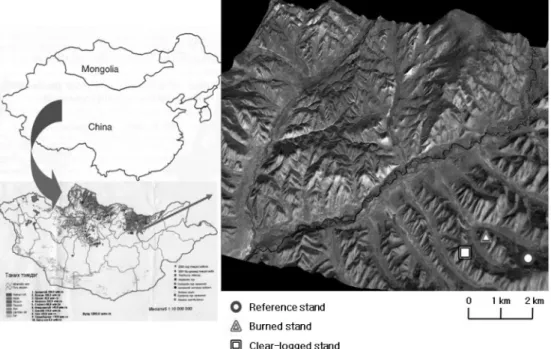
The field study was conducted at the southern area of Khenti in Mongolia (Figure 1). This area lies between the southern fringe of the Siberian boreal forest and mid- Asia steppe zone, and it is about 80 km from the north- east of Ulaanbaatar. It is very sensitive and vulnerable to external disturbances due to its geographical character- istics and also had been continuously disturbed by peo- ple in the vicinity of Ulaanbaatar, capital of Mongolia.
The most dominant species is
Larix sibirica, which is distributed between 1,500 m and 1,700 m, and it only exist in the northern aspect due to harsh climate condi- tion (average annual temperature ranges from -1.9 to -3.8
oC and annual precipitation ranges from 240 to 320 mm). Hardwood species such as
Betula platyphylla,
Salix
spp. and
Populusspp. were invaded and occupied rapidly after forest fire and clear-cutting as pioneer spe- cies in this area.
Burned and clear-cut
L. sibiricastands (having more than one ha disturbed), and reference
L. sibiricastand as a control (which is undisturbed and adjacently located
Figure 1. Location of the study sites.
with each other) were chosen in this study (Table 1). It is estimated that forest fire and clear-cutting in this area occurred in the similar period, between 1965 and 1966, according to local record (written in Mongolian) and interview with the local people. In each study site, three 30 m
×30 m square plots, a total of nine plots were ran- domly established to investigate stand characteristics including overstory coverage and density of
L. sibiricaseedlings (Table 1), and to set subplots for understory survey and soil sampling.
2. Identification of understory vegetation
A total of 15 square subplots (2 m
×2 m) in each study site were set to investigate the composition of understory vegetation. Identification of understory species according to nomenclature of Grubov (1982) was conducted jointly with researchers from the Institute of Botany, Mongolian Academy of Sciences. The importance value, species diversity (richness, evenness, Shannon’s index and Sim- pson’s index) and similarity of all identified vegetation were calculated using the following formula (Ludwig and Reynolds, 1988; Kent and Coker, 1994).
3. Micro-climate data collection
Portable HOBO data loggers were launched in each stand with three replications to measure air temperature and relative humidity during the research period. All data were automatically collected with one-hour interval
and the daily mean temperature and relative humidity were calculated (BoxCar Pro 4.0, Onset Computer Cor- poration, USA).
4. Soil sampling and statistical analysis
In each study stand, soil samples were collected using soil auger at three soil depths: the forest floor (O) and mineral horizons (A and B) with five replica- tions. The soil samples were air-dried after collection and transported to Korea for analysis with consent from the Ministry of Nature and Environment of Mon- golia and the National Plant Quarantine Service in Korea. The physical and chemical properties of all soil samples were analyzed, such as moisture content, pH, soil texture, organic matter, nitrogen and phosphorous (Bigham, 1986; Klute, 1986). The differences in soil properties among the study plots were determined by analysis of variance (ANOVA) and Tukey’s Studen- tized Range test (SAS 8.2). The significance for all analyses was determined at
α=0.05.
Results and Discussion
1. Changes in understory vegetation after forest fire and clear-cutting
Composition of understory vegetation in
Larix sibiricastands in Mongolia drastically changed after forest fire and clear-cutting (Table 2).
Table 1. Characteristics of the study sites.
Study sites Location Elevation
(m) Dominant species
in overstory Age
(yr.) Overstory
coverage Seedling density of
L. sibirica
(no./ha) Reference stand 48°03´N, 107°88´E 1,601
Larix sibirica40-120 70% 1,520 Burned stand 48°03´N, 107°88´E 1,564
L. sibirica,Betula platyphylla20-40 40% 320
Clear-cut stand 48°03´N, 107°88´E 1,550
B. platyphylla10-30 10% 80
where
IVis the importance value,
RFis the relative frequency and
RCis the relative coverage.
where
Ris the species richness,
Sis the number of species observed in the sample and
nis the total number of plots sampled.
where
Eis the species evenness,
H'is the number derived from the Shannon diversity index and
H'max is the maximum value of
H'.
where
H’is the Shannon’s index of diversity,
sis the number of species observed in the sample,
niis the number of individuals belonging to the
ith of s species in the sample, and
nis the total num- ber of individuals in the sample.
where
Dis the Simpson’s index of diversity,
sis the number of species observed in the sample,
niis the number of individuals belonging to the
ith of s species in the sample, and
nis the total num- ber of individuals in the sample.
where
Ssis the Sørensen’s coefficient of similarity,
xis the number of species at site
A,
yis the num- ber of species at site
B, and
zis the number of common species at both sites.
IV %( ) FR RC %+ ( ) ---2
= R S 1– ln n( ) ---
=
E H′
H′max ---
=
H′ ni
----n
⎝ ⎠⎛ ⎞ln ni ----n
⎝ ⎠⎛ ⎞
i=1
∑
s=
D ni(ni–1) n n 1( – ) ---
i=1
∑
s=
Ss 2z
x y+ --- 100×
=
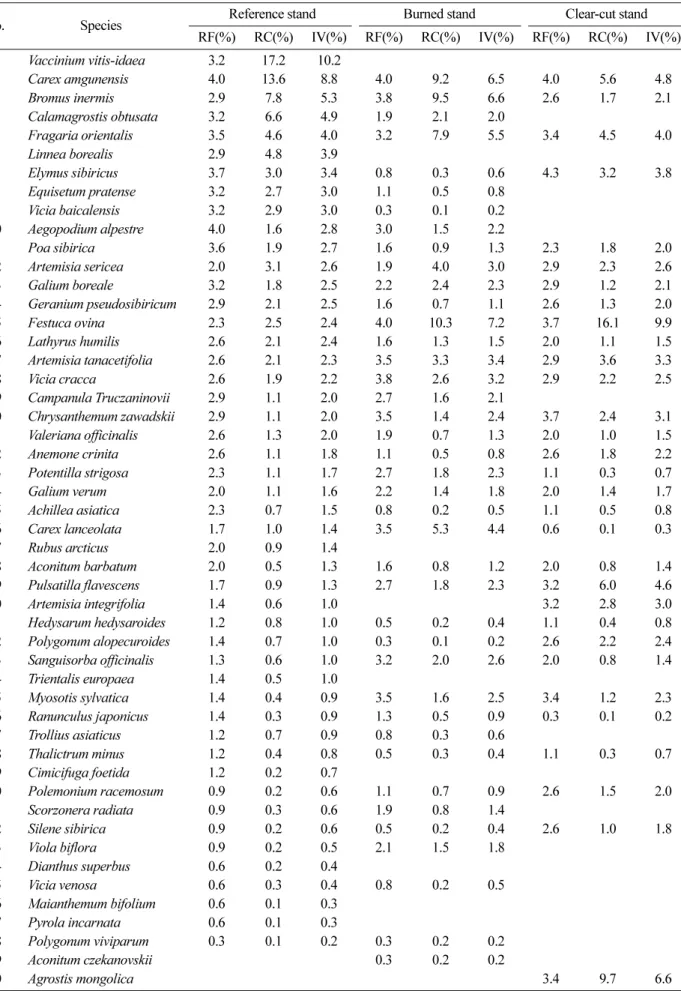
Table 2. Changes in Importance value (IV) of understory vegetation at reference, burned and clear-cut stands.
No. Species Reference stand Burned stand Clear-cut stand RF(%) RC(%) IV(%) RF(%) RC(%) IV(%) RF(%) RC(%) IV(%)
1 Vaccinium vitis-idaea 3.2 17.2 10.2
2 Carex amgunensis 4.0 13.6 8.8 4.0 9.2 6.5 4.0 5.6 4.8
3 Bromus inermis 2.9 7.8 5.3 3.8 9.5 6.6 2.6 1.7 2.1
4 Calamagrostis obtusata 3.2 6.6 4.9 1.9 2.1 2.0
5 Fragaria orientalis 3.5 4.6 4.0 3.2 7.9 5.5 3.4 4.5 4.0
6 Linnea borealis 2.9 4.8 3.9
7 Elymus sibiricus 3.7 3.0 3.4 0.8 0.3 0.6 4.3 3.2 3.8
8 Equisetum pratense 3.2 2.7 3.0 1.1 0.5 0.8
9 Vicia baicalensis 3.2 2.9 3.0 0.3 0.1 0.2
10 Aegopodium alpestre 4.0 1.6 2.8 3.0 1.5 2.2
11 Poa sibirica 3.6 1.9 2.7 1.6 0.9 1.3 2.3 1.8 2.0
12 Artemisia sericea 2.0 3.1 2.6 1.9 4.0 3.0 2.9 2.3 2.6
13 Galium boreale 3.2 1.8 2.5 2.2 2.4 2.3 2.9 1.2 2.1
14 Geranium pseudosibiricum 2.9 2.1 2.5 1.6 0.7 1.1 2.6 1.3 2.0
15 Festuca ovina 2.3 2.5 2.4 4.0 10.3 7.2 3.7 16.1 9.9
16 Lathyrus humilis 2.6 2.1 2.4 1.6 1.3 1.5 2.0 1.1 1.5
17 Artemisia tanacetifolia 2.6 2.1 2.3 3.5 3.3 3.4 2.9 3.6 3.3
18 Vicia cracca 2.6 1.9 2.2 3.8 2.6 3.2 2.9 2.2 2.5
19 Campanula Truczaninovii 2.9 1.1 2.0 2.7 1.6 2.1
20 Chrysanthemum zawadskii 2.9 1.1 2.0 3.5 1.4 2.4 3.7 2.4 3.1
21 Valeriana officinalis 2.6 1.3 2.0 1.9 0.7 1.3 2.0 1.0 1.5
22 Anemone crinita 2.6 1.1 1.8 1.1 0.5 0.8 2.6 1.8 2.2
23 Potentilla strigosa 2.3 1.1 1.7 2.7 1.8 2.3 1.1 0.3 0.7
24 Galium verum 2.0 1.1 1.6 2.2 1.4 1.8 2.0 1.4 1.7
25 Achillea asiatica 2.3 0.7 1.5 0.8 0.2 0.5 1.1 0.5 0.8
26 Carex lanceolata 1.7 1.0 1.4 3.5 5.3 4.4 0.6 0.1 0.3
27 Rubus arcticus 2.0 0.9 1.4
28 Aconitum barbatum 2.0 0.5 1.3 1.6 0.8 1.2 2.0 0.8 1.4
29 Pulsatilla flavescens 1.7 0.9 1.3 2.7 1.8 2.3 3.2 6.0 4.6
30 Artemisia integrifolia 1.4 0.6 1.0 3.2 2.8 3.0
31 Hedysarum hedysaroides 1.2 0.8 1.0 0.5 0.2 0.4 1.1 0.4 0.8
32 Polygonum alopecuroides 1.4 0.7 1.0 0.3 0.1 0.2 2.6 2.2 2.4
33 Sanguisorba officinalis 1.3 0.6 1.0 3.2 2.0 2.6 2.0 0.8 1.4
34 Trientalis europaea 1.4 0.5 1.0
35 Myosotis sylvatica 1.4 0.4 0.9 3.5 1.6 2.5 3.4 1.2 2.3
36 Ranunculus japonicus 1.4 0.3 0.9 1.3 0.5 0.9 0.3 0.1 0.2
37 Trollius asiaticus 1.2 0.7 0.9 0.8 0.3 0.6
38 Thalictrum minus 1.2 0.4 0.8 0.5 0.3 0.4 1.1 0.3 0.7
39 Cimicifuga foetida 1.2 0.2 0.7
40 Polemonium racemosum 0.9 0.2 0.6 1.1 0.7 0.9 2.6 1.5 2.0
41 Scorzonera radiata 0.9 0.3 0.6 1.9 0.8 1.4
42 Silene sibirica 0.9 0.2 0.6 0.5 0.2 0.4 2.6 1.0 1.8
43 Viola biflora 0.9 0.2 0.5 2.1 1.5 1.8
44 Dianthus superbus 0.6 0.2 0.4
45 Vicia venosa 0.6 0.3 0.4 0.8 0.2 0.5
46 Maianthemum bifolium 0.6 0.1 0.3
47 Pyrola incarnata 0.6 0.1 0.3
48 Polygonum viviparum 0.3 0.1 0.2 0.3 0.2 0.2
49 Aconitum czekanovskii 0.3 0.2 0.2
50 Agrostis mongolica 3.4 9.7 6.6
Vaccinium vitis-idaea
,
Carex amgunensisand
Bromus inermiswere most abundant understory species in the reference stand. However,
Festuca ovinaand
Chamaen- erion angustifoliumwere the dominant species in burned and clear-cut stands.
Chamaenerion angustifolium(fireweed) was reported in the previous studies (Li
et al., 2005;
Pugachev
et al., 2005) as very well-known good post- fire indicator in Khenti area, Mongolia and Russian Far East. The species abundance and biodiversity indices were higher in the burned and clear-cut stands than ref- erence stand (Table 3). It was the result of increased for-
est gap due to elimination of upper layer trees by forest fire and clear-cutting. This provided better light environ- ment for the invasion and development of understory vegetation (Messier
et al., 1998; de Römer
et al., 2007).
There was positive result after forest disturbance on quantitative changes in species diversity but species compo- sition changed negatively, such as the boreal understory species was replaced by sedge and steppe species.
Vac- cinium vitis-idaea,
Pyrola incarnata,
Linnea borealisand
Maianthemum bifoliumare boreal understory species which are distributed in humid and closed forest at high
Table 2. Continued.
No. Species Reference stand Burned stand Clear-cut stand
RF(%) RC(%) IV(%) RF(%) RC(%) IV(%) RF(%) RC(%) IV(%)
51
Allium senescens0.3 0.1 0.2
52
Androsace septentrionalis0.5 0.2 0.4
53
Artemisia lacianata1.1 0.7 0.9
54
Aster alpinus0.5 0.3 0.4
55
Bromus pumpelliana2.3 1.7 2.0
56
Carex caespitosa2.9 1.5 2.2
57
Carex duriuscula1.9 0.7 1.3
58
Carex pediformis1.7 1.1 1.4
59
Cerastium ceratoides0.3 0.1 0.2 0.9 0.5 0.7
60
Chamaenerion angustifolium4.0 8.4 6.2 3.2 7.3 5.2
61
Draba nemosa0.3 0.1 0.2
62
Dracocephalum grandiflorum1.3 2.8 2.1
63
Halenia corniculata0.6 0.1 0.3
64
Helictotrichon schellianum1.6 0.7 1.1
65
Moerhingia laterifolia0.5 0.1 0.3
66
Pedicularis resupinata0.3 0.2 0.2
67
Poa attenuata0.9 3.1 2.0
68
Poa pratensis0.3 0.1 0.2
69
Potentilla nivea3.0 1.0 2.0 3.4 1.9 2.7
70
Primula farinosa0.3 0.1 0.2
71
Rodiola rosea0.5 0.3 0.4
72
Sedum aizoon1.3 0.5 0.9
73
Stellaria graminea0.3 0.1 0.2 2.0 1.0 1.5
74
Taraxacum officinale2.3 1.2 1.8
75
Trifolium lupinaster1.3 0.6 0.9 0.7 0.3 0.5
76
Trisetum sibiricum1.3 0.7 1.0
77
Vicia amoena2.7 2.3 2.5 0.3 0.4 0.3
Sum 100.0 100.0 100.0 100.0 100.0 100.0 100.0 100.0 100.0
*The blank indicates no species exist.
Table 3. Species diversity indices of reference, burned and clear-cut stands.
Diversity indices Reference stand Burned stand Clear-cut stand
Richness (
R) 22.9 (3.7) 24.9 (2.9) 23.2 (4.4)
Evenness (
E) 0.824 (0.064) 0.865 (0.038) 0.842 (0.034)
Shannon (
H’) 2.577 (0.291) 2.779 (0.203) 2.635 (0.224)
Simpson (
D) 0.8795 (0.0423) 0.9072 (0.0267) 0.8874 (0.026)
*Values in parenthesis indicate standard deviation.
altitude with strong shade-tolerance under dense conifers but they are very vulnerable to anthropogenic distur- bances, such as forest fire and clear-cutting in Mongolia (Zoyo, 2000).
In this study, they completely disappeared after forest fire and clear-cutting whereas sedge and steppe species, such as
Carex duriuscula, C. lanceolata, C. pediformis, Poa attenuataand
P. pratensis,newly invaded the area or increased their abundance. This result implied signif- icantly that forest degradation has seriously progressed in
Larix sibiricastand in Mongolia after forest fire and clear-cutting due to loss of habitat and decline of species diversity on boreal understory vegetation. Moreover, intense occupation of tall sedge grass after forest fire and clear- cutting has a vital role as obstacle on natural regenera- tion of
Larix sibirica, which possibly accelerated forest degradation process. Thus, boreal understory vegetation has important ecological implication, which can serve as an indicator of forest degradation as well as useful in monitoring restoration process in Mongolia.
The Sørensen similarity index of understory vegetation among the reference, burned and clear-cut stands was determined. The similarity coefficient of species compo- sition between reference and burned stands (73.6%) was higher than between reference and clear-cut stands (63.8%). This result indicates that clear-cutting activity changed species composition more differently compared to forest fire, which is supported by other studies (Ever- ett
etal., 1990; Rees and Juday, 2002). Therefore, clear- cutting activities have more adverse effects on species composition and diversity of understory vegetation than forest fire in Mongolia.
2. Changes in microclimatic variables after forest fire or clear-cutting
Forest fire and clear-cutting activities sharply alter microclimatic conditions and mainly affect species com- position and stand development (Reich
et al., 2001).
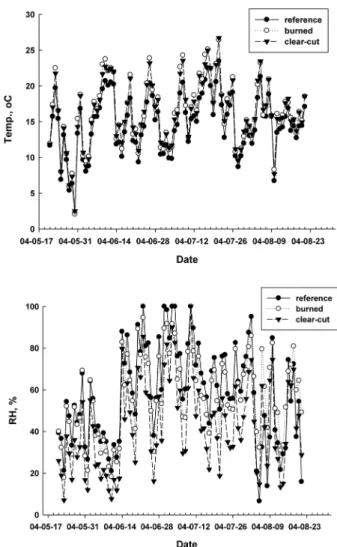
Microclimate variables, such as temperature and relative humidity (RH), in study plots were measured.
During the research period, temperature increased by an average of 1.6°C in burned stand and 1.7°C in clear- cut stand compared to reference stand, but RH sharply decreased up to 15.7% in clear-cut stand (Figure 2). This Figure 2. Daily mean temperature and RH in the study plots.
Table 4. Changes in physical soil properties after forest fire or clear-cutting.
horizon Soil Study sites Soil texture Water content
(%) Bulk density (g cm
−3) Sand (%) Silt (%) Clay (%) Texture
O Reference 29.6 (2.7) 49.2 (2.3) 21.2 (0.5) loam 14.3 (2.2)
a0.9 (0.1) Burned 27.5 (2.8) 46.9 (3.2) 25.6 (5.5) loam
09.2 (1.2)b0.9 (0.2) Clear-cut 38.1 (4.2) 44.0 (4.5) 17.9 (0.9) loam
06.5 (1.0)c1.1 (0.1) A Reference 27.9 (1.4) 43.2 (3.2) 28.9 (2.9) clay loam 13.1 (3.5)
a1.2 (0.1) Burned 20.2 (4.0) 47.3 (6.6) 32.5 (3.3) clay loam
08.2 (0.6)b1.4 (0.1) Clear-cut 18.0 (2.5) 53.9 (0.6) 28.1 (3.1) clay loam
05.9 (1.0)c1.6 (0.1) B Reference 24.2 (5.7) 48.0 (11.7) 27.8 (7.2) loam
05.8 (0.8)a1.7 (0.1) Burned 18.9 (4.9) 49.5 (6.3) 31.6 (2.4) clay loam
04.9 (0.4)b1.6 (0.0) Clear-cut 26.5 (1.6) 48.5 (5.7) 25.0 (5.1) loam
03.9 (0.3)c1.7 (0.0)
*Values in parenthesis indicate standard error. Different letter indicate significant difference at
p<0.05
result indicates that microclimatic condition of
Larix sibiricastand became warmer and drier after forest fire and clear-cutting, and affected the species composition of understory vegetation. For instance, more sedge and grass species became abundant in burned and clear-cut stands compared to reference stand.
3. Changes in soil properties after forest fire or clear- cutting
Soil moisture significantly decreased after forest fire or clear-cutting, and the extent of decrease was more severe in the clear-cut stand (Table 4). This result indi- cate that changes in physical soil properties, such as water content and bulk density, were more negatively affected by clear-cutting activity than by forest fire. The loss of soil moisture resulted in the compaction of soil which accelerated soil erosion and harmfully affected to plant root growth (Gombosuren, 1992).
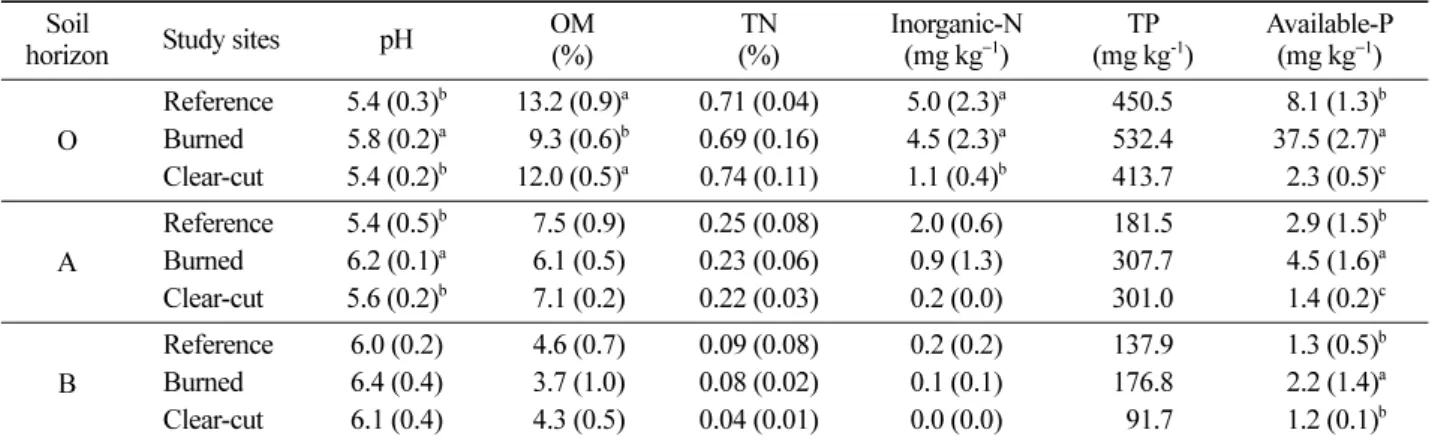
The chemical properties at soil organic layer were sig- nificantly affected by forest fire and clear-cutting but not the mineral horizons (Table 5). Forest fire stimulated the increase of pH while organic matter (OM) content sig- nificantly decreased. This was caused by ash deposition on surface soil and nutrient losses through leaching (DeBano
et al., 1998; Fisher and Binkley, 2000). Clear- cutting activities stimulated the decrease of inorganic N (NH
4+-N, NO
3−-N). Inorganic nitrogen of the forest floor (O horizon) significantly decreased in the clear-cut stand compared to the burned and reference stands. Decreased nutrient and water uptake by vegetation, increased amounts of dead organic matter and changed soil hydraulic prop- erties all promote N leaching after clear cutting but degree of leaching depends largely on the types of oper- ation and its intensity (Piirainen
et al., 2007). Available P of soil significantly increased after fire, whereas it decreased after clear-cutting. Therefore, the results indi- cate that clear-cutting activity rather than forest fire changed the soil properties more negatively. Loss of for-
est floor and surface mineral soil by improper clear-cut- ting activity can be a serious obstacle to the restoration or rehabilitation (Giardina and Rhoades, 2001).
4. Ecological indicators
Numerous studies have been attempted to develop eco- logical indicators for understanding ecological changes after forest disturbance and to monitor the ecological restora- tion process (Keddy and Drummond, 1996; Harris, 2003; Dodson
et al., 2007; Nichols and Grant, 2007) at diverse forest ecosystems. SERI has produced a “Primer on Ecological Restoration (2004)” with nine ecological attributes, but some of them are conceptual and not real- istic. Ruiz-Jaen and Aide (2005) simply categorized the use of three attributes, such as vegetation structure, biodiversity and ecological processes, to achieve realistic goals. The development of ecological indicators is needed to understand ecological changes brought by for- est disturbance, to decide restoration techniques, and to monitor and value its achievement.
In this study, forest degradation process was identified by the composition of understory vegetation and forest soil properties in the
Larix sibiricastand of Mongolia.
The existence of boreal understory species, such as
Vac- cinium vitis-idaea,
Pyrola incarnata,
Linnea borealisand
Maianthemum bifolium,was a very important indi- cator to define forest degradation in boreal forest, Mon- golia, whereas soil moisture and available P among soil physical and chemical properties were distinct indicators to detect changes in forest soil after forest fire or clear- cutting. It is expected that the result of this study can be applied to decide on restoration treatments and to prac- tically monitor restoration process in the
Larix sibiricastand of Mongolia.
Conclusions
Forest fire and clear-cutting activity significantly affected
Table 5. Changes in pH, OM and nitrogen contents of forest soil after fire or clear-cutting.
horizon Soil Study sites pH OM
(%) TN
(%) Inorganic-N
(mg kg
−1) TP
(mg kg
-1) Available-P (mg kg
−1) O Reference 5.4 (0.3)
b13.2 (0.9)
a0.71 (0.04) 5.0 (2.3)
a450.5
08.1 (1.3)bBurned 5.8 (0.2)
a 09.3 (0.6)b0.69 (0.16) 4.5 (2.3)
a532.4 37.5 (2.7)
aClear-cut 5.4 (0.2)
b12.0 (0.5)
a0.74 (0.11) 1.1 (0.4)
b413.7
02.3 (0.5)cA Reference 5.4 (0.5)
b 07.5 (0.9)0.25 (0.08) 2.0 (0.6) 181.5
02.9 (1.5)bBurned 6.2 (0.1)
a 06.1 (0.5)0.23 (0.06) 0.9 (1.3) 307.7
04.5 (1.6)aClear-cut 5.6 (0.2)
b 07.1 (0.2)0.22 (0.03) 0.2 (0.0) 301.0
01.4 (0.2)cB Reference 6.0 (0.2)
04.6 (0.7)0.09 (0.08) 0.2 (0.2) 137.9
01.3 (0.5)bBurned 6.4 (0.4)
03.7 (1.0)0.08 (0.02) 0.1 (0.1) 176.8
02.2 (1.4)aClear-cut 6.1 (0.4)
04.3 (0.5)0.04 (0.01) 0.0 (0.0)
091.7 01.2 (0.1)b*Values in parenthesis indicate standard error. Different letters indicate significant difference at
p<0.05
understory vegetation and soil properties in the
Larixsibirica
stands of Mongolia. The boreal understory spe- cies replaced into sedge and steppe species after forest disturbance and the similarity coefficient of species com- position between reference and burned stands was higher than between reference and clear-cut stands. The phys- ical and chemical soil properties were significantly changed after forest disturbance, and it was more neg- atively in the clear-cut stand. Therefore, clear-cutting activity affected more negatively the understory compo- sition and soil properties compared to forest fire. The existence of boreal understory species was an important indicator to define forest degradation in boreal forest of Mongolia while soil moisture and available P among soil physical and chemical properties were distinct indicators to detect changes in forest soil after forest fire and clear- cutting. Therefore, the results of this study could be use- ful in identifying ecological indicators of forest degra- dation, making decision on restoration treatments and monitoring restoration process in Mongolia.
Acknowledgement
This study was supported by the Korea Research Foundation (KRF-2006-214-F00009).
Literature Cited
1. Angelstam, P.K. 1998. Maintaining and restoring biodi- versity in European boreal forests by developing natu- ral disturbance regimes. Journal of Vegetation Science 9(4): 593-602.
2. Bigham, J.M. 1986. Methods of soil analysis, Part 3, Chemical methods. 2nd edition. Monograph No. 9, ASA, Madison, Wisconsin.
3. Clewell, A. F. and J. Aronson. 2006. Motivations for the restoration of ecosystems. Conservation Biology 20(20): 420-428.
4. DeBano, L.F., D.G. Neary and P.F. Ffolliott. 1998.
Fire’s Effects on Ecosystems. John Wiley & Sons, Inc.
333pp.
5. de Römer, H. André, D.D. Kneeshaw and Y. Bergeron.
2007. Small gap dynamics in the southern boreal forest of eastern Canada: Do canopy gaps influence stand development? Journal of Vegetation Science 18: 815- 6. Dodson, E.K., K.L. Metlen and C.E. Fiedler. 2007. 826.
Common and uncommon understory species differen- tially respond to restoration treatments in ponderosa pine/douglas-fir forests, Montana. Restoration Ecology 15(4): 696-708.
7. Everett, R., D. Zabowski and P. McColley. 1990. Veg- etative restoration of western-montane forest soils.
Pages 29-31 in Proceedings of Management and Pro- ductivity of Western Montane Forest Soils. April 10- 12, 1990. Boise, ID, USA.
8. Fisher, R.F. and D. Binkley. 2000. Ecology and Man- agement of Forest Soils. John Wiley & Sons. USA.
489pp.
9. Giardina, C.P. and C.C. Rhoades. 2001. Clear cutting and burning affect nitrogen supply, phosphorus frac- tions and seedling growth in soils from a Wyoming lodgepole pine forest. Forest Ecology and Management 140: 19-28.
10. Gombosuren, N. 1992. The Role of Sub-taiga Larch Forest for Water Regulation and Soil Conservation at Eastern Khenti, Mongolia. Ph. D. Dissertation. Agri- cultural University. Ulaanbaatar, Mongolia.
11. Grubov, V.I. 1982. Key to the Vascular Plants of Mon- golia. Science Publisher Inc. USA. 817pp.
12. Harris, J.A. 2003. Measurements of the soil microbial community for estimating the success of restoration.
European Journal of Soil Science 54: 801-808.
13. Keddy, P.A. and C.G. Drummond. 1996. Ecological properties for the evaluation, management, and resto- ration of temperate deciduous forest ecosystems. Eco- logical Applications 6(3): 748-762.
14. Kent, M. and P. Coker. 1994. Vegetation Description and Analysis: A Practical Approach. John Wiley &
Sons. 363pp.
15. Klute, A. 1986. Methods of soil analysis, Part 1, Phys- ical and Mineralogical Methods. 2nd edition. Mono- graph No. 9, ASA, Madison, Wisconsin.
16. Krzic, M., R.F. Newman and K. Broersma. 2003. Plant species diversity and soil quality in harvested and grazed boreal aspen stands of northeastern British Columbia. Forest Ecology and Management 182: 315- 17. Li, S.-G., J. Asanuma, A. Kotani, W. Eugster, G. Davaa, D. 325.
Oyunbaatar, and M. Sugita. 2005. Year-round measure- ments of net ecosystem CO
2flux over a montane larch forest in Mongolia. Journal of Geophysical Research 110: D09303, doi:10.1029/2004JD005453.
18. Ludwig, J.A. and J.F. Reynolds. 1988. Statistical Ecol- ogy. Wiley Interscience, New York. 337pp.
19. McLachlan, S.M. and D.R. Bazely. 2001. Recovery patterns of understory herbs and their use as indicators of deciduous forest regeneration. Conservation Biology 15: 98-110.
20. Messier, C., S. Parent and Y. Bergeron. 1998. Effects of overstory and understory vegetation on the under- story light environment in mixed boreal forests. Journal of Vegetation Science 9(4): 511-520.
21. Ministry of Nature and Environment of Mongolia. 2002.
State of the Environment of Mongolia. Ulaanbaatar.
57pp.
22. Nichols, O.G. and C.D. Grant. 2007. Vertebrate fauna
recolonization of restored Bauxite mines - Key findings from almost 30 years of monitoring and research. Res- toration Ecology 15(4): 116-126.
23. Ohlson, M., L. Söderström, G. Hörnberg, O. Zackrisson and J. Hermansson. 1997. Habitat qualities versus long- term continuity as determinants of biodiversity in Boreal old-growth swamp forests. Biological Conser- vation 81: 221-231.
24. Piirainen, S., L. Finér, H. Mannerkoski and M. Starr.
2007. Carbon, nitrogen and phosphorus leaching after site preparation at a boreal forest clear-cut area. Forest Ecology and Management 243: 10-18.
25. Pugachev, A.A., E.A. Tikhmenev and P.E. Tikhmenev.
2005. Natural recovery of technogenic landscapes in open larch forests in northeastern Russia. Russian Jour- nal of Ecology 36(6): 391-395.
26. Rees, D.C. and G.P. Juday. 2002. Plant species diver- sity on clear-cut versus burned sites in central Alaska.
Forest Ecology and Management 155: 291-302.
27. Reich, P.B., P. Bakken, D. Carlson, L.E. Frelich, S.K.
Friedman and D. F. Grigal. 2001. Influence of logging, fire, and forest type on biodiversity and productivity in southern boreal forests. Ecology 82(10): 2731-2748.
28. Ruiz-Jaen, M.C. and T.M. Aide. 2005. Restoration suc- cess: How is it being measured? Restoration Ecology 13(3): 569-577.
29. Society for Ecological Restoration International Sci-
ence & Policy Working Group. 2004. The SER Inter- national Primer on Ecological Restoration. www.ser.org &
Tucson: Society for Ecological Restoration Interna- tional.
30. Thomas, T.L. and J.K. Agee. 1986. Prescribed fire effects on mixed conifer forest structure at Crater Lake, Ore- gon. Canadian Journal of Forest Research 16: 1082- 1087.
31. Tsogtbaatar, J. 2004. Deforestation and reforestation needs in Mongolia. Forest Ecology and Management 201(1): 57-63.
32. United Nations Environment Programme (UNEP). 2002.
Mongolia: State of the Environment. Ulaanbaatar.
33. Venturelli, R.C. and A. Galli. 2006. Integrated indica- tors in environmental planning: Methodological consid- erations and applications. Ecological Indicators 6: 228- 34. Wyant, J.G., R.A. Meganck and S.H. Ham. 1995. A 237.
planning and decision-making framework for ecologi- cal restoration. Environmental Management 6: 789- 35. Zoyo, D. 2000. The changes of herbaceous and bush 796.
cover in larch and pine forests after cutting and forest fire. Ph. D. Dissertation. Mongolian National Univer- sity, Ulaanbaatar, Mongolia.
(Received August 31, 2009; Accepted October 8, 2009)