Introduction
Roflumilast is the only approved oral phosphodiesterase-4 (PDE4) inhibitor for the treatment of severe chronic ob- structive pulmonary disease (COPD) patients with chronic bronchitis and a history of frequent exacerbations
1. A dose of 500 mg roflumilast once daily has demonstrated modest improvements in lung function and reduced the frequency of exacerbations in patients with COPD
2-9. However, roflumilast has also shown significant adverse effects (AEs), primarily gastrointestinal problems
10. Previous clinical trials showed a relatively low incidence of AEs
2-4. However, the AEs of roflu- milast are commonly observed in clinical practice
11-13. In this study, we examined the AE incidence of roflumilast in a real- world setting and compared the incidence of AEs and the dis-
Incidence of Adverse Effects and
Discontinuation Rate between Patients
Receiving 250 Micrograms and 500 Micrograms of Roflumilast: A Comparative Study
Hyonsoo Joo, M.D.
1, Deokjae Han, M.D.
1, Jae Ha Lee, M.D.
2and Chin Kook Rhee, M.D., Ph.D.
11
Division of Pulmonary, Allergy and Critical Care Medicine, Department of Internal Medicine, Seoul St. Mary’s Hospital, College of Medicine, The Catholic University of Korea, Seoul,
2Division of Pulmonology and Critical Care Medicine, Department of Internal Medicine, Inje University Haeundae Paik Hospital, Inje University College of Medicine, Busan, Korea
Background: Roflumilast is the only approved oral phosphodiesterase-4 inhibitor for the treatment of severe chronic obstructive pulmonary disease (COPD) in patients with chronic bronchitis and a history of frequent exacerbations.
The purpose of this study was to examine the incidence of adverse effects associated with roflumilast treatment in a real-world setting. Further, we compared the incidence of adverse effects and the discontinuation rate among patients receiving different doses.
Methods: We identified all outpatients diagnosed with COPD at Seoul St. Mary’s Hospital between May 2011 and September 2016 and retrospectively reviewed their medical records. Roflumilast was prescribed to patients in doses of 500 mg and 250 mg.
Results: A total of 269 COPD patients were prescribed roflumilast in our hospital during the study period. Among them, 178 patients were treated with 500 mg and 91 patients were treated with 250 mg. The incidence of adverse effects was 38.2%
in the 500 mg group and 25.3% in the 250 mg group (p=0.034). The discontinuation rate of roflumilast was 41.6% (n=74) in the 500 mg group and 23.1% (n=21) in the 250 mg group (p=0.003). When adjusted by age, sex, smoking status, and lung function, 500 mg dose was significantly associated with the discontinuation of roflumilast (odds ratio, 2.87; p<0.001).
Conclusion: There was a lower incidence of adverse effects and discontinuation among patients treated with 250 mg compared with 500 mg dose. Further studies regarding the optimal dose of roflumilast are required.
Keywords: Pulmonary Disease, Chronic Obstructive; Roflumilast; Adverse Effects; Safety
Address for correspondence: Chin Kook Rhee, M.D., Ph.D.
Division of Pulmonary, Allergy and Critical Care Medicine, Department of Internal Medicine, Seoul St. Mary’s Hospital, College of Medicine, The Catholic University of Korea, 222 Banpo-daero, Seocho-gu, Seoul 06591, Korea
Phone: 82-2-2258-6067, Fax: 82-2-599-3589E-mail: [email protected] Received: Feb. 14, 2018 Revised: Mar. 1, 2018 Accepted: Mar. 14, 2018 Published online: Jun. 19, 2018
cc
It is identical to the Creative Commons Attribution Non-Commercial License (http://creativecommons.org/licenses/by-nc/4.0/).
Copyright © 2018
The Korean Academy of Tuberculosis and Respiratory Diseases.
continuation rate between patients receiving 250 mg and 500 mg of roflumilast.
Materials and Methods
1. Study population
All outpatients diagnosed with COPD at Seoul St. Mary’s Hospital between May 2011 and September 2016 were identi- fied, and a retrospective review of their medical records was conducted. Roflumilast was prescribed to patients in doses of 500 mg and 250 mg. The study population comprised adults aged 40 years or older with a history of COPD as defined by the Global Initiative for Chronic Obstructive Lung Disease (GOLD) criteria. This study was approved by the Institutional Review Board of Seoul St. Mary’s Hospital (KC17RESI0294).
The requirement for written informed consent from each pa- tient was waived due to the retrospective nature of the study.
2. Clinical measurements
Demographic information including sex, age, and body mass index (BMI), smoking history, prescribed dose of roflu- milast, pulmonary function test (PFT), adverse events and frequency of severe exacerbation were collected by retrospec- tive review of medical records. PFTs were performed for all patients by experienced technicians. During the lung function test, multiple forced expiratory efforts were performed to meet American Thoracic Society acceptability criteria
14. For data re- garding exacerbation, only severe exacerbation was recorded due to the potential for underdetection of mild or moderate exacerbation based on chart review. Severe exacerbation was defined as a worsening of any respiratory symptoms or increased dyspnea, which required an emergency room visit or hospitalization with prescription of systemic corticosteroid and/or antibiotics. To assess the effectiveness of roflumilast, frequency of severe exacerbation in patients who received roflumilast more than 1 year were checked during 12 months from the initial prescription.
3. Statistical analysis
Data are expressed as frequencies with percentages or as means with standard deviation (SDs). Differences between groups were assessed using the chi-square test for categorical variables and Student’s t test for continuous variables. The pro- portion of patients continuing with roflumilast was compared between the groups using the log-rank test. Cox’s regression was used to identify variables associated with the discontinuation of roflumilast. Statistical analysis was performed using the SPSS statistical package version 24.0 (IBM Corp., Armonk, NY, USA);
a p-value of <0.05 was considered statistically significant.
Results
1. Baseline characteristics
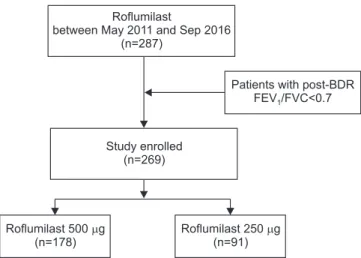
A total of 287 patients were prescribed roflumilast in our hospital during the study period. Of these, 18 patients who were incompatible with COPD according to their spirometry results were excluded. Finally, 269 COPD patients were in- cluded in the study. Among them, 178 patients were treated with 500 mg roflumilast once daily and 91 patients were treat- ed with 250 mg once daily (Figure 1).
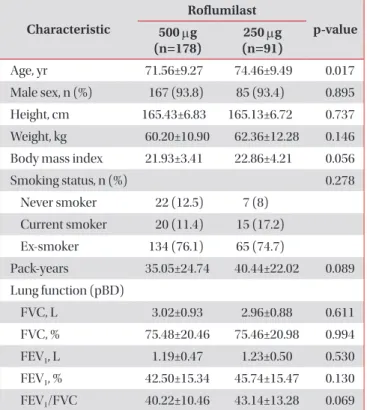
Baseline characteristics of the study population are shown in Table 1. The mean patient age (mean±SD) was 72.5±9.4 years, and 93.7% of the patients were male. The mean post- bronchodilator (pBD) forced expiratory volume in 1 second (FEV
1, % predicted) was 42.50±15.34% in 500 mg roflumilast treatment group and 45.74±15.47% in 250 mg roflumilast treat- ment group (p=0.130) and pBD FEV
1/forced vital capacity was 40.22±10.46 and 43.14±13.28, respectively (p=0.069). Overall, the demographics and baseline characteristics were similar between the groups, with the exception of age. Patients in the 250 mg roflumilast treatment group were older compared with the 500 mg roflumilast treatment group (p=0.017).
2. Incidence of AEs
During the study period, a higher percentage of patients in the 500 mg roflumilast treatment group reported AE than those in the 250 mg roflumilast treatment group. The incidence of AEs was 38.2% in the 500 mg treatment group and 25.3% in the 250 mg treatment group (p=0.034) (Figure 2A). One hun- dred and seventeen AEs were occurred, and 16 patients expe- rienced more than two AEs, 10 patients in 500 mg treatment
Patients with post-BDR FEV /FVC<0.71 Roflumilast
between May 2011 and Sep 2016 (n=287)
Study enrolled (n=269)
Roflumilast 500 g
(n=178) Roflumilast 250 g (n=91)
Figure 1. Flow diagram of the study. BDR: bronchodilator respon-
siveness; FEV
1: forced expiratory volume in 1 second; FVC: forced
vital capacity.
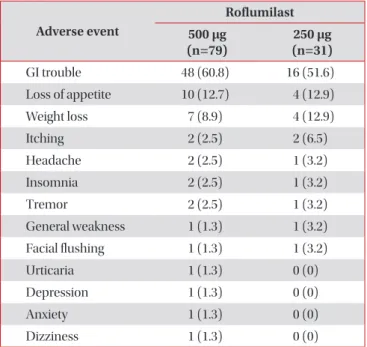
group, and 6 patients in 250 mg treatment group. The most common AEs were gastrointestinal symptoms including nau- sea, vomiting, and diarrhea (48 cases in the 500 mg treatment group and 16 cases in the 250 mg treatment group) (Table 2).
The next most common AEs were loss of appetite (10 cases vs.
4 cases), headache (2 cases vs. 1 case), insomnia (2 cases vs. 1 case), and tremor (2 cases vs. 1 case) in the 500 mg treatment group and 250 mg treatment group, respectively (Table 2). No patients died during the study period.
3. Discontinuation rate
Roflumilast was discontinued due to AEs in 74 patients (41.6%) in the 500 mg treatment group and 21 patients (23.1%) in the 250 mg treatment group. The discontinuation rate dif- fered significantly between the two groups (p=0.003) (Figure 2B). The mean duration of roflumilast use was 344.5±397.8 days (mean±SD). The proportion of patients continuing with roflumilast was analyzed between the two groups using the log-rank test (Figure 3A). There was a significant difference in the proportion of patients continuing with roflumilast (p=0.003). The survival rate for the continuation of roflumilast was lower in the 500 mg treatment group compared with the 250 mg treatment group. Cox’s regression was performed to find significant factors associated with the discontinuation of roflumilast. When adjusted by age, sex, smoking status, and lung function, a dose of 500 mg was significantly associated with the discontinuation of roflumilast (odds ratio [OR], 2.87;
p<0.001) (Table 3, Figure 3B).
Table 1. Demographics and baseline characteristics of the study patients
Characteristic
Roflumilast
p-value 500 mg
(n=178) 250 mg (n=91)
Age, yr 71.56±9.27 74.46±9.49 0.017
Male sex, n (%) 167 (93.8) 85 (93.4) 0.895 Height, cm 165.43±6.83 165.13±6.72 0.737 Weight, kg 60.20±10.90 62.36±12.28 0.146 Body mass index 21.93±3.41 22.86±4.21 0.056
Smoking status, n (%) 0.278
Never smoker 22 (12.5) 7 (8) Current smoker 20 (11.4) 15 (17.2) Ex-smoker 134 (76.1) 65 (74.7)
Pack-years 35.05±24.74 40.44±22.02 0.089 Lung function (pBD)
FVC, L 3.02±0.93 2.96±0.88 0.611
FVC, % 75.48±20.46 75.46±20.98 0.994 FEV
1, L 1.19±0.47 1.23±0.50 0.530 FEV
1, % 42.50±15.34 45.74±15.47 0.130 FEV
1/FVC 40.22±10.46 43.14±13.28 0.069 Values are presented as mean±SD.
pBD: post-bronchilator response; FVC: forced vital capacity; FEV
1: forced expiratory volume in 1 second.
A B C
Side effect ( ) Side effect (+)
Continuation Discontinuation
AE history ( ) (+) AE history 100
90 80 70 60 50 40 30 20 10
0
250 g 76.9%23.1%
500 g 58.4%
41.6%
p=0.003
100 90 80 70 60 50 40 30 20 10
0
250 g 14.3%85.7%
500 g 18.1%
81.9%
p=0.635 100
90 80 70 60 50 40 30 20 10
0
250 g 25.3%74.7%
500 g 38.2%
61.8%
p=0.034
Comparisonof sideeffectofroflumilast Comparisonof discontinuationofroflumilast Comparisonof exacerbationofroflumilast
Figure 2. Comparison of 500 mg roflumilast and 250 mg roflumilast treatment. (A) Comparison of the side effects of roflumilast. The incidence
of adverse effects was significantly higher in patients in the 500 mg treatment group (p=0.034). (B) Comparison of the discontinuation of ro-
flumilast. The discontinuation rate was significantly higher in patients in the 500 mg treatment group (p=0.003). (C) Comparison of the severe
exacerbation of roflumilast. There was no significant difference in severe exacerbation rate (p=0.635).
4. Effectiveness of roflumilast
During the study period, 96 patients maintained roflumilast for more than 1 year, 61 patients in 500 mg treatment group and 35 patients in 250 mg treatment group. The mean dura- tion of roflumilast use in these patients was 834.64±308.35 days (mean±SD). Eleven patients (18.1%) in 500 mg treatment
group and five patients (14.3%) in 250 mg treatment group ex- perienced at least one severe exacerbation. There was no sig- nificant difference between the two groups (p=0.635) (Figure 2C).
Discussion
COPD is a common, preventable, and treatable disease that is characterized by persistent respiratory symptoms and airflow limitation due to airway and/or alveolar abnormalities usually caused by significant exposure to noxious particles or gases
15. Chronic inflammation causes structural changes, narrowing of the small airways, and destruction of the lung parenchyma that leads to the loss of alveolar attachments to the small airways and decreases lung elastic recoil
15. A loss
Table 3. Cox’s regression for factors associated with the discontinuation of roflumilast
Variable Odds ratio 95% Confidence
interval p-value
Age 1.02 0.99–1.04 0.249
Male 0.40 0.16–1.01 0.051
Smoking 0.125
Never-smoker Reference
Current-smoker 1.11 0.46–2.64 0.819
Ex-smoker 0.64 0.30–1.34 0.237
Post-bronchodilator FEV
1,%
1.00 0.99–1.02 0.589
Roflumilast 500 mg 2.87 1.63–5.05 <0.001 FEV
1: forced expiratory volume in 1 second.
Table 2. Incidence of adverse effects Adverse event
Roflumilast 500 μg
(n=79) 250 μg
(n=31)
GI trouble 48 (60.8) 16 (51.6)
Loss of appetite 10 (12.7) 4 (12.9)
Weight loss 7 (8.9) 4 (12.9)
Itching 2 (2.5) 2 (6.5)
Headache 2 (2.5) 1 (3.2)
Insomnia 2 (2.5) 1 (3.2)
Tremor 2 (2.5) 1 (3.2)
General weakness 1 (1.3) 1 (3.2)
Facial flushing 1 (1.3) 1 (3.2)
Urticaria 1 (1.3) 0 (0)
Depression 1 (1.3) 0 (0)
Anxiety 1 (1.3) 0 (0)
Dizziness 1 (1.3) 0 (0)
Values are presented as number (%).
Adverse effects are listed in order of decreasing frequency based on the sum of the numbers of patients in each group in which the adverse effect occurred.
GI: gastrointestinal.
0 1.0
0.8
0.6
0.4
0.2
2,000
Proportionofcontinuation
Follow-up (day) 0.0
500 1,000 1,500 0
1.0
0.8
0.6
0.4
1,200
Proportionofcontinuation
Follow-up (day)
200 400 600 800 1,000
250 g 500 g
p=0.003
250 g 500 g