• 검색 결과가 없습니다.

Outcome of Inhaler Withdrawal in Patients Receiving Triple Therapy for COPD

N/A
N/A
Protected

Academic year: 2021

Share "Outcome of Inhaler Withdrawal in Patients Receiving Triple Therapy for COPD"

Copied!
9
0
0

로드 중.... (전체 텍스트 보기)

전체 글

(1)

Copyright © 2016

The Korean Academy of Tuberculosis and Respiratory Diseases. All rights reserved.

Outcome of Inhaler Withdrawal in Patients Receiving Triple Therapy for COPD

Sae Ahm Kim, M.D.

1

, Ji-Hyun Lee, M.D., Ph.D.

2

, Eun-Kyung Kim, M.D., Ph.D.

2

, Tae-Hyung Kim, M.D., Ph.D.

3

, Woo Jin Kim, M.D., Ph.D.

4

, Jin Hwa Lee, M.D., Ph.D.

5

, Ho Il Yoon, M.D., Ph.D.

6

, Seunghee Baek, Ph.D.

7

, Jae Seung Lee, M.D., Ph.D.

8

, Yeon-Mok Oh, M.D., Ph.D.

8

and Sang-Do Lee, M.D., Ph.D.

8

1

Department of Internal Medicine and

2

Division of Pulmonary and Critical Care Medicine, Department of Internal Medicine, CHA Bundang Medical Center, CHA University, Seongnam,

3

Division of Pulmonology, Department of Internal Medicine, Hanyang University Guri Hospital, Hanyang University College of Medicine, Guri,

4

Department of Internal Medicine, Kangwon National University College of Medicine, Chuncheon,

5

Department of Internal Medicine, Ewha Womens University Mokdong Hospital, Ewha Womens University School of Medicine, Seoul,

6

Seoul National University Bundang Hospital, Seoul National University College of Medicine, Seongnam,

7

Department of Clinical Epidemiology and Biostatistics, Asan Medical Center, University of Ulsan College of Medicine, Seoul,

8

Department of Pulmonary and Critical Care Medicine, Asthma Center, and Clinical Research Center for Chronic Obstructive Airway Diseases, Asan Medical Center, University of Ulsan College of Medicine, Seoul, Korea

Background: The purpose of this study was to document outcomes following withdrawal of a single inhaler (step-down) in chronic obstructive pulmonary disease (COPD) patients on triple therapy (long-acting muscarinic antagonist and a combination of long-acting β2-agonists and inhaled corticosteroid), which a common treatment strategy in clinical practice.

Methods: Through a retrospective observational study, COPD patients receiving triple therapy over 2 years (triple group;

n=109) were compared with those who had undergone triple therapy for at least 1 year and subsequently, over 9 months, initiated inhaler withdrawal (step-down group, n=39). The index time was defined as the time of withdrawal in the step- down group and as 1 year after the start of triple therapy in the triple group.

Results: Lung function at the index time was superior and the previous exacerbation frequency was lower in the step- down group than in the triple group. Step-down resulted in aggravating disease symptoms, a reduced overall quality of life, decreasing exercise performance, and accelerated forced expiratory volume in 1 second (FEV

1

) decline (54.7±15.7 mL/yr vs. 10.7±7.1 mL/yr, p=0.007), but there was no observed increase in the frequency of exacerbations.

Conclusion: Withdrawal of a single inhaler during triple therapy in COPD patients should be conducted with caution as it may impair the exercise capacity and quality of life while accelerating FEV

1

decline.

Keywords: Pulmonary Disease, Chronic Obstructive

Address for correspondence: Sang-Do Lee, M.D., Ph.D.

Department of Pulmonary and Critical Care Medicine, Asthma Center, and Clinical Research Center for Chronic Obstructive Airway Diseases, Asan Medical Center, University of Ulsan College of Medicine, 88 Olympic-ro 43-gil, Songpa-gu, Seoul 05505, Korea

Phone: 82-2-3010-3130, Fax: 82-2-3010-6968, E-mail: [email protected] Received: Oct. 1, 2015

Revised: Oct. 14, 2015 Accepted: Oct. 19, 2015

cc
It is identical to the Creative Commons Attribution Non-Commercial License (http://creativecommons.org/licenses/by-nc/4.0/).

(2)

Introduction

Chronic obstructive pulmonary disease (COPD) is charac- terized by persistent and progressive airflow limitation

1

. The principal therapeutic options aim to relieve symptoms and fu- ture risk

1

. In the current guidelines, inhalers are the mainstay for the pharmacological treatment of the disease

1-3

. Since long- acting β2-agonists (LABA) and long-acting muscarinic an- tagonists (LAMA) dilate airways by different mechanisms, the combination of LABA and LAMA results in greater broncho- dilation than either inhaler alone

4-6

. Another pharmacological therapy for COPD is inhaled corticosteroid (ICS). While the recommendation for ICS in the management of stable COPD is limited to special conditions

1,2

, in clinical practice, they are often prescribed in a combination inhaler with LABA, which provide greater symptom control, pulmonary function im- provement, and exacerbation reduction than either individual component in patients with moderated to severe COPD

7-9

. Theoretically, therefore, adding LAMA to a LABA/ICS combi- nation inhaler (i.e., triple therapy) could result in even greater treatment efficacy in COPD.

Given the progressive nature of COPD, most patients re- quire triple therapy at some point during the course of the disease. Moreover, in most cases (unlike in asthma), once such treatment has been started, it is generally maintained.

Nevertheless, there are triple therapy cases where one inhaler is withdrawn (step-down) because of a marked improvement in the symptoms or the development of side effects. However, no study has investigated the effects of step-down in COPD patients treated with triple therapy.

To investigate the effect of step-down (withdrawing one inhaler) in triple therapy, we retrospectively assessed the out- come of step-down in COPD patients who had been treated with LAMA and a LABA/ICS combination.

Materials and Methods

1. Patients

The data of all patients who were diagnosed with COPD in the Korean Obstructive Lung Disease (KOLD) Cohort were analyzed retrospectively. These patients were prospectively recruited from the 16 hospitals in South Korea in June 2005–

October 2012 and inclusion criteria have been described elsewhere

10

. At the enrolment visit, all patients were evaluated with medical interviews, physical examinations, spirometry, and lung volume, diffusing capacity, and 6-minute walk dis- tance (6MWD). The dyspnea degree was determined by using the modified Medical Research Council (MMRC) dyspnea scale. Health-related quality of life was evaluated by calculat- ing the total score in the validated Korean version of the St.

George’s Respiratory Questionnaire (SGRQ). Comorbidity

scores were calculated by using the updated Charlson comor- bidity index

11

. Chronic bronchitis was diagnosed if patients had a chronic cough and phlegm production for 3 months per year for at least 2 consecutive years. Volumetric computed tomography (CT) scans were performed by using a 16-multi- detector CT scanner (Somatom Sensation; Siemens Medical System, Bonn, Germany), and the automatically calculated volume fraction of the lung below –950 Hounsfield units at full inspiration was termed as the emphysema index (EI).

Thereafter, the patients were followed every 3 months: at each visit, they were asked about the compliance regarding the prescribed medication, degree of dyspnea, and exacerba- tion history in the previous 3 months. Pre-bronchodilator spi- rometry was performed every 6 months. Post-bronchodilator spirometry after inhalation of 400 mg of albuterol, diffusing ca- pacity, lung volume, 6MWD, and SGRQ were performed every 12 months. Spirometry (Vmax 22 instrument; SensorMedics, Yorba Linda, CA, USA and PFDX instrument; MedGraphics, St. Paul, MN, USA) was performed as recommended by the American Thoracic Society.

This study was approved by the Institutional Review Boards of all hospitals, and each patient provided written informed consent.

2. Study design

The KOLD Cohort patients who had been treated with LAMA and a LABA/ICS combination (i.e., triple therapy) for at least 1 year and had been followed for at least 2 years after the start of triple therapy were identified retrospectively. The patients who were treated continuously with triple therapy for more than 2 years were classified as the triple group. Patients who were treated with triple therapy at least for 1 year, after which LAMA or the LABA/ICS combination was withdrawn, and maintained only one inhaler without adding other long acting inhalers for at least 9 months was defined as the step- down group. The step-down group only included the patients who had not been prescribed discontinued inhaler for at least 9 months because it was considered that a period of at least 9 months was needed to evaluate the effect of step-down.

Patients who replied that their compliance to the prescribed inhaler was <70% were excluded.

Some patients in the step-down group restarted the discon- tinued inhaler: they were defined as the step-up group. The re- maining step-down patients who maintained the withdrawal were defined as the maintained step-down group.

Index time (IT) was defined as the time point of step-down in the step-down group. For the triple group, IT was arbitrarily defined as 12 months after the start of triple therapy. The vari- ables that were obtained in the visit just preceding the IT were considered to be the IT baseline data.

We defined an exacerbation as a severe episode that re-

quired hospitalization or a visit to the emergency room

12

. The

(3)

numbers of exacerbation in the year before and after the IT were determined.

At first, the IT baseline data were compared between the triple and step-down group, and then changes in variables after the IT relative to the baseline values were compared be- tween the two groups. The long-term effects of step-down (i.e., the effects over the entire follow-up period after the IT) on the decline of forced expiratory volume in 1 second (FEV

1

) and on the time-to-first exacerbation were also determined.

Some patients in the step-down group restarted the dis- continued inhaler (step-up group), and the data that were ob- tained after restarting the discontinued inhaler in the patients were not included in these analyses.

3. Statistical analysis

Descriptive statistics are presented as mean and standard deviation for normally distributed variables and as median (first and third quartiles) for non-normally distributed vari- ables. To compare the triple and step-down groups in terms of baseline characteristics at the IT, Student’s t test and chi- squared tests were used for the continuous variables and cat- egorical variables, respectively. To compare the two groups in terms of variable changes after IT relative to baseline, analysis of covariance (ANCOVA) was used for continuous variables, and logistic regression analysis was used for categorical vari- ables. To estimate the slopes of the long-term decline of FEV

1

in the various groups, a linear mixed effects model was fitted with fixed coefficients (fixed effects) for follow-up time, step- down group, follow-up time by step-down, baseline FEV

1

, gen- der, age, smoking status, chronic bronchitis, and comorbidity score. Random intercepts and coefficients (random effects) of subject and group (each eye nested within subject) for the effect of time were used. Time by step-down interaction ef-

fect was included to explore whether the groups differed in terms of FEV

1

slopes. To investigate the long-term effect of step-down on exacerbations, Cox proportional hazard models were fitted with time-to-first exacerbation while adjusting for step-down group, gender, age, baseline FEV

1

, smoking status, chronic bronchitis, comorbidity score, and previous exacerba- tion history. Statistical analyses were performed by using SAS version 9.3 (SAS Inc., Cary, NC, USA).

Results

1. Baseline characteristics at the IT

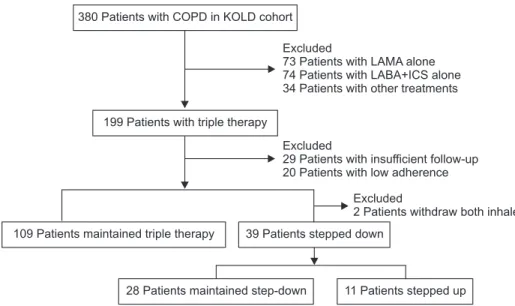
Of the 380 COPD patients in the KOLD Cohort, 181 patients were excluded because they were treated with either LAMA or a LABA/ICS combination inhaler alone (n=147) or oral medi- cations and/or other types inhalers (n=34). The remaining 199 patients had been treated with triple therapy for >1 year. Of these, 29 and 20 were excluded due to insufficient follow-up and low compliance to the prescribed inhaler(s), respectively.

Two patients who withdrew both inhalers were also excluded.

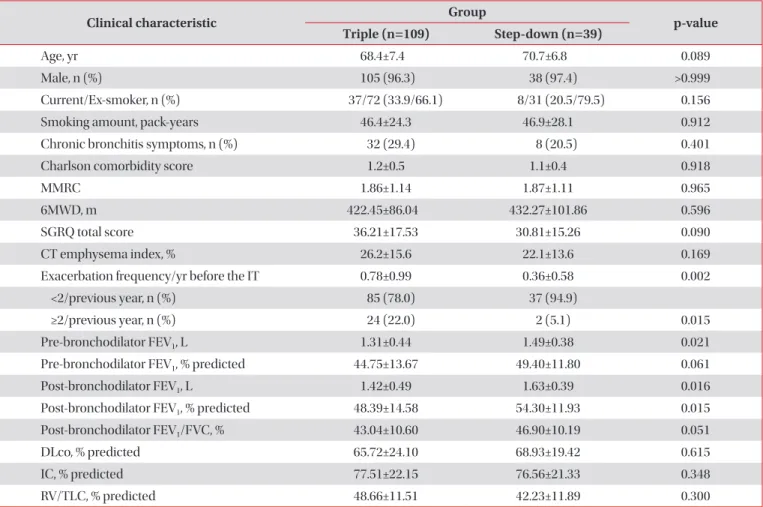
Thus, there were 148 patients left. Of these, 109 were included in the triple group and 39 were in the step-down group (Figure 1). The median duration of triple therapy before IT in step- down groups was 18 months (12–81 months).

Table 1 shows the baseline characteristics at IT of the triple and step-down groups. The two groups did not differ signifi- cantly in terms of age, gender distribution, smoking history, chronic bronchitis, comorbidty score, MMRC, 6MWD, SGRQ score, or EI. However, the step-down group had significantly lower exacerbation/yr frequencies before IT than the triple group (0.36±0.58 vs. 0.78±0.99, p=0.002). Moreover, of the 109 triple group patients, 24 (22%) had more than two exacerba-

Figure 1. Flow chart illustrating the disposition of the patients who were en- rolled and analyzed in the study. COPD:

chronic obstructive pulmonary disease;

KOLD: Korean Obstructive Lung Disease;

LAMA: long-acting muscarinic antago- nists; LABA: long-acting β2-agonists; ICS:

inhaled corticosteroid.

380 Patients with COPD in KOLD cohort

199 Patients with triple therapy

109 P atients maintained triple therapy 39 Patients stepped down

28 P atients maintained step-down 11 P atients stepped up Excluded

73 Patients with LAMA alone 74 Patients with LABA+ICS alone 34 Patients with other treatments

Excluded

29 Patients with insufficient follow-up 20 Patients with low adherence

Excluded

2 Patients withdraw both inhalers

(4)

tions in the previous year, which only two of the 39 step-down patients (5.1%) had (p=0.015). The step-down group also had significantly higher pre- and post-bronchodilator FEV

1

and percentage of predicted post-bronchodilator FEV

1

at IT than the triple group (p=0.021, p=0.016, and p=0.015, respectively).

2. Changes in COPD variables after the IT

Table 2 shows the changes relative to baseline in several COPD variables within 12 months after IT in the triple and step-down groups. Compared to the triple group, the step- down group exhibited a significant increase in the SGRQ total score and a significant decrease in 6MWD. Thus, the health status and exercise capacity of the patients aggravated after withdrawal. However, the triple and step-down groups did not differ in terms of changes in lung function variables, dyspnea degree, or exacerbation/year frequencies within 12 months

after IT.

3. Characteristics of the subgroups in the step-down group Among the patients in the step-down group, 17 and 22 withdrew LAMA and a LABA/ICS combination, respectively.

These two subgroups did not differ in terms of baseline char- acteristics except the patients who had withdrawn a LABA/

ICS combination inhaler had a lower exacerbation/yr fre- quency than the patients withdrawn LAMA (0.18±0.40/yr vs.

0.59±0.71/yr, p=0.029).

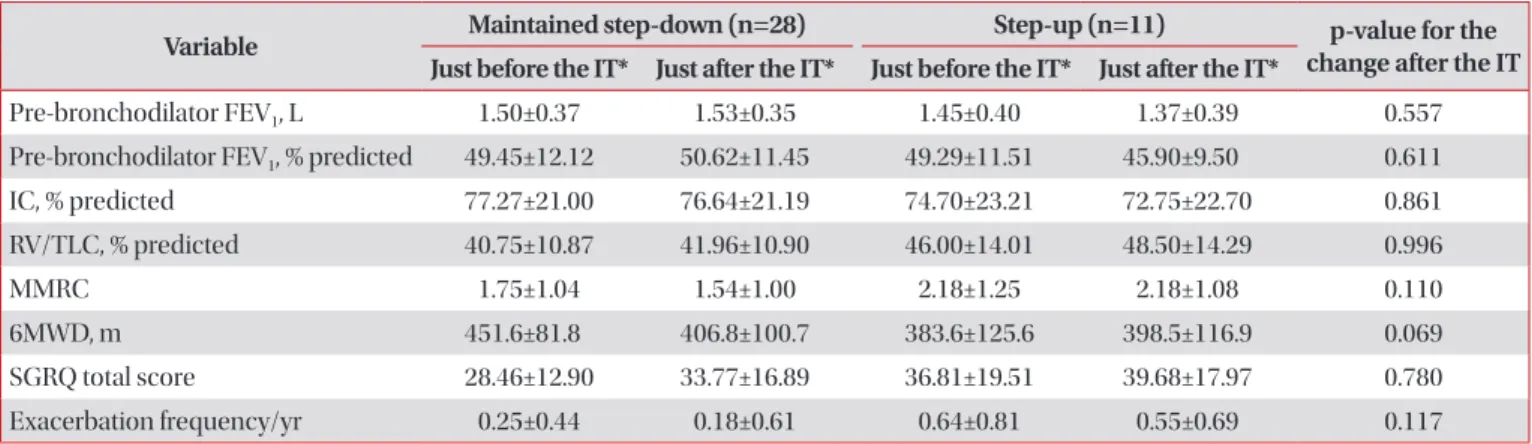
Of the 39 patients in the step-down group, 28 maintained step-down (maintained step-down group) and 11 restarted the discontinued drug (step-up group) during the follow-up period (Figure 1). The patients in the step-up group restarted the discontinued drug 17±8 months (9–33 months) after IT.

Six and five patients restarted LAMA and a LABA/ICS combi- Table 1. Demographic and baseline clinical characteristics at the index time

Clinical characteristic Group

p-value Triple (n=109) Step-down (n=39)

Age, yr 68.4±7.4 70.7±6.8 0.089

Male, n (%) 105 (96.3) 38 (97.4) >0.999

Current/Ex-smoker, n (%) 37/72 (33.9/66.1) 8/31 (20.5/79.5) 0.156

Smoking amount, pack-years 46.4±24.3 46.9±28.1 0.912

Chronic bronchitis symptoms, n (%) 32 (29.4) 8 (20.5) 0.401

Charlson comorbidity score 1.2±0.5 1.1±0.4 0.918

MMRC 1.86±1.14 1.87±1.11 0.965

6MWD, m 422.45±86.04 432.27±101.86 0.596

SGRQ total score 36.21±17.53 30.81±15.26 0.090

CT emphysema index, % 26.2±15.6 22.1±13.6 0.169

Exacerbation frequency/yr before the IT 0.78±0.99 0.36±0.58 0.002

<2/previous year, n (%) 85 (78.0) 37 (94.9)

≥2/previous year, n (%) 24 (22.0) 2 (5.1) 0.015

Pre-bronchodilator FEV

1

, L 1.31±0.44 1.49±0.38 0.021

Pre-bronchodilator FEV

1

, % predicted 44.75±13.67 49.40±11.80 0.061

Post-bronchodilator FEV

1

, L 1.42±0.49 1.63±0.39 0.016

Post-bronchodilator FEV

1

, % predicted 48.39±14.58 54.30±11.93 0.015

Post-bronchodilator FEV

1

/FVC, % 43.04±10.60 46.90±10.19 0.051

DLco, % predicted 65.72±24.10 68.93±19.42 0.615

IC, % predicted 77.51±22.15 76.56±21.33 0.348

RV/TLC, % predicted 48.66±11.51 42.23±11.89 0.300

Values are presented as the mean±standard deviation unless otherwise indicated.

p-values were generated by Student’s t tests for continuous variables and chi-squared tests for categorical variables.

MMRC: modified Medical Research Council; 6MWD: 6-minute walk distance; SGRQ: St. George’s Respiratory Questionnaire; CT, computed

tomography; IT: index time; FEV

1

: forced expiratory volume in 1 second; FVC: forced vital capacity; DLco: diffusing capacity of the lung for

carbon monoxide; IC: inspiratory capacity; RV: residual volume; TLC: total lung capacity.

(5)

nation inhaler, respectively. The maintained step-down and step-up groups did not differ significantly in terms of baseline variables at IT, although the patients in the step-up group tended to have worse lung function, poorer exercise perfor- mances, a lower quality of life, and more frequent exacerba-

tions (Table 3). Also, the two groups did not differ significantly in terms of change in the variables within 12 months after IT (Table 3).

Table 2. Changes in COPD variables after the index time

Variable Triple (n=109) Step-down (n=39) p-value for the

change after the IT Just before the IT* Just after the IT* Just before the IT* Just after the IT*

Pre-bronchodilator FEV

1

, L 1.31±0.44 1.28±0.46 1.49±0.38 1.48±0.36 0.752

Pre-bronchodilator FEV

1

, % predicted 44.75±13.67 44.53±14.45 49.40±11.80 49.33±11.01 0.485

IC, % predicted 77.51±22.15 76.05±24.19 76.56±21.33 75.60±21.28 0.470

RV/TLC, % predicted 48.66±11.51 49.60±11.38 42.23±11.89 43.83±12.12 0.983

MMRC 1.86±1.14 1.94±1.09 1.87±1.11 1.72±1.05 0.146

6MWD, m 422.45±86.04 413.07±99.16 432.27±101.86 403.85±105.52 0.019

SGRQ total score 36.21±17.53 36.91±19.22 30.81±15.26 35.25±17.10 0.037

Exacerbation frequency/yr 0.78±0.99 0.72±1.00 0.36±0.58 0.28±0.65 0.266

Values are presented as the mean±standard deviation.

p-values were obtained by analysis of covariance (ANCOVA) for continuous variables and logistic regression analysis for categorical variables. All analyses were adjusted for baseline FEV

1

, gender, age, smoking status, computed tomography emphysema index, and the time intervals when the variables were measured.

*“Just before the IT” refers to the most recent results before the IT and “Just after the IT” refers to the first results collected after the IT. MMRC was measured every 3 months, pre-bronchodilator FEV

1

was measured every 6 months, and IC, RV/TLC, 6MWD, SGRQ total score, and exacerbation/year were measured every 12 months.

COPD: chronic obstructive pulmonary disease; IT: index time; FEV

1

: forced expiratory volume in 1 second; IC: inspiratory capacity; RV:

residual volume; TLC: total lung capacity; MMRC: modified Medical Research Council; 6MWD: 6-minute walk distance; SGRQ: St. George’s Respiratory Questionnaire.

Table 3. Changes in variables after the index time in the maintained step-down and step-up groups

Variable Maintained step-down (n=28) Step-up (n=11) p-value for the

change after the IT Just before the IT* Just after the IT* Just before the IT* Just after the IT*

Pre-bronchodilator FEV

1

, L 1.50±0.37 1.53±0.35 1.45±0.40 1.37±0.39 0.557

Pre-bronchodilator FEV

1

, % predicted 49.45±12.12 50.62±11.45 49.29±11.51 45.90±9.50 0.611

IC, % predicted 77.27±21.00 76.64±21.19 74.70±23.21 72.75±22.70 0.861

RV/TLC, % predicted 40.75±10.87 41.96±10.90 46.00±14.01 48.50±14.29 0.996

MMRC 1.75±1.04 1.54±1.00 2.18±1.25 2.18±1.08 0.110

6MWD, m 451.6±81.8 406.8±100.7 383.6±125.6 398.5±116.9 0.069

SGRQ total score 28.46±12.90 33.77±16.89 36.81±19.51 39.68±17.97 0.780

Exacerbation frequency/yr 0.25±0.44 0.18±0.61 0.64±0.81 0.55±0.69 0.117

Values are presented as the mean±standard deviation.

p-values were obtained by analysis of covariance (ANCOVA) for continuous variables and logistic regression analysis for categorical variables. All analyses were adjusted for baseline FEV

1

, gender, age, smoking status, emphysema index, and the time intervals when the variables were checked.

*“Just before the IT” refers to the most recent results before the IT, and “Just after the IT” refers to the most recent results after the IT. MMRC was measured every 3 months, pre-bronchodilator FEV

1

was measured every 6 months, and IC, RV/TLC, 6MWD, SGRQ total score, and exacerbation/yr were measured every 12 months.

IT: index time; FEV

1

: forced expiratory volume in 1 second; IC: inspiratory capacity; RV: residual volume; TLC: total lung capacity; MMRC:

modified Medical Research Council; 6MWD: 6-minute walk distance; SGRQ: St. George’s Respiratory Questionnaire.

(6)

4. Effect of step-down on FEV

1

decline and exacerbations Although the short-term FEV

1

did not deteriorate after step- down, the step-down group exhibited more pronounced long- term annual declines in FEV

1

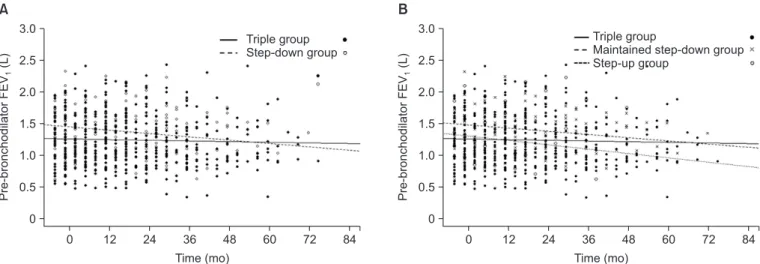
after IT than the triple group (54.7±15.7 mL/yr vs. 10.7±7.1 mL/yr, p=0.007) (Figure 2A).

With regard to the maintained step-down and step-up subgroups in the step-down group, their annual rates of FEV

1

decline were 52.9±14.6 mL/yr and 72.3±48.3 mL/yr, respec- tively (p=0.92) (Figure 2B). Comparison of the step-down pa- tients who discontinued LAMA or a LABA/ICS combination revealed that their annual rates of FEV

1

decline did not differ significantly (53.0±18.6 mL/yr vs. 52.5±17.4 mL/yr, p=0.98).

Figure 3 shows Kaplan-Meier curves for the estimated prob- ability of COPD exacerbations. The step-down patients had longer time-to-the first exacerbation than the triple patients (Figure 3A): the hazard ratio of the probability of exacerbation in step-down group was 0.400 (95% confidence interval [CI], 0.202–0.791; p=0.008) compared to the triple group. The main- tained step-down group also had a significantly longer time- to-first exacerbation than the triple group and step-up group, the hazard ratio was 0.221 (95% CI, 0.086–0.571; p=0.002) and 0.201(95% CI, 0.058–0.699; p=0.012) (Figure 3B), respectively.

A

0 12 24 36 48 60 72 84

3.0 2.5

2.0

1.5 1.0

0.5

0 Pre-bronchodilator FEV (L)

1

Time (mo)

Triple group Step-down group

0 12 24 36 48 60 72 84

3.0 2.5

2.0

1.5 1.0

0.5

0 Pre-bronchodilator FEV (L)

1

Time (mo) Triple group

Maintained step-down group Step-up group

B

Figure 2. Mean rate of change from baseline in pre-bronchodilator forced expiratory volume in 1 second (FEV

1

) during follow-up. (A) The de- cline in lung function in the step-down group after the index time was significantly accelerated compared to that in the triple group. (B) The maintained step-down and step-up groups had a significantly accelerated decline in lung function after the index time compared to the triple group.

A

Time (mo) Time (mo)

Maintained step-down group

B

0 12 24 36 48 60

1.0

0.8

0.6

0.4

0.2

0

Probability of no exacerbation

Triple group Step-down group

0 12 24 36 48 60

1.0

0.8

0.6

0.4

0.2

0

Probability of no exacerbation

Triple group Step-up group

Figure 3. Kaplan-Meier curves for the estimated probability of chronic obstructive pulmonary disease exacerbations. (A) The step-down

group had a significantly longer time to the first exacerbation than the triple group. (B) The maintained step-down group had a significantly

longer time to the first exacerbation than the triple group and also than the step-up group.

(7)

Discussion

In this retrospective observational study, we found that over 50% (199/380) of the KOLD cohort patients had been treated with triple therapy. Among them, about one-third of the patients tried to withdraw one of the two inhalers, and about one-third of those restarted their discontinued inhaler.

The patients in the step-down group showed relatively better lung function and fewer exacerbations before the step-down than the triple group patients, which suggests that the patients who underwent step-down may have had less severe COPD than the triple group patients. However, we also observed that when one of the two inhalers was withdrawn, the quality of life and exercise performance of the patients declined signifi- cantly. Moreover, even though the two groups did not differ significantly in terms of FEV

1

within 6 months after IT, the step-down group exhibited a faster long-term FEV

1

decline than the triple group, although this did not associate with an increased frequency of exacerbations.

Although the guidelines recommend that triple therapy should only be used in stable COPD for a narrow range of indications

1,2

, triple therapy is widely used in clinical practice.

The high prevalence of triple therapy prescription in our co- hort may be due in part to the fact that LABA-alone inhalers disappeared in 2007 in our country and were replaced by the LABA/ICS combination inhalers. Only in 2012 did indacaterol, a new ultra-long-acting LABA-alone inhaler, become available in our country. Therefore, despite the guidelines regarding ICS use in stable COPD, patients were inevitably treated with a LABA/ICS combination inhaler if a LABA was needed in this period.

While several studies suggested that triple therapy improves lung function and quality of life in COPD

13-15

, the benefit ap- pears to be rather small, and its clinical relevance remains uncertain

16,17

. There is also concern about ICS overuse in COPD

18

because of the elevated risk of side effects

19-21

. Two randomized controlled trials evaluated the effect of withdraw- ing ICS in COPD patients who are treated with a combina- tion of LABA/ICS; both showed that withdrawing ICS led to an acute and persistent deterioration in lung function and dyspnea, even when LABA treatment was continued

22,23

. Nev- ertheless, recent systematic reviews did not find evidence sup- porting the notion that withdrawing ICS causes the outcomes of COPD patients to deteriorate significantly

24,25

.

In the present study, we hypothesized that the FEV

1

firstly measured after IT would drop after step-down because the withdrawal of LAMA or LABA/ICS would eliminate the bronchodilatory effects of these drugs that are usually seen in the initial phase of the treatment

8,26

. We also hypothesized that drug discontinuation would not affect the long-term FEV

1

decline because at present, a drug that can modify the long-term decline of FEV

1

in COPD does not exist. However we found that step-down group exhibited a faster long-term

FEV

1

decline without short-term FEV

1

drop after IT. One of the possible explanations for the lack of acute deterioration of FEV

1

after step-down in the present study is that some of the patients who underwent step-down might still have had and used the remnants of previous prescriptions for the same kind of inhaler at home.

Our study showed that the pre-bronchodilator FEV

1

decline of the triple group was 10.7 mL/yr. This is smaller than the mean annual decline of pre-bronchodilator FEV

1

of 26 mL in the patients in the UPLIFT study who were treated with triple therapy (50% of the patients in the tiotropium-treated arm were also being treated with a combination LABA/ICS in- haler)

26

. In contrast, our patients in the step-down group had a greater annual decline of FEV

1

than other groups of patients treated with LAMA alone (mean pre-bronchodilator FEV

1

, 31–35 mL/yr; post-bronchodilator FEV

1

, 40–42 mL/yr) or a combination of LABA/ICS (mean post-bronchodilator FEV

1

, 39 mL) in other studies

8,26

.

The rate of FEV

1

decline in this study should be interpreted cautiously, because, the faster FEV

1

decline in the step-down group could also be explained by the additive loss of the bron- chodilatory effect of one inhaler after real withdrawal during the follow-up period. Also, the step-down group had a relative- ly higher baseline FEV

1

than the triple group, which is known to be one of the risk factors for a rapid decline in FEV

127

. In addition, several studies found that patients who discontinue treatment have a more rapid decline in lung function than those who continue treatment, although the reason for this is not clear

26,28

. All of these could explain, at least in part, why there was a relatively large difference between the step-down and triple groups in terms of annual FEV

1

decline.

Withdrawing one inhaler (step-down) did not affect the ex- acerbation frequency and step-down group had a significantly longer time-to-first exacerbation than triple group. However, it does not mean that step-down is always safe in terms of exac- erbation, because step-down group showed better FEV

1

and less exacerbation frequency before the IT. It is well known that the best predictors of future exacerbation in COPD are a his- tory of exacerbations and low FEV

129

. However, it is important to know that step-down did not lead to increase the exacerba- tion frequency.

Interestingly, the results of our study are similar to those of a recent study done by Magnussen et al.

30

, where stepwise withdrawal of ICS in severe stable COPD patients treated with triple therapy resulted in a significant decline in lung func- tion without increasing the frequency of moderate or severe exacerbations. Therefore, we speculated that the accelerated decline of lung function in our step-down group was due spe- cifically to the withdrawal of an ICS. However, the step-down patients who withdrew LABA/ICS did not differ from those who withdrew LAMA in terms of rate of FEV

1

decline.

Since this study was a retrospective observational study, it

has several limitations. First, the reason for discontinuing the

(8)

inhalers in the middle of treatment could not be determined.

It could have been because the patient exhibited marked im- provement in symptoms and/or lung function, or developed unbearable complications. It could also have reflected eco- nomic issues. Secondly, although we only included patients who replied that their inhaler compliance exceeded 70%, and we meticulously examined the medical records, this did not guarantee that individual patients actually took all of the prescribed medication. Also, patients who underwent step- down may not have withdrawn the inhaler at the IT, and may still have had and used medication remaining from previous prescriptions for some time. This could explain why the step- down group exhibited a significant deterioration in 6MWD and SGRQ (measured every 12 months) but not in MMRC (checked every 3 months) or pre-bronchodilator FEV

1

(mea- sured every 6 months), and may also explain the discrepancy between short-term FEV

1

change and long-term FEV

1

decline.

Lastly, we used the pre-bronchodilator FEV

1

for measuring FEV

1

decline rather than the more widely used post-bron- chodilator FEV

1

. This reflects the fact that in our cohort, each patient underwent pre-bronchodilator FEV

1

testing every 6 months while post-bronchodilator FEV

1

was tested every 12 months. Therefore, we considered pre-bronchodilator FEV

1

to be better for monitoring the change in FEV

1

soon after IT and the long-term decline of FEV

1

.

In conclusion, withdrawing one of the two inhalers during treatment with triple therapy in COPD patients aggravated the exercise capacity and quality of life. Additive loss of the bronchodilatory effect of one inhaler after the real withdrawal seemed to affect the rate of FEV

1

decline. However, step-down did not associate with an increased frequency of exacerba- tions. Tailoring or modification of the treatment regimen should always be considered to reduce the economic burden and unnecessary side effects of the treatment. Therefore, a well-designed randomized controlled study that precisely evaluates the effect of the step-down is needed. It is also im- portant to identify the patients in whom step-down would be safe or disadvantageous in terms of patient outcome.

Conflicts of Interest

No potential conflict of interest relevant to this article was reported.

Acknowledgements

This study was supported by a grant from the Korean Health 21 R&D Project, Ministry of Health and Welfare, Republic of Korea (HI10C2020 and A102065).

References

1. Global Initiative for Chronic Obstructive Lung Disease. Glob- al strategy for the diagnosis, management and prevention of COPD [Internet]. Bethesda: National Institutes of Health, GOLD; c2014 [cited 2014 Dec 1]. Available from: http://www.

goldcopd.org/guidelines-global-strategy-for-diagnosis-man- agement.html.

2. National Clinical Guideline Centre. Chronic obstructive pulmonary disease: management of chronic obstructive pulmonary disease in adults in primary and secondary care [Internet]. London: National Clinical Guideline Centre; c2010 [cited 2010 Jun 1]. Available from: http://guidance.nice.org.

uk/CG101/Guidance/pdf/English.

3. Qaseem A, Wilt TJ, Weinberger SE, Hanania NA, Criner G, van der Molen T, et al. Diagnosis and management of stable chronic obstructive pulmonary disease: a clinical practice guideline update from the American College of Physicians, American College of Chest Physicians, American Thoracic Society, and European Respiratory Society. Ann Intern Med 2011;155:179-91.

4. van Noord JA, Aumann JL, Janssens E, Verhaert J, Smeets JJ, Mueller A, et al. Effects of tiotropium with and without for- moterol on airflow obstruction and resting hyperinflation in patients with COPD. Chest 2006;129:509-17.

5. van Noord JA, Aumann JL, Janssens E, Smeets JJ, Zaagsma J, Mueller A, et al. Combining tiotropium and salmeterol in COPD: effects on airflow obstruction and symptoms. Respir Med 2010;104:995-1004.

6. Tashkin DP, Pearle J, Iezzoni D, Varghese ST. Formoterol and tiotropium compared with tiotropium alone for treatment of COPD. COPD 2009;6:17-25.

7. Calverley P, Pauwels R, Vestbo J, Jones P, Pride N, Gulsvik A, et al. Combined salmeterol and fluticasone in the treatment of chronic obstructive pulmonary disease: a randomised con- trolled trial. Lancet 2003;361:449-56.

8. Calverley PM, Anderson JA, Celli B, Ferguson GT, Jenkins C, Jones PW, et al. Salmeterol and fluticasone propionate and survival in chronic obstructive pulmonary disease. N Engl J Med 2007;356:775-89.

9. Mahler DA, Wire P, Horstman D, Chang CN, Yates J, Fischer T, et al. Effectiveness of fluticasone propionate and salmeterol combination delivered via the Diskus device in the treatment of chronic obstructive pulmonary disease. Am J Respir Crit Care Med 2002;166:1084-91.

10. Kim WJ, Oh YM, Sung J, Kim TH, Huh JW, Jung H, et al. Lung function response to 12-week treatment with combined inhalation of long-acting beta2 agonist and glucocorticoid according to ADRB2 polymorphism in patients with chronic obstructive pulmonary disease. Lung 2008;186:381-6.

11. Quan H, Li B, Couris CM, Fushimi K, Graham P, Hider P, et al.

Updating and validating the Charlson comorbidity index and

score for risk adjustment in hospital discharge abstracts using

(9)

data from 6 countries. Am J Epidemiol 2011;173:676-82.

12. Wedzicha JA, Seemungal TA. COPD exacerbations: defining their cause and prevention. Lancet 2007;370:786-96.

13. Singh D, Brooks J, Hagan G, Cahn A, O’Connor BJ. Superiority of “triple” therapy with salmeterol/fluticasone propionate and tiotropium bromide versus individual components in moder- ate to severe COPD. Thorax 2008;63:592-8.

14. Cazzola M, Ando F, Santus P, Ruggeri P, Di Marco F, Sanduzzi A, et al. A pilot study to assess the effects of combining fluti- casone propionate/salmeterol and tiotropium on the airflow obstruction of patients with severe-to-very severe COPD.

Pulm Pharmacol Ther 2007;20:556-61.

15. Aaron SD, Vandemheen KL, Fergusson D, Maltais F, Bour- beau J, Goldstein R, et al. Tiotropium in combination with placebo, salmeterol, or fluticasone-salmeterol for treatment of chronic obstructive pulmonary disease: a randomized trial.

Ann Intern Med 2007;146:545-55.

16. Karner C, Cates CJ. Combination inhaled steroid and long-act- ing beta(2)-agonist in addition to tiotropium versus tiotropi- um or combination alone for chronic obstructive pulmonary disease. Cochrane Database Syst Rev 2011;(3):CD008532.

17. Kew KM, Dias S, Cates CJ. Long-acting inhaled therapy (beta-agonists, anticholinergics and steroids) for COPD:

a network meta-analysis. Cochrane Database Syst Rev 2014;3:CD010844.

18. Barnes PJ. Inhaled corticosteroids in COPD: a controversy.

Respiration 2010;80:89-95.

19. Singh S, Amin AV, Loke YK. Long-term use of inhaled cortico- steroids and the risk of pneumonia in chronic obstructive pul- monary disease: a meta-analysis. Arch Intern Med 2009;169:

219-29.

20. Suissa S, Kezouh A, Ernst P. Inhaled corticosteroids and the risks of diabetes onset and progression. Am J Med 2010;123:

1001-6.

21. Singh S, Loke YK. An overview of the benefits and drawbacks of inhaled corticosteroids in chronic obstructive pulmonary disease. Int J Chron Obstruct Pulmon Dis 2010;5:189-95.

22. Wouters EF, Postma DS, Fokkens B, Hop WC, Prins J, Kui- pers AF, et al. Withdrawal of fluticasone propionate from combined salmeterol/fluticasone treatment in patients with COPD causes immediate and sustained disease deteriora- tion: a randomised controlled trial. Thorax 2005;60:480-7.

23. van der Valk P, Monninkhof E, van der Palen J, Zielhuis G, van Herwaarden C. Effect of discontinuation of inhaled cortico- steroids in patients with chronic obstructive pulmonary dis- ease: the COPE study. Am J Respir Crit Care Med 2002;166:

1358-63.

24. Nadeem NJ, Taylor SJ, Eldridge SM. Withdrawal of inhaled corticosteroids in individuals with COPD: a systematic review and comment on trial methodology. Respir Res 2011;12:107.

25. Agarwal R, Aggarwal AN, Gupta D, Jindal SK. Inhaled corti- costeroids vs placebo for preventing COPD exacerbations: a systematic review and metaregression of randomized con- trolled trials. Chest 2010;137:318-25.

26. Tashkin DP, Celli B, Senn S, Burkhart D, Kesten S, Menjoge S, et al. A 4-year trial of tiotropium in chronic obstructive pul- monary disease. N Engl J Med 2008;359:1543-54.

27. Tantucci C, Modina D. Lung function decline in COPD. Int J Chron Obstruct Pulmon Dis 2012;7:95-9.

28. Calverley PM, Spencer S, Willits L, Burge PS, Jones PW; IOSL- DE Study Group. Withdrawal from treatment as an outcome in the ISOLDE study of COPD. Chest 2003;124:1350-6.

29. Hurst JR, Vestbo J, Anzueto A, Locantore N, Mullerova H, Tal- Singer R, et al. Susceptibility to exacerbation in chronic ob- structive pulmonary disease. N Engl J Med 2010;363:1128-38.

30. Magnussen H, Disse B, Rodriguez-Roisin R, Kirsten A, Watz

H, Tetzlaff K, et al. Withdrawal of inhaled glucocorticoids and

exacerbations of COPD. N Engl J Med 2014;371:1285-94.

수치

Table 1 shows the baseline characteristics at IT of the triple  and step-down groups. The two groups did not differ  signifi-cantly in terms of age, gender distribution, smoking history,  chronic bronchitis, comorbidty score, MMRC, 6MWD, SGRQ  score, or EI
Table 2 shows the changes relative to baseline in several  COPD variables within 12 months after IT in the triple and  down groups
Table 3. Changes in variables after the index time in the maintained step-down and step-up groups
Figure 3 shows Kaplan-Meier curves for the estimated prob- prob-ability of COPD exacerbations

참조

관련 문서

The aim of this study was to provide a optimal drug therapy which secures effectiveness and safeness in elderly patients by analyzing polypharmacy and the

Purpose: This study was performed to identify the association between family support, ADL and depression among hospitalized older patients with chronic

The purpose of this study was to compare the microleakage of different adhesive systems (three 2-step adhesives and two 1-step adhesives) in class V

The purpose of this study was to examine the effects of football on PAPS in sports club activity for 12 weeks in middle school boys.. The following

Purpose: This study was aimed to compare the functional outcomes of the continuous and discontinuous fractures, retrospectively, in multiple thoracolumbar

Objective: The purpose of this study was to analyze recent trend in incidence of basal cell carcinoma and squamous cell carcinoma in patients from the Gwangju City

The purpose of this study was to identify the frequency and related factors of advanced airway management for patients with cardiac arrest by the

The purpose of this study was to examine the effects of a swimming program for 12 weeks on health-related physical fitness and growth hormone in