What Can We Apply to Manage Acute
Exacerbation of Chronic Obstructive Pulmonary Disease with Acute Respiratory Failure?
Deog Kyeom Kim, M.D., Ph.D.
1, Jungsil Lee, M.D.
1, Ju-Hee Park, M.D.
1and Kwang Ha Yoo, M.D., Ph.D.
21
Division of Pulmonary and Critical Care Medicine, Department of Internal Medicine, Seoul Metropolitan Government-Seoul National University Boramae Medical Center, Seoul National University College of Medicine, Seoul,
2Division of Pulmonary and Critical Care Medicine, Department of Internal Medicine, Konkuk University School of Medicine, Seoul, Korea
Acute exacerbation(s) of chronic obstructive pulmonary disease (AECOPD) tend to be critical and debilitating events leading to poorer outcomes in relation to chronic obstructive pulmonary disease (COPD) treatment modalities, and contribute to a higher and earlier mortality rate in COPD patients. Besides pro-active preventative measures intended to obviate acquisition of AECOPD, early recovery from severe AECOPD is an important issue in determining the long- term prognosis of patients diagnosed with COPD. Updated GOLD guidelines and recently published American Thoracic Society/European Respiratory Society clinical recommendations emphasize the importance of use of pharmacologic treatment including bronchodilators, systemic steroids and/or antibiotics. As a non-pharmacologic strategy to combat the effects of AECOPD, noninvasive ventilation (NIV) is recommended as the treatment of choice as this therapy is thought to be most effective in reducing intubation risk in patients diagnosed with AECOPD with acute respiratory failure.
Recently, a few adjunctive modalities, including NIV with helmet and helium-oxygen mixture, have been tried in cases of AECOPD with respiratory failure. As yet, insufficient documentation exists to permit recommendation of this therapy without qualification. Although there are too few findings, as yet, to allow for regular andr routine application of those modalities in AECOPD, there is anecdotal evidence to indicate both mechanical and physiological benefits connected with this therapy. High-flow nasal cannula oxygen therapy is another supportive strategy which serves to improve the symptoms of hypoxic respiratory failure. The therapy also produced improvement in ventilatory variables, and it may be successfully applied in cases of hypercapnic respiratory failure. Extracorporeal carbon dioxide removal has been successfully attempted in cases of adult respiratory distress syndrome, with protective hypercapnic ventilatory strategy.
Nowadays, it is reported that it was also effective in reducing intubation in AECOPD with hypercapnic respiratory failure.
Despite the apparent need for more supporting evidence, efforts to improve efficacy of NIV have continued unabated. It is anticipated that these efforts will, over time, serve toprogressively decrease the risk of intubation and invasive mechanical ventilation in cases of AECOPD with acute respiratory failure.
Keywords: Pulmonary Disease, Chronic Obstructive; Respiratory Insufficiency; Noninvasive Ventilation; Oxygen Inhalation Therapy; Carbon Dioxide
Address for correspondence: Deog Kyeom Kim, M.D., Ph.D.
Division of Pulmonary and Critical Care Medicine, Department of Internal Medicine, Seoul Metropolitan Government-Seoul National University Boramae Medical Center, Seoul National University College of Medicine, 20 Boramae-ro 5-gil, Dongjak-gu, Seoul 07061, Korea
Phone: 82-2-870-2228, Fax: 82-2-831-2826, E-mail: [email protected] Received: Aug. 10, 2017, Revised: Aug. 20, 2017, Accepted: Aug. 23, 2017 Published online: Jan. 24, 2018
cc
It is identical to the Creative Commons Attribution Non-Commercial License (http://creativecommons.org/licenses/by-nc/4.0/).
Copyright © 2018
The Korean Academy of Tuberculosis and Respiratory Diseases.
Introduction
Chronic obstructive lung disease is characterized by airflow limitation and chronic airway inflammation and it is expected to be the third leading cause of death in 2030
1. In the natural course of chronic obstructive pulmonary disease (COPD), acute exacerbation of chronic obstructive pulmonary disease (AECOPD) is a critical event leading to poorer outcomes of COPD. AECOPD is clinically defined as the events of increas- ing respiratory symptoms including dyspnea, cough, and sputum production, and increased sputum purulence
2,3. It is manifested with the exaggerated airway inflammation and bronchial obstruction.
AECOPD is a trigger for catastrophic cascades in COPD and it is one of the most important risk predictor for subsequent exacerbation, lung function decline, and mortality
4,5. Severe AECOPD requires hospitalization or visiting the emergency room and it may be associated with acute respiratory failure.
One-year mortality of patients with AECOPD requiring non- invasive ventilation (NIV) and intensive care unit (ICU) care is reported to be as high as 28% and 43%, respectively
6. There- fore, prevention of AECOPD is one of the most important goal in manging COPD. Once AECOPD develops, early recovery is crucial in determining prognosis of patients with COPD and delayed recovery from exacerbation accelerates decline in forced expiratory volume in 1 second (FEV
1)
7. Therefore, as well as prevention of AECOPD, efforts to recover from the disaster as soon as possible is required.
In this review, recent updates for management of AECOPD will be discussed with special focus on the patients with acute respiratory failure and life-threatening exacerbation.
Updated Management of AECOPD with Acute Respiratory Failure
1. Pharmacological treatment
Short acting bronchodilators (short-acting inhaled β2- agnosits, with or without short-acting anticholinergics) are recommended as an initial choice to treat an AECOPD
8. The short acting bronchodilators can be administered using nebu- lizer or metered dose inhaler (MDI) with spacer. Even though the emitted dose of drug is larger in nebulizer than MDI plus spacer, relative lung deposition of short acting bronchodilator following inhalation in AECOPD is similar in both delivery systems
9. Long-acting bronchodilators also should be applied as soon as possible in AECOPD.
Systemic steroids is a cornerstone of treating AECOPD and it can improve FEV
1, oxygenation, shorten recovery time, and hospital stay. Some data suggested the association between response to corticosteroids and blood eosinophil count
10. Recently, American Thoracic Society/European Respiratory
Society reported updated clinical recommendation for treat- ing AECOPD in terms of six key questions including “Should oral corticosteroids be used to treat ambulatory patients who are having a COPD exacerbation?”
8. It recommended a short course of oral corticosteroids even for ambulatory patients with AECOPD.
Although the roles of antibiotics in AECOPD have been debated, antibiotics can be used when patients have clini- cal sings of bacterial infection such as increased sputum and purulence. In a systemic review of placebo-controlled studies, antibiotics reduced short-term mortality, treatment failure, and sputum purulence
10.
2. Non-pharmacological ventilatory support
AECOPD with respiratory failure can be manifested with hypoxemic respiratory failure and/or ventilatory failure. Sup- plementary oxygen is essential to improve patient’s hypox- emia and it should be titrated as treatment goes on with target saturation of 88%–92% and assessing CO
2retention
11,12.
If respiratory acidosis progresses despite proper pharma- cological and oxygen therapy, ventilatory support should be considered and applied to treat acute respiratory failure. Until now, whereas NIV is regarded as the first choice for ventilatory support in AECOPD, the following some adjunctive strate- gies with NIV and high-flow nasal cannula (HFNC) oxygen therapy may have limited controlled trials and evidence for in AECOPD. However, recent updated reports may be help- ful in managing AECOPD with respiratory failure and show a breakthrough point in current practice.
1) Non-invasive ventilation
NIV is preferentially recommended in AECOPD over in-
vasive mechanical ventilation with intubation
12,13. Trends in
mechanical ventilation among patients with AECOPD have
been changed. For an example in U.K., all mechanical ventila-
tory support has been increased
14. Initial NIV increased by
15.1% yearly while invasive mechanical ventilation declined
by 3.2% as shown in Figure 1 and the trends is predominant as
the frequency of administration was increased and in patients
without pneumonia
14. NIV can reduce intubation risk and
complication including ventilatory associated pneumonia. It
is also favored in reducing mortality
15. The benefits of NIV is
achieved by recruitment of collapsed alveoli and improving
ventilation-perfusion imbalance resulting in improving oxy-
genation and respiratory acidosis. Positive ventilation will de-
crease work of breathing by increasing mean airway pressure
and decreasing air trapping. The efficacy of NIV in acute re-
spiratory failure due to AECOPD in terms of improving treat-
ment failure, mortality, and intubation risk is well reviewed in
remote and recent meta-analyses. Therefore, for hospitalized
patients with acute or acute-on-chronic hypercapnic respira-
tory failure due to AECOPD, the use of NIV is strongly recom-
mended. General indications for NIV include (1) respiratory acidosis (partial pressure of carbon dioxide [PaCO
2] ≥45 mm Hg and pH ≤7.35); (2) severe dyspnea with clinical signs in use of respiratory accessary muscles, paradoxical movement, and retraction of intercostal muscles; and (3) persistent hypox- emia despite oxygen therapy.
(1) NIV with a helmet: When NIV is applied with a face mask, patients frequently suffer from many complications including pressure intolerance, air leak related adverse effects (sleep disruption, reduced ventilation, and eye irritation), skin erosion on nasal bridge, naso-oral airway complications (dry- ness, nasal congestion, rhinitis, and bleeding), and aerophagia (eructation, flatulence, and abdominal disturbance)
16. Be- cause of high complication rate, overall failure of NIV occurs in 16%–30% of patients
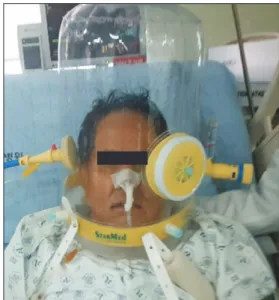
17. NIV with a helmet was developed to improve performance and reduce complication of NIV with mask. It has advantages in terms of nutrition and hydra- tion through patient access port, lower air leaks, no facial skin lesions, no eye irritation, and independence of the patient’s anatomy as shown in Figure 2. However, it has disadvantages for noise, larger dead space, and the risk of claustrophobia
17.
Despite the previous controversy on effects of oxygenation and CO
2retention, reduction on intubation rate and mortal- ity, recent studies reported favorable results. For example, in a randomized controlled study in patients with adult respiratory distress syndrome (ARDS), NIV delivered by helmet showed lower mortality and decreased endotracheal intubation (ab- solute difference –21.4% for mortality and –43.3% for endotra- cheal intubation)
18. Also, a recent meta-analysis of controlled studies for NIV with helmet in patients with acute respiratory failure showed that NIV with a helmet was associated with lower hospital mortality (odds ratio [OR], 0.43; 95% confidence interval [CI], 0.26–0.69; p=0.0005), intubation rate (OR, 0.32;
95% CI, 0.21–0.47; p<0.00001), and complications (OR, 0.6;
95% CI, 0.4–0.92; p=0.02)
17. However, until now, trials of NIV with helmet in patients with AECOPD have been rarely per- formed or tested in small population. In a small randomized controlled study recruited patients with AECOPD, there is no statistical difference in length of ICU stay, ICU mortality, NIV failure, and complications in helmet group and facial mask group
19. In a multi-center short-term randomized controlled study for patients with acute hypercapnic respiratory failure, NIV with hemet significantly improved ventilation parameters (pH, PaCO
2, partial pressure of oxygen [PaO
2]/fraction of in- spired oxygen [FiO
2], respiration rate), heart rate, and dyspnea score than baseline level and the improved results were simi- lar to those of oronasal mask
20. Therefore, helmet may be a valid alternative option to a mask in improving gas exchange and achieving a good tolerance to NIV. However, higher level of positive end-expiratory pressure or pressure support may be required to compendate the larger dead space
18.
(2) NIV with helium-oxygen mixture: Another adjunc- tive treatment for NIV ever tried is the use of helium-oxygen mixture (He/O
2). He/O
2has lower density than air/oxygen and it enhances transition to laminar flow and reduce den- sity dependent components of airway resistance. Therefore, hypothetically, it is expected to reduce NIV failure rate when using He/O
2instead of air/oxygen in AECOPD. However, in recent meta-analysis including relevant three randomized controlled trials enrolled a total of 772 patients, He/O
2didn’t reduce NIV failure rate and ICU mortality rate compared with air/oxygen
21. Nevertheless, NIV with He/O
2was associated with less NIV-related adverse events (OR, 0.56; 95% CI, 0.4–0.8;
p=0.001) and a shorter length of ICU stay (difference in means,
−1.07 day; 95% CI, −2.14 to −0.004; p=0.049) in hypercapnic
25
20
15
10
5
0
AnnualrateofinitialNIV(%)
2001 2002 2003 2004 2005 2006 2007 2008 2009 2010 2011 Year
IMV initial
NIV initial Any MV
Figure 1. Trends in initial ventilation. IMV: invasive mechanical ven- tilation; MV: mechanical ventilation; NIV: noninvasive ventilation.
Adapted from Stefan et al. Chest 2015;147:959-68, with permission of Elsevier
14.
Figure 2. A patient with acute respiratory failure supported by non-
invasive ventilation with a helmet (The patient provided written
informed consent).
COPD exacerbation
21.
An extended prospective, randomized, open-label trial in 16 ICUs and six countries was performed to elucidate the ef- ficacy of He/O
2with continuous administration for 72 hours in severe exacerbation of COPD. This trial was closed early due to low global NIV failure rate and the primary outcomes, NIV failure rate and intubation rate, were not different in He/
O
2and air/oxygen group. In subgroup analysis for patients failed with NIV, the ventilation duration and length of ICU stay was significantly shorter in He/O
222. Additionally, primary out- comes seemed to be better in trends and showed better ven- tilation outcomes for initial three days of treatment without final statistical significance
22.
(3) NIV with extracorporeal CO
2removal: Extracorpore- al life support (ECLS) has been rapidly progressed for treating ARDS and expanding its indications including hypercapnic respiratory failure, bride to lung transplantation, earlier use in less severe hypoxemic respiratory failure, resuscitation of donor lungs before transplantation, and bridge to early mobil- ity
23. Extracorporeal CO
2removal (ECCO
2R) as a kind of ECLS has been focused on improving hypercapnia during protec- tive ventilation strategy in ARDS. Comparing with convention- al extracorporeal membrane oxygenation, ECCO
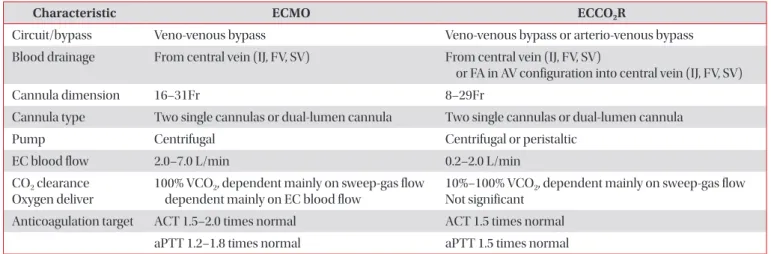
2R presents many advantages including a lower blood flow rate and con- sequently smaller veno-venous catheters (Table 1). Therefore, ECCO
2R has been applied for non-ARDS hypercapnic respi- ratory failure as case studies or single centered prospective pilot studies
23. In a multicenter retrospective randomized con- trolled study in patients with hypercapnic respiratory failure failing NIV, arterio-venous ECCO
2R group avoided intubation risk (10% for intervention group vs. 100% for controlled group) and showed short term and long-term survival
24. Another multicenter matched cohort study with historical control in
patients with hypercapnic respiratory failure also decreased the risk of intubation to a third
25. In the matched cohort study with historical control, when ECCO
2R with NIV was applied for hypercapnic patients at risk of NIV failure, respiratory vari- ables such as PaCO
2, arterial pH, respiratory rate, and PaO
2/ FiO
2were significantly improved and cumulative incidence of endotracheal intubation (hazard ratio, 0.27; 95% CI, 0.07–0.98;
p=0.047) and hospital mortality (8% vs. 35%, p=0.0347) were significantly lowered in patients applied with NIV and EC- CO
2R
25. Recently, a multicenter case-control study was per- formed in five European ICUs to evaluate the feasibility and safety of avoiding invasive mechanical ventilation by using ECCO
2R in patients with AECOPD and acute hypercapnic respiratory failure refractory to NIV
26. Although it was a small study, the primary outcome, intubation risk was avoided in 56% of patients in the ECCO
2R group with extracorporeal blood flow of 1.3 L/min. In this trial, major bleeding was de- veloped in 36% of patients which was significantly higher than compared with control (8%)
26. Further studies with ECCO
2R for prevention of intubation in AECOPD, facilitating extuba- tion, and benefits in stable COPD with chronic hypercapnic failure are ongoing.
Modern ECLS including ECCO
2R offers new and promis- ing therapeutic options in patients with COPD in acute on chronic respiratory failure. However, severe complications including hemorrhage and needs for further evidence on the overall efficacy in AECOPD may be obstacles to expanding clinical application of NIV with ECCO
2R
23. Also, the right indi- cation, timing, and strategy for applying ECCO
2R in patients with AECOPD should be further explored
27.
2) HFNC oxygen therapy
HFNC oxygen therapy can deliver a heated and humidified
Table 1. Characteristics of ECMO and ECCO
2R
Characteristic ECMO ECCO
2R
Circuit/bypass Veno-venous bypass Veno-venous bypass or arterio-venous bypass Blood drainage From central vein (IJ, FV, SV) From central vein (IJ, FV, SV)
or FA in AV configuration into central vein (IJ, FV, SV)
Cannula dimension 16–31Fr 8–29Fr
Cannula type Two single cannulas or dual-lumen cannula Two single cannulas or dual-lumen cannula
Pump Centrifugal Centrifugal or peristaltic
EC blood flow 2.0–7.0 L/min 0.2–2.0 L/min
CO
2clearance Oxygen deliver
100% VCO
2, dependent mainly on sweep-gas flow dependent mainly on EC blood flow
10%–100% VCO
2, dependent mainly on sweep-gas flow Not significant
Anticoagulation target ACT 1.5–2.0 times normal ACT 1.5 times normal aPTT 1.2–1.8 times normal aPTT 1.5 times normal
ECMO: extracorporeal membrane oxygenation; ECCO
2R: extracorporeal carbon dioxide removal; IJ: internal jugular vein; FV: femoral vein;
SV: subclavian vein; VCO
2: carbon dioxide production; EC: extracorporeal; ACT: activated clotting time; aPTT: activated partial thromboplas-
tin time.
air flow of 20–50 L/min with or without supplementary oxy- gen and it has been reported to be an effective method to pre- vent post-extubation respiratory failure and reduce intubation failure rate in acute hypoxemic respiratory failure. Physiologi- cally, HFNC oxygen therapy reduces functional dead space and decrease nasopharyngeal resistance and exerts a positive expiratory pressure effect and increase alveolar recruitment resulting in improving ventilation-perfusion mismatching
28. It also contributes to humidify airway mucosa. In patients with stable hypercapnic COPD, the overall physiologic effects can lead to improve respiratory pattern (decreased respiration rate, increased tidal volume, increased airway pressure, decreased work of breathing, and improving hypercapnia, etc.) in a minor flow dependent pattern (Figure 3)
29,30.
Despite HFNC oxygen therapy showed beneficial effects in acute hypoxemic respiratory failure
31, the clinical significance of HFNC oxygen therapy in AECOPD has not been widely studied and the role of HFNC oxygen therapy in hypercapnic respiratory failure may be controversial. Recently, a small ran- domized controlled cross-over trial to evaluate the physiologic effects of titrated oxygen via HFNC compared with standard nasal prongs in Asian patients with AECOPD by measur- ing transcutaneous CO
2tension (PtCO
2)
32. The difference in PtCO
2adjusted for time zero was significantly lower after 30 minutes for HFNC compared with standard nasal prong (–1.4 mm Hg) (95% CI, –2.2 to –0.6, p=0.001) while there was no dif- ference in SpO
2(p=0.96).
Conclusion
As well as pharmacologic treatment, NIV is recommended as a beneficial strategy to reduce intubation risk in AECOPD
with acute respiratory failure. Overcoming shortness of con- ventional NIV, some adjunctive modalities including NIV with helmet and helium-oxygen mixture have been tried. NIV with a helmet was noninferior to conventional facial mask in reducing intubation risk while avoiding commo complica- tions of mask. Until now, NIV with helium-oxygen mixture didn’t show any superiority compare to air-oxygen ventilation in terms of NIV failure rate and ICU mortality. HFNC oxygen therapy is another supportive strategy improving hypoxic re- spiratory failure and it also showed improvement in ventilato- ry variables and can be applicable in hypercapnic respiratory failure. As ECCO
2R has been successfully applied in ARDS with protective hypercapnic ventilatory strategy, some reports showed effectiveness in reducing intubation in AECOPD with hypercapnic respiratory failure adjunctive with NIV. Currently, despite the shortness of evidence, efforts to improve efficacy of NIV will be continued and it may be expected to decrease the risk of intubation and invasive mechanical ventilation in AECOPD with acute respiratory failure.
Conflicts of Interest
No potential conflict of interest relevant to this article was reported.
References
1. European Respiratory Society. European Respiratory Soci- ety’s white book. Sheffield: European Respiratory Society;
2016.
2. Yoon HK, Park YB, Rhee CK, Lee JH, Oh YM; Committee of Figure 3. The effect of high-flow nasal cannula oxygen therapy on changes in mean airway pressure (A) and tidal volume (B) in patients with stable hypercapnic chronic obstructive pulmonary disease. nCPAP: nasal continuous positive airway pressure; nBiPAP: nasal bi-level posi- tive airway pressure. Adapted from Braunlich et al. Int J Chron Obstruct Pulmon Dis 2016;11:1077-85, according to the Creative Commons license Dove Medical Press
30.
200 180 160 140 120 100 80 60 Percentagechangesintidalvolume 40
B
20 L/min
30 L/min
40 L/min
50 L/min
nCPAP 6 mbar
nCPAP 10 mbar
n PAP 14/6 mbar
Bi
* * * *
* * *
**
**
**
A
12 10 8
6 4
2 0 Increaseinmeanairway pressure(mbar)
nCPAP 6 mbar
nCPAP 10 mbar
nBiPAP 14/6 mbar 20
L/min 30 L/min
40 L/min
50 L/min