ABSTRACT
Purpose: It has been previously reported that breast tumor incidence, growth, and metastasis are stimulated by high-fat diet but reduced by caloric restriction. However, few studies have elucidated the effects of dietary change from a high-fat diet after breast cancer initiation.
Therefore, in this study, we attempted to provide practical assistance to breast cancer prevention and management by investigating the effects of dietary change from a high-fat diet to normal diet on breast cancer growth and metastasis.
Methods: The experimental animals were divided into 2 groups (high-fat diet control [HFC]
group and diet restriction [DR] group) and consumed a high-fat diet for 8 weeks. 4T1 cells were transplanted into subcutaneous fat or tail vein to measure the growth and metastasis of breast cancer. The HFC and DR groups continuously ingested either high-fat diet or AIG-93G diet for 5 weeks or 3 weeks, respectively. Cell proliferation and apoptosis markers from tumor tissues were analyzed by Western blot analysis. The data were analyzed using the SPSS 25.0 package program.
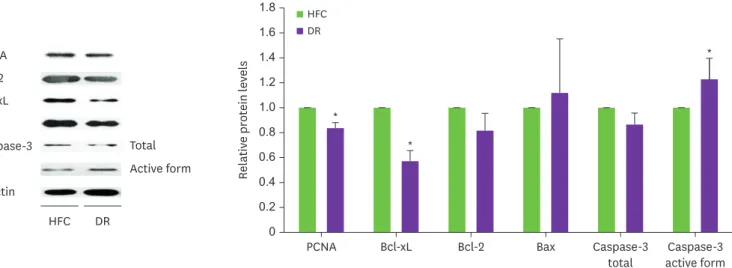
Results: The results show that the DR group significantly reduced breast tumor initiation, growth, and tumor tissue weight compared to the HFC group. The DR group suppressed tumor growth by decreasing proliferation and inducing apoptosis through down-regulation of Bcl-xL and up-regulation of caspase-3 activity. Furthermore, the DR group significantly reduced numbers of metastasized tumors in lung tissues.
Conclusion: These results suggest that dietary change from a high-fat diet to normal diet decreased breast growth by reducing cell proliferation and inducing apoptosis and metastasis.
Taken together, these results indicate that dietary change to a low-fat and balanced diet might suppress breast tumor growth and metastasis even after tumor diagnosis.
Keywords: breast cancer, high-fat diet, apoptosis, metastasis
Research Article
Received: May 18, 2020 Revised: Jun 16, 2020 Accepted: Jun 18, 2020 Correspondence to Jung-Hyun Kim
Department of Physical Education, Chung-Ang University, 84 Heukseok-ro, Dongjak-gu, Seoul 06974, Korea.
Tel: +82-2-820-5378 E-mail: [email protected]
© 2020 The Korean Nutrition Society This is an Open Access article distributed under the terms of the Creative Commons Attribution Non-Commercial License (http://
creativecommons.org/licenses/by-nc/3.0/) which permits unrestricted non-commercial use, distribution, and reproduction in any medium, provided the original work is properly cited.
ORCID iDs Seung hwa Park
https://orcid.org/0000-0003-3318-0784 InKyung Jung
https://orcid.org/0000-0003-3914-4143 Jung-Hyun Kim
https://orcid.org/0000-0001-5882-4094 Funding
This work was supported by the Ministry of Education of Republic of Korea and the National Research Foundation of Korea (NRF- 2017S1A5B8067020).
Conflict of Interest
There are no financial or other issues that might lead to conflict of interest.
Effect of dietary changes from high-fat diet to normal diet on breast cancer growth and metastasis
Seung hwa Park , InKyung Jung , and Jung-Hyun Kim
Department of Physical Education, Chung-Ang University, Seoul 06974, Korea
고지방식이에서 일반식이로의 전환이 유방암의 성장 및 전이에 미치는 영향
박성화 , 정인경 , 김정현
중앙대학교 체육교육과
서론
1990 년 이후 한국인의 사망원인 1 위는 악성종양으로 해마다 암으로 인한 사망률이 증가하고
있으며 , 발생하는 암의 종류도 생활 패턴과 식생활의 서구화로 인해 변화되고 있다 [1,2]. 최
근 연구 보고에 따르면 , 우리나라의 경우 서구 사회에서 많이 발생하는 암인 유방암 , 전립선 암 , 대장암의 발병률이 꾸준히 증가하는 추세로 나타났으며 [3], 특히 유방암은 우리나라 여 성들에게 가장 빠르게 증가하는 암으로 보고되었다 [3]. 서구 사회의 경우 , 유방암은 연령이 증가할수록 발병률이 증가하는 것으로 나타났으나 , 우리나라의 경우 40 대 이하의 여성이 전
체 환자의 55.7% 를 차지할 만큼 젊은 여성의 발병률이 높아지고 있으며 [2], 갑상선암 다음으
로 발병률이 높은 암으로 보고되었다 [3].
유방암 발생은 초경 , 폐경 , 출산 시기 , 수유 경험 등 유전적 · 환경적인 요인에 의해 영향을 받 으며 , 고지방식 , 고칼로리로 대변되는 서구화된 식생활과 비활동적인 생활습관에 의해 발병
률이 증가되는 것으로 보고되고 있다 [4]. 서구화된 식습관과 비활동적인 생활습관은 체지
방의 양을 증가시킴으로써 비만을 유발하며 , 이로 인해 체내 염증반응이 증가하여 암의 생성 과 성장을 촉진시키는 것으로 나타났다 [5-8].
비만은 유방암의 위험 인자일 뿐 아니라 유방암의 치료 및 재발 , 생존에도 영향을 주는 환 경요인으로 알려져 있다 [9]. 국민건강영양조사 결과에 의하면 전체 유방암 생존자의 2/3 가 과체중 이상으로 나타났으며 , 체지방률이 30% 를 넘는 경우도 89.2% 인 것으로 보고되었다 [10]. 또한 , Rooney 와 Wald [11] 는 50%–96% 의 여성이 유방암 진단 후 평균 2.5–5.2 kg 의 체중 이 증가하였으며 , 체중 증가에 따른 비만은 유방암 유발에 대한 위험률을 증가시킬 뿐 아니 라 유방암 진단 후 예후를 악화시키고 삶의 질을 저하시킨다고 보고하였다 . 비만인 여성의 경우 체지방으로 부터 에스트로겐 분비가 증가되어 유방암의 발생 위험이 높아질 뿐 아니라 유방암 진단 후 체중이 증가하게 되면 암 재발률이 1.5 배 , 사망률이 1.6 배 증가하는 것으로 알 려져 있어 비만이 유방암의 성장과 전이의 위험을 증가시키는 것으로 나타났다 [2]. 특히 , 비 만을 유발하는 주요 요인 중 고지방식이는 유방암의 생성과 성장 , 전이를 촉진시키는 것으로 보고되어 유방암 생성 및 전이 억제를 위해 체중 조절과 함께 건강하고 균형 있는 식이를 섭 취하는 것이 매우 중요한 것으로 보고되었다 [12-14].
유방암을 조기에 발견하면 수술이나 방사선 및 화학적 요법으로 치료가 가능하나 다양한 부
작용을 겪게 되며 , 전이가 된 경우 , 치료가 어려울 뿐 아니라 여러 합병증에 의해 사망에 이르
게 될 수 있다 . 따라서 , 유방암 발견 시 유방암의 성장과 전이를 안전하게 억제할 수 있는 방안
이 강구되고 있으며 , 다양한 기능성 식품의 섭취나 식이 조절 , 열량 제한 등이 안전하게 유방
암의 성장과 전이를 억제하는 것으로 보고되었다 [15,16]. 그러나 , 대부분의 연구에서는 유방
암 생성 이전의 열량 제한에 의한 암 억제 효과나 식이 섭취 시간 제한에 의한 영향을 검증하
였으며 , 유방암의 생성이나 전이 이후 열량이나 식이 제한에 대한 연구는 매우 미흡한 실정
이다 . 이에 본 연구에서는 정상식이로의 전환이 고지방식이로 인해 촉진된 유방암의 성장과
전이에 미치는 영향과 그 기전을 알아보고자 한다 .
연구방법
연구설계
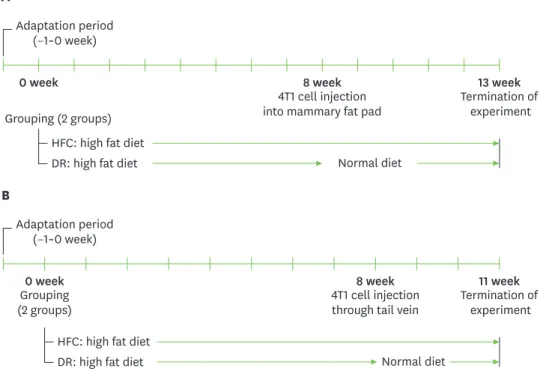
고지방식이에서 일반식이로의 전환이 유방암세포의 성장 (Fig. 1A) 과 전이 (Fig. 1B) 에 미치는
영향을 알아보기 위해 Fig. 1
과같이 실험을 진행하였다 . 실험 동물을 1 주간 기본 식이 (AIN-
93G) 로 실험 환경에 적응시킨 후 임의적으로 고지방식이 유방암 유도군 (high-fat diet control;
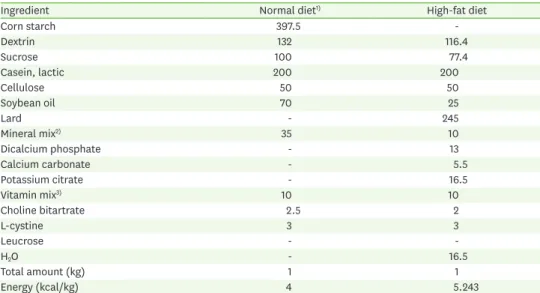
HFC) 과 고지방식이 후 일반식이로 전환한 유방암 유도군 (diet restriction; DR) 으로 나누었 다 . 일반식이와 고지방식이의 조성은 Table 1 과 같다 . 모든 군은 8 주간 고지방식이로 비만을
유발한 후 유방암 세포인 4T1 세포를 유방 조직에 이식하거나 꼬리 정맥을 통해 전이시켰으
며 , DR 군은 식이를 AIN-93G 로 전환하고 , 대조군 (HFC) 은 고지방식이를 계속 유지시켰다 . 유
방암 성장 실험은 유방암 세포 이식 5 주 후 , 전이 실험은 3 주 후에 종료하였으며 , 본 동물 실험 은 중앙대학교의 동물윤리위원회에 의해서 승인받아 실시되었다 ( 승인번호 : 2016-00099).
실험동물
실험 동물은 Koatech (Seoul, Korea) 에서 8 주령의 Balb/c female mouse 20 마리씩 나누어 분양
받아 사용하였으며 , 온도 22 ± 1°C, 습도 55 ± 1°C, 12 시간 간격으로 점등과 소등을 반복한 동물 실험실에서 사육되었다 . 체중과 유방암의 크기는 매주 2 회 측정하였다 .
세포 배양 및 유방암과 전이 유도
Balb/c mouse 에 유방암을 유도하기 위해 4T1 (CRL-2539™) 세포를 이승민 교수님 ( 연세대학
교 ) 께 받아 사용하였다 . 4T1 세포는 37°C, 5% CO
2, 90% 이상 습도가 유지된 항온기에서 10%
A
Adaptation period (−1~0 week)
4T1 cell injection
into mammary fat pad Termination of
experiment
0 week 8 week 13 week
Normal diet Grouping (2 groups)
HFC: high fat diet DR: high fat diet B
Adaptation period (−1~0 week)
4T1 cell injection
through tail vein Termination of experiment
0 week 8 week 11 week
Normal diet Grouping
(2 groups)
HFC: high fat diet DR: high fat diet
Fig. 1. Experimental study design. After 1 week of adaptation, 8-week-old Balb/c mice were fed a high-fat diet for 8 weeks, and then 4T1 mouse mammary tumor cells were transplanted into their mammary fat pads (1 × 10
4) (A) or injected into tail vein (5 × 10
3). After tumor cell injection (B), DR group was fed a normal diet and HFC group was continuously fed a high-fat diet until the experiments ended (n = 10 per group).
HFC, high-fat diet control; DR, diet restriction.
fetal bovine serum (Gibco; Thermo Fisher Scientific, Waltham, MA, USA), 1% penicillin strepto- mycin (WelGENE, Daegu, Korea), 1% non-essential amino acid (WelGENE) 가 포함된 Roswell
Park Memorial Institute 1640 (WelGENE) 배지를 이용하여 계대 배양하였다 . 원발성 종양 (pri-
mary tumor) 을 유도하기 위해 4T1 세포를 trypsin 처리하여 단세포의 형태로 만든 후 , mam-
mary fat pad 에 1 × 10
4개를 피하 주사하였다 . 또한 , 유방암의 전이를 유도하기 위해 적외선 램
프로 Balb/c mouse 의 체온을 상승시켜 혈관을 확장시킨 후 , 5 × 10
3개의 4T1 세포를 꼬리 정맥
을 통해 전이시켰다 . 유방암의 개시 및 성장 측정
암의 개시는 종양이 처음 촉진된 시점을 말하는 것으로 8 mm
3이상 일 때를 기준으로 계산
하였다 . 유방암의 부피는 버니어 캘리퍼스 (Mitutoyo, Kawasaki, Japan) 를 이용하여 주 2 회 종
양의 가장 긴 지름과 가장 짧은 지름을 측정하였으며 , 피하 두께를 제외하기 위해 지름에서 1 mm 를 빼고 지름을 계산하였다 . 종양의 부피는 4/3πr
3공식으로 계산하였다 [17].
시료 채취
유방암 유도 5 주 , 유방암 전이 3 주 후 조직 채취를 위해 실험동물을 전신 마취제 (isoflu-
rane) 로 마취시킨 후 종양 , 간 , 비장 , 신장 주변 지방조직을 적출하여 차가운 phosphate
buffer saline 로 혈액을 제거한 후 여과지로 수분을 제거하고 장기의 무게를 측정하였다 .
Table 1. Ingredients of the experimental diets (g/kg diet)
Ingredient Normal diet
1)High-fat diet
Corn starch 397.5 -
Dextrin 132 116.4
Sucrose 100 77.4
Casein, lactic 200 200
Cellulose 50 50
Soybean oil 70 25
Lard - 245
Mineral mix
2)35 10
Dicalcium phosphate - 13
Calcium carbonate - 5.5
Potassium citrate - 16.5
Vitamin mix
3)10 10
Choline bitartrate 2.5 2
L-cystine 3 3
Leucrose - -
H
2O - 16.5
Total amount (kg) 1 1
Energy (kcal/kg) 4 5.243
1)