INTRODUCTION
Breast cancer has been increased during last 10 yrs in those nations with low incidence rates, such as Asian countries, especially in Korea. Breast cancer is among the second most prevalent type of cancer in Korean women. And interest- ingly, the age group of the highest breast cancer incidence rate in Korean women was from 45 to 55 yrs of age (1).
Study on geographic differences in breast cancer incidence and mortality has emphasized the role of environmental fac- tors, particularly dietary factor. Animal experiments suggest that total fat consumption promotes mammary tumorigen- esis (2). The role of diet in etiology of breast cancer has been extensively evaluated, however, the evidence from epidemi- ologic studies is conflicting. A large scale of epidemiologic studies have been reported the association between fat intake and breast cancer risk (3-5).
In a prospective cohort study (6), there was no association between fat intake during adulthood and breast cancer in postmenopausal women, whereas in one recent cohort study
(7) indicated a significant positive association between total fat and risk of breast cancer. Interestingly, there is evidence that dietary fat may be a stronger risk factor for breast can- cer for postmenopausal women than for premenopausal women (3). The possible protective effect of various dietary factors against breast cancer risk received more attention, in particular antioxidant vitamin intake, such as vitamin A, C and E. It has been suggested that these vitamins may help prevent the development of breast cancer. Fruits and vegeta- bles, which contain a variety of vitamin and other antioxi- dant, are also generally believed to reduce breast cancer (8, 9). Several cohort studies (9, 10) have reported the associa- tion between the intake of antioxidant vitamin and the risk of breast cancer, whereas other studies (11-13), showed no association between vitamin intake and breast cancer risk, and therefore the results have been controversial. However, epidemiological study on association of dietary factors such as fat and vitamin intake and breast cancer risk were usually limited to European, western nations, and oriental nations population of Japanese (14) and Chinese (15-17) .
Min Hee Do, Sang Sun Lee, Pa Jong Jung*, Min Hyuk Lee�
Department of Food and Nutrition, College of Human Ecology, Hanyang University, *Department of Surgery, College of Medicine, Hanyang University,
�Department of Surgery, College of Medicine, Soonchunhyang University, Seoul, Korea
Address for correspondence Sang Sun Lee, Ph.D.
Department of Food and Nutrition, College of Human Ecology, Hanyang University, 17 Haengdang-dong, Sungdong-gu, Seoul 133-791, Korea
Tel : +82.2-2290-1206, Fax : +82.2-2281-8285 E-mail : [email protected]
534
Intake of Dietary Fat and Vitamin in Relation to Breast Cancer Risk in Korean Women
: A Case-Control Study
To investigate association between breast cancer risk and nutrients intake in Korean women, a case-control study was carried out, at Seoul, Korea. Incident cases (n=224) were identified through the cancer biopsy between February 1999 and December 2000 at two University hospitals in Seoul. Hospital-based controls (n=250) were selected from patients in the same hospitals, during the same periods. Food intake was investigated semiquantitative frequency questionnaire (98 items) by trained dietitian. Subjects were asked to indicate the average food intake and vitamin supplement for a 12 months period of 3-yr prior to the base- line phase. In investigation of vitamin supplement use, subjects were asked the average frequency of use, duration, dose and the brand name of vitamin sup- plement (multivitamins, vitamin A, vitamin C and vitamin E). And nutrients were calorie adjusted by the residuals method. In this study, higher breast cancer risk incidence was not observed with higher intake of total fat and saturated fatty acids, however statistically significant trends with breast cancer incidence for total saturated fatty acids were found (ptrend=0.0458). In analyses of vitamins, - carotene and vitamin C were significantly associated with decreasing risk of breast cancer. In analyses, results from dietary plus supplement of vitamin was not associated with breast cancer risk in this study. In conclusion, our findings suggest that antioxidant vitamins such as -carotene and vitamin C intake could lower the breast cancer risk in Korean women.
Key Words : Breast Cancer; Case-Control Study; Fat Intake; Fatty Acid Intake; Vitamin Intake
Received : 18 September 2002 Accepted : 19 March 2003
Therefore, we have examined the association of intake of fat and vitamin and breast cancer risk in Korean women by case-control study.
MATERIALS AND METHODS
Case and control subjects were collected from Hanyang University Hospital and Soonchunhyung University Hospi- tal in Seoul, Korea. Breast cancer cases included in this study were enrolled only women for whom histologically newly confirmed diagnosis of cancer, and cancer stage were restrict- ed to stage 3. The reason for cancer stage restriction to stage 3 is that it seemed that stage 4 patients have changed their usual diet because of the disease condition. To minimize information bias, all cases were interviewed after biopsy prior to histologic diagnosis in a status not to recognize about their own disease exactly. Their ages were restricted to between 20-69 yr. From February 1999 to December 2000, a total of 272 patients were identified and of those, 15 (5.5%) rejected the interview, 11 (4.0%) left out by age-matching, 10 (3.7%) ruled out in analysis because of surrogate interview, 12 (4.4%) was over 70s and ruled out in final analysis. Finally, 224 (82.4%) were eventually included in this analysis. All patients were interviewed immediately after admission prior to know the result about their disease exactly. Hospital-based controls were collected using frequency matching method from the patients at the Department of Plastic Surgery, General Surgery, and Opthalmology at the same hospital during the same periods. Frequency matching variables were age (±4 yrs), sex and menopausal status. We used outpatients as well as in patients as controls. Some inpatients with a disease asso- ciate with breast cancer were excluded.
Among total of 299 controls, 20 (6.7%) had diabetes mel- litus, 15 (5.0%) had hypertension, and 14 (4.7%) had other disease conditions such as cataract, tuberculosis, and thyroids disorder, which believed that might associate with breast can- cer. Finally therefore, only 250 (83.6%) controls were includ- ed in this study. All cases and controls were interviewed in the hospital by trained dietician. The questionnaire was includ- ed of general information (age, sex, marital status, education level, occupation and income), family history of breast cancer, age at menarche, menstrual periods, pregnancy history, meno- pausal status, and breast feeding. We also investigated alco- hol consumption, cigarette smoking, physical exercise, and nutrient supplement such as vitamin supplements and calci- um supplements. A section of vitamin supplements use includ- ed questions about the use of vitamin supplements (multivi- tamins, vitamin A, vitamin C, and vitamin E). Subjects were asked the average frequency of use, duration, dose and the brand name of vitamin supplement, in a 12 months period of 3 yrs prior to the baseline phase. Irregular vitamin users (reported
“very occasionally use” or use <5 times per month) were exclud- ed in final analysis.
Menopause was defined as not experience a menstrual period during previous 6 months and menopause status only restricted to the natural menopause. Artificial menopause (ex: ovariectomy, hysterectomy) were excluded in analysis.
Subjects were asked regarding the total duration of breast feeding for each full term live birth and also were questioned regarding use of oral contraceptives and replacement hormone therapy after menopause. Information about diet was collect- ed using semiquantitative frequency questionnaire with 98 food items. Trained dietitian were interviewed the average frequency of consumption and portion size of each food for a 12 months period of 3 yr prior to the baseline phase. The quantitative food frequency of 98 items used in our study was developed by revising from the semiquantitative food frequen- cy questionnaire of 84 items used in a large prospective study (the Korean Cancer Research Survey), which was developed to consider commonly consumed food items based nation- wide data on food consumption in Korea (18). Purpose of our study was on the association of breast cancer with nutrients intake in Korea, some of food items which are seemed to be interested in breast cancer was added to nationwide food con- sumption data. A validity and reproducibility of this semiquan- titative food frequency questionnaire were not carried out yet, however, Kim et al. (19) conducted study of validity and reli- ability of initial 84 food items based on our questionnaire.
They evaluated the validity and reproducibility of this semi- quantitative food frequency questionnaire (84 food items) by administering it twice at an intervals of 3 months. The Pear- son’s correlation coefficients after energy adjusted between 1st questionnaire versus 24 hr recalls and 2nd questionnaire versus 24 hr recalls were as follows, respectively: total fat r=0.19, 0.14, (1st vs. 24 hr recall, 2nd vs. 24 hr recall) vitamin A r=
0.44, 0.35, (1st vs. 24 hr recall, 2nd vs. 24 hr recall) and vita- min C r=0.17, 0.28, (1st vs. 24 hr recall, 2nd vs. 24 hr recall).
Information on portion size was collected through open- ended questions about the intake amount according to the defined unit (200 mL cup, bowl, etc). To help recall of food intake, the interviewers complied by significant personal events (example, holidays, vacation, individual special event etc.).
Our main goal was to investigate effect of fat and vitamin intake against breast cancer and thus we analyzed following nutrients: total energy, total fat, total fatty acids, cholesterol, vitamin A (retinol, -carotene), vitamin C, vitamin E, thi- amin and riboflavin. In vitamin analyses, we evaluated risk associated with vitamin consumption from diet and diet plus supplementation, respectively. All nutrients were transformed by loge to improve normality.
We adjusted nutrients values for total energy intake, since most nutrients are positively correlated with total energy intake, calorie adjustment was needed. Therefore, fat and vitamin intake were adjusted for total caloric intake by using the residuals method recommended by Willett (20). Amount of fat and vitamin intake was divided into 3 groups (<25, 25-75, >75 percentiles) according to the intake of control
group, and in each category of fat and vitamin intake was compared with that in the lowest intake category (reference group).
All data were analyzed through unconditional logistic regression using the SPSS (version 10.0) statistical package, and tests for trend after adjustment for confounding factors were also obtained by unconditional logistic regression analy- sis and employed the median value for each category. Statis- tical analyses were done after adjusted for age and other con- founding factors. The confounding factors for breast cancer in this study were as follows: age at menarche, family history of breast cancer, pregnancy, total number of full term delivery, total periods of breast feeding and current body mass index (BMI). For all relative risk, age-adjusted odds ratios (OR) and 95% confidence intervals (CIs) were calculated.
RESULTS
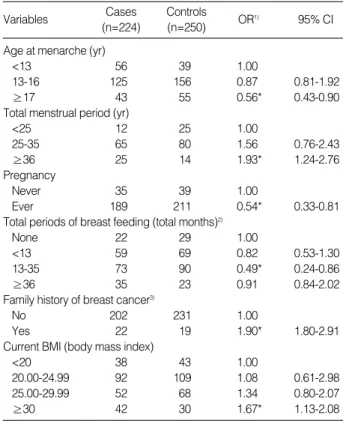
Table 1 shows general characteristics of breast cancer cases and controls by age and marital status. Total number of case was 224, and the age group showing a high breast cancer incidence rate was from 40 to 59 yr of age. Table 2 presents odds ratios (OR) of breast cancer in relation to confounding factors in Korean women. In this study subjects, age at menar- che for ≥17 yr was significantly related to the decreased risk of breast cancer (OR=0.56, CI=0.43-0.90). In analyses for association between breast cancer risk and menstrual his- tory, total menstrual periods more than 36 yr was signifi- cantly related to the increased risk of breast cancer (OR=1.93, CI=1.24-2.76). Pregnancy experience and breast feeding experience for total 13-35 months showed the lowest risk of breast cancer (pregnancy, OR=0.54, 95% CI=0.33-0.81 and total periods of breast feeding, OR=0.49, 95% CI=0.24- 0.86). In our data, family history of breast cancer was observed as a risk factor for breast cancer (OR=1.90, 95% CI=1.80- 2.91). High current BMI (≥30) also appeared to be a risk
factor for breast cancer (OR=1.67, 95% CI=1.13-2.08).
Table 3 presents adjusted odds ratios (OR) of breast cancer in relation to total energy, fat and fatty acids in Korean women.
In these adjusted analyses, total fat intake was not signifi- cantly associated with the risk of breast cancer. Higher breast cancer incidence was not observed with higher intake of sat- urated fatty acids however statistically significant trends with breast cancer incidence were found for total saturated fatty
Sex
Female 224 (100)� 250 (100) 122 (100) 131 (100) 102 (100) 119 (100)
Age (yr)
20-29 14 (6.3) 18 (7.2) 14 (11.5) 18 (13.7) - -
30-39 38 (16.9) 35 (14.0) 38 (31.1) 35 (26.7) - -
40-49 71 (31.7) 82 (32.8) 65 (53.3) 69 (52.7) 6 (5.9) 13 (10.9)
50-59 73 (32.6) 81 (32.4) 5 (4.1) 9 (6.9) 68 (66.7) 72 (60.5)
60-69 28 (12.5) 34 (13.6) 28 (27.4) 34 (28.6)
Marital status
Married 178 (79.5) 203 (81.2) 98 (80.3) 108 (82.4) 80 (78.4) 95 (79.8)
Unmarried 26 (11.6) 23 (9.2) 21 (17.2) 17 (13.0) 5 (4.9) 6 (5.0)
Widowed 20 (8.9) 24 (9.6) 3 (2.5) 6 (4.6) 17 (16.7) 18 (15.2)
Variables Total women Premenopausal women Postmenopausal women*
Case Control Case Control Case Control Table 1.The distribution of the subjects by age and marital status
*This category included only naturally menopaused women, �Number (%).
Age at menarche (yr)
<13 56 39 1.00
13-16 125 156 0.87 0.81-1.92
≥17 43 55 0.56* 0.43-0.90
Total menstrual period (yr)
<25 12 25 1.00
25-35 65 80 1.56 0.76-2.43
≥36 25 14 1.93* 1.24-2.76
Pregnancy
Never 35 39 1.00
Ever 189 211 0.54* 0.33-0.81
Total periods of breast feeding (total months)2)
None 22 29 1.00
<13 59 69 0.82 0.53-1.30
13-35 73 90 0.49* 0.24-0.86
≥36 35 23 0.91 0.84-2.02
Family history of breast cancer3)
No 202 231 1.00
Yes 22 19 1.90* 1.80-2.91
Current BMI (body mass index)
<20 38 43 1.00
20.00-24.99 92 109 1.08 0.61-2.98
25.00-29.99 52 68 1.34 0.80-2.07
≥30 42 30 1.67* 1.13-2.08
Variables OR1) 95% CI
Table 2. Odds ratios (OR) of breast cancer in relation to con- founding factors in Korean women
1)Odds ratio in total women adjusted for age. 2)This category included only women ever pregnant. 3)This category included only the first- degree relatives (parents and siblings). *p<0.05.
Cases Controls (n=224) (n=250)
acid (ptrend=0.0458). Total dietary cholesterol was weakly, but not significantly, associated with risk of breast cancer.
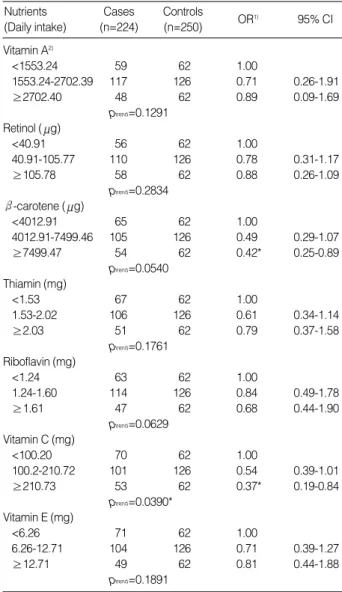
We evaluated risk associated with dietary sources of vitamin (Table 4) and observed no association for the risk of breast can- cer and intake of vitamin A, retinol, thiamin, riboflavin, vita- min E. As shown in Table 4, higher intake of -carotene were significantly decreased breast cancer risk (OR=0.42, 95%
CI=0.25-0.89). Higher consumption of vitamin C showed the protective effect on the breast cancer (OR=0.37, 95% CI=
0.19-0.84), and the tests for trend for vitamin C were also sig- nificant (ptrend=0.0390). In Table 5, OR of breast cancer accord- ing to the intake of vitamins from dietary sources and supple- mental sources are presented. Statistically significant associ- ation between breast cancer risk and consumption of thiamin, riboflavin, vitamin C and vitamin E were not observed.
Table 6 presents major sources of vitamins in the diet of cases and controls in this study population. Soybean paste stew were the first ranked in major sources of -carotene, and Kimchi (Korean cabbage) were the first ranked in major sources of vitamin C in this study population. Major sources of vitamin E in study subjects were citrus fruit among both of cases and controls.
DISCUSSION
The role of dietary factors, especially fat consumption, in the etiology of breast cancer has been extensively evaluated for many years. Case-control studies (21, 22) generally support an positive association with fat consumption and breast can- cer, while some cohort studies (4, 23) have shown no associa- tion between breast cancer and fat consumption. However, the intake of total fat and certain fatty acid has been shown to be positively associated with breast cancer in recent cohort study (24), and therefore the association between fat intake and breast cancer risk are still considerable debate. In present case-control study, we found no association between total fat and breast cancer risk in Korean women. Recently some epi-
Energy (kcal)
<1200.9 60 62 1.00
1200.9-1840.5 106 126 0.92 0.54-1.89
≥1840.6 58 62 1.04 0.68-2.59
ptrend=0.0678 Total fat (g)2)
<29.5 58 62 1.00
29.5-49.1 105 126 0.96 0.52-1.79
≥49.2 61 62 1.15 0.58-2.41
ptrend=0.0723 Total saturated fatty acid (g)2)
<10.7 60 62 1.00
10.7-19.4 98 126 1.12 0.80-1.75
≥19.5 66 62 1.65 0.92-2.45
ptrend=0.0458*
Total unsaturated fatty acid (g)2)
<18.8 59 62 1.00
18.8-29.1 102 126 0.98 0.76-1.90
≥29.2 63 62 1.02 0.86-1.64
ptrend=0.0675 Cholesterol (mg)2)
<115.3 52 62 1.00
115.3-230.8 109 126 1.05 0.63-2.77
≥230.9 63 62 1.32 0.67-1.98
ptrend=0.0590
OR1) 95% CI Table 3. Odds ratios (OR) of breast cancer according to the intake of total energy, fat and fatty acid in Korean women
1)OR adjusted for age at menarche, total menstrual periods (years), pregnancy, total number of full term delivery, total periods of breast feeding (total months), family history of breast cancer and current BMI (body mass index). 2)OR for total energy intake according to methods described by Willett and Stamper (References 43). *p<0.05.
Nutrients Cases Controls
(Daily intake) (n=224) (n=250)
Vitamin A2)
<1553.24 59 62 1.00
1553.24-2702.39 117 126 0.71 0.26-1.91
≥2702.40 48 62 0.89 0.09-1.69
ptrend=0.1291 Retinol ( g)
<40.91 56 62 1.00
40.91-105.77 110 126 0.78 0.31-1.17
≥105.78 58 62 0.88 0.26-1.09
ptrend=0.2834 -carotene ( g)
<4012.91 65 62 1.00
4012.91-7499.46 105 126 0.49 0.29-1.07
≥7499.47 54 62 0.42* 0.25-0.89
ptrend=0.0540 Thiamin (mg)
<1.53 67 62 1.00
1.53-2.02 106 126 0.61 0.34-1.14
≥2.03 51 62 0.79 0.37-1.58
ptrend=0.1761 Riboflavin (mg)
<1.24 63 62 1.00
1.24-1.60 114 126 0.84 0.49-1.78
≥1.61 47 62 0.68 0.44-1.90
ptrend=0.0629 Vitamin C (mg)
<100.20 70 62 1.00
100.2-210.72 101 126 0.54 0.39-1.01
≥210.73 53 62 0.37* 0.19-0.84
ptrend=0.0390*
Vitamin E (mg)
<6.26 71 62 1.00
6.26-12.71 104 126 0.71 0.39-1.27
≥12.71 49 62 0.81 0.44-1.88
ptrend=0.1891
OR1) 95% CI Table 4. Odds ratios (OR) of breast cancer according to the intake of vitamins from dietary sources
1)OR adjusted for age at menarche, total menstrual periods (years), pregnancy, total number of full term delivery, total periods of breast feeding (total months), family history of breast cancer and current BMI (body mass index). 2)RE: retinol equivalent. *p<0.05.
Nutrients Cases Controls
(Daily intake) (n=224) (n=250)
demiologic studies focused on the relation between a specif- ic fat subtype such as fatty acid including linoleic acid and breast cancer. Our result of no association between fatty acid and breast cancer risk in this study population is also gener- ally consistent with other epidemiologic studies (7, 25, 26).
No association was observed between intake of saturated fatty acid and breast cancer incidence in recent cohort study (4, 6, 25, 26), however, one recent cohort study (27) reported that statistically significant positive association between saturated fatty acid and breast cancer. In our study, it should be noted that fat intake of the subjects ranged from 11.2-27.9% of total energy, and subjects’ mean intake was 17.9% (39.8 g per day) of total energy intake. Total saturated fatty acid consumption was 6.8% (15.1 g per day) and unsaturated fatty acid consump- tion was 11.1% (24.7 g per day) of total energy intake in this study subjects. And which is the much smaller quantity than study population of other nation, especially European and western countries. In recent study carried out in the United State (6), means of daily intake of total fat was 35.0% of total energy, saturated fat intake was 11.5% of total energy, and unsaturated fat intake was 23.5% of total energy, and which is almost two times higher than those of our study population.
In addition to a narrow range of fat intake and low amount
of fat consumption, the relatively homogeneous fat intake in this study subjects may contribute to the inability to detect a strong association of fat intake and breast cancer risk in the present study. The main sources of fat in this study popula- tion were meat (26.4%), vegetable oil (19.8%), grain prod- ucts (17.2%), fish (10.3%), eggs (6.7%) and milk (4.1%).
We also examined the association between each vitamin intake and breast cancer risk. Inverse associations with high intake of -carotene and vitamin C were observed in our study.
A number of epidemiologic studies have considered the asso- ciation between dietary antioxidant vitamins and breast can- cer. However, the results of studies were controversial until now. Levi et al. (30) reported significant inverse associations between total carotenoids, lycopene, vitamin C and vitamin E and breast cancer risk.
About survival rate of breast cancer, one study (31) reported that women with greater intake of vitamin C was at lower risk of dying from their cancer. In present study, we also obtained an evidence that high intake of -carotene decreased the risk of breast cancer among Korean women. Consistent with our results, high intake of antioxidant vitamin, especial- ly -carotene, were associated with decreased risk of breast cancer among premenopausal women in other epidemiolog- ic study (32). For retinol, as similar to our study, no signifi- cant inverse association with breast cancer risk were observed in most epidimiologic study (33, 34). However, in most ani- mal studies (35, 36), retinoids inhibit the progression phase of mammary carcinogenesis. The most promising retinoids
Vitamin A (RE)
<1773.41 76 62 1.00
1773.41-2902.71 100 126 0.68 0.44-1.09
≥2902.72 48 62 0.63* 0.39-0.98
ptrend=0.1013 Thiamin (mg)
<1.79 72 62 1.00
1.79-2.49 105 126 0.81 0.62-1.82
≥2.50 47 62 0.72 0.81-2.72
ptrend=0.0639 Riboflavin (mg)
<1.39 60 62 1.00
1.39-2.02 83 126 0.82 0.35-1.12
≥2.03 81 62 1.32 0.82-2.50
ptrend=0.1904 Vitamin C (mg)
<151.01 78 62 1.00
151.01-350.09 101 126 0.58 0.39-1.14
≥350.10 45 62 0.70 0.69-1.84
ptrend=0.2790 Vitamin E (mg)
<8.21 72 62 1.00
8.21-21.72 97 126 0.51 0.32-1.02
≥21.73 55 62 0.67 0.21-1.89
ptrend=0.0692
OR1) 95% CI Table 5. Odds ratio (OR) of breast cancer according to the in- take of vitamins from dietary sources and vitamin supplement
1)OR adjusted for age at menarche, total menstrual periods (years), pregnancy, total number of full term delivery, total periods of breast feeding (total months), family history of breast cancer and current BMI (body mass index). *p<0.05.
Nutrients Cases Controls
(Daily intake) (n=224) (n=250)
1) Major sources of -carotene
1 Soybean paste 31.46 1 Soybean paste 30.42
stew stew
2 Kimchi, Korean 23.53 2 Kimchi, Korean 21.93
cabbage cabbage
3 Kimchi, kkakduki 18.11 3 Cooked spinach 18.32 4 Cooked spinach 9.72 4 Kimchi,kkakduki 15.21
5 Carrot 8.31 5 Lettuce 9.82
2) Major sources of vitamin C
1 Kimchi, Korean 24.52 Kimchi, Korean 26.78
cabbage cabbage
2 Kimchi, kkakduki 18.49 Kimchi, kakduki 21.03 3 Fruit juice 12.93 Citrus fruit 14.09 4 Cooked spinach 9.82 Fruits juice 12.34 5 Citrus fruit 8.71 Cooked spinach 10.93 3) Major sources of vitamin E
1 Citrus fruit 23.54 1 Citrus fruits 27.45 2 Cooked rice 13.64 2 Cooked rice 11.53 3 Cooked spinach 12.31 3 Broiled-dried anchovy 9.02 4 Broiled-dried anchovy 6.67 4 Grilled laver with salt 8.93 5 Grilled laver with salt 5.49 5 Cooked spinach 7.72 Table 6. Major sources of -carotene, vitamin C and vitamin E in the diet of cases and controls in Korean women
Case Control
Rank Food item % of Rank Food item nutrient
% of nutrient
are retinyl acetate (RA) and N-4-hydroxyphenyl retinamide (4-HPR). Som et al. (37) reported that beta-carotene inhib- ited DMBA-induced transformation of the mammary glands in vitro, acting both at the initiation and the promotional stages. Vitamin C, -carotene and vitamin E have antioxi- dant activity and thus is thought to provide a cellular defense against reactive oxygen species that damage DNA (38).
Significant negative association between vitamin C intake and breast cancer risk were disappeared when we analyzed vita- min C intake from dietary sources plus supplemental sources.
In one case-control study (39), breast cancer risk was not associated with antioxidant vitamin intake, from dietary and/
or supplemental sources. The Iowa Women’s Health Study (40) provided no evidence that higher vitamin C consump- tion both from supplement and from food sources is associ- ated with breast cancer. Recently, it was reported that dietary supplementation of 500 mg per day of vitamin C to healthy volunteers for 6 weeks results in a significant prooxidant effects (41). Considering uncertainty about the optimum level of vitamin intake, we suggest that vitamin C consumption from dietary sources may be better than that of supplementation to prevent cancer and other disease.
In hospital-based case-control studies, the bias cannot be totally excluded, and there are also several limitations to our study. The potential problem comes from the disease condi- tion for which the controls were hospitalized. However, the hospital was considered as a proper matching factor because that most of the cases and controls in this study are residing in the area near the hospital where present study was perfo- rmed. One limitation of this study is that we used outpatients as well as inpatients as controls. We selected controls from outpatients who visited the same hospital and same depart- ment. Basically, in hospital-based case-control study, only inpa- tients should be used as control, however in our study, a lot of inpatient have a disease associated with breast cancer (for exam- ple, benign thyroid, benign breast diseases and cataract) and therefore we could not collect suitable matching number of control among inpatients. In this case, it may give rise to a selection bias and a lack of comparability between cases and controls. Therefore, in the future study, community based case-control study also needed.
Owing to the retrospective design of the present study, recall bias is also a limitation. Therefore, interviewers complied with significant personal events to help recall of past food intake (individual event, domestic event etc.). And misclassification of exposure may have influenced the results. We used semi- quantitative food frequency questionnaire method to measure usual fat and vitamin intake of subjects. From one validation study (42), it was concluded that the questionnaire could satis- factorily rank subjects according to intake of nutrients and food groups. In this study, nutrient intake were estimated from the food-frequency questionnaire and calculated as amount per day.
Nutrient intake is often strongly correlated with total ener- gy intake, therefore we analyzed the association of fat and
vitamin intake with breast cancer risk using method of ener- gy adjustment: the “residual” method suggested by Willett and Stampfer (43). In this study, we calculated caloric adjust- ed value using 2,000 kcal for a constant value.
Finally, the issue of bias in this study arises owing to a lim- ited number of cases and controls, therefore further study with a greater number of subjects should be conducted to investigate the breast cancer risk and dietary factor in Korean women.
In conclusion, we found no overall association between intake of total fat, fatty acid and breast cancer risk among Korean women, however, we observed the increasing trends according to the higher level of saturated fatty acid consumption. We found a significant reduction in breast cancer risk in associa- tion with the intake of antioxidant vitamin such as -carotene, and vitamin C. In future study, it will be interesting to anal- ysis association between many fat subtype and breast cancer risk. Most of all, further comprehensive well constructed cohort study, is needed to assess dietary factor in relation to breast cancer of Korea women.
REFERENCES
1. Kim JP, Park IS, Ahn YO, Shin MH, Ahn DH, Kang TW, Ko UR, Ku PS, Kim KY, Kim KH, Kim NK, Kim DJ, Kim DH, Kim BS, Kim SH, Park CT, Min JS, Park TK, Woo BH, Yoo H, Lee SW, Lee SJ, Cho KS, Joo HZ, Ham EK. 1991 cancer incidence in Seoul, Korea:
results of the Implementation Study of the Seoul Cancer Registry. J Korean Med Sci 1995; 10: 74-84.
2. Freedman LS, Clifford C, Messina M. Analysis of dietary fat, calo- ries, body weight, and the development of mammary tumors in rats and mice: a review. Cancer Res 1990; 50: 2040s-8s.
3. Hunter DJ, Willett WC. Nutrition and breast cancer. Cancer Cause Control 1996; 7: 56-68.
4. Holmes MD, Hunter DJ, Colditz GA, Stampfer MJ, Hankinson SE, Speizer FE, Rosner B, Willett WC. Association of dietary intake of fat and fatty acids with risk of breast cancer. JAMA 1999; 281: 914- 20.
5. Martin-Moreno JM, Willett WC, Gorgojol L, Banegas JR, Rodriguez AF, Fernandez JC, Boyle P. Dietary fat, olive oil intake and breast cancer risk. Int J Cancer 1994; 58: 774-80.
6. Velie E, Kulldorff M, Schaier C, Block G, Albances D, Schatzkin A.
Dietary fat, fat subtypes and breast cancer in postmenopausal women:
a prospective cohort study. J Natl Cancer Inst 2000; 92: 833-9.
7. Sieri S, Krogh V, Muti P, Micheli A, Pala V, Crosignani P, Berrino F. Fat and protein intake and subsequent breast cancer risk in post- menopausal women. Nutr Cancer 2002; 42: 10-7.
8. Gandini S, Merzenich H, Robertson C, Boyle P. Meta-analysis of studies on breast cancer risk and diet: the role of fruit and vegetable consumption and the intake of associated micronutrients. Eur J Can- cer 2000; 36: 636-46.
9. Ronco A, De Stefani E, Boffetta P, Deneo-Pellegrini H, Mendila- harsu M, Leborgne F. Vegetables, fruits, and related nutrients and risk of breast cancer: a case-control study in Uruguay. Nutr Cancer
1999; 35: 111-9.
10. Zhang S, Hunter DJ, Forman MR, Rosner BA, Speizer FA, Colditz GA, Manson JE, Hankinson SE, Willet WC. Dietary carotenoids and vitamins A, C and E and risk of breast cancer. J Natl Cancer Inst 1999; 91: 547-56.
11. Michels KB, Holmberg L, Bergkvist L, Ljung H, Bruce A, Wolk A.
Dietary antioxidant vitamins, retinol and breast cancer incidence in a cohort of Swedish women. Int J Cancer 2001; 91: 563-7.
12. Graham S, Zielezny M, Marshall J, Priore R, Freudenheim J, Bra- sure J, Haughey B, Nasca P, Zdeb M. Diet in the epidemiology of postmenopausal breast cancer. Am J Epidemiol 1992; 116: 68-72.
13. Rohan TE, Howe GR, Friedinreich CM, Jain M, Miller AB. Dietary fiber, vitamin A, C and E and risk of breast cancer; A cohort study.
Cancer Cause Control 1993; 4: 29-37.
14. Ogimoto I, Shibata A, Fukuda K. World Cancer Research Fund/ Amer- ican Institute of Cancer Research 1997 recommendations: applicabili- ty to digestive tract cancer in Japan. Cancer Cause Control 2000; 11: 9- 23.
15. Shu XO, Jin F, Dai Q, Wen W, Potter JD, Kushi LH, Ruan Z, Gao YT, Zheng W. Soyfood intake during adolescence and subsequent risk of breast cancer among Chinese women. Cancer Epidem Biomar 2001;
10: 483-8.
16. Dai Q, Shu XO, Jin F, Potter JD, Kushi LH, Teas J, Gao YT, Zheng W. Population-based case-control study of soyfood intake and breast cancer risk in Shanghai. Br J Cancer 2001; 85: 372-8.
17. Shrubsole MJ, Jin F, Dai Q, Shu XO, Potter JD, Hebert JR, Gao YT, Zheng W. Dietary folate intake and breast cancer risk: results from the Shanghai Breast Cancer Study. Cancer Res 2001; 61: 7136-41.
18. Ministry of Health and Welfare. 1995 National nutrition survey in Korea. Seoul: Ministry of Health and Welfare. 1997.
19. Kim MK, Lee SS, Ahn YO. Reproducibility and validity of a self- administered semiquantative food frequency questionnaire among middle-aged men in Seoul. Koran J Commun Nutr 1997; 10: 111-5.
20. Willett WC. Nutritional epidemiology, 2nd edition. New York: Oxford University Press, 1998: 92-6.
21. Wakai K, Dillon DS, Ohno Y, Prihartono J, Budiningsih S, Ramli M, Darwis I, Tjindarbumi D, Tjahjadi G, Soetrisno E, Roostini ES, Sakamoto G, Herman S, Cornain S. Fat intake and breast cancer risk in an area where fat intake is low: a case-control study in Indonesia.
Int J Epidemiol 2000; 29: 20-8.
22. La Vecchia C, Negri E, Franceschi S, Decarli A, Giacosa A, Lip- worth L. Olive oil, other dietary fats, and the risk of breast cancer (Italy). Cancer Cause Control 1995; 6: 545-50.
23. Thiebaut AC, Clavel-Chapelon F. Fat consumption and breast can- cer: preliminary results from the E3N-Epic cohort. Bull Cancer 2001;
88: 954-8.
24. Sieri S, Krogh V, Muti P, Micheli A, Pala V, Crosignani P, Berrino F. Fat and protein intake and subsequent breast cancer risk in post- menopausal women. Nutr Cancer 2002; 42: 10-7.
25. Byrne C, Rockett H, Holmes MD. Dietary fat, fat subtypes, and breast cancer risk: lack of an association among postmenopausal women with no history of benign breast disease. Cancer Epidem Biomar 2002; 11:
261-5.
26. Wolk A, Bergstrom R, Hunter D, Willett W, Ljung H, Holmberg L, Bergkvist L, Bruce A, Adami HO. A prospective study of associa- tion of monounsaturated fat and other types of fat with risk of breast cancer. Arch Intern Med 1998; 158: 41-5.
27. Voorrips LE, Brants HA, Kardinaal AF, Hiddink GJ, van den Brandt PA, Goldbohm RA. Intake of conjugated linoleic acid, fat, and other fatty acids in relation to postmenopausal breast cancer. Am J Clin Nutr 2002; 76: 873-82.
28. Hunter JE, Applewhite TH. Reassessment of trans fatty acid avail- ability in the U.S. diet. Am J Clin Nutr 1999; 54: 363-9.
29. Ip C, Marshall JR. Trans fatty acids and cancer. Nutr Rev 1996; 54:
138-45.
30. Levi F, Pasche C, Lucchini F, La Vecchia C. Dietary intake of selected micronutrients and breast-cancer risk. Int J Cancer 2001; 91: 260-3.
31. Jain M, Miller AB. Premorbid diet and the prognosis of women with breast cancer. J Natl Cancer Inst 1994; 86: 1390-7.
32. Mezzetti M, La Vecchia C, Decarli A, Boyle P, Talamini R, Franceschi S. Population attributable risk for breast cancer; diet, nutrition, and physical exercise. J Nat Cancer Inst 1998; 90: 389-94.
33. Freudenhem JL, Marxhali JR, Vena JE, Laughlin R, Brasure JR, Swanson MK, Nemoto T, Graham S. Premenopausal breast cancer risk and intake of vegetables, fruits, and related nutrients. J Nat Can- cer Inst 1996; 88: 340-8.
34. Verhoeven DTH, Assen N, Gldbohm RA, Dorant E, Veer P van’t , Sturmans F, Hermus RJ, van den Brant PA. Vitamin C and E, retinol, beta-carotene and dietary fibre in relation to breast cancer risk: a prospective cohort study. Br J Cancer 1997; 75: 149-55.
35. Hartmann HR, Bollag W. The effects of carotinoids rat mammary carcinogenesis. Cancer Chemother Pharmacol 1985; 15: 141-3.
36. McCormick DL, Moon RE. Influence of delayed administration of retinyl acetate on mammary carcinogenesis. Cancer Res 1982; 42:
2639-43.
37. Som S, Ciatterjee M, Banerjee MR. Beta-carotene inhibition of 7, 12-dimethylbez[a]-anthracene-induced transformation of murine mammary cells in vitro. Carcinogenesis 1984; 5: 937-40.
38. Hunter DJ, Willett WC. Diet, body build, and breast cacner. Annu Res Nutr 1994; 14: 393-418.
39. Potischman N, Swanson CA, Coates RJ, Gammon MD, Brogan DR, Curtin J, Brinton LA. Intake of food groups and associated micronu- trients in relation to risk of early-stage breast cancer. Int J Cancer 1999; 82: 315-21.
40. Kushi LH, Fee RM, Sellers TA, Zheng W, Foisom AR. Intake of vitamin A, C, and E and postmenopausal breast cancer. The lowa Women’s Health Study. Am J Epidemiol 1996; 144: 165-74.
41. Podmore ID, Griffiths HR, Herbert HE, Mistry N, Mistry P, Lunec J.
Vitamin C exhibits pro-oxidant properties. Nature 1998; 392: 559-67.
42. Goldbohm RA, Van den Brandt PA, Brants HA, van’t Veer P, Al M, Sturmans F, Hermus RJ. Validation of a dietary questionnaire used in a large-scale prospective cohort study on diet and cancer. Eur J Clin Nutr 1994; 48: 253-65.
43. Willett WC, Stampfer MJ. Total energy intake; implication for epi- demiologic analyses. Am J Epidemiol 1986; 124: 17-27.